

Key Takeaways
- SaaS delivers faster deployment and lower upfront costs, making it ideal for standard business processes and early-stage growth.
- Custom web applications require higher initial investment but often generate stronger long-term ROI through ownership and flexibility.
- Total cost of ownership should include subscriptions, integrations, compliance costs, vendor lock-in risks, and future scalability needs.
- Businesses gain the greatest value by building differentiating capabilities while purchasing commodity software through trusted SaaS platforms.
- A structured build vs buy framework helps leaders align technology investments with growth, compliance, and competitive goals.
In short, SaaS is usually the fastest and lowest-risk option in the early stages, but custom web application development often delivers better long-term ROI when software becomes central to operations, differentiation, scalability, or compliance.
The debate around custom web application development vs SaaS is no longer just about implementation speed or upfront investment. The debate around custom web application development and SaaS is no longer just about implementation speed or upfront investment.
As organizations evaluate custom web app vs SaaS solutions, the conversation increasingly extends beyond functionality. Leaders are assessing long-term ownership, AI readiness, security requirements, and the strategic value of proprietary systems. This is why businesses often consult a custom web application development company to determine whether custom web application development or SaaS will deliver stronger ROI, scalability, and competitive advantage over time.
Whether you are a startup founder building an MVP, a CTO modernizing enterprise systems, or an operations leader facing rising software costs, this guide provides a practical framework to determine which approach generates the strongest return on investment.
Table of Contents
What is the Difference Between a Custom Web App and SaaS at a Glance?
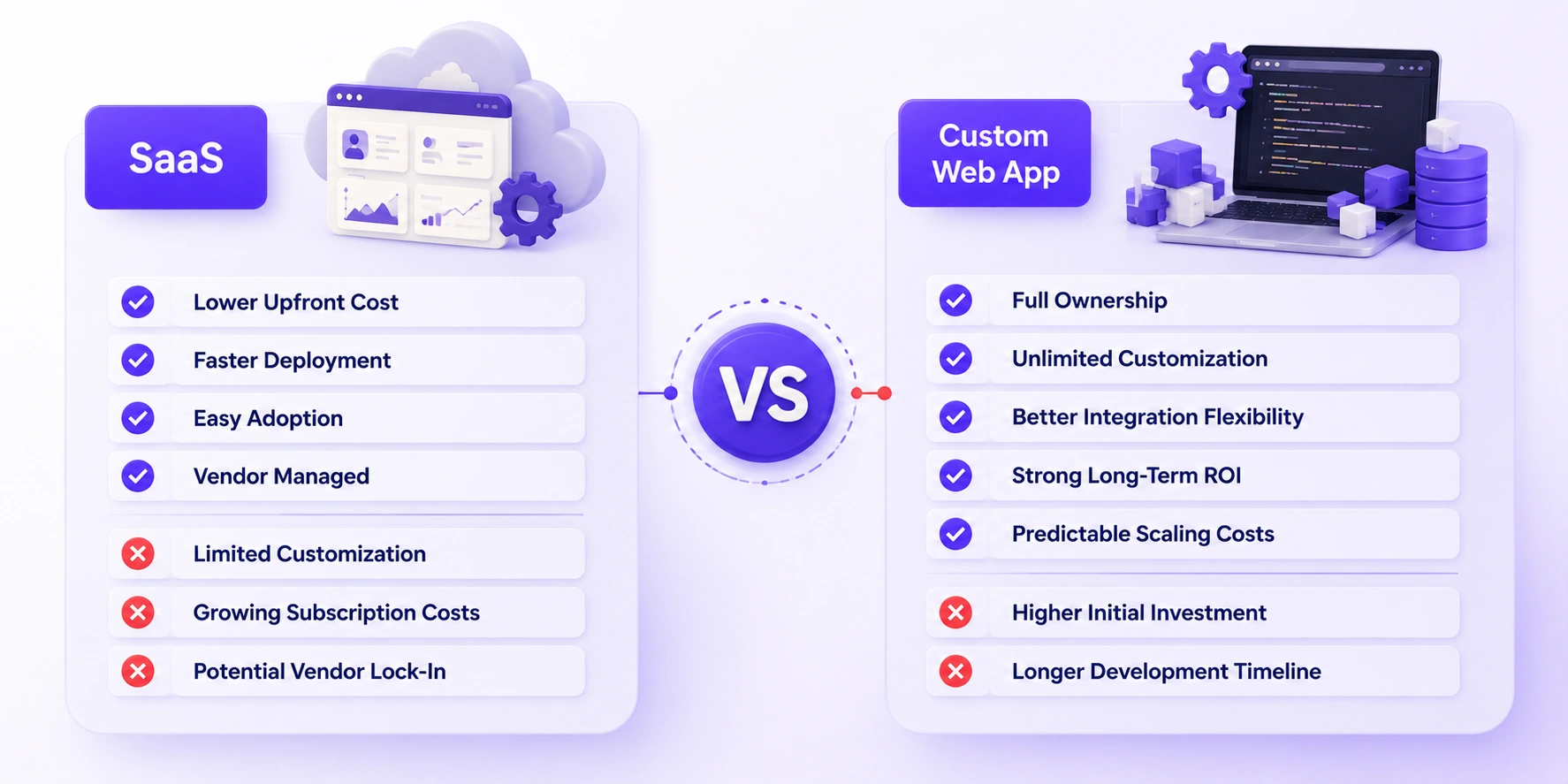
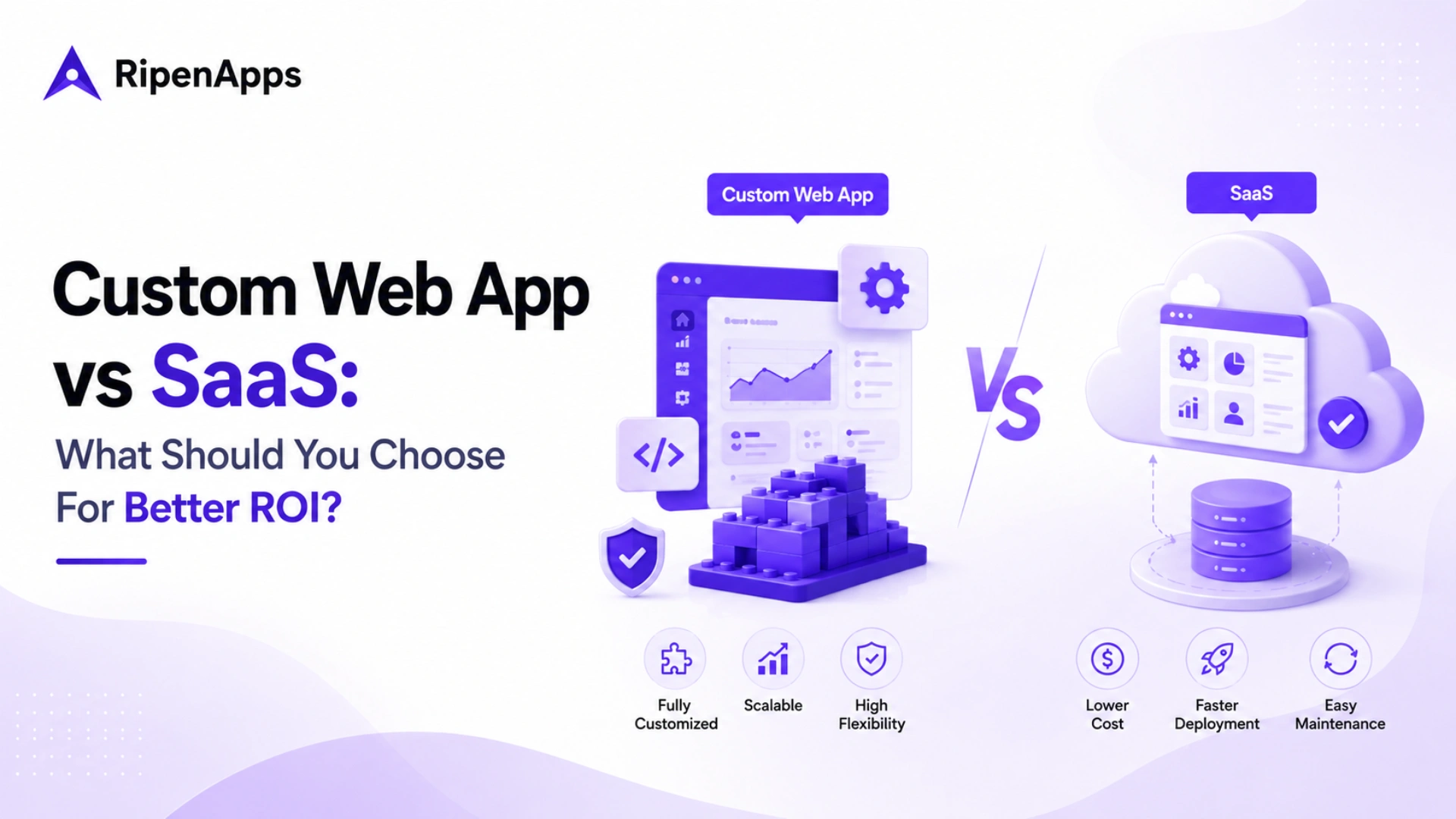
The primary difference lies in ownership and flexibility. SaaS provides ready-made software that businesses subscribe to and use immediately, while a custom web app is built specifically for an organization’s unique requirements, offering greater control, customization, and long-term strategic value.
| Decision Factor | SaaS | Custom Web App |
| Upfront Cost | Low | Higher |
| Time-to-Market | Days to weeks | Months |
| Ownership | Vendor-owned | Business-owned |
| Customization | Limited | Unlimited |
| Scalability Costs | Often increases with usage | More predictable |
| Integration Flexibility | Depends on vendor APIs | Built around your ecosystem |
| Long-Term ROI | Strong for standard needs | Strong for strategic systems |
For many organizations, SaaS provides immediate value because deployment is fast and infrastructure management is handled by the vendor. Businesses can start using software almost immediately without investing in development resources.
Custom software follows a different model. It requires a larger upfront investment but provides complete ownership, flexibility, and control. Over time, these advantages can create substantial financial and operational benefits, especially when software directly impacts revenue generation, efficiency, customer experience, or competitive positioning.
The challenge is determining where your organization sits on this spectrum. The answer depends on how critical the software is to your business model and whether the long-term benefits justify the initial investment. Businesses evaluating their options can benefit from following a structured web application development guide to better understand development costs, scalability considerations, and long-term ROI implications before making a build-versus-buy decision.
What Does Each Model Mean for Your ROI?
The debate around custom software scalability vs SaaS becomes particularly important as businesses expand users, workflows, and operational complexity.
SaaS Is Defined by Its Cost Model
Software-as-a-Service (SaaS) operates on recurring subscription pricing. Businesses typically pay monthly or annual fees based on users, features, storage, API usage, or transaction volume.
The biggest advantage is speed. Organizations avoid development costs and gain immediate access to proven functionality.
However, SaaS ROI can decline over time due to:
- Per-seat pricing increases
- Premium feature upgrades
- API access fees
- AI feature surcharges
- Vendor price increases
- Additional integration tools
- Data migration expenses
The result is that SaaS total cost of ownership often becomes significantly higher than the headline subscription price.
Custom Web Application Development Is Defined by Ownership
Custom software requires a larger initial investment because the application is designed specifically for your business processes and objectives.
Among the most important custom web app development benefits are complete ownership, deeper customization, stronger integration flexibility, and freedom from recurring licensing constraints.
Benefits include:
- Full ownership of intellectual property
- Tailored workflows
- Unlimited customization
- Better integration flexibility
- Greater control over data
- Reduced long-term licensing expenses
However, custom development is not always the right choice. Businesses must account for development timelines, maintenance responsibilities, technical expertise, and project governance.
The strongest ROI occurs when software supports a unique business advantage rather than standard operational functions.
What is the Real Cost Comparison Over Five Years?
Many organizations compare only upfront costs. The more accurate comparison is five-year total cost of ownership.
A comprehensive web application development cost comparison should account for licensing fees, infrastructure expenses, maintenance costs, integrations, and future scalability requirements rather than focusing solely on upfront investment.
SaaS: Total Cost of Ownership Includes Hidden Costs
While a SaaS subscription may seem cost-effective initially, the total cost of ownership often increases as usage grows. Businesses can encounter additional expenses from expanding user licenses, premium support plans, extra storage requirements, third-party integrations, API usage limits, compliance-related upgrades, vendor-driven price increases, and eventual migration or exit costs.
Understanding SaaS total cost of ownership is essential because recurring subscriptions often represent only a fraction of the actual long-term investment. These factors can significantly impact long-term ROI and should be evaluated before committing to a SaaS solution.
For example:
| Cost Category | Year 1 | Year 5 |
| Subscription Fees | $36,000 | $60,000+ |
| Additional Users | $0 | $40,000 |
| Integrations | $5,000 | $20,000 |
| Premium Features | $3,000 | $15,000 |
| Total Annual Cost | $44,000 | $135,000+ |
As teams grow, costs often scale faster than expected. This is why many organizations eventually compare SaaS hidden costs vs custom software development rather than evaluating subscription pricing alone.
Custom Web Application: Development Cost Declines Over Time
The other Custom software vs SaaS ROI is that Custom software requires significant upfront investment.
Example:
| Cost Category | Year 1 | Year 5 |
| Development | $180,000 | $0 |
| Infrastructure | $12,000 | $15,000 |
| Maintenance | $18,000 | $25,000 |
| Enhancements | $15,000 | $20,000 |
| Total Annual Cost | $225,000 | $60,000 |
After launch, spending shifts from creation to optimization. Organizations gain more control over future expenditures.
The Crossover Year: When Does Custom Become Cheaper?
Custom software typically becomes less expensive than SaaS when cumulative subscription costs exceed cumulative ownership costs. For many mid-sized organizations, this crossover occurs between years three and five, depending on user growth, integration complexity, and licensing expenses.
Consider this scenario:
- SaaS cost: $90,000 annually with 20% annual growth
- Custom development: $250,000 upfront
- Annual maintenance: $40,000
By Year 4, cumulative SaaS expenses approach custom ownership costs. Beyond that point, the custom solution often produces stronger long-term ROI.
This milestone is what we call The Crossover Year.
What is the SaaS Vendor Lock-In Tax?
Vendor lock-in occurs when switching away from a SaaS platform becomes difficult, expensive, or operationally disruptive.
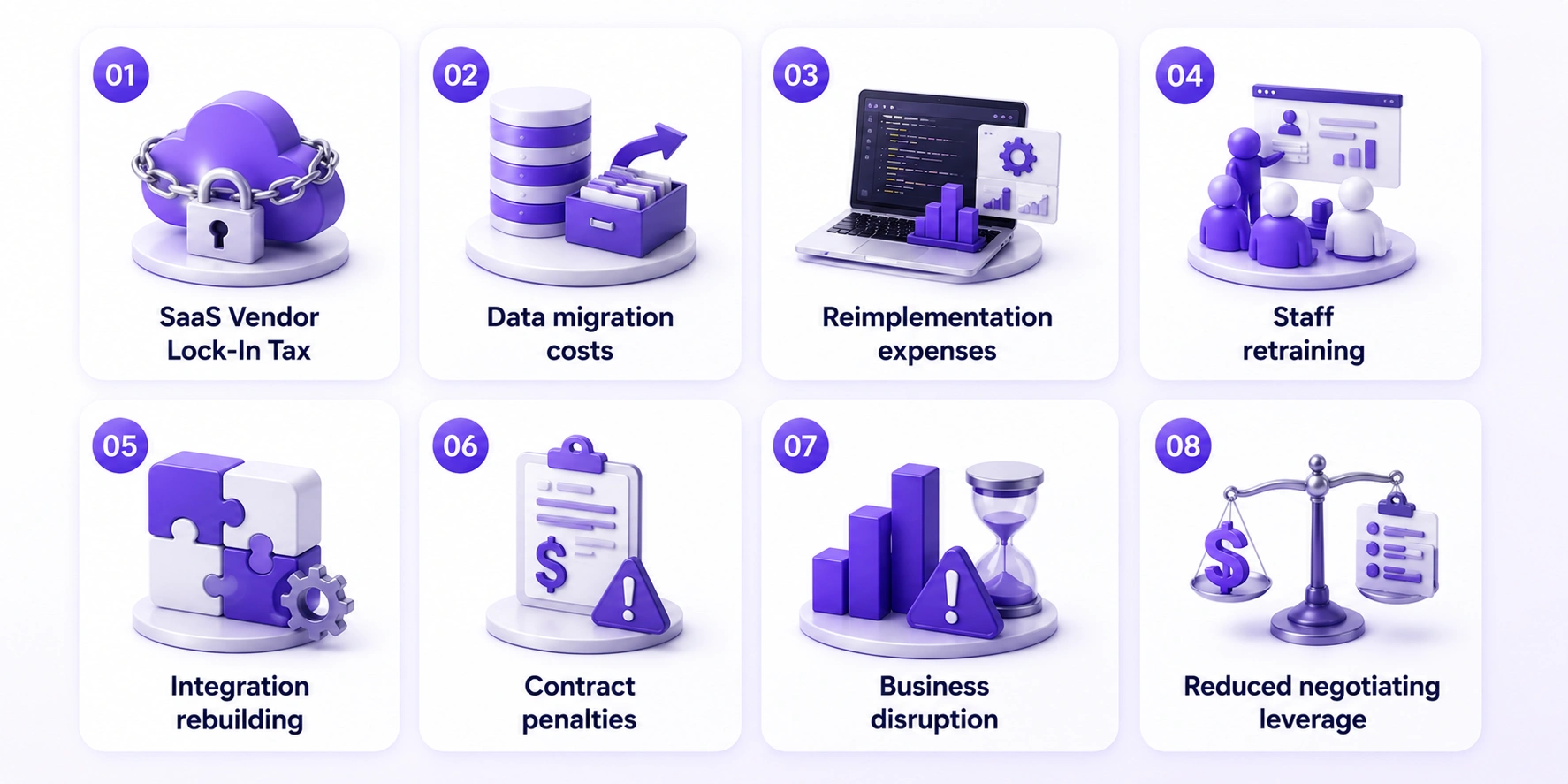
Most organizations understand lock-in conceptually. Few quantify its financial impact.
The Lock-in tax includes:
- Data migration costs
- Reimplementation expenses
- Staff retraining
- Integration rebuilding
- Contract penalties
- Business disruption
- Reduced negotiating leverage
For example, if a vendor increases prices by 25%, many organizations remain because migration costs exceed the increase. This creates a hidden financial burden that compounds over time.
A simple definition: SaaS vendor lock-in is the financial and operational cost created when changing platforms becomes significantly more expensive than staying with an existing provider.
Businesses should evaluate SaaS vendor lock-in risks before signing long-term agreements rather than after growth makes migration difficult.
When Should You Choose a Custom Web App Over SaaS?
The answer depends on business strategy, not technology preference. Understanding when to choose a custom web app over SaaS depends on whether technology serves as a support function or a core business differentiator.
Signs You’ve Outgrown SaaS
You may have reached the limits of SaaS when:
- Software costs increase every quarter
- Teams rely on multiple workarounds
- Critical workflows cannot be customized
- Integration requirements become complex
- Vendor roadmap conflicts with business needs
- Compliance requirements exceed platform capabilities
- Proprietary data becomes strategically important
- AI initiatives require greater data ownership
These signals often indicate that software is becoming a competitive asset rather than a support tool. These indicators often signal when to build custom software instead of using SaaS, particularly when growth is constrained by platform limitations.
SaaS Remains the Smarter ROI Choice
SaaS is usually preferable when:
- Speed is the highest priority
- Requirements are standardized
- Budgets are limited
- Internal technical resources are unavailable
- Processes are unlikely to change
- Market validation has not yet occurred
Many successful businesses begin with SaaS and transition to custom software only after reaching operational scale.
How Can You Use a Build vs Buy Framework to Make the Right Decision?
A structured software build vs buy framework helps you evaluate a technology investment on measurable business outcomes instead of gut feel. The principle is simpler than the debate makes it sound: buy the commodity, build the differentiator. The framework below turns that principle into a score, but only after you’ve cleared two questions that no score should override.
Step 1: Clear the gate first (the knockout questions)
Some requirements decide the question before any scoring begins. If you answer yes to any of these, custom development (or controlled, single-tenant hosting) is effectively required, and the scorecard’s job is only to shape how much you build, not whether to build:
- Do hard regulatory or data-residency rules (e.g., HIPAA, GDPR, financial compliance) prevent your data from living on shared, multi-tenant SaaS infrastructure?
- Is the software itself the product you sell, i.e., it is your business, not a tool that supports it?
- Is there a non-negotiable functional or security requirement that no available SaaS platform can meet?
If you answered no to all three, run the scorecard.
Step 2: Score the decision (1-5 per variable)
Score every variable on the same axis: 1 = strongly favors buying SaaS, 5 = strongly favors building custom. The anchors keep scoring consistent between people.
| Decision Variable | Weight | A “1” looks like (favors SaaS) | A “5” looks like (favors custom) |
| Competitive Differentiation | 25% | A commodity back-office function customers never see | A core capability customers choose you for, part of your moat |
| Workflow Uniqueness | 15% | Standard processes any mainstream tool handles out of the box | Genuinely unique workflows no vendor models without heavy workarounds |
| Scalability Needs | 15% | Predictable, modest scale well within SaaS tiers | Aggressive growth where per-seat/usage pricing compounds and you hit platform ceilings |
| Long-Term Cost Profile | 15% | SaaS stays cheaper for your usage; crossover never arrives | Subscription costs cross above a custom build’s 5-year TCO within a few years |
| Time-to-Market Flexibility | 10% | Needed live in weeks – speed is the priority | Months of runway; you can invest in building it right |
| Data Ownership & Control | 10% | Vendor-hosted handling on reputable infrastructure is fine | Strategic data you want fully owned, portable, and AI-ready |
| Internal Technical Capability | 10% | No in-house or partner capacity to build or maintain | Strong engineering capacity (in-house or a committed partner) to build and support |
Step 3: Calculate your score
- Rate each variable 1–5 using the anchors.
- Multiply each rating by its weight as a decimal, e.g., a 4 on Competitive Differentiation = 4 × 0.25 = 1.0.
- Add the seven results. Your total lands between 1.0 and 5.0.
Step 4: Interpret the result
- Under 3.0: Buy- SaaS likely delivers the better ROI. Subscribe and move on.
- 3.0–4.0: Blend- A hybrid architecture is usually the strongest play: buy the commodity, build the differentiator, and keep a clear boundary between them (your Commodity Line).
- Above 4.0: Build- Custom development likely creates more durable value than any subscription can.
Adjust the weights to your reality
These are recommended starting weights, not gospel. A regulated enterprise might raise Data Ownership; a seed-stage startup might double Time-to-Market; a scaling business feeling per-seat pain might lift Long-Term Cost Profile. Re-weight to match what actually drives your decision; just keep the total at 100%.
The reason Competitive Differentiation carries the most weight is borne out in the data: McKinsey’s State of AI 2025 found that fundamental workflow redesign correlates more strongly with measurable business impact than almost any other organizational change. The lesson isn’t “always build”; it’s that lasting value comes from reshaping what makes you different, and a build vs buy decision is really a decision about where that reshaping is worth the investment.
The Differentiation Test: Buy the Commodity, Build the Edge
A simple rule for software investment is: buy the commodity and build the competitive advantage. Standard business functions such as payroll, accounting, email marketing, and HR management are typically better served by SaaS solutions.
In contrast, capabilities that directly differentiate the business, such as proprietary workflows, customer experience platforms, AI-driven recommendation engines, industry-specific operational systems, and revenue-generating digital products, often justify custom development. If the software creates a unique competitive edge, investing in a custom solution deserves serious consideration.
This principle is especially relevant for enterprise web application custom development, where proprietary workflows often create competitive advantages that off-the-shelf platforms cannot replicate. For example, businesses building highly interactive customer portals, SaaS platforms, or data-intensive applications often partner with a ReactJS development company to create scalable, high-performance user experiences tailored to their specific operational needs.
Is SaaS or Custom Software Better for Regulated Industries?
Regulated industries such as healthcare, financial services, insurance, government, and legal services face unique compliance and security requirements that directly influence software ROI.
In regulated sectors, the stakes are measured in millions: IBM’s Cost of a Data Breach Report 2025 puts the global average breach at $4.44 million and a U.S. record $10.22 million.
The discussion around SaaS vs custom software for regulated industries extends beyond compliance and often includes data residency, auditability, and governance requirements.
Organizations in these sectors must often address standards and regulations such as HIPAA, GDPR, SOC 2, and ISO 27001, while also meeting data residency mandates, maintaining detailed audit trails, and enforcing advanced access controls.
As a result, the choice between SaaS and custom software depends not only on cost and speed but also on the ability to meet strict regulatory, security, and governance requirements.
SaaS solutions can support compliance. However, organizations often discover limitations when regulations require specialized workflows, unique reporting structures, or specific data governance controls.
Custom web applications provide greater flexibility but introduce additional responsibilities. Security architecture, compliance monitoring, and governance become internal obligations. In many cases, businesses leverage modern frameworks and AngularJS development services to build secure, scalable, and highly customized interfaces that align with complex compliance requirements and industry-specific workflows.
For organizations where compliance is a competitive necessity, custom development often provides stronger long-term control and risk management.
What Is the Best Hybrid Custom and SaaS Architecture Strategy?
A well-designed hybrid custom and SaaS architecture strategy allows organizations to balance speed, flexibility, innovation, and long-term cost control. The most successful organizations use SaaS solutions for standardized business functions while investing in custom software for capabilities that directly drive competitive advantage. This approach accelerates deployment, reduces costs, and allows teams to focus development resources where they create the most value.
Many businesses also work with a web portal development company when building customer, employee, vendor, or partner portals that require specialized workflows beyond the capabilities of standard SaaS platforms.
The Commodity Line separates software into two categories:
Buy Below the Commodity Line (Use SaaS)
Use SaaS for:
- Accounting systems for managing finances efficiently.
- HR platforms for employee and workforce management.
- CRM tools for standard customer relationship processes.
- Collaboration software for communication and productivity.
- Marketing automation platforms for campaign execution and lead nurturing.
These functions are essential but rarely differentiate a business in the market.
Build Above the Commodity Line
Develop custom software for:
- Core operational workflows that define how the business operates.
- Customer-facing platforms that shape the user experience.
- Proprietary analytics that generate unique business insights.
- AI systems that create intelligent, data-driven capabilities.
- Industry-specific processes that require specialized functionality.
- Revenue-generating applications that directly support growth and profitability.
This strategy balances speed, cost control, scalability, and innovation. For example, a logistics company may use SaaS solutions for payroll and CRM while building a custom route optimization platform powered by proprietary operational data. Hybrid is no longer a hedge; it’s the default; Gartner expects 90% of organizations to adopt a hybrid cloud approach through 2027.
The result is lower development costs while preserving strategic differentiation and long-term competitive advantage.
What Do Real-World Businesses Choose: Custom Web Apps or SaaS?
The custom web app vs SaaS decision becomes clearer when examining how successful businesses solve real operational challenges. In practice, very few organizations choose one approach exclusively. Most adopt a mix of SaaS tools and custom-built platforms based on strategic priorities, scalability requirements, and competitive goals.
The following examples illustrate when businesses benefit from custom web application development and when SaaS remains the more practical option. They also highlight a key lesson: companies create the highest ROI when they own systems that drive differentiation while purchasing software that supports standard business functions. In many cases, the decision is influenced by the organization’s web application architecture, as businesses must determine whether standardized SaaS platforms can support their scalability, integration, security, and performance requirements over the long term.
Netflix: Owning the Core Experience
Netflix began by leveraging existing technologies but gradually invested in custom systems to support content delivery, personalization, recommendation engines, and streaming infrastructure.
The company’s competitive advantage depends heavily on proprietary algorithms and user data. A standard SaaS platform could not deliver the level of personalization, scalability, and performance required by a global streaming service.
This illustrates the Differentiation Test in action: build what creates market advantage and buy what does not.
Salesforce: A SaaS-First Success Story
Not every business requires custom software. Salesforce demonstrates how SaaS can generate exceptional ROI when business processes align closely with industry-standard functionality.
Thousands of organizations use Salesforce instead of building custom CRM systems because customer relationship management is rarely their primary differentiator. The platform provides rapid deployment, ongoing innovation, and predictable operating costs.
For businesses with standard sales and marketing workflows, SaaS often remains the smartest financial decision.
Amazon: The Hybrid Architecture Model
Amazon represents one of the strongest examples of a hybrid custom-and-SaaS strategy. The company develops proprietary systems for logistics optimization, recommendation engines, fulfillment operations, and customer experiences while also utilizing third-party technologies where appropriate. Its success is supported by robust cloud infrastructure services that enable scalability, reliability, and operational efficiency across global markets.
This approach mirrors the Commodity Line Framework discussed earlier. Commodity functions are purchased, while strategic capabilities are built and owned internally.
Many modern enterprises follow a similar model. They use SaaS for HR, accounting, collaboration, and marketing automation while investing in custom web applications for customer-facing experiences, proprietary workflows, AI-driven capabilities, and data-intensive operations.
The result is a balanced architecture that maximizes innovation without creating unnecessary development costs.
eGurukul: Building a Custom Learning Ecosystem at Scale
eGurukul serves hundreds of thousands of medical exam aspirants through a comprehensive digital learning platform featuring video lectures, assessments, progress tracking, and community engagement capabilities. The platform supports specialized educational workflows that would be difficult to replicate using standard SaaS learning management systems.
This is a strong example of when custom development creates better ROI. The learning experience itself is the business’s competitive advantage. Owning the platform enables continuous innovation, deeper student engagement, and complete control over educational data. While SaaS tools may support communication or analytics, the core learning ecosystem benefits from custom ownership.
Cobone: Custom Commerce Beyond Standard E-Commerce SaaS
Cobone, one of the Middle East’s largest deals and discount platforms, serves millions of users through a customized commerce ecosystem that includes geo-based discovery, category management, secure payments, and large-scale promotional campaigns.
Although SaaS e-commerce platforms can launch marketplaces quickly, businesses operating at this scale often require custom workflows, regional payment integrations, and unique customer experiences. For organizations where digital commerce directly drives revenue, custom software frequently delivers stronger long-term ROI than relying entirely on off-the-shelf platforms.
These real-world web application examples demonstrate that the highest-performing organizations rarely rely entirely on either SaaS or custom software. Instead, they strategically combine both approaches based on business goals, scalability requirements, and competitive priorities.
Should Startups Choose SaaS or Custom Development?
Evaluating custom web application development for startups ROI requires balancing rapid market validation against long-term ownership and scalability considerations.
However, while SaaS solutions can accelerate early growth, founders should be cautious about becoming overly dependent on tools that could limit scalability, customization, or long-term competitive differentiation as the business evolves. As startups mature, understanding the web application development process becomes increasingly important for planning the transition from off-the-shelf solutions to proprietary platforms that support future growth.
A common strategy is:
- Phase 1: Launch with SaaS
- Phase 2: Validate product-market fit
- Phase 3: Build custom systems around growth bottlenecks
- Phase 4: Migrate strategic capabilities into owned platforms
This staged approach minimizes risk while preserving long-term flexibility.
The emergence of AI-driven products also changes the equation. Startups increasingly recognize that proprietary data can become a defensible moat. When AI capabilities depend on unique datasets, ownership becomes more valuable than convenience.
Conclusion
There is no universal winner between software as a service (SaaS) and custom development. The best choice depends on your growth trajectory, compliance requirements, operational complexity, and long-term business objectives. The strongest ROI comes from aligning technology decisions with strategic business objectives rather than focusing only on upfront costs.
For organizations evaluating custom web application development vs SaaS, the most effective approach is to assess total cost of ownership, lock-in exposure, growth plans, and competitive requirements through a structured framework. Whether you are partnering with a SaaS app development company to build a scalable subscription-based platform or investing in a custom solution tailored to your business needs, the goal should be long-term value creation. RipenApps helps startups, scale-ups, and enterprises make informed build-vs-buy decisions by identifying where custom software creates measurable business value and where SaaS remains the smarter investment.
FAQs
1. Is custom software cheaper than SaaS in the long run?
Often, yes. While SaaS requires a lower upfront investment, subscription costs increase over time as user counts, data usage, integrations, and feature requirements grow. Custom software typically involves a higher initial development cost but can become more cost-effective once cumulative SaaS expenses exceed ownership and maintenance costs. For many growing businesses, this crossover point occurs between years three and five.
2. What are the hidden costs of SaaS?
The advertised subscription fee is rarely the full cost of SaaS ownership. Hidden expenses often include per-user pricing increases, premium feature upgrades, API access fees, integration tools, compliance add-ons, AI feature surcharges, data storage charges, and vendor-driven price hikes. Businesses should also factor in migration and exit costs when evaluating long-term SaaS ROI.
3. Can a custom web app integrate with existing SaaS tools?
Yes. Modern custom web applications are typically built using API-first architectures, making it easier to connect with existing SaaS platforms. Businesses can integrate custom software with CRM systems, ERP solutions, HR platforms, payment gateways, analytics tools, marketing automation software, and customer support systems to create a unified technology ecosystem. Strong integration capabilities are among the most valuable web application features for organizations managing multiple software systems.
4. Is SaaS or custom software better for regulated industries?
It depends on the complexity of compliance requirements. SaaS platforms can support many regulatory standards, but organizations in healthcare, finance, insurance, government, and legal sectors often require greater control over security policies, audit trails, data residency, and reporting workflows. In these situations, custom software can provide the flexibility needed to meet strict compliance and governance requirements. Different types of web applications may also be required to address industry-specific regulatory and operational needs.
5. What is vendor lock-in and how can businesses avoid it?
Vendor lock-in occurs when a business becomes heavily dependent on a software provider, making migration costly, complex, or disruptive. The risk increases when critical data, workflows, and integrations are tied to a single platform. Businesses can reduce lock-in by choosing vendors with open APIs, maintaining portable data formats, documenting integrations, and establishing a clear exit strategy before adoption.
6. Can you combine SaaS and custom software?
Absolutely. In fact, many organizations achieve the best ROI through a hybrid approach. SaaS solutions are often used for standardized functions such as accounting, HR, and collaboration, while custom software is developed for customer-facing experiences, proprietary workflows, and competitive differentiators. This strategy balances speed, flexibility, and cost efficiency.
7. How long does it take to build a custom web application?
Development timelines vary based on project complexity, feature requirements, integrations, and compliance needs. A basic MVP may take three to four months, while enterprise-grade applications can require six to twelve months or more. Proper planning, agile development practices, and clear business requirements can significantly improve delivery speed and project outcomes. As digital experiences become increasingly important to business growth, web application development is critical for organizations looking to improve scalability, efficiency, and customer engagement.
Discuss your project and request for proposal
SHARE
WRITTEN BY

Ishan Gupta
CEO & Founder
Ishan Gupta is a seasoned entrepreneur and CEO with extensive 10+ years of experience in business and mobile app development landscape. He believes that the right digital product allows companies to focus on what they do best, while technology handles the rest. With deep exposure to global markets, he understands what makes an app succeed. His approach translates business needs into clear product strategies, ensuring that every feature contributes to measurable ROI.
View All Articles