


Key Takeaways
- The benefits of AI integration go beyond automation, helping businesses improve app engagement, customer retention, operational efficiency, and long-term revenue growth.
- AI-powered personalization, recommendation engines, and predictive analytics enable businesses to deliver smarter and more relevant user experiences at scale.
- Companies using AI-driven engagement strategies can proactively reduce churn, improve customer loyalty, and increase lifetime value through real-time behavioral insights.
- Successful AI adoption requires clear business goals, high-quality data, scalable infrastructure, and continuous optimization aligned with measurable KPIs.
- Businesses investing early in AI innovation and intelligent digital transformation strategies will be better positioned to gain a competitive advantage and accelerate future growth.
Artificial intelligence is no longer a future investment for digital businesses. The benefits of AI integration are now helping companies increase app engagement, improve customer retention, and unlock new revenue opportunities at scale. Businesses integrating AI into digital products are seeing measurable gains in customer satisfaction, operational efficiency, and long-term business value.
For founders, the challenge is no longer whether AI matters. The real question is how quickly businesses can implement AI capabilities that create competitive differentiation without increasing complexity or development risk. From predictive personalization to intelligent automation, AI is transforming how modern digital products acquire, engage, and retain users.
The growing pressure to improve user experiences while reducing churn has accelerated AI adoption across industries. Businesses that fail to evolve often face declining engagement, rising acquisition costs, and stagnant customer lifetime value. As a result, enterprises are increasingly exploring scalable AI integration solutions that connect AI capabilities with existing products, streamline user experiences, and support measurable business outcomes.
Table of Contents
Why Does AI Integration Matter for Modern Digital Products?
Digital products have evolved from static platforms into intelligent ecosystems. Today’s users expect personalized interactions, instant support, predictive recommendations, and seamless experiences across devices. Traditional engagement tactics alone can no longer meet these expectations.
AI integration allows businesses to move beyond reactive product experiences. Instead of waiting for users to disengage, AI systems proactively identify behavioral patterns, personalize interactions, and optimize journeys in real time. According to McKinsey & Company’s 2025 report, “The State of AI: Agents, Innovation, and Transformation,” nearly 88% of organizations are already using AI in at least one business function. This rapid adoption demonstrates how AI has shifted from an experimental technology into a core business growth strategy.
For B2B businesses alike, the benefits of AI integration extend across multiple operational and strategic layers:
- Increased customer engagement
- Reduced churn rates
- Better product decision-making
- Faster operational execution
- Higher monetization efficiency
- Improved scalability
Another major shift comes from changing consumer behavior. Users now compare every app experience to highly personalized platforms like Netflix, Spotify, and Amazon. If an application cannot deliver contextual relevance, users quickly abandon it. In fact, one of the biggest reasons why users quit your mobile apps is the lack of personalized and intuitive user experiences.
AI addresses this challenge by helping businesses understand user intent, automate engagement strategies, and continuously optimize product performance based on behavioral insights.
What Are the Top Benefits of AI Integration for Businesses and Apps?
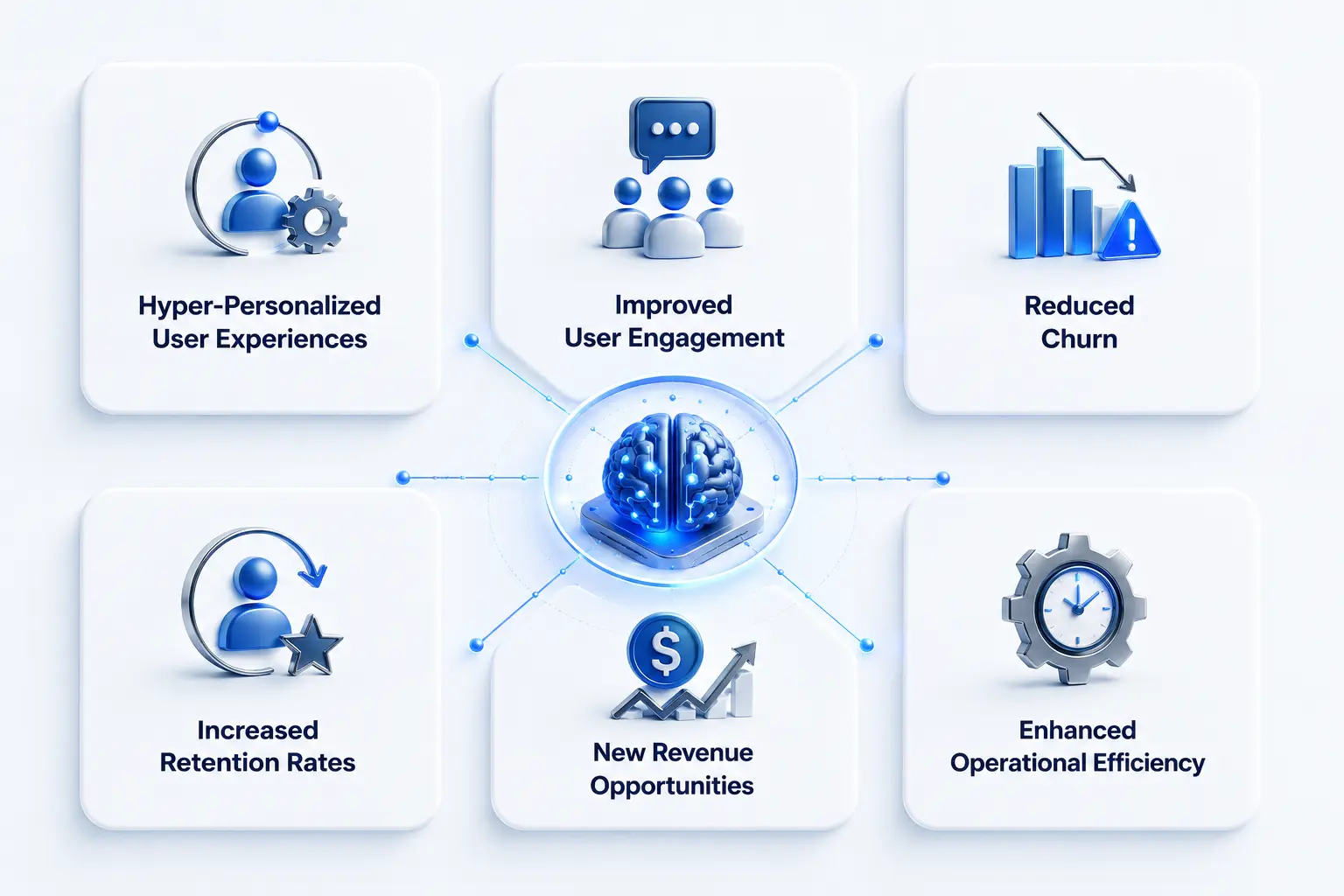
AI integration helps businesses create smarter, faster, and more personalized digital experiences that improve customer engagement, operational efficiency, and long-term scalability. While many businesses compare AI vs. automation, AI goes beyond rule-based processes by enabling predictive intelligence, adaptive learning, and personalized decision-making. From predictive automation to intelligent personalization, AI enables apps and platforms to drive higher retention, better decision-making, and stronger revenue growth.
1. Hyper-Personalized User Experiences Drive Higher Engagement
Personalization has become one of the strongest competitive differentiators in digital products. AI enables businesses to create highly customized user experiences by analyzing behavioral data, preferences, interaction history, and real-time engagement patterns.
Instead of delivering generic content, AI-powered systems dynamically adapt interfaces, recommendations, notifications, and workflows based on user intent.
Examples include:
- Personalized product recommendations
- Adaptive onboarding flows
- Contextual content suggestions
- Behavioral segmentation
- AI-driven search optimization
This level of personalization significantly improves user satisfaction and increases session duration.
Businesses leveraging recommendation system development services are particularly benefiting from improved conversion rates and stronger customer retention. Recommendation engines now power engagement strategies across e-commerce, media, fintech, healthcare, and SaaS applications.
2. AI Improves User Engagement Through Intelligent Interactions
AI-powered engagement systems help businesses maintain consistent communication with users without creating friction.
Modern AI engagement capabilities include:
- Conversational chatbots
- Smart push notifications
- Voice-based interactions
- AI-generated content recommendations
- Predictive customer support
Unlike rule-based systems, AI continuously learns from user interactions and optimizes engagement strategies over time.
For example, AI-powered notification engines can determine:
- The best time to send messages
- Which users are likely to respond
- What type of content drives action
- Which offers increase conversions
This creates highly efficient engagement loops that improve customer activity and platform stickiness.
3. AI Reduces Churn and Increases Retention Rates
Customer retention is often more profitable than customer acquisition. However, identifying disengaged users before they leave has traditionally been difficult.
AI solves this through predictive analytics and behavioral modeling.
AI systems can analyze:
- Drop-off patterns
- Session frequency
- Feature usage
- Transaction behavior
- Customer support interactions
These insights allow businesses to intervene before churn occurs.
For instance, subscription-based applications can use predictive models to identify at-risk users and trigger:
- Retention offers
- Personalized onboarding
- Educational content
- Product recommendations
- Automated support
This proactive retention strategy creates substantial business impact because even small improvements in retention can significantly increase long-term revenue.
The benefits of AI in business become particularly visible when companies use AI not only for automation but also for customer lifecycle optimization.
4. AI Creates New Revenue Opportunities
One of the most important benefits of AI for business is revenue expansion.
AI enables businesses to improve monetization through:
- Dynamic pricing
- Intelligent upselling
- Predictive recommendations
- Subscription optimization
- Behavioral targeting
- Automated sales assistance
AI-driven platforms continuously analyze customer intent and purchasing patterns to maximize conversion opportunities.
For example:
- Streaming apps increase watch time through recommendation engines
- E-commerce platforms improve cart value through cross-selling
- SaaS companies optimize upgrades through predictive usage insights
According to McKinsey’s 2025 State of AI report, 64% of organizations say AI is already enabling innovation within their business operations. This statistic strongly supports the growing role of AI in improving product innovation, revenue generation, and scalable digital transformation strategies for modern enterprises.
Businesses implementing AI adaptation business strategies are increasingly using AI to create scalable revenue ecosystems rather than relying solely on manual growth efforts.
5. AI Accelerates Operational Efficiency
Operational efficiency is another critical advantage of AI integration.
AI helps automate:
- Customer support workflows
- Data analysis
- Reporting systems
- User segmentation
- Fraud detection
- Content moderation
This reduces operational overhead while improving scalability.
For startups and enterprise businesses alike, automation allows teams to focus on innovation and strategic execution instead of repetitive manual tasks.
The benefits of using AI in Mobile App Development also include faster feature optimization, intelligent testing automation, and improved release cycles that help businesses reduce time-to-market.
How Does AI Improve App Engagement and Retention?
AI improves app engagement and retention by delivering personalized user experiences, predictive recommendations, and intelligent interactions that keep users actively connected to the platform. By analyzing behavioral patterns in real time, AI helps businesses reduce churn, increase session duration, and build stronger long-term customer loyalty.
1. AI-Powered Onboarding Creates Better First Impressions
User onboarding significantly influences retention outcomes. If users fail to understand value quickly, abandonment rates increase dramatically.
AI improves onboarding by:
- Personalizing tutorials
- Adapting onboarding flows
- Recommending relevant features
- Identifying friction points
- Predicting user intent
Instead of forcing every user through the same journey, AI can tailor onboarding based on goals, industry, behavior, and usage patterns. Custom AI chatbot development can further support this process by giving users real-time guidance, answering product-related questions, and helping them discover relevant features during their first interactions.
2. Predictive Analytics Improves User Retention Strategies
Retention strategies become more effective when businesses can predict behavior before problems occur.
AI-powered predictive data analytics enables organizations to identify:
- High-value users
- Churn risk indicators
- Feature adoption patterns
- Engagement decline
- Revenue opportunities
With these insights, businesses can launch targeted retention campaigns that improve long-term engagement.
For example, a SaaS platform may discover that users who fail to activate a specific feature within seven days are more likely to churn. AI systems can automatically trigger educational workflows to guide those users toward successful adoption.
This proactive approach helps businesses build sustainable retention models.
3. Smart Recommendation Engines Increase User Activity
Recommendation systems are among the most impactful AI engagement tools available today.
AI-powered recommendation engines improve:
- Content discovery
- Product relevance
- Purchase frequency
- Session duration
- Cross-selling opportunities
By continuously learning from user interactions, AI creates increasingly accurate recommendations over time.
Businesses using advanced personalization models often experience:
- Higher click-through rates
- Better conversion performance
- Increased average order value
- Improved customer loyalty
Recommendation systems have become essential for modern digital products because users now expect highly relevant experiences across every interaction.
4. AI-Driven Gamification Encourages Continuous Engagement
Gamification strategies powered by AI are helping businesses increase user participation and habit formation.
AI enhances gamification by personalizing:
- Rewards
- Challenges
- Progress tracking
- Achievement systems
- Engagement incentives
This creates dynamic engagement environments tailored to individual motivation patterns.
Industries such as education, fitness, fintech, and ecommerce are increasingly using AI-powered gamification to strengthen retention and customer loyalty.
Which Real-World Apps Successfully Use AI for Engagement and Revenue Growth?
Leading digital platforms like Netflix, Spotify, and Amazon use AI to personalize user experiences, optimize recommendations, and increase customer engagement at scale. These AI-driven strategies help businesses improve retention, boost conversions, and create sustainable revenue growth through data-driven decision-making.
Netflix Uses AI to Maximize Viewer Retention
Netflix has built one of the most sophisticated recommendation ecosystems in the world. Its AI algorithms analyze viewing behavior, preferences, search history, and engagement patterns to deliver highly personalized recommendations.
This AI-driven personalization significantly increases:
- Watch time
- User retention
- Subscriber loyalty
- Content discovery efficiency
Netflix demonstrates how AI can directly influence platform revenue through engagement optimization.
Spotify Uses AI to Personalize Music Experiences
Spotify leverages AI to create curated playlists such as Discover Weekly and Daily Mix. These AI-driven experiences continuously adapt to listening behavior and engagement trends.
This strategy has helped Spotify improve:
- Listening duration
- Subscription conversions
- User satisfaction
- Platform loyalty
Its recommendation engine remains one of the strongest examples of AI-powered customer engagement.
Amazon Uses Predictive AI for Revenue Optimization
Amazon uses AI across virtually every customer touchpoint.
Its AI systems support:
- Product recommendations
- Dynamic pricing
- Search optimization
- Inventory forecasting
- Customer behavior analysis
These capabilities contribute directly to higher sales conversion and improved operational scalability.
eGurukul Uses Intelligent Learning Experiences to Improve Retention
eGurukul 2.0, developed by RipenApps, showcases how personalized and data-driven digital experiences can improve student engagement and long-term retention in the EdTech industry.
Among our AI Case Studies, eGurukul demonstrates how intelligent product ecosystems can enhance learning outcomes and platform performance.
The platform highlights how intelligent product ecosystems can improve:
- Student engagement
- Personalized learning experiences
- Content accessibility
- Platform scalability
Cashbook Strengthens User Engagement Through Smart Social Experiences
Cashbook, a social networking platform developed by RipenApps, demonstrates how personalized digital interactions and seamless social experiences can improve user engagement and community participation.
The platform helps improve:
- User engagement and retention
- Community interaction
- Personalized user experiences
- Scalable digital growth
These examples highlight how businesses are leveraging intelligent digital experiences to drive stronger engagement, retention, and business growth.
What Challenges Do Businesses Face During AI Integration?
While AI offers significant business advantages, many organizations face challenges related to data quality, integration complexity, implementation costs, and privacy compliance during adoption. Successfully scaling AI also requires the right technical expertise, infrastructure readiness, and a clear strategy aligned with long-term business goals.
1. Data Quality Directly Impacts AI Performance
AI systems are only as effective as the data powering them.
Poor-quality data can lead to:
- Inaccurate recommendations
- Weak personalization
- Faulty predictions
- Inefficient automation
Businesses must prioritize strong data governance frameworks before scaling AI initiatives.
2. AI Implementation Costs Require Strategic Planning
One common concern among business leaders involves investment requirements.
The AI Agent Software Development Cost & ROI discussion often centers around balancing upfront implementation expenses with long-term operational and revenue benefits.
Businesses should evaluate:
- Infrastructure readiness
- Data maturity
- Development complexity
- Integration requirements
- Expected ROI timelines
The most successful AI projects begin with focused, high-impact use cases rather than attempting enterprise-wide transformation immediately.
3. Privacy and Compliance Challenges Require Attention
As AI systems collect and process large amounts of user data, businesses must ensure compliance with evolving privacy regulations.
This includes:
- Transparent data policies
- Consent management
- Ethical AI practices
- Security frameworks
- Governance controls
Trust remains a major factor in AI adoption success.
4. Talent and Integration Complexity Slow Adoption
Many organizations struggle with:
- Limited AI expertise
- Legacy system compatibility
- Technology integration challenges
- Cross-functional alignment
This is why businesses increasingly partner with experienced AI development companies capable of accelerating implementation while reducing technical risk.
Read More : AI Integration Cost In 2026: Full Pricing Breakdown For SaaS & Apps
What Are the Best Practices for Successful AI Integration?
Successful AI integration starts with identifying clear business objectives, high-impact use cases, and scalable implementation strategies that align with product and customer needs. Businesses should also prioritize data quality, continuous optimization, security compliance, and measurable KPIs to maximize long-term AI performance and ROI.
1. Businesses Should Start With Clear Use Cases
AI adoption should solve specific business problems rather than follow market hype.
High-impact starting points include:
- Personalization
- Customer support automation
- Recommendation systems
- Churn prediction
- Workflow optimization
Focused implementation creates faster ROI and reduces unnecessary complexity.
2. AI Strategies Must Align With Product Goals
A successful AI strategy for digital product development requires alignment between:
- Business objectives
- User expectations
- Technical architecture
- Scalability requirements
- Operational capabilities
3. Continuous Optimization Improves Long-Term AI Performance
AI systems require ongoing optimization.
Businesses should continuously:
- Monitor performance
- Retrain models
- Analyze engagement trends
- Refine automation workflows
- Improve personalization accuracy
AI adoption is not a one-time implementation. It is an evolving operational capability.
4. Measuring KPIs Strengthens AI ROI
Organizations should track AI performance using metrics such as:
- Customer retention rate
- Lifetime value
- Engagement duration
- Churn reduction
- Revenue growth
- Conversion improvements
Measuring outcomes ensures AI investments remain aligned with business growth goals.
AI integration in product development plays a critical role in helping businesses build scalable, intelligent, and customer-centric digital experiences that adapt to evolving market demands. Rather than functioning as an isolated feature, AI should enhance the core product ecosystem and support long-term innovation, automation, and business growth.
Read More: Top AI Trends 2026: What Every Entrepreneur Must Know To Stay Ahead?
How Will Future AI Innovations Transform Customer Engagement?
AI adoption is rapidly moving toward more autonomous and predictive experiences.
Key trends shaping the future include:
- Generative AI interfaces
- Voice-driven interactions
- Predictive UX systems
- AI-powered virtual assistants
- Autonomous workflow automation
- Real-time personalization engines
Businesses are increasingly integrating AI into every layer of digital product ecosystems.
As AI models become more advanced, customer experiences will become increasingly contextual, adaptive, and proactive.
Companies investing early in scalable AI infrastructure will be better positioned to lead market innovation and outperform slower-moving competitors.
Final Thoughts
AI is fundamentally changing how businesses build, scale, and optimize digital products. Companies that strategically adopt AI can improve customer engagement, reduce churn, unlock new revenue streams, and create highly personalized user experiences that drive long-term competitive advantage. As user expectations continue to evolve, AI integration is quickly becoming essential for sustainable digital growth.
For startups, enterprises, and product leaders looking to accelerate innovation, partnering with experienced AI development experts can significantly reduce implementation risk and improve ROI. RipenApps helps businesses build scalable AI-powered digital products through advanced AI feature integration, intelligent automation, and future-ready product strategies designed for measurable business impact.
FAQs
1. What are the biggest benefits of AI integration for businesses?
The biggest benefits of AI integration include improved customer engagement, faster operational efficiency, smarter decision-making, and scalable automation. AI helps businesses personalize user experiences, predict customer behavior, optimize workflows, and uncover new revenue opportunities through data-driven insights. For startups and enterprises alike, AI also improves agility, reduces manual workload, and strengthens long-term competitive advantage.
2. How does AI improve customer retention?
AI improves customer retention by analyzing user behavior in real time and identifying patterns that indicate disengagement or churn risk. Businesses can then trigger personalized recommendations, targeted offers, onboarding assistance, or automated engagement campaigns before users abandon the platform. This proactive approach helps companies build stronger customer relationships and increase lifetime value.
3. Is AI integration only useful for large enterprises?
No. AI integration is highly valuable for startups, mid-sized businesses, and enterprises. Modern AI technologies are becoming more accessible and scalable, allowing growing businesses to automate operations, personalize customer experiences, improve efficiency, and compete more effectively without requiring massive infrastructure investments. Many startups now use AI to accelerate product innovation and scale faster with leaner teams.
4. How do recommendation engines improve app performance?
Recommendation engines improve app performance by delivering highly relevant content, products, or services based on user behavior, preferences, and interaction history. These AI-powered systems increase user engagement, boost session duration, improve conversion rates, and encourage repeat interactions. Recommendation engines are widely used in streaming platforms, e-commerce apps, SaaS products, and social media platforms to create personalized experiences that drive retention and revenue growth.
5. What industries benefit most from AI-powered engagement?
AI-powered engagement is transforming industries such as e-commerce, healthcare, fintech, SaaS, education, logistics, travel, media, and retail. Businesses in these sectors use AI to personalize customer journeys, automate support, improve operational efficiency, enhance fraud detection, optimize recommendations, and deliver more intelligent digital experiences. As customer expectations continue to evolve, AI adoption is becoming a critical growth strategy across nearly every industry.
6. What challenges should businesses consider before integrating AI?
Before integrating AI, businesses should evaluate factors such as data quality, infrastructure readiness, compliance requirements, integration complexity, and long-term scalability. Successful AI adoption requires clear business goals, reliable datasets, strong security frameworks, and continuous optimization strategies. Organizations that align AI initiatives with measurable business outcomes typically achieve faster ROI and more sustainable growth.
7. How can businesses start implementing AI into their digital products?
Businesses should begin AI implementation by identifying high-impact use cases that directly solve customer or operational challenges. Common starting points include recommendation systems, predictive analytics, customer support automation, and personalized onboarding experiences. Partnering with experienced AI development teams can also help businesses reduce technical risk, accelerate deployment, and create scalable AI adoption roadmaps aligned with long-term business objectives.
Discuss your project and request for proposal
SHARE
WRITTEN BY

Ishan Gupta
CEO & Founder
Ishan Gupta is a seasoned entrepreneur and CEO with extensive 10+ years of experience in business and mobile app development landscape. He believes that the right digital product allows companies to focus on what they do best, while technology handles the rest. With deep exposure to global markets, he understands what makes an app succeed. His approach translates business needs into clear product strategies, ensuring that every feature contributes to measurable ROI.
View All Articles