

Key Takeaways
- Product idea validation with prototypes helps teams reduce development risk by testing assumptions before committing significant resources.
- The most effective validation process focuses on customer behavior, demand signals, usability insights, and willingness-to-pay evidence.
- Choosing the minimum prototype fidelity needed for learning accelerates feedback cycles while preventing unnecessary design investments.
- Structured testing with target users uncovers critical issues early, enabling faster iterations and more confident product decisions.
- Validation succeeds when assumptions are systematically replaced with evidence, creating a stronger foundation for MVP development.
Building a product without validating the idea first is one of the quickest ways to waste time, budget, and development resources. Many startups invest heavily in designing features, building infrastructure, and scaling teams, only to discover that the market has little interest in what they have created.
Research consistently shows that a significant number of startups fail because they solve problems that customers do not consider important enough to pay for. Without early validation, product decisions are often based on assumptions rather than evidence, increasing the risk of costly mistakes and missed opportunities.
This is why product idea validation has become a critical step in the development process. By testing concepts before committing to full-scale development, teams can gather meaningful user feedback, assess market demand, and identify potential usability or feasibility challenges early on. As a result, rapid prototyping services have become an essential part of the product development process, helping teams validate concepts, collect user insights, and reduce risk before full-scale development begins.
Successful product creation often depends on testing ideas early and learning from real users before making significant investments. By validating assumptions, businesses can make more informed decisions, allocate resources more effectively, accelerate time-to-market, and improve their chances of achieving product-market fit. This blog explores the different frameworks, tools, mistakes to avoid, and best practices for startups to validate a product idea.
Table of Contents
What is Product Idea Validation, and Why are Prototypes the Best Vehicle for It?
Product idea validation is the process of testing whether a proposed product solves a real problem, attracts genuine demand, and can generate sustainable business value before significant development investment.
According to PwC’s 29th Annual Global CEO Survey, 42% of CEOs believe their businesses will not remain economically viable over the next decade if they continue on their current trajectory. This highlights a widening execution gap between current operating models and future market realities shaped by AI, shifting customer expectations, and industry convergence.
What Validating a Product Idea Actually Means
Product idea validation with prototypes is the process of using early product representations to test customer demand, usability, willingness to pay, and business viability before building a fully functional product. This stage is a critical part of the product development life cycle, helping teams avoid building features that don’t align with user needs
Validation is not about proving your idea is right. It is about discovering whether your assumptions are wrong while the cost of change remains low.
Effective validation helps answer critical business questions:
- Does the problem actually exist?
- Is the problem important enough to solve?
- Does the proposed solution resonate with users?
- Will customers pay for it?
- Is the opportunity commercially viable?
The goal is evidence-based decision-making rather than assumption-driven development.
Why Prototypes Outperform Surveys and Interviews Alone
Customer interviews and surveys provide valuable qualitative insights. However, they often reveal what people say rather than what they actually do.
Prototypes create realistic experiences that allow users to interact with a potential solution. This behavioral feedback is significantly more reliable than hypothetical opinions.
At this stage, many teams also leverage structured product prototyping services to rapidly convert ideas into interactive test environments.
Benefits of prototype-based validation include:
- Observable user behavior
- Faster learning cycles
- Better usability insights
- More accurate feature prioritization
- Stronger stakeholder alignment
- Reduced development risk
When users click, navigate, hesitate, or abandon tasks inside a prototype, teams gain insights that traditional surveys cannot uncover.
The Three Questions Every Validation Must Answer
Every validation initiative should focus on three core questions:
- Is there real demand for this solution?
- Will target users pay for it?
- Can the product be built before resources or runway are exhausted?
If any of these questions remain unanswered, the product remains a business risk rather than a validated opportunity.
Prototypes create realistic experiences that allow users to interact with a potential solution. This approach is widely adopted by the best app developers for startups, who use early validation and user feedback to reduce risk, refine product direction, and build solutions that align with real market demand.
Prototype vs. MVP vs. Proof of Concept: How Are They Different?
Many teams use these terms interchangeably. However, each serves a different purpose within the product development lifecycle.
What Is a Prototype?
A prototype is an early representation of a product created to test assumptions, user experience, workflows, and design concepts.
A prototype may be:
- Paper sketches
- Wireframes
- Clickable mockups
- Interactive simulations
Importantly, prototypes are designed for learning, not production use. This stage is often where product designing plays a critical role in shaping usability and interaction clarity.
Where the MVP Fits in the Validation Journey
A Minimum Viable Product (MVP) is a functional version of a product containing only the essential features required to deliver value and gather market feedback.
Unlike prototypes, MVPs involve actual development and real-world usage.
The typical progression looks like this:
POC – Prototype – MVP – Product-Market Fit -Scale
This sequence allows organizations to gradually increase investment while reducing uncertainty.
POC, Prototype, MVP: A Side-by-Side Comparison
Understanding the differences between a Proof of Concept (POC), Prototype, and MVP helps teams validate feasibility, usability, and market demand at the right stage of product development.
Here is a quick comparison table for your convenience:
| Criteria | Proof of Concept (POC) | Prototype | MVP |
| Purpose | Technical feasibility | User validation | Market validation |
| Fidelity Level | Very low | Low to high | Fully functional |
| Who Tests It | Internal team | Target users | Real customers |
| When to Use | Before design begins | Before development begins | Before scaling |
| Cost Range | Low | Low to medium | Medium to high |
For a deeper dive into prototyping methodologies, a Rapid Prototyping in Product Development guide will be helpful.
How Do You Choose the Right Prototype Fidelity for Validation?
Prototype fidelity determines how closely a prototype resembles the final product. The appropriate fidelity level depends entirely on what assumption you need to test.
Startups often refine this stage through MVP app development services, ensuring they don’t overbuild before validating demand.
Low-Fidelity Prototypes Deliver the Fastest Early Signals
Low-fidelity prototypes prioritize speed, simplicity, and rapid learning, making them ideal for validating early-stage product assumptions before investing in design or development. By focusing on core concepts rather than visual details, they enable teams to gather feedback quickly, identify usability issues, and iterate on ideas at a minimal cost. These prototypes are particularly valuable during the discovery phase, where the goal is to test whether users understand and engage with a proposed solution rather than evaluate its aesthetics or functionality.
Examples include:
- Paper sketches
- Hand-drawn workflows
- Basic wireframes
- Whiteboard concepts
Best for:
- Concept validation
- User journey mapping
- Navigation testing
- Early assumption testing
Limitations:
- Limited visual realism
- No micro-interactions
- Cannot accurately test aesthetics
For very early-stage startup validation, low-fidelity prototypes often deliver the highest learning-to-cost ratio.
Mid-Fidelity Prototypes Become the Workhorse of Startup Validation
Mid-fidelity prototypes strike the ideal balance between speed and realism, making them one of the most effective tools for product validation. They provide enough structure and interactivity for users to experience key workflows while remaining flexible and cost-efficient to modify.
By simulating core features and navigation patterns, these prototypes help teams validate user journeys, prioritize functionality, gather stakeholder feedback, and uncover usability challenges before investing in high-fidelity design or development. For many startups, especially those exploring startup app ideas, mid-fidelity prototypes serve as the primary validation asset throughout multiple testing and iteration cycles, helping refine concepts before committing to full-scale development.
Examples include:
- Clickable wireframes
- Grey-box interfaces
- Interactive user flows
Best for:
- Feature prioritization
- Workflow testing
- Stakeholder presentations
- Navigation validation
Many SaaS startups conduct multiple validation rounds using mid-fidelity prototypes before investing in high-fidelity design.
High-Fidelity Prototypes Generate Realistic User Feedback
High-fidelity prototypes closely replicate the look, feel, and interactions of the final product, allowing users to engage with a highly realistic experience. Their visual polish and interactive functionality help teams gather more accurate feedback on usability, user expectations, and overall product perception.
These prototypes are particularly valuable for advanced user testing, investor presentations, stakeholder reviews, and pre-launch validation, where realistic interactions can reveal insights that lower-fidelity prototypes may miss. By simulating real-world usage, high-fidelity prototypes help teams build confidence in design decisions before moving into full-scale development.
Characteristics include:
- Branded interfaces
- Realistic interactions
- Visual polish
- Dynamic content simulations
Best for:
- Usability testing
- Investor demonstrations
- Pre-launch validation
- Executive stakeholder buy-in
The risk is over-investment. Teams often spend excessive time polishing interfaces before validating core assumptions.
The Decision Rule: Minimum Fidelity for Maximum Learning
The best validation framework follows one simple principle:
Use the minimum prototype fidelity required to answer your validation question.
- If a sketch answers the question, do not build a clickable mockup.
- If a clickable wireframe answers the question, do not build a pixel-perfect design.
- The objective is learning, not design perfection.
A typical fidelity progression looks like:
Paper Sketch – Wireframe – Clickable Prototype – High-Fidelity Interactive Prototype
Gartner’s Top Strategic Technology Trends for 2025 highlights that over 80% of emerging technologies are expected to be AI-enabled by 2025, signaling a major shift in how digital products are conceived and built.
Step-by-Step Framework for How Startups Validate Product Ideas Using Prototypes
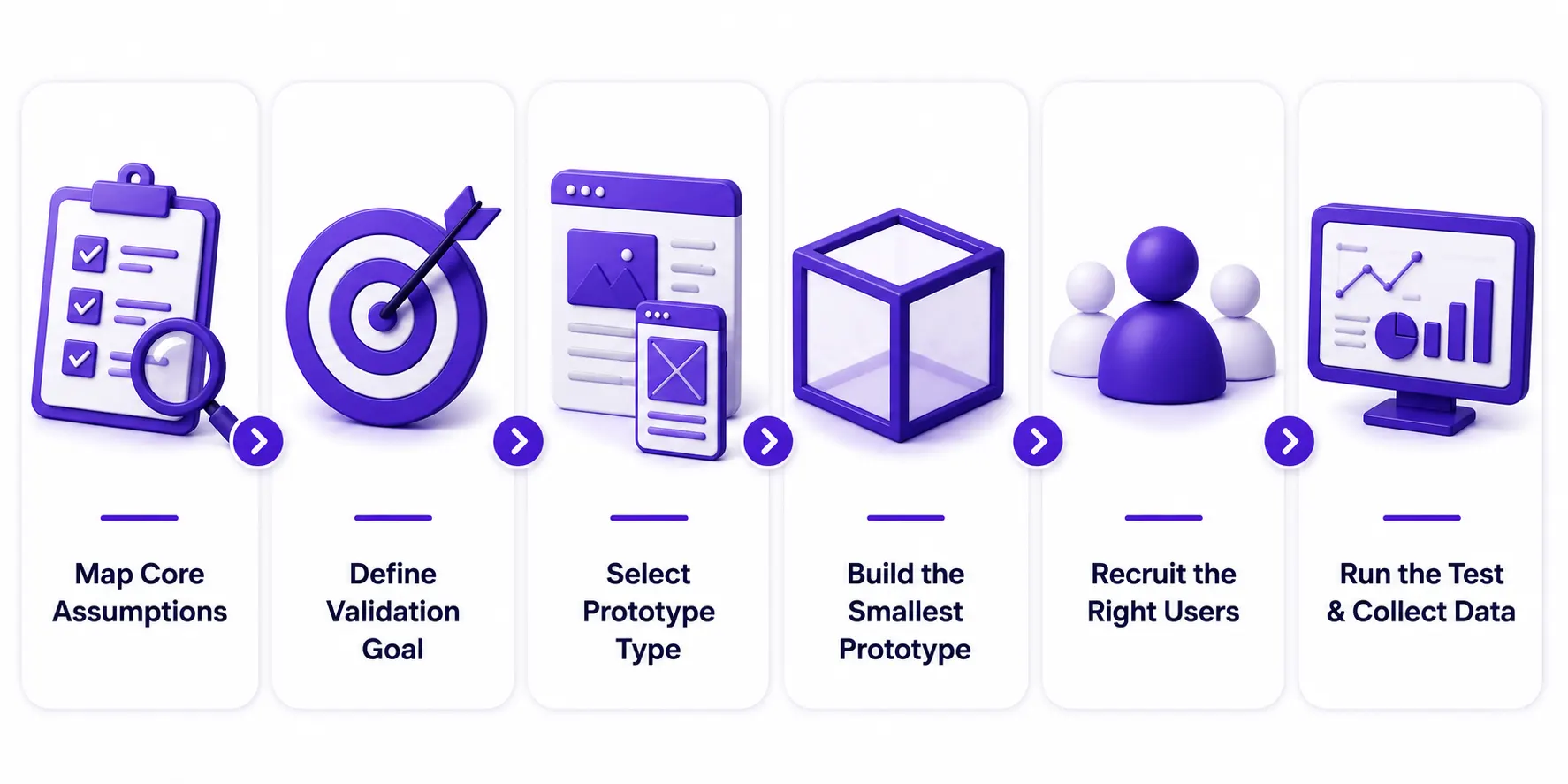
Successful validation follows a structured process. The framework below helps product teams systematically reduce uncertainty before committing significant development resources.
This phase is often executed alongside product engineering services, ensuring technical feasibility aligns with validated user needs.
Step 1: Map Your Core Assumptions Before Building Anything
Every product begins as a collection of assumptions.
Examples include:
- Users have a specific problem
- Customers will pay for the solution
- The workflow is intuitive
- The market opportunity is large enough
Start by creating two living documents:
- Assumptions List
- Decisions List
Next, prioritize assumptions according to risk.
Ask:
If this assumption is wrong, does the product fail?
The highest-risk assumptions should always be tested first.
Step 2: Define Your Validation Goal for This Prototype
Each prototype should answer one primary question. This step ensures alignment between user problems and solution direction, often refined through structured MVP testing practices.
Examples:
- Can users complete onboarding without guidance?
- Do users understand the pricing structure?
- Is the dashboard navigation intuitive?
- Can users complete a core task within three minutes?
Avoid testing multiple hypotheses simultaneously.
Focused prototypes produce cleaner data and clearer decisions.
Step 3: Select Your Prototype Type and Fidelity Level
Choose fidelity based on the question being tested. Fidelity selection is a key output of the product discovery process, where teams decide what needs validation first.
Examples:
| Validation Question | Recommended Fidelity |
| Is the concept valuable? | Low fidelity |
| Is navigation intuitive? | Mid fidelity |
| Is usability acceptable? | High fidelity |
For digital products such as SaaS platforms, enterprise applications, and mobile apps, fidelity should increase gradually as uncertainty decreases.
Step 4: Build the Smallest Prototype That Answers Your Question
The prototype scope should be intentionally limited.
Include only:
- Relevant screens
- Core interactions
- Necessary workflows
Exclude:
- Secondary features
- Advanced integrations
- Edge cases
- Nice-to-have functionality
A useful rule is:
If a wireframe can answer the question, do not build a high-fidelity prototype.
This approach accelerates learning and preserves budget.
Step 5: Recruit the Right Users
One of the most common validation mistakes is testing with friends, colleagues, or family members.
Instead, recruit participants who match your Ideal Customer Profile (ICP).
Research suggests that approximately 5-8 participants uncover the majority of usability issues in qualitative testing.
General guidelines:
- Qualitative testing: 5-8 participants
- Quantitative studies: 30+ participants
- Enterprise validation: Decision-makers and stakeholders
- Consumer validation: Representative target users
Use screening questionnaires to ensure participant quality.
Step 6: Run the Test and Collect Behavioral and Verbal Data
Testing methods typically fall into two categories:
Moderated Testing
- Facilitator present
- Deeper insights
- Follow-up questions
- Rich qualitative feedback
Unmoderated Testing
- Remote participation
- Faster scaling
- Larger sample sizes
- Lower cost
Best practices include:
- Use think-aloud protocols
- Record screens and audio
- Capture user quotes
- Observe hesitation points
- Track task completion rates
Behavioral data often reveals more than direct opinions.
The strongest teams treat validation as an ongoing process rather than a one-time checkpoint. Every testing cycle should reduce uncertainty, improve confidence, and move the product closer to sustainable market success.
What Are the Best Tools for Product Idea Validation With Prototypes in 2026?
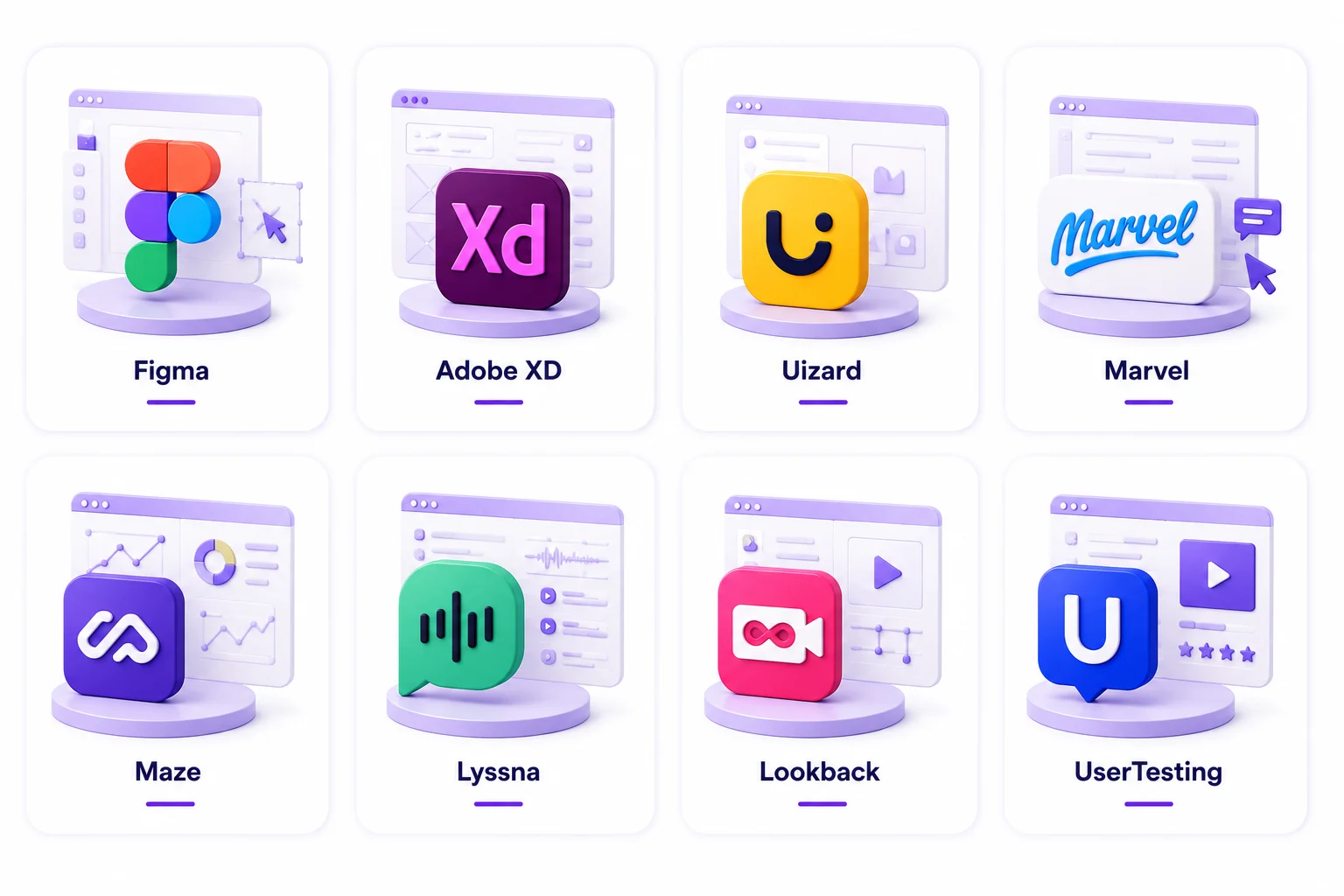
The validation technology landscape continues to evolve rapidly. Today’s ecosystem is often supported by a development company that integrates design, prototyping, and testing workflows into one system.
According to McKinsey’s State of AI in 2025, 64% of organizations are already using generative AI in at least one business function.
Design and Prototyping Tools Support Visual Product Validation
| Tool | Best For | Fidelity | Free Tier |
| Figma | Clickable mockups, collaborative design | Low – Hi-Fi | Yes |
| Adobe XD | Interactive prototypes, design systems | Mid – Hi-Fi | Limited |
| Uizard | AI wireframing for non-designers | Low – Mid-Fi | Yes |
| Marvel | Quick clickable prototypes from images | Low – Mid-Fi | Yes |
Figma remains the industry standard due to its collaborative capabilities and seamless integration with testing tools. Meanwhile, AI-powered platforms are significantly reducing the time required to transform concepts into testable experiences.
User Testing and Behavioral Research Tools Deliver Actionable Insights
User testing and behavioral research tools help teams understand how users interact with prototypes by capturing real actions, feedback, and pain points. These insights enable data-driven decisions, helping businesses refine user experiences and validate assumptions before development begins.
| Tool | Best For | Standout Feature |
| Maze | Automated prototype testing and analytics | Direct Figma integration |
| Lyssna | Remote usability testing | Fast participant recruitment |
| Lookback | Live moderated interviews | Video annotation tools |
| UserTesting | Enterprise usability testing | Large tester panel |
These platforms help teams move beyond opinions and gather behavioral evidence from actual users.
The strongest validation programs combine usability metrics, screen recordings, heatmaps, and qualitative interviews to create a complete picture of user behavior.
Real-World Apps That Use Prototype-Driven Product Validation
Many successful digital products begin with prototype-driven validation, where ideas are tested through early designs, MVPs, and iterative user feedback before full-scale development.
Dropbox
Dropbox validated demand using a simple explainer video prototype that demonstrated the core product concept before any full backend system was built. This early validation helped confirm strong user interest and generated massive waitlist sign-ups, proving real market demand.
Airbnb
Airbnb improved its early product experience through continuous prototype testing focused on trust, booking flow, and user experience. Iterative feedback from real users helped refine the platform into a scalable marketplace built on validated assumptions.
Uber
Uber tested its initial service model using early UX prototypes and controlled experiments to validate the demand for on-demand ride-hailing. These early validations helped shape its core workflow before global expansion.
Hungama
Hungama used early-stage UX prototyping and iterative product validation to refine its digital entertainment experience. User feedback on navigation, content discovery, and engagement flows helped shape a scalable media platform.
Cobone
Cobone evolved through structured prototype testing and iterative validation of deal discovery and user engagement flows. Early user insights helped optimize conversion paths and improve platform usability for large-scale adoption.
How Do You Know When a Prototype Is Validated Enough?
Most validation guides explain how to run tests. Few explain when sufficient evidence exists to move forward.
The following benchmarks provide practical decision-making thresholds.
Usability Benchmarks Measure Product Readiness
Usability benchmarks provide objective indicators of how effectively users can interact with a product prototype. By measuring factors such as task completion, error rates, and overall user satisfaction, teams can assess readiness, identify friction points, and determine whether further improvements are needed before development or launch.
| Metric | Benchmark |
| System Usability Scale (SUS) | ≥70 acceptable, ≥85 excellent |
| Task Completion Rate | ≥75% on core flows |
| Critical Error Rate | ≤2 major errors per session |
If users cannot complete core workflows, additional validation or redesign is typically required.
Demand Signal Benchmarks Indicate Market Interest
Demand signal benchmarks help teams evaluate whether there is genuine market interest in a product before significant investment. Metrics such as click-through rates, waitlist signups, pre-orders, and demo requests provide tangible evidence of customer intent and potential commercial viability.
| Metric | Benchmark |
| Fake Door CTR | ≥5% |
| Organic Waitlist Signups | ≥100 |
| Pre-Sell Commitment Rate | ≥30% |
Demand indicators matter because usability alone does not guarantee commercial success.
A product that users enjoy but refuse to purchase remains a business risk.
SaaS and Mobile App PMF Benchmarks Guide Go-to-Market Decisions
Product-Market Fit (PMF) benchmarks help SaaS and mobile app teams determine whether their solution delivers enough value to sustain growth. By measuring user satisfaction, retention, engagement, and demand signals, businesses can make more informed go-to-market and scaling decisions.
| Metric | Benchmark |
| Sean Ellis PMF Test | ≥40% “Very Disappointed” |
| Micro SaaS Validation | 10 interviews + 100 signups |
| Enterprise SaaS Validation | 50+ interviews + 3 LOIs |
These metrics provide stronger confidence before allocating larger development budgets.
The Two Lists Framework Simplifies Build Decisions
High-performing product teams maintain:
Assumptions List
- Unverified beliefs
- Open questions
- Remaining risks
Decisions List
- Validated findings
- Confirmed behaviors
- Evidence-backed changes
A practical green-light rule is simple:
When the Decisions List outweighs the Assumptions List for core features, development can proceed with significantly lower risk.
What Common Prototype Validation Mistakes Should A Business Avoid?
Even experienced product teams can undermine validation efforts through avoidable mistakes.
Building High-Fidelity Prototypes Too Early Increases Risk
Creating polished, high-fidelity prototypes too early can shift attention away from core product assumptions and toward visual details such as colors, typography, and aesthetics. Start with low-fidelity concepts to validate the problem and solution first, then gradually increase fidelity as confidence in the product grows.
Confusing Positive Feedback With Purchase Intent Creates False Confidence
Positive reactions do not necessarily indicate market demand. Users may express interest in a product but still be unwilling to pay for it. Strong validation comes from commitment signals such as waitlist signups, pre-orders, demo requests, deposits, or letters of intent, which provide stronger evidence of genuine demand.
Testing Too Many Features at Once Obscures Learning
Large and feature-heavy prototypes often generate confusing feedback, making it difficult to identify which elements are driving user behavior. Focus on testing a single hypothesis, workflow, or feature at a time. A more focused approach produces clearer insights and supports better product decisions.
Skipping Documentation Between Iterations Wastes Future Learning
Failing to document validation results can lead to repeated mistakes and lost insights. Maintain a simple record of each assumption, test, result, and decision to create a structured learning process. Over time, this documentation becomes a valuable knowledge base that guides future product development efforts.
Final Thoughts
Product idea validation with prototypes is ultimately about replacing assumptions with evidence. The most successful digital products are not built because founders believe they will succeed. They are built because prototype testing demonstrates genuine customer demand, validates usability, and confirms business viability. By understanding the type of validation required, selecting the appropriate fidelity level, using the right tools, and following proven testing practices, organizations can reduce risk while accelerating innovation and time-to-market.
For startups, enterprises, and digital product teams looking to transform ideas into scalable products, validation should be the first investment, not the final checkpoint. Rapid prototyping for startups has become one of the most effective ways to test assumptions, gather user feedback, and refine product direction before significant development resources are committed. At RipenApps, our experts help businesses leverage rapid prototyping, UX research, MVP development, and product validation frameworks to build products that are grounded in real user evidence. Whether you are launching a SaaS platform, enterprise solution, or mobile application, a validated prototype provides the foundation for smarter product development and sustainable growth.
FAQs
1. What is product idea validation with prototypes?
Product idea validation with prototypes is the process of testing product concepts, usability, demand, and business viability using low-, mid-, or high-fidelity representations before investing in full-scale development. It is a key step in the product development life cycle, where ideas are tested before building a full product.
2. Why are prototypes better than surveys for validation?
Prototypes allow users to interact with a solution, revealing real behavior rather than hypothetical opinions. This produces more reliable validation insights.
3. How many users are needed for prototype testing?
For qualitative usability testing, 5-8 participants often uncover most major usability issues. Quantitative validation generally requires 30 or more participants.
4. What is the difference between a prototype and an MVP?
A prototype is designed for learning and validation. An MVP is a functional product designed for market testing with real customers. POC vs MVP vs Prototype explains different stages of validation, from feasibility to usability to market readiness.
5. Which prototype fidelity level should startups choose?
Startups should use the minimum fidelity required to answer their validation question. Early-stage concepts typically benefit from low- or mid-fidelity prototypes.
6. Can AI tools help with prototype validation?
Yes. AI-powered tools such as Figma Make, Lovable, Bolt, and Sketchflow.ai can accelerate prototype creation, reduce costs, and support faster experimentation.

SHARE
WRITTEN BY

Ishan Gupta
CEO & Founder
Ishan Gupta is a seasoned entrepreneur and CEO with extensive 8+ years of experience in business and mobile app development landscape. He believes that the right digital product allows companies to focus on what they do best, while technology handles the rest. With deep exposure to global markets, he understands what makes an app succeed. His approach translates business needs into clear product strategies, ensuring that every feature contributes to measurable ROI.
View All Articles


 India
India USA
USA Australia
 Canada
 UK
UK UAE
UAE