


Key Takeaways
- Healthcare cloud security requires integrated protection across data, applications, identities, infrastructure, APIs, and third-party integrations.
- HIPAA readiness depends on appropriate technical, administrative, and physical safeguards rather than cloud provider capabilities alone.
- Continuous monitoring, access reviews, security testing, and recovery planning help organizations manage evolving healthcare cloud security risks.
- Secure architecture should address encryption, API protection, data lifecycle management, backups, identity controls, and incident response.
- Long-term healthcare cloud security requires governance, secure engineering, vendor oversight, operational discipline, and continuous improvement.
Healthcare organizations are increasingly moving patient records, telemedicine platforms, clinical applications, connected medical devices, analytics systems, and digital patient services to cloud environments. The shift can improve scalability, accessibility, collaboration, and operational efficiency, but it also creates new responsibilities for protecting sensitive health information. A healthcare application can connect patients, clinicians, laboratories, pharmacies, insurers, medical devices, and third-party platforms, creating multiple points where data must be secured.
Cloud security in healthcare therefore goes far beyond choosing a reliable cloud provider. Organizations need to protect electronic protected health information (ePHI), control access, secure APIs, encrypt sensitive information, monitor activity, protect backups, manage vendors, and prepare for security incidents.
For businesses developing or modernizing healthcare applications, cloud consulting services can help establish security-focused cloud architectures that account for data flows, identity management, infrastructure, application security, and compliance requirements from the beginning rather than treating security as an afterthought.
This guide explains how healthcare organizations can approach cloud security, from HIPAA considerations and risk assessments to cloud architecture, identity controls, API protection, monitoring, disaster recovery, AI, connected devices, and long-term security planning.
Table of Contents
What is Cloud Security in Healthcare?
Cloud security in healthcare refers to the technologies, processes, policies, and architectural controls used to protect healthcare applications, infrastructure, systems, and sensitive health information hosted or processed in cloud environments.
The scope is much broader than protecting a database. A healthcare application may collect information through a mobile application, transmit it through APIs, process it through backend services, store it in databases and cloud storage, expose it through clinician dashboards, and exchange information with external healthcare systems. A useful way to understand the scope is to look at where healthcare information exists throughout an application ecosystem.
| Security area | What it protects | Common concern |
| Patient data | Medical records, reports and other ePHI | Unauthorized access |
| Applications | Mobile, web and backend systems | Application vulnerabilities |
| APIs | Data exchanged between systems | Excessive data exposure |
| Cloud infrastructure | Networks, compute and storage | Misconfiguration |
| Identity | Patients, clinicians and employees | Credential compromise |
| Backups | Recovery copies of healthcare data | Ransomware |
| Integrations | External healthcare platforms | Third-party exposure |
For example, a telemedicine app like Teladoc Health may store patient information in authentication services, application databases, object storage, logs, backups, analytics platforms, notification systems, and external integrations.
Protecting only the primary database would therefore leave other potential exposure points unaddressed. Organizations evaluating the broader role of cloud environments can also refer to the cloud computing in healthcare resource when assessing how cloud technology supports healthcare applications and operations.
Why Healthcare Cloud Security Requires a Different Approach
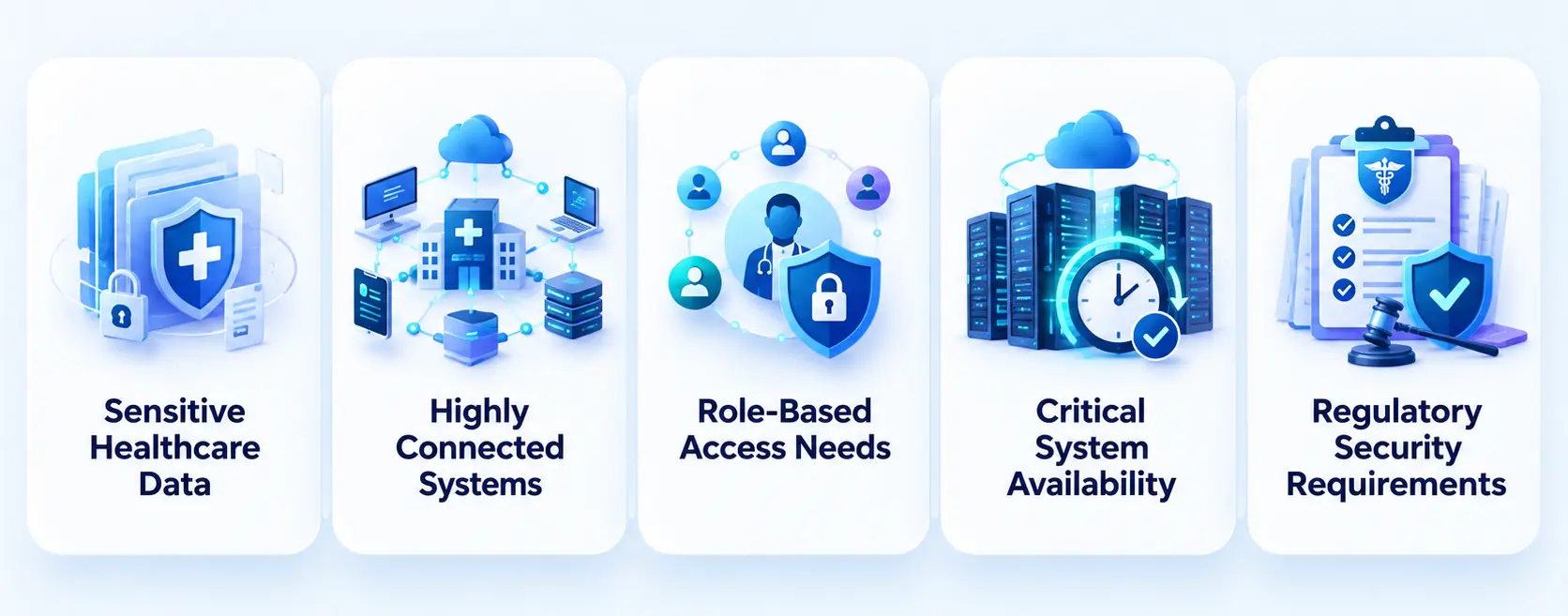
Healthcare organizations deal with a combination of sensitive information, interconnected systems, regulatory requirements, and operational dependencies.
1. Healthcare Data Is Highly Sensitive
Healthcare applications can contain diagnoses, treatment records, medications, laboratory results, insurance information, identity details, clinical notes, and payment information.
A data breach can create privacy and financial consequences, but healthcare incidents can also affect operational continuity when clinicians or patients lose access to important systems. This is why [healthcare data security] needs to be considered across the complete application and infrastructure environment rather than limited to individual databases.
2. Healthcare Applications Are Highly Connected
A modern healthcare platform may communicate with:
- Electronic health record systems
- Laboratories
- Pharmacies
- Insurance providers
- Payment platforms
- Medical devices
- Identity providers
- Analytics systems
- Communication services
Each connection creates another trust boundary.
A secure internal application can still become exposed if an external integration has weak authentication, excessive permissions, insecure APIs, or inappropriate data-sharing practices.
3. Access Requirements Differ by User
A physician, nurse, billing employee, administrator, laboratory technician, and support representative may all use the same healthcare system but require different permissions.
A secure platform must therefore determine not only whether a user is authenticated but also what information and functions that user is authorized to access.
4. Availability Matters
Healthcare systems can support time-sensitive workflows. Security controls therefore need to protect sensitive information without unnecessarily preventing authorized users from accessing systems required for clinical or operational activities.
5. Regulatory Accountability Adds Another Layer
Healthcare organizations need processes for risk management, access control, security monitoring, incident response, vendor management, and documentation.
This combination of data sensitivity, connectivity, availability, and regulatory responsibility makes healthcare cloud security a broader discipline than generic cloud infrastructure protection.
HIPAA and Cloud Computing: What Healthcare Organizations Need to Know
HIPAA does not prevent healthcare organizations from using cloud computing. The important question is how the cloud environment is designed, configured, governed, and used.
1. Does Using a Cloud Provider Make an Application HIPAA Compliant?
No, a provider may offer capabilities that support HIPAA-regulated workloads, but those capabilities do not automatically make an individual application compliant. The healthcare organization remains responsible for its own application architecture, data handling, user permissions, configurations, integrations, policies, and operational processes.
This is where understanding HIPAA Compliance Application Development becomes important. HIPAA considerations need to influence application requirements and architecture instead of being treated as documentation that is completed after development.
2. Understanding Business Associate Agreements
When a cloud provider acts as a business associate in relation to ePHI, an appropriate business associate agreement is an important part of the relationship. However, contractual protection does not replace technical security. A signed agreement cannot automatically:
- Restrict excessive permissions
- Secure an exposed API
- Protect compromised credentials
- Encrypt application data
- Detect suspicious activity
- Prevent insecure application code
HIPAA readiness therefore requires both governance and technical controls.
The Three Pillars of a HIPAA-Ready Cloud Environment
Healthcare cloud security can be understood through three connected safeguard categories: administrative, physical, and technical.
| Safeguard | Focus | Example |
| Administrative | Organizational security processes | Risk analysis and security policies |
| Physical | Physical protection | Infrastructure and facility safeguards |
| Technical | Technology controls | Authentication and audit controls |
1. Administrative Safeguards
Administrative safeguards address how an organization manages security. They include risk analysis, security responsibilities, workforce controls, policies, incident response, contingency planning, and procedures for managing access to ePHI.
2. Physical Safeguards
Physical safeguards focus on protecting facilities, devices, systems, and physical infrastructure. Even when infrastructure is hosted by a cloud provider, healthcare organizations need to understand the provider’s responsibilities and the physical protections supporting the cloud environment.
3. Technical Safeguards
Technical safeguards involve controls implemented through technology. Authentication, access control, audit mechanisms, integrity protections, and secure transmission are important examples.
These three areas need to operate together. Strong encryption cannot compensate for poor access management, while an excellent security policy cannot protect an application with an exposed API.
Conducting a Healthcare Cloud Security Risk Assessment
Risk analysis provides the foundation for deciding which security controls an organization needs. For cloud environments, the process should begin with understanding the information rather than simply listing cloud services.
1. Start With the Data
Organizations should identify what healthcare information exists, where it originates, where it travels, where it is stored, who can access it, which services process it, how long it is retained, and what happens when it is no longer needed. This creates a foundation for understanding the actual attack surface.
2. Map the Data Flow
A typical healthcare cloud architecture may look like:
- Patient
- Mobile/Web Application
- API Gateway
- Application Services
- Database/Storage
- External Healthcare Systems
Each stage requires appropriate controls. For example, an organization may have a secure database but an improperly protected API that exposes sensitive information. Another organization may have secure application code but accidentally configure cloud storage for public access. Mapping the flow makes these gaps easier to identify.
3. Identify Risks and Vulnerabilities
The assessment should consider risks such as:
- Unauthorized access
- Credential compromise
- Insecure APIs
- Excessive privileges
- Exposed storage
- Ransomware
- Vulnerable software
- Cloud misconfiguration
- Third-party failures
- Accidental disclosure
- Data loss
- Service outages
Risk assessment should also be continuous. Adding an AI platform, connected medical device, new API, analytics service, or external healthcare integration can change the security profile of an existing application.
Designing a Secure Healthcare Cloud Architecture
A secure healthcare cloud architecture should begin with clear separation between application services, APIs, databases, storage, and administrative systems. Network segmentation helps limit unnecessary communication between these components and reduces the potential impact of a compromised service. API gateways can add another control layer by managing authentication, traffic, and access policies before requests reach backend services.
Databases should be isolated from public access, while sensitive healthcare files should be stored in appropriately protected cloud storage. Secrets such as API keys and database credentials should be managed through dedicated secrets-management systems rather than application code. Development, staging, and production environments should also remain separated to prevent testing activity from affecting live patient data.
For organizations building or reviewing the underlying cloud infrastructure, security requirements should be incorporated into infrastructure design rather than handled separately from application architecture.
Identity and Access Management in Healthcare Applications
Identity is one of the most important security boundaries in healthcare applications.
1. Role-Based Access Control
Role-based access control can align permissions with professional responsibilities. For example, a physician may need access to clinical information for assigned patients, while a billing employee may need payment-related information without access to clinical notes.
Larger organizations may need more granular controls based on department, location, organization, patient relationship, or operational context.
2. Multi-Factor Authentication
Sensitive and privileged accounts should have stronger authentication protections. Multi-factor authentication provides an additional layer when passwords or other credentials are compromised.
3. Privileged Access
Administrative accounts can provide access to infrastructure, databases, cloud services, and security configurations. Privileged accounts should therefore be restricted, monitored, and reviewed more carefully than ordinary user accounts.
4, Access Reviews
Permissions should be reviewed periodically. When an employee changes roles or leaves an organization, previous access should not remain active indefinitely.
The same principle applies to contractors, temporary employees, service accounts, and third-party integrations.
Encryption and Healthcare Data Protection
Encryption is an important component of healthcare data protection, but it should operate alongside identity management, access controls, monitoring, and other security safeguards. Healthcare information can exist across databases, object storage, backups, archives, logs, and other persistent systems, making protection necessary throughout the data environment. Encryption at rest can help reduce the risk associated with unauthorized access to stored information, particularly when sensitive patient records are maintained in cloud databases or storage systems.
Healthcare information also moves continuously between mobile applications, APIs, backend services, databases, laboratories, pharmacies, and other healthcare systems. Secure communication mechanisms should protect this information while it is in transit and help prevent unauthorized parties from accessing data as it moves between systems.
Encryption is only as effective as the controls protecting the encryption keys. Key access should therefore be restricted, monitored, and managed according to appropriate organizational policies. Where practical, encryption keys should also be separated from ordinary application credentials to reduce the impact of compromised application accounts.
Data minimization is another important part of healthcare data protection. Organizations should evaluate whether every data field needs to be collected, processed, and retained. If an application does not require specific information, collecting it creates additional security, retention, privacy, and governance responsibilities. Limiting unnecessary data collection can therefore reduce the overall amount of information that an organization must protect throughout its lifecycle.
Securing APIs and Healthcare Integrations
APIs connect many healthcare applications and systems. An application may use APIs for appointment scheduling, patient records, insurance verification, laboratory results, prescriptions, payments, notifications, analytics, and connected devices.
1. Authentication and Authorization:
Authentication establishes who is making a request. Authorization determines whether that user or system is allowed to perform the requested operation. Both are required for secure API access.
2. Input Validation
Incoming API requests should be validated before reaching application logic. This can help prevent malformed or malicious data from being processed.
3. Rate Limiting
Rate limiting can reduce abuse and help protect APIs from excessive traffic.
4. Minimize API Responses
APIs should return only the information necessary for a specific operation. An appointment endpoint, for example, should not expose unrelated clinical information simply because the backend has access to it.
5. Third-Party API Security
External integrations need their own security assessment. A healthcare application can become exposed through a third-party integration even when its own infrastructure is appropriately protected. For organizations managing the wider combination of healthcare applications, integrations, infrastructure, and technology operations, healthcare IT services can form part of the broader implementation strategy.
Protecting Healthcare Databases, Storage and Backups
Healthcare data repositories require multiple layers of protection.
| Area | Security priority |
| Database access | Least-privilege permissions |
| Stored information | Appropriate encryption |
| Database activity | Monitoring and auditing |
| Cloud storage | Restrictive permissions |
| Backups | Isolation and access control |
| Recovery | Tested restoration |
- Database Protection: Production databases should be accessible only to authorized applications and personnel. Database activity should also be monitored so unusual access patterns can be identified and investigated.
- Backup Protection: Backups may contain large volumes of healthcare information and can become targets during ransomware attacks. They should have appropriate access controls and protection against unauthorized modification.
- Recovery Testing: A backup that has never been restored does not prove that recovery will work when needed. Organizations should periodically test recovery procedures and verify that critical systems can be restored with data integrity intact.
Logging, Monitoring and Audit Controls
Security controls become more effective when organizations have visibility into activity across applications and infrastructure.
1. What Should Be Logged?
Security-relevant events can include:
- Successful and failed authentication attempts
- Privilege changes
- Administrative actions
- Access to sensitive records
- API activity
- Configuration changes
- Security alerts
- Unusual data-access behaviour
The objective is not to collect every possible event without purpose. Excessive logging can increase storage requirements and make important signals difficult to identify. Instead, logs should support security, operational, compliance, and incident-response objectives.
2. Protecting Audit Logs
Logs should also be protected from unauthorized modification or deletion. Monitoring can then help identify patterns such as repeated failed logins, unexpected access, privilege escalation, unusual downloads, or abnormal API behaviour. Security alerts only provide value when organizations have procedures for investigating and responding to them.
Common Cloud Security Risks in Healthcare
The cloud security risks in healthcare are not limited to external hacking.
| Risk | How it occurs | Potential impact |
| Cloud misconfiguration | Incorrect storage or network permissions | Data exposure |
| Credential compromise | Phishing or leaked credentials | Unauthorized access |
| Insecure APIs | Weak authentication or authorization | Data exposure |
| Ransomware | Compromised accounts or malware | Service disruption |
| Insider risk | Excessive or inappropriate access | Data disclosure |
| Third-party exposure | Weak vendor controls | Integration-related compromise |
| Legacy vulnerabilities | Outdated systems or components | Exploitable weaknesses |
1. Cloud Misconfiguration
Incorrect cloud permissions can unintentionally expose databases, storage resources, services, or other infrastructure.
2. Credential Compromise
Attackers who obtain privileged credentials may interact directly with cloud resources and bypass application-level controls.
3. Ransomware
Ransomware can affect both availability and data security. This is particularly significant for healthcare organizations because disruption to critical systems can affect clinical and administrative operations.
4. Third-Party Risk
Healthcare organizations often rely on vendors for cloud infrastructure, analytics, communication, AI, payment processing, and integrations. Each relationship should therefore be assessed according to the information being handled and the vendor’s role in the environment.
How to Choose Healthcare Cloud Providers
Healthcare organizations should evaluate cloud providers based on their actual workloads, security requirements, compliance obligations, and operational capabilities rather than selecting a platform based only on brand recognition. The evaluation should consider areas such as compliance requirements, identity and access controls, encryption and key management, infrastructure security, monitoring, backup and recovery, data management, incident response, and the division of security responsibilities between the provider and the customer.
1. Understand Shared Responsibility
Cloud security is based on a shared responsibility model. The provider typically secures the underlying cloud infrastructure, while the customer remains responsible for areas such as application configuration, user identities, permissions, healthcare data, and customer-side security controls. Understanding this division is important because using a reputable cloud platform does not automatically make an application secure or compliant.
2. Compare Cloud Platforms Carefully
Healthcare organizations may evaluate AWS, Microsoft Azure, Google Cloud, or combinations of platforms depending on their architecture, workloads, compliance requirements, internal expertise, and operational model. The AWS vs Azure vs Google Cloud Platform comparison can provide useful background when comparing major cloud platforms. The final decision should reflect the organization’s specific technical and regulatory requirements rather than relying on a general platform preference.
Cloud Security Tools for Healthcare Data
Security tools should support a defined architecture rather than become a collection of disconnected products.
1. Identity and Access Management
IAM solutions help manage authentication, authorization, roles, and permissions.
2. Security Monitoring
SIEM and cloud-native monitoring solutions can aggregate security events and help identify suspicious activity.
3. Vulnerability Management
Vulnerability-management tools can identify weaknesses across infrastructure, dependencies, applications, and workloads.
4. Web Application Firewalls
Web application firewalls can provide an additional protection layer for internet-facing healthcare applications.
5. Data-Loss Prevention
DLP technologies can help organizations identify and control inappropriate movement of sensitive information.
Security tooling should ultimately be selected according to the organization’s architecture, risks, cloud platform, staffing, and operational maturity.
For a broader understanding of the application layer, the cloud application security resource can complement this discussion of infrastructure and operational controls.
Secure Healthcare App Development Practices
Security should begin before the first line of application code is written.
1. Security During Requirements
Teams should identify sensitive data, user roles, integrations, retention requirements, compliance requirements, and critical workflows during product discovery.
2. Security During Architecture
Architecture teams should define trust boundaries, identity flows, network segmentation, storage strategies, encryption requirements, logging, backup architecture, and recovery processes.
3. Security During Development
Secure coding should become part of normal development.
Dependencies should be monitored for vulnerabilities, secrets should remain outside source code, and sensitive information should not unnecessarily appear in application logs.
4. Security During Testing
Testing should cover authentication, authorization, APIs, input validation, session management, data exposure, configuration, dependencies, and common application security weaknesses.
5. Security After Launch
Security continues after deployment. Cloud configurations, permissions, vulnerabilities, integrations, logs, backups, and application changes should be continuously reviewed. Organizations planning a broader healthcare app development guide should therefore treat security architecture as a foundational part of healthcare product planning rather than a separate post-development activity.
Cloud Security for AI-Powered Healthcare Applications
AI introduces additional data-security considerations for healthcare applications. AI may support clinical decision-making, documentation, patient communication, medical imaging, workflow automation, analytics, and personalization.
1. Protecting Patient Data Used by AI
Organizations need to understand what information is sent to an AI system, where it is processed, whether it is retained, how access is controlled, and what contractual arrangements apply. Patient information should not automatically be sent to an external AI service simply because an API is available.
2. AI Model Access and Governance
Organizations should consider access permissions, model inputs and outputs, data provenance, retention, monitoring, and potential information disclosure. The subject becomes even more important when evaluating AI models trained on patient data, because the security considerations extend beyond application inputs to datasets, training environments, model outputs, and data governance.
AI security should therefore be treated as part of healthcare data security rather than as an isolated AI feature.
Security Testing and Continuous Validation
Security testing should not be limited to one penetration test immediately before launch. Healthcare applications continuously evolve. New APIs, dependencies, integrations, cloud services, features, user roles, and AI capabilities can introduce new risks.
1. Vulnerability Scanning
Regular scanning can help identify known weaknesses across applications and infrastructure.
2. Dependency Testing
Third-party libraries and components should be monitored for vulnerabilities.
3. Infrastructure Testing
Infrastructure-as-code and cloud configuration reviews can identify security problems before or after deployment.
4. Penetration Testing
Penetration testing can provide deeper assessment of exploitable weaknesses in applications and infrastructure.
5. Continuous Configuration Reviews
Cloud infrastructure can change even when application code remains unchanged. Continuous review can help identify newly exposed storage, excessive permissions, insecure configurations, and other changes.
Incident Response and Disaster Recovery
Even a strong security architecture cannot eliminate every possible incident. Preparation determines how effectively an organization can respond.
1. Incident Detection and Containment
An incident-response plan should establish how events are detected, who investigates them, who makes containment decisions, how evidence is preserved, and how affected systems are isolated.
2. Breach Response
Healthcare organizations should understand applicable breach-notification obligations and establish procedures for coordinating security, legal, compliance, operational, and communications teams.
3. Disaster Recovery
Disaster recovery should operate alongside incident response. Ransomware, cloud outages, infrastructure failures, accidental deletion, and database corruption can all affect availability.
4. Recovery Testing
Organizations should periodically test whether critical systems can actually be restored and whether restored applications maintain data integrity and required functionality.
Documentation and Audit Readiness
Security controls need supporting evidence.
| Documentation area | Example |
| Risk management | Risk assessments |
| Architecture | System and data-flow diagrams |
| Access management | Access reviews |
| Vendors | Security assessments |
| Testing | Vulnerability and penetration testing |
| Recovery | Backup and restoration tests |
| Incidents | Incident-response records |
| Governance | Policies and procedures |
Why Documentation Matters
Documentation allows organizations to demonstrate how security decisions were made and how controls are maintained. For healthcare applications, architecture documentation should clearly explain where ePHI resides and how it moves through the environment. A clear data-flow diagram can support security assessments, incident response, vendor reviews, onboarding, audits, and future modernization.
Healthcare Cloud Security and Operational Costs
Security should also be considered alongside cloud operating costs. A healthcare organization may need additional resources for monitoring, logging, backups, storage, security testing, identity management, compliance processes, and disaster recovery. This does not mean security should be reduced to a cost-control exercise. Instead, organizations should understand which cloud resources are required for the security and resilience objectives of the application.
For example, excessive logging can increase storage expenses, while insufficient logging can create security and audit gaps. Similarly, reducing backups may lower infrastructure costs but increase recovery risk. The cloud cost optimization guide can provide additional context when organizations need to balance cloud efficiency with operational and security requirements.
Healthcare Applications That Require Additional Security Considerations
Cloud security requirements can vary significantly according to the type of healthcare application being developed.
1. Clinical Data Management
Platforms managing large volumes of clinical information require careful consideration of data access, storage, interoperability, auditability, and retention. Organizations evaluating clinical data management software should therefore consider security architecture alongside workflow and data-management requirements.
2. Mental Healthcare Applications
Mental healthcare platforms may handle particularly sensitive patient information, including therapy records, assessments, communications, and personal information. Organizations planning a mental healthcare app development strategy should therefore incorporate privacy and access controls into the application architecture.
3. Pharmacy Applications
Pharmacy platforms can involve prescriptions, medication information, patient details, payments, and communication between patients, pharmacies, and healthcare professionals. The security requirements should extend across these workflows and integrations. Organizations researching a pharmacy app development guide should consider security at both the application and integration levels.
Building a Long-Term Healthcare Cloud Security Strategy
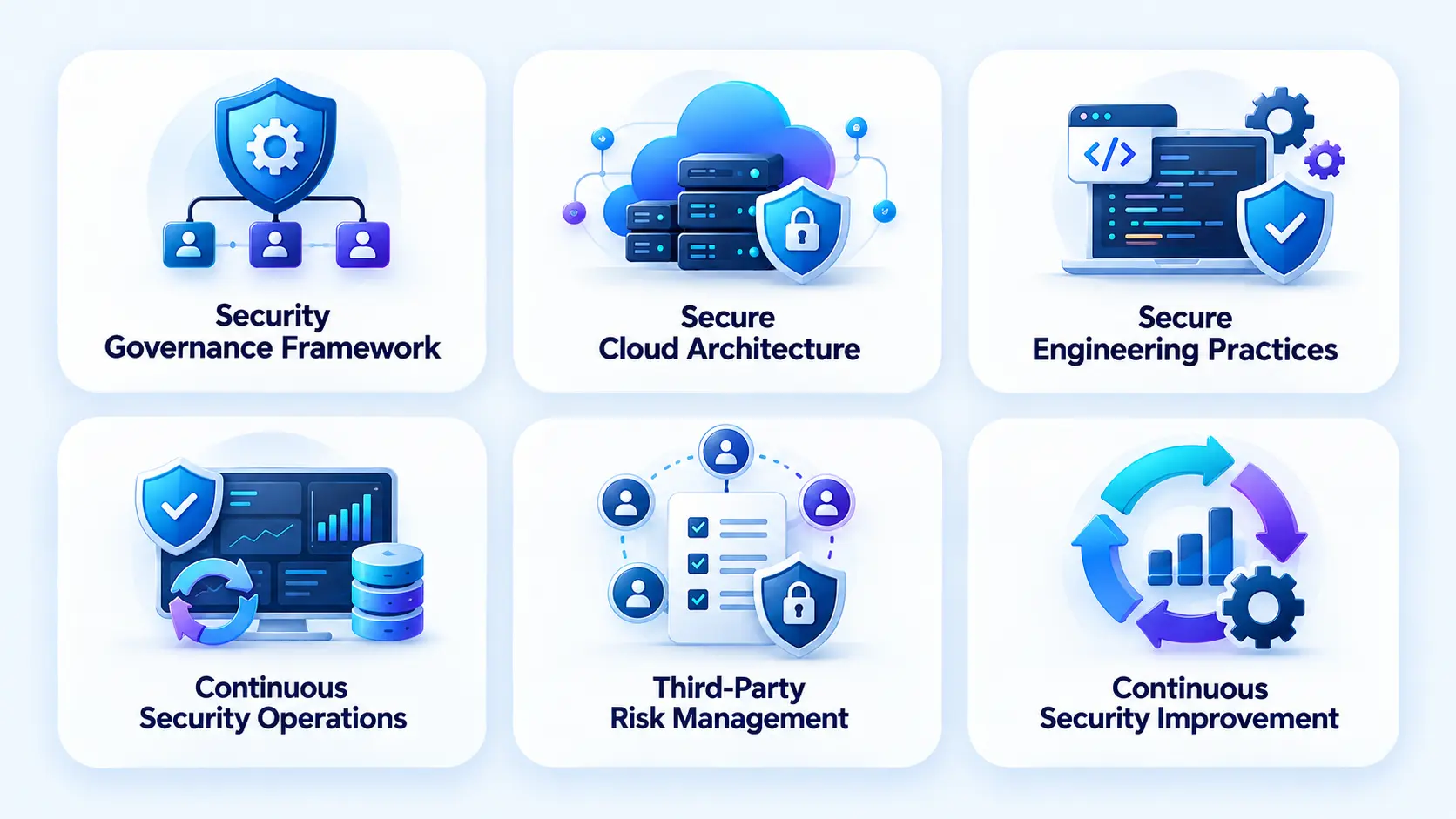
Healthcare cloud security becomes sustainable when it is incorporated into the organization’s operating model rather than treated as a one-time compliance or implementation task. Cloud environments change continuously as applications evolve, new integrations are introduced, employees and vendors change, and organizations adopt technologies such as AI and connected devices. A long-term strategy should therefore connect governance, architecture, engineering, operations, vendor management, and continuous improvement.
1. Security Governance Framework
Security ownership should be clearly assigned across technology, business, compliance, and operational teams. Governance should define who is responsible for protecting healthcare data, approving access, reviewing risks, managing incidents, evaluating vendors, and maintaining security policies.
Clear ownership helps prevent gaps where different teams assume that another department is responsible for a particular security control. Governance should also establish processes for risk assessment, policy reviews, security reporting, and escalation when significant risks are identified.
2. Secure Cloud Architecture
A long-term security strategy should maintain a clear understanding of how data and systems interact across the cloud environment. Data flows, identities, trust boundaries, integrations, storage systems, APIs, and recovery dependencies should be documented and periodically reviewed.
This documentation becomes particularly important when applications are modernized, new cloud services are introduced, or healthcare organizations expand their digital platforms. Architecture reviews can help identify whether existing security controls still match the application’s current structure and data flows.
3. Secure Engineering Practices
Security should become part of normal software delivery rather than being handled only before deployment. Development teams should consider secure coding, dependency management, secrets protection, authentication, authorization, data handling, logging, and vulnerability management throughout the development lifecycle.
Security requirements should also be incorporated into product planning and architecture decisions so that teams can address potential weaknesses before they become expensive to correct. For organizations planning cloud adoption or modernization, the Cloud App Development Guide provides additional context on the broader cloud application development lifecycle.
4. Continuous Security Operations
Security responsibilities continue after an application goes live. Monitoring, vulnerability management, access reviews, backup testing, incident response, and cloud configuration reviews should remain part of regular operations. User permissions may change, new vulnerabilities may emerge, infrastructure configurations may be modified, and new integrations may introduce additional exposure. Continuous operational oversight helps organizations identify these changes and determine whether existing controls remain appropriate.
5. Third-Party Risk Management
Cloud providers, SaaS platforms, AI services, analytics providers, and healthcare integrations can all become part of the security environment. Organizations should therefore assess vendors according to the type of information they handle, the access they receive, the services they provide, and their role in processing or transmitting healthcare information. Vendor management should not end when a contract is signed. Security requirements, access permissions, contractual responsibilities, incident procedures, and changes to vendor services should be reviewed throughout the relationship.
6. Continuous Security Improvement
Healthcare cloud security should evolve alongside the application and its surrounding environment. A platform that was appropriately protected several years ago may require additional safeguards as its architecture, users, integrations, threat environment, and regulatory expectations change.
Organizations should periodically reassess risks, review security controls, analyze incidents and testing results, and update their security practices accordingly. This creates an ongoing security cycle in which lessons from operations and new risks are used to strengthen the application’s architecture and controls over time.
A Practical Healthcare Cloud Security Checklist
Healthcare organizations preparing a cloud application should review the following areas:
- Identify all ePHI and map where it is created, processed, stored, transmitted, backed up, and deleted.
- Complete and document a healthcare cloud security risk assessment.
- Establish appropriate administrative, physical, and technical safeguards.
- Implement role-based access and stronger controls for privileged accounts.
- Protect sensitive data in transit and at rest based on the organization’s risk assessment.
- Secure APIs through authentication, authorization, validation, rate limiting, and monitoring.
- Prevent unnecessary public exposure of databases and sensitive storage resources.
- Centralize secrets management and prevent credentials from entering source code.
- Protect backups and regularly test restoration.
- Establish meaningful audit logging and security monitoring.
- Continuously review cloud configurations and permissions.
- Evaluate cloud providers, vendors, and business associates before exchanging ePHI.
- Establish incident-response and disaster-recovery procedures.
- Test application and infrastructure security throughout the development lifecycle.
- Reassess security whenever major integrations, AI features, connected devices, or business processes are introduced.
The checklist should be adapted to the organization’s actual architecture and risk profile rather than treated as a universal compliance template.
Conclusion
Cloud adoption can give healthcare organizations the scalability and flexibility required for modern digital health products, but security needs to be designed into the application rather than added after deployment. Effective cloud security in healthcare combines risk analysis, identity management, encryption, secure APIs, controlled data storage, monitoring, backup protection, incident response, vendor governance, and continuous validation.
HIPAA provides a risk-based security framework rather than a single technology recipe, making architecture and operational decisions particularly important. Healthcare businesses also need to account for evolving applications, AI services, connected devices, third-party integrations, and changing security risks.
For organizations planning a new healthcare platform, cloud migration, or modernization initiative, RipenApps can help translate security, scalability, interoperability, and product requirements into a practical architecture through cloud application development services. Building healthcare technology securely from the beginning can reduce avoidable exposure and create a stronger foundation for long-term digital growth.
FAQs
1. Is cloud computing allowed for HIPAA-regulated healthcare applications?
Yes. Healthcare organizations can use cloud computing for storing and processing ePHI when applicable HIPAA requirements are satisfied. When a cloud provider acts as a business associate, appropriate contractual arrangements and safeguards are also required.
2. Does using a HIPAA-capable cloud provider make an application HIPAA compliant?
No. A cloud provider’s capabilities are only one component of the overall security environment. The healthcare organization remains responsible for its application, identities, configurations, data, integrations, and operational processes.
3. What are the biggest cloud security risks in healthcare?
Common risks include cloud misconfiguration, compromised credentials, insecure APIs, excessive permissions, exposed storage, vulnerable software, third-party weaknesses, ransomware, insufficient monitoring, inadequate backups, and poor data lifecycle management.
4. Is encryption required for healthcare cloud applications?
Encryption should be evaluated within the applicable HIPAA risk-based framework and according to the organization’s specific environment. Healthcare organizations should document their security decisions and implement appropriate safeguards.
5. How often should healthcare organizations perform security risk assessments?
Risk assessment should be treated as an ongoing activity. Organizations should reassess their environment when technologies, applications, integrations, business processes, vulnerabilities, or other relevant circumstances change.
6. What should organizations consider when choosing healthcare cloud providers?
Organizations should evaluate security capabilities, identity management, encryption, network controls, logging, monitoring, backup capabilities, incident response, data handling, contractual requirements, and the shared-responsibility model.
7. Can AI be integrated into a HIPAA-regulated healthcare application?
AI can be incorporated into healthcare applications, but organizations should evaluate data flows, AI providers, contractual relationships, security controls, access permissions, retention practices, model-processing environments, and applicable requirements before sending ePHI to an AI service.
8. How is healthcare cloud security different from general cloud security?
The underlying cloud technologies can be similar, but healthcare environments must additionally account for sensitive health information, clinical workflows, availability requirements, healthcare interoperability, regulatory obligations, and relationships with healthcare vendors and business associates.

SHARE
WRITTEN BY

Ishan Gupta
CEO & Founder
Ishan Gupta is a seasoned entrepreneur and CEO with extensive 8+ years of experience in business and mobile app development landscape. He believes that the right digital product allows companies to focus on what they do best, while technology handles the rest. With deep exposure to global markets, he understands what makes an app succeed. His approach translates business needs into clear product strategies, ensuring that every feature contributes to measurable ROI.
View All Articles




 India
India USA
USA Australia
 Canada
 UK
UK UAE
UAE