


Key Takeaways
- A car rental app like Turo can cost $40,000–$150,000+ to develop, depending on scope and technical complexity.
- A basic MVP focuses on listings, search, booking, payments, profiles, and essential host and guest management.
- P2P rental features such as identity verification, insurance workflows, damage claims, telematics, and keyless access increase development complexity.
- A cross-platform application can reduce duplicated development effort when the product does not require extensive platform-specific functionality.
- Development is only the initial investment. Payment fees, maps, verification, insurance, cloud infrastructure, support, and maintenance create ongoing operating costs.
Building a car rental app like Turo typically costs $40,000 to $150,000+, depending on marketplace complexity, platforms, integrations, security requirements, and the level of automation. A focused MVP can start around $40,000–$60,000, while a more sophisticated two-sided marketplace can reach $60,000–$100,000. A Turo-scale platform with advanced mobility, trust, and operational capabilities can require $100,000–$150,000+.
These figures cover product discovery, UX/UI design, application development, backend engineering, testing, and deployment. They do not include recurring expenses such as cloud infrastructure, payment processing, insurance, third-party APIs, maintenance, customer support, or marketplace operations.
The key budgeting question is not just how many features you need, but how much of the rental journey you want to automate. This guide covers car rental app development cost, key features, development timelines, and the factors that affect your overall budget, helping you understand what to consider when evaluating a travel app development company for your project.
Table of Contents
Car Rental App Development Cost: At a Glance
A car rental app like Turo costs approximately $40,000–$150,000+ to build. The final cost depends on the app’s features, platform scope, booking complexity, payment integrations, fleet management, and level of automation. A basic MVP can stay closer to the lower end, while a feature-rich marketplace can require a significantly higher investment.
| Development Tier | Estimated Cost | Typical Timeline | What it Includes |
| MVP | $40,000–$60,000 | 3–5 months | Listings, search, booking, payments, profiles, basic host and guest workflows |
| Mid-range marketplace | $60,000–$100,000 | 5–7 months | Advanced search, availability, reviews, verification, notifications, admin tools, marketplace workflows |
| Turo-scale platform | $100,000–$150,000+ | 6–9+ months | Advanced trust and safety, insurance workflows, telematics, keyless access, sophisticated operations, scalable architecture |
These are planning ranges rather than fixed quotes. The final budget depends on the number of platforms, integrations, user roles, backend architecture, design requirements, compliance needs, and the complexity of the rental marketplace. For a broader view of how app scope affects development budgets, see the mobile app development cost guide.
What Is Turo and How Does Its Model Work?
Turo is a peer-to-peer car-sharing marketplace that connects vehicle hosts with guests looking to rent cars. Instead of operating only its own fleet, the platform enables individual vehicle owners and other hosts to list cars for rental.
Turo reported that it ended 2024 with 3.5 million active guests, 140,000 active hosts, and 340,000 active vehicles, with operations across more than 16,000 cities in five countries. It also reported $2.5 billion in gross booking value and $1.5 billion in host earnings for the year.
The model has two primary sides. Hosts create listings, define availability, set pricing, manage bookings, and provide vehicle access. Guests search for vehicles, compare options, book trips, make payments, and complete the rental process.
This makes a Turo-style application more complex than a conventional car rental booking app. The platform has to coordinate two different user journeys while also handling payments, identity, vehicle information, availability, reviews, disputes, and trust mechanisms.
Turo’s current US earnings plans also demonstrate how a mature marketplace can introduce different host economics and protection structures. As of September 2026, Turo offered three US earnings plans with different host-share and damage-responsibility levels.
That marketplace structure is important when estimating development cost because each additional layer of automation creates more backend rules, integrations, testing requirements, and administrative workflows.
Car Rental App Development Cost by Tier
The right budget depends largely on how much of the Turo model you actually need at launch.
MVP: $40,000–$60,000
An MVP should validate the marketplace without attempting to reproduce every capability of an established platform. The core experience can include vehicle listings, location-based search, availability, booking, payments, user profiles, basic reviews, notifications, and an administrative dashboard.
At this stage, hosts can manually handle some operational processes that would later be automated. For example, complex telematics, automated claims management, dynamic pricing, and advanced fleet integrations can be introduced after the marketplace proves demand.
Mid-Range Marketplace: $60,000–$100,000
A mid-range product adds the capabilities needed to operate a more complete P2P rental marketplace. These may include identity and driver’s license verification, advanced search filters, cancellation rules, deposits, stronger host controls, reviews, automated notifications, dispute workflows, and more sophisticated administration.
The backend also becomes more important at this stage. The platform must coordinate availability, booking status, payments, user verification, vehicle data, and marketplace rules without creating conflicts between hosts and guests.
Turo-Scale Platform: $100,000–$150,000+
A larger platform requires more than additional screens. It needs a stronger operational and technical foundation.
Advanced capabilities can include telematics integrations, keyless vehicle access, automated pricing, insurance workflows, sophisticated fraud controls, real-time vehicle information, claims management, location services, analytics, and infrastructure designed for significant transaction volumes.
At this level, architecture, security, monitoring, testing, and third-party integrations can become as important to the budget as the visible application features.
Cost Breakdown by Feature
Feature-level pricing varies significantly between projects, so it is more useful to evaluate each area by its relative development impact.
| Feature Area | Cost Impact | Why it Affects the Budget |
| User registration and profiles | Medium | Requires account management, authentication, and role-based access |
| Vehicle listings | Medium | Includes vehicle details, images, availability, pricing, and host controls |
| Search and location | Medium–High | Requires maps, geolocation, filtering, sorting, and availability logic |
| Booking and availability | High | Requires real-time booking rules, calendars, cancellations, and conflict prevention |
| Payments and payouts | High | Requires secure transactions, refunds, marketplace payments, and payout workflows |
| Identity verification | High | Adds document processing, verification providers, and compliance workflows |
| Reviews and trust features | Medium–High | Requires two-sided ratings, moderation, deposits, and cancellation logic |
| Insurance and claims | Very High | Introduces protection rules, documentation, claims workflows, and external integrations |
| Telematics and keyless access | Very High | Requires hardware or API integrations, access controls, and real-time data |
| Admin and operations | High | Supports disputes, users, vehicles, payments, verification, and marketplace monitoring |
The expensive features are not necessarily the ones with the most screens. They are often the features that introduce complex business rules or connect the application to external systems.
Cost by Platform: Native vs. Cross-Platform
Platform strategy can materially change the development budget, as building separately for iOS and Android typically requires more development effort than using a cross-platform approach. The right choice depends on your target users, performance requirements, feature complexity, and long-term maintenance needs.
| Approach | Budget Impact | Suitable When |
| Native iOS | Lower initial scope | Launching specifically for Apple users |
| Native Android | Lower initial scope | Launching specifically for Android users |
| Native iOS + Android | Higher | Each platform requires deep native functionality |
| Cross-platform | Moderate | The product needs both platforms while sharing most application logic |
A cross-platform approach can reduce duplicated development work by allowing teams to share a significant portion of application logic between iOS and Android. It does not eliminate platform-specific engineering, particularly when the product uses hardware, payments, location services, or advanced device capabilities.
The right framework should therefore be selected based on the product’s integrations and long-term roadmap rather than development speed alone. See this guide to cross-platform app development frameworks for the main framework options.
What Drives Car Rental App Development Cost?
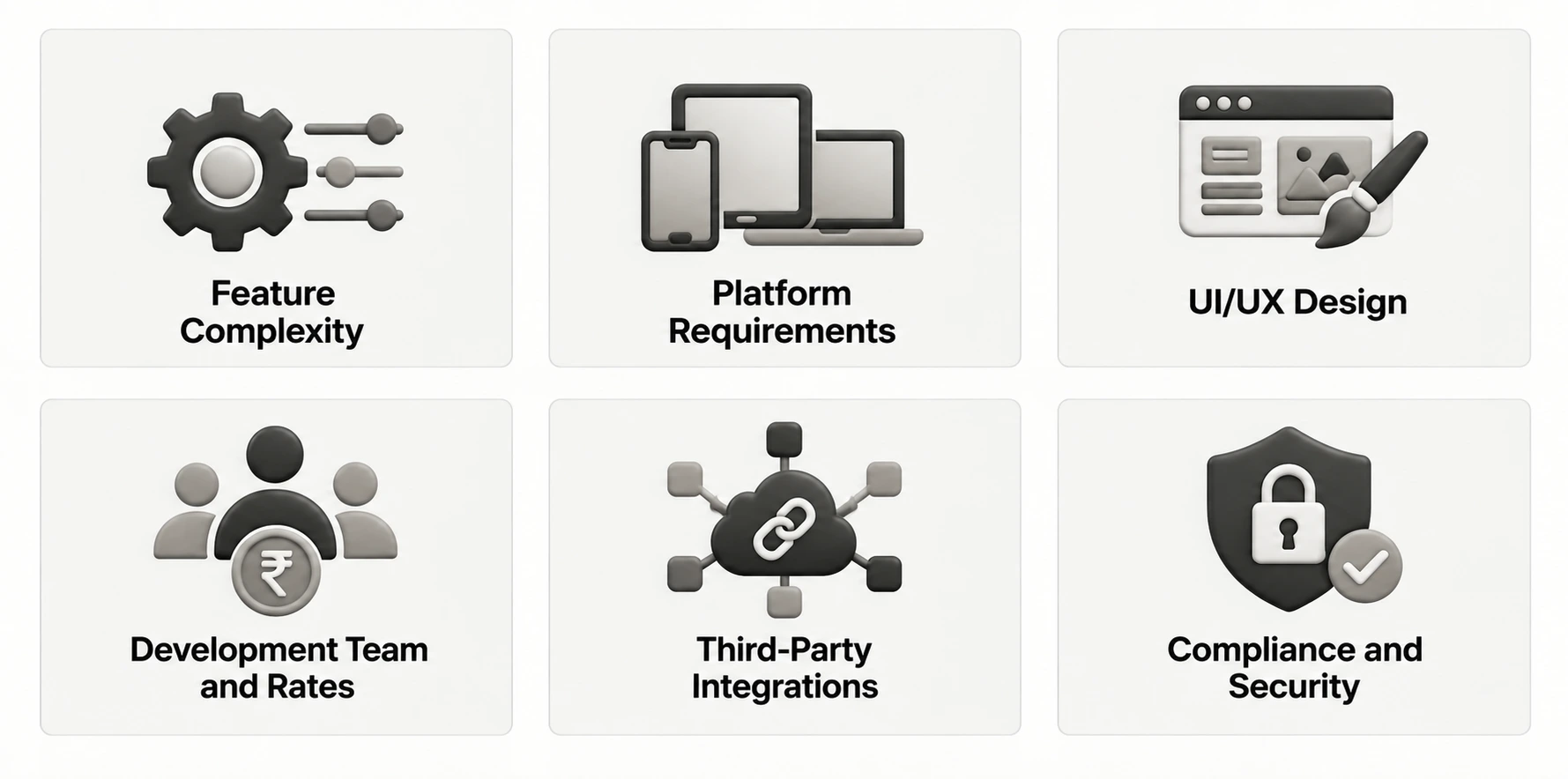
Car rental app development cost depends on more than the number of features. Platform choice, booking complexity, real-time tracking, payment integrations, third-party services, security, and the level of automation can all affect the final budget.
Feature Complexity
The basic booking journey is relatively straightforward. The complexity increases when the application has to support multiple pricing rules, vehicle availability states, deposits, cancellations, refunds, host payouts, verification, disputes, and insurance-related workflows.
A marketplace also needs separate permissions and experiences for guests, hosts, administrators, and potentially support or operations teams.
Platform Requirements
Developing for one platform limits the initial scope, while launching on both iOS and Android increases testing, deployment, and maintenance requirements.
Hardware-connected functionality can further affect the architecture. Keyless entry, vehicle tracking, or telematics may require platform-specific integrations and real-time communication between vehicles, external systems, and the application.
UI/UX Design
A rental marketplace needs to make several decisions easy for users, including finding the right vehicle, understanding the total cost, checking availability, reviewing host information, completing verification, and managing bookings.
The host experience has separate requirements around listing creation, pricing, availability, earnings, vehicle management, and guest communication. Designing these journeys clearly requires more work than a simple booking interface. Investing in professional UI UX design services can help product teams create intuitive flows for both sides of the marketplace while reducing friction across search, booking, listing, and post-rental experiences.
Development Team and Rates
Team location, expertise, and composition also influence the final cost. A typical project may involve product management, UX/UI design, mobile development, backend engineering, QA, and DevOps resources.
The rate structure matters, but the lowest hourly rate does not necessarily produce the lowest project cost. Poor architecture, weak testing, or unclear requirements can create additional rework later.
Third-Party Integrations
External services can shorten development time for complex capabilities, but they introduce integration work and recurring usage costs.
For example, Stripe’s standard U.S. pricing starts at 2.9% + $0.30 per successful domestic card transaction. For marketplace models, Stripe Connect supports user onboarding, verification, payment collection, and payouts, making it suitable for platforms that need to manage transactions between renters and vehicle owners.
Identity verification can also introduce per-use charges. Twilio Verify, for example, currently lists a $0.05 fee per successful verification before applicable channel fees.
Location-heavy rental applications may also generate significant map and geocoding usage. Google Maps Platform uses a pay-as-you-go model based on billable events and individual service SKUs.
Compliance and Security
A car rental marketplace can process payment information, identity documents, driver’s license data, vehicle information, location data, and insurance-related information.
That makes authentication, authorization, encryption, secure payment handling, audit trails, data protection, and fraud prevention important parts of the architecture rather than optional additions.
The Costs Specific to Peer-to-Peer Car Rental
P2P car rental introduces several cost areas that do not appear in a basic booking application.
| P2P Requirement | What Needs to be Built | Cost Impact |
| Insurance and protection | Eligibility rules, protection information, documentation, claims support | High–Very High |
| Identity and driver’s license verification | Document capture, verification, approval and rejection workflows | High |
| Damage claims and disputes | Evidence collection, case management, communication and resolution workflows | Very High |
| Telematics and keyless entry | Vehicle APIs, access control, location data and real-time communication | Very High |
| Trust and marketplace controls | Reviews, deposits, cancellations, fraud controls and host/guest policies | High |
Insurance and Protection
Insurance is one of the most important differences between a standard booking system and a P2P vehicle marketplace.
Turo states that hosts must maintain applicable personal auto insurance and registration requirements, while its US earnings plans include third-party liability insurance and physical-damage reimbursement arrangements.
A new marketplace therefore needs to determine which insurance processes will be handled internally, through an insurance partner, or through a combination of both. Each approach affects integrations, workflows, compliance, documentation, and operational costs.
Identity and Driver’s License Verification
A P2P rental platform needs greater confidence that the person booking a vehicle is eligible to drive it.
This can involve identity verification, driver’s-license validation, age checks, document capture, fraud screening, and manual review for exceptions. These workflows also need secure handling of sensitive information.
Damage Claims and Disputes
Vehicle rentals create physical-world risks that ordinary digital marketplaces do not face to the same extent.
The application may need to collect vehicle photos, timestamps, trip information, communication records, inspection details, and other evidence. Administrators then need tools to review claims and manage disputes between hosts and guests.
Telematics and Keyless Entry
Connected vehicles can make a marketplace more scalable by reducing the need for manual handovers. However, telematics and keyless entry introduce hardware, APIs, authentication, location data, and real-time communication requirements.
These integrations can significantly increase development and testing effort, especially when the application must support multiple vehicle systems.
Trust, Deposits, Reviews, and Cancellations
Trust is central to a two-sided rental marketplace. Guests need confidence in the vehicle and host, while hosts need safeguards against unreliable bookings, misuse, and fraudulent activity.
Reviews, deposits, cancellation policies, identity verification, vehicle photos, and transaction histories all contribute to this system. Together, they create additional business rules that need to be reflected across the mobile apps, backend, and administration platform.
Development Cost vs. Ongoing Operating Cost
The initial development budget should not be confused with the cost of running the marketplace. Development covers product discovery, design, engineering, testing, deployment, and the initial architecture. Once the application launches, the business continues to pay for cloud infrastructure, payment processing, maps, verification, notifications, analytics, maintenance, security monitoring, customer support, insurance, and marketplace operations.
For a P2P rental platform, these recurring expenses can become significant because many are tied directly to transaction volume. More bookings mean more payments, payouts, verification checks, notifications, location requests, support cases, and potentially insurance activity.
A realistic financial model should therefore estimate both the one-time development investment and recurring cost per transaction or active user.
How Long Does It Take to Build an App Like Turo?
Development time depends on the scope of the first release.
| Product Scope | Approximate Timeline |
| Focused MVP | 3–5 months |
| Mid-range marketplace | 5–7 months |
| Turo-scale product | 6–9+ months |
Discovery and UX design typically happen before or alongside early development. Backend architecture, mobile development, integrations, testing, security, and deployment then progress in parallel where practical.
The timeline can extend when the product includes complex verification, insurance integrations, telematics, keyless access, multiple payment flows, or extensive administrative tooling. Regulatory requirements and third-party approval processes can also affect launch timing even when application development itself is complete.
How to Build a Car Rental App Like Turo: Step by Step
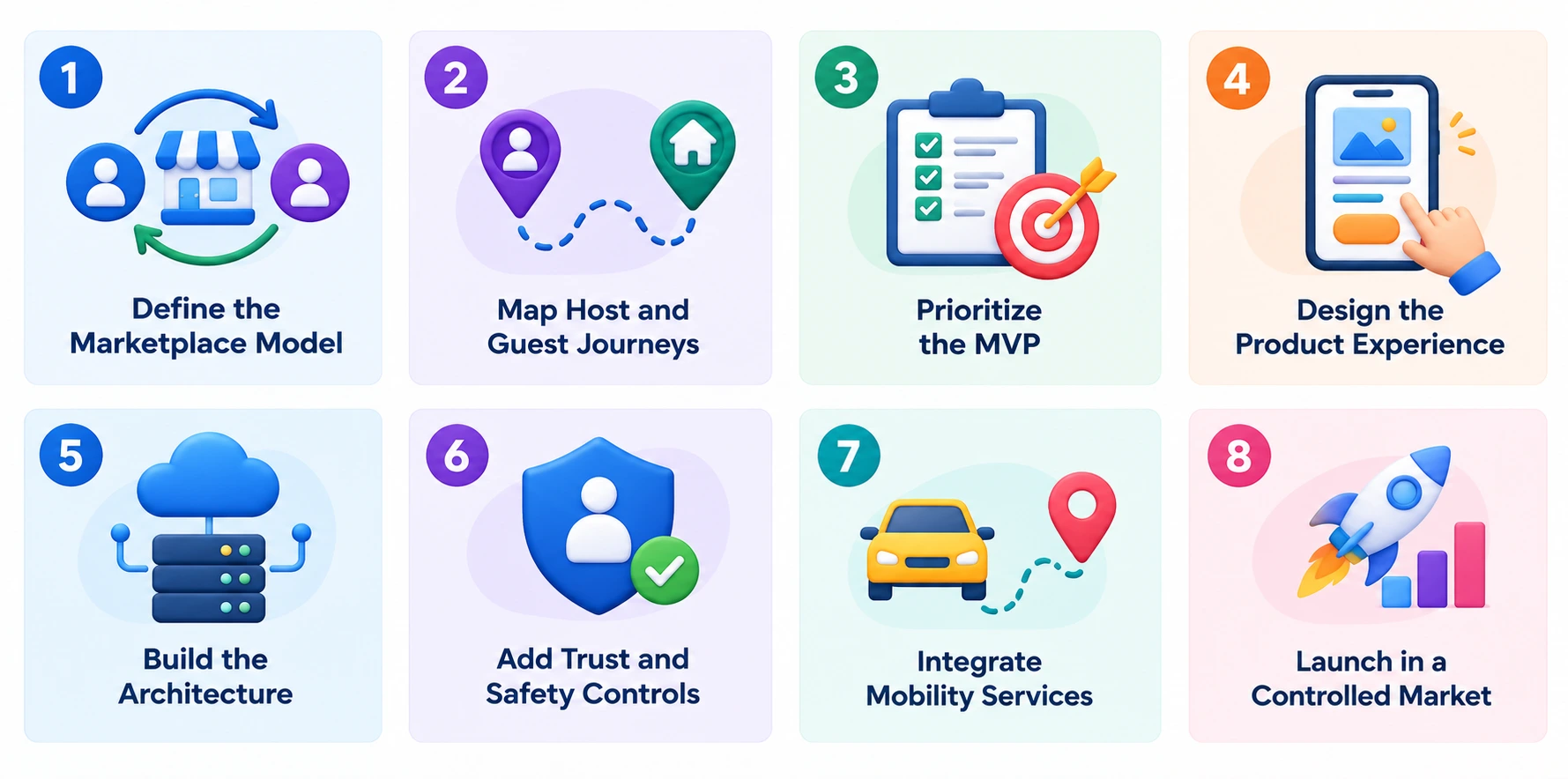
Building a car rental app like Turo requires more than developing booking features. This step-by-step process covers planning, UI/UX design, development, integrations, testing, and launch.
1. Define the Marketplace Model
Start by determining who can list vehicles, who can rent them, how pricing works, how hosts are paid, and what responsibilities the platform assumes.
Decide whether you will operate as a peer-to-peer marketplace, a traditional rental service, or a hybrid model. This decision will influence your platform workflows, revenue model, and compliance requirements.
2. Map Host and Guest Journeys
Define the complete journeys from registration to completed rental. Include listing creation, search, booking, verification, payment, vehicle access, trip completion, reviews, and support. Mapping these interactions early helps identify where automation, notifications, and customer support are needed.
3. Prioritize the MVP
Choose the smallest feature set that can validate the marketplace. Listings, search, booking, payments, profiles, verification, and basic administration usually provide the foundation. A clear MVP development guide can help structure these priorities around your core business goals and avoid investing too early in non-essential features.
Keep advanced features such as telematics, dynamic pricing, and keyless entry for later stages unless they are central to your business model.
4. Design the Product Experience
Create separate interfaces for guests, hosts, and administrators. Focus on reducing friction around vehicle discovery, booking, verification, and post-rental actions. A clear booking flow and intuitive host dashboard can also reduce drop-offs and support requests.
A structured mobile app design guide can help shape consistent navigation, responsive layouts, clear calls to action, and role-specific experiences across the platform. Prioritize the screens and interactions that directly support bookings and marketplace operations before adding secondary features.
5. Build the Architecture
Choose the mobile framework, backend architecture, database, cloud environment, payment infrastructure, authentication system, and third-party services based on your expected user volume and marketplace scale. A well-planned mobile app architecture should support secure transactions, real-time availability, growing vehicle inventory, and reliable communication between hosts and guests.
Plan for scalability from the start, particularly for booking, payments, notifications, location services, and host payouts. A modular architecture also makes it easier to introduce features such as dynamic pricing, telematics, and keyless access as the marketplace grows.
6. Add Trust and Safety Controls
Implement identity verification, driver’s license checks, reviews, cancellation rules, deposits, fraud controls, and the workflows required to handle disputes. These controls are particularly important for a marketplace where users exchange vehicles and payments with other individuals.
7. Integrate Mobility Services
Integrate maps, location services, payment and payout systems, notifications, insurance partners, telematics, or keyless access based on your product roadmap. Payment gateway integration is particularly important for handling secure bookings, deposits, refunds, and host payouts across the marketplace.
Choose third-party services based on your target markets, compliance requirements, expected transaction volume, and the level of automation your rental model requires. This approach helps control integration costs while keeping the platform flexible as your operations expand.
8. Launch in a Controlled Market
Start with a defined geography, vehicle category, or user segment. Monitor booking completion, vehicle supply, cancellations, support cases, and transaction economics before expanding. Early performance data can help refine pricing, acquisition strategies, and marketplace operations before scaling to additional markets.
Custom Build vs. Turo Clone Script
A Turo clone script can reduce initial development effort because common marketplace functionality, such as listings, bookings, payments, and user profiles, may already be available. However, it may limit how deeply you can tailor the platform to your business model, workflows, integrations, and scaling requirements.
Custom app development offers greater control over the product architecture and user experience, allowing you to build features around your specific host, guest, payment, and operational workflows. While the initial investment may be higher, a custom approach can provide more flexibility as the marketplace expands and its requirements become more complex.
| Factor | Custom Development | Turo Clone Script |
| Initial development | Higher | Potentially lower |
| Custom workflows | Flexible | Depends on the script |
| Integrations | Built around requirements | May require additional customization |
| Scalability | Architecture can be designed for the roadmap | Depends on underlying architecture |
| Security controls | Designed specifically for the product | Requires careful assessment |
| Long-term flexibility | High | Can be limited by the platform |
| Ongoing customization | Easier to control | May depend on vendor or codebase |
The apparent savings from a clone can also shrink when substantial customization is required. If the business needs proprietary pricing, insurance workflows, verification, telematics, complex payouts, or specialized administration, the team may need to modify large parts of the underlying system.
A custom build generally makes more sense when the marketplace model itself is a competitive differentiator. A prebuilt solution may be considered when speed and a narrower initial scope are more important than deep customization.
Marketplace Mechanics in Production: Cobone
A RipenApps marketplace example is Cobone, a multi-vendor platform built with React Native. It supports marketplace listings, geo-fenced discovery across more than 20 categories, secure in-app transactions, and shared logic across platforms.
The project was delivered in three months with 100% logic parity across the supported platforms. As of August 2026, the application had more than 500,000 Google Play installs and a 4.0-star rating from more than 6,810 reviews.
Cobone demonstrates marketplace capabilities relevant to car rental platforms, including multi-vendor listings, location-based discovery, transactions, and cross-platform delivery.
Final Thoughts
The cost to build a car rental app like Turo generally falls between $40,000 and $150,000+, with the final budget determined by marketplace complexity rather than the number of app screens alone. For a new mobility business, starting with a focused MVP can help validate host supply, guest demand, booking behavior, and transaction economics before investing in advanced capabilities such as telematics, keyless access, automated claims, or sophisticated pricing. Working with an experienced marketplace app development company can also help align the technology scope with your business model and long-term scaling plans.
The development budget is only one part of the business case. Payment processing, verification, insurance, maps, cloud infrastructure, maintenance, customer support, and marketplace operations should be included in the financial model from the beginning. If you’re planning a P2P rental marketplace, the next step is to translate your host, guest, and operational workflows into a feature-level scope and development estimate, with a technology partner such as RipenApps helping turn that scope into a practical build plan.
FAQs
Q1. How much does it cost to build an app like Turo?
A Turo-style car rental marketplace typically costs $40,000–$150,000+ to develop. A focused MVP can fall around $40,000–$60,000, while a more advanced marketplace can reach $100,000–$150,000+.
Q2. How long does it take to build a car rental app like Turo?
A focused MVP can take approximately 3–5 months. A mid-range marketplace may require 5–7 months, while a larger platform with advanced integrations and operational workflows can take 6–9+ months.
Q3. What features are essential for a Turo-like app?
The core product generally requires vehicle listings, search, availability, booking, payments, host and guest profiles, notifications, reviews, and administration. P2P platforms also need identity verification, driver’s license checks, cancellation rules, deposits, dispute workflows, and appropriate insurance processes.
Q4. Is it cheaper to build a car rental app with Flutter or React Native?
Both Flutter and React Native can support cross-platform development and reduce duplicated engineering compared with building separate applications entirely from scratch. The actual budget depends on the team’s expertise, required integrations, platform-specific functionality, and long-term maintenance requirements.
Q5. What makes a P2P car rental app more expensive than a normal booking app?
P2P rental adds another side to the marketplace and introduces vehicle-owner workflows, identity verification, insurance, claims, disputes, deposits, reviews, payouts, and potentially telematics or keyless access. These requirements create additional backend logic and operational tooling.
Q6. Can I build a Turo-like app using a clone script?
Yes, a clone script can provide a starting point for a rental marketplace. However, substantial customization may be necessary for payment flows, insurance, verification, pricing, telematics, compliance, and business-specific workflows. The cost advantage depends on how much of the existing system can actually be reused.
Discuss your project and request for proposal
SHARE
WRITTEN BY

Ishan Gupta
CEO & Founder
Ishan Gupta is a seasoned entrepreneur and CEO with extensive 10+ years of experience in business and mobile app development landscape. He believes that the right digital product allows companies to focus on what they do best, while technology handles the rest. With deep exposure to global markets, he understands what makes an app succeed. His approach translates business needs into clear product strategies, ensuring that every feature contributes to measurable ROI.
View All Articles