



Key Takeaways
- Clear requirements and well-defined business goals help teams avoid misunderstandings, costly rework, scope confusion, and development delays.
- Early product discovery and validation reduce uncertainty by testing user needs, technical assumptions, workflows, and market expectations.
- Realistic planning, controlled scope, and transparent communication help development teams manage changing requirements without compromising quality or timelines.
- Continuous testing, security practices, and appropriate architecture prevent technical problems from becoming expensive production issues and operational disruptions.
- Post-launch monitoring, user feedback, and continuous improvement ensure software continues delivering measurable business value as requirements and markets evolve.
Software projects rarely fail because a team cannot write code. More often, failure begins earlier, when a business problem is poorly defined, expectations are unclear, priorities keep changing, or technical decisions are made without enough context. A project can have talented developers, a modern technology stack, and a generous budget and still miss its intended outcome. Understanding why software projects fail therefore requires looking beyond bugs and delays to the decisions, processes, and assumptions that shape development from the start.
Software project failure can appear in different forms. A product may be abandoned before launch, delivered far beyond its original budget, released with critical defects, rejected by users, or technically completed but unable to support the business goal it was meant to achieve. Some failures are caused by one major mistake, while others result from several smaller problems that compound over time.
This guide examines the most common causes behind failed software development projects, explains how those problems develop, and outlines practical ways teams can reduce the risk. It also looks at lessons from real-world software failures and shows how better discovery, planning, communication, engineering practices, testing, and post-launch management can turn a risky project into a controlled development effort.
For organizations preparing to build or modernize a digital product, working with an experienced custom software development company can also provide structured technical and product guidance throughout the process.
Table of Contents
What Does Software Project Failure Actually Mean?
Software project failure does not have a single definition. A project can fail financially, technically, operationally, strategically, or from a user-experience perspective. In some cases, the software is delivered but does not solve the problem it was created to address. In others, the product never reaches production because costs, timelines, technical limitations, or stakeholder disagreements make continuation impractical.
This distinction matters because measuring failure only by whether software was delivered can hide serious problems.
Imagine a company commissions a customer management platform. The development team delivers the system on schedule, but employees find it difficult to use, the application does not integrate properly with existing systems, and adoption remains low. From a technical perspective, the project may have been completed. From a business perspective, however, the expected outcome was not achieved.
Similarly, a product may launch successfully but require constant emergency fixes because its architecture was rushed. Another project may be technically sound but arrive months after the market opportunity has changed. The consequences of software failure can therefore include:
- Budget overruns and unexpected development costs
- Missed launch windows and delayed business opportunities
- Low adoption or poor customer satisfaction
- Security vulnerabilities and compliance problems
- Performance and scalability limitations
- Rework caused by changing or misunderstood requirements
- Loss of stakeholder confidence
- Abandonment of the project before completion
- Operational disruption after launch
- Difficulty maintaining or extending the software
The important question is not simply whether a software project failed. It is why the project moved away from its intended outcome. That question leads to the underlying causes.
Common Reasons Software Projects Fail and How to Prevent Them
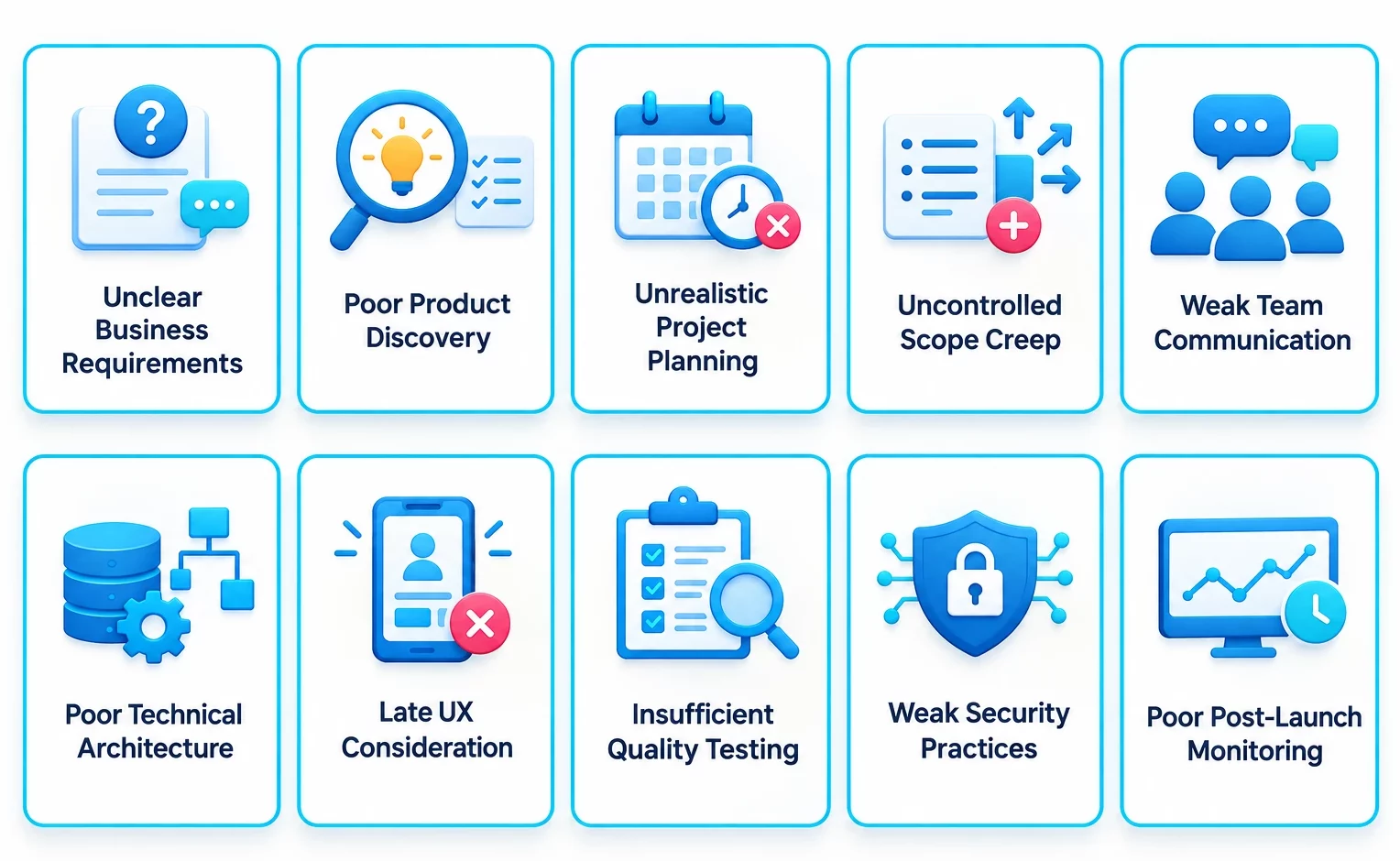
Software project failure rarely happens because of a single mistake. More often, multiple issues develop throughout the project lifecycle, from unclear requirements and unrealistic timelines to communication gaps, technical limitations, and inadequate testing. Identifying these risks early gives businesses an opportunity to address them before they affect budgets, deadlines, product quality, or user adoption.
The following are some of the most common causes of software project failure and practical approaches to preventing them:
1. Unclear Business Requirements
One of the most common reasons software projects fail is that teams start development without establishing exactly what the product needs to accomplish.
A requirement such as “build an app that improves customer engagement” sounds reasonable but does not give a development team enough information to make consistent decisions. Which customers? Which engagement problem? What actions should users take? How will improvement be measured? Which features are essential for achieving the goal?
When these questions remain unanswered, different stakeholders develop different expectations. Business teams may imagine one product while designers, developers, and project managers interpret the requirement differently. The differences may not become visible until development is already underway.
This creates a chain reaction. Developers build features based on assumptions. Stakeholders review the work and request changes. The changes affect architecture, design, testing, and schedules. Additional work increases costs and pushes deadlines further away. The problem is not necessarily that requirements changed. Requirements naturally evolve in software development. The bigger problem is beginning development without a sufficiently shared understanding of the problem.
How to avoid it
Start by defining the business problem before defining the complete feature set. Establish who the users are, what problem they experience, what outcome the software should produce, and how success will be measured.
Requirements should then be translated into clear functional and non-functional specifications. User stories, acceptance criteria, process flows, wireframes, and technical constraints can help eliminate ambiguity.
A requirements baseline also gives the team something against which future changes can be evaluated.
2. Poor Product Discovery and Validation
A software idea can sound compelling without being validated. Organizations sometimes invest heavily in development because they believe a particular product, feature, or workflow will solve a market problem. The assumption may be based on internal opinions rather than evidence from customers, employees, competitors, or actual workflows.
This creates a significant risk: the team can build the wrong thing efficiently. Product discovery is intended to reduce this uncertainty before substantial development investment begins. Research can reveal whether users actually experience the identified problem, how they currently solve it, which alternatives they use, and what they expect from a new solution.
Prototyping and usability testing can also expose issues before they become expensive engineering changes. The broader product development life cycle demonstrates why product development extends beyond implementation. Discovery, validation, planning, development, launch, and improvement are connected stages rather than isolated activities.
Why skipping discovery becomes expensive?
Suppose a business spends six months developing a complex platform before testing its assumptions with real users. After launch, customers report that the central workflow is confusing and that a simpler feature would have solved their problem.
The organization now faces a difficult choice: accept low adoption, redesign the product, or rebuild substantial parts of the system. Testing that assumption during the discovery stage could have required only a prototype and several user sessions. The cost of discovering a wrong assumption generally increases as the project moves further into development.
How to avoid it
Before committing to a large development scope, validate the problem, target users, workflows, competitive alternatives, technical assumptions, and business model where applicable. Use prototypes and experiments to answer uncertain questions. Treat discovery as risk reduction rather than an administrative phase before “real” development begins.
3. Unrealistic Planning, Estimates, and Deadlines
Software development is difficult to estimate precisely because the work often contains unknowns. A project plan may appear straightforward at the beginning, but technical dependencies, integration requirements, security considerations, infrastructure work, testing, design revisions, and stakeholder feedback can significantly affect the schedule.
Problems emerge when estimates are treated as fixed promises rather than informed forecasts. For example, a team may estimate that a feature requires two weeks of development. That estimate may not include API integration, edge cases, automated testing, accessibility work, deployment preparation, documentation, and stakeholder review.
When the missing work appears later, the schedule starts slipping. The result can be a familiar pattern: management asks developers to accelerate, developers reduce testing or technical cleanup, defects increase, and more time is eventually required for rework.
What realistic planning looks like
Planning should account for uncertainty rather than pretending it does not exist. A useful project plan separates major workstreams and dependencies. It identifies assumptions, external dependencies, risks, review points, and acceptance criteria. Estimates should also be revisited when new information becomes available.
Teams should distinguish between a target date and a guaranteed date. A target helps coordinate the organization; a guarantee can create pressure to compromise quality when assumptions change.
The software development life cycle provides a useful framework for understanding how requirements, design, implementation, testing, deployment, and maintenance interact. Treating these activities as connected parts of the delivery process helps prevent planning from focusing exclusively on coding.
How to avoid it
Build estimates from defined requirements and known assumptions. Include testing, deployment, integration, review, documentation, and contingency where appropriate.
Break large projects into measurable milestones so that actual progress can be compared with the original assumptions. If an estimate changes, explain why rather than simply moving the deadline.
4. Scope Creep and Constant Requirement Changes
Scope creep occurs when additional requirements enter a project without corresponding adjustments to time, budget, resources, or priorities. A single additional feature may appear harmless. The problem is that software features are rarely independent.
Adding a payment method may affect backend services, database structures, security controls, user interfaces, testing, reporting, and third-party integrations. Adding another user role may require changes across permissions, workflows, notifications, analytics, and administration.
When these changes accumulate without formal prioritization, the original project gradually becomes a different project. This is particularly common when stakeholders review progress informally and request improvements throughout development.
Scope change is not automatically bad
A flexible product process should allow requirements to change when new information becomes available. The issue is uncontrolled change. A healthy process asks:
- What problem does this change solve?
- Is it essential for the current release?
- What existing work will it affect?
- Does it change the architecture?
- What will it add to cost and timeline?
- Can it be deferred to a later release?
This creates a trade-off between business value and development capacity.
How to avoid it
Create a clear scope baseline and establish a change-control process. Changes should be documented, evaluated, prioritized, and approved by the appropriate stakeholders. For products using iterative development, maintain a prioritized backlog instead of treating every new request as an immediate requirement. This allows flexibility without allowing every idea to disrupt the current release.
5. Weak Communication Between Stakeholders and Development Teams
Communication problems are among the less visible causes of software failure. A business stakeholder may describe an outcome while a developer interprets it as a technical feature. A designer may understand the intended user journey differently from the product manager. A client may assume that a feature is included while the development team considers it outside scope.
Each individual can perform their role correctly while the overall project moves in the wrong direction. Communication also becomes difficult when teams rely on fragmented channels. Requirements may exist in email threads, meeting notes, project management tools, design files, and private conversations. Important decisions can then become difficult to trace. The result is not only misunderstanding but also repeated work.
How to improve communication
The project should have a clear source of truth for requirements, decisions, designs, tasks, and acceptance criteria. Regular reviews are valuable because they allow stakeholders to see actual progress instead of relying on status reports.
Demonstrating working software can be particularly effective. A completed feature often reveals misunderstandings that would remain hidden in written descriptions. Communication should also work in both directions. Stakeholders need to understand technical constraints, while technical teams need to understand the business reason behind requirements.
6. Building Without a Clear Technical Architecture
Technology decisions made early can influence the project for years. Choosing a framework, database, cloud architecture, integration strategy, or application structure simply because it is popular does not guarantee that it will fit the product. A technology stack should reflect the project’s functional requirements, expected scale, security needs, team capabilities, integration environment, budget, and long-term maintenance requirements.
Architecture problems can remain hidden during early development because a small application does not immediately expose scalability or maintainability limitations. As the product grows, however, weaknesses can become increasingly expensive.
For example, tightly coupled components may make it difficult to introduce new functionality. Poor database design may create performance issues. An inappropriate hosting model may increase infrastructure costs. Weak API design may make integrations unreliable.
How to avoid architectural failure
Architecture should be designed around actual requirements rather than technology trends. Before implementation, evaluate major technical decisions and identify critical dependencies. Where uncertainty is high, build a proof of concept or technical spike instead of assuming that an approach will work.
Documentation also matters. Future developers need to understand why important architectural decisions were made. The goal is not to create an unnecessarily complex architecture. It is to create an architecture that is appropriate for the product’s current requirements while leaving a reasonable path for future growth.
7. Ignoring User Experience Until Too Late
A technically functional product can still fail if people do not understand how to use it. UX problems often appear when design is treated as a visual layer added after development rather than as part of product definition. Users care about whether they can complete their tasks easily. Navigation, information hierarchy, forms, feedback, accessibility, error handling, loading states, and mobile responsiveness all influence whether software feels useful.
A product can contain every requested feature and still create friction. This is particularly important for consumer applications, employee-facing software, e-commerce platforms, and products with complex workflows. The web application development challenges perspective is useful here because modern web products must account for performance, compatibility, security, responsiveness, integrations, and user expectations at the same time.
How to avoid UX-related failure
UX research should begin before the interface is finalized. Create user flows that represent actual tasks. Develop wireframes and prototypes before implementing complex screens. Test important workflows with representative users.
Pay particular attention to high-value journeys such as registration, search, checkout, onboarding, account management, and support. Usability testing does not need to wait until the product is complete. Early prototypes can reveal major usability problems at a fraction of the cost of redesigning a finished application.
8. Insufficient Testing and Quality Assurance
Testing is sometimes compressed when a project falls behind schedule. This creates a dangerous short-term trade-off. Skipping testing may appear to save time, but defects discovered after release can require considerably more effort to diagnose and fix. Software quality is not limited to checking whether a button works.
A modern application may require functional testing, integration testing, regression testing, performance testing, security testing, compatibility testing, usability testing, and automated testing for critical workflows. The required mix depends on the product.
Why late testing causes problems
If testing begins only after all development is complete, defects can become difficult to isolate. A problem found in a final workflow may have originated from a requirement, design decision, API, database structure, or earlier implementation. Continuous testing provides earlier feedback.
Developers can run automated tests during implementation. QA teams can validate completed stories throughout the sprint. Stakeholders can review working increments rather than waiting for a final release candidate.
How to avoid it
Define acceptance criteria before development begins. Automate repetitive regression checks where practical. Test integrations early instead of waiting until the end. Production-like environments should be used where appropriate, particularly for systems involving external services, payments, complex infrastructure, or large data sets. Quality should be treated as a shared responsibility rather than something assigned exclusively to a QA team at the end.
9. Security and Compliance Are Treated as Afterthoughts
Security problems can transform a software issue into a business crisis. Organizations sometimes focus heavily on functionality and postpone security considerations until deployment. By that stage, insecure authentication flows, excessive permissions, weak data handling, vulnerable dependencies, or poorly designed APIs may already be deeply embedded in the application.
Security should instead influence architecture and implementation from the beginning. This includes determining what information the application stores, who can access it, how authentication works, how sensitive data is protected, how permissions are managed, and how security events are monitored. For regulated products, compliance requirements may also affect data retention, auditability, consent, access controls, and infrastructure.
How to avoid security-related failure
Conduct security requirements analysis during discovery and architecture planning. Use secure development practices throughout implementation. Keep dependencies updated, validate inputs, apply least-privilege access controls, protect secrets, encrypt sensitive information appropriately, and conduct security testing before release.
Security should also continue after launch. New vulnerabilities, dependencies, integrations, and attack patterns can change the risk profile of an application over time.
10. Lack of Post-Launch Monitoring and Product Ownership
Launching software is not the end of the project. Once real users begin interacting with the application, organizations receive information that was impossible to obtain during development. Users may discover unexpected workflows, performance problems may appear under real traffic, and business teams may identify features that need refinement.
Without monitoring and ownership, these signals can be missed. A product may technically launch but gradually deteriorate because bugs are not addressed, dependencies become outdated, infrastructure is not reviewed, or user feedback is ignored.
What happens after launch matters
A mature software process defines how the product will be supported after release. Monitoring can track availability, errors, performance, infrastructure health, and important business events. Analytics can show where users abandon workflows. Customer support can reveal recurring usability issues.
Product ownership then turns this information into priorities. This creates a feedback loop:
- Release
- Measure
- Learn
- Prioritize
- Improve
- Release again
The loop is especially important for products that operate in changing markets or depend heavily on user behavior.
The ten causes above rarely occur in isolation. A project may begin with vague requirements. Because the requirements are unclear, estimates become optimistic. When stakeholders see the first version, they request changes. The changing scope puts pressure on the schedule. Testing is compressed to meet the launch date. Technical shortcuts accumulate. After launch, users encounter usability and performance problems.
What appears to be a testing failure may therefore have started with requirements. This is why examining individual mistakes can be misleading. Software project failure is often systemic.
Consider a hypothetical chain: An unclear problem can lead to incomplete requirements, which may result in inaccurate estimates and scope expansion. As the schedule comes under pressure, teams may take technical shortcuts and reduce testing, eventually causing production defects and user dissatisfaction. Each stage increases the pressure on the next. The practical lesson is that organizations should identify risks early rather than waiting for visible failure.
What Failed Software Projects Can Teach Teams
Real-world software failures are useful because they demonstrate how technical, organizational, and planning decisions can interact. Some well-known examples involve large government technology initiatives, enterprise systems, transportation software, financial platforms, and consumer products. The details differ, but recurring themes include changing requirements, integration complexity, inadequate testing, unrealistic expectations, communication problems, and insufficient consideration of real-world operating conditions.
When reviewing a case study of software failure, it is important to distinguish between the immediate technical incident and the underlying conditions that made the incident possible. For example, a system outage might be triggered by a software defect. But the deeper causes may involve inadequate testing, insufficient capacity planning, poor deployment procedures, or missing monitoring.
Similarly, a cancelled software project may appear to be a development failure even though the underlying issue was that the business case changed or the product no longer addressed a validated customer need.
Studying failed software projects can therefore be more valuable when the focus is on transferable lessons rather than simply cataloging dramatic failures.
Organizations can ask:
- What assumptions were made?
- Which risks were known?
- When did the team first receive warning signs?
- Were those warnings acted upon?
- Which decisions increased the cost of correction?
- What could have been tested earlier?
These questions convert historical examples into practical project-management lessons.
Common Warning Signs That a Software Project is Going Off Track
Failure usually does not appear suddenly. There are often warning signals weeks or months before a project is formally considered unsuccessful. One warning sign is that stakeholders cannot consistently explain what the product is supposed to achieve. Another is that the backlog grows faster than completed work. Frequent deadline changes can indicate that estimates or scope are not under control.
Other signals include increasing numbers of unresolved defects, repeated rework, unclear ownership, growing technical debt, low stakeholder participation in reviews, and significant differences between the demonstrated product and the original expectations.
A project can also appear busy while making little meaningful progress. Teams may complete many small tasks without delivering the capabilities required to validate the product’s central value. This is why progress should be measured through outcomes and working functionality, not only task counts.
How to Create a More Reliable Software Development Process
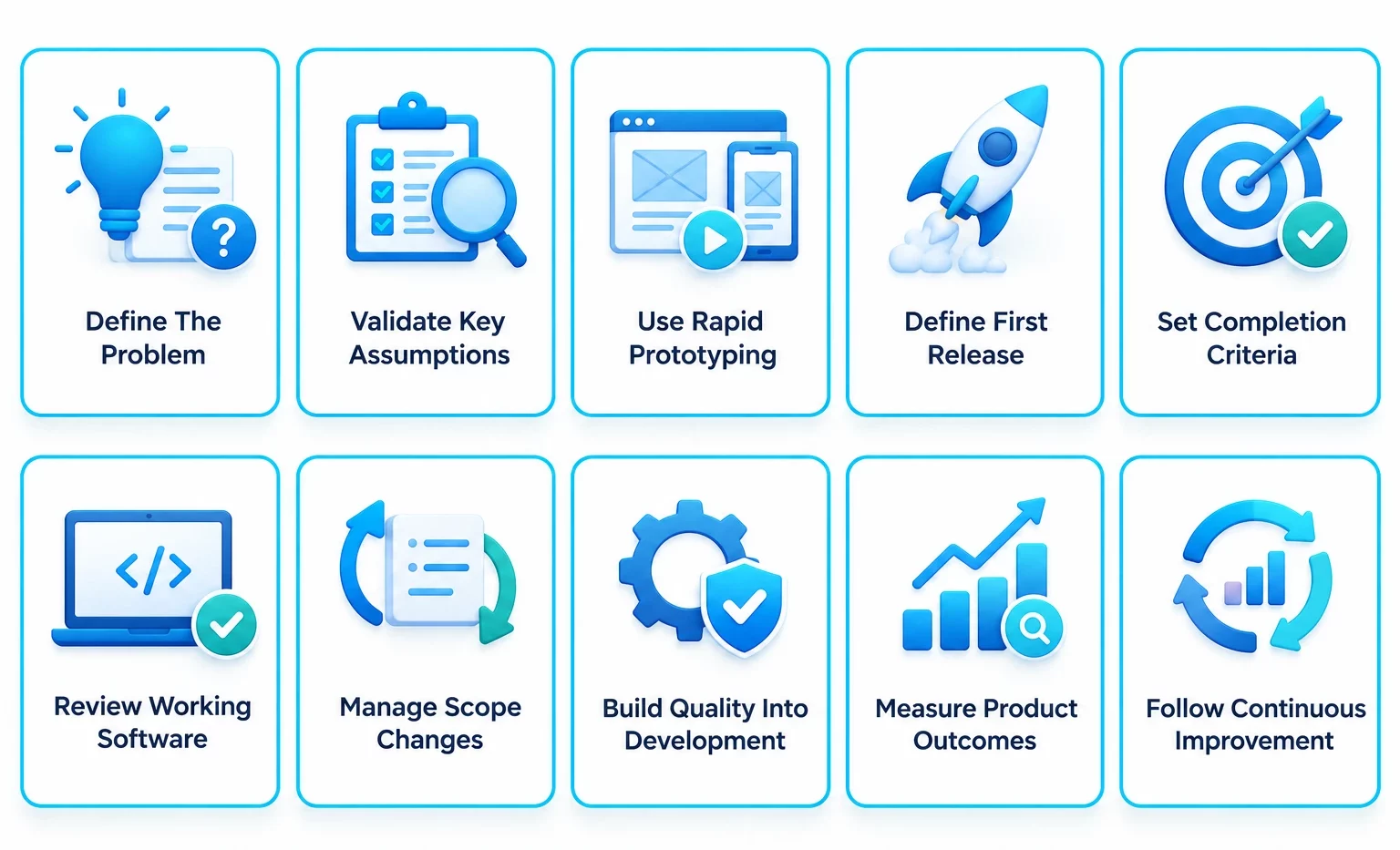
Preventing software project failure does not require creating a rigid process filled with documentation and meetings. It requires enough structure to make uncertainty visible, validate important assumptions, manage changing requirements, and give teams opportunities to identify problems before they become expensive.
Start With the Problem
Define the business problem and target users before committing to implementation. A clear problem statement gives the team a reference point when deciding which features belong in the product. It also helps stakeholders evaluate whether proposed features contribute to the intended business outcome.
Validate Important Assumptions
Not every assumption deserves months of engineering work. Identify the assumptions that could materially change the product’s value or feasibility and validate them first through research, prototypes, technical experiments, interviews, or user testing.
The development approach should also reflect the level of uncertainty involved. There is no universal software development methodology that guarantees success. The appropriate approach depends on the product, team, requirements, regulatory environment, risk level, and degree of uncertainty. Some organizations benefit from iterative development because requirements are expected to evolve, while others may require more formal processes because of regulatory or approval requirements.
Understanding the relationship between product and engineering processes can help teams make better decisions. The distinction explained through PDLC vs SDLC shows that product decisions and software engineering activities address different but connected questions. The product side focuses on whether the organization should build something, for whom, and why, while the development side focuses on how that software should be designed, built, tested, deployed, and maintained.
Confusing these responsibilities can create significant gaps. A development team can execute an effective engineering process on a product that should never have been built. Conversely, a validated product idea can still fail if the engineering process cannot deliver it reliably.
Use Prototyping to Reduce Risk
Prototypes are particularly valuable when teams are uncertain about user workflows, product concepts, or technical assumptions. A prototype can reveal whether users understand navigation, whether a workflow contains unnecessary steps, whether a proposed feature solves the intended problem, and whether stakeholders share the same understanding of the product.
The rapid prototyping process can therefore help reduce uncertainty before substantial engineering resources are committed. Prototypes can also expose technical assumptions. For example, a business may assume that a third-party API can support a particular workflow. A technical proof of concept can test that assumption before the architecture is built around it.
The key is to use prototypes to answer specific questions. A prototype does not necessarily need to become production software. Its value comes from the information it provides and the decisions that information enables.
Define a Focused First Release
A first release should provide enough value to test important product assumptions without attempting to solve every possible user need. This is where an appropriately planned MVP can reduce unnecessary investment.
For businesses evaluating that approach, a structured MVP development company can help translate a product concept into a focused first version while keeping development priorities aligned with the intended outcome.
Create a Shared Definition of Done
A feature should not be considered complete merely because its code has been written. The definition of done may include implementation, code review, testing, documentation, security checks, deployment readiness, and stakeholder acceptance depending on the project.
Review Progress With Working Software
Demonstrations reveal misunderstandings much earlier than status reports. Stakeholders should regularly see working functionality and provide feedback against agreed requirements.
Manage Changes Deliberately
Changing requirements should be expected, but each significant change should be evaluated for business value, cost, timeline, technical impact, and opportunity cost. This helps teams remain flexible without allowing every new request to disrupt the current release.
Build Quality Into Development
Testing, security, performance, accessibility, and maintainability should be considered throughout development rather than added at the end. Integrating these considerations into the development process reduces the likelihood of discovering critical problems shortly before launch.
Measure the Product After Launch
Track both technical and business outcomes after release. Technical metrics can include availability, response time, error rates, and infrastructure performance. Product metrics may include activation, retention, conversion, feature adoption, task completion, or customer support volume depending on the product.
Post-launch measurement also gives teams evidence for deciding what should be improved, removed, expanded, or prioritised in subsequent releases.
Follow a Continuous Improvement Cycle
A reliable software development process should create repeated opportunities to learn and adapt. Teams can define the problem, validate assumptions, prioritise requirements, plan the work, design and build the solution, test it, release it, and use real-world results to guide the next iteration.
This approach does not eliminate uncertainty. Instead, it creates multiple opportunities to discover and address uncertainty before it becomes expensive. The goal is not to predict every project challenge in advance, but to build a process that can identify risks early and respond to new information without losing sight of the product’s purpose.
When Custom Development Creates Additional Risk
Custom software can provide greater control over workflows, integrations, branding, data, and business-specific requirements. It can also introduce additional responsibility. Organizations developing custom systems must consider architecture, maintenance, infrastructure, security, integrations, documentation, hiring or vendor relationships, and future upgrades.
The custom software development approach is therefore most useful when the business requirements cannot be adequately addressed through existing products or configurable platforms. Before starting a custom project, teams should evaluate whether customization is actually necessary. A custom build should have a clear reason to exist. The project should also account for its full lifecycle rather than focusing only on initial development costs.
Mobile and Cross-Platform Projects Have Their Own Failure Risks
Mobile applications introduce additional considerations because the product may need to operate across devices, operating-system versions, screen sizes, network conditions, and hardware capabilities. Teams must also consider app-store requirements, permissions, notifications, offline behavior, battery consumption, device performance, and platform-specific user expectations.
The mobile app development challenges involved in these projects can affect planning and architecture if they are discovered too late. Cross-platform development can introduce another set of considerations. A shared codebase may improve development efficiency in certain situations, but teams still need to understand platform differences.
The cross-platform app development challenges involved in performance, native integrations, platform behavior, and testing should be evaluated before selecting an approach. The correct question is not simply which technology is most popular. It is whether the chosen approach fits the product’s requirements and constraints.
Enterprise Projects Require Additional Coordination
Enterprise software often involves more stakeholders, existing systems, security requirements, approval processes, data sources, and operational dependencies than smaller applications. A technically simple feature can become complicated when it needs to interact with legacy systems, identity providers, internal databases, reporting platforms, or external vendors.
The enterprise app development challenges involved in these environments demonstrate why integration and organizational dependencies need to be considered during planning. Enterprise projects can also suffer when decision-making becomes fragmented.
If business units have competing priorities, requirements can become inconsistent. If ownership is unclear, important decisions can remain unresolved. If legacy systems are poorly documented, integration estimates can become unreliable.
A strong governance structure helps establish who owns product decisions, technical decisions, security approvals, scope changes, and release decisions.
Web Applications Need More Than a Functional Interface
Web applications operate in an environment where performance, browsers, devices, connectivity, accessibility, security, APIs, databases, and infrastructure all interact. A development team may successfully implement the required functionality while still delivering an application that performs poorly under real traffic.
A broader web application development strategy should therefore consider architecture, user experience, performance, security, integrations, deployment, and ongoing maintenance. Performance should be evaluated under realistic conditions rather than only on a developer’s local machine. Likewise, error handling should account for failed network requests, unavailable external services, expired sessions, unexpected user inputs, and infrastructure problems. Software becomes reliable when it is designed for the conditions in which it will actually operate.
Operational Software Can Fail Even When the Core Features Work
Consider business applications such as point-of-sale systems. A POS application is not successful merely because it can process a transaction in a development environment. It may need to handle unreliable networks, printers, payment services, inventory synchronization, refunds, taxes, user permissions, reporting, and high transaction volumes.
The POS software development perspective highlights why business-critical software needs to be evaluated as part of an operational workflow rather than as an isolated application. This principle applies to many other systems. Software should be evaluated under the conditions of actual use, including interruptions and exceptions. The more critical the software is to day-to-day operations, the more important resilience, monitoring, recovery procedures, and support become.
The Role of the Development Team
The choice of a development partner can affect communication, technical decision-making, delivery practices, and long-term support. However, hiring an external team does not transfer responsibility for product decisions to the vendor. The client organization still needs to provide business context, prioritize requirements, review progress, make timely decisions, and define what success means.
When evaluating top software development companies, organizations should therefore look beyond technology lists and consider how potential partners approach discovery, communication, architecture, quality assurance, documentation, security, and post-launch support.
A successful relationship requires shared accountability. The development team should be able to explain technical trade-offs clearly. The business team should be able to explain priorities clearly. Both sides should have mechanisms for identifying risks before they become delivery problems.
How to Recover a Software Project That is Already Failing
Not every troubled project needs to be abandoned. The first step is to establish the current state honestly. Review the original objectives, actual scope, completed functionality, outstanding work, technical architecture, known defects, dependencies, budget, timeline, stakeholder expectations, and user feedback.
Then identify the gap between the current state and the desired outcome. Avoid immediately adding more developers or demanding faster delivery. Increasing resources without understanding the bottleneck can make coordination harder. Instead, determine whether the primary problem is requirements, scope, architecture, team capacity, technical debt, testing, dependencies, decision-making, or some combination.
A recovery plan should then establish a realistic target. In some cases, the right solution is to reduce scope. In others, technical restructuring may be necessary. A project may also benefit from releasing a smaller validated version before continuing with a broader roadmap. The important point is to make the problem measurable.
A Practical Framework for Preventing Software Project Failure
Teams can use a simple sequence throughout the project:
- Define: Clarify the problem, users, business objectives, constraints, and measurable outcomes.
- Discover: Research users, workflows, competitors, technical dependencies, and assumptions.
- Validate: Use prototypes, technical experiments, interviews, or other evidence to test important assumptions.
- Prioritize: Separate essential requirements from desirable enhancements and establish release priorities.
- Plan: Create estimates, milestones, dependencies, responsibilities, risk registers, and communication processes.
- Design: Develop user flows, architecture, interfaces, data structures, APIs, and security considerations.
- Build: Implement in manageable increments with code review, testing, documentation, and continuous stakeholder feedback.
- Test: Validate functionality, integrations, security, performance, compatibility, usability, and critical user journeys.
- Release: Deploy using a controlled process with monitoring, rollback plans, documentation, and operational readiness.
- Learn: Measure real-world results, collect feedback, identify issues, and use the findings to prioritize future improvements.
This framework does not eliminate uncertainty. Instead, it creates multiple opportunities to discover and address uncertainty before it becomes expensive.
Why Early Decisions Have an Outsized Impact
The earlier a problem is discovered, the more options the team generally has for addressing it. During discovery, a product assumption can be changed through research. During prototyping, an interface can be redesigned. During architecture planning, a technology decision can be replaced. During development, a defect may require code changes.
After launch, the same problem may affect customers, revenue, support operations, reputation, and infrastructure. This does not mean every decision must be made perfectly at the beginning. It means decisions should be made deliberately, and high-risk assumptions should be tested as early as practical. Good software development is therefore not about predicting everything. It is about creating a process where wrong assumptions can be discovered before they become deeply embedded.
Building a Culture That Reduces Software Failure
Technology teams can reduce project risk not only through processes but also through organizational behavior. Teams should be able to raise concerns without waiting until a problem becomes severe.
If developers believe an architecture will create scalability problems, that concern should be investigated. If designers discover that users cannot understand a workflow, the product team should have a mechanism for addressing it. If QA identifies a critical defect close to launch, the organization should evaluate the business impact rather than automatically treating the deadline as immovable.
This requires leadership to distinguish between bad news and bad performance. Early visibility into a risk is useful information. A team that reports a problem while there is still time to address it is giving the organization an opportunity to make a better decision.
Final Checklist Before Starting a Software Project
Before development begins, stakeholders should be able to answer several basic questions.
- What problem are we solving?
- Who experiences the problem?
- Why does the problem matter?
- What evidence supports the proposed solution?
- What does the first release need to accomplish?
- Which requirements are essential?
- Which assumptions are uncertain?
- What technical dependencies exist?
- How will success be measured?
- Who owns product decisions?
- Who owns technical decisions?
- How will changes to scope be handled?
- How will quality be measured?
- What security requirements apply?
- How will the product be monitored after launch?
- What happens if an important assumption proves wrong?
If these questions cannot be answered, the project may not yet be ready for full-scale development.
That does not mean development must stop indefinitely. It means the unknowns should be identified and prioritized so the team knows what needs to be resolved first.
Final Thoughts
Software project failure is rarely the result of one coding mistake. It usually develops through a combination of unclear goals, weak discovery, unrealistic planning, changing scope, communication gaps, technical debt, inadequate testing, security oversights, and insufficient attention to users and operations. Problems often remain invisible until they become expensive to correct.
Reducing that risk starts with treating software development as a business process rather than a sequence of coding tasks. Clear requirements, early validation, realistic estimates, measurable milestones, disciplined change management, continuous testing, and stakeholder feedback give teams opportunities to identify problems while they are manageable. Strong engineering practices then help ensure the delivered product remains secure, maintainable, and scalable.
At RipenApps, the focus is on helping businesses turn software ideas into well-defined, validated, and scalable digital products. A thoughtful product discovery workshop can help validate ideas, clarify requirements, identify risks, and align product decisions with clearly defined business goals. The objective is not to eliminate uncertainty, but to surface it early, make informed decisions, and build a development process that can adapt without losing sight of the product’s purpose and business objectives.
FAQs
Q1. Why do software projects fail?
Software projects commonly fail because of unclear requirements, poor product discovery, unrealistic planning, uncontrolled scope changes, weak communication, unsuitable architecture, inadequate testing, security gaps, and poor post-launch management.
Q2. What is the most common cause of software project failure?
Unclear or incomplete requirements are a major cause of software project failure. When stakeholders and development teams have different expectations, projects can experience rework, scope changes, delays, and increased costs.
Q3. How can businesses prevent software project failure?
Businesses can reduce project failure risks by clearly defining business goals, validating assumptions early, setting realistic timelines, controlling scope, maintaining regular communication, testing continuously, addressing security requirements, and monitoring the product after launch.
Q4. How does product discovery help prevent software project failure?
Product discovery helps businesses validate user needs, workflows, business assumptions, and technical considerations before committing significant development resources. This can reduce the risk of building a product that does not address the intended problem.
Q5. How does scope creep affect software projects?
Scope creep can increase development effort, costs, and timelines when new requirements are added without adjusting resources or priorities. A structured change-control process helps teams evaluate and prioritize changes before including them in the current release.
Q6. Can a failing software project be recovered?
Yes. A troubled project can sometimes be recovered by assessing its current scope, architecture, defects, dependencies, budget, timeline, and stakeholder expectations. The team can then identify the primary bottlenecks and create a realistic recovery plan, which may involve reducing scope, restructuring technical components, or releasing a smaller validated version.
Discuss your project and request for proposal
SHARE
WRITTEN BY

Ishan Gupta
CEO & Founder
Ishan Gupta is a seasoned entrepreneur and CEO with extensive 10+ years of experience in business and mobile app development landscape. He believes that the right digital product allows companies to focus on what they do best, while technology handles the rest. With deep exposure to global markets, he understands what makes an app succeed. His approach translates business needs into clear product strategies, ensuring that every feature contributes to measurable ROI.
View All Articles