



Key Takeaways
- Generative AI can support manufacturing across maintenance, engineering, production, quality, supply chain, documentation, and knowledge management.
- Its strongest value often comes from helping employees access and interpret complex enterprise information.
- Generative AI works particularly well when combined with existing ERP, MES, IoT, PLM, analytics, and maintenance systems.
- Predictive analytics and generative AI can complement one another, with predictive models producing insights and generative AI explaining them.
- Manufacturing organizations should begin with clearly defined, measurable use cases rather than attempting enterprise-wide deployment immediately.
Manufacturing has entered a new phase of digital transformation. Factories are no longer relying only on automation, industrial sensors, enterprise software, and traditional analytics to improve production. Generative AI is adding another layer of intelligence by enabling systems to understand large volumes of operational information, generate useful content, support decision-making, assist engineers, and help employees interact with complex manufacturing data through natural language.
The potential of generative AI in manufacturing extends across the factory floor, engineering departments, supply chains, quality teams, maintenance operations, and corporate functions. Unlike conventional AI systems that are typically designed to predict a specific outcome or classify a particular input, generative AI can create text, summaries, recommendations, technical documentation, code, simulations, and other outputs based on contextual information.
For manufacturers, this opens opportunities to reduce repetitive work, accelerate problem-solving, improve knowledge accessibility, and make better use of data already available across connected systems. Businesses exploring these opportunities can work with a generative AI development company to identify practical applications and build solutions around their operational requirements.
However, successful adoption requires more than adding a chatbot or connecting a foundation model to existing data. Manufacturers need to identify valuable use cases, prepare their data, address security requirements, integrate AI with existing systems, and establish appropriate governance.
Table of Contents
What is Generative AI in Manufacturing?
Generative AI refers to artificial intelligence models capable of producing new content based on patterns learned from large datasets and information supplied through prompts or connected sources. In manufacturing, those outputs can take many forms. A system might generate a summary of a production incident, explain a machine alarm, create a draft maintenance report, assist an engineer in reviewing technical specifications, answer questions about standard operating procedures, or help employees retrieve information from thousands of internal documents.
This makes generative AI particularly interesting for manufacturing environments because the industry produces enormous quantities of structured and unstructured information. A modern manufacturing organization may have data distributed across:
- Enterprise resource planning systems
- Manufacturing execution systems
- Industrial IoT platforms
- Computerized maintenance management systems
- Product lifecycle management platforms
- Quality management systems
- Warehouse and supply chain systems
- Engineering documentation
- Equipment manuals
- Standard operating procedures
- Inspection reports
- Emails and internal knowledge repositories
The challenge is not simply generating more data. It is making existing information accessible and actionable. Generative AI can act as an intelligent interface across these information sources when it is implemented with appropriate retrieval, permissions, integration, and governance mechanisms.
This is where generative AI for manufacturing differs from simply using a general-purpose AI assistant. The greatest value comes when the model is connected to relevant business context and designed around specific operational workflows.
Why is Generative AI Gaining Attention in Manufacturing?
Manufacturing organizations face several challenges simultaneously. They must increase productivity, control costs, maintain quality, respond to changing customer expectations, manage complex supply networks, and retain operational knowledge while dealing with workforce changes.
Traditional software can automate predefined processes, but many manufacturing activities still involve interpretation and human judgment. For example, an engineer investigating recurring equipment failures may need to review maintenance records, machine specifications, previous incident reports, inspection notes, and production information before identifying a likely cause.
Generative AI can help bring these sources together and present the relevant information in a conversational or summarized form. The technology can also reduce the time employees spend searching for information. Instead of navigating multiple applications and documents, an authorized employee could ask a question in natural language and receive an answer based on approved internal sources.
This does not mean AI should independently make every operational decision. Rather, it can become an assistant that helps employees understand information faster and perform knowledge-intensive tasks more efficiently.
Key Use Cases of Generative AI in Manufacturing
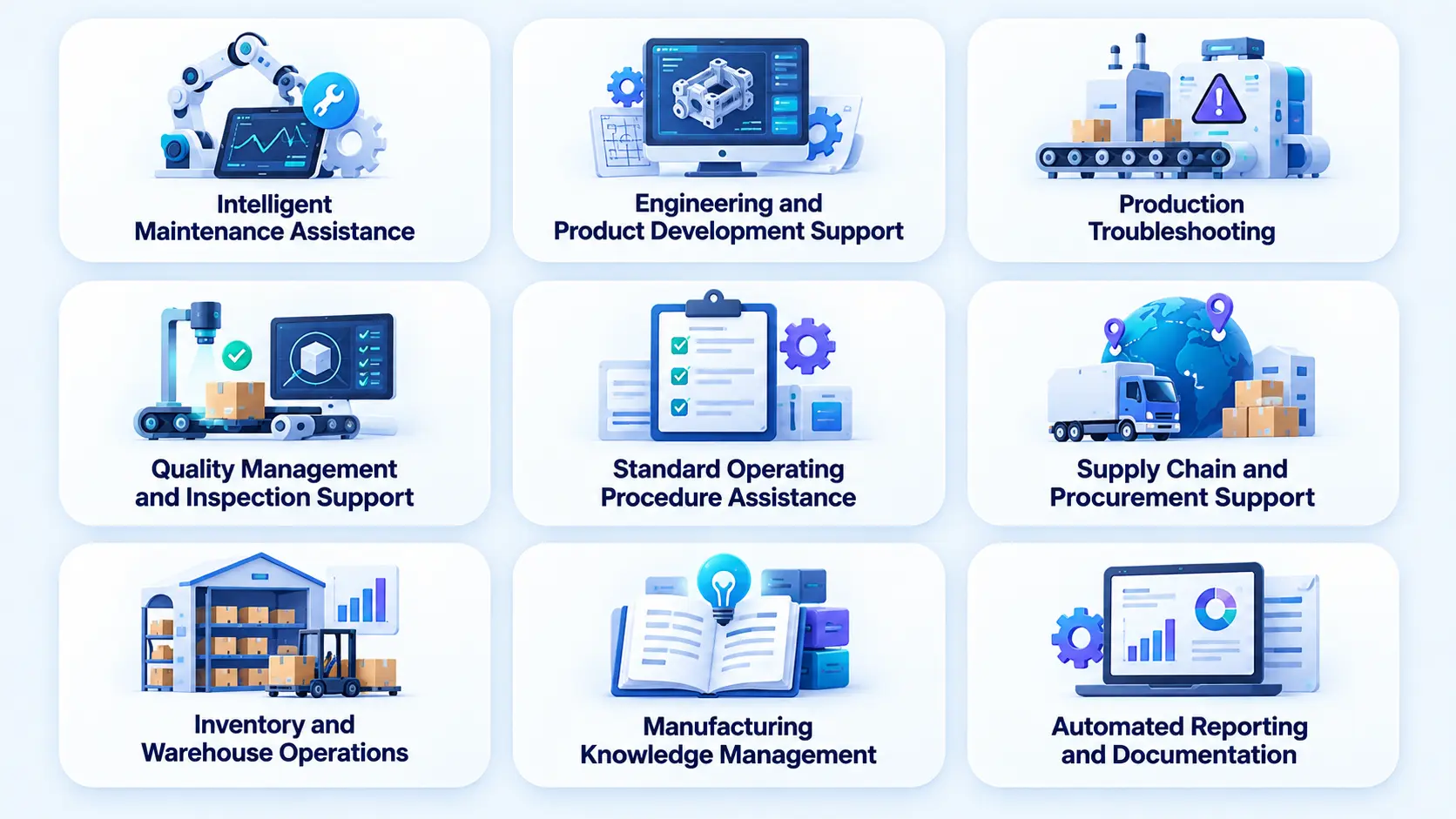
The strongest generative AI use cases in manufacturing are usually those that combine large amounts of information with repetitive knowledge work.
1. Intelligent Maintenance Assistance
Maintenance is one of the most practical areas for generative AI adoption. Industrial equipment produces information through sensors, maintenance systems, inspection records, and operator observations. Traditionally, technicians may need to examine several sources before understanding the history of a machine.
A generative AI assistant can help summarize equipment history and provide relevant troubleshooting information. For example, a technician could ask: “What maintenance issues have occurred with this machine in the last six months?”
The system could retrieve authorized maintenance records and summarize recurring problems, previous repairs, and relevant documentation. It could also help explain alarm codes by referencing equipment manuals and approved maintenance procedures.
The goal is not to allow AI to independently repair machinery. Instead, it provides technicians with faster access to relevant knowledge. This can be particularly useful in organizations with large equipment fleets where experienced technicians possess valuable knowledge that is difficult to transfer to newer employees.
2. Engineering and Product Development Support
Engineering teams work with drawings, specifications, technical requirements, test results, product documentation, and change requests. Generative AI can help engineers interact with this information more efficiently.
An AI assistant could summarize engineering change requests, compare technical documents, identify potentially relevant historical designs, or generate an initial draft of technical documentation.
Generative models can also assist with software and code used in manufacturing environments, provided outputs are reviewed and validated.For product development teams, the technology can support early-stage brainstorming by generating design alternatives or summarizing customer and field feedback. Human engineers remain responsible for technical decisions, validation, safety, and regulatory compliance, but AI can reduce the administrative burden surrounding those decisions.
3. Production Troubleshooting
Production interruptions can be expensive, especially when teams need to investigate multiple variables. Generative AI can provide a conversational interface for accessing production information.
Instead of manually searching reports, a supervisor might ask: “Summarize the major production issues from the last shift and identify which ones require immediate attention.” If the AI system is properly connected to relevant production data, it can organize information into an understandable summary.
More advanced implementations can combine generative AI with predictive models, rules, and real-time operational data. The generative layer then becomes responsible for explaining results rather than replacing the underlying analytical systems. This distinction is important. A language model may be good at explaining a prediction, but the prediction itself may need to come from a specialized machine-learning model.
4. Quality Management and Inspection Support
Quality teams handle inspection results, non-conformance reports, corrective actions, audit documentation, supplier quality information, and customer complaints. Generative AI can help organize this information and produce summaries. For example, it could summarize recurring quality issues across production lines and highlight patterns for further investigation.
It could also generate initial drafts of corrective-action documentation based on approved data. Another potential application is quality knowledge retrieval. Employees could ask questions about inspection procedures and receive answers based on authorized quality documentation. The technology can therefore support consistency while reducing the amount of manual documentation work.
5. Standard Operating Procedure Assistance
Manufacturing operations depend heavily on standard operating procedures. However, employees may struggle to find the right document when organizations have thousands of procedures, manuals, safety instructions, and work instructions. Generative AI can provide a natural-language interface to this knowledge base.
An employee could ask how a particular process should be performed and receive an answer referencing the relevant approved documentation. This is particularly useful when combined with retrieval-augmented generation, where the AI retrieves information from a controlled knowledge base before generating a response.
Such systems should clearly distinguish between retrieved company information and generated content. For safety-critical procedures, employees should always be able to access the underlying approved source.
6. Supply Chain and Procurement Support
Manufacturing supply chains generate substantial amounts of information involving suppliers, purchase orders, inventory, logistics, forecasts, contracts, and disruptions. Generative AI can help employees understand this information faster.
For example, an AI assistant could summarize supplier communications, identify delayed purchase orders, explain changes in demand forecasts, or prepare a briefing for procurement teams. Organizations already exploring connected supply-chain technologies can also benefit from understanding the broader role of technology in supply chain and how AI fits into these digital workflows.
The technology may also help generate supplier communication drafts or summarize procurement meetings. The objective is to reduce administrative work while allowing procurement professionals to spend more time on supplier relationships, negotiation, risk management, and strategic sourcing.
7. Inventory and Warehouse Operations
Warehouse teams need quick access to information about stock, locations, orders, replenishment, and logistics. Generative AI can act as a conversational interface for warehouse and inventory systems.
A manager could ask: “Which products are below their replenishment threshold?” Or: “Summarize the inventory issues affecting this week’s production schedule.”
When connected to appropriate systems, AI can retrieve relevant information and present it in a more accessible format. This becomes especially valuable when organizations operate multiple warehouses or production facilities and employees need information across different systems.
Cloud-based platforms can further extend accessibility and scalability. For organizations evaluating connected warehouse environments, a cloud warehouse management system can provide useful context for how digital warehouse infrastructure supports modern operations.
8. Manufacturing Knowledge Management
One of the less obvious but highly valuable generative AI manufacturing use cases is institutional knowledge preservation. Experienced employees often know how to solve unusual production problems, interpret equipment behavior, or respond to specific operational scenarios.
Much of this knowledge may never be formally documented. Generative AI can help capture and organize this information through structured documentation, searchable knowledge bases, and conversational assistants. Instead of asking a retired or transferred employee how a particular machine problem was historically resolved, employees could potentially retrieve documented knowledge through an AI interface. This can reduce dependence on individual employees and make organizational knowledge more accessible.
9. Automated Reporting and Documentation
Manufacturing involves a considerable amount of reporting. Production managers, quality teams, maintenance departments, engineers, and executives may all create recurring reports. Generative AI can automate the first draft of these reports by converting structured information into readable narratives.
For example, an operations report could summarize:
- Production output
- Downtime
- Quality incidents
- Maintenance activities
- Material shortages
- Safety observations
- Significant operational changes
Employees can then review, correct, and approve the generated report. This is an example of using generative AI where its strengths are particularly relevant: transforming large amounts of information into concise, readable content.
Generative AI Enterprise Use Cases Beyond the Factory Floor
While factory operations receive significant attention, generative AI enterprise use cases extend into corporate functions that support manufacturing businesses. Finance teams can use AI to summarize financial information and assist with management reporting. Human resources teams can use AI for internal knowledge retrieval, policy questions, onboarding materials, and employee communication.
Sales teams can summarize customer interactions and prepare account briefs. Legal and compliance teams can organize documents and assist with information retrieval. Executives can use AI assistants to generate summaries from approved business information. The broader opportunity is therefore not to build one isolated manufacturing AI application, but to develop an AI ecosystem in which different departments benefit from appropriately governed intelligent tools.
The Role of AI, IoT, and Existing Manufacturing Systems
Generative AI does not have to replace the technologies already used to run manufacturing operations. Instead, it can work as an intelligent layer over existing systems, helping teams access, understand, and use information more efficiently.
IoT platforms collect data from machines, sensors, and connected equipment, while ERP systems manage resources, planning, inventory, and business processes. MES platforms provide visibility into production activities, and PLM systems manage product designs, engineering data, and related documentation. Quality management systems handle inspections, non-conformance records, and corrective actions.
Generative AI can bring relevant information from these systems together through APIs, data pipelines, retrieval systems, or middleware. This allows employees to interact with complex operational data through natural-language queries instead of manually searching across multiple platforms.
For example, a production manager could ask an AI assistant to summarize recent equipment downtime, identify recurring maintenance issues, and retrieve the relevant operating procedures. The underlying systems continue to perform their core functions, while generative AI makes the information they contain easier to access, interpret, and act upon.
Organizations already implementing IoT in manufacturing can therefore consider generative AI as another intelligence layer that helps employees interpret and interact with the information generated by connected operations. This architecture is more practical than attempting to replace every existing manufacturing application.
Read More: AI in ERP: Trends, Benefits, and Real-World Use Cases
How Generative AI Can Work With Predictive Analytics
Generative AI and predictive analytics serve different purposes, but they can complement one another. Predictive models may determine that a machine has a high probability of failure within a certain period. Generative AI can then explain that prediction in natural language. For example: “Machine A has an elevated failure risk based on vibration and temperature patterns. Similar patterns occurred before two previous bearing failures.”
The predictive model performs the analytical task. The generative model communicates the result. This distinction helps manufacturers build more reliable systems.
Generative AI in Automotive Manufacturing
The automotive sector is particularly suitable for exploring generative AI in automotive industry applications because it involves complex engineering, large-scale production, extensive supplier networks, and enormous volumes of technical documentation.
Potential applications include engineering assistance, supplier communication, quality analysis, maintenance support, manufacturing documentation, and customer feedback analysis. Generative AI can also assist teams working with vehicle specifications and engineering information by helping them locate and summarize relevant documentation.
In highly regulated environments, however, organizations need strong controls around data access, intellectual property, validation, and model behavior. AI-generated information should not automatically become part of engineering or production processes without appropriate review.
Generative AI in Pharma Manufacturing
Pharmaceutical manufacturing introduces another important application area. The industry operates under strict quality and regulatory requirements and generates substantial documentation. Potential generative AI in pharma manufacturing applications include document summarization, knowledge retrieval, deviation-report assistance, SOP navigation, training support, and controlled documentation workflows.
However, pharmaceutical organizations must apply particularly strong governance. AI-generated content may assist with documentation, but organizations need appropriate review processes to ensure that regulated information remains accurate, traceable, and compliant.
For this reason, the most suitable implementations often begin with lower-risk administrative and knowledge-management applications before moving toward more operationally sensitive workflows.
What Are the Benefits of Generative AI in Manufacturing?
The benefits of generative AI are not limited to automation.
1. Faster Access to Information
Employees can spend less time searching through documents and systems. A conversational interface can make information easier to retrieve, particularly when users do not know the exact document or terminology required to locate it.
2. Improved Employee Productivity
Generative AI can handle repetitive tasks such as summarization, documentation drafting, report preparation, and information organization. This gives employees more time for activities requiring judgment and expertise.
3. Better Knowledge Sharing
AI-powered knowledge systems can make organizational information available to a broader workforce. This is particularly valuable for manufacturers with multiple plants, shifts, locations, and generations of employees.
4. Faster Problem Resolution
When technicians and engineers can quickly access equipment history, procedures, and previous incidents, they may be able to investigate problems more efficiently.
5. Improved Decision Support
Generative AI can bring information together and present it in a way that makes complex operational situations easier to understand.
6. Reduced Administrative Work
Manufacturing teams often spend considerable time preparing reports, updating documentation, and communicating information. Automating parts of these processes can create measurable efficiency improvements.
7. Greater Accessibility of Enterprise Data
Instead of requiring employees to understand multiple software interfaces, AI can provide a natural-language layer over approved enterprise information.
Read More: Intelligent Automation: How Should Enterprises Get Started?
What is an Example of a Generative AI Application in Manufacturers?
A practical example would be an AI-powered manufacturing operations assistant. Imagine a factory where supervisors have access to information from an MES, maintenance system, quality platform, and internal documentation.
Instead of manually checking each system, a supervisor could ask: “Why was production output lower yesterday?” The AI assistant could retrieve approved operational information and generate a summary showing that one production line experienced extended downtime because of a recurring equipment issue, while another line was affected by a material shortage.
The system could then direct the supervisor to relevant maintenance records and operating procedures. This represents a realistic example of a generative AI application in manufacturers because the AI is not simply generating generic text. It is helping employees interact with manufacturing information in context.
How to Implement Generative AI in Manufacturing
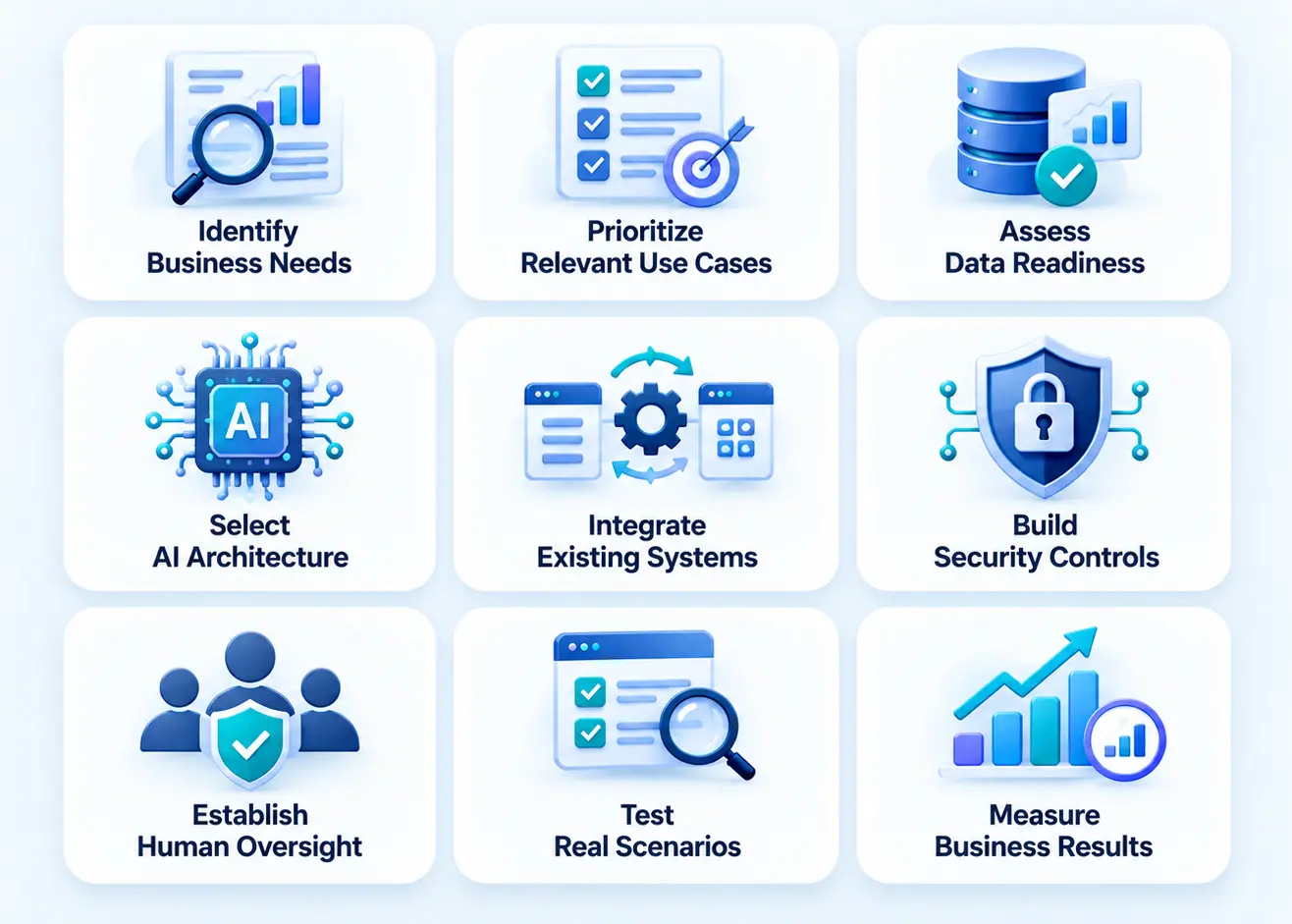
A successful generative AI implementation should be approached as a business and technology transformation rather than a standalone software experiment.
Step 1: Identify the Business Problem
Start with the operational problem, not the AI model. Ask where employees spend excessive time searching for information, preparing documentation, analyzing repetitive data, or handling knowledge-intensive tasks. A good use case should have a clear business outcome.
Step 2: Prioritize the Right Use Case
Not every manufacturing process needs generative AI. A strong initial use case generally has:
- A clear user group
- A repetitive knowledge-intensive workflow
- Accessible data
- A measurable business outcome
- Manageable implementation risk
Low-risk internal knowledge and documentation applications can often provide a practical starting point.
Step 3: Assess Data Readiness
Generative AI is only as useful as the information available to it. Manufacturers should evaluate the quality, consistency, accessibility, ownership, and security of their data. Old documents, conflicting procedures, incomplete records, and duplicated information can reduce answer quality. Data preparation is therefore a major part of AI implementation.
Step 4: Select the Appropriate AI Architecture
Businesses need to determine whether they require a general-purpose model, enterprise model, fine-tuned model, retrieval-augmented generation architecture, or a combination of technologies. For many manufacturing knowledge applications, retrieval-augmented generation can be useful because the model can retrieve relevant company information before generating an answer. The architecture should be selected according to the use case rather than based solely on model popularity.
Step 5: Integrate With Existing Systems
The AI solution may need to connect with ERP, MES, CRM, IoT, PLM, maintenance, warehouse, or document-management systems. This requires APIs, authentication, data pipelines, permissions, and integration logic. Businesses looking at integrating AI features into existing systems can use this approach to introduce AI capabilities without necessarily replacing their existing technology stack.
Step 6: Build Security and Access Controls
Manufacturing data may include confidential product designs, intellectual property, supplier information, operational details, and employee information. AI systems must therefore respect existing permissions. An employee should only be able to retrieve information they are authorized to access. Security should be designed into the architecture rather than added after deployment.
Step 7: Introduce Human Oversight
Human review remains essential, particularly when AI outputs influence production, safety, quality, engineering, regulatory, or financial decisions. The system should make it clear when content is AI-generated and provide users with access to supporting sources wherever practical.
Step 8: Test the System With Real Scenarios
Before deployment, manufacturers should test the system using representative questions and operational situations. Testing should evaluate accuracy, relevance, hallucination rates, response time, data security, and user experience. Teams should also test how the system behaves when information is missing or contradictory.
Step 9: Measure Business Results
A generative AI project should have measurable success criteria. Depending on the use case, organizations might track:
- Time saved per employee
- Report preparation time
- Search time
- Maintenance troubleshooting time
- Knowledge retrieval success
- Documentation productivity
- User adoption
- Error rates
- Operational response time
Measurement helps determine whether the technology is creating genuine business value.

Common Challenges of Generative AI Adoption
The potential of generative AI is significant, but manufacturing organizations should not underestimate implementation challenges.
1. Data Fragmentation
Information may exist across disconnected systems and formats. Bringing these sources together can require substantial integration work.
2. Hallucinations and Incorrect Answers
Generative models can produce plausible but incorrect information. This is particularly concerning in manufacturing environments where inaccurate instructions could have operational consequences. Retrieval mechanisms, validation, guardrails, and human review can reduce these risks.
3. Legacy Technology
Many manufacturers operate equipment and software that were not designed for modern AI integration. Connecting legacy systems can therefore become a significant part of the project.
4. Security and Intellectual Property
Manufacturers must carefully control how sensitive data is processed and stored. AI architecture should account for confidentiality, authentication, authorization, data retention, and vendor policies.
5. Employee Adoption
Employees may resist AI if they believe it threatens their jobs or produces unreliable answers. Successful deployment requires communication, training, and clear positioning of AI as an assistant rather than an unquestioned replacement for human expertise.
6. Regulatory and Compliance Requirements
Industries such as pharmaceuticals, aerospace, automotive, and medical manufacturing may face additional requirements around documentation, traceability, safety, and quality. AI systems need to be designed around those requirements from the beginning.
How Much Does Generative AI Implementation Cost?
The cost of implementing generative AI in manufacturing varies considerably. A basic internal knowledge assistant may require significantly less investment than a system connected to multiple factory applications and real-time operational data. The major cost factors include:
- AI model selection
- Data preparation
- System integration
- Application development
- User interface design
- Cloud infrastructure
- Security controls
- Testing
- Monitoring
- Maintenance
- Employee training
The complexity of the manufacturing environment also affects cost. A company with clean, centralized documentation may have a relatively straightforward implementation path. A manufacturer with multiple plants, legacy systems, fragmented databases, and strict access requirements may require considerably more integration work.
Businesses should therefore avoid treating generative AI as a fixed-price software feature. The appropriate investment depends on the use case, architecture, data environment, and expected business value. Organizations evaluating their implementation approach can also review the AI integration cost considerations before defining a project scope.
Building Custom AI Applications for Manufacturing
Off-the-shelf AI tools can be useful for experimentation, but manufacturers with specialized workflows may eventually require custom solutions. A custom application can connect AI capabilities to specific operational data, business rules, user roles, and existing software. For example, an organization could develop an internal AI assistant specifically for maintenance teams, with access restricted to approved equipment records and technical manuals.
Another organization could create an AI quality assistant designed around non-conformance management and corrective-action workflows. The value of customization is not simply a different interface. It is the ability to design the AI experience around the organization’s actual processes. Businesses considering custom AI application development can use this approach when standard AI tools do not provide the required integration or workflow capabilities.
How Manufacturing AI Solutions Can Scale
A common mistake is attempting to deploy AI across the entire organization immediately. A better approach is to start with a clearly defined use case and gradually expand. For example, a company might begin with an internal manufacturing knowledge assistant.
Once employees demonstrate adoption and the organization understands the technology’s strengths and limitations, the same infrastructure could potentially be extended to maintenance, quality, procurement, or engineering. AI chatbot development services can help organizations build scalable conversational assistants that evolve alongside these use cases. This creates a reusable AI foundation rather than a collection of disconnected experiments. The scaling strategy should include model governance, data governance, security policies, monitoring, evaluation, and integration standards.
Choosing the Right Development Partner
Selecting an implementation partner can have a major impact on the outcome of a manufacturing AI project. Manufacturers should look beyond whether a provider can build a chatbot or connect an AI model. The more important question is whether the partner understands how AI needs to work within real business systems.
A capable partner should be able to discuss data architecture, API integration, security, model selection, retrieval mechanisms, user experience, testing, deployment, and long-term maintenance. It is also useful to examine the partner’s understanding of enterprise AI adoption rather than focusing only on technical demonstrations. Organizations can review guidance around choosing an AI development partner when evaluating potential technology partners.
Avoiding Common AI Integration Mistakes
Manufacturers should also be careful about treating AI implementation as a simple API integration. Several problems can emerge when organizations deploy AI without sufficient planning. For example, connecting a model to poor-quality data can produce unreliable answers.
Giving users unrestricted access to internal information can create security risks. Deploying AI without monitoring can make it difficult to identify declining performance. Another mistake is trying to automate a process that was poorly designed in the first place. Organizations should first understand the workflow, remove unnecessary complexity, and then determine where AI can add value. A practical review of common AI integration mistakes can help teams identify potential implementation risks before deployment.
Generative AI as Part of a Broader Digital Transformation Strategy
Generative AI should not be treated as an isolated technology trend. Manufacturers are increasingly building connected digital environments in which IoT, cloud platforms, analytics, automation, ERP, supply chain systems, and AI work together. This makes strategic planning important.
An organization might already have sensors collecting machine data, an ERP managing resources, an MES controlling production workflows, and analytics systems identifying operational patterns.
Generative AI can then provide an intelligent interaction layer that helps employees understand and use these capabilities. For businesses developing a broader roadmap, a digital transformation strategy can provide useful context for positioning AI alongside other digital initiatives. The goal should be a connected technology strategy rather than a collection of independent tools.
The Future of Generative AI in Manufacturing
The next stage of manufacturing AI will likely involve increasingly integrated systems. AI assistants may move beyond answering questions and begin supporting complete workflows. For example, an employee could ask an AI system to investigate a production issue. The system could retrieve operational data, summarize relevant events, identify historical incidents, prepare a recommended investigation checklist, and route the issue to the appropriate team.
Similarly, engineering assistants may increasingly work across technical documentation, product information, and historical design knowledge. Maintenance assistants may combine predictive analytics with generative explanations, while supply chain assistants may bring together procurement, logistics, inventory, and supplier information. As these workflows become more connected, businesses may also work with a logistics app development company to build AI-enabled applications that connect logistics processes with broader manufacturing and supply chain operations.
However, greater automation will also increase the importance of governance. Manufacturers will need clear rules defining which decisions AI can support, which actions require human approval, and how AI-generated outputs are validated. The organizations that benefit most will likely be those that combine AI capabilities with strong operational processes and reliable data foundations.
Conclusion
Generative AI in manufacturing has the potential to change how factories and manufacturing organizations interact with information, automate knowledge-intensive work, and support employees across complex operational environments. From maintenance and engineering to quality, supply chain, documentation, and enterprise knowledge management, the technology can create value when applied to clearly defined business problems.
The most effective adoption strategy is not to implement AI everywhere at once. Manufacturers should identify high-value use cases, assess their data, integrate AI with existing systems, establish governance, and measure outcomes before expanding.
With the right architecture and implementation approach, generative AI can become a practical intelligence layer across manufacturing operations rather than simply another technology experiment. Organizations interested in combining these capabilities can explore predictive analytics consulting to determine how predictive models and generative interfaces can work together within existing operational environments.
RipenApps helps businesses explore and implement AI solutions aligned with their operational goals, data infrastructure, and existing technology ecosystem. Our team focuses on practical AI applications that can integrate with enterprise systems, improve decision-making, and support scalable digital transformation across industries.
FAQs
1. What is generative AI in manufacturing?
Generative AI in manufacturing uses AI models to generate content, summarize information, support decision-making, and help employees interact with complex operational data.
2. What are the main use cases of generative AI in manufacturing?
Common use cases include intelligent maintenance assistance, engineering support, production troubleshooting, quality management, SOP assistance, supply chain support, inventory management, knowledge management, and automated reporting.
3. How can generative AI benefit manufacturing companies?
Generative AI can help employees access information faster, reduce repetitive documentation work, improve knowledge sharing, support faster problem resolution, and make enterprise data easier to understand.
4. How can manufacturers implement generative AI?
Manufacturers can begin by identifying a measurable business problem, prioritizing a suitable use case, assessing data readiness, selecting an AI architecture, and integrating existing systems such as ERP, MES, IoT, and PLM. An ERP software development strategy can also help businesses understand how ERP systems can support AI-enabled manufacturing workflows.
5. How much does generative AI implementation cost in manufacturing?
The cost varies based on the AI model, data preparation, system integrations, application development, infrastructure, security, testing, monitoring, maintenance, and employee training. The complexity of the manufacturing environment also affects the overall investment.
6. What are the challenges of using generative AI in manufacturing?
Key challenges include fragmented data, AI-generated inaccuracies, legacy system integration, security and intellectual property concerns, employee adoption, and regulatory or compliance requirements. Human oversight and appropriate governance are important for managing these risks.
Discuss your project and request for proposal
SHARE
WRITTEN BY

Ishan Gupta
CEO & Founder
Ishan Gupta is a seasoned entrepreneur and CEO with extensive 10+ years of experience in business and mobile app development landscape. He believes that the right digital product allows companies to focus on what they do best, while technology handles the rest. With deep exposure to global markets, he understands what makes an app succeed. His approach translates business needs into clear product strategies, ensuring that every feature contributes to measurable ROI.
View All Articles