



Key Takeaways
- Cloud computing helps oil and gas companies manage operational data, applications, analytics, and workloads at scale.
- Cloud architecture connects field equipment, edge systems, data platforms, applications, analytics, and security controls.
- Predictive maintenance and remote monitoring can improve equipment visibility, maintenance planning, and operational decision-making.
- Hybrid cloud environments can connect legacy operational technology with modern cloud platforms and digital applications.
- Cloud costs depend on compute, storage, data transfer, AI workloads, security, and application requirements.
- AI, IoT, edge computing, and digital twins will continue influencing cloud adoption across oil and gas operations.
The oil and gas industry generates enormous amounts of data across exploration, drilling, production, transportation, refining, and distribution. Seismic surveys, geological records, equipment readings, production data, pipeline information, maintenance records, and environmental measurements all need to be collected, processed, stored, and analyzed efficiently.
This is driving greater interest in cloud computing in oil and gas industry, as companies look for more scalable ways to manage operational data and digital workloads. Instead of relying entirely on physical servers and isolated systems, organizations can use cloud platforms for computing, storage, analytics, application hosting, data integration, and artificial intelligence.
Cloud adoption can support different parts of the oil and gas value chain. Upstream companies can use cloud platforms for seismic analysis and exploration, while midstream operators can apply them to pipeline monitoring and logistics. Downstream organizations can use cloud-based applications for production planning, asset management, supply chain operations, and analytics.
However, cloud adoption in this industry is not simply about moving existing systems to a public cloud. Oil and gas companies often need to connect cloud environments with legacy infrastructure, SCADA systems, industrial equipment, edge computing platforms, and other operational technologies.
For businesses exploring digital transformation across the energy sector, an energy and utility app development company can help provide context around industry-specific digital applications and technology requirements. This guide explains cloud computing for oil and gas, including its use cases, architecture, benefits, costs, deployment models, challenges, implementation approach, and future trends.
Table of Contents
What is Cloud Computing in Oil and Gas?
Cloud computing in oil and gas refers to using cloud-based infrastructure, storage, databases, applications, analytics platforms, and computing resources to support energy operations. Instead of purchasing and maintaining physical infrastructure for every workload, companies can access computing and storage resources through cloud platforms. Resources can be increased or reduced according to operational requirements. The approach can support all three major areas of the industry:
- Upstream operations include exploration, geological analysis, seismic processing, drilling, and production. Cloud infrastructure can provide the computing resources needed to process large datasets and run advanced analytics.
- Midstream operations include pipelines, transportation, storage, terminals, and logistics. Cloud systems can connect geographically distributed assets and centralize operational information.
- Downstream operations include refining, processing, distribution, and retail. Cloud applications can support production planning, equipment monitoring, inventory management, business intelligence, and enterprise workflows.
Cloud platforms can also connect data from sensors, industrial equipment, enterprise systems, and applications. This allows companies to create centralized data environments instead of maintaining isolated information repositories. The cloud app development process provides useful context for understanding how cloud applications are planned, developed, deployed, and scaled.
Cloud adoption can take place gradually. Companies may initially move analytics, reporting, development, or selected business applications to the cloud while keeping critical operational systems within existing environments.
Why Oil and Gas Companies Are Adopting Cloud Computing
The growth of cloud adoption in oil and gas is closely connected with the industry’s increasing data volumes, geographically distributed operations, and demand for faster decision-making.
1. Managing Large Volumes of Operational Data
Oil and gas companies generate data from seismic surveys, drilling systems, production equipment, SCADA platforms, IoT devices, maintenance applications, and enterprise systems. Traditional infrastructure can make it difficult to bring these datasets together. Information may remain distributed across different databases, facilities, applications, and departments.
Cloud platforms can provide centralized storage and processing environments where authorized users and applications can access relevant information. This can support better data availability while also providing scalable infrastructure for growing datasets. Companies can also establish data lakes and analytics platforms to combine structured and unstructured operational information.
2. Supporting Remote and Distributed Operations
Oil and gas operations often take place across offshore platforms, remote wells, pipelines, terminals, refineries, and other geographically distributed facilities. Cloud computing can help centralize information from these locations while allowing local systems to continue supporting operational processes.
Connected devices can collect information from remote assets and transmit relevant data to centralized systems. Where connectivity is limited, edge infrastructure can process critical information locally before synchronizing it with the cloud.
Read More: Applications of IoT Across Industries
3. Improving Operational Efficiency
Cloud environments can help reduce information silos by connecting operational applications, data platforms, analytics systems, and business applications. For example, production information can feed analytics dashboards, equipment data can support maintenance models, and logistics information can be integrated with inventory systems.
Cloud Computing Use Cases in Oil and Gas
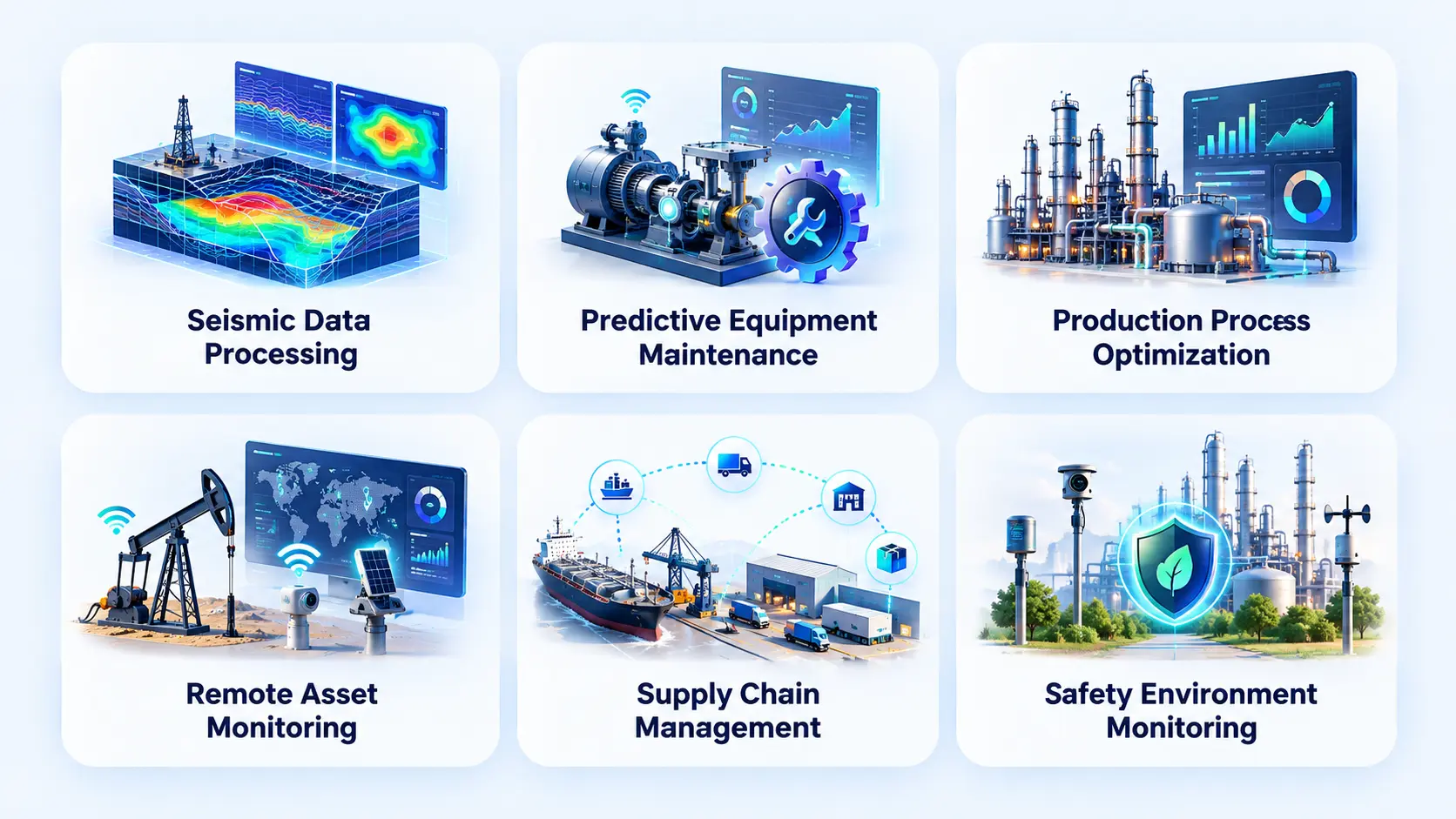
Cloud technology can support a wide range of operational and business use cases. The value of cloud adoption depends on how these capabilities are connected with existing operational processes.
1. Exploration and Seismic Data Processing
Exploration generates large and complex datasets. Seismic surveys, geological information, reservoir models, and other exploration data can require substantial processing resources. Cloud platforms can provide scalable computing capacity for these workloads. Instead of maintaining physical infrastructure capable of handling peak requirements throughout the year, organizations can provision resources based on project requirements. Cloud environments can also make exploration datasets available to authorized teams across locations.
Advanced analytics and machine learning can further help identify patterns in seismic and geological information. These technologies can support exploration teams by making large datasets easier to analyze.
Organizations evaluating cloud infrastructure can also consider different cloud providers and services based on workload requirements. The AWS vs Azure vs Google Cloud comparison provides a broader framework for evaluating major cloud platforms.
2. Predictive Maintenance
Equipment failure can result in production interruptions, maintenance costs, and operational risks. Predictive maintenance uses equipment data to identify potential problems before they become major failures.
Sensors can collect information such as vibration, temperature, pressure, operating hours, and equipment performance. This data can then be processed using cloud-based analytics and machine learning models.
For example, a predictive system may identify unusual vibration patterns in a pump and flag the asset for inspection before a significant failure occurs. Predictive maintenance can also help maintenance teams prioritize resources based on actual equipment conditions rather than relying exclusively on fixed maintenance intervals. Businesses developing advanced predictive systems can explore predictive analytics services for approaches to data modeling, forecasting, and operational analytics.
3. Production Optimisation
Production optimization involves monitoring wells, equipment, reservoirs, and operating conditions to improve output and resource utilization. Cloud platforms can consolidate production data from multiple assets and make it available through analytics systems and dashboards. Engineers can analyze production trends, identify deviations, compare asset performance, and use historical information to support optimization decisions.
Cloud-based oil and gas production software can also connect production data with forecasting models and operational workflows. Cloud cost should also be considered when designing these environments. Data processing, storage, analytics, and continuous workloads can all affect operating expenditure, making resource management important from the beginning. A structured cloud cost optimization approach can help organizations monitor resource usage and identify opportunities to control unnecessary cloud spending.
4. Remote Asset Monitoring
Remote asset monitoring allows organizations to observe equipment and facilities without requiring personnel to be physically present at every location. IoT sensors can collect information from pumps, pipelines, compressors, drilling equipment, storage facilities, and other assets. Cloud platforms can aggregate this information and make it available through centralized dashboards.
For remote locations, edge computing can process time-sensitive data closer to the equipment. Only relevant information may then be transferred to the central cloud platform. This combination of edge and cloud infrastructure can help organizations maintain operational visibility even when connectivity is constrained. The role of edge computing and on-device AI provides relevant context around processing information closer to devices.
5. Supply Chain and Logistics
Oil and gas supply chains involve equipment, spare parts, raw materials, contractors, warehouses, transportation providers, and multiple operational facilities. Cloud-based systems can centralize information related to procurement, inventory, transportation, suppliers, and equipment movement. IoT-enabled tracking can provide additional visibility into shipments and assets throughout the supply chain.
This becomes particularly valuable when equipment needs to move between warehouses, field locations, offshore facilities, and maintenance sites. The IoT in logistics and supply chain management guide provides additional context on connected logistics, tracking, and supply chain visibility.
6. Safety and Environmental Monitoring
Oil and gas operations need to monitor environmental conditions, emissions, equipment conditions, and safety-related information. Cloud systems can consolidate information from environmental sensors, inspection platforms, incident management systems, and operational databases. Dashboards can provide centralized visibility into emissions, equipment status, safety events, and compliance-related information.
Connected devices also introduce additional security considerations because sensors, gateways, and industrial devices can become part of the broader digital environment. The IoT security challenges resource discusses important security considerations for connected environments.
Cloud Architecture for Oil and Gas
Cloud architecture for oil and gas typically combines field equipment, operational technology, connectivity, edge systems, cloud infrastructure, data platforms, analytics, applications, and security controls. The architecture should account for both modern digital requirements and existing industrial systems.
1. Data Sources and Edge Layer
The data layer begins with physical equipment and operational systems. Common data sources include:
- IoT sensors
- SCADA systems
- Industrial equipment
- PLCs
- Production systems
- Environmental sensors
- Cameras
- Monitoring devices
Edge computing can process data close to the source before transferring information to centralized cloud systems. This can be particularly useful when connectivity is limited or when certain decisions require low-latency processing. The IoT in manufacturing guide provides useful background on connected equipment, industrial IoT, monitoring, and data collection.
2. Cloud Data and Processing Layer
The cloud data layer provides centralized infrastructure for storing and processing operational information. It can include object storage, data lakes, relational databases, NoSQL databases, data warehouses, and data processing systems. A well-designed cloud infrastructure architecture should also account for scalability, data lifecycle management, backup, recovery, and workload requirements. It can include:
- Object storage
- Data lakes
- Relational databases
- NoSQL databases
- Data warehouses
- Data processing systems
- Stream-processing platforms
- Backup systems
Different types of information may require different storage and processing approaches. Frequently accessed operational data may require high-performance infrastructure, while historical datasets may be stored using lower-cost storage tiers. Organizations designing these environments can consider cloud architecture design services to establish appropriate data flows, infrastructure components, scalability mechanisms, and security controls.
3. Analytics and Application Layer
The analytics and application layer converts operational data into usable information. It can include:
- Business intelligence dashboards
- AI and machine learning
- Predictive analytics
- Production analytics
- Forecasting tools
- Operational applications
- Reporting systems
Different users may need different information. Field engineers may need equipment performance information, while operations managers may need production dashboards and executives may require high-level business metrics. Cloud applications for oil and gas can therefore be designed around specific users and operational workflows.
4. Security and Integration Layer
Security needs to span the entire cloud architecture. Important controls can include:
- Identity and access management
- Role-based permissions
- Encryption
- Network segmentation
- API security
- Logging
- Monitoring
- Threat detection
- Backup and recovery
- Governance
Cloud security also needs to account for applications, APIs, devices, and third-party integrations. The cloud application security risks guide provides additional information about protecting cloud applications and infrastructure.
Benefits of Cloud Computing in Oil and Gas
Cloud computing can provide benefits across operations, technology management, analytics, and collaboration.
1. Scalability and Flexibility
Oil and gas workloads can vary significantly. An exploration project may require large amounts of computing capacity for a specific period, while a business application may have relatively stable requirements.
Cloud infrastructure allows resources to be scaled according to workload demand. This can reduce the need to maintain physical infrastructure designed exclusively for peak capacity.
2. Faster Data Access and Collaboration
Cloud platforms can centralize information and make it available to authorized users across different locations. Engineering teams, operations teams, analysts, and management can work with information from shared platforms instead of relying entirely on isolated systems.
Cloud technology is also used in other data-intensive sectors. Cloud computing in healthcare provides an example of how cloud platforms can support distributed data and digital applications.
3. Support for AI, IoT, and Automation
AI and IoT applications depend heavily on data collection, processing, storage, and analytics. Cloud infrastructure can provide the computing resources required to train and run machine learning models, process sensor information, and support intelligent applications. Oil and gas organizations can use these capabilities for predictive maintenance, production analytics, anomaly detection, forecasting, and operational optimization.
Read More: Cloud Computing in Sports Industry
4. Improved Infrastructure Efficiency
Cloud infrastructure can reduce the need to maintain physical servers for every application and workload. It can also support more efficient management of operational and business resources. However, cloud does not automatically guarantee lower costs. Poorly managed environments can result in unused resources, inefficient storage, excessive data transfer, and unnecessary computing expenditure.
The objective should therefore be to align infrastructure with actual business and operational requirements. Cloud adoption patterns can also be seen in digital commerce, where scalability and infrastructure flexibility are important. The cloud computing in E-commerce guide provides additional industry context.
Cloud Computing Cost in Oil and Gas
Cloud costs vary considerably between oil and gas companies. The cost depends on data volumes, processing requirements, storage, application architecture, security controls, connectivity, AI workloads, and the deployment model. A company processing large seismic datasets can have very different requirements from one running a small production analytics application.
| Cost Factor | What Influences Cost |
| Compute | Processing capacity and workload duration |
| Storage | Data volume and storage tier |
| Data Transfer | Volume of data moving between systems |
| AI/ML | Model training and inference workloads |
| Security | Monitoring, compliance, and protection tools |
| Applications | Number and complexity of cloud workloads |
1. Major Factors Affecting Cloud Costs
- Data storage and processing: Large historical datasets can require substantial storage capacity. Retention requirements, redundancy, and storage tiers all influence costs.
- Compute requirements: Seismic processing, simulation, machine learning, and advanced analytics can require significant computing resources.
- Data transfer: Data moving between field systems, edge environments, cloud platforms, and external systems can contribute to overall costs.
- AI and analytics workloads: Training and running machine learning models can increase compute consumption.
- Security and compliance: Identity management, monitoring, encryption, logging, backups, and security tools can contribute to cloud expenditure.
- Application complexity: Cloud-based oil and gas software can require application servers, databases, APIs, integration services, monitoring, and other infrastructure.
2. Strategies to Optimise Cloud Costs
Organizations can manage cloud spending by right-sizing compute resources, removing idle resources, selecting appropriate storage tiers, applying autoscaling, scheduling non-critical workloads, monitoring resource utilization, tracking costs by application, reviewing data transfer usage, and establishing effective cloud governance.
Cloud cost optimization should be an ongoing process. As workloads grow and architectures evolve, organizations need to regularly review resource consumption, identify inefficiencies, and adjust their cloud infrastructure to maintain cost efficiency.
Cloud Deployment Models for Oil and Gas
Oil and gas companies can select from different cloud deployment models depending on workload requirements.
| Deployment Model | Suitable For | Key Consideration |
| Public Cloud | Scalable workloads and analytics | Scalability |
| Private Cloud | Sensitive workloads | Infrastructure control |
| Hybrid Cloud | Mixed IT and operational environments | Integration complexity |
| Multi-Cloud | Multiple cloud providers | Flexibility and governance |
1. Public Cloud
Public cloud platforms provide scalable computing, storage, database, analytics, and application services. They can be suitable for data analytics, application development, business applications, reporting, and selected operational workloads.
2. Private Cloud
Private cloud environments can provide greater control over infrastructure and data. They may be appropriate for workloads with specific security, compliance, or operational requirements.
3. Hybrid Cloud
Hybrid cloud combines cloud environments with private infrastructure or on-premises systems. This model is particularly relevant to oil and gas companies because existing operational technology may need to remain in place while cloud capabilities are introduced. Hybrid cloud can allow latency-sensitive processes to remain close to operational assets while less time-sensitive workloads are processed in centralized cloud platforms.
4. Multi-Cloud
Multi-cloud involves using services from multiple cloud providers. It can provide flexibility and access to specialized services, but it also increases governance and integration complexity. Companies should therefore have a clear technical or business reason before adopting a multi-cloud strategy.
Challenges of Cloud Adoption in Oil and Gas
Cloud adoption can introduce several technical and operational challenges.
1. Legacy Systems and OT Integration
Many oil and gas facilities use legacy operational technology that was not designed for modern cloud connectivity. SCADA systems, industrial control systems, proprietary applications, and older databases may use different architectures and communication protocols.
Replacing all these systems simultaneously can introduce significant operational risk. A phased modernization approach can allow companies to maintain existing infrastructure while gradually introducing modern cloud capabilities. The legacy application modernization guide provides additional context on modernizing older applications and infrastructure.
2. Data Security and Compliance
Oil and gas organizations need to protect sensitive operational and business information across exploration, production, processing, and distribution activities. A comprehensive security strategy should address identity management, access controls, encryption, network segmentation, monitoring, incident response, backup, data governance, and third-party access.
Security should be integrated into the architecture from the beginning rather than added after deployment. This approach helps organizations establish stronger protection across systems, reduce security gaps, and support the safe operation of critical infrastructure.
3. Remote Connectivity
Offshore and remote facilities may experience limited or intermittent connectivity. A cloud architecture therefore needs to account for situations where communication with centralized systems is temporarily unavailable. Edge systems can continue processing selected workloads locally and synchronize information once connectivity is restored.
4. Data Migration and Integration
Moving large datasets and interconnected applications into the cloud can be complex. Organizations need to understand:
- Data dependencies
- Application dependencies
- Integration points
- Security requirements
- Migration sequencing
- Downtime constraints
- Data validation requirements
Companies planning large-scale transitions can use cloud migration consulting to support migration assessment, planning, architecture, and implementation.
How to Implement Cloud Computing in Oil and Gas
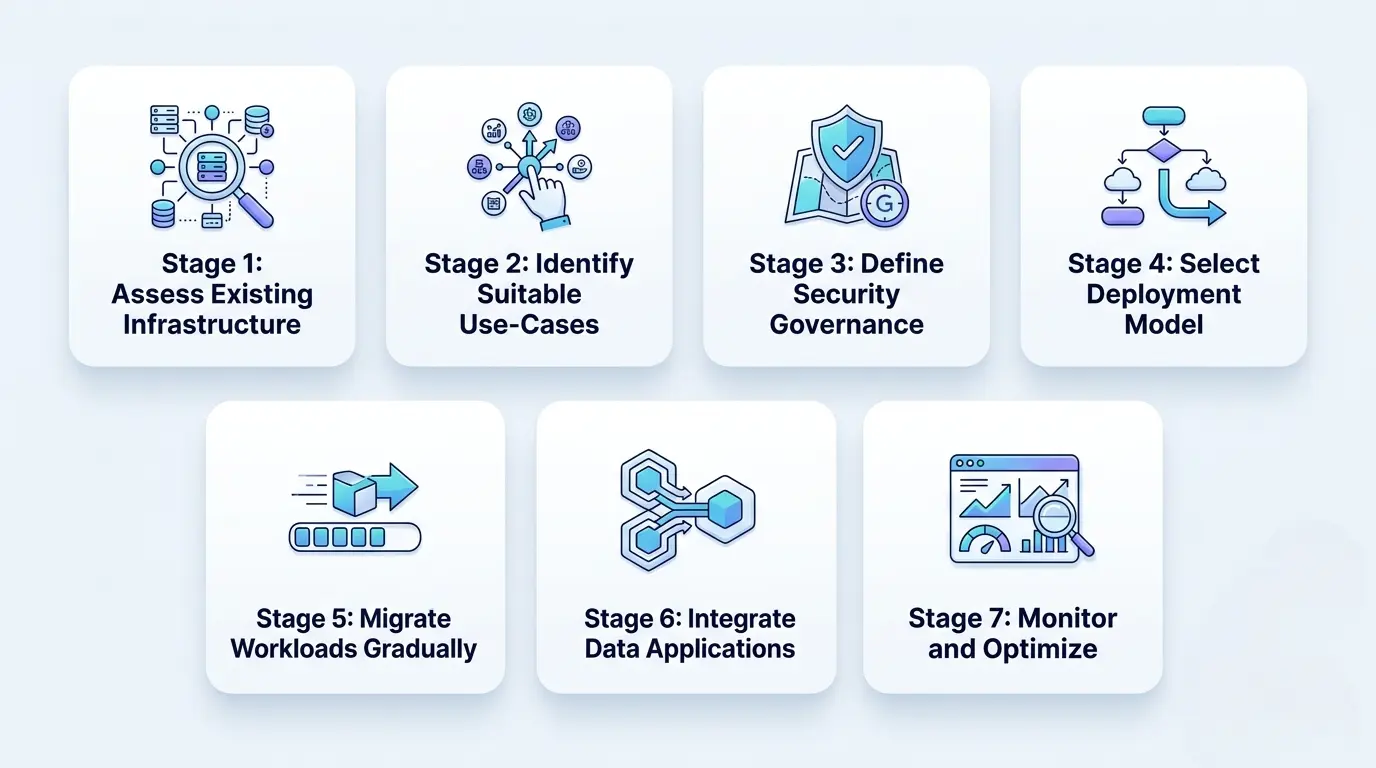
A successful cloud transformation requires more than selecting a cloud provider. Oil and gas companies need a structured implementation strategy that considers existing infrastructure, operational requirements, security, data integration, compliance, and long-term scalability.
A phased approach allows organizations to evaluate their current environment, prioritize suitable workloads, reduce migration risks, and gradually expand cloud adoption based on measurable business and operational value.
Stage 1: Assess Existing Infrastructure
The first step is to understand the organization’s current technology environment. This includes documenting applications, databases, operational systems, data sources, integrations, networks, and existing infrastructure. Organizations should also classify workloads based on business importance, technical complexity, security requirements, data sensitivity, and suitability for cloud migration.
This assessment helps determine which systems should be migrated, modernized, retained on existing infrastructure, or replaced. It also gives teams a clearer understanding of application dependencies, potential migration challenges, infrastructure gaps, and the resources required for a successful cloud transformation.
Organizations should also evaluate existing hardware capacity, software dependencies, network connectivity, data volumes, and system performance. A detailed infrastructure assessment provides the baseline needed to estimate migration effort, identify modernization opportunities, and establish realistic implementation priorities.
Stage 2: Identify Suitable Use Cases
Not every workload needs to move to the cloud immediately. Organizations should prioritize use cases where cloud technology can deliver measurable operational or financial value. Common opportunities include data analytics, predictive maintenance, remote monitoring, production reporting, data platforms, and selected business applications.
Starting with well-defined use cases allows teams to validate cloud technologies before expanding adoption across the organization. Companies can measure improvements in areas such as operational efficiency, data accessibility, scalability, and application performance while minimizing unnecessary migration costs.
Use cases should also be evaluated according to their business impact, technical feasibility, data requirements, and expected return on investment. Prioritizing these factors helps organizations focus their initial cloud efforts on workloads that can demonstrate tangible value and support broader transformation goals.
Stage 3: Define Security and Governance Requirements
Security and governance requirements should be established before migration begins. Organizations need to define policies for identity and access management, encryption, monitoring, data classification, retention, compliance, backup, and incident response. These requirements should directly influence cloud architecture and technology decisions.
This approach is particularly important for oil and gas companies that manage sensitive operational information and critical infrastructure. Establishing governance early also helps maintain consistent security controls, regulatory compliance, and accountability as cloud adoption expands.
Organizations should also define clear responsibilities for managing cloud resources, data, access permissions, security incidents, and compliance activities. Regular audits and policy reviews can help ensure that governance requirements remain aligned with changing operational risks and cloud environments.
Stage 4: Select a Deployment Model
Organizations must determine whether each workload is best suited to public cloud, private cloud, hybrid cloud, or multi-cloud infrastructure. The decision should consider security, connectivity, performance, regulatory requirements, scalability, existing infrastructure, and cost.
A hybrid approach may be suitable when companies need to retain certain operational workloads on-premises while using cloud infrastructure for analytics, applications, or data processing. The deployment model should ultimately align with the technical and operational requirements of each workload rather than following a one-size-fits-all approach.
Organizations should also evaluate how the selected deployment model will affect future scalability and integration. Choosing an appropriate architecture early can make it easier to accommodate new applications, connect additional data sources, and expand cloud capabilities as business requirements evolve.
Stage 5: Migrate Workloads in Phases
A phased migration approach can reduce the risks associated with moving multiple systems simultaneously. Organizations can begin with lower-risk workloads, test the cloud architecture, evaluate performance, and address technical issues before migrating more critical applications.
Each migration phase should have clearly defined objectives, dependencies, security controls, testing requirements, and rollback procedures. This enables teams to learn from early migration activities and apply those lessons when moving more complex or business-critical workloads.
Before each migration, teams should validate data integrity, application compatibility, connectivity, and recovery procedures. Post-migration testing should then confirm that applications perform as expected and that operational teams can manage the new cloud environment effectively.
Stage 6: Integrate Data and Applications
Cloud environments need to work alongside existing operational and enterprise systems. Organizations can use APIs, integration platforms, data pipelines, and event-driven architectures to connect cloud applications with systems such as SCADA, ERP, production, maintenance, and analytics platforms.
Effective integration allows data to move between operational and business environments while reducing isolated data silos. It can also provide teams with more consistent access to information for monitoring, analytics, reporting, and decision-making.
Data integration should be designed around reliability, security, and real-time requirements. For example, operational systems may require continuous data flows for monitoring, while enterprise applications may rely on scheduled data synchronization. Designing integrations according to these requirements helps maintain data consistency across the environment.
Stage 7: Monitor and Optimise
Cloud implementation does not end when workloads are migrated. Organizations should continuously monitor performance, security, availability, resource utilization, data flows, and cloud spending to ensure that the environment continues to meet operational requirements.
Regular reviews can help identify underutilized resources, performance bottlenecks, security gaps, and opportunities for cost optimization. Treating cloud transformation as an ongoing optimization process allows oil and gas organizations to adapt their infrastructure as workloads, technologies, and business priorities evolve.
Organizations should establish clear performance and cost metrics to evaluate the effectiveness of their cloud environment over time. Continuous monitoring and optimization can help maintain system reliability, control cloud expenditure, improve resource utilization, and support long-term operational efficiency.
Future of Cloud Computing in Oil and Gas
The future of cloud technology in oil and gas is closely linked with AI, IoT, edge computing, digital twins, and automation. AI can analyse operational data to detect patterns, identify anomalies, support forecasting, and improve decision-making, while cloud platforms provide the scalable infrastructure needed for these workloads. IoT devices can collect real-time data from physical assets, which can be combined with engineering models and historical data to create digital twins for monitoring, simulation, predictive analysis, and optimisation.
Cloud and edge computing will increasingly work together, with edge systems processing latency-sensitive data closer to field assets and cloud platforms supporting centralised storage, advanced analytics, machine learning, and cross-site visibility. As sensors, AI, robotics, remote monitoring, and automated workflows become more integrated, oil and gas companies can move toward more autonomous and remote operations, creating connected environments where data flows securely between field assets, edge systems, cloud platforms, analytics tools, and business applications.
Final Thoughts
Cloud computing is becoming an important part of digital transformation across the oil and gas value chain. It supports exploration, production optimization, predictive maintenance, remote monitoring, logistics, and environmental management through scalable infrastructure and connected data systems.
Successful adoption requires more than migrating applications to the cloud. Companies must consider legacy systems, operational technology, connectivity, cybersecurity, data architecture, integration, and governance. Hybrid environments can help connect existing infrastructure with modern cloud capabilities.
Cost management is equally important. Organizations should monitor compute, storage, data transfer, security, and AI workloads to control spending. Partnering with a reliable cloud app development company can help build scalable solutions aligned with operational requirements and support future adoption of AI, IoT, predictive analytics, and edge computing.
FAQs
1. How is cloud computing used in the oil and gas industry?
Cloud computing is used for seismic processing, production analytics, predictive maintenance, remote monitoring, supply chain management, environmental monitoring, business intelligence, and enterprise applications. Cloud platforms can also support AI, machine learning, IoT, and digital twin workloads. For organizations managing equipment, spare parts, and materials across multiple facilities, a cloud-based warehouse management system can provide centralized inventory visibility and improve coordination across locations.
2. What are the main benefits of cloud computing for oil and gas companies?
The major benefits include scalable infrastructure, centralized data access, improved collaboration, support for AI and IoT, flexible computing capacity, and improved operational visibility. The actual benefits depend on workload selection, architecture, governance, and implementation.
3. How much does cloud computing cost for an oil and gas company?
There is no fixed cost because cloud expenditure depends on data volumes, compute requirements, storage, data transfer, application complexity, AI workloads, security controls, and deployment model. Organizations should estimate costs based on actual workloads rather than using a generic industry figure.
4. What type of cloud architecture is used in the oil and gas industry?
Oil and gas companies often use architectures that connect field equipment, SCADA systems, edge infrastructure, cloud platforms, data systems, analytics, applications, and security controls. Hybrid architecture can be useful where existing operational technology needs to work alongside modern cloud infrastructure.
5. Is cloud computing secure for oil and gas operations?
Cloud platforms can support strong security controls, but security depends on architecture and implementation. Identity management, encryption, access control, network segmentation, monitoring, backup, governance, endpoint security, and connected-device protection all need to be addressed.
6. Should oil and gas companies use public, private, or hybrid cloud?
The appropriate model depends on individual workload requirements. Public cloud can support scalable analytics and applications, private cloud can provide greater infrastructure control, and hybrid cloud can connect existing operational systems with cloud environments. Organizations should evaluate security, performance, connectivity, compliance, scalability, and cost before selecting a model.
Discuss your project and request for proposal
SHARE
WRITTEN BY

Ishan Gupta
CEO & Founder
Ishan Gupta is a seasoned entrepreneur and CEO with extensive 10+ years of experience in business and mobile app development landscape. He believes that the right digital product allows companies to focus on what they do best, while technology handles the rest. With deep exposure to global markets, he understands what makes an app succeed. His approach translates business needs into clear product strategies, ensuring that every feature contributes to measurable ROI.
View All Articles