

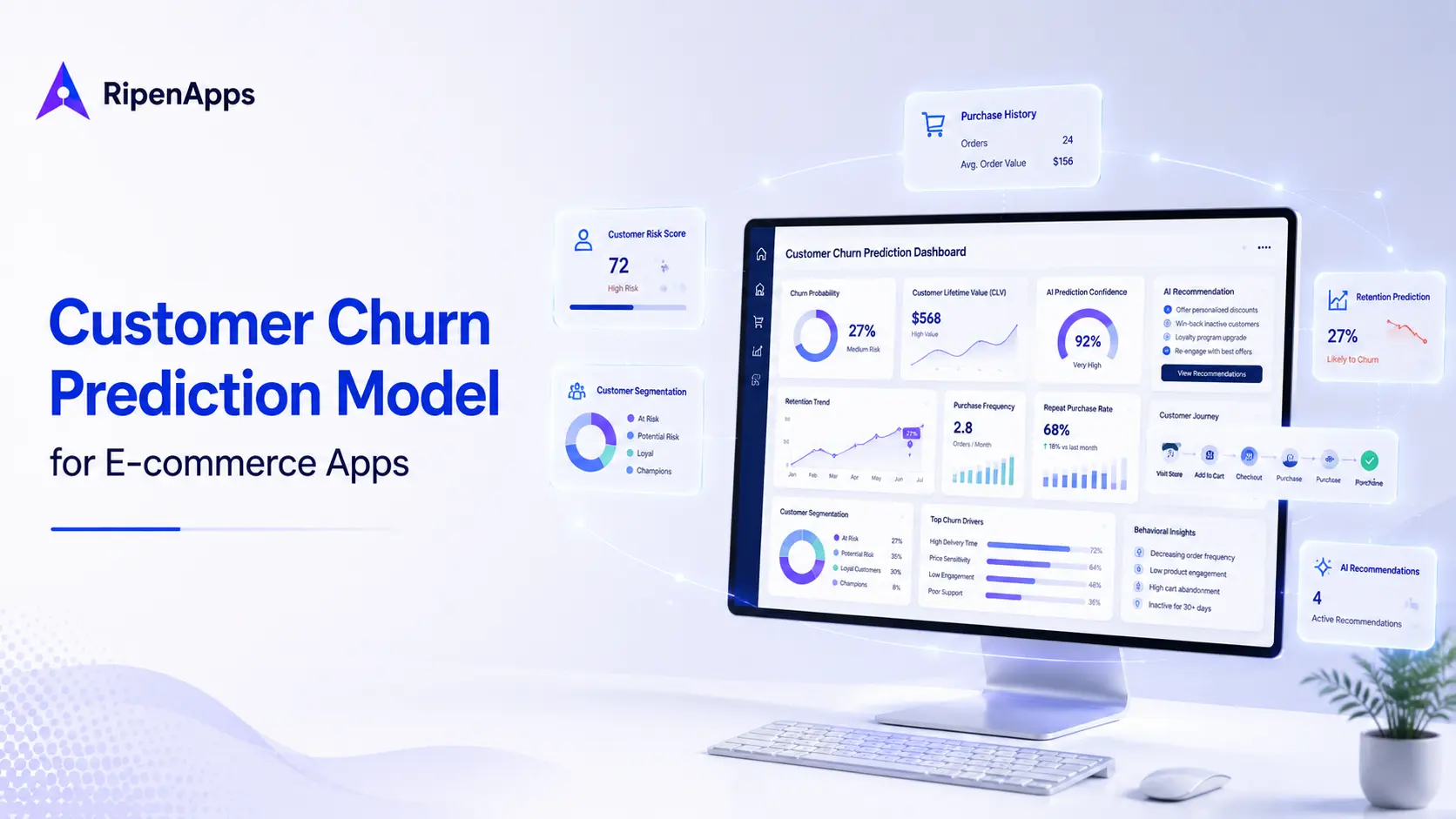

Key Takeaways
- Customer churn prediction enables ecommerce businesses to identify at-risk customers early and implement personalised retention strategies before revenue declines.
- High-quality customer data and appropriate machine learning models are essential for building accurate, scalable, and reliable churn prediction systems.
- Predictive analytics improves customer retention, marketing efficiency, demand forecasting, and personalised shopping experiences across modern ecommerce platforms.
- A structured seven-step implementation framework helps businesses deploy customer churn prediction models that deliver measurable long-term business value.
- Combining predictive analytics with continuous monitoring and optimisation ensures churn prediction models remain accurate as customer behaviour evolves.
Every ecommerce business invests heavily in acquiring new customers, but long-term growth depends on retaining them. Unfortunately, many businesses only recognise customer churn after users have already stopped purchasing, making it far more expensive to win them back than to retain them.
This is where customer churn prediction for ecommerce becomes a strategic advantage. Instead of reacting to customer losses, businesses can use predictive analytics to identify early warning signs, understand customer behaviour, and intervene before valuable customers abandon the brand.
Modern machine learning models analyse purchasing patterns, browsing behaviour, engagement history, and other behavioural signals to estimate which customers are most likely to churn, allowing businesses to personalise retention strategies at the right moment. Many organisations also leverage AI strategy and consulting services to identify the right predictive analytics approach, align AI initiatives with business goals, and maximise long-term customer retention outcomes.
As ecommerce becomes increasingly competitive, predictive analytics is no longer limited to large enterprises with dedicated data science teams. Businesses of every size are adopting AI-driven customer analytics to improve retention, increase customer lifetime value, optimise marketing investments, and deliver more personalised shopping experiences.
In this guide, you’ll learn how customer churn prediction models work, the data required to build them, which machine learning approaches are most effective, and how ecommerce businesses can measure the return on investment from predictive analytics initiatives.
Table of Contents
What is Customer Churn Prediction in E-commerce?
Customer churn prediction for ecommerce is the process of using predictive analytics and machine learning to identify customers who are most likely to stop purchasing from an online store, enabling businesses to take proactive actions that improve retention and maximise customer lifetime value.
Rather than relying on assumptions or historical reports, predictive analytics analyses customer behaviour continuously to uncover patterns that indicate declining engagement. These insights help businesses intervene before customers leave, whether through personalised offers, loyalty rewards, targeted marketing campaigns, or improved customer experiences.
Unlike traditional reporting, which explains what has already happened, churn prediction focuses on what is likely to happen next. This forward-looking approach enables ecommerce teams to allocate marketing budgets more effectively, prioritise high-value customers, and make faster, data-driven decisions that support long-term business growth.
How Predictive Analytics Identifies Customers at Risk of Leaving
Every interaction a customer has with an ecommerce platform creates valuable behavioural data. Purchase frequency, browsing sessions, abandoned carts, product preferences, email engagement, customer support interactions, and mobile app activity collectively reveal changing customer behaviour over time.
Predictive analytics for mobile apps combines these signals to identify patterns associated with customer attrition. Machine learning models evaluate historical customer behaviour alongside current activity to estimate the likelihood of churn. Customers displaying similar behavioural patterns to previously lost customers receive higher churn risk scores, allowing businesses to respond before disengagement becomes permanent.
For example, a customer whose purchase frequency declines, opens fewer promotional emails, spends less time browsing products, and abandons multiple shopping carts may be identified as high risk. Instead of waiting until the customer disappears entirely, ecommerce businesses can proactively personalise incentives, recommendations, or support interactions to improve retention.
This predictive approach shifts customer retention from reactive problem-solving to proactive customer relationship management.
Customer Churn Prediction vs Traditional Customer Segmentation
Traditional customer segmentation groups customers according to demographic characteristics, purchasing habits, geographic location, or historical spending patterns. While segmentation helps businesses understand different customer groups, it does not indicate which customers are about to leave.
Customer churn prediction adds another layer of intelligence by evaluating future behavioural risk rather than simply describing existing customer categories.
A customer classified as a loyal, high-spending shopper may still exhibit behavioural changes suggesting an increased likelihood of churn. Conversely, a relatively new customer may demonstrate engagement patterns indicating strong long-term retention potential.
By combining predictive analytics with customer segmentation, ecommerce businesses gain a more complete understanding of both who their customers are and how their future behaviour is likely to evolve. This enables marketing teams, product managers, and customer success teams to deliver more targeted and timely retention revenue strategies.
Why Customer Churn Is One of the Biggest Challenges for E-commerce Businesses
Customer acquisition remains essential for ecommerce growth, but retaining existing customers often determines long-term profitability. As competition intensifies across digital commerce, businesses face increasing pressure to maximise customer lifetime value while controlling marketing costs. Losing existing customers not only reduces revenue but also increases the investment required to replace them.
Customer churn directly affects business performance across multiple functions, from marketing efficiency to inventory planning and customer experience. Understanding why churn matters is the first step towards building an effective customer retention strategy.
Rising Customer Acquisition Costs
Acquiring new customers has become increasingly expensive as digital advertising platforms become more competitive and customer expectations continue to rise. Businesses invest heavily in paid advertising, social media campaigns, influencer partnerships, search marketing, and promotional offers to attract new shoppers.
When newly acquired customers fail to make repeat purchases, these acquisition costs become significantly more difficult to recover. High customer churn forces businesses to continually replace lost customers simply to maintain existing revenue levels.
Predictive analytics helps reduce this dependency on constant customer acquisition by identifying opportunities to retain existing customers before they leave, improving the efficiency of overall marketing investments.
Why Repeat Customers Drive Long-Term Profitability
Repeat customers typically generate more value over time than first-time buyers. As customer relationships strengthen, businesses benefit from increased purchasing frequency, higher average order values, stronger brand loyalty, and greater opportunities for cross-selling and upselling.
Returning customers also require less marketing effort than acquiring entirely new audiences because they are already familiar with the brand and purchasing experience.
By identifying customers who are most likely to discontinue purchasing, predictive analytics enables businesses to strengthen these valuable relationships through personalised engagement strategies before customer loyalty declines.
Improving customer retention ultimately supports sustainable revenue growth while reducing dependence on increasingly expensive acquisition channels.
The Hidden Cost of Customer Churn
The financial impact of customer churn extends well beyond lost sales. Every departing customer represents lost future purchases, reduced customer lifetime value, missed cross-selling opportunities, and lower marketing efficiency.
Customer churn also creates operational challenges. Businesses may struggle with inaccurate demand forecasting, ineffective inventory planning, declining customer engagement metrics, and lower return on marketing investments.
Because many businesses only recognise churn after customers have already left, valuable intervention opportunities are often missed. Predictive analytics addresses this challenge by identifying behavioural warning signs much earlier, allowing businesses to implement targeted retention campaigns while customers remain engaged with the brand.
8 Predictive Analytics Use Cases in E-commerce
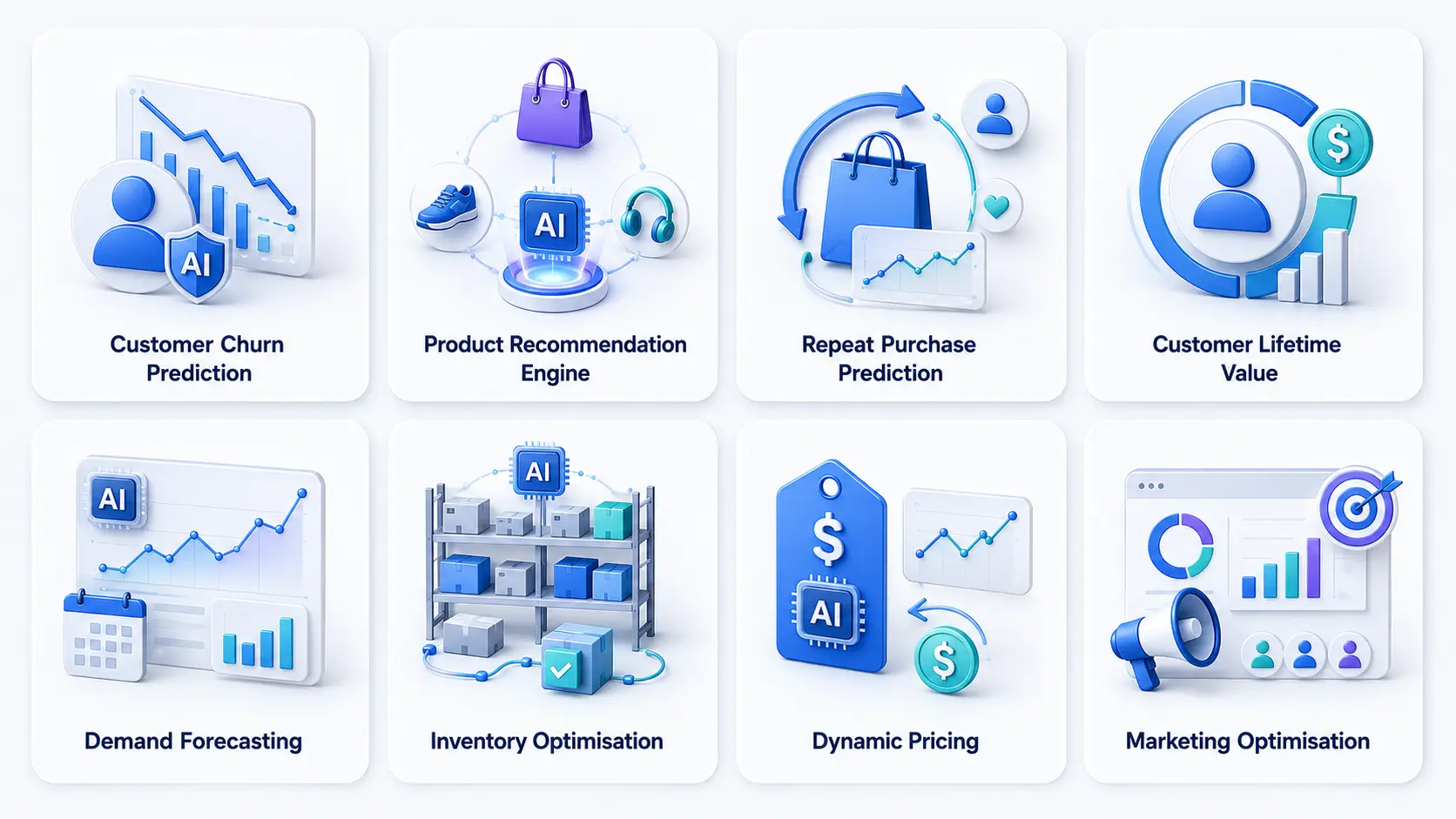
Predictive analytics supports far more than customer retention alone. Modern ecommerce businesses use machine learning models to improve decision-making across marketing, merchandising, inventory management, pricing, and customer experience.
The following use cases demonstrate how predictive analytics transforms customer data into measurable business value.
Customer Churn Prediction
Customer churn prediction identifies customers who are most likely to stop purchasing so businesses can intervene before they leave. This is one of the highest-value applications of predictive analytics because retaining existing customers is often more cost-effective than continuously acquiring new ones.
By analysing historical purchases, browsing activity, engagement levels, and behavioural changes, ecommerce businesses can prioritise retention campaigns for customers with the highest predicted churn risk. This approach supports more personalised communication, loyalty initiatives, promotional strategies, and customer support interventions that improve long-term retention.
For businesses investing in an eCommerce app development company, integrating churn prediction directly into digital commerce platforms enables continuous monitoring of customer behaviour and proactive retention strategies.
Product Recommendation Engines
Recommendation engines personalise product suggestions based on customer behaviour, purchasing history, and browsing patterns. Rather than presenting identical product catalogues to every visitor, predictive analytics helps ecommerce platforms recommend products most relevant to each individual customer.
These personalised recommendations improve customer engagement, encourage larger basket sizes, and create more satisfying shopping experiences. Businesses that align these capabilities with a well-defined AI strategy for digital products are better positioned to deliver scalable personalisation and long-term customer retention.
The implementation expertise demonstrated through projects such as Cobone illustrates how AI in product development enables scalable digital commerce platforms to deliver personalised customer experiences within modern ecommerce environments.
Repeat Purchase Prediction
Repeat purchase prediction estimates which customers are most likely to make another purchase within a specific timeframe. Understanding repeat purchase behaviour allows marketing teams to schedule campaigns more effectively, optimise promotional timing, and deliver personalised offers when customers are most receptive.
Rather than sending generic campaigns to every customer, businesses can focus retention efforts where they are most likely to generate measurable results.
Customer Lifetime Value Prediction
Customer lifetime value prediction estimates the long-term revenue potential of individual customers. Not every customer contributes equally to business growth. Predictive analytics helps identify customers with the highest future value, enabling businesses to prioritise premium support, loyalty programmes, exclusive offers, and personalised engagement strategies. This allows marketing budgets and customer success efforts to be allocated more efficiently.
Demand Forecasting
Demand forecasting predicts future product demand using historical sales data, seasonal trends, and customer purchasing behaviour. More accurate forecasts enable ecommerce businesses to improve inventory planning, reduce stock shortages, and minimise excess inventory.
Implementation experience from Ebease demonstrates how ecommerce platforms benefit from stronger retail technology foundations that support better customer experiences and operational decision-making.
Inventory Optimisation
Inventory optimisation uses predictive insights to maintain appropriate stock levels while reducing waste and operational inefficiencies. By anticipating purchasing trends before they occur, businesses can balance inventory availability with customer demand, improving fulfilment performance while reducing storage costs.
Dynamic Pricing Optimisation
Dynamic pricing optimisation adjusts product pricing based on predicted customer demand, market conditions, and purchasing behaviour. Rather than relying solely on fixed pricing strategies, predictive analytics enables businesses to respond more effectively to changing customer demand and competitive conditions while protecting profitability.
Marketing Campaign Optimisation
Marketing campaign optimisation identifies which campaigns, channels, and customer segments are most likely to deliver successful outcomes. Predictive analytics helps marketing teams prioritise customers who are more likely to respond positively to personalised messaging, promotional offers, and retention campaigns. Instead of distributing budgets evenly across all audiences, businesses can invest where predictive insights indicate the highest potential return.
Machine Learning Models for Customer Churn Prediction: Which One Should You Use?
Selecting the right machine learning model is one of the most important decisions when building a customer churn prediction model. The ideal model depends on the quality of available customer data, the complexity of customer behaviour, business objectives, and the level of prediction accuracy required.
Some organisations prioritise model transparency so business teams can easily understand why a customer is predicted to churn. Others focus on achieving the highest possible prediction accuracy, even if the model becomes more complex. Rather than searching for a universally “best” algorithm, ecommerce businesses should evaluate machine learning models according to their specific business goals, technical resources, and operational requirements.
The following models are among the most commonly used approaches for customer churn prediction.
| Machine Learning Model | Accuracy | Complexity | Best Use Case | Advantages | Limitations |
| Logistic Regression | Moderate | Low | Simple churn prediction with structured customer data | Easy to understand and implement | May not capture complex behavioural patterns |
| Decision Trees | Moderate to High | Low | Businesses needing explainable predictions | Easy visual interpretation | Can overfit without optimisation |
| Random Forest | High | Medium | Large customer datasets with multiple behavioural variables | Strong prediction performance and stability | Less interpretable than individual trees |
| Gradient Boosting (XGBoost, LightGBM) | Very High | High | High-accuracy customer churn prediction | Excellent predictive performance | Higher computational requirements |
| Neural Networks | High | Very High | Large-scale ecommerce platforms with extensive customer data | Captures complex customer behaviour | Requires significant data and expertise |
Logistic Regression
Logistic regression remains one of the most widely used algorithms for customer churn prediction because it provides a strong balance between simplicity, speed, and interpretability.
The model estimates the probability that a customer will churn by analysing relationships between customer attributes and historical outcomes. Features such as purchase frequency, average order value, browsing activity, loyalty programme participation, and marketing engagement can all contribute to the prediction.
One of the greatest strengths of logistic regression is its transparency. Business teams can understand which factors contribute most to churn, making it easier to explain predictions and design targeted retention strategies. For organisations beginning their predictive analytics journey, logistic regression often provides a reliable baseline model before moving towards more sophisticated machine learning techniques.
Decision Trees and Random Forests
Decision trees predict customer churn by repeatedly splitting customer data into smaller groups based on behavioural characteristics. For example, the model may first separate customers according to purchase frequency before evaluating browsing behaviour, customer support interactions, or engagement history. The resulting decision structure makes predictions relatively easy to understand.
Random forests build upon this concept by combining many decision trees rather than relying on a single one. Each tree analyses customer behaviour slightly differently, and their combined predictions produce more accurate and stable results.
Compared with individual decision trees, random forests generally reduce overfitting and perform better when analysing complex customer datasets containing numerous behavioural variables. These models are well suited for ecommerce businesses that require both strong predictive performance and reasonable interpretability.
Gradient Boosting (XGBoost, LightGBM)
Gradient boosting algorithms such as XGBoost and LightGBM are widely recognised for delivering highly accurate customer churn predictions. Rather than creating multiple independent models, gradient boosting builds a sequence of models that continuously improve upon previous prediction errors. Each new model focuses on correcting mistakes made by earlier models, gradually increasing prediction accuracy.
Because ecommerce customer behaviour often depends on numerous interconnected variables, gradient boosting can capture complex relationships that simpler algorithms may overlook. These models are particularly valuable for businesses with large customer datasets and sufficient technical resources to train, optimise, and maintain advanced machine learning systems.
Neural Networks and Deep Learning
Neural networks are designed to identify highly complex patterns within customer data that traditional machine learning models may struggle to detect. By analysing numerous behavioural variables simultaneously, deep learning models can recognise subtle interactions between purchasing habits, browsing activity, marketing engagement, customer support history, and many other factors.
Large ecommerce marketplaces with extensive customer datasets often use neural networks for sophisticated predictive analytics applications because they can continually improve as more customer data becomes available. This growing adoption also highlights the broader role of AI in product development, where intelligent models help businesses build more personalised, scalable, and data-driven digital products.
However, these models typically require greater computational resources, longer training times, and specialised expertise than traditional machine learning approaches. Businesses should therefore carefully evaluate whether the additional complexity provides meaningful business value compared with more interpretable alternatives.
Choosing the Right Model Based on Business Goals
There is no single machine learning model that suits every ecommerce business. Businesses seeking transparency and rapid implementation may begin with logistic regression or decision trees. Organisations handling larger customer datasets often benefit from random forests or gradient boosting because of their higher prediction accuracy. Deep learning becomes increasingly valuable when customer behaviour is highly complex and large volumes of behavioural data are available.
Ultimately, the right model should balance prediction accuracy, implementation complexity, explainability, scalability, and ongoing maintenance requirements. Selecting the appropriate algorithm ensures that predictive insights remain practical, actionable, and aligned with long-term business objectives.
What Data Powers Customer Churn Prediction Models?
The effectiveness of any customer churn prediction model depends on the quality of the underlying data. Even the most sophisticated machine learning algorithm cannot produce reliable predictions if customer information is incomplete, inaccurate, or inconsistent.
Successful customer behaviour analytics combines multiple sources of customer information to create a comprehensive understanding of purchasing habits, engagement patterns, and behavioural changes over time. Rather than relying on a single dataset, ecommerce businesses typically integrate behavioural, transactional, and operational information to improve prediction accuracy. Collecting and validating this data during the product discovery phase also helps businesses identify the right data sources, define prediction objectives, and establish a stronger foundation for building effective churn prediction models.
| Data Category | Example Information | Contribution to Churn Prediction |
| Customer Purchase History | Purchase frequency, order value, product categories | Identifies changing buying patterns |
| Website & App Behaviour | Browsing sessions, page views, abandoned carts | Detects declining customer engagement |
| Customer Engagement | Email opens, campaign clicks, loyalty participation | Measures ongoing customer interaction |
| Customer Support & Feedback | Support tickets, complaints, satisfaction ratings | Reveals dissatisfaction before churn occurs |
Customer Purchase History
Purchase history forms the foundation of most customer churn prediction models. Historical transactions provide valuable insights into purchasing frequency, average order value, preferred product categories, seasonal buying behaviour, payment methods, and repeat purchase patterns.
Machine learning algorithms analyse these historical trends to determine whether customer behaviour is changing over time. A gradual reduction in purchasing frequency or spending often provides an early indication of increasing churn risk. Because purchasing behaviour directly reflects customer value and engagement, transaction data typically becomes one of the strongest predictors within a churn prediction model.
Website and App Behaviour
Customer interactions across ecommerce websites and mobile applications provide additional behavioural signals that may indicate declining engagement. Browsing frequency, session duration, product searches, product views, wishlist activity, abandoned shopping carts, navigation patterns, and mobile app usage collectively reveal how actively customers continue interacting with the platform.
Customers who gradually reduce browsing activity or abandon purchases repeatedly may demonstrate behavioural changes that precede complete customer churn. Analysing these digital interactions enables predictive analytics models to identify behavioural shifts before they become visible through purchasing data alone.
Customer Engagement and Marketing Interactions
Marketing engagement provides another important source of predictive insight. Customer responses to email campaigns, push notifications, promotional offers, loyalty programmes, referral initiatives, and personalised recommendations help measure ongoing customer interest in the brand.
Declining email open rates, fewer campaign interactions, reduced loyalty programme participation, or lower response rates may indicate weakening customer relationships. When combined with transactional and behavioural data, marketing engagement helps create a more comprehensive picture of customer retention risk.
Customer Support and Feedback Data
Customer support interactions often reveal dissatisfaction before customers completely disengage. Support tickets, complaint history, return requests, product reviews, customer satisfaction surveys, and feedback submissions provide valuable context that purchasing behaviour alone cannot capture.
Customers experiencing unresolved issues may continue making purchases temporarily while gradually losing confidence in the brand. Incorporating support and feedback data allows machine learning models to detect these hidden behavioural signals earlier.
Including customer experience metrics also helps businesses design more personalised retention strategies based on the underlying causes of dissatisfaction rather than relying solely on promotional incentives.
Data Quality: The Foundation of Accurate Predictions
Accurate customer churn prediction depends not only on collecting large amounts of customer information but also on maintaining high-quality data. Duplicate customer records, missing values, inconsistent data formats, outdated information, and disconnected systems can significantly reduce prediction accuracy.
Businesses should establish consistent data collection practices, validate incoming customer information, and integrate customer data across ecommerce platforms, marketing systems, CRM platforms, and customer support tools before developing predictive models.
High-quality data enables machine learning models to generate reliable predictions that support better business decisions, stronger customer retention strategies, and more effective long-term growth planning. This data foundation is equally important for successfully implementing machine learning in Android app development, where model performance depends on accurate, well-structured data.
How to Build a Customer Churn Prediction Model: A 7-Step Framework
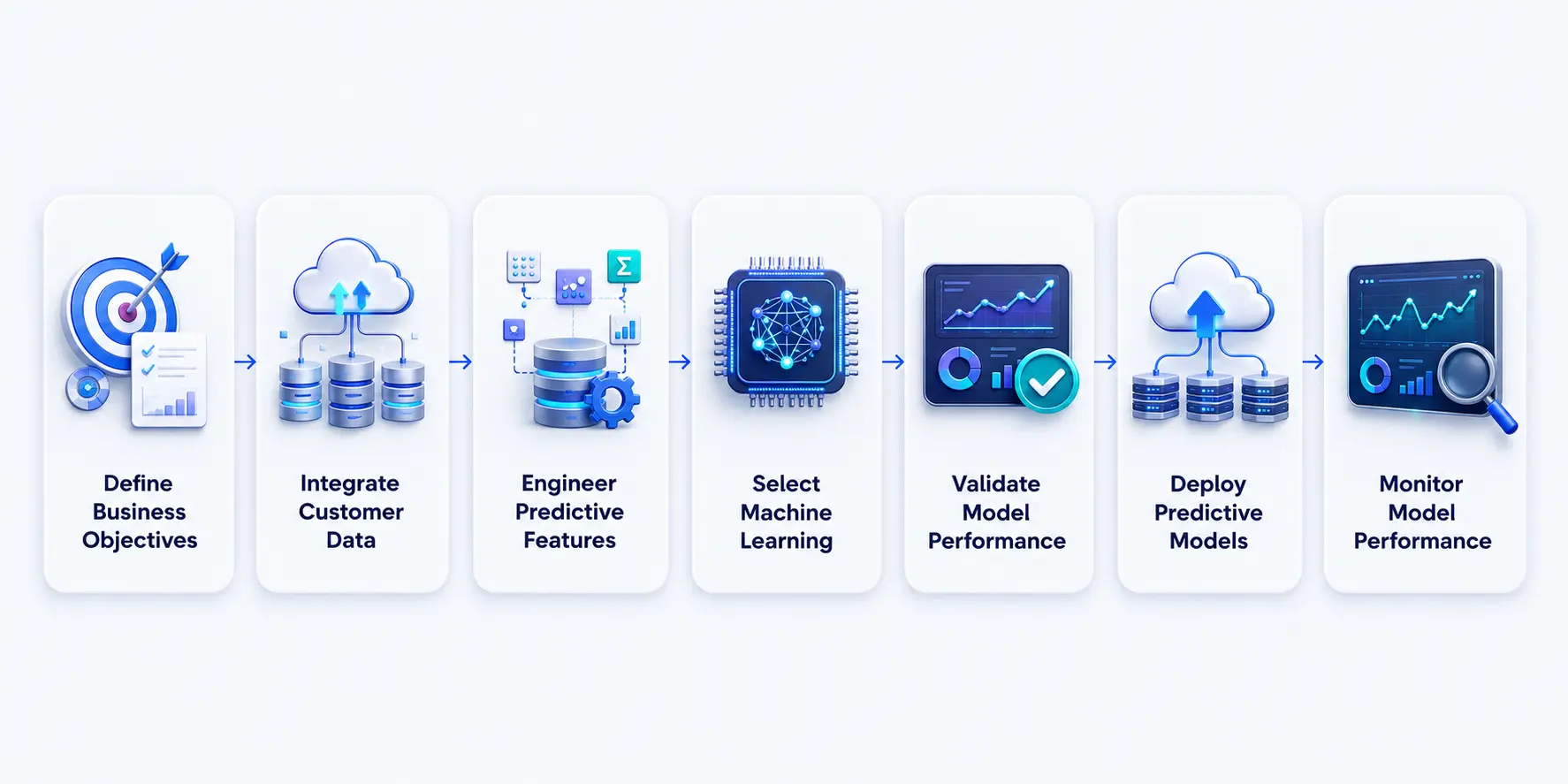
Building an effective customer churn prediction model requires more than selecting a machine learning algorithm. Success depends on combining high-quality customer data, well-defined business objectives, continuous model improvement, and operational integration that allows predictive insights to influence real business decisions.
The following framework outlines a structured approach that ecommerce businesses can follow when implementing customer churn prediction.
Step 1: Define Business Objectives and Churn Criteria
Before building any predictive model, businesses must establish exactly what customer churn means within their organisation. For one ecommerce business, churn may represent six months without a purchase. For another, it may involve declining engagement despite regular browsing activity. Clearly defining churn ensures that machine learning models learn from consistent historical examples.
Businesses should also identify how churn predictions will support broader objectives such as improving retention, increasing repeat purchases, strengthening customer lifetime value, or optimising marketing investments.
Step 2: Collect and Integrate Customer Data
The next stage involves gathering customer information from every relevant source. Purchase history, website activity, mobile app behaviour, marketing interactions, customer support records, loyalty programmes, and CRM platforms should all contribute to a unified customer profile. Integrating these datasets enables predictive models to analyse customer behaviour from multiple perspectives rather than relying on isolated information.
Step 3: Prepare and Engineer Predictive Features
Raw customer data rarely performs well without preparation. Businesses should clean duplicate records, address missing values, standardise formats, and transform raw information into meaningful predictive features.
Examples include purchase frequency, days since the last purchase, average basket value, browsing consistency, campaign engagement rates, and loyalty participation scores. Well-designed features significantly improve machine learning performance and prediction reliability.
Step 4: Select the Appropriate Machine Learning Model
Once customer data has been prepared, businesses can evaluate different machine learning algorithms according to their objectives. Simpler models may provide sufficient accuracy for straightforward retention strategies, while larger ecommerce platforms with extensive behavioural datasets may benefit from more advanced algorithms. The selected model should balance prediction accuracy with explainability, scalability, implementation complexity, and long-term maintenance requirements.
Step 5: Train, Validate, and Evaluate Model Performance
Training involves teaching the machine learning model using historical customer data where churn outcomes are already known. The model should then be validated using separate datasets to measure how accurately it predicts customer behaviour it has never previously encountered. Businesses should evaluate prediction accuracy alongside other performance metrics to ensure the model consistently identifies at-risk customers while minimising incorrect predictions.
Step 6: Deploy the Model Within Business Operations
A predictive model only creates value when its insights become part of everyday business processes. Churn scores can support personalised marketing campaigns, customer support prioritisation, loyalty initiatives, product recommendations, and customer success activities. Integrating predictive analytics into existing ecommerce operations allows businesses to respond proactively rather than waiting for customers to disengage completely.
Businesses building new ecommerce platforms should plan predictive analytics alongside other essential ecommerce app features during product planning to maximise long-term scalability and customer retention.
Step 7: Continuously Monitor and Improve Predictions
Customer behaviour constantly evolves as market conditions, purchasing habits, and competitive environments change. Machine learning models should therefore be monitored regularly to ensure prediction accuracy remains high over time.
Businesses should periodically retrain models using recent customer data, evaluate performance against current customer behaviour, and refine predictive features as new behavioural patterns emerge. Continuous improvement ensures customer churn prediction remains aligned with changing business needs and delivers long-term value.
Benefits of Predictive Analytics for E-commerce Businesses
Predictive analytics enables ecommerce businesses to move beyond reactive decision-making by anticipating customer behaviour before it affects revenue. Instead of analysing historical reports after opportunities have been missed, businesses can use predictive insights to improve customer retention, optimise marketing investments, personalise shopping experiences, and strengthen operational efficiency.
When implemented effectively, predictive analytics supports every stage of the customer journey while helping businesses make faster and more informed decisions. One of the most significant advantages is stronger customer retention. By identifying customers who are likely to disengage, businesses can introduce personalised offers, loyalty programmes, or targeted communication before those customers are lost. This proactive approach reduces customer churn while improving long-term relationships.
Predictive analytics also enhances personalisation across ecommerce platforms. AI Integration process and recommendation engines, product suggestions, and marketing campaigns become more relevant because they are based on predicted customer preferences rather than broad customer segments. As shopping experiences become increasingly personalised, customer engagement naturally improves.
Marketing efficiency is another major benefit. Instead of distributing advertising budgets equally across every customer segment, predictive insights help businesses prioritise audiences with the highest probability of responding positively. This improves campaign performance while reducing unnecessary marketing expenditure.
Operational planning also becomes more accurate. Demand forecasting and inventory optimisation allow ecommerce businesses to prepare for changing purchasing patterns, helping minimise stock shortages, excess inventory, and supply chain inefficiencies.
Ultimately, predictive analytics transforms customer data into actionable business intelligence that supports sustainable growth, improved customer experiences, and more confident strategic decision-making.
The ROI of Customer Churn Prediction
Customer churn prediction delivers value because it helps businesses retain customers who would otherwise be lost. While implementation requires investment in data infrastructure, machine learning, and operational processes, the long-term returns often extend across marketing, customer experience, and revenue growth.
Rather than evaluating return on investment through technology alone, ecommerce businesses should measure how predictive analytics influences customer retention, repeat purchases, and customer lifetime value.
Lower Customer Acquisition Costs
Acquiring new customers requires continuous investment in digital advertising, search marketing, influencer campaigns, and promotional activities.
When predictive analytics improves retention, businesses rely less heavily on constantly replacing lost customers. Existing customer relationships become more valuable, allowing acquisition budgets to generate stronger long-term returns. Reducing customer churn therefore contributes indirectly to lower acquisition costs while improving overall marketing efficiency.
Higher Repeat Purchases and Customer Lifetime Value
Customers who continue purchasing over longer periods contribute significantly more value than one-time buyers.
Predictive analytics helps identify customers whose purchasing behaviour is beginning to decline, allowing businesses to implement personalised retention strategies before disengagement occurs. Improving repeat purchases naturally increases customer lifetime value while strengthening long-term revenue stability.
Better Marketing ROI
Marketing campaigns become more effective when predictive analytics identifies customers who are most likely to respond positively.
Rather than sending identical campaigns to every customer, businesses can prioritise high-value customer segments, personalise communication, and optimise campaign timing using behavioural predictions. This improves marketing efficiency while reducing unnecessary promotional spending.
A Worked ROI Example
The following example illustrates how customer churn prediction can influence business performance. These figures are illustrative only and should not be interpreted as guaranteed business outcomes.
| Business Metric | Before Predictive Analytics | After Predictive Analytics |
| Monthly Active Customers | 100,000 | 100,000 |
| Monthly Churn Rate | 8% | 6% |
| Customers Retained | 92,000 | 94,000 |
| Repeat Purchase Rate | Moderate | Improved |
| Marketing Efficiency | Standard | Higher |
| Customer Lifetime Value | Baseline | Increased |
Even relatively small improvements in retention can produce meaningful long-term revenue gains because retained customers continue making purchases over multiple buying cycles.
The Predictive Analytics Readiness Scorecard
Before investing in customer churn prediction, businesses should evaluate whether they possess the organisational capabilities needed for successful implementation.
| Readiness Area | Key Consideration |
| Customer Data | Is sufficient behavioural and transactional data available? |
| AI Readiness | Can predictive models be supported operationally? |
| Platform Integration | Can customer data be connected across systems? |
| Analytics Capability | Are reporting and measurement processes established? |
| Business Goals | Are retention objectives clearly defined? |
| Team Readiness | Do business and technical teams support implementation? |
Businesses demonstrating strong readiness across these areas are generally better positioned to generate measurable value from predictive analytics initiatives.
Common Challenges When Implementing Customer Churn Prediction
Although predictive analytics offers significant business value, successful implementation requires more than selecting a machine learning model. Data quality, organisational readiness, operational integration, and continuous optimisation all influence long-term success.
Recognising these challenges early helps businesses develop more effective implementation strategies.
Poor-Quality Customer Data
Machine learning models depend entirely on the quality of the information they receive. Incomplete customer records, duplicate profiles, inconsistent data formats, and missing behavioural information reduce prediction accuracy and limit the effectiveness of retention strategies. Establishing strong data governance practices before implementation creates a more reliable foundation for predictive analytics.
Data Silos Across Multiple Platforms
Customer information is often distributed across ecommerce platforms, CRM systems, marketing automation tools, customer support software, and loyalty programmes. When these systems operate independently, predictive models receive only a partial view of customer behaviour. Integrating customer data into a unified environment enables machine learning models to generate more accurate and actionable predictions.
Model Drift and Changing Customer Behaviour
Customer behaviour evolves continuously as shopping habits, market conditions, seasonal trends, and competitive environments change. Machine learning models trained using historical customer behaviour may gradually become less accurate if they are not updated regularly. Continuous monitoring, periodic retraining, and ongoing performance evaluation help ensure predictive models remain aligned with current customer behaviour.
Privacy and Compliance Considerations
Customer churn prediction relies on analysing behavioural and transactional information, making responsible data management essential. Businesses should establish appropriate governance processes for collecting, storing, and using customer information while complying with applicable privacy and regulatory requirements. Strong data governance not only supports compliance but also strengthens customer trust in predictive analytics initiatives.
Final Thoughts
Customer retention has become one of the most important drivers of long-term ecommerce growth, making predictive analytics an increasingly valuable business capability. Rather than waiting until customers have already disengaged, businesses can use customer churn prediction to identify behavioural changes early, personalise customer experiences, optimise marketing investments, and improve long-term customer relationships.
Building an effective customer churn prediction model requires more than selecting the right machine learning algorithm. Success depends on combining high-quality customer data, appropriate predictive models, continuous optimisation, and business processes that translate predictive insights into measurable action. By following a structured implementation approach, ecommerce businesses can improve customer retention while creating more personalised and data-driven shopping experiences.
For organisations looking to accelerate implementation, partnering with a trusted predictive analytics consulting company can help transform customer data into practical business intelligence that supports sustainable ecommerce growth.
FAQs
1. What is customer churn prediction in ecommerce?
Customer churn prediction uses predictive analytics and machine learning to identify customers who are most likely to stop purchasing, enabling businesses to take proactive actions that improve retention before customers leave.
2. Why is customer churn prediction important for ecommerce businesses?
It helps businesses retain valuable customers, improve repeat purchases, increase customer lifetime value, optimise marketing investments, and reduce dependence on expensive customer acquisition activities.
3. Which machine learning model is best for customer churn prediction?
There is no single best model. Logistic regression, decision trees, random forests, gradient boosting, and neural networks each offer different advantages depending on business goals, customer data, and implementation complexity.
4. What data is required for customer churn prediction?
Successful models typically combine purchase history, website and app behaviour, marketing engagement, customer support interactions, and other customer behaviour analytics to improve prediction accuracy.
5. How does predictive analytics improve customer retention?
Predictive analytics identifies customers showing early signs of disengagement so businesses can introduce personalised offers, loyalty initiatives, or targeted communication before customers churn.
6. Can predictive analytics support demand forecasting?
Yes. Predictive analytics analyses historical purchasing behaviour and customer trends to help businesses forecast future demand and improve inventory planning.
7. What are the biggest implementation challenges?
Common challenges include poor-quality customer data, disconnected systems, model drift caused by changing customer behaviour, and privacy or compliance considerations.
8. How should businesses begin implementing customer churn prediction?
Businesses should first define clear retention objectives, prepare high-quality customer data, choose an appropriate machine learning model, and integrate predictive insights into everyday ecommerce operations.

SHARE
WRITTEN BY

Ishan Gupta
CEO & Founder
Ishan Gupta is a seasoned entrepreneur and CEO with extensive 8+ years of experience in business and mobile app development landscape. He believes that the right digital product allows companies to focus on what they do best, while technology handles the rest. With deep exposure to global markets, he understands what makes an app succeed. His approach translates business needs into clear product strategies, ensuring that every feature contributes to measurable ROI.
View All Articles






 India
India USA
USA Australia
 Canada
 UK
UK UAE
UAE