


Key Takeaways
- Native iOS apps provide strong security, high performance, and seamless integration with Apple’s healthcare ecosystem.
- Healthcare iOS app development costs range from $40,000 to $450,000+, depending on features, compliance, and integrations.
- HealthKit, CareKit, ResearchKit, and Apple Watch enable secure, connected healthcare experiences.
- Healthcare apps must comply with HIPAA, FDA, FTC, state privacy laws, and Apple’s health data guidelines.
- A structured development process reduces risks, speeds up delivery, and maximizes long-term ROI.
iOS Healthcare app development is the process of building secure, native healthcare applications for iPhone, iPad, and Apple Watch that support patient care, clinical workflows, and digital health services. Costs typically range from $40,000 to $450,000+, with timelines of 4–12+ months including compliance, testing, and App Store approval.
According to Statista’s Digital Health Outlook 2026, the global digital health market is expected to reach $177.77 billion in 2026, highlighting the increasing need for secure healthcare iOS applications. With advanced security, seamless device integration, and specialized healthcare frameworks, native iOS applications enable organizations to deliver secure, high-performance patient experiences while meeting evolving regulatory expectations.
Whether you are planning a telemedicine platform, remote patient monitoring solution, or patient engagement application, partnering with an experienced provider of iOS app development services can help you navigate Apple’s healthcare ecosystem, meet compliance requirements, optimize development costs, and maximize the long-term ROI of your healthcare product.
Table of Contents
What is iOS Healthcare App Development?
iOS Healthcare app development refers to the process of designing, developing, and maintaining native healthcare applications specifically for Apple’s ecosystem, including iPhone, iPad, and Apple Watch. These applications enable healthcare providers, hospitals, clinics, digital health startups, and wellness businesses to deliver digital services including telemedicine, remote patient monitoring, electronic health record access, medication management, and patient engagement.
Unlike platform-agnostic healthcare applications, native iOS solutions are built using Apple’s technologies, allowing developers to fully leverage device capabilities, system-level security, and healthcare frameworks. This approach delivers better performance, smoother user experiences, and stronger integration with Apple’s growing health ecosystem.
For healthcare organizations serving patients across the United States, native iOS development offers significant advantages because Apple’s devices are widely adopted among digitally engaged healthcare consumers. While this guide focuses exclusively on native iOS healthcare applications, businesses evaluating multiple platforms should first understand the broader healthcare product landscape in our healthcare app development guide before choosing the right technology stack for their product.
Why Native iOS Is a Strategic Choice for Healthcare
Healthcare applications manage highly sensitive patient information, making security, reliability, and performance top priorities. Apple’s tightly controlled hardware and software ecosystem creates a consistent environment that simplifies development, testing, and long-term maintenance.
Key advantages include:
- Strong device-level security architecture
- Consistent performance across Apple devices
- High-quality user experience
- Faster adoption of new iOS capabilities
- Better integration with healthcare wearables
- Greater patient confidence through Apple’s privacy-focused ecosystem
For healthcare startups and enterprises, these benefits translate into improved product quality, lower maintenance complexity, and stronger patient engagement over time.
Apple’s Healthcare Ecosystem
One of the biggest advantages of iOS healthcare app development is Apple’s healthcare technology stack. These frameworks help organizations build secure digital health experiences without developing healthcare functionality from scratch.
- HealthKit: Apple’s central health data framework that enables secure access to user-approved health metrics such as heart rate, activity, sleep, medications, and other wellness data for personalized healthcare experiences.
- CareKit: A framework designed for patient care applications, supporting treatment plans, symptom tracking, medication reminders, and ongoing patient engagement.
- ResearchKit: Enables healthcare researchers to create medical studies, collect participant data, manage consent, and conduct health research through iOS applications.
- Apple Health: Acts as a centralized health data repository where users can manage and view their health information while allowing connected healthcare apps to deliver unified experiences.
- watchOS and Apple Watch: Extends healthcare applications by capturing real-time health metrics through wearable sensors, supporting remote patient monitoring and proactive care.
Together, these Apple technologies help healthcare organizations create secure, connected, and scalable digital health solutions while improving patient engagement and care delivery.
What Does HIPAA-Ready Architecture Mean at the iOS Layer?
Healthcare organizations handle highly sensitive electronic protected health information (ePHI), making mobile application security a critical business and compliance priority. According to IBM’s latest Cost of a Data Breach Report, healthcare has remained the costliest industry for data breaches for the 14th consecutive year, with an average breach cost of $7.42 million, while the U.S. cross-industry average reached $10.22 million.
To reduce these risks, healthcare organizations need a HIPAA-ready architecture rather than relying solely on native iOS capabilities. While iOS provides built-in security features such as device encryption, biometric authentication, and secure hardware, building a native iPhone application does not automatically make it HIPAA compliant. HIPAA compliance depends on how electronic protected health information (ePHI) is collected, transmitted, stored, accessed, and governed across the entire technology stack.
Think of iOS as providing a secure foundation, while HIPAA-ready architecture adds the technical, administrative, and operational safeguards required to protect patient data.
The Business Case: Why Healthcare Companies Choose Native iOS
Investing in iOS healthcare app development is no longer driven solely by digital transformation goals. Healthcare organizations increasingly view native iOS applications as strategic business assets that improve operational efficiency, strengthen patient relationships, and create long-term competitive advantages.
Apple’s healthcare ecosystem combines enterprise-grade security, premium user experiences, and advanced health technologies that help organizations deliver measurable business outcomes while supporting regulatory compliance. For healthcare startups and established providers alike, native iOS applications enable innovation without compromising patient trust.
1. Strengthens Patient Engagement and Retention
Patient engagement directly influences treatment adherence, health outcomes, and long-term customer retention. Native iOS applications provide intuitive experiences that encourage patients to actively participate in their healthcare journeys.
Features such as personalized dashboards, appointment scheduling, medication reminders, secure messaging, and Apple Health integration make healthcare services more accessible and convenient. As patients engage more consistently, organizations experience higher retention rates and stronger long-term relationships.
2. Streamline Clinical Workflows
Healthcare professionals often spend valuable time managing administrative tasks instead of delivering patient care. Native iOS applications simplify clinical workflows by providing quick access to patient information, appointment schedules, medical records, and communication tools from a single interface.
This improved accessibility reduces manual processes, increases productivity, and allows healthcare teams to make faster clinical decisions.
3. Enable Secure Patient Communication
Secure communication has become a fundamental requirement for modern healthcare delivery. Native iOS applications support encrypted messaging, virtual consultations, document sharing, and real-time notifications while protecting sensitive patient information.
These capabilities improve care coordination, strengthen patient-provider relationships, and reduce unnecessary in-person visits.
4. Increase Accuracy with Wearable Health Data
Wearable devices have transformed how healthcare organizations collect and monitor patient health information. Apple Watch continuously captures valuable physiological data that can be integrated into healthcare applications through HealthKit.
Real-time health insights enable clinicians to identify trends earlier, monitor chronic conditions remotely, and provide proactive interventions before health issues become more serious.
5. Reduce Operational Costs and No-Shows
Missed appointments and inefficient administrative processes significantly increase operational expenses for healthcare organizations. Native iOS applications help reduce these costs through automated appointment reminders, digital registration, virtual consultations, and streamlined scheduling.
By minimizing manual coordination, organizations improve resource utilization while delivering more convenient healthcare experiences.
6. Support Revenue Growth Through Remote Patient Monitoring
Remote Patient Monitoring (RPM) continues to create new opportunities for healthcare providers to expand digital care services. Native iOS applications integrated with Apple Watch and connected medical devices enable continuous patient monitoring beyond traditional clinical settings.
These capabilities support scalable care delivery models while helping organizations improve patient outcomes and operational efficiency.
7. Strengthen Compliance as a Competitive Advantage
Healthcare buyers increasingly evaluate technology vendors based on their ability to manage security, privacy, and regulatory risks. Organizations that build compliance-aware iOS applications from the beginning position themselves as trusted healthcare technology partners.
Rather than treating compliance as a legal requirement alone, forward-thinking healthcare companies leverage secure product architecture to accelerate enterprise sales, strengthen partnerships, and build long-term market credibility.
Ultimately, investing in native iOS healthcare applications delivers value beyond technology implementation. It enables healthcare organizations to improve patient experiences, optimize operations, support innovation, and create sustainable business growth.
Popular Types of iOS Healthcare Apps
Native iPhone applications support a wide range of healthcare use cases, helping organizations improve patient outcomes, streamline clinical operations, and expand digital health services. Below are some of the most common categories of medical iPhone app development, each serving unique business and healthcare objectives.
1. Telemedicine Apps
Long wait times, limited access to specialists, and geographic barriers often prevent patients from receiving timely care. Telemedicine apps address these challenges by enabling secure video consultations, messaging, appointment scheduling, digital prescriptions, and medical record sharing. A comprehensive telemedicine app development guide helps businesses understand the essential features, technology requirements, and compliance considerations needed to build effective virtual care solutions. Native iOS development delivers high-quality video performance, reliable notifications, and seamless Apple ecosystem integration, making virtual care more accessible while reducing operational costs.
2. Remote Patient Monitoring Apps
Remote patient monitoring applications combine Apple Watch, HealthKit, and connected medical devices to continuously collect patient health data outside clinical settings. Healthcare providers can monitor chronic conditions, detect early warning signs, and intervene sooner when needed. This technology supports proactive care, reduces avoidable hospital readmissions, and improves long-term patient outcomes.
3. EHR and EMR Companion Apps
Healthcare professionals need secure, real-time access to patient records regardless of location. EHR and EMR companion apps provide mobile access to medical histories, prescriptions, laboratory reports, imaging results, and appointment schedules while supporting interoperability through standards such as HL7 and FHIR. This enables faster clinical decision-making and improves care coordination across providers.
4. Mental Health and Teletherapy Apps
Mental health care often requires consistent patient engagement beyond scheduled therapy sessions. These applications offer features such as mood tracking, guided meditation, cognitive behavioral therapy exercises, journaling, secure messaging, and virtual therapy sessions. Native iOS capabilities help create private, responsive experiences that encourage treatment adherence and long-term patient engagement.
5. Medication Management Apps
Mental health care often requires consistent patient engagement beyond scheduled therapy sessions. These applications offer features such as mood tracking, guided meditation, cognitive behavioral therapy exercises, journaling, secure messaging, and virtual therapy sessions. A mental healthcare app development guide helps businesses understand the key features, technology considerations, security requirements, and development approach needed to build effective digital mental health solutions. Native iOS capabilities help create private, responsive experiences that encourage treatment adherence and long-term patient engagement.
6. Fitness and Wellness Apps
Fitness and wellness applications leverage HealthKit, Apple Watch, and other Apple technologies to track activity levels, nutrition, sleep quality, heart rate, and overall wellness. By delivering personalized health insights and wellness recommendations, these applications encourage preventive healthcare and healthier lifestyle choices while increasing user engagement.
Businesses planning AI-powered wellness experiences can also explore our comprehensive guide to AI fitness app development to understand intelligent personalization, activity tracking, and health analytics for modern fitness platforms.
7. Chronic Disease Management Apps
Managing chronic illnesses requires continuous monitoring rather than occasional clinical visits. Applications designed for diabetes, cardiovascular disease, hypertension, respiratory disorders, and other long-term conditions combine symptom tracking, medication adherence, remote monitoring, and clinician communication into a single platform. This continuous care model improves disease management and enhances patient outcomes.
8. Appointment and Practice Management Apps
Administrative inefficiencies can increase operational costs and reduce patient satisfaction. Practice management applications simplify appointment scheduling, digital check-ins, patient registration, billing, provider availability, and follow-up communication. Native iOS experiences streamline healthcare operations while giving patients convenient self-service tools that improve the overall care experience.
Essential Features of a Healthcare iOS App
The success of an iOS healthcare application development project depends on delivering secure, intuitive experiences for patients, healthcare providers, and administrators. A well-designed feature set improves patient engagement, streamlines clinical workflows, and ensures regulatory readiness.
| Patient Features | Provider Features | Admin Features |
| User registration & login | Patient management | Role-based access control (RBAC) |
| Appointment booking | Clinical dashboard | Audit logs |
| Video consultations | EHR/FHIR integration | Content management |
| E-prescriptions | E-prescription management | Security monitoring |
| Medical records access | Billing & payments | User management |
| Medication reminders | Secure messaging | Compliance reporting |
| Apple Health sync | Analytics & reports | Backup & disaster recovery |
| Push notifications | Appointment management | System monitoring |
These features create a connected healthcare ecosystem while supporting operational efficiency, patient satisfaction, and long-term scalability. Partnering with an experienced app development company helps businesses design secure iOS healthcare applications that align with user needs, compliance requirements, and future growth goals.
Apple Technologies Powering Healthcare Apps (2026)
Apple’s technology ecosystem gives healthcare organizations access to powerful native capabilities that improve security, interoperability, and patient experiences.
If you’re evaluating Apple’s development ecosystem, our detailed iOS app development guide explains the native development process, architecture decisions, and best practices for building scalable iPhone applications.
| Technology | Business Value |
| Swift & SwiftUI | Fast, scalable, and responsive native app development. |
| HealthKit | Secure integration with Apple Health and wearable health data. |
| CareKit | Supports treatment plans, symptom tracking, and patient care workflows. |
| ResearchKit | Enables digital clinical studies and patient research participation. |
| CloudKit | Secure cloud synchronization across Apple devices. |
| CoreBluetooth | Connects medical devices like glucose monitors and ECG equipment. |
| Face ID, Touch ID & Secure Enclave | Strengthens authentication and protects sensitive patient data. |
| Siri & App Intents | Enables voice-driven healthcare interactions and accessibility. |
2026 Innovations Driving Healthcare Apps
Modern iOS medical app development increasingly leverages Apple’s latest innovations:
- iOS 27 Health app enhancements support expanded women’s health tracking, including perimenopause and menopause insights.
- Apple’s on-device foundation models enable AI-powered features without sending protected health information (PHI) to external cloud services.
- watchOS continuously captures health metrics, creating a seamless Remote Patient Monitoring (RPM) pipeline from Apple Watch to provider dashboards through HealthKit.
Together, these technologies help healthcare organizations deliver intelligent, secure, and future-ready digital health solutions. Organizations building femtech solutions can also learn how to develop a secure women’s health tracker app that leverages Apple’s latest health capabilities for personalized care experiences.
HIPAA Compliance & Security Architecture on iOS
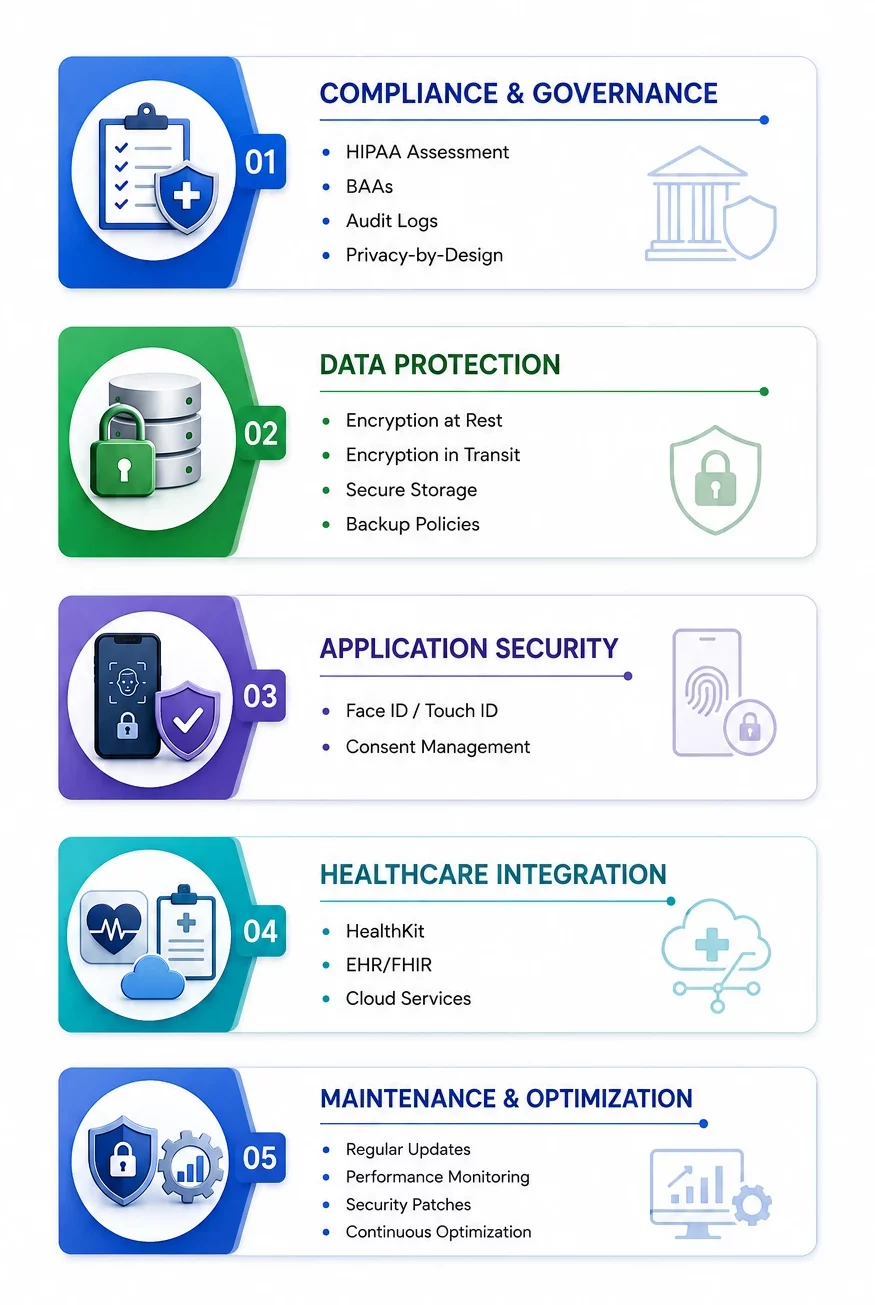
Building a healthcare app requires more than strong functionality. Security and compliance must be embedded throughout the application architecture to protect electronic protected health information (ePHI).
Key Components of HIPAA-Ready iOS Architecture
- Determine HIPAA applicability based on whether your organization is a covered entity or business associate.
- Encrypt data both at rest and in transit using industry-standard encryption.
- Implement biometric authentication with Face ID or Touch ID alongside multi-factor authentication.
- Use role-based access control (RBAC) to restrict access to authorized users.
- Maintain audit logs for user activity and data access.
- Sign Business Associate Agreements (BAAs) with cloud and backend service providers handling PHI.
- Manage patient consent for collecting, sharing, and processing health data.
- Establish secure backup and retention policies that align with regulatory requirements.
- Adopt privacy-by-design principles throughout development and testing.
A compliance-first architecture reduces security risks, simplifies regulatory audits, and builds trust among patients, providers, and healthcare organizations.
The US Regulatory Landscape Beyond HIPAA
While HIPAA remains the primary healthcare data protection framework in the United States, modern healthcare applications must also consider additional regulations that govern medical software, consumer health data, and digital health platforms. Depending on the app’s functionality, data collection practices, and target users, organizations may need to comply with requirements from federal agencies such as the FDA and FTC, state privacy laws, and platform-specific requirements from companies like Apple.
1. FDA Mobile Medical App Framework
The U.S. Food & Drug Administration (FDA) regulates certain healthcare software functions that qualify as medical devices under the Federal Food, Drug, and Cosmetic Act. Applications that perform clinical decision support, diagnosis, treatment recommendations, or control medical devices may require regulatory oversight based on their intended use and potential impact on patient safety.
However, not every healthcare application falls under FDA regulation. Apps designed for general wellness, administrative support, health tracking, medication reminders, or patient engagement may fall outside medical device requirements depending on their functionality and risk level.
According to the FDA’s Policy for Device Software Functions and Mobile Medical Applications Guidance, developers must evaluate whether their software performs medical device functions and determine the appropriate regulatory pathway before launching digital health products.
2. FTC Health Breach Notification Rule
Healthcare wellness apps that are not covered by HIPAA may still be subject to the FTC Health Breach Notification Rule. If a health data breach occurs, organizations must notify affected users and, in certain cases, the FTC. This rule reinforces accountability for consumer health applications handling sensitive personal information.
3. Washington My Health My Data Act
Healthcare data protection requirements are expanding beyond HIPAA through state privacy regulations. The Washington My Health My Data Act requires organizations handling consumer health data to provide transparency, obtain consent for certain processing activities, and support consumer rights such as access and deletion requests.
4. Apple App Store Health Data Guidelines
Apple’s App Store Review Guidelines (Section 5.1.3) require healthcare applications to collect, use, and share health data responsibly. Developers must clearly explain why health information is collected, obtain user permission, and avoid using health data for advertising or unauthorized purposes.
Building compliance into the development process helps healthcare organizations reduce legal risks, gain user trust, and accelerate App Store approval.
How Much Does Healthcare iOS App Development Cost?
The iOS healthcare app development cost depends on feature complexity, regulatory requirements, integrations, and deployment scale. Applications with advanced AI capabilities, wearable integrations, or FDA-regulated functionality require significantly higher investment than basic healthcare MVPs.
| App Type | Estimated Cost (USD) |
| MVP Healthcare iOS App | $40,000–$80,000 |
| Mid-Level Healthcare iOS App | $80,000–$180,000 |
| Enterprise Healthcare Platform | $180,000–$450,000+ |
Key Cost Drivers
Several factors influence the overall project budget:
- Feature complexity and custom functionality
- HIPAA and regulatory compliance requirements
- HealthKit and Apple Watch integration
- EHR/EMR integration using HL7 FHIR APIs
- AI capabilities (on-device or cloud-based)
- Security testing and compliance audits
- Development team location and expertise
- Ongoing maintenance and updates (typically 15–20% of the initial development cost annually)
Planning these requirements early helps organizations optimize budgets while avoiding expensive redesigns during later development stages. While enterprise healthcare applications require higher upfront investment, native iOS solutions often reduce long-term maintenance costs through Apple’s standardized ecosystem, longer OS support cycles, and improved application stability.
iOS Healthcare App Development Process
A structured development process ensures healthcare applications meet business goals, regulatory requirements, and user expectations while minimizing project risks.
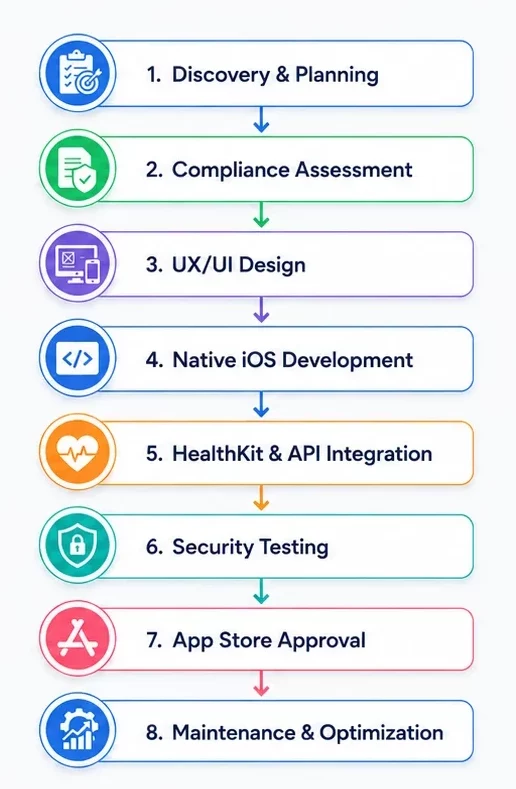
| Stage | Key Activities |
| 1. Discovery & Planning | Define business goals, target users, compliance needs, and product roadmap. |
| 2. Requirements & Compliance Planning | Identify HIPAA, FDA, and privacy requirements while planning integrations. |
| 3. UX/UI Design | Create intuitive, accessible, and patient-friendly interfaces for iPhone, iPad, and Apple Watch. |
| 4. Architecture & Development | Build secure backend architecture and develop native iOS features using Swift and SwiftUI. |
| 5. HealthKit & API Integration | Connect Apple Health, wearable devices, EHR systems, and third-party healthcare services. |
| 6. Testing & Security Audit | Perform functional, performance, security, and compliance testing before release. |
| 7. App Store Review & Launch | Submit the application while meeting Apple’s health app review requirements. |
| 8. Maintenance & Optimization | Release feature updates, monitor performance, ensure compatibility with new iOS versions, and maintain regulatory compliance. |
Typical Development Timeline
| Project Scope | Estimated Timeline |
| MVP Healthcare App | 4–6 months |
| Mid-Level Healthcare App | 6–9 months |
| Enterprise Healthcare Platform | 9–12+ months |
Following a structured development roadmap helps healthcare organizations reduce delivery risks, maintain compliance, and launch scalable native iOS applications more efficiently.
Challenges in Healthcare iOS App Development
Developing a healthcare iOS application involves balancing user experience, regulatory compliance, and technical complexity. Addressing these challenges early helps reduce risks, control costs, and accelerate time to market.
1. Regulatory Compliance
Healthcare apps must comply with HIPAA and, depending on their functionality, may also be subject to FDA regulations, FTC requirements, or state privacy laws. Integrating compliance into the development lifecycle minimizes legal and operational risks.
2. Legacy EHR Interoperability
Many healthcare providers still rely on legacy Electronic Health Record (EHR) systems. Ensuring seamless interoperability through standards like HL7 FHIR can be technically challenging but is essential for secure data exchange and efficient clinical workflows.
3. Multi-Device Compatibility
Although Apple’s ecosystem is more standardized than other platforms, healthcare applications must still provide a consistent experience across iPhone, iPad, and Apple Watch while supporting the latest iOS and watchOS updates.
4. Clinical User Adoption
Healthcare professionals expect applications that simplify their work, not add complexity. Intuitive interfaces, minimal learning curves, and optimized workflows are critical for successful adoption.
5. Cybersecurity Risks
Healthcare remains a frequent target for cyberattacks. Organizations must continuously strengthen authentication, encryption, monitoring, and vulnerability management to safeguard sensitive patient information.
6. Keeping Pace with Technology
Apple releases new iOS features and APIs every year, while healthcare regulations continue to evolve. Regular updates and proactive maintenance ensure applications remain secure, compliant, and competitive.
7. App Store Approval
Healthcare apps undergo additional App Store scrutiny because they process sensitive health information. Incomplete privacy disclosures, unclear consent flows, or unsupported medical claims may delay approval.
Why Choose RipenApps for Healthcare iOS App Development?
Building a successful healthcare iOS application requires expertise in native Apple technologies, healthcare workflows, and regulatory compliance. At RipenApps, we combine all three to help healthcare businesses launch secure, scalable, and future-ready digital products.
- Healthcare Product Expertise: We build telemedicine, patient engagement, wellness, and remote patient monitoring apps tailored to healthcare business needs.
- Native iOS Development Excellence: Our team develops high-performance iOS apps using Swift, SwiftUI, HealthKit, CareKit, and Apple’s latest technologies.
- Compliance-Aware Development: We embed security, privacy, and HIPAA-ready practices throughout the development lifecycle.
- End-to-End Product Development: From strategy and design to development, launch, and support, we deliver complete healthcare iOS app solutions.
With experience building healthcare platforms like Mednovate Connect and Holypills, RipenApps combines healthcare domain knowledge with native iOS engineering expertise to help businesses launch secure, scalable, and compliance-aware digital health products.
How RipenApps Built Mednovate Connect: A HIPAA-Compliant Telemedicine Platform
Challenge: The client needed a secure telemedicine platform that simplified medication management, enabled virtual consultations, and ensured HIPAA compliance while integrating EHR capabilities.
Achievement: We developed a HIPAA-ready solution with secure video consultations, automated medication reminders, EHR management, and seamless patient-provider communication, improving care accessibility and operational efficiency.
How RipenApps Developed Holypills: An AI-Powered Women’s Health Platform
Challenge: The client wanted to build a personalized women’s health platform that helps users manage conditions like PCOS, Endometriosis, Menopause, and Postpartum recovery while simplifying symptom tracking, expert consultations, and long-term care through a single mobile application.
Achievement: RipenApps developed an AI-powered healthcare app with symptom and cycle tracking, personalized care plans, AI-guided health insights, and online consultations, enabling women to proactively manage their health through a secure and intuitive digital experience.
Conclusion
Healthcare iOS applications enable organizations to deliver secure, scalable, and patient-centric digital experiences while leveraging Apple’s ecosystem, including HealthKit, Apple Watch, Face ID, and other native capabilities. By combining HIPAA-ready architecture, interoperability standards, and a user-first approach, businesses can build solutions that improve patient engagement, streamline clinical workflows, and support long-term digital transformation.
Although development costs vary based on features, integrations, and compliance requirements, investing in a well-planned healthcare iOS application can generate significant returns through improved operational efficiency, enhanced patient outcomes, and reduced maintenance costs. By partnering with a trusted provider of healthcare app development services, businesses can build secure, compliant, and future-ready solutions. At RipenApps, we help healthcare organizations design and develop high-performing iOS applications tailored to their goals, ensuring every solution is built for compliance, scalability, and sustainable business growth.
FAQs
Q1. What is iOS healthcare app development?
Healthcare iOS app development is the process of building native healthcare applications for iPhone, iPad, and Apple Watch. These apps support services such as telemedicine, remote patient monitoring, appointment scheduling, EHR access, medication management, and wellness tracking.
Q2. How much does it cost to build a healthcare iOS app?
The iOS healthcare app development cost typically ranges from $40,000 to $450,000+. The final investment depends on application complexity, compliance requirements, integrations, AI capabilities, and overall project scope.
Q3. How long does healthcare iOS app development take?
A healthcare iOS MVP generally takes 4-6 months, while mid-sized applications require 6–9 months. Enterprise-grade healthcare platforms with advanced integrations and compliance features may take 9-12 months or longer.
Q4. Is HealthKit HIPAA compliant?
HealthKit itself is not HIPAA compliant or HIPAA certified. It is an Apple framework for managing health data. Compliance depends on how your application collects, stores, transmits, and secures protected health information, along with the backend infrastructure and organizational safeguards.
Q5. Do healthcare apps need FDA approval?
Not every healthcare application requires FDA approval. Apps that function as medical devices or influence clinical diagnosis or treatment may fall under FDA regulation, while many wellness and administrative applications do not.
Q6. Why choose native iOS over cross-platform for healthcare apps?
Native iOS development provides stronger security, better performance, seamless integration with HealthKit and Apple Watch, improved reliability, and faster access to Apple’s latest healthcare technologies, making it well suited for healthcare applications.
Q7. Can an existing healthcare app integrate Apple Health?
Yes. Existing healthcare applications can integrate with Apple Health using HealthKit, provided users grant permission. This enables secure access to health metrics, activity data, sleep information, heart rate, medications, and other supported health records, enhancing personalized care experiences.
Discuss your project and request for proposal
SHARE
WRITTEN BY

Ishan Gupta
CEO & Founder
Ishan Gupta is a seasoned entrepreneur and CEO with extensive 10+ years of experience in business and mobile app development landscape. He believes that the right digital product allows companies to focus on what they do best, while technology handles the rest. With deep exposure to global markets, he understands what makes an app succeed. His approach translates business needs into clear product strategies, ensuring that every feature contributes to measurable ROI.
View All Articles