


Key Takeaways
- Start with a validated problem instead of jumping directly into development.
- Define your target users, product value, and core business goals before choosing technologies.
- Use an MVP to test the core product idea with real users.
- Choose a technology stack based on product requirements, scalability, security, budget, and available expertise.
- Build flexible architecture so the product can evolve as your startup grows.
- Use Agile development and regular feedback loops to reduce unnecessary rework.
- Treat security, testing, analytics, and documentation as part of development rather than post-launch tasks.
- Plan for launch, monitoring, feedback, and future iterations from the beginning.
A startup idea can look promising on paper, but turning that idea into a working software product requires much more than writing code. You need to validate the problem, understand your users, define the right features, choose a suitable technology stack, and build a product that can evolve as you learn.
This is where custom software development services can become valuable for startups exploring AI-driven products, automation, intelligent recommendations, or data-powered workflows. However, technology should follow the product need. Building advanced functionality before validating the core idea can increase costs without proving that users actually need the solution.
For founders, software development for startups is therefore a process of making informed product decisions at each stage. The goal is not to build everything at once. It is to create a useful first version, gather real feedback, and improve the product based on what users actually need.
Table of Contents
What Is Software Development for Startups?
Software development for startups refers to the process of turning a startup’s business idea into a functional digital product through research, planning, design, development, testing, deployment, and continuous improvement.
Unlike mature businesses, startups often work with limited budgets, smaller teams, uncertain product-market fit, and changing requirements. This means the development process needs to support experimentation without sacrificing product quality or future scalability.
The focus should be on solving a clearly defined user problem first. Once the problem and target audience are validated, founders can prioritize the features, technology, and resources needed to build the first usable version. This problem-first approach is central to mobile app development for startups, as it helps founders build around a validated need rather than assumptions.
How Is Startup Software Development Different From Traditional Software Development?
The basic development stages may look similar, but startups usually operate under different constraints. They need to validate assumptions quickly, control spending, respond to user feedback, and reach the market without building unnecessary functionality.
In traditional enterprise projects, requirements may be more established before development begins. A startup, however, may discover during development that users need a different workflow, feature, or business model. This makes flexibility an important part of the product strategy.
Faster Validation
Startups cannot always afford months of development before discovering whether their product solves a real problem. Early validation helps founders test their assumptions before committing significant resources.
Leaner Feature Scope
Instead of building a complete product immediately, startups can prioritize the features required to deliver the core value proposition. This creates a smaller and more manageable first release.
Flexible Product Direction
User feedback can change the product roadmap. The architecture, development process, and team should therefore support changes without requiring a complete rebuild every time requirements evolve.
Focus on Scalability
A startup’s first version may have a small user base, but the product should not be designed in a way that makes future growth unnecessarily difficult. Cloud infrastructure, modular components, and maintainable code can support this progression.
Software Development Process for Startups
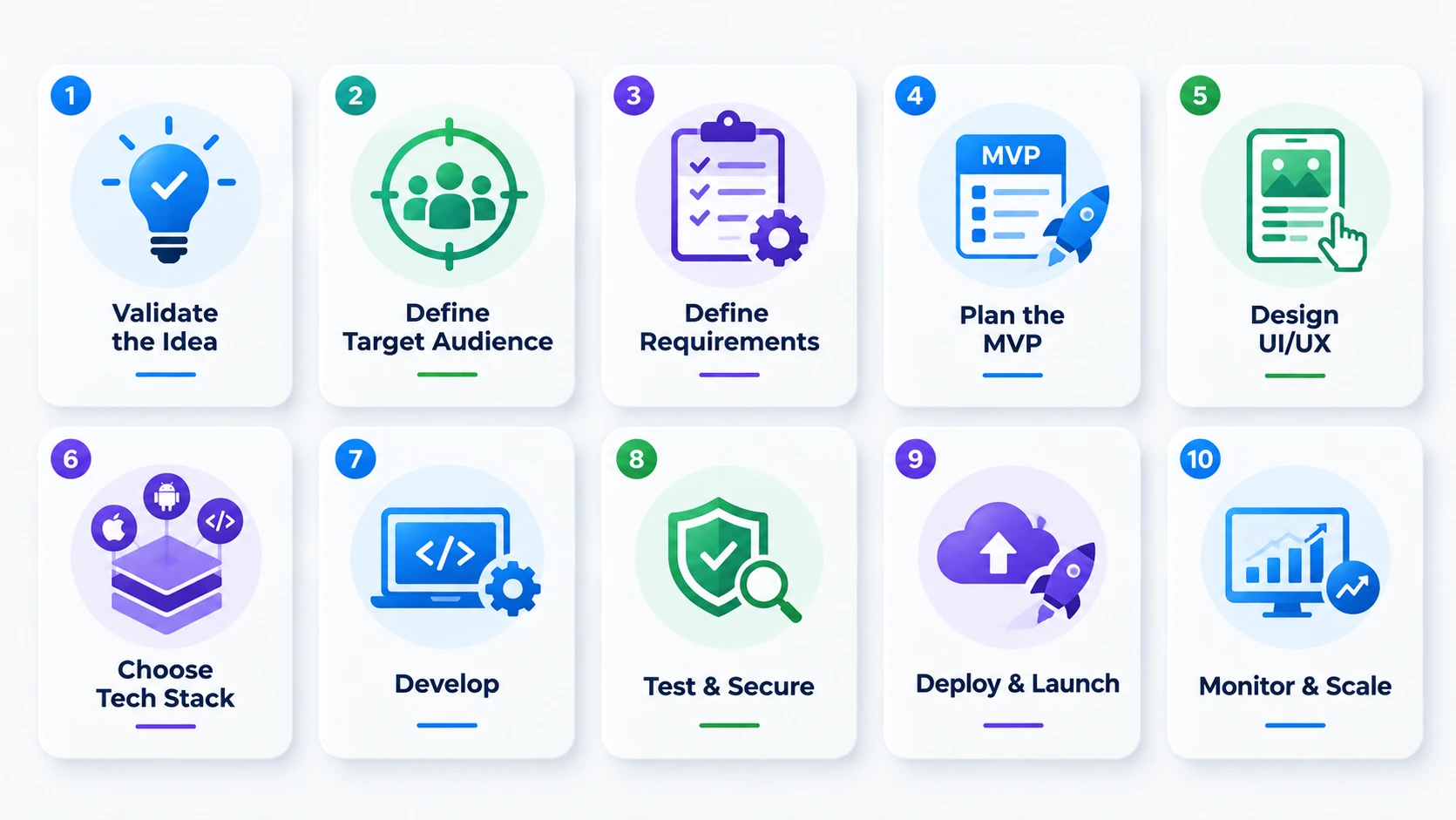
A structured software development process for startups helps founders move from an initial idea to a launch-ready product without losing sight of business goals. The exact stages can vary depending on the product, but a practical process usually includes discovery, validation, planning, design, development, testing, deployment, and post-launch optimization.
1. Validate the Software Idea
Start by defining the problem your software will solve. Identify who experiences the problem, how they currently solve it, and why they would switch to your proposed solution. Market research, user interviews, competitor analysis, surveys, and early prototypes can help test these assumptions before development begins.
2. Define the Target Audience
A product designed for everyone often struggles to solve a specific problem well. Define your initial audience based on factors such as industry, user needs, behavior, company size, or use case. This gives your team a clearer direction when deciding which features and workflows should be included in the first version.
3. Define the Product Requirements
Once the problem and audience are clear, document the product requirements. This should cover core workflows, functional requirements, integrations, user roles, technical requirements, security considerations, and success metrics. A clear requirements document also gives developers and designers a shared understanding of what needs to be built.
4. Prioritize the MVP
The next step is deciding what belongs in the first release. Availing professional MVP development services can help startups convert the validated product concept into a focused first version with the functionality needed to solve the core user problem. The MVP should be useful enough for real users to interact with and provide measurable feedback. It should not be treated as a stripped-down version of the final product with every possible feature removed.
5. Design the User Experience
Before development starts, map the main user journeys and create wireframes and interface designs. The design should make the core task easy to understand and complete. For a startup, good design is not about adding visual complexity. It is about helping users reach the product’s primary value with minimal friction.
6. Select the Technology Stack
Choose technologies based on the product’s requirements rather than following whatever technology is currently trending. Consider performance, security, scalability, development speed, maintenance, integrations, developer availability, and long-term costs.
7. Develop the Product
The development team can then build the frontend, backend, database, APIs, integrations, and other required components. Agile sprints can help the team deliver smaller increments and review progress regularly.
8. Test and Validate
Testing should happen throughout development rather than being left until the final week. Functional testing, integration testing, performance testing, security checks, and usability testing can help identify problems before launch.
9. Deploy and Launch
Once the product meets the agreed release criteria, prepare the production environment, configure monitoring, complete deployment, and release the product to the intended users.
10. Collect Feedback and Improve
Launch is not the end of development. Analytics, support requests, reviews, interviews, and usage patterns can reveal what users need next. These insights should feed into future product iterations.
What Should Startups Do Before Writing the First Line of Code?
The biggest mistake founders can make is treating development as the first step. Before coding begins, you need enough clarity to answer three basic questions: What problem are you solving? Who has this problem? Why will your solution be useful?
Startups investing in software development services for startups should use this pre-development stage to validate assumptions, define the target audience, analyze competitors, establish business objectives, and prioritize the initial product scope.
1. Define the Core Problem
Describe the problem in specific terms instead of starting with a list of features. A strong problem statement gives the development team a reason behind every major product decision.
2. Research Your Target Users
Talk to potential users and understand their existing workflows, frustrations, expectations, and alternatives. Direct feedback can reveal requirements that founders might otherwise overlook.
3. Analyze Competitors
Competitor research can help you identify existing solutions, pricing models, feature gaps, positioning, and opportunities for differentiation. The goal is not to copy competitors but to understand the market you are entering.
4. Define Your Value Proposition
Explain why users should choose your product. Your value proposition should connect the problem, target audience, and outcome your software intends to provide.
5. Set Measurable Goals
Decide what success means before development begins. Depending on the product, this could include user activation, subscriptions, transactions, retention, feature adoption, or revenue.
How to Turn a Startup Idea Into a Software Product
Turning an idea into software requires several decisions between the initial concept and the first release. A practical approach is to move from broad assumptions toward increasingly specific product requirements.
- Idea: Start with the problem and proposed solution.
- Validation: Test whether the problem exists and whether your target users consider it important enough to solve.
- Product Definition: Convert validated assumptions into user journeys, requirements, and a prioritized feature list.
- Prototype: Create a clickable representation of the product to test workflows and gather early feedback before full development.
- MVP: Build the smallest functional product that delivers the core value and generates real usage data.
- Launch: Release the product to a defined audience and monitor how users interact with it.
- Iteration: Use feedback and analytics to decide which features to improve, introduce, remove, or postpone.
This approach keeps software development services for startup projects connected to actual product validation instead of treating development as an isolated technical activity.
Read Also: MVP vs Prototype: Key Differences, Use Cases & When to Build Each
MVP vs Full Product Development for Startups
A startup does not necessarily need to build the complete product before testing its idea. An MVP allows the team to launch a focused version that addresses the primary user problem and provides evidence for future product decisions.
When an MVP Makes Sense
An MVP is useful when the startup has an untested product idea, needs early user feedback, has budget constraints, or wants to validate product-market assumptions before making a larger investment. Real-life successful examples of MVP development for startups show how well-known products started with a focused first release, validated demand, and then expanded based on user feedback.
What an MVP Should Include
An MVP should include the features necessary to complete the core user journey. Supporting features can be added later based on actual demand and business priorities.
What an MVP Should Avoid
Avoid adding features simply because competitors have them. Complex integrations, advanced personalization, unnecessary dashboards, and secondary workflows can increase development time without helping validate the central idea.
How to Choose the Right Technology Stack for a Startup
Technology decisions made during the early stages can influence development speed, maintenance, scalability, and future hiring. Startups should therefore choose technologies based on the product’s actual requirements rather than selecting a stack because it is popular.
For custom startup software development, the technology stack should support the MVP while leaving enough flexibility for future features, integrations, and user growth.
1. Frontend Technology
The frontend determines how users interact with the product. The choice between native, cross-platform, or web technologies depends on the target platforms, performance requirements, device capabilities, and product complexity.
2. Backend Technology
The backend manages business logic, authentication, databases, APIs, integrations, and other core processes. It should be designed to handle the expected workload while remaining maintainable as the product evolves.
3. Database
Choose a database based on the type and volume of data the application needs to manage. Relational and NoSQL databases can serve different use cases, so the decision should follow the product’s data structure and access patterns.
4. Cloud Infrastructure
Cloud platforms can help startups scale infrastructure as demand changes without investing heavily in physical hardware. They can also support automated deployments, monitoring, backups, and distributed services. Moreover, our cloud app development guide covers how to choose and structure this layer for an early-stage product.
5. APIs and Integrations
Third-party APIs can reduce development time by connecting the product with payment gateways, communication tools, maps, analytics platforms, AI services, and other external systems. However, each integration adds dependency and maintenance considerations.
How to Design Scalable Software Architecture for a Startup
A startup’s first release may serve a relatively small audience, but its architecture should not create unnecessary barriers to future growth. The goal is to build enough technical flexibility without overengineering the product before its requirements are proven.
A modular architecture can make it easier to update individual components, introduce new features, and integrate external services. This is particularly relevant when planning startup software development services for products expected to evolve rapidly after launch.
Start With the Core Business Logic
Identify the processes that are central to the product and keep them clearly separated from secondary functionality. This makes future changes easier to manage.
Build Modular Components
Independent components allow teams to modify or replace specific parts of the system without affecting the entire application.
Plan API-First Where Appropriate
Well-structured APIs can make it easier to connect mobile apps, web applications, third-party services, and future product interfaces.
Use Scalable Infrastructure
Infrastructure should support gradual growth rather than requiring a complete redesign when traffic increases. Cloud-based services, caching, monitoring, and automated deployment can contribute to this flexibility.
Avoid Premature Overengineering
Scalability does not mean building infrastructure for millions of users before you have your first hundred. Start with a practical architecture that can evolve as actual usage patterns become clearer.
Custom UI and UX Design for Startup Software
A strong software product should make its primary user journey easy to understand. Users should know what the product does, what action to take next, and how to recover when something goes wrong.
Custom software design for startups should therefore begin with user flows rather than visual elements alone. Wireframes can help teams identify unnecessary steps before designers invest time in high-fidelity interfaces. Understanding the difference between UI and UX design helps founders brief both disciplines properly instead of treating design as a single visual step.
Keep the Core Journey Simple
Identify the main action users need to complete and make that journey easy to follow. Secondary features should not distract from the product’s primary purpose.
Design for Different User States
New users, returning users, inactive users, and paying customers may interact with the product differently. The interface should account for these states without making the core navigation inconsistent.
Create a Consistent Design System
Reusable components, typography, spacing, buttons, forms, and interaction patterns make the product easier to maintain and expand.
Validate Designs Before Development
Clickable prototypes can help founders test workflows with potential users before development begins. This can reveal usability problems while they are still relatively inexpensive to fix.
Read Also: Rapid Prototyping For Startups: Benefits, Real Use Cases & When To Use It
Agile Development for Startup Software
Startup requirements often change as founders learn from users, competitors, and market conditions. A rigid development process can make these changes expensive and slow.
Agile development divides work into smaller iterations. Teams can plan a sprint, develop the selected functionality, test it, review the results, and use the feedback to prioritize the next cycle.
This approach works well for software development for startup products because it keeps development connected to ongoing product validation. Founders can review working increments instead of waiting until the end of a long development cycle to see the complete product.
Sprint Planning: Define a manageable set of tasks for each development cycle based on business and technical priorities.
Regular Reviews: Review completed functionality with stakeholders and identify changes based on feedback.
Continuous Testing: Test features as they are developed instead of accumulating defects until the final stage.
Retrospectives: Review what worked, what created friction, and what should change in the next sprint.
Should Startups Hire Developers or Outsource Software Development?
The In-House vs. outsourcing decision depends on your budget, technical requirements, timeline, and long-term product plans. Some founders build an internal team, while others work with an external development partner. For startups with limited technical resources, outsourcing can provide access to experienced developers without the cost of building a full in-house team.
Building an In-House Team
An internal team provides direct control over development and can become a long-term technical function within the startup. However, hiring multiple specialists can increase fixed costs and take time.
Working With an External Team
An external partner can provide access to developers, designers, QA specialists, project managers, and technical expertise without requiring a complete internal team.
For founders considering outsourcing software development for startups, it is important to evaluate technical expertise, communication processes, portfolio relevance, development methodology, security practices, and post-launch support.
Hiring Freelancers
Freelancers can work well for focused tasks or smaller projects. However, startups should consider how project coordination, quality assurance, documentation, and long-term maintenance will be managed.
How to Build the Right Startup Software Development Team
The development team should reflect the product’s complexity rather than follow a fixed headcount. A simple MVP may require fewer specialists, while an AI, fintech, healthcare, or enterprise product may require additional technical and compliance expertise.
When hiring software developers for startup projects, assess both technical skills and their ability to work with changing requirements. A startup team needs people who can understand product goals, communicate clearly, identify technical risks, and make practical trade-offs.
A typical team can include:
- Product manager or product owner
- UI/UX designer
- Frontend developer
- Backend developer
- Mobile developer when required
- QA engineer
- DevOps or cloud specialist
- Business analyst for complex products
The exact structure should depend on the product scope and development model.
Outsourcing Software Development for Startups
Outsourcing can help startups access specialized skills without building a complete technical department from scratch. It can also provide flexibility when the product requires expertise in areas such as AI, cloud infrastructure, cybersecurity, mobile development, or complex integrations.
Before choosing a partner, review their experience with similar products, development process, communication structure, security controls, ownership terms, documentation, and maintenance support.
For software development companies for startups, transparency around scope, timelines, deliverables, responsibilities, and intellectual property is particularly important because unclear expectations can create problems later.
Security Considerations for Startup Software
Security should be included from the earliest stages of development. Adding security controls after launch can require architectural changes and create unnecessary risk.
Startups should consider secure authentication, authorization, encryption, access controls, secure API design, data protection, dependency management, logging, backups, and vulnerability testing.
The requirements become more demanding when the product handles financial, healthcare, personal, or other sensitive information. Security requirements should therefore be mapped to the product’s data and regulatory environment before development begins.
Testing and Quality Assurance for Startup Software
A fast launch should not mean skipping quality assurance. Software defects can damage user trust, increase support costs, and slow future development.
A structured QA process should cover the core user journeys as well as edge cases and failure scenarios.
- Functional Testing: Checks whether individual features work according to their requirements.
- Integration Testing: Verifies that different components, APIs, databases, and external services work together correctly.
- Performance Testing: Tests how the product behaves under different levels of traffic and workload.
- Security Testing: Identifies vulnerabilities related to authentication, authorization, data handling, APIs, and other attack surfaces.
- Usability Testing: Observes how real or representative users interact with the product and identifies confusing workflows.
- Regression Testing: Ensures that new changes do not break functionality that was already working.
AI in Startup Software Development
AI can become part of the product itself or support internal development workflows. Startups are using AI for recommendations, search, automation, customer support, data analysis, content generation, forecasting, and other product capabilities.
An AI startup product launch should begin with a clear user or business problem rather than adding AI simply because it is available. Teams should determine what data the AI feature needs, how its output will be evaluated, what happens when the model is incorrect, and how users can control or challenge automated decisions.
For AI-heavy products, teams should also plan for model costs, data privacy, monitoring, model updates, latency, and fallback workflows.
Common Mistakes Startups Make During Software Development
Even a promising idea can face problems when development decisions are made without sufficient product validation.
Building Too Many Features
A large feature list can increase development time while making it harder to identify which functionality users actually value.
Skipping User Validation
Developing based entirely on founder assumptions can result in a technically functional product that does not solve the expected user problem.
Choosing Technology Based on Trends
A technology should solve a product requirement. Choosing it because it is popular can create unnecessary complexity.
Ignoring Technical Debt
Moving quickly is important, but repeatedly compromising code quality without a plan can make future changes slower and more expensive.
Treating Security as a Later Task
Security requirements should be considered while designing authentication, data storage, APIs, infrastructure, and user permissions.
Launching Without Analytics
Without product analytics, founders may struggle to understand where users drop off, which features they use, and what needs improvement.
How Much Does Software Development for a Startup Cost?
The cost of building startup software depends on product complexity rather than a single standard rate. An MVP with a few core workflows will require different resources from an AI-powered platform with complex integrations and real-time functionality.
Key cost factors include:
- Product complexity
- Number of platforms
- UI/UX requirements
- Number of features
- Backend architecture
- Third-party integrations
- AI or machine learning requirements
- Security and compliance
- Development team structure
- Testing requirements
- Cloud infrastructure
- Post-launch maintenance
Instead of focusing only on the initial development quote, founders should consider the total cost of ownership, including infrastructure, maintenance, security updates, third-party services, and future development.
Real-World Example of Startup Software Development
Turning a business idea into software requires more than development. The product needs to solve a clear problem, support real business workflows, and create measurable value. Volt Energy is an example of how a software platform can turn a complex business process into a structured digital experience.
Volt Energy CleanTech Platform
RipenApps developed a commercial solar software platform for Volt Energy in 3 months, focusing on the challenges that often slow down solar adoption. The platform brings together solar feasibility and quoting, zero-risk financial modelling, installation workflow management, and operational cost tracking. According to the client, the platform has supported 140,000 clients and 300+ installations, while contributing to a 60% reduction in operational costs and 44% monthly growth.
How to Launch Startup Software Successfully
Development is only one part of a successful launch. Your team should prepare the technical infrastructure, product analytics, support workflows, documentation, and user communication before releasing the software.
A practical launch process includes:
- Complete Product Testing: Resolve critical bugs and verify the main user journeys.
- Prepare Production Infrastructure: Configure servers, databases, domains, security controls, backups, monitoring, and deployment workflows.
- Set Up Analytics: Track activation, engagement, retention, conversion, feature usage, and other product-specific metrics.
- Prepare Customer Support: Give users clear ways to report problems, ask questions, and provide feedback.
- Launch With a Controlled Audience: A limited release or beta program can help identify issues before a wider launch.
- Monitor the First Release: Track errors, performance, user behavior, and feedback closely during the initial period.
Post-Launch Software Development for Startups
Launching the product does not mean development stops. The first release gives you real-world information that can guide the next stage of the product roadmap.
Startup application development should therefore continue through regular maintenance, security updates, performance optimization, feature improvements, analytics reviews, and user feedback cycles.
A post-launch roadmap can include:
- Bug fixes and security updates
- Performance optimization
- User experience improvements
- New feature development
- Third-party integration updates
- Analytics and experimentation
- Infrastructure scaling
- AI model improvements
- Platform and OS compatibility updates
How to Scale Software as Your Startup Grows
The architecture that works for an MVP may need to evolve as traffic, data, integrations, and team size increase. Scaling should be driven by actual product requirements and measurable system constraints.
Monitor infrastructure performance, database load, API response times, error rates, storage requirements, and user activity. This allows teams to identify bottlenecks before they significantly affect the user experience.
A modular approach also makes it easier to introduce new functionality without changing unrelated parts of the system. This is where custom software development for startups can provide greater control over how the product evolves compared with a rigid off-the-shelf solution.
How to Choose a Software Development Company for Your Startup
The development partner you choose can influence product quality, communication, technical decisions, and the ability to respond to changing requirements.
When comparing a software development company for startups, look beyond the portfolio. Evaluate how the company approaches discovery, requirements, architecture, UI/UX, development, QA, security, deployment, and post-launch support.
Check Relevant Experience
Look for experience with products that have similar workflows, technologies, users, or technical challenges.
Review the Development Process
Ask how requirements are gathered, how progress is reported, how changes are handled, and how quality is measured.
Understand Team Composition
Know who will work on the product and whether you will have access to developers, designers, QA specialists, and project leadership.
Clarify Ownership
Make sure contracts clearly define intellectual property, source-code ownership, data access, documentation, and third-party dependencies.
Discuss Post-Launch Support
Understand what happens after launch, including maintenance, bug fixes, security updates, monitoring, and future development.
Best Practices for Software Development for Startups
A practical startup development strategy should balance speed, quality, cost, and future flexibility.
- Validate the problem before building the product.
- Define a specific target audience.
- Prioritize the MVP around the core user journey.
- Choose technologies based on product requirements.
- Design the architecture for realistic future growth.
- Use Agile iterations and regular product reviews.
- Test continuously throughout development.
- Build security into the product from the beginning.
- Track product analytics from the first release.
- Document important technical and product decisions.
- Avoid unnecessary features and premature complexity.
- Treat launch as the beginning of product learning.
- Use real user feedback to guide future development.
These principles help software product development services for startups stay connected to business objectives while giving the product enough flexibility to evolve after launch.
How Long Does It Take to Develop Software for a Startup?
There is no fixed timeline for startup software development because the duration depends on product complexity, feature scope, platforms, integrations, team size, and testing requirements. A focused MVP may take a few months, while a complex platform with advanced workflows can require considerably more time.
A typical timeline can be divided into:
| Stage | Typical Focus |
| Discovery and planning | Problem validation, requirements, user journeys |
| UI/UX design | Wireframes, prototypes, interface design |
| MVP development | Core frontend, backend, APIs, and integrations |
| Testing | Functional, usability, performance, and security testing |
| Launch preparation | Deployment, analytics, monitoring, and documentation |
| Post-launch | Feedback, optimization, maintenance, and new features |
The timeline should be based on the product scope and release goals rather than an arbitrary launch date.
Final Checklist Before Launching Startup Software
Before releasing the first version, review the product across business, technical, security, and operational areas.
Product
- Core user journey works end to end
- MVP features match the defined requirements
- User feedback has been incorporated where necessary
- Analytics events are configured
Design
- Main workflows are easy to understand
- Responsive behavior has been tested
- Error and empty states are covered
- Accessibility considerations are addressed
Technology
- Production infrastructure is configured
- APIs and integrations are tested
- Database backups are configured
- Monitoring and logging are active
Security
- Authentication and authorization are tested
- Sensitive data is protected
- Access permissions are reviewed
- Dependencies are checked for known vulnerabilities
Launch
- Deployment process is documented
- Support channels are ready
- Privacy policy and relevant legal documents are available
- Rollback or recovery procedures are defined
Conclusion
Software development for startups works best when product decisions evolve alongside user feedback. From validating the initial idea and defining the MVP to choosing the technology stack, developing the product, testing it, and preparing for launch, each stage should support a clear business and user objective.
The right development approach also leaves room for improvement after launch. Startups can use real usage data to refine workflows, prioritize new features, improve performance, and scale the product as demand grows.
Working with a recognized startup app development company can give founders access to product strategy, UI/UX, development, testing, and technical expertise under one development process. RipenApps team helps turn the initial idea into a practical product while keeping future iterations and growth in view.
FAQs
Q1. How much does it cost to develop software for a startup?
The cost depends on product complexity, features, platforms, integrations, development team, security requirements, and post-launch needs. An MVP generally requires fewer resources than a full-scale platform.
Q2. What is the first step in startup software development?
Start by validating the problem and target audience. Once you have evidence that the problem is worth solving, define the product requirements and prioritize the core MVP functionality.
Q3. Should startups build an MVP before a full product?
An MVP can help startups test their core value proposition with real users before making a larger development investment. The MVP should include enough functionality to deliver the intended core experience.
Q4. Should I hire an in-house team or outsource software development?
The decision depends on budget, technical complexity, internal expertise, hiring timelines, and long-term product plans. Outsourcing can provide access to a broader technical team, while an in-house team offers direct internal ownership.
Q5. How can startups make their software scalable?
Use maintainable architecture, modular components, appropriate cloud infrastructure, scalable databases, monitoring, and APIs. Scale based on actual usage rather than overengineering for hypothetical traffic.
Q6. What are the biggest mistakes in startup software development?
Common mistakes include skipping validation, building too many features, choosing technology based on trends, ignoring security, underestimating testing, and launching without analytics.
Q7. How can AI be used in startup software?
AI can support recommendations, automation, search, customer support, data analysis, personalization, forecasting, and other workflows. The use case should be defined first, followed by the appropriate AI technology.

SHARE
WRITTEN BY

Ishan Gupta
CEO & Founder
Ishan Gupta is a seasoned entrepreneur and CEO with extensive 8+ years of experience in business and mobile app development landscape. He believes that the right digital product allows companies to focus on what they do best, while technology handles the rest. With deep exposure to global markets, he understands what makes an app succeed. His approach translates business needs into clear product strategies, ensuring that every feature contributes to measurable ROI.
View All Articles



 India
India USA
USA Australia
 Canada
 UK
UK UAE
UAE