


Key Takeaways
- Mobile apps can accelerate startup validation by helping founders test ideas, gather customer feedback, and improve the product based on real usage.
- A well-planned app can strengthen acquisition and retention through personalized experiences, direct communication, and convenient repeat interactions.
- MVP-first development reduces unnecessary investment by focusing on the features needed to solve the core customer problem before expanding the product.
- The right time to build depends on business readiness, customer needs, validated demand, and whether mobile is central to the user experience.
- Startup app ROI goes beyond revenue and can include improved retention, lower operational costs, faster learning, and stronger product-market validation.
Mobile apps can help startups validate ideas, engage customers, automate workflows, and create new revenue opportunities. Their value depends on solving a validated problem, launching a focused MVP, and measuring real user behavior. For startups, the right mobile strategy can reduce uncertainty while creating a direct channel for customer growth and retention.
For founders considering mobile app development for startups, the bigger question is not simply whether to build an app. It is whether mobile is the right channel for the target audience, business model, and stage of growth.
When planned around clear business goals, a mobile app can become more than a customer-facing product. Partnering with a startup app development company can help turn a validated idea into a focused product, test market demand, improve customer retention, streamline key workflows, and create measurable opportunities for growth. The key is knowing what benefits an app can deliver, when to build it, and how to approach development without overinvesting too early.
Table of Contents
Why Startups Are Investing in Mobile Apps
Mobile usage is deeply embedded in U.S. consumer behavior, creating a strong foundation for mobile-first products and services. According to a Pew Research Center 2026 survey of U.S. adults, 90% of Americans use the internet daily, while 41% say they are online almost constantly. The same study found that 16% of U.S. adults are smartphone-dependent, meaning they own a smartphone but do not have home broadband access.
The commercial opportunity is equally strong. According to the latest report from EMARKETER, mobile shopping accounted for 56.4% of U.S. online transactions during the final two months of 2025, up from 54.5% in the same period a year earlier. This highlights the growing role of mobile in digital purchasing behavior.
Together, these figures show why mobile apps can be strategically important for U.S. startups: consumers already spend substantial time online through smartphones, while mobile devices represent a meaningful channel for digital commerce.
Key Benefits of Mobile App Development for Startups
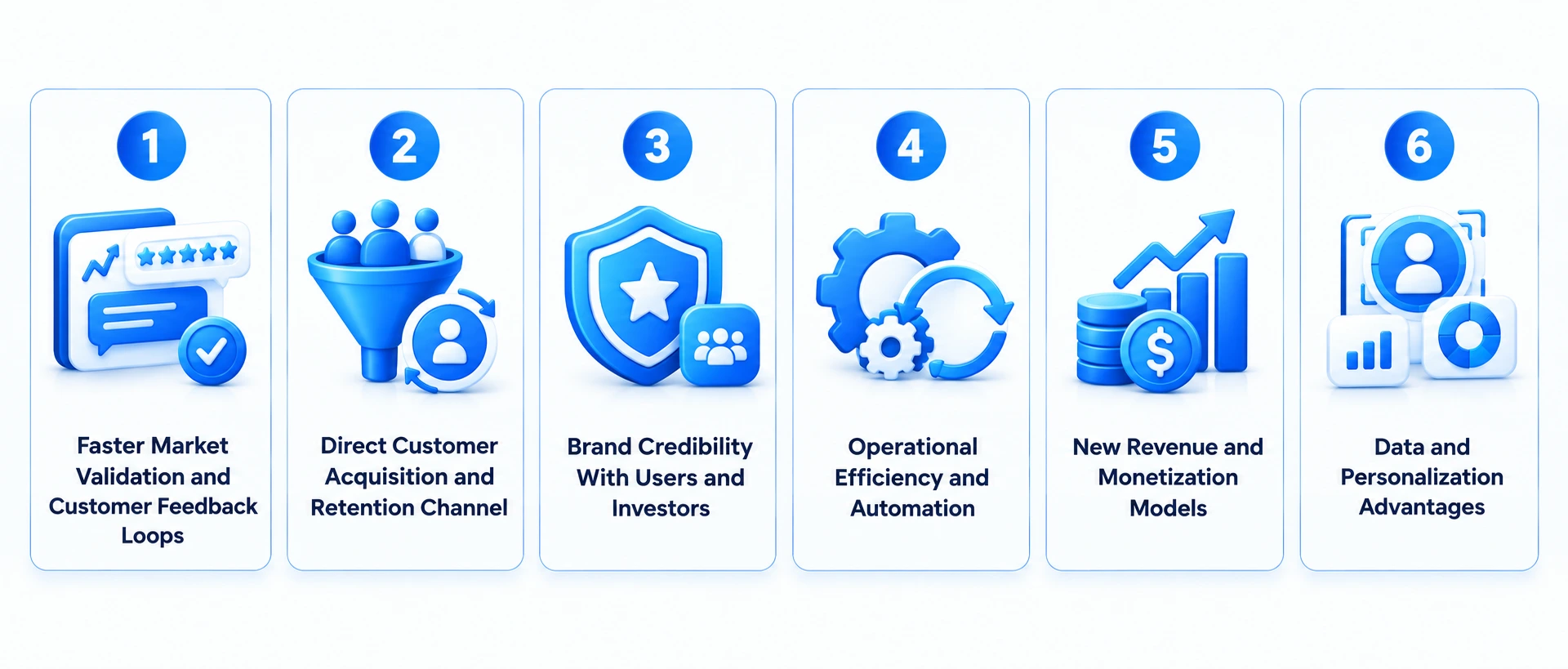
Explore how mobile apps help startups validate ideas, engage customers, streamline operations, and unlock scalable growth.
1. Faster Market Validation and Customer Feedback Loops
Startups often begin with assumptions about their target users, problems, features, pricing, and business model. A focused mobile MVP helps test these assumptions with real users without investing heavily in a fully featured product. By tracking usage and collecting feedback, startups can identify what customers actually need and improve the product accordingly. For example, a fintech startup may discover that users engage more with spending alerts than budgeting tools, helping the team prioritize future development. This creates a continuous cycle:
Build – Launch – Measure – Learn – Improve
This makes MVP-focused app development for startups a practical approach to faster market validation.
2. Direct Customer Acquisition and Retention Channel
A mobile app gives startups a direct channel to engage customers through personalized recommendations, push notifications, saved preferences, loyalty programs, in-app offers, and streamlined repeat purchases. The goal should be to deliver useful experiences rather than simply increase notification frequency.
For example, an on-demand home-services app can allow customers to book services, track providers, make payments, and leave reviews in one place while storing preferences for faster repeat bookings. This convenience can encourage repeat usage, strengthen customer relationships, and provide valuable insights into evolving customer needs. For founders comparing mobile app development for startup opportunities, the decision should begin with the customer problem and business model rather than technology alone.
3. Brand Credibility With Users and Investors
For an early-stage company, the product itself can become evidence of execution. A functional, reliable application gives prospective customers and investors something tangible to evaluate. Instead of presenting only a pitch deck or prototype, founders can demonstrate an actual customer journey and show how users interact with the product.
But simply having an app does not create credibility. Poor performance, confusing navigation, unreliable payments, weak security, or an unfinished user experience can damage trust instead. A startup therefore needs to treat product quality as part of its brand.
For example, a healthcare startup could demonstrate its value through a polished patient journey covering appointment discovery, booking, communication, and follow-up. Investors can then evaluate not only the concept but also how effectively the team has translated that concept into a usable product.
An MVP can be particularly useful here. It allows startups to demonstrate execution without requiring them to build every planned feature before gathering market evidence.
4. Operational Efficiency and Automation
Mobile applications can automate repetitive tasks such as booking, payments, order management, tracking, notifications, and customer support. For example, a service startup can connect customers, providers, and operations through one workflow, from booking and provider assignment to status updates, payment, and feedback.
This reduces manual coordination, improves operational visibility, and helps small teams serve more customers without increasing administrative workload at the same rate.
5. New Revenue and Monetization Models
Mobile products can support multiple business models depending on what customers value. Common options include:
- Subscriptions
- Freemium upgrades
- In-app purchases
- Transaction fees
- Marketplace commissions
- Premium memberships
- Advertising
- Usage-based pricing
The monetization strategy should follow the product’s value proposition. For instance, an education startup could offer basic learning content for free while charging for advanced courses, assessments, or personalized learning plans. A marketplace could earn a commission from transactions, while a productivity app might use a recurring subscription for premium functionality.
The mobile channel can also support commerce directly. But startups should not add monetization mechanisms simply because they are available. A successful model should align the revenue event with the moment when users receive meaningful value. For founders exploring different approaches, this guide to mobile app monetization strategies provides additional options to evaluate.
6. Data and Personalization Advantages
With proper consent and privacy controls, mobile apps help startups understand feature usage, conversion paths, purchases, retention, and drop-offs. These insights enable evidence-based improvements; for example, an e-commerce startup can optimize checkout to increase conversion rates, reduce cart abandonment, and improve revenue per user.
Personalized recommendations can further boost engagement, repeat purchases, retention, and customer lifetime value while keeping data collection focused and responsible.
When Should a Startup Build Its App?
A successful mobile app startup usually begins with a focused problem, clear target users, and a measurable MVP. The best time to build an app depends on the startup’s customer problem, business model, resources, and evidence of demand. For many early-stage businesses, an MVP-first approach is the most practical starting point.
Build an MVP When:
- The target customer is clearly defined.
- A specific problem has been validated.
- You understand the core customer journey.
- You can identify the minimum features required to deliver value.
- You have a plan to acquire early users.
- You know which metrics will determine success.
- Mobile is central to the user experience.
An app may also be appropriate early when the product depends on location, real-time communication, mobile payments, frequent repeat usage, personalized content, or device capabilities. MVP development services for startups can help turn these validated requirements into a focused first release without overbuilding.
When Building an App May Be Premature
An app may not be the right first investment when:
- The target audience is still unclear.
- The problem has not been validated.
- The business model is still being tested.
- A website or landing page can validate the idea first.
- Customers do not need frequent mobile interactions.
- The MVP has not been defined.
- There is no realistic customer acquisition strategy.
The goal should not be to launch an app simply because competitors have one. It should be to choose the product channel that helps the startup validate its most important assumptions with the least unnecessary investment.
App vs. Website: Which Should Come First?
A website can be the better starting point when a startup needs to validate demand, capture leads, publish content, or test search-driven acquisition.
An app becomes more compelling when customers need frequent interactions, personalization, notifications, location services, mobile transactions, or device-specific capabilities.
Many startups ultimately need both. The decision should be based on customer behavior and product requirements rather than technology preference. Start with the channel that validates your core business assumption fastest. Expand when customer behavior justifies it.
Where Startups Are Winning With Apps
Mobile products can support startups across industries, while a mobile application development company can help build convenient, recurring, or personalized digital experiences.
Fintech
Fintech startups use apps for payments, money transfers, personal finance, lending, investing, and digital banking. Security, compliance, identity verification, transaction reliability, and trust must be designed alongside the user experience. Explore this FinTech software development guide for a deeper look at the industry.
Healthcare
Healthcare startups can use apps for appointment booking, telehealth, patient communication, health tracking, medication reminders, and engagement. The challenge is balancing convenience with privacy, security, accessibility, and applicable healthcare requirements. Partnering with a healthcare app development company can help startups build secure, scalable apps that meet user needs while supporting healthcare-specific requirements.
E-commerce
E-commerce apps can support product discovery, personalized recommendations, loyalty programs, mobile checkout, order tracking, and repeat purchases. The strongest products reduce friction instead of simply reproducing a website inside an app. Working with an experienced e-commerce app development company can help businesses build seamless shopping experiences tailored to their customers and growth goals
Education
Education startups can deliver courses, assessments, live classes, practice tools, progress tracking, and personalized learning through mobile experiences. This can make learning accessible in shorter sessions throughout the day.
On-Demand Services
On-demand startups often rely on real-time coordination between customers and providers. Mobile apps can bring booking, location, communication, tracking, payment, and ratings into one workflow, making them particularly valuable for transportation, delivery, home services, and local marketplaces.
How to Get Started With Mobile Application Development for Startups
Building an app should begin with product validation rather than development. A startup mobile app development strategy should focus on testing the core business assumption, validating customer demand, and creating a product that can evolve with real user feedback.
1. Validate the Problem
Start by understanding the customer problem. Ask:
- Who experiences it?
- How frequently does it occur?
- How do they solve it today?
- What makes existing solutions frustrating?
- What would make them switch?
- Would they pay for a better solution?
Customer interviews, competitor research, prototypes, surveys, and landing-page experiments can help test assumptions before significant development begins. Founders still exploring potential opportunities can also review billion-dollar app ideas for startups before narrowing down a specific problem and target audience.
2. Define the MVP
Turn the validated problem into a focused product scope by prioritizing features based on their importance to the core customer journey. Must-have features are essential for the first release, Should-have features add value but are not critical, and Could-have features can be considered as future enhancements.
For example, an on-demand delivery MVP may require discovery, ordering, payment, delivery tracking, and notifications. Advanced loyalty programs, gamification, AI recommendations, and social features can wait until customer behavior shows that they are worthwhile.
The goal is to launch a useful product, not a complete version of the final vision. Read this guide on what entrepreneurs should focus on during the app development process for more practical guidance.
3. Choose the Development Approach
The technology approach should reflect the product’s requirements. For mobile application development for startups, the right approach should balance performance, development speed, scalability, maintenance, and available expertise. Startups can consider:
- Native development for platform-specific performance and capabilities.
- Cross-platform development for efficient multi-platform delivery.
- Hybrid or web-based approaches where product requirements support them.
Evaluate performance, device capabilities, development speed, maintenance, scalability, available expertise, and long-term product plans before deciding. For startups that need a highly tailored product, this custom app development guide explains the approach in greater detail.
4. Build and Test
Development should happen in short, controlled iterations.
Design – Develop – Test – Review – Improve
Testing should cover more than whether features technically work. Evaluate usability, performance, security, compatibility, payment flows, onboarding, accessibility, analytics, and error handling. Early testing can expose product problems before they become expensive to fix.
5. Launch, Measure, and Iterate
The MVP launch begins the next stage of product learning. Depending on the business model, startups can monitor:
- Acquisition
- Activation
- Retention
- Conversion
- Customer acquisition cost
- Churn
- Revenue per user
- Lifetime value
Avoid tracking metrics simply because analytics tools make them available. Each metric should help answer a business or product question.
When the data shows what customers value, the startup can prioritize improvements, expand functionality, and scale the product with greater confidence. Founders building an internal team can also explore this guide on how to hire mobile app developers for a startup.
What Is the ROI of a Mobile App for Startups?
The ROI of an app should be measured against the business outcome it is designed to create. For one startup, success may mean higher repeat purchases. For another, it may mean lower operational costs, higher subscription retention, more transactions, or faster customer acquisition. A simple framework is:
App ROI = (Incremental Revenue + Cost Savings − App Investment) ÷ App Investment
But revenue and savings should not be the only considerations. An MVP can also create strategic value by validating a business model, revealing customer behavior, reducing uncertainty, and helping the team decide which features deserve further investment.
That is why startup app economics should be evaluated over the product lifecycle rather than only against the initial development invoice. For a detailed breakdown of development expenses, see how much does it cost to develop an app?.
How RipenApps Helps Startups?
RipenApps works with startups on product strategy, MVP development, user experience, technology implementation, testing, and post-launch evolution. The focus is on translating a validated business idea into a usable product without treating the MVP as a miniature version of an unnecessarily complex final product.
For example, Mind Alcove demonstrates how thoughtful product design can address privacy and engagement in mental wellness. Built for Android and iOS, the app combines multi-format journaling, eight customized diaries, Mood-o-meter tracking, mood insights, journal prompts, and a moderated anonymous community. RipenApps also implemented biometric locking to protect private journal entries. The app has achieved 50K+ Google Play installs, a 4.2 rating from 210 reviews, and continues to be actively maintained.
For founders who are still evaluating their idea, RipenApps can also help structure the path from product concept and MVP definition through development and iteration.
Conclusion
The right mobile app development for startup strategy should begin with the core customer problem rather than a long feature list. Mobile apps can give startups a direct customer channel, faster feedback loops, stronger engagement, operational leverage, and new monetization opportunities. Working with the right mobile application development company can help startups translate these goals into a focused and scalable product. Start with a validated problem. Define a focused MVP. Choose the development approach based on actual requirements.
That approach helps startups control risk while creating room for sustainable product growth. If mobile is central to how your customers discover, use, or pay for your product, the right app can become more than a digital channel. With the right product strategy and development partner, such as RipenApps, it can become a core part of the business model.

FAQs
Q1. Do startups really need a mobile app?
Not every startup needs an app from day one. An app makes the strongest business case when customers need frequent mobile interactions, personalized experiences, notifications, location-based functionality, transactions, or device-specific capabilities. Startups should validate the problem and business model before committing to a large mobile product.
Q2. How much does a startup app cost?
Startup app costs depend on the MVP scope, features, platforms, design complexity, integrations, backend requirements, security, and development approach. A focused MVP will have different requirements from a feature-rich product built for large-scale usage. See the app development cost guide for a detailed breakdown.
Q3. Should a startup build an app or website first?
A website is often useful for validating demand, capturing leads, publishing content, and testing search-driven acquisition. An app can be the better first product when the core experience depends on frequent mobile usage, personalization, notifications, location, device capabilities, or mobile transactions. The customer journey should determine the choice.
Q4. How long does it take to build a startup app?
There is no universal timeline. Development time depends on MVP scope, platform requirements, integrations, design complexity, backend architecture, testing, and team structure. A focused MVP can generally be delivered faster than a comprehensive application. Defining the MVP before development provides a more realistic estimate.
Q5. What should a startup include in its MVP?
An MVP should contain only the functionality required to solve the core customer problem and test the most important business assumptions. Start with the primary user journey and add essential supporting functions such as authentication, payments, notifications, analytics, or administration where required. Advanced features should be prioritized after user behavior provides evidence that they are valuable.
Discuss your project and request for proposal
SHARE
WRITTEN BY

Ishan Gupta
CEO & Founder
Ishan Gupta is a seasoned entrepreneur and CEO with extensive 10+ years of experience in business and mobile app development landscape. He believes that the right digital product allows companies to focus on what they do best, while technology handles the rest. With deep exposure to global markets, he understands what makes an app succeed. His approach translates business needs into clear product strategies, ensuring that every feature contributes to measurable ROI.
View All Articles