


Key Takeaways
- AI can support telemedicine through intelligent triage, remote monitoring, virtual assistance, predictive analytics, and workflow automation.
- AI should support healthcare professionals rather than operate as an unsupervised replacement for clinical judgment.
- Healthcare data security, privacy, access control, and regulatory requirements need to be considered from the beginning.
- AI capabilities should be selected according to specific patient, provider, and operational needs.
- The cost of an AI-enabled telemedicine app depends on AI complexity, integrations, data requirements, compliance, infrastructure, and ongoing maintenance.
- ROI should be measured through operational efficiency, provider productivity, patient engagement, retention, and other measurable business outcomes.
- Successful AI telemedicine solutions require continuous monitoring, evaluation, model governance, and improvement after launch.
Telemedicine has made healthcare more accessible by allowing patients to consult healthcare professionals, manage appointments, access medical information, and receive follow-up care remotely. AI is taking these capabilities further by helping telemedicine platforms analyze patient information, automate repetitive workflows, support clinical teams, and deliver more personalized digital experiences.
AI in telemedicine is not about replacing healthcare professionals. Its value lies in supporting patients and providers with faster information processing, intelligent triage, predictive insights, remote monitoring, and administrative automation. The FDA recognizes AI and machine learning as part of the broader digital health ecosystem, which includes telehealth, mobile health, wearable devices, and software that supports healthcare decisions.
For businesses exploring intelligent healthcare products, the challenge is choosing AI capabilities that solve genuine patient or provider problems. A leading AI app development company can help define suitable use cases, select the right AI models, connect healthcare data sources, and design the solution around security, compliance, usability, and scalability.
This guide explains how AI in telehealth is being applied across virtual care, the most relevant use cases and features, development costs, ROI metrics, implementation challenges, compliance considerations, and the future of AI-powered telemedicine.
Table of Contents
What Is AI in Telemedicine?
Artificial intelligence in telemedicine refers to the use of AI and machine learning technologies within remote healthcare platforms to analyze information, automate selected tasks, generate insights, and support interactions between patients and healthcare providers.
Depending on the application, AI can process symptoms, medical histories, wearable data, appointment information, clinical documentation, or other authorized healthcare data. The resulting insights can support activities such as patient triage, risk identification, remote monitoring, documentation, and personalized follow-ups.
The level of AI involvement depends on the intended use of the product. A simple telemedicine platform might use AI for appointment assistance or patient communication, while a more advanced system could incorporate predictive analytics, clinical decision support, or continuous monitoring. Higher-risk applications require stronger validation, oversight, and regulatory consideration.
How Is AI Used in Telemedicine?
The question of how is AI used in telemedicine depends largely on the problems the platform is designed to solve. AI can operate before, during, and after a virtual consultation, supporting both patient-facing and provider-facing workflows.
For patients, AI can help collect preliminary information, answer routine questions, identify appropriate care pathways, provide reminders, and support ongoing monitoring. For providers, it can organize relevant information, automate documentation, identify patterns in patient data, and surface cases that require attention.
This makes telemedicine AI particularly useful when large amounts of information need to be processed quickly or when healthcare teams need support managing repetitive workflows. However, AI-generated outputs should be appropriately validated and presented within the boundaries of the intended clinical use.
Why Integrate AI Into Telemedicine Apps?
Traditional telemedicine platforms primarily connect patients with healthcare professionals through digital channels. AI adds an intelligence layer that can help these platforms process information and automate selected parts of the care journey.
1. Faster Patient Triage
AI can collect symptoms and relevant patient information before a consultation and help categorize cases according to predefined clinical criteria. This can help direct patients toward appropriate care pathways and allow healthcare teams to prioritize cases that require more immediate attention.
An AI symptom checker app can support this process by asking structured questions and presenting potential next steps. It should not be positioned as a definitive diagnosis tool unless the specific system has the required validation and regulatory basis.
2. More Efficient Provider Workflows
Healthcare professionals spend significant time on administrative activities such as documentation, information retrieval, scheduling, and follow-ups. AI can automate or assist with selected tasks, giving providers more time for direct patient interaction.
For example, an ambient AI scribe for telehealth can capture and structure information from a consultation to create a draft clinical note for provider review. Such systems should include appropriate privacy controls and human review rather than treating automatically generated documentation as final.
3. Continuous Patient Monitoring
Telemedicine becomes more useful for chronic care when patient information can be collected between consultations. AI can analyze incoming data from connected devices and identify changes that may require attention.
An AI remote patient monitoring system can work with information from devices such as blood pressure monitors, glucose meters, pulse oximeters, or other connected health technologies. The AI layer can help identify patterns or anomalies, while predefined clinical workflows determine when a care team should be notified.
AI Use Cases in Telemedicine
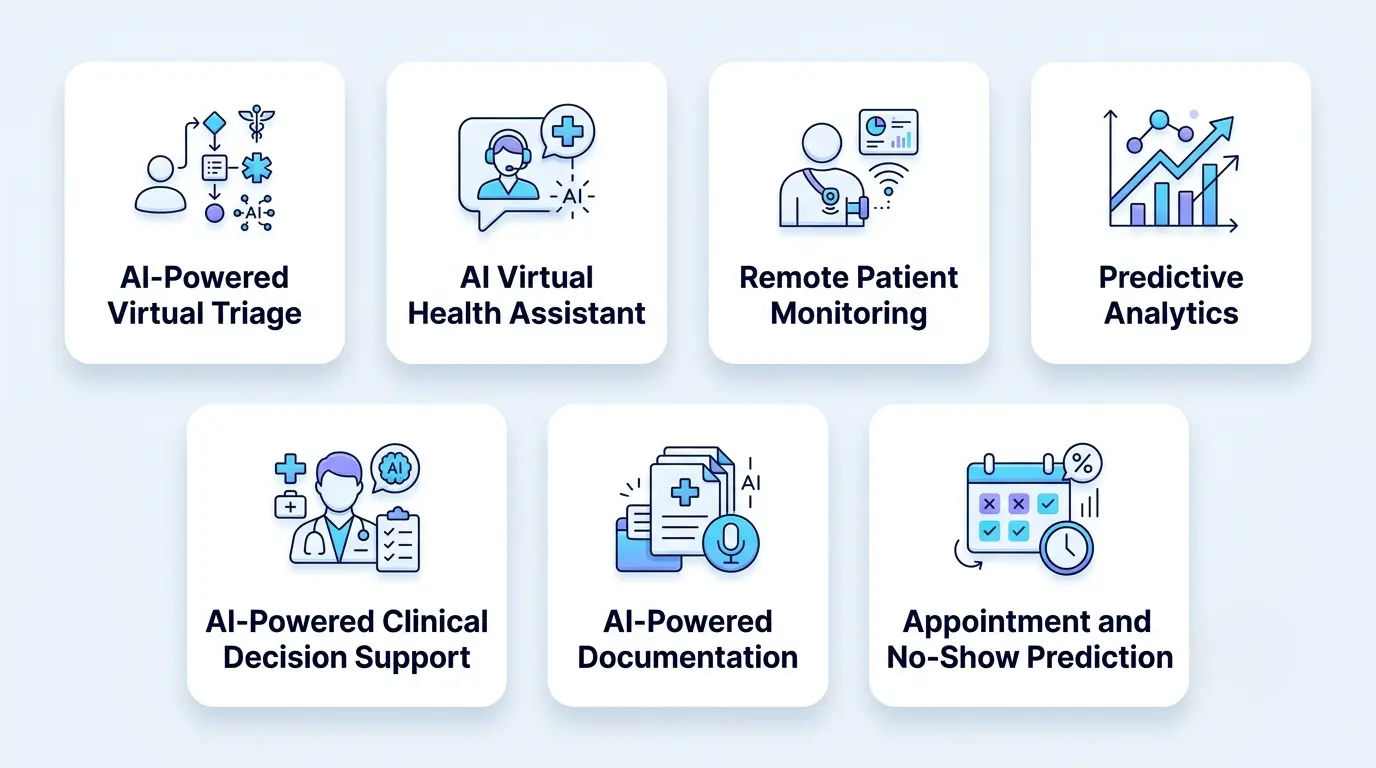
The strongest AI use cases in telehealth are those where AI improves a clearly defined workflow without introducing unnecessary complexity. These applications can support patients, healthcare professionals, and telemedicine operators in different ways.
1. AI-Powered Virtual Triage
AI can collect symptoms, medical history, and other relevant information before a consultation and help determine the appropriate next step based on predefined rules or validated models. This can help route patients to emergency care, primary care, specialist consultations, or other appropriate pathways.
AI triage in telehealth should be designed with clear escalation rules. When symptoms indicate a potentially urgent situation or the system lacks sufficient information, the patient should be directed to appropriate human or emergency care rather than receiving an unsupported automated recommendation.
2. AI Virtual Health Assistant
Patients often have routine questions about appointments, medications, preparation instructions, follow-ups, and platform navigation. AI can handle appropriate low-risk interactions and direct more complex questions to healthcare professionals.
An AI virtual health assistant can also help patients schedule appointments, receive reminders, find relevant information, and navigate telemedicine services. Its responses should be based on approved information and clearly distinguish general assistance from clinical advice.
3. Remote Patient Monitoring
AI can analyze health information collected between virtual consultations and identify patterns that warrant attention. This is particularly relevant for chronic disease management, where changes in health indicators may occur before the next scheduled consultation.
AI-enabled monitoring can complement connected devices and wearables, helping providers review large volumes of patient data more efficiently. This connects naturally with IoT in healthcare app development, where connected medical and wearable devices supply data to healthcare platforms.
4. Predictive Analytics
Predictive models can analyze historical and current patient information to identify patterns associated with potential risks or changes in health status. In telemedicine, this can support preventive care, patient prioritization, and population health management.
The predictions should be treated as decision-support information rather than unquestionable clinical conclusions. Model performance also needs to be monitored across relevant patient populations to identify accuracy or bias issues.
5. AI-Powered Clinical Decision Support
AI can help clinicians organize patient information and surface relevant patterns, evidence, or risk indicators during a consultation. This can reduce information overload and support more informed decision-making.
However, AI diagnosis in telemedicine is a higher-risk application than administrative automation. Its intended use, validation, clinical oversight, and regulatory requirements need to be established before deployment.
6. AI-Powered Documentation
AI can assist with clinical documentation by converting consultation information into structured drafts for healthcare professionals to review and edit. This can reduce manual documentation effort while maintaining provider oversight.
The system should also apply appropriate data handling, retention, access controls, and audit mechanisms because consultation data can contain sensitive patient information.
7. Appointment and No-Show Prediction
Missed appointments create operational inefficiencies for healthcare providers. AI can analyze historical appointment behavior and other authorized signals to identify patterns associated with no-shows.
An AI no-show prediction healthcare feature can help providers prioritize reminders or follow-up communication. The system should avoid using sensitive attributes in ways that could unfairly restrict access to care.
Benefits of AI in Telehealth
The benefits of AI in telehealth depend on how well the technology is integrated into actual healthcare workflows. AI does not automatically improve care simply because it is added to a telemedicine app. Its value comes from solving specific problems and producing measurable improvements.
1. Improved Operational Efficiency
AI can automate selected repetitive tasks such as appointment assistance, documentation, information retrieval, and patient communication. This can reduce manual workload and help healthcare teams use their time more efficiently.
2. Faster Access to Relevant Information
AI can organize and analyze large amounts of authorized patient or operational information, helping providers locate relevant details faster. This becomes increasingly valuable as healthcare organizations manage information across multiple systems.
3. More Personalized Patient Experiences
AI can use relevant patient information and interaction history to support more tailored reminders, follow-ups, recommendations, and care pathways. Personalization should remain within appropriate privacy, consent, and clinical boundaries.
4. Continuous Care Between Consultations
Remote monitoring and AI-assisted analysis can help healthcare providers stay informed between scheduled consultations. This is particularly useful for patients who require ongoing monitoring rather than occasional virtual visits.
5. Better Use of Healthcare Resources
AI-supported triage and workflow automation can help direct human attention toward cases that require professional intervention. The objective is not to remove human involvement but to use healthcare resources more efficiently.
Read Also: Telemedicine App Development Guide: Benefits, Features, & Cost
Essential AI Features in a Telemedicine App
AI features should solve specific patient and provider problems rather than add complexity to the platform. The right combination depends on the care model, target users, available data, and level of clinical involvement.
1. AI Symptom Assessment
An AI-powered symptom assessment feature can collect symptoms, medical history, and other relevant information before a consultation. It can organize this information for providers and, where appropriately validated, support preliminary triage.
The system should communicate its limitations clearly and escalate cases when symptoms indicate urgent attention or when the available information is insufficient.
2. Intelligent Appointment Management
AI can help patients find suitable appointment slots, receive reminders, reschedule consultations, and manage follow-ups. Predictive models can also identify appointment patterns that indicate a higher likelihood of no-shows.
This reduces administrative work while making appointment management more convenient for both patients and healthcare teams.
3. AI Healthcare Chatbot
An AI healthcare chatbot can handle suitable routine queries about appointments, medication instructions, preparation requirements, platform navigation, and follow-up processes. More complex or clinical questions should be routed to qualified professionals.
For reliable responses, the chatbot should use approved healthcare information and maintain appropriate safeguards around patient data.
4. AI Clinical Documentation
AI can convert consultation conversations into structured draft notes, summaries, and follow-up information for provider review. This can reduce documentation time and help maintain consistent records.
The final clinical record should remain under healthcare professional control, with appropriate review, correction, and audit capabilities.
5. Personalized Patient Support
AI can analyze authorized patient information and interaction history to deliver relevant reminders, follow-up prompts, educational content, and care recommendations. Personalization should be based on legitimate healthcare needs and applicable consent and privacy requirements.
6. AI Remote Monitoring
AI can process data from connected devices and wearables to identify changes in health indicators between consultations. This creates opportunities for more continuous care, particularly for patients managing chronic conditions.
Businesses planning wearable technology in healthcare solutions should also consider device compatibility, data quality, connectivity, and the clinical workflow for responding to alerts.
How to Build an AI-Powered Telemedicine App
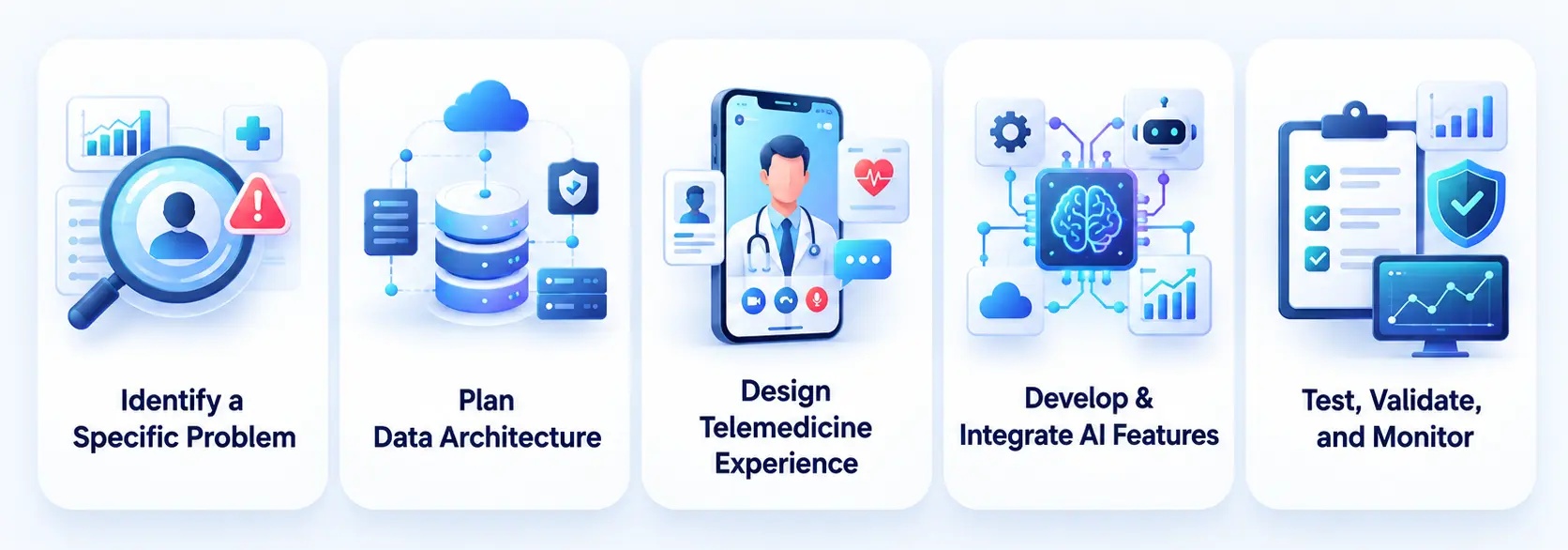
Building an AI-enabled telemedicine product requires healthcare workflows and AI capabilities to be planned together. A practical development process includes the following stages.
1. Define the Healthcare Use Case
Start by identifying the specific problem AI needs to solve. This could involve patient triage, clinical documentation, remote monitoring, appointment management, or patient support.
Clear use cases help determine the required data, AI model, integrations, compliance requirements, and level of human oversight.
2. Plan the AI and Data Architecture
The next step is to determine what data the system needs and where that data will come from. Depending on the use case, this could include patient profiles, consultation records, wearable data, appointment history, or healthcare knowledge bases.
For broader AI in healthcare app development, teams should define data flows, model inputs and outputs, APIs, storage, access controls, and integration points before development begins.
3. Design the Telemedicine Experience
AI should fit naturally into existing patient and provider workflows. Patient-facing features need clear interfaces, understandable responses, and appropriate escalation options. Provider dashboards should make AI-generated insights easy to review without creating additional information overload.
4. Develop and Integrate AI Features
Developers can then integrate the selected AI models, APIs, databases, healthcare systems, and telemedicine functionality. Depending on the product, this could involve machine learning models, natural language processing, generative AI, predictive analytics, or computer vision.
Businesses looking for AI features integration services should also consider how these capabilities will interact with video consultations, EHR systems, payment workflows, notifications, and other core platform components.
5. Test, Validate, and Monitor
AI features need more than standard software testing. Teams should evaluate accuracy, reliability, edge cases, bias, response quality, security, and performance across relevant user groups.
After launch, model performance should continue to be monitored because changes in data, user behavior, or clinical workflows can affect results over time.
Read Also: How To Build A Telemedicine App Like Teladoc Health?
Security and Compliance Considerations
Healthcare applications handle sensitive information, so security needs to be built into the product from the beginning rather than added after development.
A HIPAA-compliant application development approach typically considers data encryption, authentication, authorization, audit logs, secure APIs, access controls, data retention, and appropriate handling of protected health information. The exact regulatory requirements depend on the markets where the product operates and the services it provides.
AI introduces additional considerations because patient data might pass through third-party AI services, model APIs, analytics platforms, or cloud infrastructure. Businesses should understand where data is processed, how it is stored, who can access it, and whether external AI providers use submitted information for model training.
Cloud and AI Infrastructure for Telemedicine
AI-powered telemedicine platforms often require scalable infrastructure because AI processing, video consultations, patient records, notifications, and connected-device data can create different workload patterns.
Cloud computing in healthcare can support scalable storage, APIs, data processing, authentication, monitoring, and integration with healthcare systems. However, cloud selection should also consider data residency, encryption, access controls, availability, backup requirements, and regulatory obligations.
The AI layer should also be designed so that model usage and infrastructure costs remain predictable as the number of patients and consultations grows.
Real-World Example of AI in Telemedicine
Building an AI-enabled telemedicine platform requires more than adding an AI chatbot or automated feature. The product also needs a reliable healthcare workflow, secure patient communication, medication management, appointment handling, and provider-facing capabilities.
Mednovate Connect Telemedicine Platform
RipenApps built Mednovate Connect, a US-based telemedicine and medication management platform that connects patients with licensed clinical pharmacists. Developed for iOS and Android in 3 months, the platform supports medication management across a landscape of 20,000+ approved drugs, with a focus on secure and healthcare-compliance-oriented digital care.
The platform includes tailored medication management plans, clinical pharmacist consultations, appointment booking, treatment monitoring, and patient-provider messaging. These connected healthcare workflows provide a strong foundation for modern telemedicine experiences, where intelligent technologies such as AI can further support patient engagement, monitoring, personalization, and provider workflows.

How Much Does an AI Telemedicine App Cost?
The cost of an AI-enabled telemedicine app depends on the number of platforms, AI capabilities, integrations, security requirements, data complexity, and development approach. A basic telemedicine MVP with limited AI functionality will cost significantly less than an enterprise platform with advanced clinical AI, EHR integrations, remote monitoring, and extensive compliance requirements.
A practical planning range for AI telemedicine app development is around $50,000 to $300,000+. Highly customized enterprise solutions with advanced AI models, multiple healthcare integrations, connected devices, and complex regulatory requirements can exceed this range.
Businesses should treat this as a planning estimate rather than a fixed development quote. A detailed estimate requires defining the AI use cases, technology stack, integrations, security requirements, and expected user scale.
Key Factors That Affect Development Cost
AI complexity is one of the biggest cost drivers. A chatbot or appointment assistant generally requires less development than predictive analytics, clinical decision support, or continuous patient monitoring.
Healthcare integrations also influence the budget. Connecting EHRs, payment systems, pharmacy platforms, wearable devices, video consultation tools, and third-party healthcare APIs adds development and testing work.
Data requirements affect both initial and ongoing costs. AI models may require data preparation, annotation, validation, storage, processing, and monitoring before they are ready for production use.
Security and compliance add further effort. Encryption, role-based access, audit trails, secure APIs, consent management, and regulatory requirements need to be considered throughout development.
For a broader estimate of telemedicine platforms, businesses can also refer to a Telemedicine app development cost guide before finalizing the project scope.
AI-Specific Cost Considerations
The AI app development cost should be evaluated separately from the core telemedicine platform because AI introduces additional infrastructure and operational expenses.
These costs can include:
- AI model or API usage
- Data preparation and processing
- Model training or fine-tuning
- Cloud computing and storage
- Vector databases where applicable
- AI monitoring and evaluation
- Third-party AI and healthcare APIs
- Ongoing model updates and maintenance
Using an existing AI API may reduce initial development effort, while custom models can require more data, infrastructure, validation, and specialist expertise.
How to Calculate the ROI of AI in Telemedicine
The ROI of AI in telemedicine should be measured against specific operational and business outcomes rather than the number of AI features launched. Start by establishing a baseline for the workflow being improved, then compare performance after implementation.
For example, if AI documentation reduces the average time providers spend preparing consultation notes, the business can measure time saved per consultation and estimate the resulting productivity impact. Similarly, an AI appointment system can be evaluated through changes in support workload, appointment completion, and no-show rates.
Key ROI metrics can include:
- Reduction in administrative hours
- Provider productivity
- Patient support cost per interaction
- Appointment completion and no-show rates
- Patient engagement and retention
- Response time for routine queries
- Remote monitoring workload
- AI feature adoption
- Cost per AI-assisted interaction
ROI should also account for ongoing expenses such as AI API usage, cloud infrastructure, monitoring, maintenance, and compliance-related costs.
Challenges of AI in Telemedicine
While AI in telehealth offers opportunities for automation and more personalized digital care, implementation comes with technical, clinical, and operational challenges.
1. Patient Data Privacy
AI systems often process sensitive healthcare information. Weak access controls, insecure integrations, or inappropriate data handling can expose patients to privacy risks.
2. Data Quality and Availability
AI performance depends heavily on the quality and relevance of the data it receives. Incomplete, inconsistent, outdated, or poorly structured healthcare data can reduce the reliability of AI outputs.
3. Accuracy and Bias
AI models can produce incorrect or biased results, particularly when training or evaluation data does not adequately represent the intended patient population. Models should therefore be tested across relevant groups and monitored after deployment.
4. Integration With Existing Systems
Healthcare organizations often use multiple legacy systems, EHRs, medical devices, and third-party platforms. Connecting these systems while maintaining reliable data flows can make implementation complex.
5. Explainability and Human Oversight
Healthcare professionals need to understand when and how AI-generated information should be used. Higher-risk applications require appropriate validation, escalation mechanisms, and human oversight rather than treating AI output as an unquestionable clinical decision.
Businesses should also avoid common AI integration mistakes, such as choosing AI before defining the actual problem, overlooking data requirements, or launching a model without a monitoring and evaluation process.
Future of AI in Telemedicine
The future of AI in telemedicine is likely to focus on deeper integration with clinical workflows rather than standalone AI features. As healthcare platforms collect more structured patient, consultation, and device data, AI can support more connected experiences across the care journey.
1. Multimodal AI for Healthcare
Future telemedicine platforms will increasingly combine different types of information, including text, voice, medical images, clinical records, and device data. This could help providers review relevant information through a single interface instead of switching between multiple systems.
2. More Advanced Remote Monitoring
AI-powered monitoring is likely to become more connected with wearable and IoT devices. Instead of simply collecting readings, systems can analyze trends and surface changes that require review.
This creates opportunities for more proactive care while keeping healthcare professionals involved in decisions that require clinical judgment.
3. Ambient Clinical Documentation
Voice-enabled AI can increasingly support consultation documentation by converting conversations into structured notes and summaries. This could reduce repetitive documentation work and allow providers to spend more attention on patient interactions.
4. Personalized Digital Care
AI can use authorized patient information, previous interactions, and monitoring data to support more personalized reminders, follow-ups, educational content, and care pathways. The quality of personalization will depend on reliable data, appropriate consent, and strong privacy controls.
5. Generative AI in Telemedicine
Generative AI in telemedicine can support conversational assistants, clinical documentation, information retrieval, patient communication, and healthcare knowledge interfaces. Its use in higher-risk clinical workflows will require stronger validation, monitoring, and human oversight.
How to Choose an AI Development Partner
The right development partner should understand both AI engineering and healthcare product requirements. Evaluate potential teams based on their experience with telemedicine workflows, healthcare integrations, data security, AI implementation, testing, and post-launch monitoring.
Look for a partner that can explain why a particular AI approach fits your use case instead of recommending AI for every feature. They should also define the data requirements, model limitations, security controls, integration strategy, and ongoing maintenance needs before development begins.
A good approach to choosing an AI development partner also involves reviewing previous healthcare projects, technical capabilities, development processes, communication practices, and ownership of the final product.
RipenApps helps businesses design and develop AI-enabled healthcare applications by combining product strategy, UI/UX, software development, AI integration, and ongoing technical support.
Wrapping Up
AI in telemedicine is changing how digital healthcare platforms support patients, providers, and operational teams. From intelligent triage and virtual assistants to remote monitoring, documentation, and predictive analytics, AI can improve specific parts of the telemedicine journey when implemented around genuine healthcare needs.
The success of an AI-powered telemedicine app depends on more than selecting the right AI model. Data quality, healthcare integrations, security, compliance, clinical oversight, usability, monitoring, and scalability all need to be considered from the beginning.
Businesses planning an AI-enabled healthcare product should start with clearly defined use cases and measurable outcomes, then select AI capabilities that fit those requirements. A reliable telemedicine app development company can help with product strategy, AI integration, healthcare workflows, secure architecture, development, testing, and post-launch improvements.

FAQ’s
1. How is AI used in telemedicine?
AI is used for patient triage, virtual assistance, remote monitoring, predictive analytics, clinical documentation, appointment management, and personalized patient support. The appropriate use depends on the application’s intended purpose and risk level.
2. How much does an AI telemedicine app cost?
An AI-enabled telemedicine app can cost around $50,000 to $300,000+, depending on AI complexity, integrations, security, data requirements, platforms, and development scope. Enterprise solutions with advanced clinical AI can cost more.
3. What are the main benefits of AI in telemedicine?
AI can reduce repetitive administrative work, support faster information processing, assist with patient triage, improve remote monitoring workflows, and provide more personalized digital interactions.
4. Can AI diagnose patients through telemedicine?
AI can support certain diagnostic or clinical decision workflows, but its role depends on the specific technology, intended use, validation, and applicable regulatory requirements. AI-generated information should not automatically be treated as a definitive diagnosis.
5. What AI technologies are used in telemedicine?
Common technologies include machine learning, natural language processing, generative AI, predictive analytics, conversational AI, speech recognition, and computer vision. The technology should be selected based on the specific healthcare use case rather than the technology itself.

SHARE
WRITTEN BY

Ishan Gupta
CEO & Founder
Ishan Gupta is a seasoned entrepreneur and CEO with extensive 8+ years of experience in business and mobile app development landscape. He believes that the right digital product allows companies to focus on what they do best, while technology handles the rest. With deep exposure to global markets, he understands what makes an app succeed. His approach translates business needs into clear product strategies, ensuring that every feature contributes to measurable ROI.
View All Articles





 India
India USA
USA Australia
 Canada
 UK
UK UAE
UAE