



Key Takeaways
- B2B portals centralize customer accounts, orders, invoices, documents, communication, and self-service workflows within one secure platform.
- Role-based access ensures employees receive appropriate permissions while protecting sensitive customer, financial, and operational information.
- Integrating CRM, ERP, inventory, payment, accounting, and shipping systems can significantly increase portal value and automation.
- Development costs vary according to features, integrations, architecture, security requirements, scalability, design, testing, and ongoing maintenance.
- A successful portal prioritizes high-value business workflows, intuitive customer experiences, scalable architecture, security, and continuous improvement.
B2B businesses increasingly rely on digital platforms to manage customers, orders, payments, documents, communication, and ongoing account relationships. While traditional websites are useful for presenting products and services, they often cannot support the complex workflows involved in business-to-business transactions. This is where a B2B customer portal becomes valuable.
A well-designed portal gives business customers a secure, centralized environment where they can access account information, place orders, track transactions, download invoices, communicate with suppliers, manage users, and perform other routine activities without depending on sales or support teams for every request. For companies managing large customer accounts or recurring business relationships, this can improve operational efficiency while creating a more convenient customer experience.
However, building a B2B portal involves considerably more than creating a login page and customer dashboard. Businesses need to consider portal features, user roles, integrations, security, scalability, architecture, development technology, and long-term maintenance before starting the project.
For businesses that also need robust administrative capabilities, admin dashboard development services can support the management layer required to oversee customers, orders, users, and portal operations. This guide explains what B2B portals are, their essential features, how their architecture works, what the development process involves, and how much it can cost to build a client portal.
Table of Contents
What is a B2B Portal?
A B2B portal is a secure web-based platform that enables businesses to interact digitally with customers, buyers, suppliers, distributors, partners, or other organizations. Unlike a standard business website, a B2B portal provides authenticated users with personalized information and functionality based on their organization, role, permissions, and relationship with the business.
For example, a manufacturer could provide distributors with a portal where they can view product catalogs, check inventory, submit bulk orders, download invoices, monitor shipments, and communicate with account managers. A wholesale supplier could allow business customers to access negotiated pricing, reorder products, review payment history, and manage multiple employees under a single company account.
In simple terms, a B2B portal connects a company’s internal business systems with its external business users through a controlled digital interface. As businesses grow, they may also need to connect functions such as finance, inventory, sales, and customer management, which is where ERP software development can help create a more unified system for managing business operations and data.
This connected approach can make it easier for businesses to maintain consistent information across departments while giving teams better visibility into day-to-day operations.
B2B Portal vs. B2B Website: What is the Difference?
A B2B website and a B2B portal may appear similar because both operate online, but their purposes are different. A B2B website primarily focuses on public-facing activities such as presenting products, explaining services, publishing company information, generating leads, and providing contact information. Most website visitors can access the same core content without logging in.
A B2B portal, on the other hand, is designed around authenticated interactions. Customers or business partners log in to access information specific to their organization. This may include custom pricing, purchase history, contracts, invoices, inventory information, order status, documents, support requests, and account-level analytics.
For companies deciding whether they need a website, portal, or larger enterprise application, understanding the distinction is important. The types of enterprise applications provide additional context on the different software systems businesses use to manage specialized and organization-wide processes.
Why are B2B Portals Important for Modern Businesses?
B2B transactions often involve multiple people, approval stages, product configurations, negotiated prices, recurring purchases, documents, and financial processes. Managing these interactions entirely through email, spreadsheets, phone calls, or disconnected systems can create unnecessary administrative work.
A centralized portal allows businesses to move repetitive activities into self-service workflows. Customers can access information themselves instead of contacting an employee for every update. Internal teams can spend less time handling routine requests and more time on account management, sales, problem-solving, and strategic activities.
B2B portals can also improve transparency. Customers can see order statuses, invoices, documents, and account information from one location instead of relying on scattered communications.
The portal can additionally become an important digital layer connecting CRM, ERP, inventory, payment, shipping, accounting, and customer-support systems. This makes portal development a strategic technology investment rather than simply another customer-facing website.
Essential B2B Portal Features
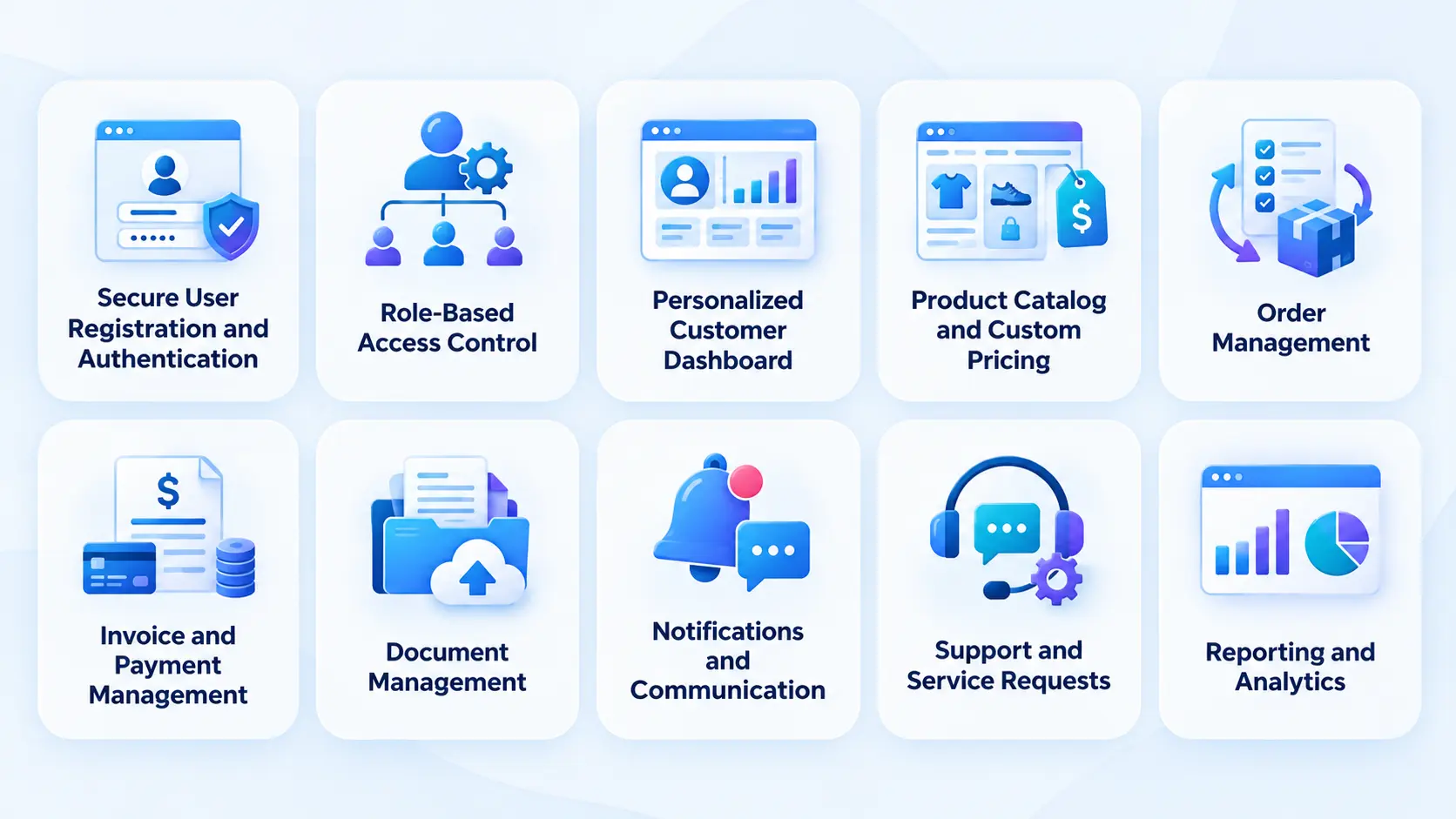
The functionality required depends on the company’s business model, but several capabilities are commonly important when building B2B portals.
1. Secure User Registration and Authentication
Security should begin with how users access the platform. B2B portals typically require secure authentication, password management, email verification, multi-factor authentication, session controls, and account recovery.
Enterprise customers may also need single sign-on so employees can access the portal through their organization’s identity provider. Authentication requirements should be defined according to the sensitivity of the information handled by the platform.
2. Role-Based Access Control
A B2B portal may serve multiple users from the same customer organization. A purchasing manager, finance employee, administrator, sales representative, and regular buyer should not necessarily have the same permissions.
Role-based access control allows administrators to define what each user can view or perform. For example, one employee might create an order while another must approve it before submission. A finance user could access invoices without having permission to change product configurations. This approach creates a more secure and manageable customer environment.
3. Personalized Customer Dashboard
The dashboard should provide users with the information they need most frequently. Depending on the business, it may display recent orders, pending approvals, outstanding invoices, account balances, support requests, shipment updates, recommended products, or important notifications. Personalization is particularly important in B2B environments because different customers may have different pricing, catalogs, contracts, purchasing limits, and workflows.
4. Product Catalog and Custom Pricing
For B2B commerce, product presentation often needs to be more sophisticated than a conventional online store. Customers may receive organization-specific pricing, volume discounts, contract rates, minimum order quantities, or access to selected products.
A portal can display catalogs based on customer permissions and automatically apply relevant pricing rules. As the business expands its online sales operations, multi-vendor marketplace development can also become relevant for managing multiple sellers, product catalogs, pricing structures, and business participants within a shared digital ecosystem. This can help create a more flexible commerce environment while keeping different users and transactions organized.
5. Order Management
Order management is often one of the core functions of a B2B portal. Customers should be able to create orders, review previous purchases, reorder products, modify eligible orders, and monitor order status.
For organizations with complex purchasing workflows, the portal can also support approval rules, purchase limits, recurring orders, bulk ordering, and organization-level purchasing policies.
6. Invoice and Payment Management
Financial visibility is another major requirement. A B2B customer portal can allow users to access invoices, payment records, outstanding balances, transaction histories, and downloadable financial documents.
Businesses can integrate payment gateways or accounting systems to support online payments where appropriate. Customers can then manage financial information without repeatedly contacting finance teams.
7. Document Management
B2B relationships often involve contracts, quotations, product documentation, compliance certificates, invoices, purchase orders, statements, and other files.
A secure document-management area can organize these files according to customer accounts and permissions. Version control, document expiration alerts, access restrictions, and audit logs can make the system more useful for organizations dealing with large volumes of business documentation.
8. Notifications and Communication
A portal can notify customers about order updates, payment deadlines, shipment changes, approvals, new documents, service announcements, or account activities.
Notifications may be delivered through the portal, email, SMS, or other communication channels depending on the workflow. Businesses should provide controls so customers can manage non-critical notification preferences.
9. Support and Service Requests
Instead of handling every support request through email, businesses can integrate ticketing or service-request functionality into the portal. Customers can submit issues, upload supporting documents, track responses, and review previous requests.
This creates a centralized history of customer interactions and can improve accountability for support teams.
10. Reporting and Analytics
Business customers may need access to account-specific reports covering purchasing activity, order volumes, spending, product usage, payment status, or other relevant metrics. Administrators also need internal analytics to understand portal usage, customer activity, order trends, and operational bottlenecks.
An effective dashboard should therefore focus on actionable information rather than simply displaying large numbers of charts. Businesses building sophisticated internal dashboards can consider specialized development solutions when planning the administrative layer of a customer-facing portal.

B2B Portal Architecture: How Does It Work?
The architecture of a B2B portal determines how its interface, business logic, databases, integrations, and security mechanisms work together. A typical architecture consists of a frontend layer, backend application layer, database layer, API layer, integration services, authentication infrastructure, and cloud or server environment.
The frontend provides the user interface through which customers interact with the portal. It may be developed using modern web technologies such as React, Angular, or Vue. The backend handles business logic, authentication, permissions, order processing, customer-specific pricing, notifications, workflows, and other application operations.
The database stores customer accounts, users, orders, products, invoices, documents, permissions, transactions, and other application data. The API layer enables communication between the portal and internal or third-party systems.
This can include CRM, ERP, payment gateways, accounting software, inventory management platforms, shipping providers, and customer-support systems. For businesses that require extensive system integration, API development services can help create secure APIs that connect the portal with existing applications and external platforms.
Choosing the Right B2B Portal Architecture
There is no universal architecture for every B2B portal. The right approach depends on business size, expected traffic, integrations, data sensitivity, functionality, and future growth. A smaller portal may start with a modular monolithic architecture because it is relatively straightforward to develop and maintain. As the system grows, selected services can be separated where independent scaling or deployment becomes necessary.
Larger organizations with multiple applications and complex workflows may benefit from service-oriented or microservices-based architectures. This can provide greater flexibility, but it also introduces additional infrastructure, monitoring, deployment, and operational complexity.
Cloud infrastructure is another important consideration. Cloud platforms can provide scalable computing, managed databases, storage, security services, monitoring, and backup capabilities. The architecture should be designed so that increased customer activity does not create a major performance bottleneck.
When deciding how the portal should be built and delivered, businesses may also need to weigh the differences between a custom web app vs SaaS, particularly in terms of scalability, ownership, customization, and long-term flexibility. The right approach will depend on the organization’s operational requirements, budget, and growth plans.
B2B Portal Integrations
Integrations are frequently one of the most technically demanding parts of B2B portal development. A portal may need to exchange information with existing business applications rather than becoming another isolated system. Common integrations include CRM platforms, ERP systems, accounting software, payment gateways, inventory systems, shipping platforms, tax systems, email services, identity providers, and customer-support software.
For example, when a customer submits an order through the portal, the system may need to send the order to an ERP. The ERP could then return inventory availability and order status. Once the order is processed, shipping information can flow back into the portal so the customer can track delivery.
This requires well-designed APIs, authentication mechanisms, error handling, data synchronization, logging, and monitoring. Companies building a broader software ecosystem may also consider working with a SaaS development company when the portal is intended to become a multi-tenant product serving multiple organizations.
Security Considerations for B2B Portals
Because B2B portals can contain financial information, customer data, contracts, business documents, pricing information, and transaction records, security needs to be considered from the beginning of development.
Authentication should be supported by appropriate password policies, multi-factor authentication, secure session management, and account protection mechanisms. Authorization should ensure that users cannot access another customer’s information simply by changing an identifier in a URL or API request.
Data should be protected during transmission and storage. Sensitive operations should be logged, and administrative actions should be auditable. The application should also be tested for common vulnerabilities such as broken access control, injection attacks, cross-site scripting, insecure authentication, and improper data exposure.
Security should not be treated as a final testing step. It should be incorporated into architecture, development, integration, deployment, and ongoing maintenance. Businesses dealing with older infrastructure should also understand the implications of legacy application modernization because outdated systems may introduce compatibility, security, and integration challenges when connected to a modern portal.
B2B Portal Development Process
The development process generally begins with business and technical discovery. Teams identify who will use the portal, what problems it should solve, which workflows should be digitized, and which existing systems need integration. Requirements are then translated into user journeys, functional specifications, technical architecture, and interface designs.
The next stage involves frontend and backend development. Developers implement authentication, customer management, product catalogs, order workflows, payment functionality, dashboards, integrations, and other required modules.
Testing should cover functional behavior, security, performance, compatibility, integrations, and user acceptance. Particular attention should be given to permission boundaries because different users and organizations may have different access levels. After testing, the portal is deployed to production. Monitoring, backups, security updates, bug fixes, performance optimization, and feature enhancements continue after launch.
A structured methodology becomes especially important when the portal is part of a larger enterprise technology environment. The enterprise app development process provides additional insight into the stages involved in planning and implementing enterprise-grade applications.
How Much Does B2B Portal Development Cost?
The cost of developing a B2B portal can vary significantly depending on its complexity. A basic customer portal with authentication, account management, documents, and simple dashboards requires considerably less development effort than a sophisticated B2B commerce platform with ERP integration, custom pricing, approval workflows, payments, advanced analytics, and multi-tenant architecture.
For a basic implementation, development costs may start around $20,000 to $40,000. A medium-complexity B2B portal with custom workflows, integrations, dashboards, and more advanced account functionality can range from approximately $40,000 to $80,000.
A highly customized enterprise B2B portal can exceed $80,000 and may reach $150,000 or more depending on integrations, security requirements, user volume, automation, architecture, and development scope.
These are indicative ranges rather than fixed quotations. The final cost depends on the project’s requirements, technology choices, development team location, integrations, testing requirements, design complexity, and ongoing support.
For businesses planning a larger-scale digital transformation, enterprise app development cost can also vary significantly based on factors such as system complexity, integrations, security requirements, scalability, and long-term maintenance. Understanding these cost drivers can help organizations set a more realistic budget before beginning development.
Factors That Influence B2B Portal Development Cost
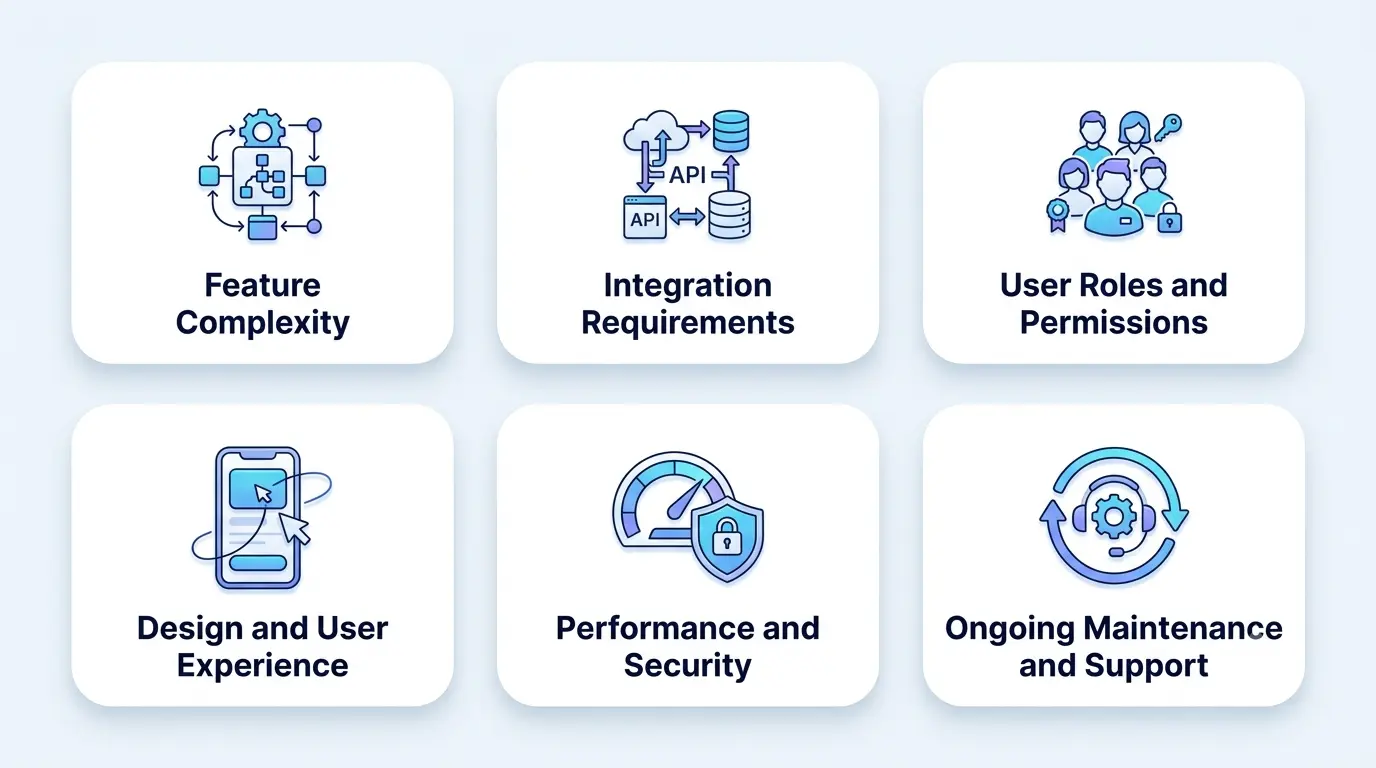
Several factors can affect the overall cost of building a B2B portal. Understanding these cost drivers can help businesses estimate their budget more realistically and prioritize the functionality they need.
1. Feature Complexity
The number and complexity of features directly influence development effort. A basic portal with customer accounts and document access requires less work than one with advanced B2B commerce and automation capabilities.
- Customer accounts and document management
- B2B purchasing and bulk ordering
- Dynamic pricing and subscriptions
- Approval workflows
- Payment processing
- Real-time inventory management
2. Integration Requirements
Integrations can significantly affect development time and cost, particularly when the portal needs to communicate with several existing business systems.
- CRM and ERP integrations
- Payment and accounting systems
- Inventory and warehouse platforms
- Shipping and logistics systems
- Legacy systems with different data structures
3. User Roles and Permissions
The number of user types and the complexity of their permissions can increase the amount of backend logic required. A simple customer account structure is easier to implement than a multi-level organizational system.
- Organization administrators
- Department-level users
- Buyers and approvers
- Finance users
- Sales representatives
- External business partners
4. Design and User Experience
Design requirements also influence development effort. A highly customized portal with complex workflows and advanced dashboards generally requires more design and engineering resources than a standard interface.
- Custom user interfaces
- Advanced dashboards
- Responsive design
- Accessibility requirements
- Complex customer workflows
- Personalized user experiences
5. Performance and Security
Performance and security requirements can increase the overall budget, especially when the portal handles sensitive business information or is expected to support a large number of users.
- Secure authentication and authorization
- Data protection and encryption
- Role-based access controls
- Performance optimization
- Scalability for growing user volumes
- Security testing and monitoring
6. Ongoing Maintenance and Support
Development costs do not end when the portal goes live. Businesses should also account for ongoing maintenance to keep the platform secure, reliable, and compatible with changing requirements.
- Security updates and patches
- Infrastructure management
- Bug fixes
- Performance optimization
- System monitoring
- Future feature development
B2B Customer Portal vs. B2B Ecommerce Portal
Although the terms are sometimes used interchangeably, a B2B customer portal and B2B ecommerce portal can serve different purposes. A customer portal primarily focuses on the ongoing customer relationship. Customers may use it to access account information, documents, support services, orders, invoices, and communications.
A B2B ecommerce portal places greater emphasis on purchasing. It may include product catalogs, bulk ordering, customer-specific pricing, shopping carts, checkout, payment processing, inventory availability, promotions, and order fulfillment. Some businesses require both. In such cases, the customer portal becomes an authenticated business environment that incorporates ecommerce capabilities.
Organizations researching larger commerce solutions can also explore the marketplace app development guide to understand the development considerations involved in building platforms that facilitate transactions between multiple business participants.
When Should a Business Invest in B2B Portal Development?
A B2B portal can be particularly valuable when employees spend significant time answering repetitive customer questions, manually processing orders, sharing documents, checking account information, or providing transaction updates. It can also make sense when a business has a large number of recurring customers, distributors, suppliers, or partners who require regular access to business information.
Another strong indicator is fragmented customer communication. If important information is spread across emails, spreadsheets, CRM records, ERP systems, and shared documents, a portal can create a centralized customer-facing layer.
Companies experiencing rapid growth may also benefit because self-service functionality can help scale customer operations without increasing administrative work at the same rate. Digital transformation initiatives can further strengthen the business case. The role of digitalization in business growth explores how digital systems can support efficiency, customer experience, and broader business growth.
Common B2B Portal Development Challenges
One of the biggest challenges is translating complicated business processes into simple digital workflows. B2B operations often contain exceptions, approval rules, negotiated contracts, and customer-specific processes that cannot be handled effectively by generic functionality. Integration is another challenge. Existing ERP, CRM, inventory, accounting, or legacy applications may use different data structures and APIs. Maintaining accurate synchronization between these systems requires careful architecture.
Security is equally important. A portal may serve thousands of users across different companies, making access-control errors particularly serious. Scalability must also be considered from the beginning. An architecture that works for a few hundred users may struggle when the customer base grows significantly.
User adoption can present another obstacle. Even a technically sophisticated portal will provide limited value if customers find it confusing or difficult to use. The interface should therefore prioritize clarity, familiar workflows, responsive design, and self-service convenience.
Organizations dealing with complex internal software should also consider how portal development interacts with existing systems. For example, companies managing HR, finance, operations, and customer workflows may need multiple applications to work together. The HRMS software development resource offers useful perspective on developing specialized business software and managing complex organizational workflows.
How to Choose a B2B Portal Development Company
Choosing the right development partner requires evaluating more than technical skills. Businesses should assess whether the development team understands B2B workflows, enterprise integrations, security, scalability, and long-term product maintenance. A suitable full stack development company should be capable of handling both frontend and backend requirements while maintaining consistency across the complete application architecture.
Businesses should also examine previous experience with portals, enterprise applications, APIs, SaaS products, dashboards, and third-party integrations. Reviewing case studies can help determine whether the team has experience solving problems similar to those involved in the proposed portal.
Communication and project management are equally important. Requirements can evolve during B2B projects, particularly when different departments have different expectations. A development partner should therefore provide a structured process for discovery, estimation, development, testing, deployment, and post-launch support.
How to Make a B2B Portal Successful
Successful B2B portal development starts with business outcomes rather than a long feature list. Instead of asking which features can be added, businesses should identify which customer and operational problems the portal needs to solve. For example, if customer-service teams spend hours answering order-status questions, order tracking should become a priority. If finance teams repeatedly send invoices manually, invoice self-service may deliver greater value than adding advanced analytics.
The first release should focus on high-value workflows that customers will actually use. Additional automation, analytics, integrations, and personalization can then be introduced based on real usage data. Performance should also be treated as a business requirement. Slow dashboards, delayed order updates, or unreliable integrations can reduce customer confidence even when the portal technically contains all the required functionality.
Finally, the portal should evolve continuously. Customer expectations, business processes, security requirements, and technology environments change over time. A scalable architecture makes it easier to introduce new capabilities without rebuilding the entire platform.
Final Thoughts
B2B portal development can transform how businesses manage customer relationships, transactions, documents, orders, payments, and self-service operations. Instead of relying on disconnected communication channels, companies can provide customers with a secure digital environment tailored to their organization and business relationship.
The right portal architecture should balance functionality, security, integration capability, scalability, usability, and development cost. Features such as role-based access, personalized dashboards, order management, customer-specific pricing, invoice access, document management, notifications, support, and analytics can create a strong foundation for a modern B2B experience.
For companies considering customer portal development, the most important step is to define the business workflows and customer problems before selecting technologies or estimating development costs. A carefully planned solution can reduce manual work, improve transparency, strengthen customer relationships, and create a scalable foundation for future digital growth.
Whether the goal is to create a standalone customer portal, a B2B ecommerce portal, or a broader enterprise platform, investing in the right full stack development company can turn repetitive customer interactions into streamlined, self-service digital experiences.
RipenApps helps businesses design and develop scalable B2B portals that connect customer-facing experiences with the systems and workflows behind them. Our team focuses on secure architecture, intuitive user experiences, integrations, and business-specific functionality to create portals that support both current operational needs and long-term growth.

FAQs
1. What is a B2B portal?
A B2B portal is a secure web-based platform that allows businesses and their customers, suppliers, distributors, or partners to manage accounts, orders, documents, payments, and other business interactions digitally.
2. What are the essential features of a B2B portal?
Essential features include secure authentication, role-based access control, personalized dashboards, product catalogs, custom pricing, order management, invoice and payment management, document management, notifications, support requests, and reporting.
3. How much does it cost to develop a B2B portal?
B2B portal development can range from around $20,000 for a basic implementation to $150,000 or more for a highly customized enterprise portal, depending on features, integrations, security, architecture, and development scope.
4. What integrations are commonly required for B2B portals?
Common integrations include CRM, ERP, accounting software, payment gateways, inventory systems, shipping platforms, tax systems, identity providers, and customer-support applications.
5. How does role-based access control improve B2B portal security?
Role-based access control ensures users can only view or perform actions appropriate to their responsibilities, helping protect sensitive customer, financial, and operational information.
6. What architecture is best for a B2B portal?
There is no single architecture that suits every B2B portal. The right choice depends on business size, expected traffic, integrations, data sensitivity, functionality, and future scalability.
7. What are the common challenges in B2B portal development?
Common challenges include handling complex business workflows, integrating existing systems, maintaining strong security, supporting scalability, and creating an interface that encourages customer adoption.
8. How can businesses choose the right B2B portal development company?
Businesses should evaluate a development partner’s experience with B2B workflows, enterprise integrations, security, scalability, APIs, SaaS products, dashboards, testing, deployment, and post-launch support.
Discuss your project and request for proposal
SHARE
WRITTEN BY

Ishan Gupta
CEO & Founder
Ishan Gupta is a seasoned entrepreneur and CEO with extensive 10+ years of experience in business and mobile app development landscape. He believes that the right digital product allows companies to focus on what they do best, while technology handles the rest. With deep exposure to global markets, he understands what makes an app succeed. His approach translates business needs into clear product strategies, ensuring that every feature contributes to measurable ROI.
View All Articles