

Key Takeaways
- AI Chatbots in Banking and Fintech Apps can support customers across account management, payments, lending, cards, investments, insurance, and other financial products.
- High-value use cases include customer support, product discovery, loan assistance, transaction queries, fraud alerts, financial guidance, and personalized recommendations.
- AI can reduce repetitive support workloads while helping financial institutions provide faster and more consistent customer experiences.
- Successful banking chatbots need strong integrations with core banking, CRM, payment, KYC, loan, and customer-support systems.
- Security, authentication, data privacy, regulatory controls, and human escalation should be built into the chatbot from the beginning.
- ROI should be measured through support deflection, resolution time, customer satisfaction, conversion rates, product adoption, operational savings, and revenue impact.
- Custom development becomes more valuable when a financial institution needs proprietary workflows, deeper integrations, stronger control over data, or product-specific AI capabilities.
Banking customers no longer want to wait on hold or navigate multiple screens to find a simple answer. They expect instant help when checking an account, understanding a financial product, tracking a transaction, applying for a loan, or resolving a payment issue.
This shift is making AI chatbots in banking an important part of modern digital financial experiences. Unlike traditional rule-based bots, AI-powered assistants can understand natural language, use relevant customer and product information, and provide more contextual responses across mobile apps, websites, and other digital channels.
The opportunity extends beyond customer support. AI Chatbots in Banking and Fintech Apps can help customers discover financial products, understand fees and eligibility, complete routine tasks, receive personalized guidance, and get assistance throughout their financial journey. Banks and fintech companies can also use these systems to automate repetitive interactions and improve service efficiency.
For financial institutions, the challenge is not simply adding an AI chatbot. The solution must work within strict requirements for security, privacy, compliance, accuracy, and human oversight. This is where an experienced AI chatbot development company can help design and build conversational solutions around specific financial products, customer journeys, and technology ecosystems.
This guide covers the top use cases of AI chatbots in banking and fintech, their potential ROI, must-have features, implementation considerations, security requirements, development costs, and how businesses can determine whether a custom solution is the right investment.
Table of Contents
What Are AI Chatbots in Banking and Fintech?
AI chatbots in banking are conversational AI systems that allow customers to interact with financial institutions through natural language. Customers can ask questions, request information, receive guidance, and complete supported tasks through text or voice instead of navigating complex menus or waiting for an employee.
Modern conversational AI in banking combines technologies such as natural language processing, machine learning, retrieval systems, and generative AI to understand customer intent and provide contextual responses. Depending on the implementation, the chatbot can retrieve information from approved financial data sources and guide customers through specific banking processes.
The difference from a traditional chatbot is important. A rule-based system may recognize a limited set of predefined questions, while an AI-powered assistant can interpret variations in language and maintain context across a conversation. This makes it better suited to complex interactions such as comparing financial products, understanding loan requirements, or resolving transaction-related questions.
For example, a customer could ask, “Why was my card payment declined?” Instead of displaying a generic FAQ, a connected banking AI chatbot could identify the relevant account or transaction, explain the available information, and guide the customer toward the next appropriate step, subject to authentication and business rules.
The technology is already being deployed at significant scale. Bank of America reported that its AI-powered virtual assistant Erica had surpassed 3 billion client interactions, with nearly 50 million users since launch. The bank also reported that more than 98% of users find the information they need through Erica.
This demonstrates how conversational AI can move beyond experimentation and become a core digital service channel when connected to real financial workflows.
Why Are Banks and Fintechs Investing in AI Chatbots?
The growing adoption of AI chatbots is not simply about keeping up with an emerging technology. Financial institutions are looking for practical ways to improve customer experience, automate service operations, increase product engagement, and make digital channels more useful.
1. Customers Expect Instant Financial Assistance
Customers may need help at any time of the day. Questions about transactions, cards, payments, account balances, fees, or applications should not always require a call-center interaction.
A chatbot in banking can provide immediate assistance for routine queries while directing complex issues to human agents. This creates a faster service experience without requiring financial institutions to expand support teams at the same rate as customer demand.
IBM notes that conversational AI can provide real-time support across mobile apps, websites, and phone systems while helping institutions handle issues such as fraud alerts, account problems, and credit or loan application questions.
2. Reduce Repetitive Customer Support Work
Financial institutions handle large volumes of repetitive questions every day. Customers may ask about account information, transaction status, card usage, payment schedules, documentation, or product eligibility.
AI can handle many of these interactions automatically, allowing human agents to focus on cases that require judgment, empathy, or specialized financial expertise.
This is already visible in real-world deployments. ING’s generative AI chatbot helped 20% more customers avoid long wait times within its first seven weeks compared with its previous chatbot.
3. Improve Financial Product Discovery
Financial products can be difficult for customers to compare. Interest rates, fees, eligibility criteria, repayment terms, rewards, risk levels, and other conditions can make product selection confusing.
AI-powered conversations can simplify this experience by asking relevant questions and presenting information in a more understandable format.
This creates opportunities for AI in banking customer service to extend beyond problem resolution and support product discovery, education, and guided customer journeys.
4. Support 24/7 Digital Banking
Unlike human support teams, AI assistants can remain available around the clock. This is particularly valuable for digital-first banks and fintech platforms serving customers across different time zones.
A chatbot for financial services can provide continuous assistance for common questions, application guidance, transaction information, and other approved workflows while maintaining escalation paths for situations that require human intervention.
5. Create More Personalized Experiences
Customers increasingly expect financial services to reflect their individual needs. A chatbot can use permitted customer context, transaction information, product data, and previous interactions to provide more relevant responses.
For example, instead of presenting every credit card or loan option, an AI assistant can help a customer understand which products may fit their stated requirements and explain the relevant terms.
This is becoming increasingly important as customers themselves adopt AI for financial decisions. McKinsey reported that 23% of surveyed consumers use generative AI for financial tasks at least monthly, with understanding financial products, investment advice, and product comparisons among the leading use cases.
Top AI Chatbot Use Cases in Banking
The strongest banking chatbot strategies focus on specific customer and business problems rather than trying to automate every interaction at once.
1. Account and Transaction Assistance
Customers frequently need quick answers about balances, transactions, transfers, deposits, fees, and payment status.
A chatbot connected to the appropriate banking systems can retrieve permitted information and provide customers with immediate answers after authentication. This reduces the need to search through transaction histories or contact customer support.
2. Card Support and Payment Assistance
Card-related issues can create immediate customer frustration. Customers may need help with declined payments, card activation, lost cards, spending limits, payment status, or replacement requests.
An AI assistant can guide customers through supported card-service workflows and escalate sensitive situations when required.
3. Loan and Mortgage Assistance
Loan applications involve multiple steps, documents, eligibility requirements, and financial terms. This makes lending an important area for conversational assistance.
A chatbot can explain eligibility criteria, required documents, application stages, repayment terminology, and general product information. It can also help customers understand what information they need before starting an application.
For more advanced lending products, AI can support the journey without making unsupported financial decisions or bypassing established underwriting controls.
4. Credit Card Product Discovery
Customers often compare credit cards based on rewards, annual fees, interest rates, benefits, eligibility, and spending patterns.
A conversational assistant can ask customers what they value and explain relevant product differences using approved product information. This can create a more guided experience than asking customers to compare multiple product pages manually.
5. Fraud Alerts and Suspicious Transaction Support
Fraud-related conversations require speed and careful handling. Customers may need to understand an unfamiliar transaction, report suspicious activity, or confirm whether an alert relates to their account.
AI can provide immediate guidance and route high-risk cases through the appropriate security workflow. It should not replace dedicated fraud detection systems or human investigation where those are required.
This is where a chatbot can complement technologies covered in AI fraud detection in fintech, creating a more connected customer-facing response after a suspicious activity signal is generated.
6. Customer Onboarding and KYC Guidance
New customers often have questions about identity verification, documentation, account setup, and application status.
A chatbot can explain each step, identify missing information, answer common questions, and guide users through the onboarding process.
The actual verification and compliance decisions should remain within approved systems and regulatory controls.
7. Investment and Wealth Management Assistance
AI assistants can help customers understand investment products, explain terminology, summarize approved information, and navigate available services.
However, financial institutions need clear boundaries between educational assistance and regulated financial advice. Responses should be grounded in approved information, with appropriate disclosures and human involvement where necessary.
8. Insurance Product Assistance
Insurance customers often need help understanding coverage, policy terms, claims processes, renewals, and documentation.
A conversational assistant can simplify these interactions by answering common questions and guiding customers to relevant policy information.
9. Payment and Money Transfer Support
Fintech platforms often depend heavily on fast payment experiences. Customers may need assistance with transfer status, failed payments, recipient information, fees, or transaction limits. With AI & ML in money lending, fintech platforms can use customer and transaction data to make these support experiences more relevant.
A fintech chatbot connected to appropriate payment and transaction systems can provide real-time guidance while reducing unnecessary support interactions.
10. Personalized Financial Guidance
Customers increasingly want help understanding their spending, saving, and financial goals.
AI assistants can provide educational insights based on approved customer information and predefined financial rules. For regulated advice or high-impact financial decisions, the chatbot should clearly distinguish general guidance from professional advice.
Real-World Fintech Success: Al Muzaini’s Money Transfer Platform
RipenApps engineered Al Muzaini FinTech, a cross-border remittance and currency exchange platform for Kuwait’s leading exchange house. Available across Android and iOS, the platform supports essential financial journeys such as domestic and international money transfers, beneficiary management, real-time exchange rates, and Western Union network integration.
The platform also includes AI-powered KYC onboarding to streamline customer verification, along with three-factor authentication and biometric login for secure account access. Multi-language support further helps serve customers across different user groups. The app has achieved 100K+ installs and 1.87K Google Play reviews, with both Android and iOS versions actively maintained as of June 2026.
Al Muzaini demonstrates how fintech platforms can combine AI with secure financial workflows to reduce onboarding friction and support complex money-transfer journeys. These capabilities also create a strong foundation for adding conversational AI, where customers can receive assistance with KYC, transfers, exchange rates, beneficiaries, and other financial services through a single interface.

AI Chatbots in Banking and Fintech Apps: High-ROI Financial Products
The strongest business case for conversational AI appears when the chatbot is connected directly to financial products and their customer journeys.
1. Banking Accounts
Chatbots can assist with account opening, account information, transaction queries, balance-related questions, and service requests.
2. Credit Cards
AI can help customers compare cards, understand rewards, check eligibility information, and receive support after application or activation.
3. Loans and Credit
Chatbots can guide users through eligibility questions, documentation, application stages, repayment information, and general loan terminology.
4. Payments and Wallets
Fintech platforms can use AI to support payment status, transaction issues, transfer queries, and wallet-related assistance.
5. Investments
AI can help users discover investment products, understand terminology, access approved educational content, and navigate investment platforms.
6. Insurance
Conversational interfaces can simplify policy-related questions, claims guidance, renewal information, and document requirements.
The broader opportunity is to make AI Chatbots in Banking and Fintech Apps a common conversational layer across multiple financial products rather than building isolated bots for individual services.
How AI Chatbots Generate ROI for Banks and Fintechs
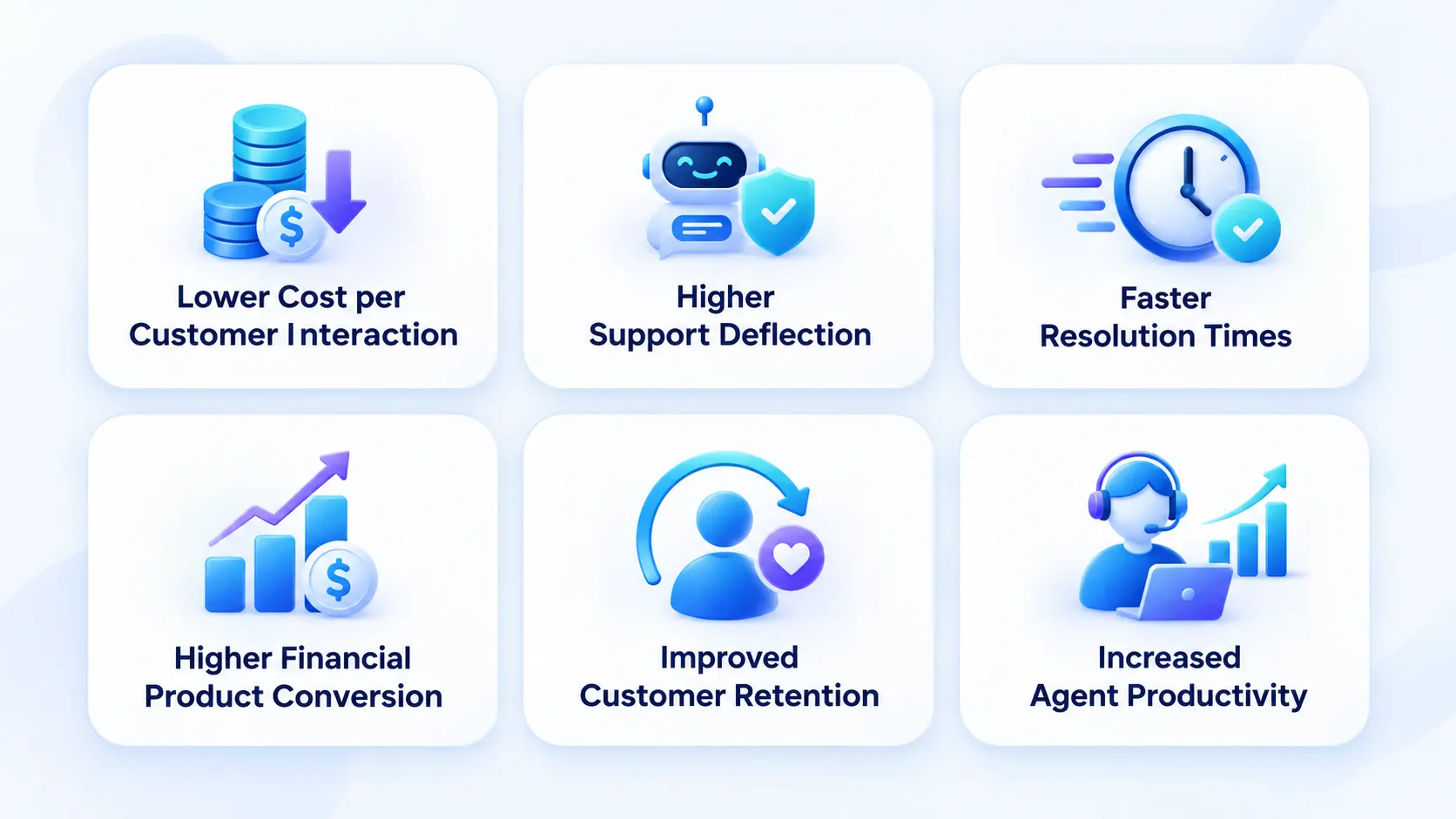
AI chatbot ROI should not be measured by the number of conversations alone. Financial institutions should connect chatbot performance to measurable business outcomes.
1. Lower Cost per Customer Interaction
Automating repetitive questions can reduce the volume of interactions that require human agents. This can lower service costs while allowing employees to focus on more complex cases.
2. Higher Support Deflection
A useful chatbot can resolve a greater percentage of routine queries without human intervention. The key is to measure successful resolution, not simply automation volume.
3. Faster Resolution Times
Customers benefit when they receive answers immediately instead of waiting for an email or call-center response. Faster resolution can also reduce repeated contacts for the same issue.
4. Higher Financial Product Conversion
Conversational assistance can help customers understand and compare financial products at the point of decision. This can create additional opportunities for credit cards, loans, accounts, insurance, investments, and other services.
5. Improved Customer Retention
Better digital service can strengthen customer relationships. Customers who can easily resolve problems and access relevant financial information may have less reason to move to another provider.
6. Increased Agent Productivity
AI can also support human agents rather than replacing them. It can retrieve information, summarize customer conversations, suggest responses, and surface relevant knowledge during live interactions.
For banks, this creates a broader ROI opportunity across both customer-facing automation and employee productivity. McKinsey estimates that generative AI could create $200 billion to $340 billion in annual value for the banking industry, although the figure represents the broader potential of generative AI rather than chatbot ROI alone.
Measuring AI Chatbot ROI in Banking and Fintech
Before deploying an AI assistant, define the metrics that will determine whether the investment is working.
| KPI | What It Measures |
| Resolution rate | Percentage of conversations resolved successfully |
| Support deflection | Queries handled without human intervention |
| Average handling time | Time required to resolve customer issues |
| Cost per interaction | Operational cost of customer support |
| Conversion rate | Customers who complete a targeted financial action |
| Product adoption | New products purchased or activated |
| Customer satisfaction | Quality of the chatbot experience |
| Escalation rate | Conversations transferred to human agents |
| Repeat contact rate | Customers returning with the same unresolved issue |
| Revenue per customer | Financial value generated through assisted journeys |
The right KPIs depend on the chatbot’s purpose. A customer-service chatbot should prioritize resolution, deflection, satisfaction, and cost savings, while a product-discovery assistant may focus more heavily on conversion and product adoption.
Must-Have Features of AI Chatbots in Banking and Fintech
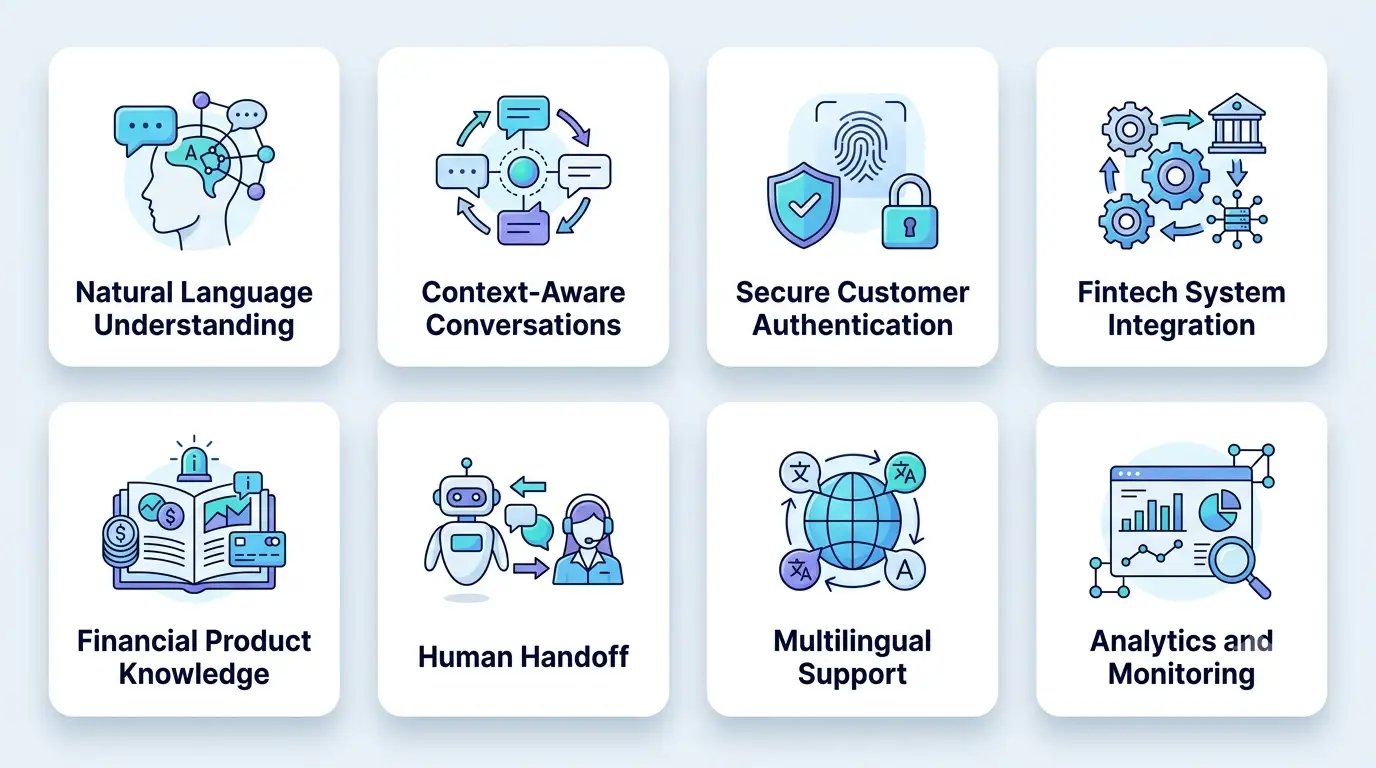
A banking chatbot needs to do more than answer routine questions. It must understand customer intent, work securely with financial systems, and provide accurate information at every step. The right feature set also helps banks reduce support friction while keeping sensitive financial interactions controlled. From authentication and integrations to human handoffs and analytics, each capability plays a role in building a reliable fintech chatbot.
1. Natural Language Understanding
Customers should be able to ask questions naturally instead of selecting rigid menu options. The system should understand intent, context, variations in language, and relevant financial terminology.
2. Context-Aware Conversations
The chatbot should retain relevant context throughout the session. Customers should not need to repeat their account issue every time the conversation moves to another step.
3. Secure Customer Authentication
Account-specific information requires strong authentication and access controls. The chatbot should verify identity before displaying or modifying sensitive information.
4. Banking and Fintech System Integration
The chatbot should connect with approved systems such as core banking platforms, CRM, payment systems, loan management platforms, card systems, KYC tools, and support software.
5. Financial Product Knowledge
The AI should have access to accurate and approved information about products, fees, eligibility criteria, policies, and terms.
6. Human Handoff
Complex complaints, fraud cases, regulated advice, and sensitive customer situations should be transferred to trained employees with relevant conversation context.
7. Multilingual Support
Banks and fintech platforms serving multiple regions can use AI to assist in multiple languages while maintaining consistent product and compliance information.
8. Analytics and Monitoring
Teams should be able to monitor conversations, failed responses, escalations, customer feedback, and business outcomes to continuously improve the system.
Read More: Fintech Software Development: Cost, Process, Features & Compliance Guide
What Makes a Custom Banking AI Chatbot Different?
Generic chatbot tools can be useful for simple FAQs, but financial institutions often require much deeper control over data, workflows, integrations, and AI behavior.
A custom solution can be designed around the institution’s specific products, customer journeys, compliance requirements, and technology stack.
1. Connected to Financial Data
A custom chatbot can retrieve approved information from banking and fintech systems instead of relying only on static knowledge bases.
2. Built Around Financial Products
The conversation flow can be designed specifically for accounts, cards, lending, payments, investments, insurance, or other products.
3. Controlled AI Responses
Financial institutions can define what the chatbot can answer, what sources it can use, which actions it can perform, and when human approval is required.
4. Deeper Integration
Custom development enables integration with proprietary banking platforms and enterprise systems that may not be supported by generic chatbot products.
5. Scalable for Future Use Cases
A chatbot that starts with customer support can later expand into product discovery, onboarding, financial education, and other approved use cases.
This is particularly important for institutions investing in fintech product development, where AI capabilities need to evolve alongside new financial products, customer journeys, and digital channels.
Custom AI Chatbot vs Off-the-Shelf Banking Bot
| Factor | Custom AI Chatbot | Off-the-Shelf Bot |
| Customization | High | Limited to moderate |
| Financial system integration | Tailored | Depends on provider |
| Product-specific workflows | Advanced | Basic |
| Data control | High | Provider dependent |
| AI behavior | Customizable | Predefined |
| Security controls | Designed around requirements | Platform dependent |
| Scalability | High | Depends on platform |
| Best suited for | Banks, fintechs, complex products | Basic support requirements |
Off-the-shelf solutions may work for simple FAQs and initial experimentation. Custom development becomes more valuable when the chatbot needs to access proprietary data, perform business-specific workflows, or support multiple financial products.
Security and Compliance Considerations
Financial chatbots handle some of the most sensitive information a customer can share. Security therefore needs to be part of the architecture from the beginning.
1. Data Access Controls
The chatbot should only access information required for the specific customer request. Role-based permissions and authentication should restrict access to sensitive data.
2. Encryption
Customer information and conversations should be protected during transmission and storage using appropriate security controls.
3. Response Guardrails
The system should prevent unsupported financial claims, unauthorized transactions, inappropriate recommendations, and responses outside its approved scope.
4. Human Oversight
High-risk activities should have clear escalation paths. The chatbot should know when it cannot safely complete a request.
5. Auditability
Financial institutions should be able to monitor chatbot interactions, system actions, escalations, and changes in AI behavior. This becomes especially important when chatbots handle sensitive financial data and connect with account or transaction systems.
Following established cybersecurity in fintech practices can help maintain clear audit trails and strengthen security across these AI-driven interactions.
Common Challenges of AI Chatbots in Banking
1. Inaccurate Financial Information
Incorrect information can damage customer trust and create regulatory or financial risks. The chatbot should use reliable, approved sources and strong retrieval and validation mechanisms.
2. Hallucinations and Unsupported Answers
Generative AI can produce convincing but incorrect responses. Financial chatbots need grounding, response controls, testing, and clear limitations.
3. Complex Legacy Systems
Many financial institutions operate on a mix of legacy and modern platforms. Connecting conversational AI with these systems can require significant integration work.
4. Regulatory Requirements
The chatbot must operate within applicable financial regulations, privacy requirements, disclosure rules, and internal policies.
5. Customer Trust
Customers may hesitate to share sensitive financial information with an AI system. Clear communication, secure authentication, transparency, and easy access to human support can help build confidence.
6. Poorly Defined Use Cases
Trying to automate every banking interaction at once can create unnecessary complexity. Institutions should begin with specific high-volume, high-value customer journeys and expand based on measurable results.
How to Build an AI Chatbot for Banking and Fintech
A successful implementation starts with the business problem rather than the technology.
Step 1: Identify High-Value Customer Journeys
Determine where customers experience the most friction. This could include support, onboarding, loan applications, product discovery, payments, or transaction assistance.
Step 2: Define the Chatbot’s Scope
Establish what the chatbot can answer, what information it can access, what actions it can perform, and which situations require human intervention.
Step 3: Map Required Data and Integrations
Identify the banking, fintech, CRM, payment, KYC, loan, support, and analytics systems required to deliver useful responses.
Step 4: Design the Conversation Experience
Create conversation flows around real customer questions. The goal should be to reduce unnecessary steps rather than simply replicate existing menus in a chat interface.
Step 5: Develop and Train the AI
Configure the conversational model, retrieval mechanisms, business rules, guardrails, and approved knowledge sources.
Step 6: Test for Accuracy and Risk
Test normal conversations, ambiguous questions, sensitive requests, security scenarios, incorrect inputs, and escalation conditions.
Step 7: Launch With Monitoring
Start with a controlled deployment and monitor resolution rates, failed responses, customer feedback, escalations, and business outcomes.
Step 8: Continuously Optimize
Use real conversation data to improve knowledge sources, prompts, workflows, integrations, and escalation rules.
For businesses that want to understand the broader lifecycle, the chatbot development complete guide can provide additional context on planning, development, testing, deployment, and optimization.
AI Chatbot Development Cost for Banking and Fintech
The cost of developing a banking or fintech chatbot depends heavily on its scope. A basic FAQ assistant requires far less development than a secure financial assistant connected to core banking, payment, CRM, KYC, and loan systems.
Key cost factors include:
- AI model and infrastructure requirements
- Number and complexity of integrations
- Customer authentication
- Financial product workflows
- Data security and compliance requirements
- Voice or multilingual capabilities
- Custom UI and mobile integration
- Analytics and monitoring
- Human-agent handoff
- Ongoing maintenance and optimization
Businesses should evaluate chatbot cost based on the complete solution rather than the chatbot interface alone. Integration, security, data preparation, testing, infrastructure, and ongoing AI optimization can significantly influence the total investment.
AI Chatbots in Banking and Fintech Apps: Build vs Buy
The decision between a custom solution and a ready-made chatbot depends on business complexity.
A ready-made platform can be suitable when the goal is to answer FAQs or automate basic support. It can also help organizations validate conversational AI before making a larger investment.
Custom development is more appropriate when the chatbot needs to:
- Access proprietary financial data
- Connect with multiple banking systems
- Support complex financial products
- Follow institution-specific business rules
- Handle personalized customer journeys
- Meet strict security requirements
- Scale across multiple products and channels
Businesses should also consider the broader technology investment. Comparing chatbot requirements with fintech app development cost can help teams determine whether conversational AI should be developed as a standalone capability or as part of a larger fintech product roadmap.
How AI Chatbots Fit Into Fintech Product Development
Fintech companies increasingly compete on the quality of their digital customer experience. A chatbot can become part of that experience rather than functioning as a separate support tool.
For example, a fintech platform can use conversational AI to help customers:
- Discover financial products
- Complete onboarding
- Understand transactions
- Manage payments
- Compare plans
- Navigate lending applications
- Resolve account issues
- Access financial education
This makes conversational AI particularly relevant to fintech app development, where customer journeys need to remain simple despite increasingly complex financial functionality.
For fintech companies planning new products, fintech app development services ai chatbot integration can help combine the conversational layer with the application’s core financial workflows.
AI Chatbots and the Future of Conversational Banking
The next stage of conversational banking is moving beyond question-and-answer interactions toward AI assistants that can understand intent, coordinate multiple steps, and help customers complete financial tasks. These capabilities reflect key AI chatbot development trends, with financial institutions moving toward more contextual and proactive customer experiences.
McKinsey reports that 57% of surveyed customers would consider using a third-party generative AI financial agent if their bank did not offer one. It also found that 62% of surveyed consumers trust their primary bank most to provide generative AI financial services, compared with 19% who most trust a major technology company.
This creates a strategic opportunity for banks to build their own trusted conversational interfaces rather than allowing third-party AI platforms to become the primary gateway between customers and financial products.
Future systems may move from reactive assistance toward proactive support. Instead of waiting for a customer to ask a question, AI could identify relevant opportunities or issues and present them through approved, personalized experiences.
However, financial institutions will need to balance convenience with control. The most successful solutions are likely to combine AI automation with strong governance, reliable data, clear boundaries, and human oversight.
How to Choose a Banking AI Chatbot Development Company
Choosing a development partner requires more than evaluating AI expertise. The company should understand the specific requirements of banking and fintech environments.
Look for experience in:
- Financial product development
- Secure API integrations
- Banking and fintech workflows
- AI and conversational interfaces
- Customer authentication
- Data privacy and security
- Fraud and risk workflows
- Human-agent escalation
- Analytics and AI optimization
- Mobile and web application development
A strong finance chatbot development company should also be able to explain how it will manage data access, AI accuracy, security, testing, integrations, and post-launch optimization.
The development partner should focus on measurable business outcomes rather than simply adding an AI chat interface to an existing application.
Why Choose RipenApps for AI Chatbot Development in Banking and Fintech?
RipenApps helps businesses design AI-powered conversational experiences around specific customer journeys, products, and operational requirements. Our approach covers conversational strategy, AI development, system integrations, testing, security considerations, and ongoing optimization.
We focus on practical financial use cases such as customer support, product discovery, loan assistance, transaction queries, onboarding, and personalized financial experiences.
Our experience across application development and AI enables us to build solutions that can connect conversational interfaces with broader digital products and business workflows. For organizations planning AI integration services, this approach can help introduce AI capabilities without treating the chatbot as an isolated feature.
The goal is to create an AI assistant that is useful to customers, manageable for internal teams, and scalable as financial products and customer expectations evolve.
Wrapping Up
AI chatbots in banking are moving beyond basic customer support to help users discover financial products, resolve issues, complete routine tasks, and receive personalized assistance. The strongest use cases focus on areas where conversational AI can reduce friction while improving operational efficiency. An experienced AI app development company can help banks identify these opportunities and design chatbot experiences around real customer and business needs. From onboarding and loan assistance to payment support and fraud-related guidance, the right use cases can create measurable value.
For banks and fintech companies, successful implementation depends on the right use cases, data, integrations, security, and governance. RipenApps helps businesses bring these capabilities together to build secure and scalable financial experiences. The goal is to use AI where it improves customer journeys, supports financial teams, and delivers lasting value across digital banking products.

FAQs
1. What are the main use cases of AI chatbots in banking?
The key chatbot use cases in banking include customer support, transaction assistance, card services, loan guidance, product discovery, onboarding, fraud-related support, and personalized financial assistance. The highest-value use cases are usually those involving frequent, repetitive customer interactions.
2. How can AI chatbots improve customer service in banking?
AI chatbots can provide 24/7 responses to routine questions, reduce waiting times, and resolve common issues without requiring a human agent. Customer service chatbot solutions can also transfer complex cases to employees with relevant conversation context.
3. What is the ROI of AI chatbots in banking and fintech?
The ROI can come from lower support costs, faster resolution, higher support deflection, improved customer satisfaction, and increased financial product conversions. Banks should measure results using metrics such as resolution rate, cost per interaction, conversion rate, and customer retention.
4. How secure are AI chatbots for financial services?
A banking AI chatbot should use authentication, encryption, access controls, response guardrails, and human escalation for sensitive requests. Financial institutions should also limit AI access to only the customer and business data required for each approved workflow.
5. How much does it cost to develop an AI chatbot for banking?
The cost depends on AI complexity, financial-system integrations, security requirements, authentication, product workflows, multilingual support, and ongoing maintenance. Businesses can also assess FinTech App Development Cost when deciding whether to build the chatbot as part of a broader fintech application.
6. Can AI chatbots be integrated with banking and fintech apps?
Yes. AI Chatbots in Banking and Fintech Apps can be connected with CRM, core banking, payment, KYC, loan management, customer support, and other approved systems. This enables the chatbot to provide contextual information and support specific financial workflows.
7. Can AI chatbots help fintech companies sell financial products?
Yes. A fintech chatbot can guide customers through product discovery, explain features and eligibility, answer questions, and direct users toward relevant financial products. This can create additional conversion opportunities while making complex products easier to understand.
8. Should banks build a custom AI chatbot or use an off-the-shelf solution?
Off-the-shelf tools can work for basic FAQs and simple customer support, while custom development is better suited to institutions requiring proprietary data, complex workflows, deeper integrations, and greater control. A finance chatbot development company can help determine the right approach based on business and compliance requirements.
Discuss your project and request for proposal
SHARE
WRITTEN BY

Ishan Gupta
CEO & Founder
Ishan Gupta is a seasoned entrepreneur and CEO with extensive 10+ years of experience in business and mobile app development landscape. He believes that the right digital product allows companies to focus on what they do best, while technology handles the rest. With deep exposure to global markets, he understands what makes an app succeed. His approach translates business needs into clear product strategies, ensuring that every feature contributes to measurable ROI.
View All Articles