


Key Takeaways
- A SaaS ecommerce platform provides ecommerce capabilities through a subscription-based, centrally managed software model.
- SaaS ecommerce products can target individual merchants, marketplaces, B2B businesses, D2C brands, enterprises, or multiple ecommerce channels.
- Multi-tenancy, merchant onboarding, catalog management, payments, order management, analytics, integrations, and security are core platform capabilities.
- The SaaS business model can generate revenue through subscriptions, transaction fees, usage-based pricing, premium features, or a combination of these models.
- Multi-tenant architecture helps businesses serve multiple merchants while maintaining appropriate data isolation and account-level controls.
- SaaS platforms require ongoing investment in infrastructure, security, performance, customer support, and product development.
- A clear MVP scope can help validate the business model before investing in advanced ecommerce capabilities.
- The right development strategy should balance merchant needs, scalability, platform economics, security, and long-term product differentiation.
Launching an online store is no longer limited to building one website and adding products to it. Businesses now need systems that can manage catalogs, orders, payments, customers, inventory, marketing, analytics, and multiple sales channels from a single environment.
This is where a saas ecommerce platform can offer a scalable approach. Instead of installing and maintaining ecommerce software on their own infrastructure, businesses access the platform through the internet and typically pay a recurring subscription for its features and services.
The SaaS model also creates an opportunity for companies that want to build and sell ecommerce technology to multiple merchants. A well-recognized saas development company can create a platform where different businesses operate their own stores while the underlying infrastructure, updates, security, and core functionality are managed centrally.
But building this type of platform requires more than creating an online storefront. The product needs multi-tenant architecture, merchant management, payments, integrations, security, analytics, subscription billing, and a strong user experience.
This guide explains how to build a SaaS ecommerce platform, the different types and business models, must-have features, development process, technology considerations, cost factors, challenges, and strategies for creating a platform that can scale with merchants and transaction volumes.
Table of Contents
What Is a SaaS Ecommerce Platform?
A SaaS ecommerce platform is cloud-based software that allows businesses to create, operate, and manage online stores without maintaining the underlying ecommerce infrastructure themselves.
The platform provider manages the core software, hosting, updates, security, and often integrations, while merchants use the platform through a web-based dashboard or application.
A saas based ecommerce platform can provide functionality such as:
- Store creation
- Product and catalog management
- Inventory management
- Shopping cart
- Checkout
- Payment processing
- Order management
- Customer management
- Discounts and promotions
- Analytics
- Marketing integrations
- Shipping integrations
The SaaS provider typically operates one core platform that serves multiple merchants. Each merchant gets a separate account and storefront environment while sharing the underlying platform infrastructure.
This model differs from traditional ecommerce software because merchants do not have to independently install, host, update, and maintain the entire application.
How Does Ecommerce SaaS Work?
The ecommerce saas model generally operates through a centralized cloud platform.
A merchant signs up, selects a subscription plan, creates a store, adds products, configures payments and shipping, and begins selling through the platform.
Behind the scenes, the SaaS provider manages:
- Application infrastructure
- Databases
- Security
- Platform updates
- Backups
- Monitoring
- Integrations
- Subscription billing
- Merchant administration
A multi-tenant architecture allows multiple merchants to use the same platform while keeping their products, customers, orders, settings, and analytics logically separated.
For a deeper understanding of the development lifecycle, businesses can refer to a SaaS development guide before defining their product architecture and development roadmap.
Types of SaaS Ecommerce Platforms
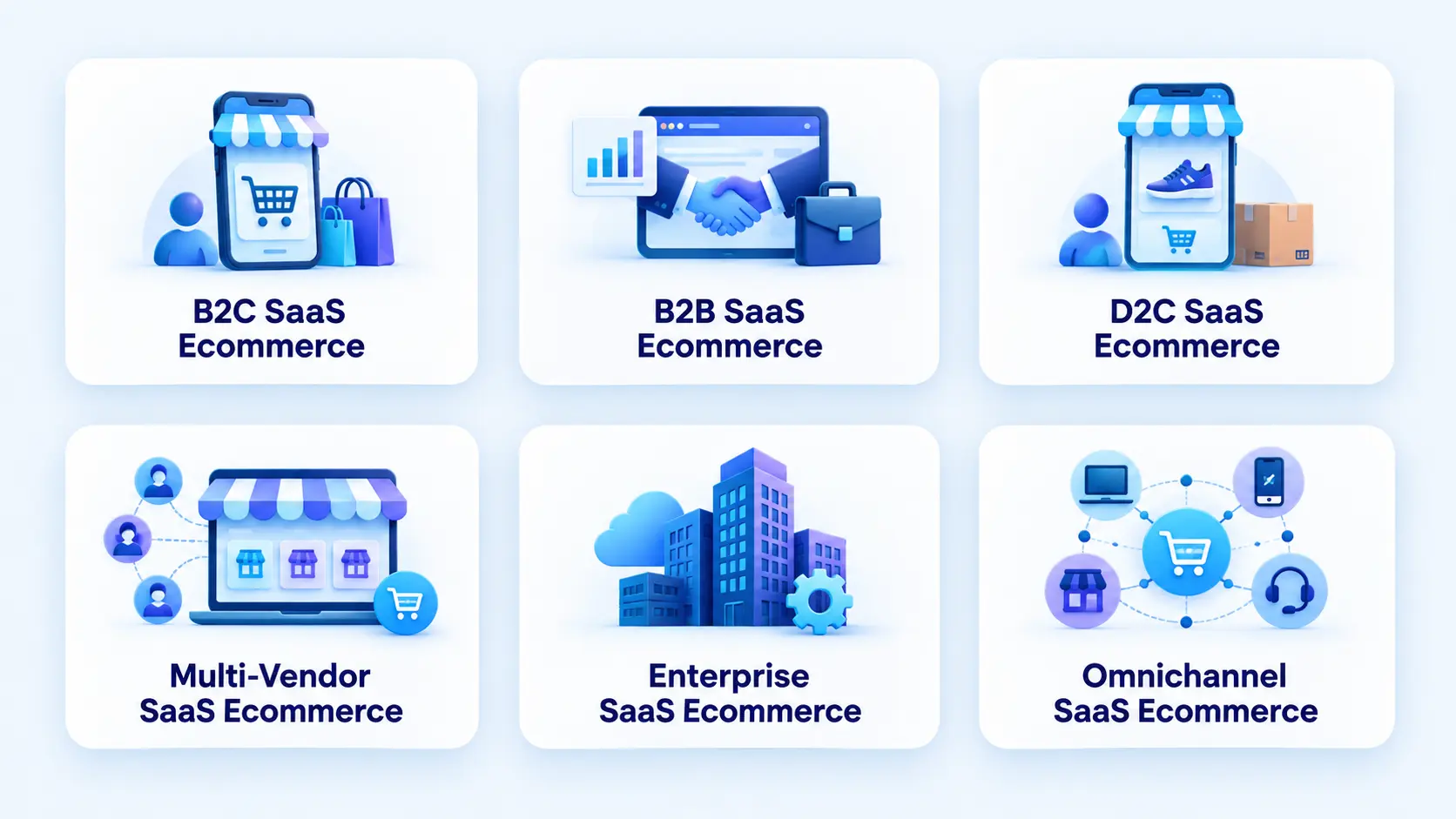
Not every SaaS ecommerce product serves the same audience. Choosing a specific market and use case can make the platform easier to position and monetize.
1. B2C SaaS Ecommerce Platform
This model targets businesses that sell directly to individual consumers.
The platform typically focuses on storefront design, product discovery, checkout, payments, customer accounts, marketing, and order management.
It works well for brands that want to launch and manage their own online stores without handling infrastructure.
2. B2B SaaS Ecommerce Platform
B2B ecommerce requires different capabilities because businesses often deal with wholesale pricing, purchase orders, account-based pricing, bulk orders, approvals, and negotiated terms.
A B2B-focused platform can provide merchant tools specifically designed around these workflows.
3. D2C SaaS Ecommerce Platform
D2C brands sell directly to customers without relying primarily on traditional retail distribution. A D2C platform can focus on branded storefronts, customer data, subscriptions, personalization, marketing automation, loyalty, and direct customer relationships.
Businesses planning this model can also refer to a D2C ecommerce app development guide when deciding how mobile experiences should fit into their broader commerce strategy.
4. Multi-Vendor SaaS Ecommerce Platform
A multi-vendor SaaS platform allows multiple sellers to operate within a shared marketplace environment. The platform owner manages sellers, commissions, product listings, orders, payments, disputes, and marketplace policies.
This model is particularly relevant when planning multi-vendor ecommerce marketplace development, where seller management becomes as important as customer-facing ecommerce functionality.
5. Enterprise SaaS Ecommerce Platform
Enterprise ecommerce platforms are designed for larger businesses with complex catalogs, multiple regions, large transaction volumes, multiple brands, and sophisticated integrations.
They often require advanced permissions, workflow automation, analytics, localization, ERP integration, and dedicated support.
6. Omnichannel SaaS Ecommerce Platform
An omnichannel platform connects multiple sales channels through a centralized system.
Merchants can manage websites, mobile apps, marketplaces, social commerce channels, physical stores, and other selling environments from one backend.
SaaS Ecommerce vs Traditional Ecommerce
The biggest difference is how the software is delivered and maintained.
| Factor | SaaS Ecommerce | Traditional Self-Hosted Ecommerce |
| Hosting | Provider managed | Business managed |
| Software updates | Centralized | Business responsibility |
| Infrastructure | Shared or managed | Usually dedicated |
| Maintenance | Provider handled | Business or agency handled |
| Scalability | Built into platform architecture | Requires additional planning |
| Customization | Platform dependent | Usually extensive |
| Upfront infrastructure effort | Lower | Higher |
| Pricing | Recurring | License/development + infrastructure |
| Best suited for | Businesses wanting managed ecommerce | Businesses needing extensive control |
Businesses should evaluate their requirements before choosing between these approaches. A broader saas vs open source ecommerce comparison can also help when deciding how much control, customization, and infrastructure responsibility the business wants.
What Are the Benefits of SaaS for Ecommerce Businesses?
Understanding how can saas ecommerce benefit my online store starts with looking at the operational advantages of a managed platform.
1. Faster Store Launch
Merchants can start with an existing ecommerce foundation instead of building infrastructure, checkout, product management, and other core capabilities from scratch.
2. Lower Infrastructure Responsibility
The platform provider manages hosting, updates, monitoring, and much of the underlying infrastructure.
3. Automatic Updates
New features, security improvements, bug fixes, and platform enhancements can be released centrally.
4. Easier Scalability
A properly designed SaaS architecture can scale infrastructure as merchant accounts, products, traffic, and transactions increase.
5. Predictable Subscription Model
Merchants typically pay recurring fees based on their selected plan, making platform costs easier to budget.
6. Access to Integrations
SaaS platforms can provide integrations with payment gateways, shipping providers, CRM tools, marketing platforms, analytics systems, ERP software, and other services.
6. Continuous Product Improvement
Because the platform serves multiple merchants, the provider can continuously improve common functionality and release updates across the ecosystem.
Must-Have Features of a SaaS Ecommerce Platform
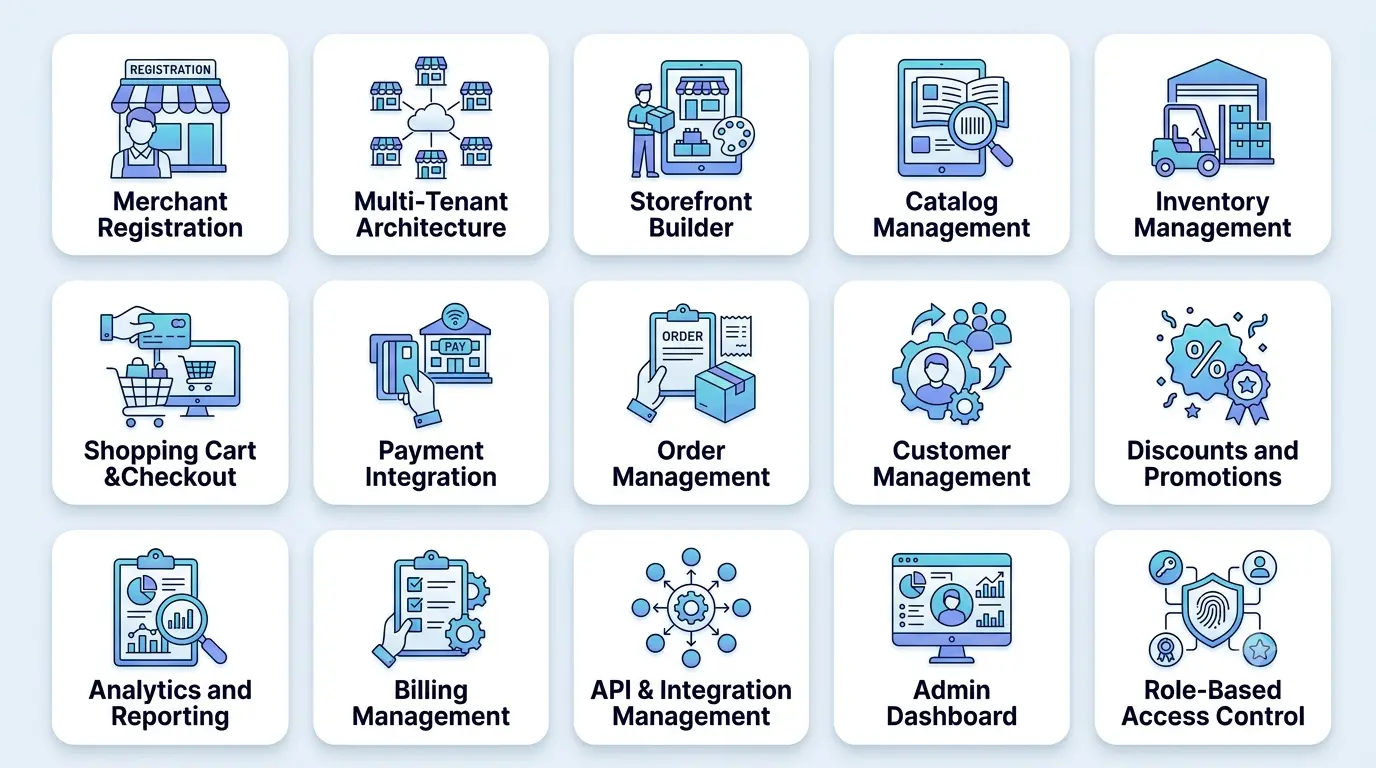
A SaaS ecommerce platform needs features for both merchants and platform administrators. Merchants need simple tools to manage products, orders, customers, payments, and storefronts, while administrators need controls for tenants, subscriptions, analytics, security, and platform-wide operations. The right feature set should support daily ecommerce needs while keeping the platform flexible as the number of merchants and stores grows.
1. Merchant Registration and Onboarding
Merchants should be able to create accounts, select plans, configure their stores, add business information, and complete onboarding without unnecessary friction.A guided setup process can help merchants configure essential settings before launching their stores.
2. Multi-Tenant Architecture
Multi-tenancy is fundamental to SaaS ecommerce.
Each merchant needs appropriate isolation for:
- Products
- Customers
- Orders
- Payments
- Store settings
- Analytics
- Staff accounts
At the same time, the platform should allow centralized management of common infrastructure and platform-level functionality.
3. Storefront Builder
Merchants should be able to create branded storefronts without depending on developers for every visual change.
Useful capabilities include:
- Themes
- Page sections
- Navigation
- Product layouts
- Custom domains
- Responsive design
- Brand settings
4. Product and Catalog Management
Merchants need tools to add products, manage variants, update prices, upload images, organize categories, and control inventory. For larger catalogs, bulk import and export functionality can significantly reduce operational effort.
5. Inventory Management
The platform should track stock levels and provide alerts when inventory reaches predefined thresholds. For merchants operating across multiple channels, inventory synchronization becomes even more important.
6. Shopping Cart and Checkout
The checkout experience should be fast, responsive, and easy to configure. The platform should support relevant payment methods, shipping options, discounts, taxes, and customer information.
7. Payment Integration
Merchants should be able to connect supported payment providers without developing payment functionality from scratch. The platform should also provide appropriate transaction status, refunds, payment records, and reconciliation capabilities.
8. Order Management
Merchants should be able to view, process, update, cancel, fulfill, and track orders from a centralized dashboard. Order workflows should also support returns, refunds, shipping updates, and customer communication.
9. Customer Management
Customer profiles should provide relevant information such as contact details, order history, preferences, and marketing consent where applicable.
10. Discounts and Promotions
Merchants should be able to create discount codes, promotional campaigns, bundles, free-shipping offers, and other sales incentives.
11. Analytics and Reporting
A SaaS platform should provide dashboards covering sales, orders, customers, products, traffic, conversion, and other relevant metrics.
12. Subscription and Billing Management
Because the platform itself operates on a SaaS model, merchants need subscription management functionality.
This can include:
- Plan selection
- Billing cycles
- Upgrades
- Downgrades
- Invoices
- Payment failures
- Trials
- Usage limits
13. API and Integration Management
Merchants may need to connect their stores with external software. This makes API development services an important consideration when creating a SaaS ecommerce ecosystem that needs to support third-party applications and custom integrations.
14. Admin Dashboard
The platform owner needs a centralized dashboard to manage merchants, subscriptions, transactions, support requests, platform settings, analytics, and system activity.
15. Role-Based Access Control
Different users should have different permissions. For example, a merchant owner may access billing and account settings while a store employee may only manage products and orders.
Advanced Features to Differentiate a SaaS Ecommerce Platform
Once the core MVP is stable, advanced capabilities can create stronger differentiation.
- AI-Powered Product Recommendations
AI can analyze customer behavior and product information to provide personalized recommendations.
- Conversational Shopping
An AI assistant can help customers discover products, compare options, and get answers without navigating multiple product pages.
- Automated Marketing
The platform can support customer segmentation, campaign automation, abandoned-cart recovery, and personalized messaging.
- Advanced Analytics
Predictive analytics can help merchants identify trends, customer segments, inventory risks, and sales opportunities.
- Headless Commerce
Headless architecture separates the frontend experience from backend commerce functionality, allowing businesses to create customized storefronts across different channels.
- Subscription Commerce
Recurring billing and subscription management can support businesses selling memberships, replenishment products, or recurring services.
How to Build a SaaS Ecommerce Platform
Building a SaaS ecommerce product requires a structured development approach. Start by defining your target merchants, validating the business idea, and selecting the right SaaS model. Then plan the platform architecture, core features, technology stack, integrations, and security requirements before moving into development. This approach helps create a scalable foundation that can support multiple merchants and evolving business needs.
Step 1. Define the Target Market
Start by identifying who the platform is for.
Will you serve:
- Small online stores?
- D2C brands?
- B2B sellers?
- Enterprise retailers?
- Multi-vendor marketplaces?
- Subscription businesses?
A clear target audience helps determine the product roadmap.
Step 2. Identify the Core Problem
Avoid trying to compete with established platforms by copying every feature. Identify a specific problem that your platform can solve better.
For example:
- Easier B2B ecommerce
- Better multi-channel management
- Industry-specific ecommerce
- More flexible subscriptions
- Better marketplace management
- AI-powered shopping
Step 3. Define the MVP
Start with the features merchants need to launch and operate their stores.
The MVP may include:
- Merchant onboarding
- Store creation
- Product management
- Inventory
- Cart
- Checkout
- Payments
- Orders
- Customers
- Basic analytics
- Subscription billing
Step 4. Design the Multi-Tenant Architecture
Decide how merchant data will be isolated and how shared infrastructure will operate. Architecture decisions at this stage have a major impact on scalability, security, and operating costs later.
Step 5. Build the Merchant Dashboard
The dashboard should make everyday ecommerce management simple. Prioritize clear navigation, actionable insights, and workflows that reduce repetitive work.
Step 6. Develop the Customer Storefront
Build responsive storefronts that provide fast product discovery, search, cart, checkout, and account experiences.
Step 7. Integrate Payments and External Services
Connect payment gateways, shipping providers, tax systems, analytics tools, marketing platforms, and other relevant services. This is where cloud application development services can support a scalable infrastructure foundation for the platform.
Step 8. Implement Security
Protect merchant and customer data with appropriate authentication, authorization, encryption, monitoring, and data isolation.
Step 9. Test the Platform
Testing should cover:
- Functional behavior
- Multi-tenancy
- Payment workflows
- Data isolation
- Security
- Performance
- Scalability
- API reliability
- Subscription billing
- Checkout
Step 10. Launch With a Controlled Merchant Group
Start with a small group of merchants instead of opening the platform to everyone immediately. Their feedback can help identify usability problems, missing features, performance issues, and workflow gaps.
Step 11. Scale Based on Usage Data
After launch, prioritize improvements based on merchant behavior, support requests, conversion data, retention, and platform performance.
SaaS Ecommerce Platform Architecture
A scalable SaaS ecommerce platform generally consists of several interconnected layers. These layers work together to manage storefronts, users, products, payments, orders, data, and third-party integrations. A well-planned architecture also supports multi-tenancy, security, performance, and future expansion as more merchants join the platform.
1. Presentation Layer
This includes merchant dashboards, customer storefronts, mobile applications, and administrative interfaces.
2. Application Layer
This manages business logic such as products, orders, customers, payments, subscriptions, promotions, and inventory.
3. Data Layer
This stores merchant, customer, product, order, transaction, and platform information while maintaining appropriate tenant isolation.
4. Integration Layer
APIs and connectors allow the platform to communicate with payment providers, shipping services, ERP systems, CRM platforms, analytics tools, and other applications.
5. Infrastructure Layer
Cloud infrastructure supports computing, storage, databases, networking, monitoring, security, backups, and scaling.
A well-designed architecture should allow individual components to scale without requiring the entire platform to scale at the same rate.
SaaS Ecommerce Business Models
The SaaS business model determines how the platform generates recurring revenue. Businesses can choose from subscription, tiered pricing, usage-based, freemium, commission, or hybrid models based on their target merchants and platform value. The right model should balance customer affordability, operational costs, and long-term revenue potential while giving merchants clear reasons to upgrade as their needs grow.
1. Subscription-Based Model
Merchants pay a fixed monthly or annual fee for access to specific platform features.
Plans can be divided by:
- Number of products
- Staff accounts
- Orders
- Advanced features
- Storage
- Analytics
- Support level
2. Freemium Model
A basic version is available at no cost, while advanced features require a paid plan. This can help attract users but requires careful limits so that free users do not create unsustainable infrastructure costs.
3. Usage-Based Pricing
Merchants pay based on usage.
Pricing could depend on:
- Number of transactions
- API requests
- Orders
- Storage
- Monthly active customers
4. Transaction-Based Model
The platform charges a percentage or fixed fee on transactions processed through the system. This can align platform revenue with merchant sales but may influence merchants’ platform-selection decisions.
5. Tiered Pricing
Different plans provide different functionality and usage limits.
For example:
| Plan | Target User | Typical Features |
| Starter | Small businesses | Storefront, products, orders |
| Growth | Growing brands | Advanced analytics, marketing |
| Professional | Established businesses | Automation, integrations |
| Enterprise | Large organizations | Custom workflows, support, integrations |
6. Hybrid Model
A platform can combine subscriptions with transaction fees, premium features, app marketplace revenue, or usage-based charges.
Real-World Example of a Scalable Ecommerce Platform
A SaaS ecommerce platform needs to support multiple stores, products, users, and transactions without creating operational complexity. A real-world ecommerce platform shows how scalable architecture and flexible features work in practice.
Cobone Ecommerce Marketplace
Cobone is a Middle Eastern daily-deals and coupons marketplace covering activities, food, services, and staycations. RipenApps built its Android and iOS apps using React Native in 3 months, with 100% logic parity across platforms. The platform supports geo-fenced discovery across 20+ categories, in-app purchase and redemption, account management, and real-time tracking. It has reached 500K+ installs with a 4.0★ rating from 6.81K Google Play reviews, demonstrating how an ecommerce platform can manage diverse categories, location-based discovery, and cross-platform experiences.
How to Price a SaaS Ecommerce Platform
Pricing should reflect the value merchants receive and the costs required to operate the platform.
Consider:
- Infrastructure costs
- Payment processing
- Customer support
- Storage
- API usage
- Third-party services
- Development and maintenance
- Security
- Merchant acquisition
- Product support
A low subscription price may attract users but become difficult to sustain if merchants generate significant infrastructure or support costs. A higher-priced plan can work when the platform delivers advanced functionality that directly improves merchant revenue, efficiency, or operational control.
SaaS Ecommerce Platform Development Cost
The cost of building a SaaS ecommerce platform depends heavily on its scope, features, technology stack, and development team. On average, a SaaS ecommerce platform can cost around $30,000 to $120,000+, depending on the level of customization and complexity.
A basic MVP with merchant onboarding, storefront management, product catalogs, checkout, payments, orders, and subscriptions requires less investment than an enterprise platform with multi-region infrastructure, advanced analytics, AI, headless commerce, complex integrations, and multi-vendor capabilities.
Major cost factors include:
- Product complexity
- Number of user roles
- Multi-tenant architecture
- UI/UX design
- Backend development
- Mobile applications
- Payment integrations
- Third-party APIs
- Cloud infrastructure
- Security requirements
- Analytics
- AI capabilities
- Testing
- Ongoing maintenance
Businesses should also evaluate ecommerce development cost in relation to their expected subscription revenue, merchant acquisition costs, retention, and lifetime customer value.
SaaS Ecommerce Platform vs Custom Ecommerce Development
A SaaS platform provides businesses with a managed ecommerce environment, while custom ecommerce development gives an individual business greater control over its own software.
| Factor | SaaS Platform | Custom Ecommerce |
| Infrastructure | Provider managed | Business managed |
| Customization | Platform dependent | High |
| Maintenance | Provider managed | Business responsibility |
| Multi-tenant capability | Core requirement | Usually not required |
| Time to launch | Faster | Longer |
| Recurring platform fee | Common | Not necessarily |
| Ownership | Provider owns platform | Business owns solution |
| Best for | Multiple merchants or managed ecommerce | Unique business requirements |
The right option depends on whether the goal is to operate an online store or build a technology product that serves multiple businesses.
Read Also: Custom Web App vs SaaS: What Should You Choose For Better ROI?
SaaS Ecommerce Platform Development Challenges
Building a SaaS ecommerce platform comes with technical and operational challenges that go beyond standard ecommerce development. Teams need to balance scalability, security, performance, merchant needs, and platform-wide operations from the beginning. Identifying these challenges early helps reduce development risks and creates a stronger foundation for long-term growth.
- Multi-Tenant Data Isolation
Merchant data must remain separated while allowing the platform to operate efficiently.
- Scalability
A platform needs to handle growth in merchants, products, traffic, transactions, and API requests without performance degradation.
- Security
The platform handles merchant and customer information, making strong security controls essential.
- Payment Complexity
Different regions and merchants may require different payment providers, currencies, tax rules, and transaction workflows.
- Third-Party Dependencies
External APIs and services can change their functionality, pricing, availability, or authentication requirements.
- Platform Performance
One merchant’s traffic spike should not negatively affect other merchants using the same platform.
- Feature Complexity
Adding every requested feature can make the platform difficult to use and maintain. Product teams need clear prioritization.
- Merchant Retention
A SaaS ecommerce platform needs more than signups. Long-term success depends on activation, usage, customer satisfaction, and retention.
How to Scale a SaaS Ecommerce Platform
Scalability should be considered from the beginning instead of being addressed after the platform starts experiencing performance problems.
1. Use Modular Architecture
Separate major business functions so they can evolve independently.
2. Implement Effective Caching
Frequently requested information can be cached to reduce database and infrastructure load.
3. Optimize Database Operations
Indexing, query optimization, partitioning, and appropriate database design can improve performance as data volumes increase.
4. Use Auto-Scaling Infrastructure
Cloud infrastructure can dynamically adjust resources based on demand.
5. Monitor Platform Health
Track:
- Response times
- Error rates
- API performance
- Database load
- Infrastructure utilization
- Checkout failures
- Payment failures
6. Design for High Availability
Critical ecommerce functions should have appropriate redundancy, backups, recovery mechanisms, and monitoring. Businesses exploring infrastructure options can also review cloud computing in ecommerce to understand how cloud capabilities can support modern commerce platforms.
Marketplace and Multi-Channel SaaS Capabilities
A SaaS ecommerce platform can eventually expand beyond individual storefronts. For example, it can support multiple marketplaces, social channels, mobile applications, physical stores, and external sales platforms.
A centralized channel order ecommerce management saas capability can help merchants manage orders from multiple channels through a unified backend. This creates additional value because merchants no longer need separate systems for each selling channel.
For multi-vendor products, the platform can also incorporate seller onboarding, commission management, seller dashboards, catalog approval, payouts, and marketplace analytics.
The broader marketplace app development process should therefore be considered when a SaaS product plans to evolve into a marketplace ecosystem.
Security Requirements for SaaS Ecommerce
Security is critical because the platform can process sensitive merchant and customer information.
A SaaS ecommerce platform should consider:
- Secure authentication
- Multi-factor authentication
- Role-based access
- Tenant-level data isolation
- Encryption
- Secure APIs
- Payment security
- Audit logging
- Vulnerability management
- Backup and disaster recovery
- Continuous monitoring
Payment information should be handled through appropriate payment infrastructure rather than unnecessarily stored within the SaaS platform. Security should also extend to third-party integrations because external services can become another source of risk.
Conclusion
Building a saas ecommerce platform requires more than adding standard ecommerce features. You need a clear business model, scalable architecture, multi-tenant capabilities, secure payments, integrations, analytics, and a smooth merchant experience. Choosing the right features and technology at the MVP stage helps control costs while creating room for future growth. Ecommerce app development can further extend the platform across mobile shopping and merchant experiences.
For businesses entering the SaaS ecommerce space, the focus should remain on solving a specific merchant problem and creating measurable value. RipenApps helps businesses plan, design, and build scalable ecommerce solutions around their target market, revenue model, and growth goals. With the right foundation, saas ecommerce can support recurring revenue while giving merchants the flexibility to manage and scale their online businesses.
FAQs
1. What is a SaaS ecommerce platform?
A SaaS ecommerce platform is cloud-based software that allows businesses to create and manage online stores without maintaining the underlying infrastructure. Merchants typically access the platform through a subscription model.
2. How does a SaaS ecommerce platform make money?
Common models include monthly or annual subscriptions, transaction fees, usage-based pricing, premium features, and hybrid plans. The right model depends on the target merchants and platform operating costs.
3. What are the must-have features of a SaaS ecommerce platform?
Core features include merchant onboarding, multi-tenancy, storefront creation, product and inventory management, checkout, payments, orders, customer management, analytics, subscriptions, integrations, and admin controls.
4. How much does it cost to build a SaaS ecommerce platform?
The average cost to build a SaaS ecommerce platform ranges from $30,000 to $120,000+, depending on its complexity. Development cost also varies based on multi-tenant architecture, integrations, security, payment systems, mobile apps, analytics, AI capabilities, and scalability requirements. An MVP generally costs less than an enterprise-grade platform with advanced functionality.
5. What is the difference between SaaS ecommerce and open-source ecommerce?
SaaS ecommerce is hosted and maintained by the platform provider, while open-source ecommerce gives businesses greater control over the software and infrastructure. saas ecommerce platforms typically reduce maintenance responsibility, while open-source solutions can offer deeper customization.
6. What are the best SaaS ecommerce platforms?
The best saas ecommerce platforms depend on factors such as business size, customization requirements, pricing, integrations, scalability, and industry. Businesses should compare features and platform limitations against their specific operational needs rather than relying only on saas ecommerce platform reviews.

SHARE
WRITTEN BY

Ishan Gupta
CEO & Founder
Ishan Gupta is a seasoned entrepreneur and CEO with extensive 8+ years of experience in business and mobile app development landscape. He believes that the right digital product allows companies to focus on what they do best, while technology handles the rest. With deep exposure to global markets, he understands what makes an app succeed. His approach translates business needs into clear product strategies, ensuring that every feature contributes to measurable ROI.
View All Articles



 India
India USA
USA Australia
 Canada
 UK
UK UAE
UAE