


Key Takeaways
- There is no one-size-fits-all tech stack; the best choice depends on your business goals, scalability needs, and product roadmap.
- Next.js, React, Node.js, Python, PostgreSQL, and cloud-native platforms are leading technologies powering modern web applications.
- AI-ready architectures, TypeScript adoption, and serverless or edge computing are becoming key factors in future-proof tech stack decisions.
- MERN remains a top choice for startups and SaaS products, while MEAN, Django, and .NET are better suited for enterprise and complex applications.
- Choosing the right tech stack early can improve development speed, reduce long-term costs, enhance user experience, and support sustainable business growth.
The best tech stack for web development in 2026 combines modern frontend frameworks, scalable backend technologies, cloud-native infrastructure, and AI-ready capabilities. For most businesses, stacks built with Next.js or React, Node.js or Python, PostgreSQL or MongoDB, and AWS, GCP, or serverless platforms offer the ideal balance of performance, scalability, and development speed.
As organizations accelerate digital transformation initiatives, choosing the right tech stack for web development has become a strategic business decision rather than a purely technical one. The technologies you select today will influence your application’s scalability, user experience, security, development costs, and ability to integrate emerging technologies such as artificial intelligence and automation.
The growing demand for AI-powered products, real-time experiences, and performance-driven applications is reshaping how modern web solutions are built. Whether you’re launching a startup MVP, scaling a SaaS platform, or modernizing an enterprise application, selecting the right foundation is critical to long-term success. Businesses investing in web design and development services increasingly seek technology stacks that support rapid innovation, operational efficiency, and sustainable growth. In this guide, we’ll explore the top web development stacks of 2026, compare their strengths and limitations, analyze emerging technology trends, and provide a practical framework for choosing the best stack for your next digital product.
Table of Contents
What Is a Tech Stack & the Layers of a Web Application?
A tech stack is the combination of technologies used to build and run a web application. It includes everything from the user interface to backend logic, databases, and infrastructure. In 2026, tech stacks are more modular, cloud-native, and AI-integrated than ever before.
A modern web application development stack typically consists of frontend frameworks, backend technologies, databases, and cloud infrastructure working together to deliver scalable digital experiences.
Modern web applications rely on layered architectures that work together to deliver performance, security, and scalability.
1) Frontend layer: what users see and interact with
The frontend is everything users see and interact with within a web application. It includes the interface, navigation, animations, and responsive design elements. Popular frontend technologies such as React, Angular, and Vue help businesses deliver fast, intuitive, and engaging digital experiences across devices.
As demand for React-based applications grows, many organizations partner with a React JS development company to accelerate development and ensure long-term scalability.
2) Backend layer: the logic engine of your app
The backend acts as the engine behind the application. It manages business logic, user authentication, APIs, integrations, and server-side operations. Leading backend frameworks like Node.js, Django, and Laravel enable developers to build secure, scalable, and high-performing applications.
3) Database layer: structured vs unstructured data choices
The database layer stores, organizes, and retrieves application data. Relational databases such as PostgreSQL are ideal for structured data and complex relationships, while NoSQL databases like MongoDB offer flexibility for handling large volumes of unstructured or rapidly evolving data.
4) DevOps, cloud & infrastructure layer
This layer supports application deployment, monitoring, security, and performance optimization. Technologies such as AWS, Azure, Google Cloud, Docker, and Kubernetes help organizations automate operations, scale efficiently, and maintain high availability in modern cloud environments.
Tech Stack Overview
A tech stack is the collection of frontend, backend, database, and infrastructure technologies that work together to build, run, and scale a web application.
Businesses evaluating a modern tech stack for web development should also stay updated on the latest full-stack web development technologies shaping digital products in 2026 and beyond.
| Frontend | Backend | Database | DevOps |
| React/Next.js | Node.js/Python | PostgreSQL/MongoDB | AWS/GCP/Docker |
Modern tech stack examples like this help teams align development with business goals and performance expectations.
Organizations exploring full-stack development should evaluate how these layers interact to ensure long-term scalability and maintainability. Understanding these layers is an important part of planning and building scalable digital products, particularly during the early stages of web application architecture and development.
Why Your Tech Stack Choice Is a Business-Critical Decision?
Choosing the right tech stack directly influences speed to market, operational efficiency, scalability, and long-term cost structure. With AI-driven development and cloud-native architecture becoming standard, outdated stack decisions can significantly limit growth potential.
AI-first development is now mainstream, with over 80% of engineering teams integrating AI tools into workflows. This shift requires stacks that support automation, machine learning, and real-time data processing. According to McKinsey’s State of AI 2025 report, 76% of organizations now use generative AI in at least one business function, highlighting the growing need for AI-ready technology stacks.
Tech stack decisions also impact Google Core Web Vitals, which directly affect SEO rankings and user experience. Faster frameworks like Next.js improve performance metrics such as LCP and FID, giving businesses a competitive edge.
The cost of choosing the wrong stack is not just financial; it includes technical debt, hiring challenges, and slower product iteration cycles. According to industry trends, JavaScript remains dominant at ~66% usage, while Python continues growing due to AI and data-driven applications.
For startups and enterprises investing in technology stack planning, aligning architecture with long-term digital transformation goals is essential for sustainable growth and innovation.
What Are the Top Tech Stacks for Web App Development in 2026?
The most effective tech stacks are designed for scalability, flexibility, and AI readiness, making them strong contenders for the best tech stack discussion.
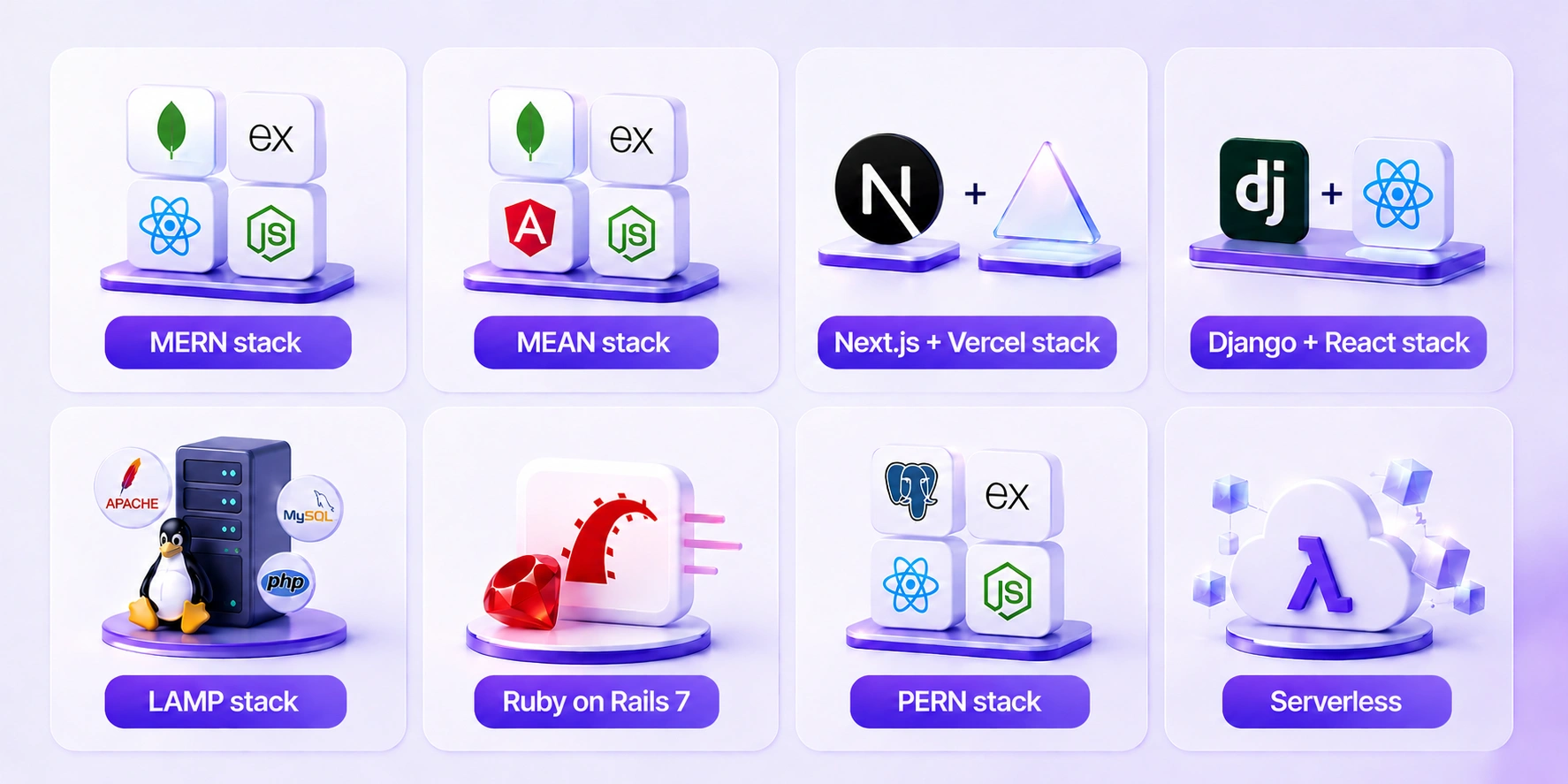
1) MERN stack (MongoDB, Express, React, Node.js)
The best for startups & SaaS MVPs
MERN remains the most popular tech stack for web development choices thanks to its JavaScript-only ecosystem and rapid development capabilities. It enables startups to launch MVPs quickly, iterate faster, and scale efficiently as user demand grows.
2) MEAN stack (MongoDB, Express, Angular, Node.js)
The best for enterprise apps
MEAN is widely adopted by enterprises that require structured development, TypeScript support, and long-term maintainability. Its opinionated architecture makes it well-suited for large-scale business applications and distributed development teams.
3) Next.js + Vercel stack
The best for SEO-heavy and full-stack JS products
Next.js combined with Vercel delivers exceptional performance, server-side rendering, and search engine optimization. It is a go-to tech stack for web development for businesses building content-rich platforms, marketplaces, and customer-facing digital products.
4) Django + React stack
The best for AI-powered & data-heavy apps
Django’s powerful backend capabilities, combined with React’s dynamic frontend experience, make this stack ideal for AI-powered platforms, analytics solutions, and data-heavy applications that require robust security and scalability.
5) LAMP stack
The best for CMS-driven and budget-conscious projects
The LAMP stack continues to be a dependable option for WordPress websites, content management systems, and organizations seeking cost-effective development with proven technologies.
6) Ruby on Rails 7
The Best for SaaS with rapid iteration needs
Ruby on Rails remains a favorite among startups and SaaS companies due to its convention-over-configuration approach, rapid development cycles, and strong focus on developer productivity.
7) PERN stack (PostgreSQL, Express, React, Node.js)
The Best for relational data apps
PERN combines the flexibility of React and Node.js with PostgreSQL’s powerful relational database capabilities, making it an excellent choice for applications that rely on complex data relationships and transactional integrity. This makes it a strong tech stack for web development for data-heavy platforms.
8) Serverless / edge-first stack
The Best for performance-critical global apps
Serverless and edge-first architectures leverage platforms such as Cloudflare Workers, Vercel Edge Functions, and AWS Lambda to deliver ultra-low latency, automatic scaling, and exceptional user experiences across global markets.
Comparison Table For The Most Popular Tech Stacks
The table below compares the most popular tech stacks based on their ideal use cases, core technologies, and implementation complexity to help you identify the best fit for your web application.
|
Stack |
Best For | Frontend | Backend | DB |
Complexity |
| MERN | Startups & SaaS MVPs | React | Node.js | MongoDB | Low |
| MEAN | Enterprise Applications | Angular | Node.js | MongoDB | Medium |
| Next.js Stack | SEO-Driven Applications | React (Next.js) | Node.js | PostgreSQL | Medium |
| Django + React | AI & Data-Intensive Apps | React | Django | PostgreSQL | High |
| LAMP | CMS & Budget-Conscious Projects | HTML, CSS, JavaScript | PHP | MySQL | Low |
| Ruby on Rails 7 | SaaS & Rapid MVP Development | Rails Views / React | Ruby on Rails | PostgreSQL | Medium |
| PERN | Relational Data Applications | React | Node.js | PostgreSQL | Medium |
| Serverless / Edge-First | Global High-Performance Apps | React | Edge Functions | Multi-Database | High |
These web dev stacks help teams align technical choices with business outcomes and scalability requirements. As React adoption for web development continues to grow, its impact on modern web application architecture and development practices remains significant.
What Do Real-World Tech Stack Choices Look Like in 2026?
The best technology stack is not determined by popularity alone. Successful companies choose technologies based on business goals, scalability requirements, performance expectations, and product complexity. Here are five real-world examples that demonstrate how different tech stack for web development choices solve different challenges.
Netflix: Building for Massive Scale and Performance
Netflix relies heavily on JavaScript, Node.js, cloud-native architecture, and microservices to support millions of users worldwide. Its technology strategy prioritizes scalability, resilience, and seamless streaming experiences across devices.
This demonstrates why Node.js and cloud-based architectures remain strong choices for high-traffic web applications.
Shopify: Powering Enterprise-Grade eCommerce
Shopify’s success has been built largely on Ruby on Rails combined with modern frontend technologies. The platform showcases how Rails can support rapid development while handling large transaction volumes and complex business operations.
It remains a strong example of choosing developer productivity without sacrificing scalability.
OpenAI: The Rise of AI-Native Technology Stacks
Modern AI platforms like OpenAI rely heavily on Python-based ecosystems, machine learning frameworks, APIs, and scalable cloud infrastructure.
This reinforces why Python, FastAPI, Django, and React-based frontends have become the preferred stack for AI-powered web applications.
Examarly: Scaling Modern eLearning Experiences
Examarly, a digital learning platform developed by RipenApps, was built to deliver interactive and scalable online education experiences for students preparing for competitive examinations.
Educational platforms like Examarly require high-performance frontend experiences, secure backend architecture, and scalable infrastructure capable of supporting large user bases and real-time learning interactions.
Conveyr: Building Community-Driven Social Platforms
Conveyr is a social networking application designed to connect local and global communities through a unified platform. Social and community-driven applications require real-time interactions, scalable backend systems, user-generated content management, and responsive user interfaces.
That makes JavaScript-based stacks such as MERN and PERN strong architectural choices for this category of products.
MERN Stack vs MEAN Stack: Which Should You Choose?
MERN and MEAN remain two of the most widely adopted JavaScript-based stacks, but they serve different business needs.
Where MERN wins: startups, UI-heavy apps, rapid iteration
MERN is ideal for fast-growing startups and product teams that prioritize speed, flexibility, and rapid iteration. Its React-powered frontend and JavaScript-only ecosystem enable faster development cycles, easier hiring, and highly interactive user experiences.
Where MEAN wins: enterprise, structured codebases, TypeScript-first teams
MEAN offers a more structured development approach through Angular and TypeScript, making it well-suited for large-scale enterprise applications. It provides stronger consistency, maintainability, and scalability for organizations managing complex systems and distributed development teams.
MEVN as the underrated alternative for Vue.js teams
MEVN combines MongoDB, Express, Vue.js, and Node.js to deliver a lightweight and flexible development experience. It is an excellent option for teams that prefer Vue’s simplicity and lower learning curve over React or Angular.
MERN vs MEAN: Comparison Table
The table below compares MERN and MEAN across key factors such as performance, scalability, learning curve, and ideal use cases to help you determine which JavaScript stack best aligns with your project requirements.
| Criteria | MERN | MEAN |
| Performance | High | High |
| Learning Curve | Easy | Moderate |
| Scalability | High | Very High |
| Use Case | Startups | Enterprises |
| Community | Large | Enterprise-focused |
| TypeScript Support | Optional | Native |
Verdict: MERN is better for speed and agility, while MEAN is stronger for enterprise-grade structure and long-term maintainability.
How Do Framework Choices Like Next.js, Nuxt, Django, and Node.js Compare?
Framework selection plays a critical role in determining performance, scalability, and developer efficiency. Selecting the best framework for web app development depends on factors such as scalability, SEO requirements, real-time functionality, and long-term maintainability.
- Next.js strength: SEO, Vercel integration, full-stack React, enterprise adoption. Next.js is the leading React framework for production-grade applications.
- Nuxt strength: Vue-first, Nitro engine, cloud-agnostic deployment. Nuxt is ideal for Vue-based ecosystems with flexible deployment needs.
Python Django vs Node.js: AI workloads vs real-time apps. Django excels in AI and data-heavy applications, while Node.js dominates real-time systems like chat apps and streaming platforms.
Next.js is best for SEO-driven applications and enterprise web platforms. Nuxt is best for Vue-first development teams seeking flexibility and simplicity. Organizations standardizing on Angular for enterprise-grade applications often invest in Angular JS development services to streamline development, improve maintainability, and support long-term scalability.
For companies investing in best backend framework decisions, aligning framework strengths with business objectives ensures better performance and scalability.
What Are the Emerging Tech Stacks Reshaping Web App Development in 2026?
Web development is rapidly evolving with AI, serverless computing, and edge technologies redefining architecture standards.
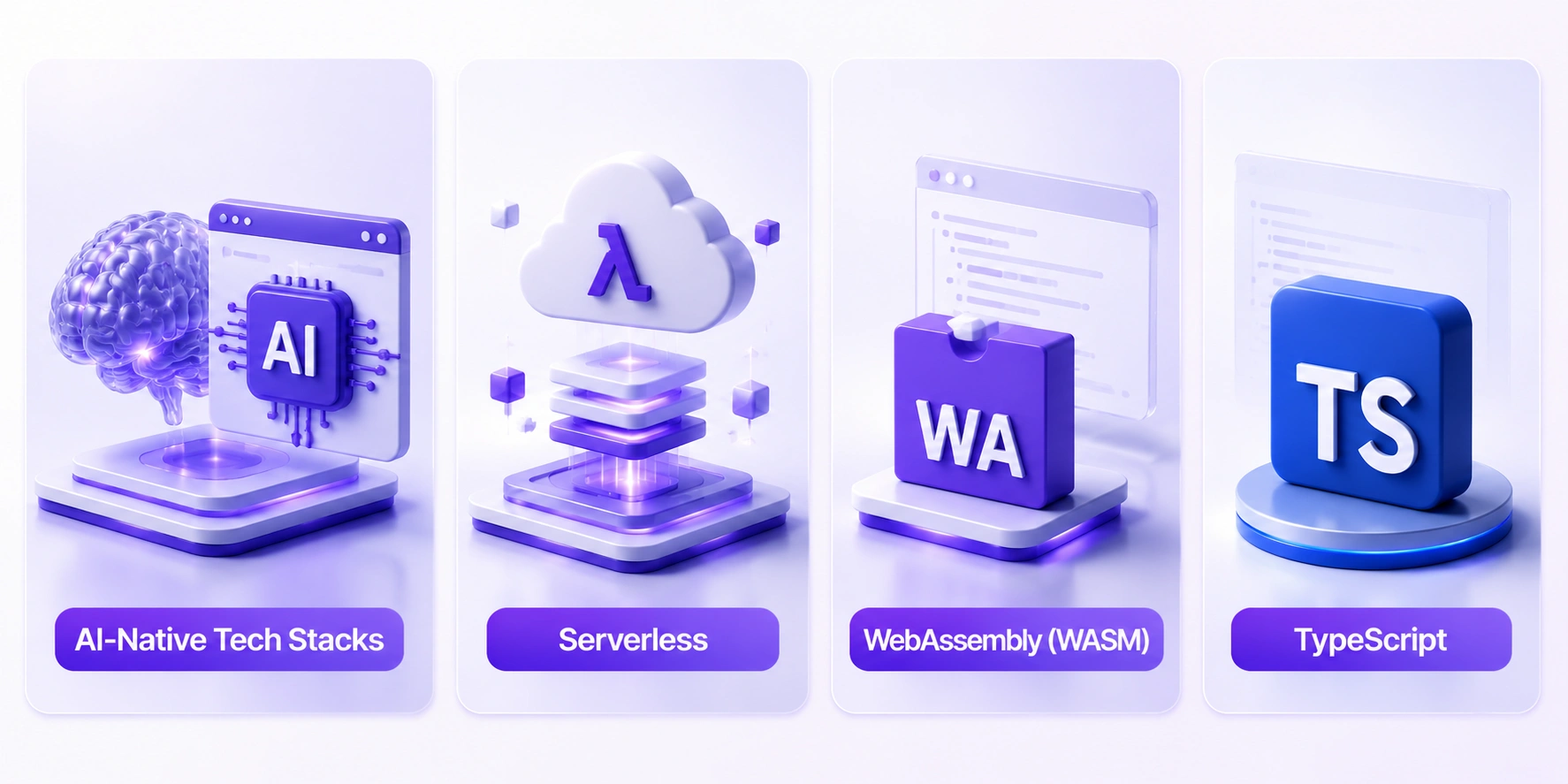
AI-Native Tech Stacks Are Becoming the Standard for Modern Applications
The leading tech stack for AI-powered web apps combines Python, FastAPI, LangChain, and React or Next.js. These technologies simplify machine learning integration, LLM deployment, and AI-driven automation while supporting scalable and responsive user experiences.
As AI adoption accelerates, understanding the broader impact of AI in web development can help businesses make smarter technology stack decisions and prepare for future innovation.
Serverless and Edge Computing Are Transforming Application Architecture
Serverless platforms enable automatic scaling and reduced infrastructure management, while edge computing delivers faster response times by running workloads closer to users. Together, they are reshaping how modern web applications achieve performance and global scalability.
WebAssembly (WASM) Is Unlocking High-Performance Browser Applications
WebAssembly enables near-native execution speeds within web browsers, making advanced use cases such as video editing, gaming, data visualization, and browser-based productivity tools more practical and efficient.
TypeScript Is Emerging as the Default Language for Large-Scale Development
TypeScript has become the preferred choice for modern development teams due to its strong typing, improved code quality, and enhanced maintainability. As applications grow in complexity, TypeScript helps reduce errors and improve long-term scalability.
With over 65% of organizations adopting AI workflows, stacks must now support automation, predictive analytics, and real-time intelligence.
Businesses focusing on AI-native web app stack strategies are gaining a competitive advantage in digital transformation.
What Is the Best Tech Stack by Use Case?
Different business models require different architectural decisions. There is no universal “best stack.”
- Best tech stack for startups: speed over perfection. Startups benefit most from MERN or Next.js + Supabase combinations for rapid MVP development.
- Best tech stack for SaaS products: scalability from day one. SaaS platforms require Node.js or Django backends with PostgreSQL for long-term scalability.
- Best stack for enterprise web apps: structure, security & compliance. Enterprises prefer MEAN, .NET, or Java-based architectures with strong governance and compliance controls.
- Best stack for eCommerce & content-heavy sites: Jamstack & Next.js. Jamstack architectures ensure speed, SEO performance, and high availability.
For businesses evaluating a tech stack for SaaS application, selecting scalable cloud-native solutions is critical for long-term success.
How to Choose the Right Tech Stack for Your Web App?
Selecting the right stack requires balancing technical, financial, and strategic considerations. Choosing the right web app tech stack requires balancing business objectives, technical requirements, development resources, and future scalability needs.
Step 1: Define project type, scale & performance goals. Clarify whether you are building an MVP, SaaS platform, or enterprise system.
Step 2: Audit your team’s existing expertise. Align stack decisions with developer skillsets to reduce ramp-up time.
Step 3: Map AI integration requirements. Determine whether AI features are part of your roadmap. Businesses should also evaluate future integration needs, as robust API integration services can simplify connections with ERP systems, CRM platforms, payment gateways, AI tools, and other mission-critical applications.
Step 4: Evaluate cost: licensing, hosting, and maintenance. Consider long-term operational expenses, not just initial development cost.
Step 5: Check community health and hiring availability. Popular stacks ensure easier hiring and better long-term support.
Step 6: Validate Core Web Vitals compatibility. Performance directly impacts SEO and user retention.
This structured approach ensures alignment between technology stack integration and business outcomes.
Performance should be a key factor when evaluating any technology stack. According to Google’s Millisecond Make Millions study, improving mobile page speed by just 0.1 seconds can increase retail conversion rates by 8.4%. Frameworks such as Next.js and modern edge-first architectures can help improve Core Web Vitals, user experience, and business outcomes.

Final Thoughts
There is no single best tech stack for every business. The right choice depends on scalability needs, product complexity, AI readiness, and long-term digital strategy. Organizations that align technology decisions with business outcomes consistently outperform competitors in speed, efficiency, and innovation.
For startups and enterprises aiming to accelerate web application development, modern stacks like Next.js, Node.js, and Python-based architectures provide the strongest foundation for growth, performance, and AI integration. Businesses looking to accelerate delivery and reduce technical complexity often choose to hire dedicated full-stack developer teams capable of managing frontend, backend, database, and cloud infrastructure requirements under a unified development approach. RipenApps helps businesses design and implement future-ready digital products by selecting the right technology stack aligned with scalability, innovation, and measurable ROI.
FAQs
1. What is the best tech stack for web app development in 2026?
The best tech stack in 2026 depends on your business goals and application requirements. For most projects, Next.js or React, Node.js or Django, PostgreSQL or MongoDB, and AWS or GCP offer the right mix of performance, scalability, and flexibility. Startups often prioritize speed, while enterprises focus on security and long-term maintainability.
2. Is the MERN stack still relevant in 2026?
Yes. MERN remains a leading choice for startups, SaaS products, and MVPs due to its JavaScript-based ecosystem, large developer community, rapid development capabilities, and strong scalability.
3. What tech stack does a startup need in 2026?
Most startups benefit from MERN or Next.js + Supabase because they enable faster development, lower costs, and easier scaling. AI-focused startups often add FastAPI or Django to support advanced AI capabilities.
4. What is the best backend framework for web apps in 2026?
The best backend framework depends on the use case. Node.js is ideal for real-time applications, Django excels in AI and data-driven products, Laravel works well for business applications, and ASP.NET Core is a strong choice for enterprise systems.
5. What is WebAssembly and why does it matter?
WebAssembly (WASM) enables near-native performance in web browsers, making it ideal for resource-intensive applications such as video editing, gaming, data visualization, and browser-based AI tools.
6. Should I use TypeScript in 2026?
Yes. TypeScript improves code quality, reduces bugs, and makes applications easier to maintain. It has become a standard choice for modern React, Next.js, Angular, and Node.js projects.
7. What is serverless vs edge computing?
Serverless runs functions on demand in centralized cloud environments, while edge computing executes code closer to users through distributed networks. Edge computing offers lower latency, making it ideal for performance-sensitive applications.
8. Is Laravel still worth using in 2026?
Yes. Laravel remains a powerful framework for CMS-driven websites, business applications, and enterprise portals. Its developer-friendly ecosystem, built-in security features, and rapid development capabilities make it a cost-effective choice in 2026.

SHARE
WRITTEN BY

Ishan Gupta
CEO & Founder
Ishan Gupta is a seasoned entrepreneur and CEO with extensive 8+ years of experience in business and mobile app development landscape. He believes that the right digital product allows companies to focus on what they do best, while technology handles the rest. With deep exposure to global markets, he understands what makes an app succeed. His approach translates business needs into clear product strategies, ensuring that every feature contributes to measurable ROI.
View All Articles

 India
India USA
USA Australia
 Canada
 UK
UK UAE
UAE