


Key Takeaways
- Security-first development helps businesses reduce cyber risks, protect customer data, and maintain long-term trust.
- Scalability planning from the start prevents performance bottlenecks and supports sustainable business growth.
- Modern web applications require balancing innovation, compliance, user expectations, and operational efficiency simultaneously.
- Emerging technologies like AI, PWAs, microservices, and serverless computing are reshaping web development.
- Choosing the right technology partner significantly improves project success, scalability, security, and future readiness.
The demand for web applications continues to grow as organizations accelerate digital transformation initiatives, improve customer experiences, and streamline business operations. From SaaS platforms and customer portals to enterprise management systems and eCommerce ecosystems, web applications have become the backbone of modern business success.
However, building and maintaining a successful web application in 2026 is significantly more challenging than it was just a few years ago. Businesses must navigate evolving security threats, increasingly complex technology ecosystems, rising user expectations, regulatory requirements, and the rapid emergence of artificial intelligence-driven experiences.
As organizations strive to deliver scalable, secure, and future-ready digital products, understanding today’s web application development challenges is no longer optional; it is a strategic necessity. Poor architectural decisions, inadequate security planning, and technology mismatches can lead to costly delays, performance issues, customer dissatisfaction, and revenue loss.
To address these challenges effectively, many organizations invest in professional web development services that help them design scalable architectures, implement robust security frameworks, and align technology decisions with long-term business goals. Taking a strategic approach from the beginning can significantly reduce development risks while accelerating time-to-market.
This comprehensive guide explores the most critical web development challenges organizations face in 2026, examines the growing web application risks for businesses, and provides practical strategies to overcome them while ensuring long-term scalability, operational resilience, and sustainable business growth.
Table of Contents
Why Web Application Development is More Complex in 2026
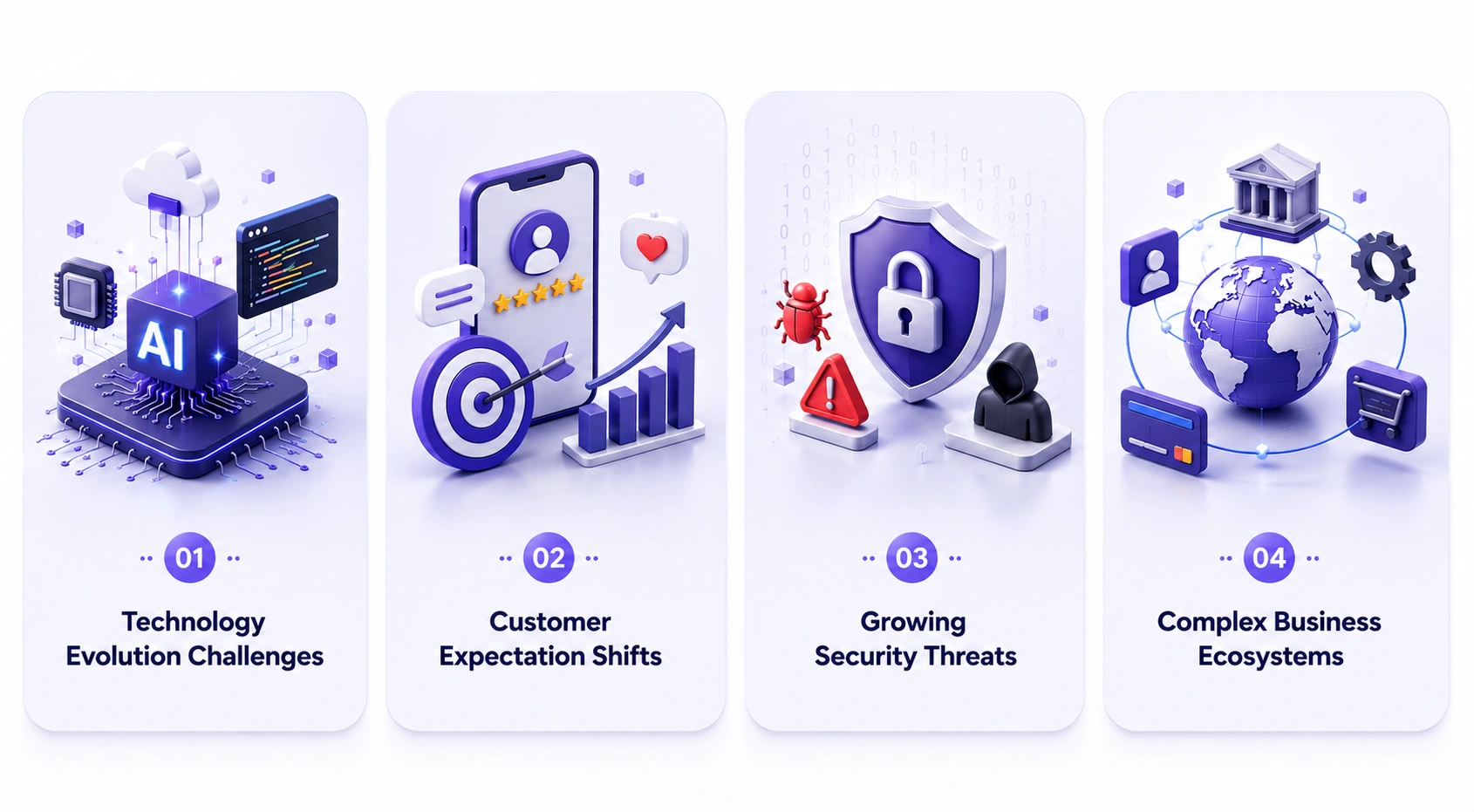
Modern web applications are expected to do much more than simply function correctly. They must deliver exceptional performance, integrate seamlessly with multiple systems, remain secure against evolving threats, and adapt to changing market demands. Several factors are driving this increased complexity:
Rapid Technology Evolution
The pace of innovation in web development technologies continues to accelerate. New frameworks, programming languages, cloud platforms, AI-powered development tools, and architectural approaches emerge at an unprecedented rate. While innovation creates new opportunities for businesses, it also makes technology selection increasingly complex. Decision-makers must determine which technologies will remain relevant over the long term and which are simply short-lived trends.
Choosing the right technology stack now requires evaluating factors such as ecosystem maturity, vendor support, scalability potential, security implications, and long-term maintenance requirements. A poor technology decision can increase development costs, create technical debt, and limit future scalability, making strategic technology planning more important than ever.
Increasing Customer Expectations
Customer expectations have transformed significantly over the past few years. Users no longer compare a web application only to its direct competitors; instead, they compare every digital experience to the best applications they use daily. Whether interacting with a SaaS platform, healthcare portal, banking solution, or eCommerce website, customers expect speed, convenience, and seamless functionality.
Modern users demand fast-loading pages, personalized experiences, intuitive navigation, mobile-first functionality, and consistent performance across devices. Organizations that fail to meet these expectations often experience lower engagement, reduced customer retention, and declining competitiveness in increasingly crowded digital markets.
Growing Security Threat Landscape
Cybersecurity has become one of the most critical web development challenges in 2026. As businesses digitize more operations and collect increasing amounts of user data, cybercriminals have more opportunities to exploit vulnerabilities. Modern attacks target not only web applications but also APIs, cloud infrastructure, third-party integrations, and software supply chains.
Organizations now face sophisticated threats such as credential theft, ransomware attacks, API abuse, automated bot attacks, and large-scale data breaches. These threats continue to evolve rapidly, making it difficult for businesses to rely solely on traditional security approaches.
As a result, security must be embedded throughout the entire development lifecycle rather than treated as a final-stage activity. Businesses that adopt a proactive security mindset can significantly reduce risk exposure, protect customer trust, and improve long-term operational resilience.
Complex Business Ecosystems
Modern applications rarely operate independently. They often integrate with CRM platforms, ERP systems, payment gateways, analytics tools, marketing automation platforms, AI services, and numerous third-party APIs.
While these integrations create powerful digital ecosystems, they also introduce additional development and maintenance challenges. Organizations that fail to plan for integration complexity often encounter scalability limitations, security vulnerabilities, and costly technical debt later in the development cycle.
Understanding Modern Web Application Development Challenges
Before implementing solutions, businesses must understand why web application development challenges have become increasingly difficult to manage.
Today’s web applications are expected to support rapid growth, process large volumes of data, maintain high availability, and adapt to evolving customer requirements. At the same time, development teams must balance cost efficiency, compliance requirements, security concerns, and technical debt. Organizations that underestimate these challenges often experience delayed product launches, poor user adoption levels, reduced operational efficiency and limited scalability opportunities.
Many of these issues originate during the planning stage. Businesses that invest time in understanding the overall web application development process are better equipped to identify potential risks early, allocate resources effectively, and establish realistic development roadmaps.
As digital ecosystems continue to evolve, organizations must take a proactive approach to risk management rather than reacting to problems after deployment. This mindset is essential for building resilient, scalable, and future-ready applications.
Top Web Application Development Challenges Businesses Face
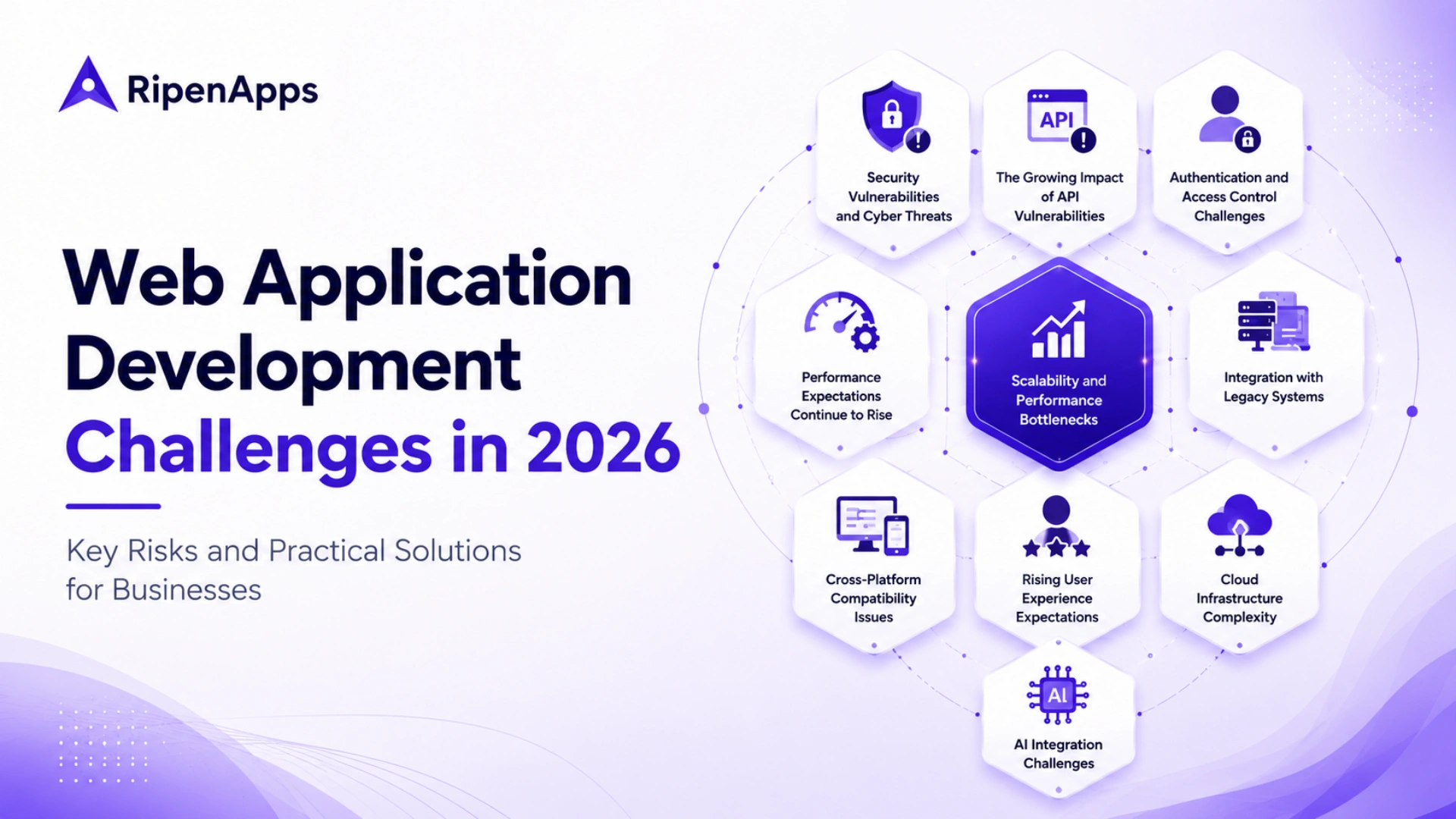
Every web application faces challenges, but not every challenge carries the same business impact. Some can slow innovation, while others can lead to security breaches, customer dissatisfaction, or significant financial losses. Identifying and addressing these risks early enables businesses to build more resilient and scalable digital products. So, let’s look at these challenges:
Security Vulnerabilities and Cyber Threats
Security remains one of the most significant web application development challenges facing businesses today. As applications become more interconnected and data-driven, attackers gain more opportunities to exploit weaknesses. Organizations can no longer rely on basic security controls or traditional perimeter defenses.
Common security challenges include:
- Weak authentication systems
- API vulnerabilities
- Insecure coding practices
- Third-party dependency risks
- Cloud misconfigurations
- Session management weaknesses
Even a single successful attack can have far-reaching consequences, including financial losses, regulatory fines, brand reputation damage, customer trust erosion, and operational downtime. Organizations investing in robust security-first development strategies often reduce both immediate threats and long-term business risks.
The Growing Impact of API Vulnerabilities
Modern applications rely heavily on APIs to connect services, exchange data, and enable seamless user experiences. Unfortunately, APIs have become one of the most attractive attack surfaces for cybercriminals.
Common API security risks include broken authentication, excessive data exposure, improper authorization controls, rate-limiting failures, and injection attacks, all of which can expose sensitive information and compromise application security. Businesses must adopt API security best practices throughout development and deployment cycles.
Authentication and Access Control Challenges
Authentication systems have become increasingly complex due to the rise of multi-device usage, remote work environments, third-party integrations, and enterprise user management requirements, all of which expand the potential attack surface for businesses.
Weak authentication mechanisms remain one of the leading causes of security incidents. To strengthen application security, organizations should implement multi-factor authentication, role-based access control, zero-trust security principles, and continuous identity verification mechanisms.
Scalability and Performance Bottlenecks
Many applications perform well during launch but struggle as user demand increases. Scalability issues frequently emerge when businesses experience:
- Rapid customer growth
- Increased transaction volumes
- Global market expansion
- Growing data requirements
Without proper planning, applications can suffer from slow response times, database congestion, infrastructure instability, and increased downtime.
Common Scalability Challenges
| Challenge | Business Impact |
| Inefficient database design | Slow application performance |
| Monolithic architecture limitations | Difficult scaling |
| Poor caching strategies | Increased server load |
| Resource-intensive processes | Higher infrastructure costs |
| Traffic spikes | Service interruptions |
Organizations pursuing long-term growth often leverage cloud application migration services to modernize infrastructure, improve scalability, and create flexible environments capable of handling fluctuating workloads.
Performance Expectations Continue to Rise
Performance is now directly linked to business outcomes. Modern users expect instant page rendering, seamless navigation, fast checkout experiences, and real-time updates regardless of the device or platform they use.
Even minor performance issues can negatively affect conversion rates, search visibility, customer satisfaction, and retention. Businesses seeking to optimize performance should understand the principles of web application architecture, as architectural decisions often determine how efficiently an application scales under growing demand.
Integration with Legacy Systems
Many enterprises still rely on legacy platforms that support critical business operations. While these systems often contain valuable business logic and historical data, integrating them with modern web applications presents significant challenges.
Common integration problems include:
- Outdated APIs
- Limited documentation
- Data inconsistencies
- Security vulnerabilities
- Compatibility limitations
Organizations frequently struggle to balance innovation with operational continuity.
Why Legacy Systems Create Development Risks
Legacy environments often lack modern security controls, scalability capabilities, cloud compatibility, and real-time data exchange functionality, making it difficult for organizations to meet current business and technology requirements.
As a result, development teams spend substantial time creating workarounds and custom integration layers. Many organizations address these challenges through legacy system modernization services, enabling them to retain valuable business assets while improving performance, security, and interoperability.
Technical Debt and Long-Term Costs
As technical debt accumulates, legacy systems become increasingly difficult and expensive to maintain, often resulting in higher operational costs, slower innovation cycles, reduced development flexibility, and greater business risk.
Modernization initiatives help reduce these constraints while creating a stronger foundation for future innovation.
Cross-Platform Compatibility Issues
Users interact with web applications through a wide range of devices, browsers, operating systems, and screen sizes. Delivering a consistent experience across all environments remains one of the most persistent challenges in website development.
Development teams must account for:
- Desktop browsers
- Mobile browsers
- Tablets
- Smart devices
- Accessibility technologies
Common Compatibility Challenges
Organizations frequently encounter compatibility challenges caused by browser rendering differences, JavaScript inconsistencies, responsive design failures, device-specific performance limitations, and accessibility compliance gaps, making it difficult to deliver a consistent experience across platforms. Even small inconsistencies can create frustration and negatively impact customer perception.
The Business Cost of Inconsistent Experiences
Even minor functionality issues can lead to increased bounce rates, lower user engagement, reduced conversion rates, customer dissatisfaction, and long-term damage to brand reputation.
Businesses developing customer-facing platforms frequently explore various types of web applications to determine the most suitable architecture and user experience approach for their target audience.
Rising User Experience Expectations
One of the fastest-growing web application development challenges involves meeting increasingly sophisticated user expectations.
Today’s users compare every digital experience against industry leaders. Whether using a banking platform, healthcare portal, SaaS solution, or eCommerce application, customers expect intuitive and frictionless interactions.
User Experience Is Now a Competitive Advantage
User experience has become a critical business differentiator, influencing everything from customer acquisition and retention to brand loyalty and revenue growth. When digital experiences fail to meet user expectations, organizations often face higher abandonment rates, lower engagement, increased support costs, and declining customer satisfaction.
Common User Experience (UX) Design Challenges
Designing an intuitive user experience is often complicated by factors such as complex navigation structures, feature overload, inconsistent interfaces, accessibility requirements, and mobile usability concerns, requiring teams to carefully balance functionality with simplicity.
Balancing business goals with user needs remains one of the most important user experience (UX) design challenges in modern web development. Organizations planning digital products should evaluate essential functionality using a comprehensive modern web application features checklist to ensure user expectations are addressed from the outset.
Personalization Expectations Continue to Increase
Modern users increasingly expect personalized recommendations, intelligent search capabilities, context-aware experiences, and predictive interactions that make digital experiences faster, more relevant, and more intuitive. Meeting these expectations requires advanced data strategies, AI capabilities, and ongoing optimization efforts.
Cloud Infrastructure Complexity
Cloud adoption continues to accelerate, but managing cloud environments introduces new technical and operational challenges. While cloud platforms offer scalability and flexibility, businesses must navigate increasingly complex infrastructures involving:
- Multi-cloud environments
- Hybrid cloud deployments
- Containerized applications
- Distributed services
- Edge computing integrations
Common Cloud Management Challenges
Organizations frequently struggle with resource optimization, cost management, security configuration, infrastructure monitoring, and service orchestration, making effective cloud management a significant operational challenge. Poor cloud governance can lead to performance issues, budget overruns, and increased security risks.
Cloud-Native Applications Require New Expertise
The shift toward cloud-native development requires organizations to adopt new technical capabilities and operational practices. Building and managing these applications successfully often demands expertise in containerization, infrastructure automation, distributed systems, cloud security, and observability to ensure scalability, reliability, and performance. Businesses that successfully adopt cloud-native architectures gain greater agility, scalability, and resilience.
AI Integration Challenges
Artificial intelligence is rapidly becoming a core component of modern web applications. Businesses are integrating AI-powered features such as chatbots, recommendation engines, predictive analytics, content generation tools, and intelligent automation capabilities. While these innovations create significant opportunities, they also introduce new development complexities.
Common AI Integration Obstacles
While AI offers significant business opportunities, successful implementation can be hindered by data quality limitations, model accuracy concerns, infrastructure demands, integration complexity, regulatory compliance requirements, and the need for continuous model monitoring and maintenance. Without proper planning, AI implementations can increase costs while delivering limited business value.
Balancing Innovation and Reliability
Many businesses rush to implement AI capabilities simply because competitors are doing so. However, successful AI adoption requires a clear understanding of use cases, customer needs, and measurable business outcomes. Organizations exploring the impact of AI in web development often discover that strategic implementation delivers significantly better results than broad, unstructured adoption efforts.
Data Privacy and Compliance Risks
Data privacy regulations continue to evolve worldwide, creating additional responsibilities for businesses developing web applications.
Organizations must ensure compliance with various regulations governing:
- Data collection
- User consent
- Data storage
- Data sharing
- Cross-border transfers
- User rights management
Key Compliance Challenges
Businesses frequently struggle with managing consent preferences, securing customer data, implementing retention policies, supporting data deletion requests, and maintaining audit trails. Failure to address these requirements effectively can result in regulatory penalties, legal consequences, customer trust issues, and long-term damage to brand reputation. Privacy requirements must be incorporated into application architecture from the earliest stages of development.
Technology Stack Selection Problems
Choosing the right technology stack remains one of the most important strategic decisions in web application development.
The wrong choice can affect:
- Scalability
- Security
- Development speed
- Maintenance costs
- Future flexibility
Common Technology Selection Mistakes
Organizations often make technology decisions based on short-term trends, developer familiarity, vendor marketing, or incomplete requirements analysis, which can lead to scalability challenges, increased maintenance costs, and long-term technical limitations. These factors may not align with long-term business objectives.
Evaluating the Right Technology Stack
To select the most suitable technology stack, businesses should carefully evaluate factors such as project complexity, performance requirements, scalability goals, security needs, available team expertise, and budget constraints.
Organizations evaluating platforms and frameworks often benefit from reviewing the best tech stack for web app development to better understand available options and selection criteria.
Talent and Skill Gaps
The demand for skilled developers continues to outpace supply. As web development technologies evolve, businesses face increasing difficulty finding professionals with expertise in:
- Cloud-native architecture
- DevOps practices
- AI integration
- Cybersecurity
- Modern frontend frameworks
- Microservices
How Talent Shortages Impact Projects
Skill gaps often result in delayed product launches, reduced development quality, increased project costs, technical debt accumulation, and innovation bottlenecks that limit an organization’s ability to compete effectively.
Organizations that invest in training, strategic hiring, and technology partnerships are better positioned to overcome these challenges.
Cost Overruns and Timeline Delays
Budget overruns remain one of the most common web application risks for businesses. Even well-planned projects can experience unexpected delays due to:
- Scope expansion
- Changing requirements
- Resource constraints
- Integration challenges
- Technology complexity
Why Projects Exceed Budgets
Many development projects exceed their budgets or timelines due to inadequate discovery and planning, unrealistic delivery expectations, stakeholder misalignment, underestimated technical challenges, and evolving business requirements throughout the development process.
Reducing Financial Risk
Reducing the risk of cost overruns and timeline delays requires a structured approach that includes clear requirement gathering, realistic milestone planning, MVP-focused development, regular stakeholder reviews, and ongoing performance monitoring to keep projects aligned with business objectives. Businesses planning digital initiatives should also understand factors affecting website development costs to establish realistic budgets and avoid costly surprises.
Web Application Security Risks Businesses Cannot Ignore
Security has evolved from a technical concern into a boardroom-level business priority. Organizations must proactively address web application security risks before they impact customers, operations, or revenue.
OWASP-Related Security Concerns
The OWASP Top 10 continues to highlight some of the most common web application vulnerabilities, including broken access control, cryptographic failures, injection attacks, security misconfigurations, and vulnerable software components. These security weaknesses often arise from insecure coding practices, inadequate testing, or outdated dependencies, making regular security assessments and adherence to secure development standards essential for reducing risk.
API Vulnerabilities
Modern web applications rely heavily on APIs to facilitate communication between systems, applications, and third-party services. However, weak authentication, excessive permissions, inadequate rate limiting, and insecure data exposure can make APIs attractive targets for cybercriminals. Implementing strong security controls and continuous monitoring is crucial to protecting sensitive data and maintaining system integrity.
Authentication Risks
Weak authentication mechanisms remain one of the leading causes of security breaches. Poor password policies, inadequate session management, and insufficient identity verification can provide attackers with opportunities to gain unauthorized access to user accounts and business systems. Organizations should implement multi-factor authentication, role-based access controls, and robust identity management practices to strengthen security.
Data Breaches
Data breaches can expose sensitive customer information, financial records, and proprietary business data, resulting in financial penalties, legal liabilities, reputational damage, and customer attrition. Protecting critical data requires a comprehensive approach that includes encryption, access controls, secure storage practices, employee training, and ongoing security monitoring.
Ransomware Threats
Ransomware attacks continue to grow in sophistication and frequency, targeting businesses of all sizes and industries. These attacks can disrupt operations, encrypt critical systems, and cause significant financial losses. To reduce exposure, organizations should maintain reliable backup systems, develop incident response plans, implement security monitoring tools, and educate employees about emerging cyber threats.
Third-Party Dependency Risks
Most modern applications depend on third-party libraries, frameworks, APIs, and cloud services to accelerate development and enhance functionality. While these dependencies provide significant benefits, they can also introduce security vulnerabilities that affect the broader application ecosystem. Regular audits, vulnerability assessments, dependency updates, and vendor evaluations help reduce exposure to supply chain attacks and strengthen overall application security.
Practical Solutions to Overcome Web Application Risks for Businesses
Understanding web application development challenges is only the first step. Businesses must also implement practical strategies that reduce risk while improving scalability, security, and long-term performance.
The most successful organizations take a proactive approach by incorporating risk management into every stage of the development lifecycle.
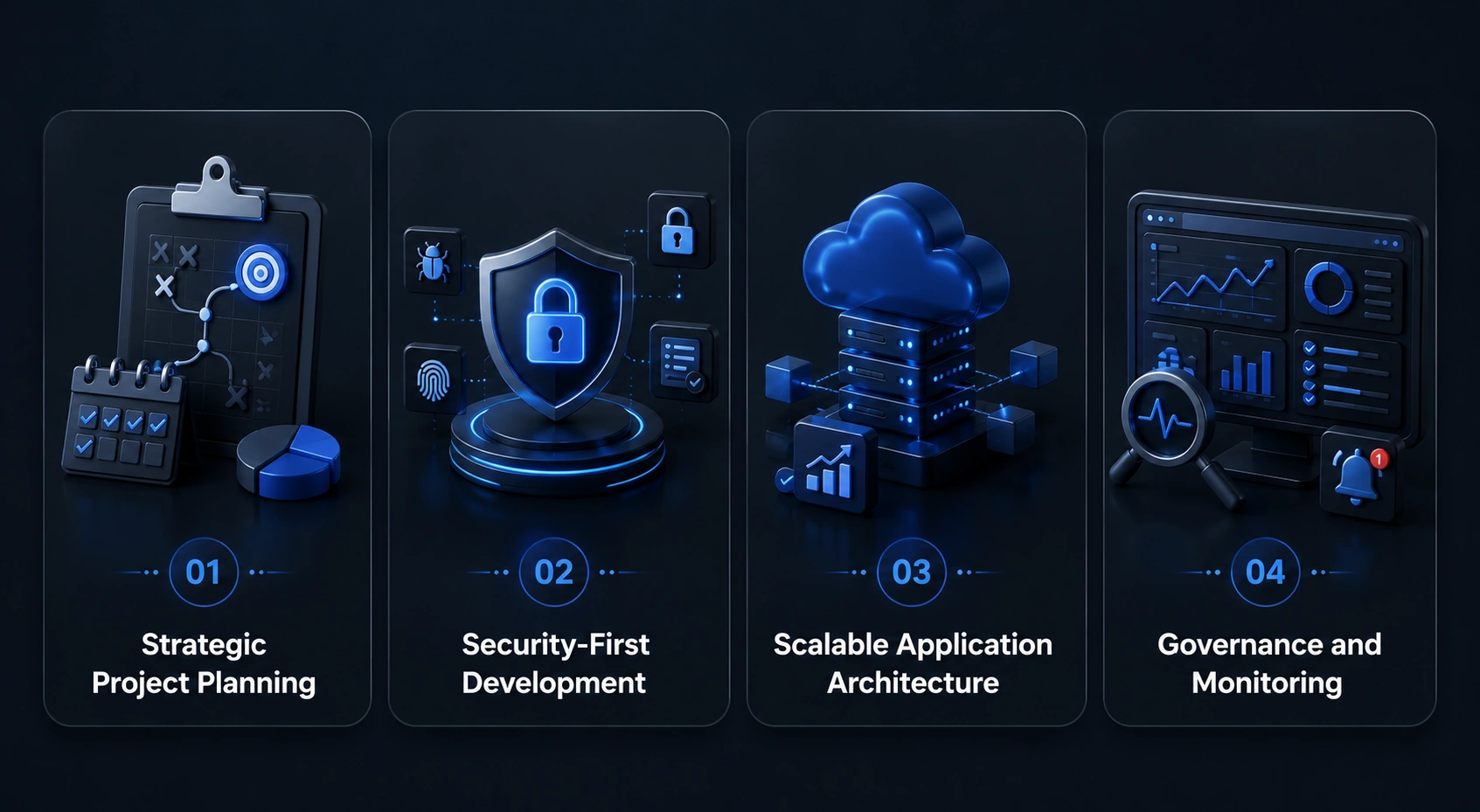
Start with a Comprehensive Discovery and Planning Phase
Many project failures can be traced back to inadequate planning.
Before development begins, organizations should clearly define:
- Business objectives
- User requirements
- Technical requirements
- Security expectations
- Scalability goals
- Compliance obligations
A structured discovery process helps identify potential roadblocks early and minimizes costly changes during development.
Adopt Security-by-Design Principles
Security should be embedded into every layer of the application rather than added after development.
Key security practices include:
- Secure coding standards
- Threat modeling
- Vulnerability assessments
- Penetration testing
- Encryption strategies
- Access control frameworks
By integrating security from the beginning, businesses can significantly reduce web application security risks and strengthen overall resilience.
Prioritize Scalability from Day One
Scalability should not be treated as a future concern.
Organizations should build architectures capable of supporting:
- User growth
- Data expansion
- Geographic expansion
- Feature enhancements
Scalable infrastructure reduces operational disruptions and allows businesses to respond quickly to market opportunities.
Establish Strong Governance and Monitoring
Effective governance enables teams to maintain performance, security, and compliance standards throughout the application lifecycle.
Organizations should implement:
- Performance monitoring
- Security monitoring
- Compliance auditing
- Incident response planning
- Regular system reviews
Continuous visibility helps teams identify issues before they impact users.

Emerging Web Development Technologies Shaping 2026
Technology innovation continues to redefine how businesses build and manage digital products. Organizations that understand emerging trends can better prepare for future opportunities, respond to changing customer expectations, and maintain a competitive advantage in an increasingly digital marketplace.
AI-Assisted Development
AI-powered development tools are transforming the software development lifecycle by helping teams generate code, automate testing, improve debugging processes, accelerate documentation, and enhance overall productivity. While human expertise remains essential, AI-assisted development is becoming a valuable tool for improving efficiency and reducing development timelines.
Serverless Computing
Serverless computing allows developers to focus on building application functionality without managing underlying infrastructure. By offering automatic scaling, faster deployments, reduced operational overhead, and cost efficiency, serverless architectures are becoming increasingly popular for event-driven and cloud-native applications.
Edge Computing
Edge computing brings data processing closer to end users, reducing latency and improving application responsiveness. This approach is particularly valuable for real-time applications, IoT ecosystems, content delivery networks, and location-based services where speed and performance directly impact user experience.
Progressive Web Applications (PWAs)
Progressive Web Applications combine the accessibility of websites with the functionality of native mobile applications. Features such as offline access, improved performance, mobile-friendly experiences, and lower development costs make PWAs an attractive option for businesses seeking broader digital reach and user engagement.
Microservices Architecture
Microservices architecture enables applications to be built as independent services that can be developed, deployed, and scaled separately. This approach improves flexibility, supports faster release cycles, enhances scalability, and reduces dependencies between different components of an application.
Modern Frontend Frameworks
Frontend technologies continue to evolve rapidly, enabling developers to create more interactive, responsive, and scalable user experiences. Modern frameworks help improve application performance, maintainability, and development efficiency while supporting the growing demand for rich digital experiences.
Organizations evaluating modern frameworks should also stay informed about the latest full-stack web development technologies that are shaping the future of application development.
How Businesses Can Future-Proof Their Web Applications
Will Your Web Application Still Meet Business Needs Five Years From Now?
This is a question every business leader should ask before launching a new web application or investing in modernization efforts. In today’s rapidly evolving digital landscape, technologies, customer expectations, and market demands can change significantly within a few years. Applications built solely to solve current challenges often struggle to support future growth, resulting in costly upgrades, performance limitations, and reduced competitiveness.
Future-proofing begins with creating applications that can adapt as business requirements evolve. Flexible architectures, scalable infrastructure, and well-planned technology choices provide the foundation needed to accommodate new features, support larger user bases, and integrate emerging technologies without major disruptions. Organizations that prioritize adaptability from the beginning are better positioned to respond quickly to changing market opportunities.
However, long-term success depends on more than technical flexibility. Businesses must continuously evaluate application performance, security readiness, user feedback, and emerging technology trends. Rather than adopting every new innovation, organizations should focus on technologies that align with strategic objectives and deliver measurable value. This balanced approach helps ensure web applications remain relevant, efficient, and capable of supporting business growth for years to come.
Choosing the Right Development Partner
Technology decisions alone cannot guarantee project success. The expertise and capabilities of your development partner often determine whether a project achieves its objectives. When evaluating potential partners, organizations should consider the following factors:
Technical Expertise
Technical expertise should extend beyond coding capabilities. Businesses should look for partners with proven experience in modern web development technologies, cloud-native architecture, security implementation, performance optimization, scalable application development, and emerging technology adoption.
For organizations building subscription-based digital products, experienced providers of custom saas development services can help accelerate product development while ensuring long-term flexibility, scalability, and growth readiness.
Industry Experience
Domain expertise helps teams understand:
- Industry regulations
- Customer expectations
- Market dynamics
- Business workflows
This knowledge often leads to more effective solutions, faster delivery cycles, and better alignment between business goals and technical execution.
End-to-End Development Capabilities
Organizations often benefit from partners capable of supporting the entire product lifecycle, from product strategy and UI/UX design to development, deployment, and post-launch optimization. A full-service technology partner can help reduce coordination challenges while ensuring consistency throughout the development journey.
Businesses should also evaluate a partner’s expertise in modern backend technologies and scalable application architectures. Working with an experienced Node js development company can help organizations build high-performance web applications that support growing user demands, complex workflows, and long-term scalability.
Long-Term Support and Innovation
The right partner should provide ongoing support beyond launch, including:
- Performance optimization
- Security updates
- Feature enhancements
- Technology consulting
Enterprises developing customer, employee, vendor, or partner-facing ecosystems often require highly specialized solutions. In such cases, investing in professional web portal development services can help businesses build secure, scalable, and feature-rich platforms that improve collaboration, engagement, and operational efficiency.
A long-term partnership helps businesses remain competitive as technology and customer expectations continue to evolve.

Conclusion
As digital transformation accelerates, web application development challenges will continue to evolve. Businesses must navigate growing security threats, increasing user expectations, complex technology ecosystems, regulatory requirements, and rapid innovation cycles. Organizations that proactively address web application risks for businesses through strategic planning, scalable architectures, modern development methodologies, and continuous improvement initiatives will be better positioned for long-term success.
Whether building a new digital product or modernizing an existing platform, success depends on making informed technology decisions, prioritizing security, and adopting development practices that support future growth. For organizations looking to deepen their understanding of modern application planning, architecture, and execution strategies, our comprehensive guide to web application development provides valuable insights into building scalable and future-ready web solutions.
FAQs
1. What are the biggest web application development challenges in 2026?
The biggest web application development challenges include cybersecurity threats, scalability limitations, cloud infrastructure complexity, AI integration challenges, technology stack selection, compliance requirements, and rising user expectations.
2. What are the most common web application security risks?
Common web application security risks include API vulnerabilities, broken authentication, insecure dependencies, ransomware attacks, data breaches, access control weaknesses, and cloud misconfigurations.
3. How can businesses reduce web application risks?
Businesses can reduce risks by implementing secure development practices, adopting DevOps practices, investing in automated testing, conducting regular security audits, and building scalable architectures from the start.
4. Why is scalability important in web application development?
Scalability ensures applications can handle increased users, transactions, and data volumes without performance degradation. Proper scalability planning helps support business growth and improve customer satisfaction.
5. What role do DevOps practices play in modern web development?
DevOps practices improve collaboration between development and operations teams, automate deployment processes, enhance software quality, and support faster release cycles with lower operational risk.
6. How hard is it to build a website in 2026?
The answer depends on the project’s complexity. Basic websites can be developed relatively quickly, but enterprise-grade platforms often involve advanced integrations, security requirements, compliance considerations, and scalability planning. Businesses evaluating project complexity should understand the factors influencing website development cost before starting development.
7. Which web development technologies are expected to dominate the future?
Key technologies expected to shape the future include AI-assisted development, serverless computing, microservices, edge computing, cloud-native applications, PWAs, and modern frontend frameworks.
8. How can businesses choose the right web development partner?
Organizations should evaluate technical expertise, industry experience, development methodology, communication processes, security capabilities, and long-term support offerings before selecting a partner.
9. What is the best technology stack for web application development?
The best technology stack depends on business goals, scalability requirements, security needs, and project complexity. Businesses should evaluate frameworks, databases, infrastructure options, and development resources carefully. Reviewing the best tech stack for web app development can help organizations make informed decisions.
10. Why is a structured web application development process important?
A structured development process improves project predictability, reduces risks, enhances collaboration, and ensures alignment between business objectives and technical execution. Understanding the web application development process helps organizations achieve better outcomes and reduce costly mistakes.
Discuss your project and request for proposal
SHARE
WRITTEN BY

Ishan Gupta
CEO & Founder
Ishan Gupta is a seasoned entrepreneur and CEO with extensive 10+ years of experience in business and mobile app development landscape. He believes that the right digital product allows companies to focus on what they do best, while technology handles the rest. With deep exposure to global markets, he understands what makes an app succeed. His approach translates business needs into clear product strategies, ensuring that every feature contributes to measurable ROI.
View All Articles