


Key Takeaways
- The web application development process directly impacts scalability, operational efficiency, and long-term business growth.
- Businesses that prioritize architecture and infrastructure early avoid expensive rebuilds later.
- Modern web applications require cloud-native systems, API-first architecture, and scalable backend engineering.
- Agile development, continuous testing, and observability systems are now essential parts of the web development lifecycle.
- The right development strategy reduces operational risks while improving performance, integrations, and scalability.
Building a web application in 2026 is no longer just about creating an online platform. Businesses now develop web applications to automate workflows, improve operational efficiency, manage customer interactions, centralize business data, and build scalable digital ecosystems. From SaaS products to enterprise platforms and operational dashboards, web applications have become a core part of modern business infrastructure.
The challenge is that many businesses still approach the web development process with a short-term mindset. They prioritize launch speed while ignoring architecture, scalability, integrations, and long-term system performance. As usage grows, these systems often face workflow fragmentation, performance bottlenecks, integration failures, and rising infrastructure costs.
Modern businesses are now investing earlier in enterprise-grade web applications because digital systems directly impact growth, productivity, customer experience, and operational agility. Today’s applications are expected to support automation workflows, API integrations, AI capabilities, cloud-native infrastructure, and real-time operations without compromising scalability or reliability.
This guide breaks down the complete web application development process step by step, including planning, architecture, UI/UX, development, testing, deployment, scalability, and optimization. Whether you are evaluating enterprise platforms, SaaS systems, or professional web app development services, this guide will help you make more informed business and technology decisions.
Table of Contents
Why Businesses Need a Structured Web Application Development Process
Most failed web applications do not fail because of poor ideas. They fail because businesses underestimate the complexity of building scalable systems. A web application may work well during launch stages, but performance issues begin appearing when users, workflows, integrations, and operational dependencies increase.
This is where the web development life cycle becomes critical. Every stage of the development lifecycle affects system reliability, operational efficiency, infrastructure costs, and future scalability. Businesses that skip planning or rush development often face rising maintenance costs, workflow bottlenecks, poor user adoption, and technical limitations within a few years.
Modern businesses are no longer building static websites alone. They are building operational systems that support customer engagement, internal collaboration, automation, analytics, ecommerce workflows, SaaS platforms, and enterprise operations. This is why the website development process has evolved into a much more strategic and infrastructure-focused discipline.
Step-by-Step Web Application Development Process
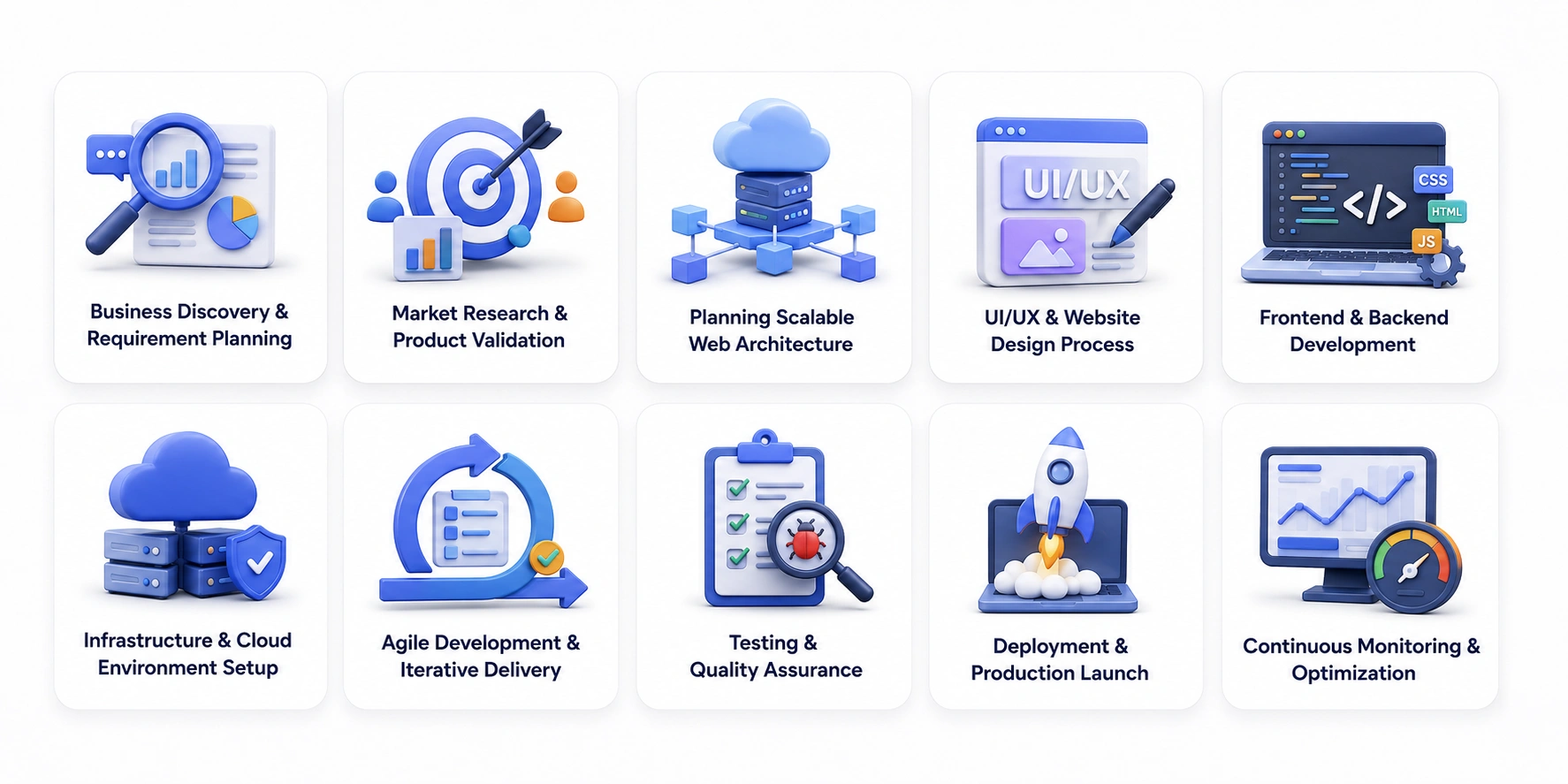
Step 1: Business Discovery and Requirement Planning
The most important stage of the web application development process happens before a single line of code is written.
Business discovery helps development teams understand what the application actually needs to achieve. Many businesses skip this stage and proceed directly to UI design or feature discussions. This creates problems later because web application features alone do not define successful applications. Workflows do.
During this stage, businesses evaluate:
- operational challenges
- target users
- business goals
- workflow complexity
- scalability expectations
- integration requirements
For example, a SaaS platform serving thousands of users requires a very different architecture compared to an internal enterprise dashboard. Similarly, a customer-facing ecommerce system has different infrastructure and performance requirements than a workflow automation platform.
This stage also helps businesses decide whether they need:
- progressive web app development
- enterprise web application development
- real-time systems
- cloud-native infrastructure
- API-heavy architecture
- AI-enabled workflows
The biggest advantage of proper discovery planning is risk reduction. Businesses that define workflows early reduce scope creep, operational confusion, and development delays later in the web development process.
Step 2: Market Research and Product Validation
Many businesses invest heavily in development before validating whether users actually need the product or workflows being built.
This is one of the biggest reasons web applications fail after launch.
Modern product teams increasingly focus on validating operational assumptions before large-scale development begins. Instead of building full systems immediately, businesses now validate:
- user expectations
- workflow behavior
- competitor gaps
- operational pain points
- feature adoption likelihood
This stage plays a critical role in reducing development risks and improving product-market alignment.
For example, businesses building SaaS platforms often start with limited MVPs to validate workflows before scaling infrastructure. This is why experienced teams offering SaaS application development services typically prioritize product validation and user feedback before investing in full-scale development. Similarly, enterprise platforms frequently test automation processes internally before expanding across departments.
The modern web page development process increasingly depends on iterative validation rather than rigid linear execution.
Businesses that validate workflows early usually achieve:
- faster adoption
- lower development waste
- better scalability planning
- improved operational alignment
Step 3: Planning Scalable Web Application Architecture
Architecture decisions define whether a web application supports growth or becomes an operational bottleneck later.
Many businesses underestimate this stage because web application architecture is not directly visible to users. However, infrastructure maturity, scalability engineering, database structuring, API design, and system modularity determine how well the platform performs under real-world demand.
A weak architecture may function properly during launch stages, but problems emerge later:
- slow performance
- rising infrastructure costs
- integration failures
- downtime during traffic spikes
- operational instability
Modern businesses increasingly prioritize scalable web application architecture from the beginning because rebuilding systems later becomes significantly more expensive.
Today’s web development framework strategies often include:
- cloud-native infrastructure
- modular architecture
- distributed systems
- API-first ecosystems
- asynchronous workflows
- event-driven systems
Businesses also increasingly evaluate monolithic vs microservices architecture depending on operational scale.
Monolithic systems work well for smaller applications and MVPs because development speed is faster. However, large enterprise systems and SaaS platforms increasingly rely on modular architecture because it supports:
- independent scaling
- better fault tolerance
- infrastructure flexibility
- faster deployments
- easier integrations
We’ve seen businesses rebuild systems within 18–24 months because their original architecture was optimized for launch speed instead of long-term scalability.

Step 4: UI/UX Design and Website Design Process
Most businesses think design is primarily visual. In reality, modern UI/UX focuses much more on usability, workflow efficiency, and operational simplicity.
A good web page design process improves:
- navigation clarity
- onboarding experience
- workflow speed
- customer retention
- operational adoption
Poor UX creates friction. Users abandon platforms when workflows feel confusing or inefficient, regardless of how technically advanced the application may be.
This is why the website design process now includes:
- user journey mapping
- interactive prototyping
- responsive UI systems
- accessibility optimization
- usability testing
Businesses building enterprise systems also prioritize dashboard usability, operational visibility, and workflow simplicity because employees interact with these systems daily.
Modern website design and development strategy increasingly focuses on reducing cognitive load. Applications should simplify operations instead of increasing complexity.
The designing a website process is now closely connected with business operations, customer behavior, and product strategy.
Step 5: Frontend and Backend Development
This is where the actual web page development process begins.
Frontend development focuses on everything users interact with directly. Modern frontend systems prioritize responsiveness, speed, accessibility, and cross-device consistency. Technologies such as React, Angular, Vue.js, and Next.js are widely used because they improve performance and support scalable interfaces.
However, frontend systems alone do not define application performance.
Backend systems power:
- APIs
- databases
- authentication
- integrations
- business logic
- workflow automation
Modern backend development services increasingly focus on building scalable API-first systems that support enterprise integrations and real-time processing.
This stage also determines how effectively the platform handles:
- concurrent users
- operational workflows
- infrastructure scaling
- security requirements
- third-party integrations
Businesses investing in enterprise-grade platforms often work with teams offering full-stack development services because frontend and backend systems now operate as deeply interconnected ecosystems.
Similarly, SaaS businesses increasingly prioritize scalable backend architecture because operational growth directly depends on infrastructure stability.
Step 6: Infrastructure and Cloud Environment Setup
Infrastructure decisions are now business decisions.
A poorly optimized infrastructure may increase operational costs, create downtime risks, and limit scalability as user activity grows.
Modern businesses increasingly adopt:
- managed cloud services
- containerized infrastructure
- serverless environments
- distributed databases
- CDN optimization
- automated deployment systems
Cloud-native infrastructure improves:
- operational flexibility
- deployment speed
- scalability
- fault tolerance
- infrastructure reliability
Many organizations also invest in cloud infrastructure management services to monitor performance, optimize resources, and maintain system reliability as applications scale.
This is especially important for businesses building:
- SaaS platforms
- enterprise dashboards
- ecommerce ecosystems
- high-traffic applications
- API-heavy systems
Today’s website development stages increasingly depend on infrastructure maturity because modern applications handle significantly more operational complexity than traditional websites.
Step 7: Agile Development and Iterative Delivery
The traditional waterfall model is becoming less effective for modern web application projects.
Businesses now increasingly follow an agile web development process because modern applications evolve continuously after launch.
Agile development improves flexibility by allowing teams to:
- Release features incrementally
- gather feedback continuously
- reduce development risks
- Prioritize workflows dynamically
Modern web app development timeline planning also becomes more realistic through agile execution because businesses can adapt to changing priorities without rebuilding entire systems.
The biggest advantage of agile delivery is operational adaptability. Businesses rarely know every requirement during the early planning stages. Agile frameworks support iteration without disrupting the entire development lifecycle.
Modern development teams increasingly combine:
- agile workflows
- DevOps pipelines
- CI/CD automation
- automated testing systems
- infrastructure monitoring
This creates faster, more stable deployment cycles.
Step 8: Testing and Quality Assurance
Testing is one of the most underestimated stages of the web development process.
Many businesses assume testing only identifies bugs. In reality, testing validates scalability, operational reliability, infrastructure stability, and workflow consistency.
Modern applications require multiple testing layers:
- functional testing
- performance testing
- security testing
- load testing
- API testing
- usability testing
Enterprise applications increasingly rely on automated testing systems because manual testing alone cannot handle large-scale operational complexity.
Without proper testing, businesses face:
- unstable releases
- broken integrations
- operational downtime
- security vulnerabilities
- workflow disruptions
Modern enterprise systems also increasingly prioritize observability and monitoring because businesses need real-time visibility into:
- infrastructure health
- API performance
- user behavior
- system bottlenecks
Applications that cannot maintain reliability under scale eventually become operational liabilities.
Step 9: Deployment and Production Launch
Deployment is no longer a simple hosting process.
Modern deployment strategies increasingly rely on:
- CI/CD pipelines
- container orchestration
- automated rollback systems
- edge infrastructure
- serverless deployment
Production systems should support:
- scalability
- resilience engineering
- observability
- fault tolerance
- infrastructure automation
Businesses that neglect deployment maturity often struggle with instability during traffic spikes or rapid operational growth.
Step 10: Continuous Monitoring and Optimization
Modern web applications are never truly finished.
The most successful digital products continuously improve through:
- infrastructure monitoring
- performance optimization
- user behavior analysis
- workflow improvements
- security updates
Continuous optimization helps businesses:
- reduce downtime
- improve scalability
- lower operational costs
- improve customer retention
- support long-term growth
This is especially important for businesses investing in custom web app development services because operational requirements evolve continuously as businesses scale.
Modern web applications increasingly depend on observability systems and performance analytics to maintain operational reliability over time.
How Much Does the Web Application Development Process Cost in 2026?
Web application development cost depends on:
- application complexity
- integrations
- architecture maturity
- infrastructure requirements
- security compliance
- scalability expectations
In 2026, businesses generally fall into these ranges:
| Application Type | Estimated Cost |
| Basic Web Applications | $20,000 – $70,000 |
| Mid-Level Business Platforms | $80,000 – $180,000 |
| Enterprise-Grade Applications | $200,000 – $500,000+ |
Applications involving AI features, distributed infrastructure, or enterprise integrations often require higher investment due to additional scalability and infrastructure complexity. Different types of web applications also influence development costs, as each category comes with unique technical requirements, integrations, and performance expectations. The real cost is not simply development. It is operational scalability over time.
The real cost is not simply development. It is operational scalability over time.

How AI Is Changing the Web Application Development Process
AI is rapidly transforming how modern web applications are planned, developed, tested, and optimized. Businesses are no longer using AI only as a product feature. The adoption of AI in web application development is helping organizations improve automation, accelerate delivery cycles, and create more intelligent digital experiences. They are also integrating AI directly into the web development process to improve speed, operational efficiency, and decision-making.
In 2026, development teams are increasingly using AI-assisted coding tools to accelerate repetitive development tasks, improve debugging, and reduce development timelines. AI-powered testing systems are also helping businesses identify performance issues, detect UI inconsistencies, and automate quality assurance workflows more efficiently.
AI is also changing how web applications function after deployment. Modern web apps now include:
- Intelligent search systems
- AI-powered chat interfaces
- Predictive recommendations
- Workflow automation
- Personalized user experiences
This shift is especially visible in enterprise web application development, where businesses are using AI to automate operations, improve reporting, and support faster decision-making across departments.
However, AI does not replace strong engineering foundations. Businesses still need scalable architecture, secure infrastructure, backend optimization, and observability systems to support long-term growth.
We are already seeing businesses rebuild systems within a few years because their original infrastructure was optimized for launch speed instead of operational scalability.
AI makes development faster. However, scalable systems still rely on the right architecture, workflows, and infrastructure planning from the outset.
Real-World Web Application Examples Built for Scale
Modern web applications are built to support operations, workflows, and scalability at a business scale. The most successful systems solve operational problems while maintaining performance as usage grows.
Shopify is one of the strongest examples of scalable web application development. The platform supports millions of businesses through centralized ecommerce management, inventory systems, payment processing, and real-time integrations. Its success comes from scalable cloud infrastructure and high-performance backend architecture.
Slack transformed enterprise communication by building a real-time collaboration platform capable of handling messaging, file sharing, notifications, and workflow integrations across distributed teams. This demonstrates how scalable backend systems and APIs directly improve operational efficiency.
RipenApps also developed Motion Learning as a scalable digital learning platform supporting live classes, real-time test systems, centralized content delivery, and concurrent user activity. The platform achieved over 500K downloads and 100K+ daily active users while maintaining stable performance.
Similarly, Stoklo was built as an operational inventory management platform with centralized stock visibility, workflow automation, reporting dashboards, and real-time inventory tracking. This helped improve operational coordination and scalability across business workflows.
Scalable web applications are not built around screens alone. They are built around infrastructure, workflows, integrations, and operational efficiency.
Wrapping Up
The web application development process is no longer limited to designing and launching digital products. Modern businesses are building scalable operational systems that support automation, integrations, AI-driven workflows, customer engagement, and long-term business growth. Every stage of the development lifecycle, from discovery and architecture planning to deployment, testing, and optimization, directly impacts scalability, performance, and operational efficiency.
Businesses that approach web application development strategically reduce technical debt, improve infrastructure scalability, and avoid expensive rebuilds later. Following a structured web application development blueprint helps organizations align technology decisions with long-term business objectives while creating a strong foundation for future expansion. As AI continues transforming how web applications are developed and experienced, companies must focus not only on faster development but also on building systems that remain stable, adaptable, and growth-ready over time. At RipenApps, we help businesses build scalable web applications designed around performance, operational workflows, and future-ready architecture, ensuring that technology investments continue delivering long-term business value.
FAQs
What is the web application development process?
The web application development process is the complete journey of building a web app, from requirement gathering and UI/UX planning to development, testing, deployment, and maintenance. A structured development lifecycle helps businesses reduce technical risks, improve scalability, and launch faster with better performance outcomes.
How long does it take to build a web application?
The web app development timeline depends on project complexity, integrations, features, and architecture requirements. Simple web applications may take 2–4 months, while enterprise-grade systems with advanced workflows and integrations often require 6–12 months or more.
How much does web application development cost in 2026?
Web application development cost in 2026 varies based on features, scalability requirements, tech stack, architecture, and development approach. Basic applications may cost between $20,000–$70,000, while enterprise web application development projects can exceed $200,000 depending on complexity and infrastructure needs.
What is the difference between a web app and a website?
A website primarily delivers information, while a web application allows users to interact with the system through workflows, dashboards, accounts, automation, or real-time functionality. Web apps are built for operations, engagement, and business processes, not just content presentation.
What technologies are used in modern web application development?
Modern web application development technologies like React, Angular, Vue.js, Node.js, Python, .NET, PostgreSQL, MongoDB, Kubernetes, and cloud-native infrastructure. The right web development framework depends on scalability goals, integrations, security, and performance requirements.
What is an MVP in web application development?
An MVP, or Minimum Viable Product, is the first functional version of a web app built with core features only. Businesses use MVP development to validate product-market fit, reduce investment risks, gather user feedback, and improve the system before large-scale development. This approach is especially common in web development for startups, where validating an idea quickly and efficiently is often a top priority.
Should businesses build a web app in-house or outsource development?
The decision depends on internal expertise, timelines, scalability goals, and budget. Many businesses prefer outsourcing to experienced web app development services providers because it reduces hiring complexity, accelerates delivery, and provides access to specialized engineering expertise.
How important is security in the web app development process?
Security is one of the most critical stages of web development. Weak authentication systems, unsecured APIs, and poor infrastructure decisions create long-term risks. Modern web applications require secure architecture, encryption, compliance management, and continuous monitoring from the beginning.
What maintenance does a web application need after launch?
Web applications require ongoing updates, security patches, performance monitoring, infrastructure optimization, scalability improvements, and feature enhancements after deployment. Continuous maintenance helps businesses prevent downtime, improve user experience, and support long-term operational growth.

SHARE
WRITTEN BY

Ishan Gupta
CEO & Founder
Ishan Gupta is a seasoned entrepreneur and CEO with extensive 8+ years of experience in business and mobile app development landscape. He believes that the right digital product allows companies to focus on what they do best, while technology handles the rest. With deep exposure to global markets, he understands what makes an app succeed. His approach translates business needs into clear product strategies, ensuring that every feature contributes to measurable ROI.
View All Articles



 India
India USA
USA Australia
 Canada
 UK
UK UAE
UAE