

Key Takeaways
- Personalization adapts app experiences based on user data, preferences, behavior, and context.
- Effective personalization starts with reliable data collection and meaningful user segmentation.
- Custom apps offer greater flexibility to personalize interfaces, content, recommendations, notifications, and user journeys.
- Personalization should be designed differently for different user segments rather than treating every user the same.
- Privacy, consent, data security, and transparency should be part of the personalization strategy from the beginning.
- A/B testing and engagement metrics help determine which personalized experiences actually perform better.
- AI and predictive analytics can take personalization beyond basic rules and recommendations.
Users expect mobile apps to feel relevant from the moment they open them. The products they see, content they discover, notifications they receive, and actions they are encouraged to take should reflect their interests and behavior. Generic experiences often make users work harder to find what they need, while relevant experiences can make an app easier and more useful to navigate.
Mobile app personalization allows businesses to adapt app experiences around individual preferences, behaviors, locations, purchase history, and engagement patterns. When personalization is planned during custom app development, it can become part of the product experience instead of being added as a marketing layer after launch.
Businesses investing in mobile app development services can use personalization to create more relevant user journeys, improve retention, support conversions, and make the app more responsive to changing user needs. The key is to collect the right data, define meaningful user segments, and personalize experiences without compromising privacy or usability.
Table of Contents
What Is Mobile App Personalization?
Mobile App Personalization is the process of adapting an app experience according to a user’s preferences, behavior, interests, location, previous interactions, or other relevant signals. Instead of presenting identical screens and content to every user, the app can adjust elements such as recommendations, onboarding flows, offers, notifications, content, and navigation based on individual needs.
For example, an ecommerce app can recommend products based on browsing and purchase history, while a fitness app can adjust workout suggestions according to a user’s activity level and goals. A personalized experience should therefore respond to meaningful user signals rather than relying only on basic details such as a user’s name or location.
The growing focus on personalized experiences reflects changing customer expectations. Salesforce reports that 73% of customers expect better personalization as technology advances, while 65% expect companies to adapt to their changing needs and preferences.
How Does Mobile App Personalization Work?
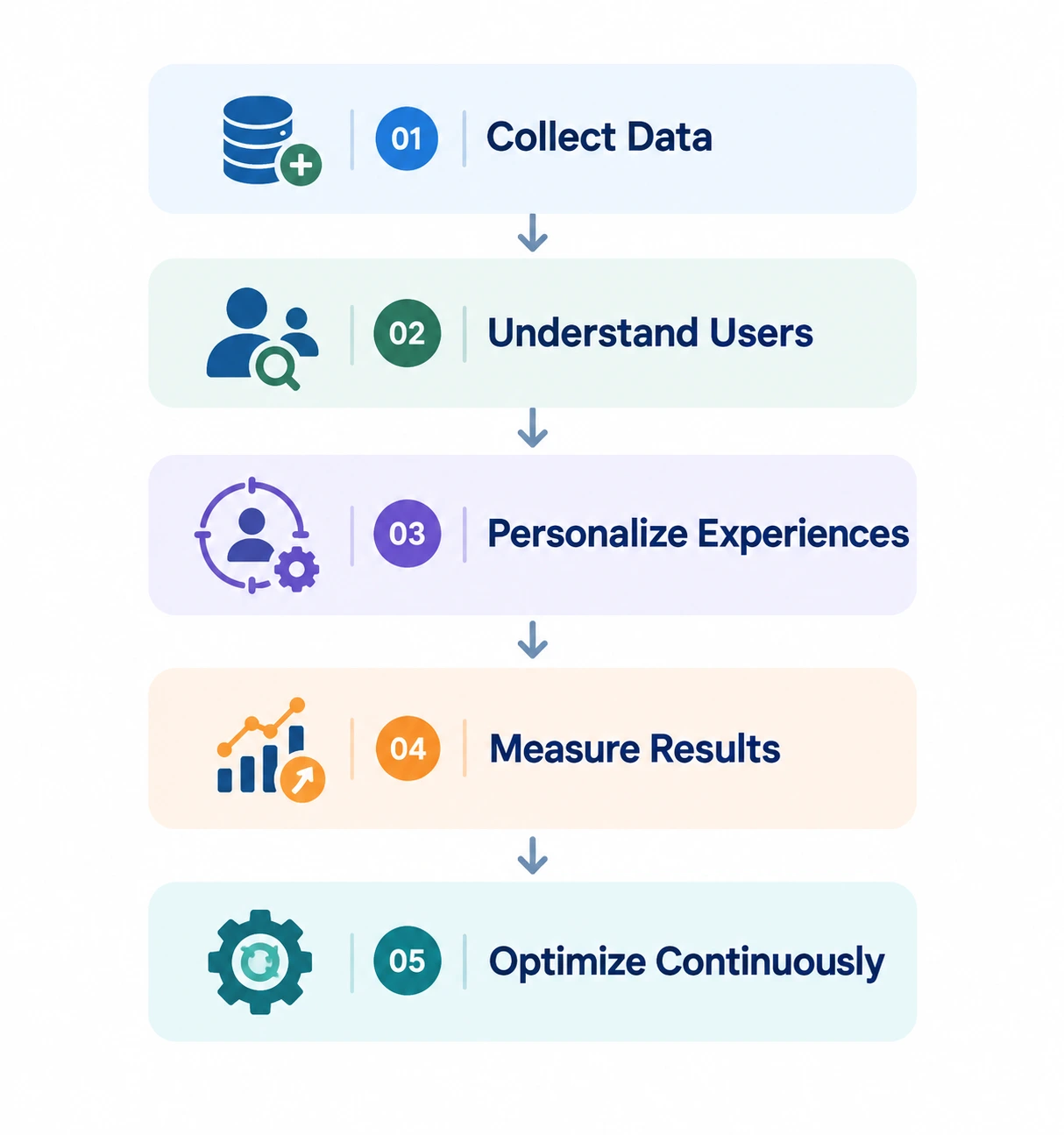
A successful personalization system generally follows a cycle of data collection → user segmentation → experience delivery → measurement → optimization. The app collects relevant signals, identifies patterns, assigns users to meaningful segments, and then delivers an experience based on those insights.
The process should also work as a continuous feedback loop. User interactions with personalized content can generate new behavioral data, which can then improve recommendations, journeys, messaging, and future personalization decisions.
1. Collect Relevant User Data
Personalization starts with reliable data. Depending on the app, this can include profile information, browsing behavior, purchase history, search activity, location, device information, content interactions, and previous engagement.
The goal is not to collect every possible data point. Businesses should identify the signals that can genuinely improve the user experience and collect them with appropriate consent and security controls.
2. Segment Users Based on Meaningful Signals
User segmentation groups people according to shared characteristics, behaviors, needs, or interests. Segments can be based on demographics, location, purchase patterns, engagement frequency, lifecycle stage, preferences, or specific actions taken inside the app.
More meaningful segmentation allows businesses to move beyond one-size-fits-all experiences. For example, a new user, frequent customer, inactive user, and high-value customer may each need a different journey.
3. Deliver Personalized Experiences
Once users and their needs are identified, the app can adapt relevant touchpoints. These can include home screens, product recommendations, content feeds, offers, search results, onboarding, push notifications, and in-app messages.
The level of personalization should match the app’s purpose. A financial app might personalize dashboards and financial insights, while a streaming app might prioritize recommendations based on viewing behavior.
4. Measure User Responses
Personalization needs measurable goals. Teams can track metrics such as engagement rate, session frequency, retention, conversion rate, feature adoption, average order value, and churn.
A/B testing can then compare personalized experiences against existing journeys or alternative versions. This helps teams identify whether a personalization strategy is creating measurable value rather than assuming that more customization automatically means better engagement.
5. Continuously Optimize the Experience
User preferences change over time. A recommendation that works today might become irrelevant after a user’s interests, location, purchase behavior, or lifecycle stage changes.
Continuous optimization allows the app to update user segments, recommendation rules, content, and communication strategies based on new behavioral signals. This makes personalization an ongoing product capability rather than a one-time feature.
Types of Mobile App Personalization
Different personalization methods can be combined depending on the app’s business model, audience, and available data. The most effective approach usually focuses on the areas where personalization can remove friction or create clear value for the user.
1. Content Personalization
Content personalization changes what users see based on their interests, activity, preferences, or previous interactions. News apps can prioritize relevant topics, streaming platforms can recommend suitable content, and ecommerce apps can highlight products based on browsing behavior.
2. UI and Experience Personalization
UI personalization adapts parts of the interface to make the experience more relevant or convenient. This can include personalized home screens, navigation options, dashboard widgets, layouts, or feature shortcuts.
Because personalization affects both what users see and how they interact with an app, UI and UX decisions need to work together. Our guide on the difference between UI and UX design explains how these two layers shape the overall user experience.
This approach is especially valuable for customizable mobile apps, where businesses can build flexible interfaces that adapt to different user preferences, needs, and usage patterns.
3. Behavioral Personalization
Behavioral personalization uses actions taken inside the app to determine what happens next. Viewed products, completed searches, skipped content, abandoned carts, frequently used features, and session patterns can all provide useful signals.
This approach helps businesses respond to what users actually do rather than relying only on information they provide during registration.
4. Location-Based Personalization
Location can help apps deliver relevant experiences based on where users are. Retail apps can highlight nearby stores, travel apps can recommend local activities, and food delivery apps can prioritize restaurants that serve the user’s current area.
Location-based personalization should always respect user consent and provide clear value for collecting or using location data.
5. Push Notification Personalization
Personalized push notifications can vary by user behavior, interests, lifecycle stage, and preferred timing. A shopping app might remind a user about an abandoned cart, while a fitness app could send a reminder based on a user’s workout pattern.
Timing matters as much as message relevance. Excessive or poorly targeted notifications can create notification fatigue and encourage users to disable alerts.
6. Recommendation Personalization
Recommendation engines use user behavior and contextual signals to suggest products, content, services, or features. These recommendations can become more accurate as the system learns from interactions.
This is one of the most visible mobile app personalization examples, particularly in ecommerce, streaming, media, travel, and financial applications.
Why Is Mobile App Personalization Important?
A personalized app experience can help businesses make each interaction more relevant while reducing unnecessary steps for users. Instead of asking every user to navigate the same journey, the app can surface information, products, features, and actions that are more aligned with their current needs.
1. Improve Mobile App Engagement
Relevant content and experiences give users stronger reasons to interact with an app. When users see products, content, recommendations, or features that match their interests, they are more likely to continue exploring the app.
A well-planned custom mobile app engagement strategy should therefore connect personalization with specific engagement goals rather than treating customization as an isolated feature.
2. Improve Retention and Reduce Churn
Users are more likely to return when an app consistently provides useful experiences. Personalized recommendations, reminders, content feeds, and loyalty experiences can help create stronger reasons to reopen the app.
Personalization should evolve with the user. Repeating the same recommendations or messages without considering new behavior can quickly make an experience feel irrelevant.
3. Increase Conversions
Personalized product recommendations, offers, content, and user journeys can help businesses guide users toward relevant actions. For example, an ecommerce app can recommend complementary products, while a subscription app can highlight plans based on usage patterns.
The objective is to reduce the gap between what users want and what the app presents to them.
4. Create Better Customer Experiences
Personalization can reduce unnecessary choices and help users reach relevant information faster. It can also make onboarding, navigation, search, recommendations, and communication feel more aligned with individual needs.
This matters particularly for apps with large feature sets, where showing every capability to every user can create unnecessary complexity.
5. Increase App Usage
When users find an app consistently useful, they have more reasons to return and use its features. Personalized content, recommendations, reminders, and feature suggestions can encourage repeat interactions without relying entirely on promotional messaging.
The goal should be to increase app usage by making the product more useful, not by overwhelming users with constant prompts.
What Makes Personalization Different in Custom App Development?
With custom app development, personalization can be considered at the product architecture and user-experience level from the beginning. Businesses can define which user signals matter, how different segments should experience the product, and which systems need to support personalized decisions.
This is different from adding basic personalization features to an existing generic product. A custom approach can connect personalization with onboarding, navigation, search, recommendations, content, notifications, account features, and backend data flows.
For businesses working with a startup app development company, this early planning can also help prioritize personalization features according to the product’s audience, business model, development resources, and growth stage.
Top Mobile App Personalization Strategies for Custom Apps
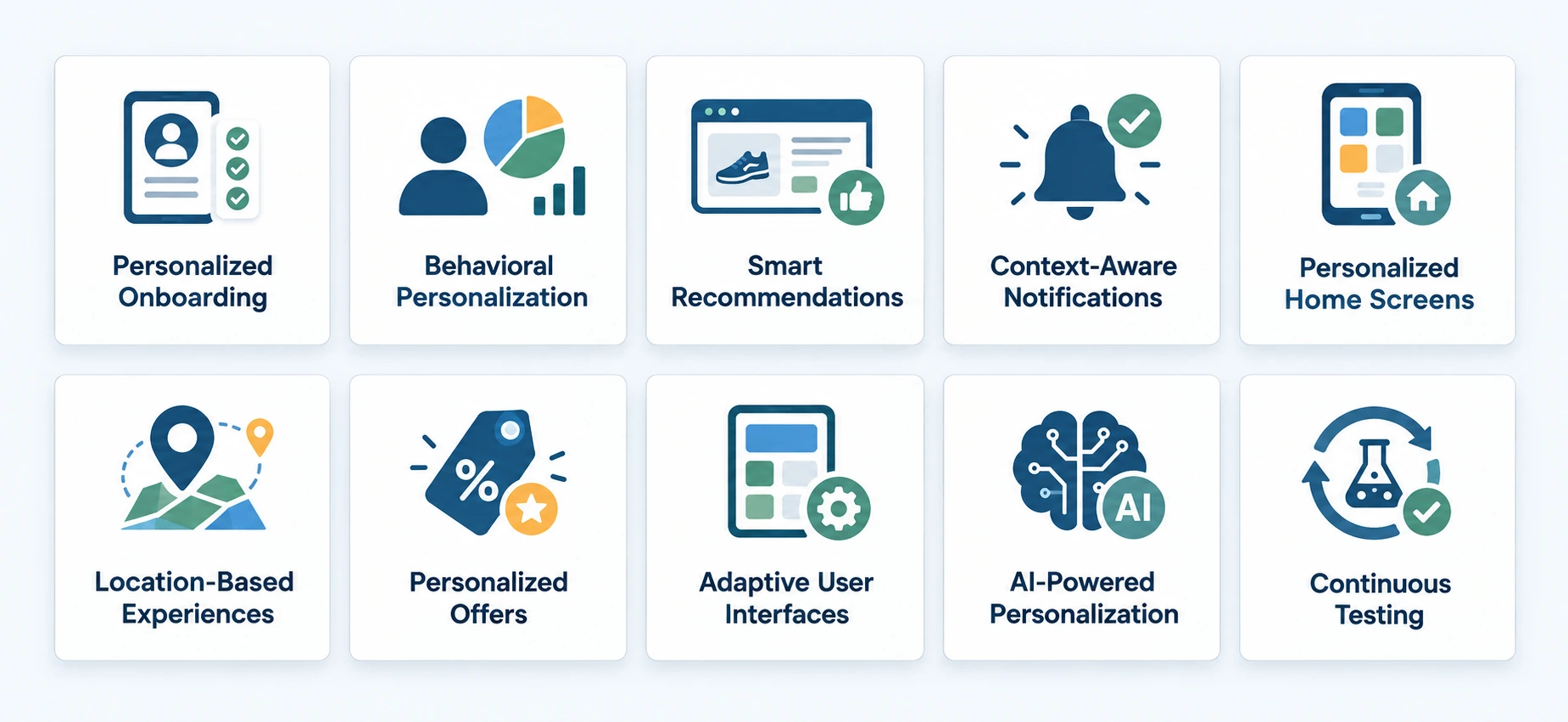
Effective personalization starts with understanding where individual users need a more relevant experience. Custom apps give businesses greater control over these touchpoints, allowing personalization to influence onboarding, content, recommendations, navigation, communication, and conversion journeys.
1. Personalize Onboarding Based on User Intent
The onboarding experience should help users reach relevant app features quickly instead of showing everyone the same introduction. Ask a small number of useful questions about goals, preferences, interests, or intended use cases, then use those responses to shape the initial experience.
For example, a personal finance mobile app can ask whether a user wants to focus on budgeting, saving, investing, or tracking expenses. The app can then prioritize relevant tools and content on the user’s dashboard.
2. Use Behavioral Data to Adapt the Experience
User actions provide valuable signals for personalization. Searches, clicks, purchases, viewed products, skipped content, feature usage, and session frequency can help the app understand changing interests and intent.
Behavior-based app personalization can then adjust recommendations, content, navigation, offers, or messages according to what users actually do. This creates a more responsive experience without requiring users to manually configure every preference.
3. Personalize Product and Content Recommendations
Recommendation systems can analyze previous interactions to suggest products, articles, videos, services, or other content that users are more likely to find relevant. Recommendations should become more useful as the app collects additional interaction data.
For example, a shopping app can recommend products based on browsing and purchase history, while a streaming app can prioritize content based on viewing patterns. This approach can also help increase app engagement by giving users more relevant reasons to explore the app.
4. Create Context-Aware Push Notifications
Push notifications become more effective when they reflect a user’s behavior, preferences, and current stage in the customer journey. A new user might receive an onboarding reminder, while an existing customer could receive an update related to a recent purchase or frequently used feature.
A strong notification strategy should also consider timing and frequency. Sending fewer but more relevant messages can support personalized mobile engagement without creating notification fatigue.
5. Personalize the App Home Screen
The home screen is one of the strongest personalization opportunities because it is often the first major interaction after login. Businesses can prioritize frequently used features, recommended products, relevant content, active subscriptions, or personalized shortcuts.
The home screen is one of the strongest personalization opportunities because it is often the first major interaction after login. As one of the must-have mobile app features, a personalized home screen can prioritize frequently used features, recommended products, relevant content, active subscriptions, or personalized shortcuts.
A returning user should not necessarily see the same home screen as a first-time user. Dynamic layouts can make the app more useful by bringing the most relevant actions closer to the user.
6. Use Location and Real-Time Context
Location, time, device type, and current activity can provide additional context for personalization. A travel app can surface nearby attractions, while a food delivery app can prioritize restaurants available in the user’s current area.
Contextual personalization should always provide clear user value and respect permission preferences. Businesses should avoid collecting location data simply because it is technically available.
7. Personalize Offers and Loyalty Experiences
Apps can use purchase history, engagement patterns, loyalty status, and preferences to create more relevant offers. A frequent customer could receive an early-access benefit, while an inactive user might receive an incentive designed to encourage a return visit.
This approach is more effective when offers reflect actual customer behavior rather than sending the same promotion to the entire user base.
8. Adapt Experiences Across iOS and Android
Personalization should account for differences between operating systems, screen sizes, permissions, and platform-specific behaviors. This is where thoughtful Android app design becomes important, as the interface should align with Android’s interaction patterns while supporting the same personalization goals across platforms.
For example, Android personalization can use Android-specific notification and widget capabilities while the iOS experience follows Apple’s interface and permission patterns. The goal is to maintain a consistent product experience without treating both platforms as identical.
9. Use AI and Predictive Personalization
AI in custom app development can help identify patterns across large volumes of behavioral data and predict what users are likely to need next. Instead of relying only on fixed rules, predictive models can support recommendations, content ranking, churn prediction, and next-best-action experiences.
However, AI should solve a clear personalization problem. Businesses should define the user experience and business objective first, then determine where predictive models add measurable value.
10. Continuously Test and Optimize Personalization
Personalization should evolve through testing. Teams can compare different recommendations, onboarding flows, notification messages, offers, layouts, or content experiences to determine which versions perform better.
Track metrics such as conversion rate, retention, session frequency, feature adoption, and revenue alongside engagement. This helps businesses how to increase user engagement on app through evidence rather than assumptions.
How Do You Personalize Your Apps Without Overcomplicating the Experience?
The goal of personalization is to make an app easier and more relevant, not to create a complicated interface that constantly changes. During the mobile app design process, teams should start with a few high-value opportunities, such as personalized onboarding, recommendations, home-screen content, or notifications.
A practical approach to how do you personalize your apps begins with identifying the user problem first. Then determine which data can help solve it, define the personalization rule or model, test the experience, and measure the outcome.
Too much personalization can also create confusion. Users should still recognize the core structure of the application even when individual content, recommendations, or actions change.
Mobile App Personalization Examples Across Industries
Personalization works differently depending on the business model and user expectations. The strongest implementations connect personalization to a specific user need rather than adding customization simply because it is available.
Ecommerce Apps
Ecommerce apps can personalize product recommendations, search results, offers, categories, and home-screen content based on browsing and purchase behavior. Businesses leveraging professional ecommerce app development services can build these personalized experiences into the app from the start, helping users discover relevant products and encouraging repeat purchases.
Banking and Fintech Apps
Financial applications can personalize dashboards, spending insights, financial education, alerts, and product recommendations. A leading fintech app development company can use behavioral and transaction data to tailor these experiences, such as showing budgeting insights to users who frequently track expenses or savings content to users focused on building their finances.
Healthcare Apps
Healthcare applications can personalize reminders, wellness content, appointment information, and patient journeys according to user preferences and relevant health workflows. A recognized healthcare app development company can build personalization into these experiences while keeping privacy, consent, security, and appropriate handling of sensitive information at the center.
Travel Apps
Travel apps can recommend destinations, hotels, activities, and offers based on previous searches, bookings, location, travel preferences, and trip history. A recognized travel app development company can help integrate these personalization capabilities to create more relevant travel experiences and reduce the time users spend searching through irrelevant options.
Media and Entertainment Apps
Streaming and content platforms can personalize feeds and recommendations based on viewing, listening, search, and interaction patterns. The same approach can support social media app development, where personalized feeds and content recommendations help users discover posts, creators, and topics that match their interests.
Fitness and Wellness Apps
Fitness apps can personalize workout plans, reminders, nutrition suggestions, and progress dashboards based on goals, activity levels, and previous sessions. With AI fitness app development, businesses can use user data and AI-driven insights to make these recommendations more relevant for both beginners and experienced users without forcing everyone through the same journey.
Data You Need for Effective Mobile App Personalization
Personalization depends on the quality and relevance of the data behind it. Businesses should identify which data points actually contribute to better experiences instead of collecting excessive information without a clear purpose.
User Profile Data
Basic information such as age range, preferences, language, location, interests, and account type can support initial personalization. Users should have appropriate control over information they provide.
Behavioral Data
App interactions often provide stronger personalization signals than static profile information. Searches, clicks, purchases, viewed content, feature usage, session frequency, and abandoned actions can reveal user intent.
Transactional Data
Purchase history, subscription status, order frequency, spending patterns, and previous transactions can help apps personalize recommendations, offers, loyalty experiences, and customer journeys.
Contextual Data
Context can include device type, location, time, session behavior, and current activity. Used responsibly, these signals can help an app provide relevant experiences at the right moment.
Engagement Data
Information about notification interactions, session frequency, retention, content engagement, and feature adoption can help teams understand which experiences users respond to and where personalization needs improvement.
How to Build Personalization Into Custom App Development
Personalization should be considered during product planning rather than added after the application architecture is complete. Teams need to decide which user data will be collected, where it will be stored, how it will be processed, and which app components will use it.
During product discovery services, teams can identify user segments, personalization opportunities, data requirements, business objectives, and success metrics before development begins. This reduces the risk of building personalization features without a clear purpose.
Define Personalization Goals
Start by identifying what the business wants personalization to improve. This could be engagement, retention, conversion, feature adoption, customer satisfaction, or average order value.
Identify Personalization Signals
Determine which user actions and attributes should influence the experience. Keep the initial set focused on signals that have a clear relationship with the intended outcome.
Design Flexible App Architecture
The application should allow relevant content, recommendations, screens, and user journeys to change without requiring major code changes each time. APIs, modular components, backend services, and data pipelines should support this flexibility.
Build Segmentation and Recommendation Logic
Create rules or models that determine which experience should be delivered to each user or segment. These can start with simple rule-based logic and become more sophisticated as the product gathers enough data.
Integrate Analytics
Analytics should capture how users interact with personalized experiences. This allows teams to understand which recommendations, messages, layouts, and journeys perform better.
Test Before Full Rollout
Start with controlled experiments or limited user groups. Validate the experience, monitor performance, and review feedback before expanding personalization across the entire user base.
Read Also: A Detailed Guide on Mobile App Development Process
Privacy and Security Considerations for App Personalization
Personalization relies on user data, which makes privacy and security essential parts of the strategy. Businesses should clearly communicate what data they collect, why they collect it, and how it contributes to the user experience.
Data collection should follow applicable privacy requirements and the principle of collecting only what is necessary for the intended personalization use case. Sensitive information requires additional care, access controls, secure storage, and appropriate consent mechanisms.
Users should also have meaningful control over personalization where appropriate. Options to manage preferences, notifications, location access, or data usage can improve transparency and trust.
Common Challenges in Mobile App Personalization
1. Poor Data Quality
Incomplete, outdated, or inconsistent data can lead to irrelevant recommendations and inaccurate user segments. Personalization should therefore include data validation and quality controls.
2. Data Silos
User information may exist across analytics tools, CRM systems, ecommerce platforms, and backend services. Connecting these sources can become difficult without a clear data architecture.
3. Privacy Concerns
Users may become uncomfortable when personalization feels intrusive. Businesses need transparent data practices and should provide clear value in exchange for relevant information.
4. Over-Personalization
Changing too many parts of the app can make the experience unpredictable. Personalization should enhance the core product experience rather than hide essential features or make navigation inconsistent.
5. Limited Data for New Users
New users have little behavioral history, making recommendations difficult. Businesses can use onboarding preferences, contextual signals, popular content, and progressive profiling to create useful initial experiences.
6. Measuring the Real Impact
An increase in clicks does not always mean personalization is successful. Teams should connect personalization experiments with meaningful outcomes such as retention, conversion, revenue, satisfaction, or feature adoption.
How to Measure the Success of Mobile App Personalization
Personalization needs clear KPIs from the beginning. The right metrics depend on the business objective and the part of the app being personalized.
| Goal | Metrics to Track |
| Improve engagement | Session frequency, session duration, content interactions |
| Improve retention | D1, D7, and D30 retention, churn rate |
| Increase conversions | Conversion rate, checkout completion, subscription rate |
| Improve recommendations | Recommendation clicks, add-to-cart rate, purchase rate |
| Improve notifications | Open rate, click-through rate, opt-out rate |
| Improve feature adoption | Feature usage, repeat usage, activation rate |
| Improve revenue | Average order value, revenue per user, customer lifetime value |
The most useful approach is to compare personalized experiences against a control group or previous baseline. This helps teams identify whether personalization is actually contributing to business outcomes.
Future of Mobile App Personalization
The next phase of personalization will move beyond basic segmentation and rule-based recommendations. AI, predictive analytics, real-time behavioral signals, and contextual decision-making are becoming important mobile app development trends that can help apps respond to user intent more dynamically.
Instead of showing the same personalized experience throughout a user’s lifecycle, apps can increasingly adapt based on what the user is doing at a specific moment. This could influence recommendations, content ranking, notifications, navigation, and the next action presented to the user.
However, the future of personalisation apps will depend on responsible implementation. Businesses will need to balance relevance with transparency, privacy, user control, and consistent product design.
Best Practices for Mobile App Personalization
A successful personalization strategy should focus on relevance rather than the amount of customization. These practices can help businesses build experiences that remain useful and manageable as the app grows.
- Start with clear business and user goals.
- Personalize high-value touchpoints first.
- Use behavioral data alongside profile information.
- Keep personalization relevant and contextual.
- Avoid collecting unnecessary data.
- Give users appropriate control over preferences.
- Test personalized experiences against a control group.
- Monitor both engagement and business outcomes.
- Keep the core navigation consistent.
- Continuously update segments and recommendation logic.
For businesses planning personalization apps, these principles can help create a product that feels relevant without becoming intrusive or difficult to manage.
When Should You Invest in Mobile App Personalization?
Personalization becomes particularly valuable when an app has multiple user segments, a large content or product catalog, frequent repeat interactions, or enough behavioral data to identify meaningful patterns.
It is also useful when businesses are experiencing low engagement, weak retention, poor recommendation performance, or high friction across important user journeys. In such cases, personalization can help address specific experience gaps rather than becoming an isolated feature.
For early-stage products, it is often better to begin with simple personalization and expand as the user base and data mature. A startup app development company can help prioritize these capabilities based on product goals, audience needs, and available resources.
Conclusion
Mobile app personalization can transform a generic application into an experience that responds to individual users, their behavior, preferences, and context. From personalized onboarding and recommendations to adaptive interfaces and targeted communication, the right strategy can improve engagement, retention, conversions, and overall product experience.
The strongest results come when personalization is planned as part of the product architecture rather than added as an afterthought. RipenApps, an experienced custom app development company, can help businesses identify relevant personalization opportunities, design flexible app experiences, and build scalable solutions aligned with their product and growth goals.
FAQs
Q1. What is mobile app personalization?
Mobile app personalization adapts an app’s content, features, recommendations, notifications, and user journeys based on individual preferences, behavior, context, and interactions.
Q2. How does mobile app personalization improve user engagement?
Personalized experiences help users discover relevant content, products, features, and offers with less effort. This can encourage repeat interactions, improve retention, and increase app engagement.
Q3. How do you personalize your apps?
You can personalize apps using user profiles, behavioral data, preferences, location, purchase history, and contextual signals. These insights can be used to customize onboarding, recommendations, notifications, and app interfaces.
Q4. What are some mobile app personalization examples?
Common examples include personalized product recommendations, dynamic home screens, targeted push notifications, customized content feeds, location-based offers, and personalized financial or fitness insights.
Q5. How can AI improve mobile app personalization?
AI can analyze large volumes of user behavior and identify patterns to deliver more relevant recommendations and experiences. Predictive models can also help apps anticipate user needs and adapt experiences in real time.
Q6. What are the challenges of mobile app personalization?
Common challenges include poor data quality, privacy concerns, data silos, limited information about new users, over-personalization, and difficulty measuring business impact. A clear data and testing strategy helps address these challenges.
Discuss your project and request for proposal
SHARE
WRITTEN BY

Prankur Haldiya
Chief Technical Officer
A tech innovator and engineering leader, Prankur Haldiya drives RipenApps’ product development strategy and oversees cutting-edge solutions in mobility, AI, and cloud ecosystems. He is passionate about building high-performance teams and helping brands launch secure, scalable, and user-centric digital products.
View All Articles