

Quick Summary
Successful web development outsourcing starts with choosing the right engagement model and estimating the total cost. Evaluate vendors for technical expertise, experience, and communication. Define clear deliverables, milestones, and responsibilities. Protect your investment through strong contracts, source code ownership, security measures, documentation, and a reliable exit strategy.
Building a web product requires more than choosing a technology stack and hiring developers. Businesses must define the product scope, select the right technical expertise, estimate development costs, establish delivery expectations, and prepare for long-term maintenance. When these decisions are not aligned, projects can experience budget overruns, missed deadlines, security gaps, and expensive rework.
For startups and established businesses, the challenge is often deciding whether to build an internal engineering team or work with an external development partner. An in-house team offers direct oversight and long-term organizational knowledge, while an external team can provide access to specialized skills without requiring the business to recruit every role internally.
The decision becomes more complex when a project needs frontend and backend development, database engineering, API integrations, cloud infrastructure, testing, and ongoing support. Businesses must also consider whether they need a complete project team, individual specialists, or a long-term delivery partner who can support product development beyond the initial launch.
Partnering with a full-stack web development company can help businesses access the technical expertise needed to manage these requirements. A structured approach to outsourcing also makes vendor proposals easier to compare because each provider is assessed against the same scope, technical expectations, delivery milestones, and acceptance criteria.
This guide explains how to plan an outsourcing engagement, compare team structures, understand pricing models, estimate costs, evaluate vendors, and reduce delivery risks. It also explores how businesses can choose an engagement model that supports their product roadmap without compromising quality, security, or control.
Table of Contents
Why Businesses Outsource Web Development
Businesses outsource web development when they need technical capabilities that are difficult, expensive, or time-consuming to establish internally. The decision can help organizations accelerate product delivery, access specialist knowledge, and scale engineering capacity according to project requirements.
However, outsourcing is not automatically cheaper or more effective than internal development. Its value depends on how clearly the business defines the work, how well the external team fits the requirements, and whether the engagement has appropriate governance.
1. Access to a Wider Range of Technical Skills
Web applications often require expertise in frontend development, backend programming, database management, API integration, testing, deployment, and security engineering. Recruiting experienced professionals across every discipline can be challenging, particularly when a business needs certain skills only for a limited period. An external team can bring these capabilities together under one engagement, allowing businesses to access the expertise needed for development without building a permanent department around every requirement.
2. Flexible Team Capacity
Development requirements change throughout a product’s lifecycle. A project may need additional engineers during implementation, increased testing capacity before launch, and fewer developers after the initial release. An outsourced team allows businesses to adjust technical resources according to project milestones and changing priorities, subject to the engagement’s commercial terms. This flexibility helps companies align team capacity with actual workloads rather than maintaining a fixed team regardless of development needs.
3. Potentially Faster Project Initiation
Recruiting, interviewing, onboarding, and integrating developers into internal processes can delay project initiation. An established outsourcing provider may already have specialists with relevant experience and established delivery workflows, reducing the time required to assemble a team. However, faster access to developers does not eliminate the need for requirement discovery, architecture planning, onboarding, and stakeholder alignment. Clear objectives and timely decision-making remain essential to keeping the project on schedule.
4. More Predictable Access to Specialized Expertise
Some projects require technical capabilities that an organisation does not need continuously, such as cloud architecture, performance optimisation, complex API integrations, security testing, or database migration. Outsourcing provides access to these specialists when their expertise is needed without requiring permanent recruitment for every role. Businesses should evaluate the provider’s relevant project experience and technical knowledge to ensure the team can address specific challenges and make decisions that support long-term application reliability.
5. Opportunity to Concentrate on Core Business Activities
Product development requires coordination across engineering, sales, marketing, customer support, operations, and leadership. Managing every technical activity internally can reduce the time available for customer research, product strategy, and commercial execution. An external team can handle agreed engineering responsibilities while internal stakeholders focus on business priorities and product outcomes. However, outsourcing does not remove the company’s accountability for product direction, user experience, prioritisation, and acceptance decisions.
In-House Development vs Outsourcing
The comparison between internal development and external delivery should consider more than salary or hourly rates. Both approaches involve recruitment or onboarding, project management, quality assurance, infrastructure, security, and ongoing maintenance.
| Evaluation factor | In-house development | Outsourced development |
| Team formation | Recruitment and onboarding may take time | An existing team may be available sooner |
| Management | Direct daily oversight | Oversight is shared through agreed governance |
| Technical knowledge | Builds internally over time | Must be transferred and documented |
| Capacity changes | Hiring and workforce changes may be required | Team capacity may be adjusted by agreement |
| Cost structure | Salaries, benefits, tools, training, and overhead | Rates, project fees, management, and support |
| Product knowledge | Can develop through long-term involvement | Requires structured onboarding and documentation |
| Specialist access | May require separate recruitment | May be available within the provider’s team |
| Long-term control | Strong direct control over staffing and priorities | Depends on contracts, access, and delivery arrangements |
The right approach depends on the organisation’s operating model, internal capabilities, and long-term product goals. In-house teams can provide continuity and preserve institutional knowledge, while external development teams offer flexibility and access to specialised expertise.
When comparing these options, the factors discussed in outsourcing mobile app development can help businesses evaluate the trade-offs between internal resources and external development partners. The final decision should align with the project’s complexity, available resources, budget, and ongoing maintenance requirements.
Define the Product Before Selecting a Vendor
Before approaching providers, decision-makers should establish what they intend to build and why. A vendor cannot produce a reliable proposal when the expected functionality, user groups, technical constraints, and delivery priorities remain unclear.
A useful planning document should describe the product objective, target users, core workflows, major integrations, performance expectations, security requirements, and expected launch milestones. It should also identify features that are essential for the first release and those that can be delivered later. Businesses planning a new digital product can use the web application development guide to understand the major stages involved in defining, designing, building, testing, and launching an application.
Establish the Minimum Viable Scope
The first release should focus on the functionality required to validate the product’s core value. Adding every possible feature to the initial scope can increase cost, lengthen development, and make acceptance more difficult.
For example, an initial customer portal might require account registration, authentication, a dashboard, payment integration, and basic reporting. Advanced analytics, extensive automation, and complex administrative controls could be planned for later releases if they are not necessary for the first launch. A prioritized scope also makes vendor estimates easier to compare because providers can assess the same essential deliverables.
Document Functional and Nonfunctional Requirements
Functional requirements explain what the application must do. Nonfunctional requirements define how well it must perform, how it should be secured, and how it should behave under expected operating conditions.
These requirements may include response-time targets, availability expectations, access permissions, backup policies, accessibility standards, browser compatibility, and data retention rules. Businesses should also document third-party services, legacy systems, and existing APIs that the product must connect to. Unknown dependencies can create significant uncertainty during implementation.
Define Acceptance Criteria
Every major feature should have an agreed method for determining whether it is complete. Acceptance criteria can describe expected user behavior, valid and invalid inputs, permission checks, error handling, and required integration outcomes.
Without clear criteria, stakeholders and developers may interpret the same requirement differently. This can lead to disagreements about whether a deliverable is finished or whether additional work should be treated as a change request. Acceptance criteria should be reviewed before implementation and updated through a controlled approval process when requirements change.
Full-Stack Team Models for Outsourced Projects
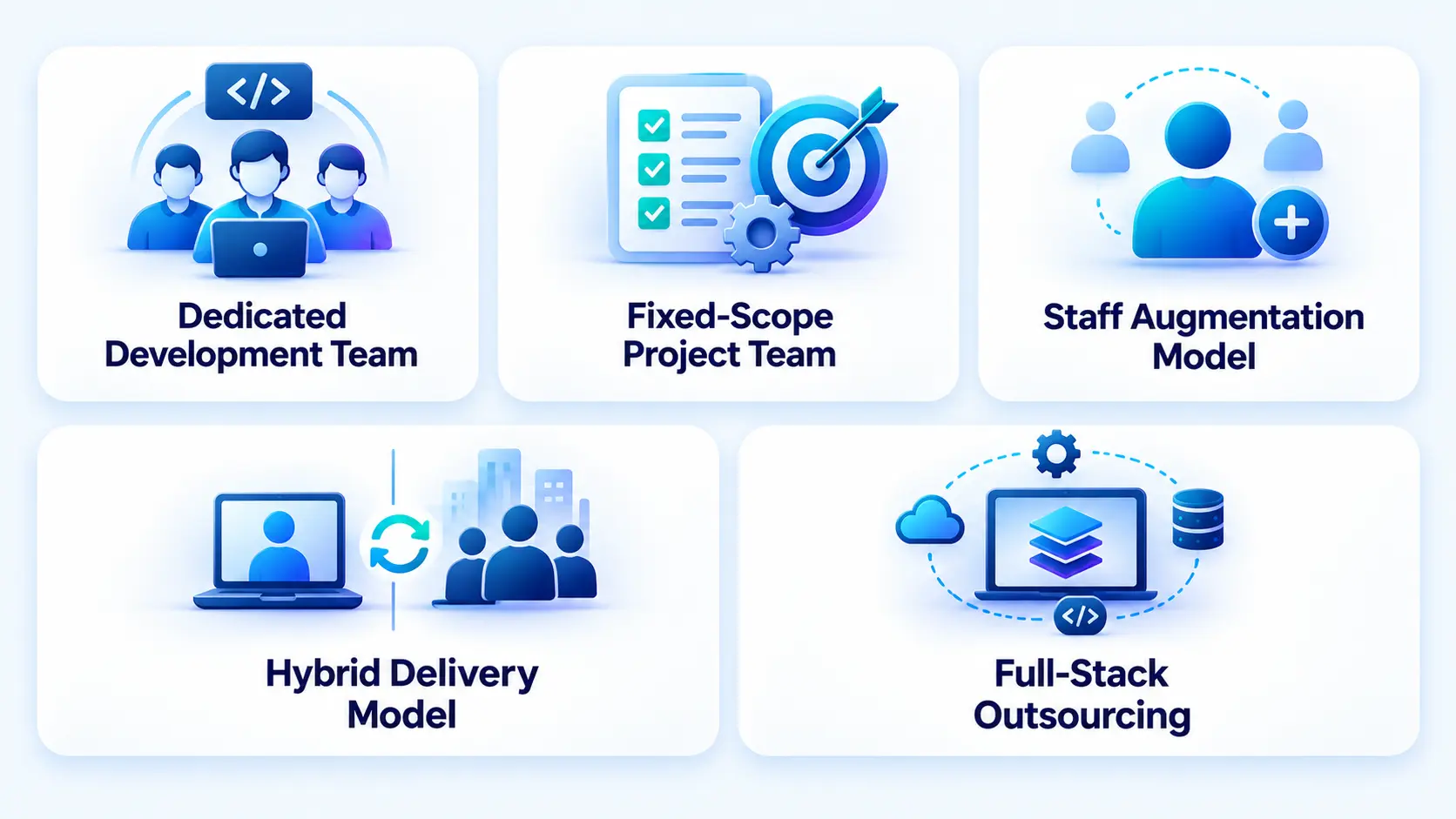
Team structure affects communication, delivery speed, accountability, and cost. Businesses should choose a model based on the amount of work, the complexity of the product, the level of internal technical leadership, and the duration of the engagement.
A small project may need only a few developers working with an internal product owner. A complex enterprise platform may require frontend and backend specialists, quality assurance, DevOps, UX design, and technical leadership.
The purpose of selecting a model is to provide sufficient expertise without creating unnecessary coordination overhead.
1. Dedicated Development Team
A dedicated team works on the client’s product for an agreed period. The team may include developers, testers, designers, and technical leads, depending on the scope. This model is useful when a business has a continuing roadmap, expects regular feature releases, or needs an external team to work closely with internal product stakeholders. It can also help maintain continuity because team members become familiar with the application’s architecture and business requirements.
The client generally retains responsibility for product priorities and business decisions, while the provider manages the agreed technical resources and delivery responsibilities. Contracts should define how capacity, replacement, reporting, and changes to team composition are handled. Businesses that need ongoing development support can hire a dedicated app developer to build and improve their products while maintaining continuity across development cycles.
2. Fixed-Scope Project Team
A fixed-scope team is organized around a defined set of deliverables. The provider estimates the work, proposes a delivery schedule, and agrees on the price and acceptance conditions.
This model can work well when requirements are sufficiently stable and the expected outcomes can be documented before implementation. It may suit a company building a defined business portal, a specific customer-facing application, or a contained integration project.
The main limitation is reduced flexibility when requirements change. Significant additions may require a revised estimate, new timeline, or formal change request. Businesses should avoid treating an early, incomplete specification as a reliable basis for a fixed price.
3. Staff Augmentation
Staff augmentation adds external specialists to an existing internal team. The organization continues to direct the broader project, while the external professionals contribute specific skills or capacity.
This approach can be suitable when internal engineering leadership is already in place but the company needs additional frontend developers, backend engineers, testers, or cloud specialists.
The arrangement can offer more direct integration with internal processes than a fully managed project. However, the client must be prepared to handle onboarding, task allocation, code reviews, and day-to-day coordination.
4. Hybrid Delivery Model
A hybrid model combines internal employees with an external team. Internal staff may retain product ownership, architecture decisions, or oversight of sensitive systems, while the provider handles defined implementation work.
This can be useful for organizations that want to preserve core technical knowledge while accessing additional development capacity. It may also allow internal engineers to review important decisions without becoming responsible for every implementation task.
The model needs clear ownership boundaries. If both teams assume the other is responsible for testing, deployment, or documentation, important work can be missed.
5. Full-Stack Development Outsourcing
Full-stack development outsourcing brings together the capabilities required to build both the user-facing and server-side parts of a web application. Depending on the project, the team may also cover database design, API development, testing, and deployment coordination.
This approach can simplify collaboration because related technical responsibilities are managed within one delivery arrangement. It can be particularly useful for products that need coordinated changes across frontend interfaces, backend services, and data models.
However, the label “full-stack” should not be treated as proof that every specialist capability is included. Businesses should confirm whether the proposed team covers UX design, automated testing, cloud infrastructure, security reviews, and ongoing support or whether these are separate services.
Choosing the Right Technology Stack
Technology decisions influence development cost, hiring requirements, scalability, maintainability, and the availability of future developers. A vendor should recommend an ideal technology stack based on the product’s needs rather than choosing technologies solely because they are familiar to its team.
The evaluation should consider the expected user load, complexity of business logic, integration requirements, hosting environment, security obligations, and the skills available for long-term maintenance.
Frontend Technologies
Frontend technologies shape the user interface and the way people interact with the application. The choice depends on interface complexity, performance needs, accessibility, browser support, and the team’s existing capabilities.
React, Angular, and Vue are commonly considered for interactive web applications. Simpler projects may require a lighter approach, while large applications with extensive state management and reusable interface components may benefit from a more structured framework.
The technology should support maintainable components, predictable updates, and reliable testing. Businesses should also ask how the team will handle responsive layouts, accessibility, browser compatibility, and frontend performance.
Backend Technologies
Backend systems manage business logic, authentication, data access, integrations, and application services. Their design affects performance, security, reliability, and the ability to introduce new features.
Node.js may be suitable for applications that benefit from JavaScript or TypeScript across the stack, especially when the system involves API-driven services and asynchronous operations. Other backend technologies may be more appropriate when existing systems, specialist libraries, or organizational standards require them.
When backend engineering is a significant part of the project, businesses can evaluate backend API development services to understand how API design and implementation can support application functionality.
Database and Infrastructure Decisions
Database selection should reflect data structure, transaction requirements, query patterns, consistency expectations, and anticipated growth. Relational databases can be appropriate for structured data and transactional workflows, while document databases may fit particular flexible data models.
Infrastructure decisions include hosting, storage, monitoring, backups, deployment automation, and disaster recovery. These elements should be planned alongside application development rather than postponed until launch.
The team should explain how environments will be separated, how credentials will be managed, how changes will be deployed, and how the system will recover from failures.
Comparing MEAN and MERN Architectures
The MEAN and MERN stacks use JavaScript-based technologies but differ in their frontend framework. MEAN combines MongoDB, Express, Angular, and Node.js, while MERN combines MongoDB, Express, React, and Node.js.
The choice should reflect the team’s experience, interface requirements, project structure, and maintenance expectations. Angular’s more opinionated framework may appeal to teams seeking an established application structure, while React offers a component-based approach with a broad ecosystem.
Before making a decision, compare how each stack handles routing, state management, testing, security, and long-term upgrades. The differences between MEAN vs. MERN can help businesses evaluate which stack better suits their application’s requirements. Rather than choosing based on popularity alone, prioritise maintainability, scalability, and compatibility with the product’s long-term goals.
Read Also: The Future of MERN Stack Development: Predictions and Trends
Architecture Planning Before Implementation
Architecture decisions shape how application components communicate, how data moves through the system, and how easily the product can evolve. A rushed approach can create tightly coupled components, complicate testing, and increase the cost of future changes as the application grows.
Before development begins, the team should define application boundaries, API contracts, authentication mechanisms, data ownership, caching strategies, background processing, and deployment requirements.
Understanding the principles of web application architecture can help businesses evaluate these decisions and establish a technical foundation that supports maintainability, scalability, and long-term product growth.
Keeping Up With Technology Changes
Frameworks and development tools evolve constantly, but adopting every new release is not always the right decision. Businesses should assess technologies based on stability, ecosystem support, security updates, compatibility, and the availability of experienced developers.
Learning and evaluating the latest full stack web development technologies can help decision-makers compare available options and identify suitable technologies to discuss with their engineering partner. Ultimately, technology selection should reflect the product’s functional requirements, scalability needs, and long-term maintenance goals rather than short-lived industry trends.
Web Development Outsourcing Pricing Models
The pricing model determines how costs are calculated, how changes are handled, and which party carries more financial uncertainty. Businesses should compare commercial structures alongside delivery responsibilities instead of choosing solely on the lowest initial quote.
The decision also depends on whether the product requires a tailored solution or can operate effectively using an existing subscription-based platform. Comparing a custom web app vs SaaS approach can help businesses understand how product ownership, customisation, recurring expenses, and long-term maintenance influence the overall investment.
1. Fixed-Price Model
A fixed-price agreement establishes a price for a defined scope of work. It can make budgeting easier when requirements, deliverables, and acceptance criteria are clear. The main risk is that a fixed price does not eliminate uncertainty. If the scope is incomplete or the parties interpret requirements differently, change requests and disputes may arise.
Before agreeing to this model, the document included functionality, exclusions, assumptions, dependencies, testing responsibilities, and the process for approving additional work.
2. Time-and-Materials Model
Under a time-and-materials agreement, the client pays for the time used by the development team and any agreed additional expenses. This model can support evolving requirements because priorities may be adjusted as the project progresses.
It is often appropriate when a product is being developed iteratively, when technical discovery is still underway, or when feedback is expected to change the roadmap. Cost control requires visibility into time reporting, completed work, upcoming tasks, and remaining budget. Regular reviews help prevent spending from drifting away from business priorities.
3. Dedicated Team Pricing
A dedicated team arrangement generally charges for an agreed team composition and engagement period. Pricing may depend on role, experience, location, workload, and contract duration.
This model can make monthly expenditure easier to plan, especially when the team works on a continuing product roadmap. However, businesses should understand whether the fee includes project management, quality assurance, design, infrastructure, and other supporting roles. The contract should also explain how additional capacity, replacement resources, holidays, and changes to the team affect the monthly cost.
4. Milestone-Based Payments
Milestone-based pricing divides payments according to agreed delivery stages. A project might include discovery, design approval, initial implementation, testing, and launch preparation as separate milestones.
This approach can improve financial visibility because payment is linked to defined progress. It is important to specify what evidence is required to approve each milestone and how defects or incomplete work will be handled. A milestone structure can be combined with other pricing models when the scope and delivery arrangement support it.
How to Compare Pricing Models
| Factor | Fixed Price | Time and Materials | Dedicated Team | Milestone-Based |
| Best suited to | Clearly defined scope | Evolving requirements | Ongoing development | Projects with defined delivery stages |
| Budget visibility | High with stable scope | Depends on tracking and limits | Predictable monthly costs | Linked to milestone payments |
| Flexibility | Limited without change requests | High | High within team capacity | Depends on milestone terms |
| Client involvement | Reviews and approvals | Frequent prioritisation | Ongoing product direction | Milestone reviews and approvals |
| Main concern | Scope disputes | Budget overruns | Underused team capacity | Delayed milestones or acceptance disputes |
Before choosing a pricing model, review the payment terms, deliverables, included services, exclusions, and approval conditions. Comparing these details across fixed-price, time-and-materials, dedicated team, and milestone-based agreements helps businesses assess the true cost and choose the right engagement structure.

Estimating the Cost of an Outsourced Web Project
The cost of outsourcing web development depends on factors such as project scope, technical complexity, team composition, delivery timelines, and ongoing support requirements. A simple business website may require a much smaller investment than a multi-tenant enterprise application with complex integrations and advanced functionality.
To estimate the budget accurately, businesses should break down the work by development phase and team role instead of relying on a single vendor quote. Understanding the key factors that influence website development cost can help businesses identify potential expenses, compare estimates, and plan their development budgets more realistically.
Discovery and Planning Costs
Discovery may include stakeholder interviews, requirements analysis, user research, technical feasibility assessments, architecture planning, and project estimation. This stage helps identify assumptions before implementation begins. It can also expose dependencies such as third-party APIs, legacy data, compliance requirements, or complex user permissions.
Skipping discovery may reduce the initial quote but increase the likelihood of scope changes later. Businesses should assess whether the provider has included sufficient time to understand the product before committing to a delivery schedule.
UX and UI Design Costs
Design costs depend on the number of screens, complexity of user journeys, research needs, prototyping requirements, and number of review cycles. A product with multiple user roles, dashboards, forms, and administrative workflows may need more design work than a simple informational website. Design also needs to account for responsive behavior, accessibility, and consistency across the application.
The proposal should specify whether user research, wireframes, visual design, prototypes, design systems, and developer handoff are included.
Development Costs
Development usually represents a major portion of the project budget. Costs depend on the number of features, complexity of business logic, integration requirements, data processing, and the experience of the team.
A basic application with standard authentication and limited workflows will generally require less effort than a platform with custom permissions, complex reporting, multiple integrations, and advanced automation. Estimates should be broken down by feature or workstream. A single total without supporting assumptions makes it difficult to identify the causes of cost differences between vendors.
Testing and Quality Assurance Costs
Testing helps confirm that the application meets functional, performance, security, and usability expectations. It may include manual testing, automated regression tests, integration testing, cross-browser checks, and user acceptance testing.
The level of testing should reflect the product’s risk profile. Applications that process sensitive data or support business-critical operations may require more extensive verification than low-risk internal tools. Businesses should confirm who writes test cases, who manages defects, how fixes are verified, and what testing evidence will be supplied before launch.
Infrastructure and Third-Party Expenses
Cloud hosting, databases, monitoring tools, email services, payment gateways, analytics platforms, and other third-party services may create costs beyond the development contract. These expenses may increase as traffic, data storage, or usage grows. The business should identify which costs are included in the vendor proposal and which will be billed directly to the client.
Ownership of cloud accounts and third-party subscriptions should be clearly defined. Keeping critical accounts under the business’s control can improve visibility and reduce dependency on a single provider.
Maintenance and Support Costs
The budget should include post-launch activities such as defect resolution, dependency updates, security patches, performance monitoring, backup verification, and compatibility improvements. Maintenance requirements depend on the application’s complexity, availability expectations, user volume, and regulatory obligations. A product with frequent releases may need continuing engineering capacity, while a smaller application may require a limited support arrangement.
Ask the provider to separate warranty-related defect correction from ongoing maintenance and new feature development. These activities have different purposes and may be priced differently.
How Much Does it Cost to Outsource Web Development?
The cost of outsourcing web development typically ranges from $3,000 to $10,000 for a simple business website to $50,000 or more for a complex enterprise application. The final investment depends on the product’s functionality, integrations, design requirements, team composition, and development location.
For example, a basic website with a few pages requires less development effort than a custom web application with user accounts, payment processing, dashboards, and third-party integrations. A practical estimate should begin with a feature list, an expected team composition, and a delivery schedule. Each workstream can then be estimated according to the number of people involved, their expected allocation, and the duration of the work.
Businesses should also account for discovery, design, testing, infrastructure, project management, and post-launch support. These expenses can increase the overall investment beyond the initial development quote.
Estimated Web Development Outsourcing Costs by Project Type
The following ranges provide an initial budgeting reference for businesses considering offshore development. Actual proposals may fall outside these estimates depending on project requirements and the vendor’s pricing structure.
| Project type | Estimated outsourcing cost (USD) |
| Simple business website | $3,000–$10,000 |
| E-commerce website | $8,000–$40,000 |
| Custom web application | $20,000–$80,000 |
| SaaS platform MVP | $15,000–$50,000 |
| Enterprise web application | $50,000–$200,000+ |
Full-Stack Developer Cost
Full-stack developer cost varies according to experience, technical specialisation, location, engagement duration, and whether the arrangement involves direct hiring, contracting, or a managed outsourcing service.
For initial budgeting, offshore full-stack development rates may fall around $25–$65 per hour, while US-based developers and agencies can charge approximately $80–$150 or more per hour. Specialised expertise and seniority can push rates higher.
A developer’s hourly or monthly rate is only one part of the overall budget. Businesses should also consider onboarding time, management overhead, testing support, infrastructure, and the amount of work the developer can complete within the expected timeline. For team-based projects, compare the total cost of the proposed delivery arrangement rather than treating the lowest individual rate as the best value.
Offshore Web Development Team Cost
Offshore web development team costs depend on team size, seniority, location, working-hour overlap, project complexity, and the services included in the contract. In 2026, indicative hourly rates for offshore development range from approximately $20–$50 in India to $30–$80 in Eastern Europe, while US-based development services can cost $80–$150 or more per hour. These ranges vary by provider and technical requirements.
A lower hourly rate does not automatically result in a lower total cost. Communication delays, unclear requirements, poor documentation, rework, and inadequate testing can increase the overall effort required to complete a project. When comparing offshore proposals, review the team’s relevant experience, delivery process, communication arrangements, quality controls, and contract terms alongside the quoted price.
A Practical Cost Estimation Method
Businesses can use a simple estimation approach to build an initial budget.
- Break the project into features and delivery phases.
- Estimate the effort required for each workstream.
- Assign the relevant roles and expected allocation.
- Multiply estimated effort by the agreed rates.
- Add design, testing, infrastructure, and project management expenses.
- Include maintenance and support costs after launch.
- Set aside a contingency for uncertainties that have not yet been resolved.
The contingency should reflect actual project uncertainty rather than compensate for an incomplete scope. High-risk integrations or unclear legacy systems may require further discovery before a meaningful estimate can be produced.
Understanding the Full Cost Beyond Development
A responsible budget includes the cost of building, launching, operating, and improving the application. Development fees may be the largest visible expense, but they do not represent the entire product lifecycle. Businesses should consider the following cost categories when preparing their budgets.
| Cost category | Typical budgeting consideration |
| Planning | Discovery, requirements, feasibility, and architecture |
| Design | Research, wireframes, interface design, and prototypes |
| Engineering | Frontend, backend, database, and integrations |
| Quality assurance | Functional, integration, regression, and performance testing |
| Infrastructure | Hosting, storage, monitoring, and backup services |
| Security | Reviews, testing, access controls, and remediation |
| Launch | Deployment, data migration, training, and release preparation |
| Maintenance | Patches, upgrades, defect fixes, and operational support |
These categories do not have universal standalone price ranges because their costs depend on the project scope, technology stack, and delivery model. Businesses should request a breakdown of estimated hours or fees for each relevant workstream rather than applying a generic percentage to every project.
The final budget should also identify recurring subscriptions, usage-based services, and contract renewals. This helps leadership distinguish one-time development expenditure from ongoing operating costs and estimate the total investment required to maintain the product after launch.
Planning for Application Features and Complexity
Feature complexity directly affects development estimates. Two applications with a similar number of screens can require very different levels of engineering effort depending on their business logic, integrations, user permissions, and data requirements. Defining the required functionality early helps businesses establish a realistic project scope, estimate development effort, and plan delivery milestones. Reviewing the web application features checklist can help identify essential capabilities and potential requirements before development begins.
Common complexity drivers include multi-role access, payment workflows, real-time updates, reporting, search, file processing, external API dependencies, and complex administrative tools. Each should be assessed for functional requirements, error handling, security, and testing. A prioritized feature list can also help separate launch-critical functionality from enhancements that can be introduced after the first release.
How to Choose a Web Development Outsourcing Company
Selecting a vendor requires a structured evaluation of technical capabilities, delivery practices, communication, commercial terms, and long-term support. A polished proposal is not enough to demonstrate that a provider can deliver the required product.
Businesses should compare potential partners using the same evaluation criteria. This reduces the risk of choosing a vendor based on price or presentation quality without adequately examining delivery capability.
Evaluate Relevant Technical Experience
Review whether the vendor has worked on products with similar workflows, integrations, technical constraints, and operational requirements. Experience in the same industry can be useful, but the most important factor is whether the provider understands the specific engineering challenges involved.
Ask the team to explain how it approached a comparable problem, what trade-offs it considered, and how it validated the final solution. Where possible, review working products, code samples, architecture documentation, or detailed project references. Do not rely solely on a list of technologies. A vendor may claim expertise in a framework without demonstrating that it can use it to build maintainable, secure applications.
Assess the Proposed Team
Ask who will work on the project, what responsibilities each person will handle, and how much time they will dedicate to delivery. Confirm whether the proposed specialists will remain involved throughout the engagement or may be replaced after the contract is signed.
The proposal should clearly define the roles of the project lead, technical decision-makers, developers, testers, and supporting specialists. It should also outline how the provider will handle staff absences, resource changes, and knowledge transfer to maintain continuity. When evaluating remote teams, understanding the considerations involved in hiring offshore development teams can help businesses assess team coordination, communication practices, and resource management across locations.
Review the Delivery Process
A reliable vendor should be able to explain how requirements are translated into tasks, how progress is reviewed, how code is tested, and how releases are approved.
Ask about sprint planning, code reviews, version control, automated testing, defect tracking, documentation, and deployment procedures. The goal is not to require every vendor to use identical tools but to confirm that its process supports visibility and quality. Request a sample project plan or delivery report if available. A clear process helps stakeholders understand what is happening, what remains incomplete, and which decisions require their attention.
Check Communication and Reporting
Communication affects every stage of an outsourced project. Stakeholders need a reliable way to raise questions, review progress, approve changes, and resolve blockers. Agree on communication channels, meeting frequency, reporting formats, response expectations, and escalation paths before work begins. Teams working across time zones should establish a practical overlap window for discussions that require real-time decisions.
Progress reporting should focus on completed deliverables, upcoming work, unresolved issues, budget status, and decisions needed from the client. Activity reports alone do not demonstrate that the project is moving toward its intended outcome.
Verify References and Commercial Terms
Speak with previous clients when possible. Ask about delivery reliability, communication, quality, responsiveness to change, and the provider’s behavior when problems occurred. The contract should define the scope, payment terms, intellectual property ownership, confidentiality, data handling, warranties, change requests, termination rights, and dispute resolution.
Businesses should also confirm how source code, credentials, technical documentation, and deployment access will be transferred. These details are essential to maintaining continuity if the relationship ends.
Questions to Ask Before Signing a Contract
A vendor evaluation should include practical questions that reveal how the team will work after the agreement is signed.
- Which roles will be assigned to the project, and what experience do they have?
- What assumptions have been used to estimate the effort and delivery timeline?
- Which services are included in the quote, and which will cost extra?
- How will the team handle changing requirements and scope disputes?
- What testing and code review practices will be followed?
- Who owns the source code, design files, documentation, and deployment accounts?
- How will security incidents, defects, and production issues be handled?
- What happens if a key team member leaves the project?
- What support is available after launch?
- How can the client transition to another team if the engagement ends?
The answers should be documented rather than left as informal assurances. Written agreements help both parties understand their responsibilities and provide a reference when delivery expectations need to be reviewed.
Risks of Outsourcing Software Development
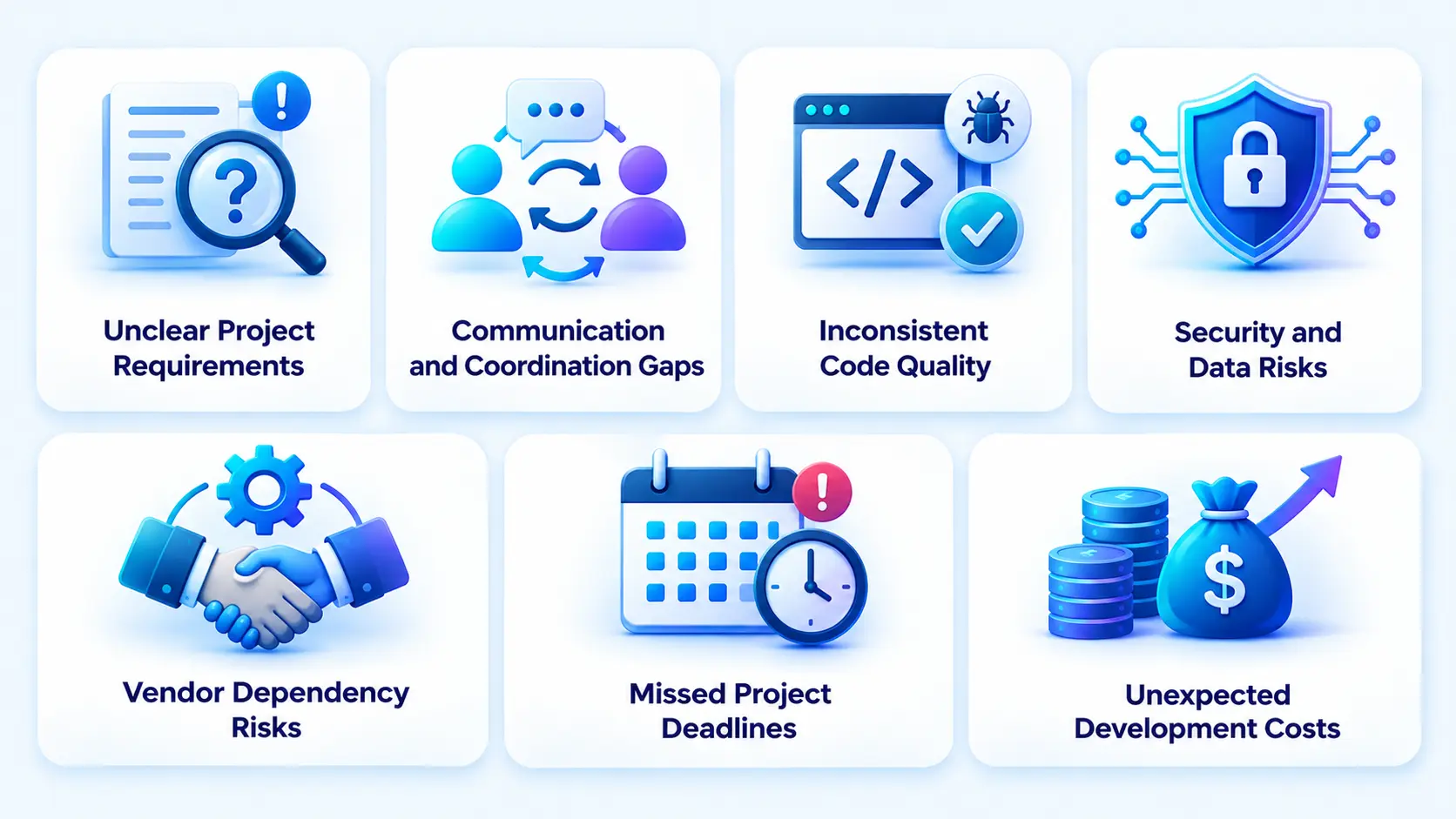
The risks of outsourcing software development often arise from unclear expectations, weak governance, limited visibility, or insufficient contractual protection. These risks can be managed, but they should be considered before selecting a provider.
Unclear Requirements and Scope Creep
A project can exceed its budget when requirements are incomplete or stakeholders introduce new functionality without evaluating its impact. The solution is to establish a baseline scope, document acceptance criteria, and use a formal change-control process. Every significant change should be assessed for cost, timeline, dependencies, and business value before it is approved.
This process should not prevent useful improvements. It should make the trade-offs visible so that stakeholders can decide whether a new requirement is worth the additional investment.
Communication Gaps
Misunderstandings can occur when teams work across time zones, use different terminology, or lack access to the same project information. To reduce this risk, maintain shared documentation, use a common task-tracking system, and establish regular review meetings. Important decisions should be recorded so that developers do not rely on informal conversations that may be forgotten or interpreted differently.
Businesses should also nominate a product decision-maker who can resolve questions without unnecessary delays.
Inconsistent Code Quality
Code that works for an initial demonstration may still be difficult to maintain, test, or extend. Shortcuts in architecture, documentation, or automated testing can create technical debt that becomes expensive after launch.
Agree on coding standards, review practices, testing expectations, and documentation requirements. Code should be stored in a repository that the client can access, with changes reviewed through an agreed process. Periodic technical reviews can help identify maintainability concerns before they affect delivery or operational stability.
Security and Data Protection Risks
External teams may need access to source code, customer information, development environments, or production systems. Inadequate access controls can expose sensitive data or create opportunities for unauthorized changes. Use least-privilege access, multi-factor authentication, secure credential management, and separate development and production environments. Avoid sharing real customer data in test environments unless the access and processing arrangements have been reviewed and approved.
The contract should define confidentiality obligations, incident reporting, data handling responsibilities, and any applicable regulatory requirements. Security should be treated as a continuing engineering responsibility rather than a final-stage checklist.
Vendor Dependency
A business may become dependent on a provider when it lacks access to source code, deployment credentials, technical documentation, or sufficient knowledge of the application.
To avoid this, maintain ownership or contractual access to critical assets, require documentation for important decisions, and ensure that deployment procedures are understood. Knowledge transfer should happen throughout the project instead of being postponed until the relationship ends. A transition plan should explain how the client can move the application to another team or internal engineering function if necessary.
Missed Deadlines
Delivery delays may result from inaccurate estimates, unresolved dependencies, changing requirements, unavailable stakeholders, or insufficient testing. A realistic project plan should include review periods, integration work, defect resolution, and launch preparation. Progress should be assessed against completed deliverables rather than optimistic status updates.
When a milestone is at risk, the team should explain the cause, likely impact, and available options. This allows decision-makers to adjust scope or resources before a delay becomes a larger business problem.
Hidden or Unexpected Costs
A proposal may exclude infrastructure, third-party services, additional testing, or post-launch support. These exclusions can make the initial price appear more competitive than the final cost.
Require a written breakdown of included services, assumptions, exclusions, and recurring expenses. Establish how additional work will be estimated and approved. A clear commercial model helps the business compare vendors on total expected expenditure instead of headline rates alone.
Read Also: Custom Software Development in 2026: A Founder’s Guide to Building Scalable Digital Products
Working With a Node.js Development Partner
When a product uses Node.js for its backend, businesses should evaluate the provider’s experience with API design, asynchronous processing, authentication, database access, performance monitoring, and dependency management.
The team should be able to explain how it will structure the application, handle errors, validate inputs, manage configuration, and protect sensitive information. It should also describe its approach to testing and deployment.
A provider’s familiarity with the technology is important, but maintainability and operational readiness matter just as much. The codebase should be understandable to future developers and supported by appropriate documentation. Businesses can assess a Node.js development company when comparing providers for backend-heavy or API-driven applications.
Managing Application Challenges During Delivery
Even a well-planned project can encounter technical issues during delivery. Third-party APIs may behave unexpectedly, performance may decline under realistic traffic, and existing systems may contain undocumented dependencies that complicate integration. Identifying these risks early gives the team time to explore alternatives before they affect key milestones. Regular technical reviews, automated testing, staged integrations, and realistic test data can help uncover problems before they become more difficult to resolve.
Understanding common web application development challenges helps teams anticipate potential roadblocks and prepare practical responses during the development process. When an issue arises, the team should document its root cause, business impact, possible solutions, and any decisions required from stakeholders. This keeps communication transparent, supports faster resolution, and prevents uncertainty from building up as the project progresses.
Planning for Startups and Growing Businesses
RipenApps helps startups and growing businesses plan and build digital products that align with their current budgets, business goals, and evolving requirements. By identifying essential features, selecting a suitable technical approach, and structuring development around immediate priorities, businesses can validate ideas efficiently while building a foundation for future growth.
Startups often need to validate a product idea while managing limited budgets and changing requirements. A large engineering team may be unnecessary during the earliest stage, particularly when the product’s core workflows have not yet been tested with users.
A focused team can build the essential functionality, collect feedback, and help the business identify which features deserve further investment. As demand grows, the team structure can evolve to support more users, integrations, security requirements, and operational complexity.
For a startup-specific perspective, full stack development for startups explores how a full-stack approach can support early product development. The key is to choose a delivery arrangement that matches the current stage of the business while leaving room for future technical and organizational needs.
Choosing a Web Application Development Partner
A web application development partner should understand the technical requirements and the business outcomes the product needs to deliver. This includes user workflows, system integrations, data management, and the support required after launch.
Look for a provider that can explain its technical decisions, document trade-offs, and identify risks before they affect the budget or timeline. A reliable partner should also communicate constraints, exclusions, and uncertainties clearly instead of making unrealistic delivery promises.
A structured outsourcing process helps businesses define requirements before committing their budget. It also makes vendor proposals easier to compare by evaluating each provider against the same scope, technical expectations, milestones, and acceptance criteria.
For products that include artificial intelligence, businesses should also assess model integration, data governance, security, and ongoing monitoring. The considerations involved in how to choose an AI development partner for your mobile or web product can help decision-makers evaluate specialist expertise and determine whether a provider can support their AI requirements effectively.
Build a Long-Term Maintenance Plan
Launching the application is not the end of the delivery process. Software needs ongoing attention as dependencies change, security vulnerabilities emerge, user expectations evolve, and new business requirements are introduced.
Before signing the development agreement, define the support period, defect-resolution process, response expectations, maintenance responsibilities, and pricing for future enhancements. Confirm whether the same team will remain available after launch or whether a separate support arrangement is required.
Documentation should cover system architecture, deployment steps, environment configuration, integrations, backup procedures, and important operational decisions. This helps future engineers understand the application without depending entirely on the original developers.
A long-term plan also helps leadership distinguish between essential maintenance and discretionary improvements. This makes it easier to forecast operating costs and prioritize work after launch.
A Practical Checklist Before Outsourcing
Before committing to a vendor, RipenApps can help you evaluate your project requirements, define the technical approach, establish clear engagement terms, and plan for quality, security, and long-term scalability. Reviewing the following points will help you confirm that your chosen development partner is aligned with your business goals and that the engagement is ready to begin.
- Product scope: Core workflows, user roles, requirements, and exclusions are documented.
- Technical direction: The proposed stack, architecture, integrations, and infrastructure have been reviewed.
- Team structure: Roles, responsibilities, availability, and reporting arrangements are clear.
- Pricing: Rates, milestones, payment terms, exclusions, and recurring expenses are documented.
- Quality assurance: Testing responsibilities, code reviews, defect handling, and acceptance criteria are agreed.
- Security: Access controls, data handling, incident reporting, and security responsibilities are defined.
- Ownership: Source code, documentation, design assets, and account access are addressed contractually.
- Governance: Decision-makers, reporting schedules, escalation paths, and change-control procedures are established.
- Launch readiness: Deployment, data migration, backups, rollback procedures, and support are planned.
- Exit planning: Knowledge transfer, asset handover, and transition assistance are included in the agreement.
This checklist should be adapted to the project’s size, risk level, and operating environment. A regulated product or business-critical platform may require more detailed controls than a small internal application.

Conclusion
Outsourcing web development can help businesses access technical expertise, adjust team capacity, and deliver digital products without recruiting every specialist internally. However, the outcome depends on more than selecting a provider or negotiating a competitive rate.
Successful planning begins with a clear scope, realistic cost estimates, an appropriate team structure, and a technology strategy that supports long-term requirements. Businesses must also evaluate communication, delivery practices, security controls, contractual ownership, and the provider’s ability to support the product after launch.
The most effective engagement is one in which both parties understand their responsibilities, risks are visible, and progress is measured against agreed deliverables. Partnering with a web app development company like RipenApps can help businesses access the technical expertise needed to manage complex requirements. With these foundations in place, businesses can make better outsourcing decisions and establish a development arrangement that supports both immediate delivery goals and future product growth.
FAQs
1. What does it mean to outsource web development?
It means engaging an external developer, team, or company to handle some or all of a website or web application’s design, engineering, testing, deployment, or maintenance. The business defines the requirements and agrees on the responsibilities, costs, and delivery arrangements with the provider.
2. How do I outsource web development successfully?
Start by defining the product scope, technical requirements, budget, and expected outcomes. Compare vendors based on relevant experience, team composition, delivery practices, communication, security, and contractual terms. Establish acceptance criteria, reporting processes, source code ownership, and a transition plan before development begins.
3. How much does it cost to outsource web development?
Outsourcing web development can cost around $3,000 for a basic website to $50,000 or more for a complex web application. The final cost depends on features, team location, developer rates, integrations, and project complexity. Businesses should also budget for design, testing, infrastructure, and ongoing maintenance.
4. Which outsourcing model is best for a web application?
A fixed-price model can suit projects with stable requirements, while time-and-materials arrangements support changing priorities. Dedicated teams can be appropriate for long-term development, and staff augmentation can help an existing engineering department fill specific skill gaps. The right choice depends on scope, uncertainty, and internal management capacity.
5. What are the main risks of outsourcing web development?
Common risks include unclear requirements, communication gaps, inconsistent code quality, security weaknesses, missed deadlines, unexpected costs, and vendor dependency. These can be reduced through clear contracts, structured project governance, code reviews, testing, controlled access, documentation, and an agreed exit strategy.
6. How can I evaluate a web development outsourcing vendor?
Review relevant project experience, technical expertise, team availability, delivery processes, testing practices, communication, client references, and support arrangements. Ask for a transparent estimate and clarify scope exclusions, ownership rights, security responsibilities, and change-request procedures before signing a contract.
7. Is offshore web development always cheaper?
No. Offshore rates may be lower, but total project cost also depends on productivity, communication, rework, management, quality assurance, and maintenance. Businesses should compare the expected cost of delivering and operating the complete product rather than selecting a provider solely on hourly rates.
8. How can I protect my source code when outsourcing?
Define intellectual property ownership in the contract, use a repository that the client can access, and document how code and other deliverables will be transferred. Control access to production systems and critical accounts, require appropriate documentation, and agree on knowledge transfer and exit procedures before work begins.
9. Should I outsource the entire project or only specific tasks?
Outsource the entire project when an external partner can manage the required delivery scope and your organization can provide clear product direction. Outsource specific tasks when internal teams already have the necessary leadership and need specialist skills or additional capacity. A hybrid model can combine internal oversight with external engineering resources.
10. What should an outsourcing contract include?
A contract should define scope, deliverables, timelines, payment terms, acceptance criteria, intellectual property rights, confidentiality, data security, change requests, warranties, support obligations, termination conditions, and transition assistance. These terms should reflect the project’s complexity and the responsibilities assigned to each party.
Discuss your project and request for proposal
SHARE
WRITTEN BY

Ishan Gupta
CEO & Founder
Ishan Gupta is a seasoned entrepreneur and CEO with extensive 10+ years of experience in business and mobile app development landscape. He believes that the right digital product allows companies to focus on what they do best, while technology handles the rest. With deep exposure to global markets, he understands what makes an app succeed. His approach translates business needs into clear product strategies, ensuring that every feature contributes to measurable ROI.
View All Articles