

Key Takeaways
- AI fitness app development can cost $30,000–$200,000+, based on AI complexity, integrations, platforms, and compliance.
- AI adds value through personalization, including adaptive workouts, AI coaching, nutrition guidance, and smart nudges.
- Retention should drive AI strategy, with features selected around specific user engagement problems.
- The AI stack affects cost and scalability, from LLMs and computer vision to wearables and on-device processing.
- Start with a focused MVP and expand advanced capabilities using real user data.
- Build privacy and compliance into the architecture when handling health, biometric, or wearable data.
AI fitness app development combines artificial intelligence, personalized coaching, activity data, and connected health technologies to create fitness experiences that adapt to individual users. Unlike static workout apps, AI-powered products can analyze permitted user data, adjust recommendations, provide contextual coaching, and respond to changing goals or behavior.
For founders, product heads, and CTOs, the opportunity is not simply to add an AI chatbot. It is to build a fitness product where AI improves the experience users return for, while the underlying architecture remains scalable, secure, and commercially viable.
The right approach starts with the business problem, not the technology. Businesses need to identify the users they want to retain, the behaviors they want to influence, the data available for personalization, and the AI capabilities that can create measurable product value. From there, teams can prioritize an MVP, choose the right AI architecture and AI app development services, and expand capabilities as real-world usage data becomes available.
Table of Contents
What Is an AI Fitness App?
An AI fitness app uses artificial intelligence to personalize workouts, coaching, recommendations, feedback, or health-related experiences based on permitted user data. It can combine app activity, workout history, wearable signals, user goals, and other inputs to create a more adaptive experience than a conventional fitness app.
| Capability | Standard Fitness App | AI Fitness App |
| Personalization | Predefined plans and user-selected goals | Plans and recommendations adapt to user behavior and available data |
| Feedback | Static instructions, metrics, and reminders | Contextual coaching, adaptive recommendations, and AI-generated feedback |
| Data inputs | User-entered information and basic activity data | App activity, sensors, wearables, health platforms, and other permitted inputs |
| Retention behavior | Relies mainly on content, reminders, and routines | Uses personalization, coaching, adaptive experiences, and behavioral signals to encourage continued use |
The distinction is important because AI should change how the product responds to users. Simply adding an LLM or recommendation API does not make a fitness product meaningfully intelligent.
A strong AI fitness app connects data to an action, such as adjusting a workout, explaining why a recommendation changed, providing form feedback, or suggesting a different activity based on available context.
Why Retention Is the Business Case for AI in Fitness
Fitness apps have a retention problem. A JMIR review found that nearly 69% of mobile health app users abandoned an app within 90 days, making retention a critical product and revenue consideration.
For a fitness business, this is more than an engagement problem. When users stop returning, subscription renewals, lifetime value, referrals, and opportunities to upsell premium features can decline. AI can address part of this challenge by making the product more responsive to individual behavior.
Instead of presenting the same workout plan every week, an AI system can consider recent activity, completed sessions, user goals, preferences, and available recovery signals before generating or selecting the next recommendation.
The business case becomes stronger when AI is tied to measurable product outcomes:
- Adaptive experiences: Recommendations can change as users progress or their goals change.
- Contextual coaching: Users can interact with the product instead of navigating only predefined content.
- Better use of connected data: Wearable and health-platform signals can become inputs for recommendations instead of isolated metrics.
- Product differentiation: AI can make the experience more responsive than a static workout library.
- Recurring value: Advanced coaching, personalization, analytics, and connected-data capabilities can support premium subscriptions.
AI does not automatically improve retention. A product still needs useful workouts, reliable recommendations, a clear user journey, and a reason for users to return. That is why the strongest AI fitness products treat personalization as a product strategy rather than a standalone technical feature.
Must-Have Features in an AI Fitness App
The right feature set depends on the target audience, business model, available data, and AI maturity required. The following ten features can be used as a scoping framework.
| Feature | Build effort | Typical tier |
| LLM-powered conversational AI coach | Advanced | Tier 2–3 |
| AI-powered adaptive workout planning | Advanced | Tier 2–3 |
| Real-time form correction | Specialist | Tier 3 |
| AR-based body scanning and posture tracking | Specialist | Tier 3 |
| Multi-wearable and health ecosystem integration | Advanced | Tier 2–3 |
| On-device AI processing | Specialist | Tier 3 |
| Predictive injury prevention | Specialist | Tier 3 |
| Gamification with social and community layers | Advanced | Tier 2 |
| AI-driven nutrition and metabolic coaching | Advanced–Specialist | Tier 2–3 |
| Smart push notifications and AI-powered nudges | Standard–Advanced | Tier 1–2 |
1. LLM-Powered Conversational AI Coach
An LLM-powered coach lets users interact with their fitness experience through natural language. They can ask questions, request modifications, understand recommendations, or receive guidance without navigating multiple screens.
The engineering challenge is not simply connecting an LLM API. The coaching layer needs context management, appropriate memory, retrieval, response validation, safety rules, and clear boundaries around health-related recommendations.
For example, the system could understand that a user completed a demanding workout recently and explain why a lower-intensity session is being recommended. This feature requires advanced build effort and typically falls within Tier 2–3, depending on its complexity and integrations.
2. AI-Powered Adaptive Workout Planning
Adaptive workout planning is a core use case in AI workout app development, changing recommendations according to user goals, completed sessions, performance, preferences, and other permitted inputs. Rather than assigning the same four-week plan to every user, the system can modify intensity, exercise selection, duration, or recovery recommendations based on new information
The product should establish clear rules around what AI can change and when predefined logic or professional-designed programming should override model-generated recommendations. This feature requires advanced build effort and typically falls within Tier 2–3.
3. Real-Time Form Correction Using Computer Vision
Computer vision can analyze camera input and estimate body position during supported exercises. The application can then provide feedback about movement patterns, positioning, or range of motion.
A production system requires more than a camera interface. Teams need to account for pose-estimation models, exercise-specific logic, camera angles, lighting, device performance, latency, and false positives.
The feature should therefore be introduced around clearly defined exercises and validated use cases rather than marketed as universal movement analysis. This feature requires specialist build effort and typically falls within Tier 3.
4. AR-Based Body Scanning and Posture Tracking
Camera-based body scanning and posture analysis can help users visualize movement or physical changes over time.
Businesses should define exactly what the system measures and how those measurements are communicated. Body analysis should not be presented as clinically accurate unless the product has appropriate validation and regulatory support.
The feature is most useful when it connects measurements to an actionable experience rather than functioning as a novelty. This feature requires specialist build effort and typically falls within Tier 3. AR can overlay posture guidance, movement cues, and body-alignment feedback directly within the user’s environment. For a broader look at AR applications in fitness, see our guide to the role of AR and VR in fitness training.
5. Multi-Wearable and Health Ecosystem Integration
Connected health data can provide additional context for AI-driven recommendations. Apple HealthKit allows authorized apps to access supported health and fitness data through permission-based APIs. (Source: Apple HealthKit documentation)
Depending on the product, businesses can also evaluate integrations with Garmin, Oura, CGM providers, and other supported ecosystems.
The objective should not be to collect the maximum amount of data. Each integration should support a defined product action, such as adjusting a workout, improving recovery guidance, or providing more relevant coaching. This feature requires advanced build effort and typically falls within Tier 2–3.
6. On-Device AI Processing
On-device inference runs selected AI workloads locally rather than sending every input to a remote server. This approach can be useful for latency-sensitive experiences such as movement analysis and can reduce the amount of sensitive information transmitted to backend systems.
However, local inference introduces its own engineering considerations, including model size, device capabilities, battery consumption, supported operating-system versions, and optimization requirements.
A hybrid architecture can therefore be more practical, with lightweight or latency-sensitive workloads handled on-device while heavier processing runs in the cloud. This feature requires specialist build effort and typically falls within Tier 3.
7. Predictive Injury Prevention
AI can analyze permitted movement, training history, workload, and recovery signals to identify patterns that may warrant attention. For consumer fitness products, these outputs should generally be positioned as risk signals or coaching prompts rather than medical diagnoses.
The value of this feature depends heavily on data quality, model validation, and appropriate safety boundaries. It should not be added simply because predictive analytics appears advanced. This feature requires specialist build effort and typically falls within Tier 3.
8. Gamification With Social and Community Layers
Streaks, challenges, achievements, leaderboards, group goals, and community interactions can give users additional reasons to return. AI can personalize challenges, recommend achievable goals, or identify appropriate moments for encouragement.
The strongest implementation connects gamification to the user’s goals instead of adding points and badges without a meaningful product purpose. This feature requires advanced build effort and typically falls within Tier 2. For businesses exploring the broader fitness product landscape, our fitness app development guide provides additional context on non-AI fitness application architecture and features.
9. AI-Driven Nutrition and Metabolic Coaching
AI-driven nutrition functionality can combine permitted user inputs, meal information, fitness activity, preferences, and connected health data to provide personalized guidance.
Products that integrate metabolic information or CGM data require additional considerations around data quality, privacy, integrations, and appropriate health claims. Businesses should also distinguish general wellness guidance from clinical nutrition or medical advice.
This feature requires advanced-to-specialist build effort and typically falls within Tier 2–3. For nutrition-focused product planning, teams can also reference our guide to creating a nutrition tracking app.
10. Smart Push Notifications and AI-Powered Nudges
AI-powered nudges can use permitted behavioral signals to determine when an intervention may be relevant. Instead of sending the same reminder to every user, the system can vary timing, messaging, and suggested actions according to individual behavior.
The objective should be useful intervention, not notification volume. Businesses should monitor whether each notification contributes to a meaningful action and give users appropriate control over communication preferences. This feature requires standard-to-advanced build effort and typically falls within Tier 1–2.
The AI Stack Behind a Fitness App
An AI fitness product is typically a combination of several technical layers:
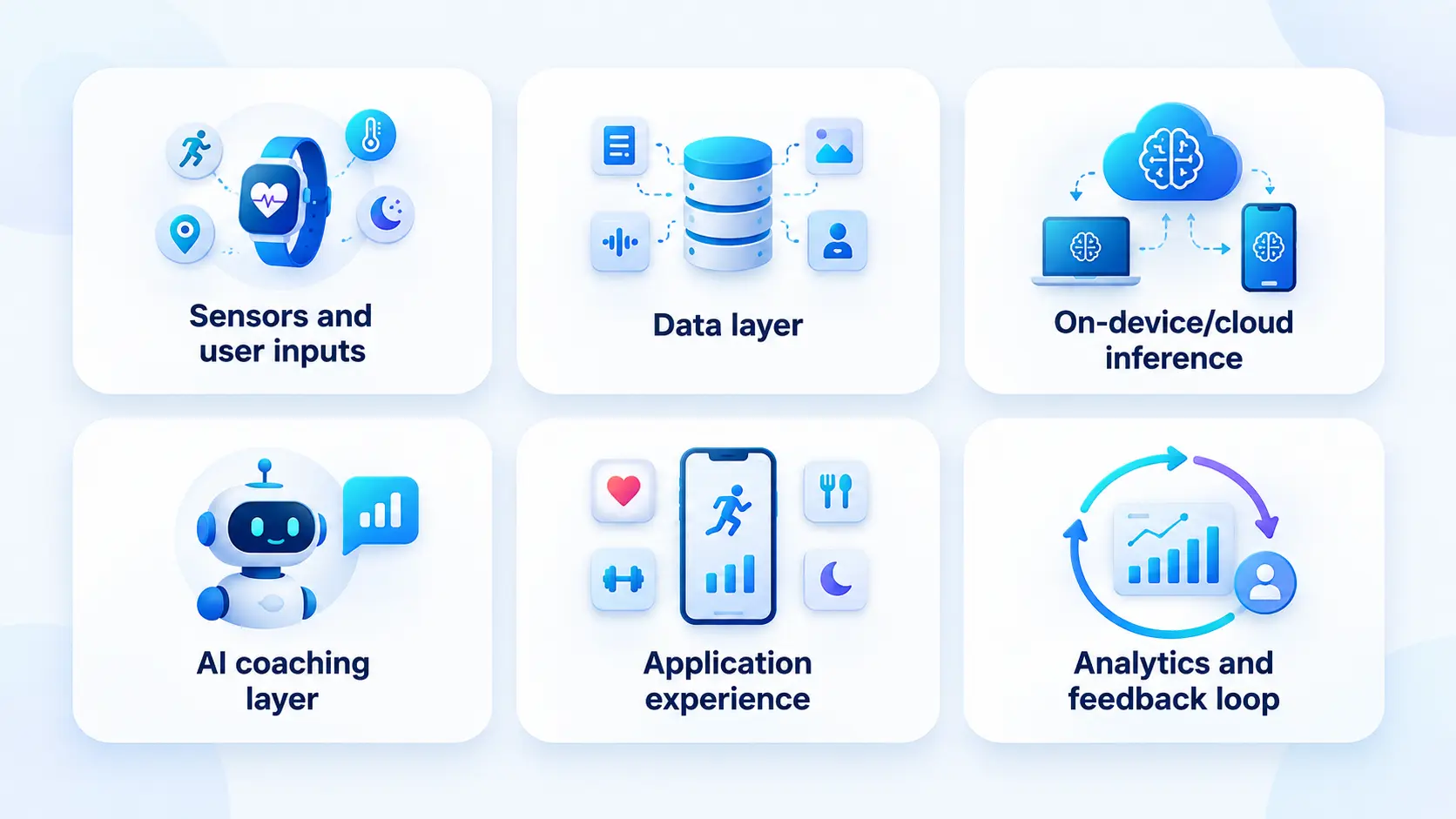
Sensors and user inputs – data layer – on-device/cloud inference – AI coaching layer – application experience – analytics and feedback loop
Pose estimation and computer vision for form correction
Computer vision can process camera frames to estimate body landmarks and movement. A fitness application then needs an interpretation layer that converts those signals into exercise-specific feedback.
For example, a supported exercise may involve detecting joint positions, calculating movement angles, comparing them against predefined patterns, and generating feedback through the app.
Production quality depends on testing across camera positions, lighting conditions, devices, body types, and exercise variations. The goal is not to claim that computer vision can perfectly judge every movement. The goal is to define where it can provide useful, measurable feedback and validate those scenarios.
The LLM coaching layer: model choice, context, memory, guardrails
The LLM layer can support conversational coaching, explanations, summaries, and personalized interactions.
Model selection should consider:
- Response quality
- Latency
- Context requirements
- Inference cost
- Privacy requirements
- Expected traffic
- Availability and vendor dependencies
The architecture should distinguish persistent user information from temporary conversation context. It should also establish guardrails for health-related questions, unsupported claims, sensitive information, and situations where users should seek qualified professional advice.
The right model is therefore not necessarily the largest. It is the model and architecture that provide the required experience at an acceptable cost and risk level.
On-device vs cloud inference and what each costs
On-device inference can reduce latency and limit the amount of sensitive data transmitted to backend infrastructure. It is particularly useful when real-time response is important. Cloud inference provides access to larger models and centralized processing but introduces infrastructure, API, latency, and data-transfer considerations.
A hybrid architecture is often practical. For example, movement analysis can run locally while a cloud service handles more complex conversational coaching. The decision should be based on workload, device requirements, privacy requirements, expected traffic, and operating costs.
Wearable and health-data integrations (HealthKit, Health Connect, Garmin, Oura, CGM APIs)
Health integrations can expand the information available to the coaching layer. HealthKit and Health Connect provide permission-based access to supported health and fitness information. Additional integrations can be evaluated for Garmin, Oura, CGM platforms, and other ecosystems based on API availability and commercial requirements.
The architecture should normalize incoming data before the AI layer consumes it. This prevents every model or feature from depending directly on a different third-party API. For businesses planning broader connected-device experiences, the wearable technology and healthcare guide provides additional context.
How to Build an AI Fitness App: A 6-Step Process
Building an AI fitness app should start with the retention problem rather than the feature list.
1. Discovery and retention modeling
Define the target user, business model, core journey, retention problem, and measurable outcomes.
Identify where users currently stop engaging and determine which behaviors indicate continued product value.
2. Data strategy and sensor plan
Map the data required for personalization. This can include user inputs, workout history, smartphone sensors, wearable data, HealthKit, Health Connect, connected equipment, or other permitted integrations.
At this stage, also define what data is collected, why it is required, where it is processed, and how long it is retained.
3. AI feature prioritization
Rank AI capabilities according to business value, feasibility, data availability, risk, and cost.
A conversational coach may be appropriate for an MVP, while computer vision, predictive analytics, or extensive wearable integrations may belong in later phases. This prevents the product from becoming an expensive collection of disconnected AI features.
4. MVP build
Build the core application, backend, data layer, analytics, and highest-priority AI capability.
The objective is to launch a usable product that can generate meaningful behavioral data rather than trying to deliver every advanced capability in the first release.
5. Model tuning on real user data
Evaluate AI outputs against real usage patterns, feedback, and defined quality metrics. Improve prompts, retrieval, models, rules, or recommendation logic as evidence accumulates.
AI quality should therefore be treated as an ongoing product responsibility rather than a one-time development milestone.
6. Launch and retention instrumentation
Track activation, workout completion, return frequency, subscription conversion, feature usage, and churn signals. The AI layer should continue evolving after launch based on measurable product behavior.
Businesses evaluating broader AI integration in mobile apps can use the same framework to prioritize AI capabilities according to business value instead of novelty.
AI Fitness App Development Cost
AI fitness app development can cost $30,000 to $200,000+, depending on AI feature depth, platform requirements, integrations, real-time processing, infrastructure, security, and compliance scope.
| Tier | Cost range | Typical scope | Delivery timeline | Best for |
| Tier 1: MVP | $30,000–$80,000 | Core fitness experience, profiles, workout library, activity tracking, basic AI recommendations, notifications | 3–5 months | Startups validating an AI fitness concept |
| Tier 2: Full-Featured | $80,000–$150,000 | AI coaching, adaptive plans, nutrition features, selected wearable integrations, analytics, gamification | 5–8 months | Growth-stage products |
| Tier 3: Enterprise-Grade | $150,000–$200,000+ | Advanced LLM coaching, computer vision, multiple health integrations, hybrid/on-device AI, complex backend and compliance requirements | 8–12+ months | Funded scaleups and enterprise products |
The main cost drivers are:
- AI feature depth: Recommendation logic generally requires less engineering than computer vision or advanced conversational AI.
- Real-time processing: Low-latency inference increases architecture and optimization requirements.
- Wearable count: Each integration introduces authentication, data mapping, testing, synchronization, and maintenance requirements.
- Inference architecture: On-device processing may require model optimization, while cloud inference adds infrastructure and usage costs.
- Compliance scope: Products handling regulated health information may require additional security, governance, auditability, and operational controls.
- Platform coverage: Supporting both iOS and Android increases development and testing requirements.
For a broader AI development cost framework, see our AI app development cost guide.
Data Privacy and Compliance for AI Fitness Apps
An AI fitness app is not automatically subject to HIPAA simply because it collects health-related information. HIPAA may apply when a product operates within the scope of covered entities or business associates and handles protected health information.
A consumer wellness application operating independently does not become HIPAA-regulated solely because it processes fitness or health data. However, consumer wellness data still requires appropriate privacy, security, consent, and data-management controls.
| Scope | Key considerations |
| Consumer wellness | Data minimization, consent, privacy disclosures, access controls, secure storage, retention policies, and platform requirements |
| Regulated health data | Applicable HIPAA/HITECH obligations, stronger access controls, auditability, security governance, and appropriate contractual arrangements |
Businesses serving users in different markets should also consider applicable privacy frameworks.
- GDPR: Applies depending on the organization’s processing activities and territorial scope.
- India’s DPDP Act: Establishes requirements concerning the processing of digital personal data in India.
- App Tracking Transparency: iOS apps must obtain appropriate permission for covered tracking across apps and websites owned by other companies. (Source: Apple User Privacy and Data Use)
- Health-platform permissions: HealthKit and Health Connect use permission-based access to supported health data.
On-device processing can also become a privacy and cost decision. Keeping selected biometric or movement processing on the device can reduce the amount of sensitive information transmitted to backend infrastructure, although it does not eliminate the need for a broader privacy and security framework. Where a product involves healthcare workflows or regulated health information, businesses can also review our healthcare app development capabilities.
Monetization Models for AI Fitness Apps
An AI-gated subscription is the clearest recurring monetization model when users receive ongoing value from personalized coaching, adaptive plans, and connected health features. A freemium structure can provide basic workouts and tracking while reserving advanced AI coaching, personalized plans, deeper analytics, or additional integrations for paying users.
B2B2C models can also work for corporate wellness providers, gyms, connected-equipment businesses, and other organizations that want to offer fitness experiences to members or employees. The important question is what users are paying for. AI should create a meaningful difference between free and premium experiences rather than simply placing a chatbot behind a paywall. For deeper strategy, see our guide to fitness app monetization models.
Why AI Fitness Apps Fail
AI fitness apps can fail even when the underlying technology works.
- The model never learns from real user behavior: Without evaluating outputs and user feedback, recommendations can become repetitive or irrelevant.
- Wearable data has no coaching action: Collecting health and activity data adds little value unless the app turns it into useful recommendations.
- Notification fatigue is mistaken for personalization: AI-generated reminders still need to be timely, relevant, and actionable.
- The AI cannot explain its recommendations: Users need to understand why their workout or recommendation changed to build trust.
- The product tries to solve everything at launch: Combining computer vision, LLM coaching, nutrition, wearables, and predictive analytics can make an MVP unnecessarily complex.
A focused first release creates a better opportunity to validate the core value proposition before adding specialist AI capabilities.
How We Build AI Into Health and Wellness Products
RipenApps applies its experience across health, wellness, and sports products to AI fitness solutions that require personalization, health-data workflows, multi-role experiences, and connected features. This includes capabilities relevant to AI-powered recommendations, user engagement, and scalable product architecture.
Our approach focuses on defining the AI use cases, data flows, integrations, and product architecture needed to deliver a practical fitness experience without overstating the scope of existing product work.
Holypills: AI inside a live, two-sided health platform
Holypills demonstrates experience with a two-sided AI health platform consisting of patient and practitioner experiences.
The platform includes AI symptom-pattern analysis, personalized care-plan functionality, and practitioner-side AI decision support. It is clinician-led and demonstrates how AI can operate across different user roles and health-related workflows. Holypills has a 4.7-star rating on Google Play as of August 2026.
For an AI fitness product, the relevant engineering foundations include AI-assisted personalization, multi-role architecture, structured health workflows, and product experiences involving sensitive information.
SportsNerve: multi-role platform, scheduling and payments in 3 months
SportsNerve demonstrates the platform architecture required when multiple user roles interact within one product. The platform supports athletes, coaches, and parents through multi-role functionality, team management, event scheduling, and secure payments. The product was built in 3 months.
The relevant takeaway for fitness and wellness businesses is the underlying platform architecture. Similar foundations can support gym, coaching, corporate-wellness, or B2B2C experiences where different users require different workflows.
These examples demonstrate engineering capability, not a shipped fitness app. The AI Stack section above explains how those foundations can be assembled for fitness specifically.
Planning Your AI Fitness Build: What to Do Next
Start with the retention problem you want the product to solve rather than the AI features you want to showcase. Define the target user, core fitness journey, business model, data sources, AI use cases, privacy position, and success metrics before development begins.
Then separate the MVP from capabilities that require larger datasets, complex model validation, or extensive integrations. A practical planning sequence is:
- Define the target user and retention problem.
- Select the highest-value AI use cases.
- Map required data and integrations.
- Choose cloud, on-device, or hybrid inference.
- Establish privacy, security, and compliance requirements.
- Build and validate the MVP.
- Instrument retention and AI quality metrics.
- Expand features based on real user behavior.
Businesses planning AI capabilities for an existing product can also explore AI feature integration as part of the implementation strategy. When product strategy, AI architecture, data strategy, and business goals are aligned from the beginning, AI becomes part of the product’s operating model rather than an isolated feature.
Final Thoughts
AI can make fitness apps more personalized, responsive, and useful, but its value depends on solving real user and business problems. A focused MVP, reliable data strategy, and continuous optimization provide a stronger foundation than adding AI features without a clear purpose.
For businesses planning an AI fitness product, RipenApps can help define the product strategy, AI architecture, integrations, and development roadmap, including conversational features supported by an AI chatbot development company. The focus should remain on building a scalable experience that delivers measurable value and gives users a reason to return.
FAQs
1. How much does AI fitness app development cost?
AI fitness app development can cost $30,000 to $200,000+. MVPs typically cost $30,000–$80,000, full-featured apps $80,000–$150,000, and enterprise platforms $150,000–$200,000+, depending on AI, integrations, infrastructure, and compliance.
2. What are the key benefits of AI integration in fitness apps?
AI can personalize workouts, support conversational coaching, analyze permitted fitness data, deliver smarter nudges, and adapt recommendations based on user behavior. These capabilities can support stronger engagement, retention, and premium feature adoption.
3. How can enterprises ensure long-term success with AI fitness apps?
Enterprises should start with a focused use case, establish data governance, validate AI outputs, monitor user behavior, and continuously improve the product. A scalable architecture also makes future integrations and feature expansion easier.
4. What features make the best AI fitness apps stand out?
The strongest AI fitness apps combine personalization with reliable execution. Key capabilities can include adaptive workouts, conversational coaching, computer-vision form analysis, wearable integration, personalized nutrition, and context-aware recommendations.
5. How is AI changing the personal training industry through fitness apps?
AI can scale personalized coaching by analyzing permitted user data, answering questions, adapting recommendations, and providing ongoing feedback. Human trainers remain valuable for complex or higher-risk situations requiring professional judgment.
6. What role does data privacy play in AI fitness app development?
Privacy should shape the architecture from the start. Businesses should define what data they collect, why they need it, where it is processed, how long it is retained, who can access it, and which regulations apply.
7. How do you create an AI fitness app?
Define the target user and retention problem, map the required data, prioritize AI features, choose the inference architecture, build the MVP, validate AI outputs, and track retention after launch.
8. Does an AI fitness app need to be HIPAA compliant?
Not necessarily. A consumer wellness app is not automatically subject to HIPAA. HIPAA may apply when the product operates with covered entities or business associates and handles protected health information. Compliance depends on the product, data, partners, and markets involved.
Discuss your project and request for proposal
SHARE
WRITTEN BY

Prankur Haldiya
Chief Technical Officer
A tech innovator and engineering leader, Prankur Haldiya drives RipenApps’ product development strategy and oversees cutting-edge solutions in mobility, AI, and cloud ecosystems. He is passionate about building high-performance teams and helping brands launch secure, scalable, and user-centric digital products.
View All Articles