

Launching and scaling a mobile app today is no longer about presence. It is about performance, adaptability, and speed. The current Flutter trend shows a clear shift toward faster builds, AI-driven experiences, and scalable architectures. Businesses tracking Flutter future trends are focusing on cost efficiency and consistent user experience across platforms.
Recent insights from new Flutter apps 2026, recent articles, and mobile development reports highlight how companies are prioritizing cross-platform strategies to stay competitive. This aligns with the rising Flutter growth and increasing Flutter market share in 2026, making Flutter a preferred choice for startups and enterprises.
Google’s cross-platform app development framework, Flutter, is now the most widely used mobile app development tool worldwide, adopted by over 2 million developers. Thus, making it the 8th most popular cross-platform solution & framework across the globe. Flutter is helping businesses reduce development costs by up to 42% while speeding up time-to-market by 35%.
For entrepreneurs and growing businesses, these statistics are a roadmap to competitive advantage. But how do you take advantage of this roadmap? Staying ahead of Flutter app development trends can help you stand out, and this blog dives deep into the most impactful trends shaping 2026 to help you understand how they can fuel your business growth in a crowded market. So, let’s get started:
Key Takeaways
- Flutter continues to lead cross-platform development with rising adoption and market share in 2026.
- AI, performance upgrades, and multi-platform support are shaping the next phase of Flutter apps.
- Businesses are choosing Flutter for faster development, lower costs, and scalable app architecture.
- Staying aligned with Flutter app development trends helps you build future-ready, high-performing apps.
Table of Contents
What is Flutter?
Before diving deep into the Flutter app development trends, let’s understand everything about the framework. Flutter is Google’s open-source UI toolkit used to create beautiful, natively designed, cross-platform applications for mobile, web, and desktop from a single codebase. Google developed Flutter in May 2017. It uses the robust programming language Dart.
Flutter mobile app SDK allows developers to quickly create native, best-in-class app interfaces for iOS and Android. It comes with its own IDE, debugging tools, and many more useful tools. With easy reading and visualization features, Flutter has become widely adopted by developers looking to build high-quality cross-platform applications with a single codebase.
Flutter works on Dart, which improves development by reducing errors in app performance. With similarities to Java and Kotlin, this language is easy for developers to learn, making the transition to Flutter faster and more efficient. Moreover, several successful Flutter app examples, such as BMW, Google Pay, Philips, Toyota, and more chose Flutter to lead the competitive industry.
Flutter Market Share & Adoption Statistics (2026)
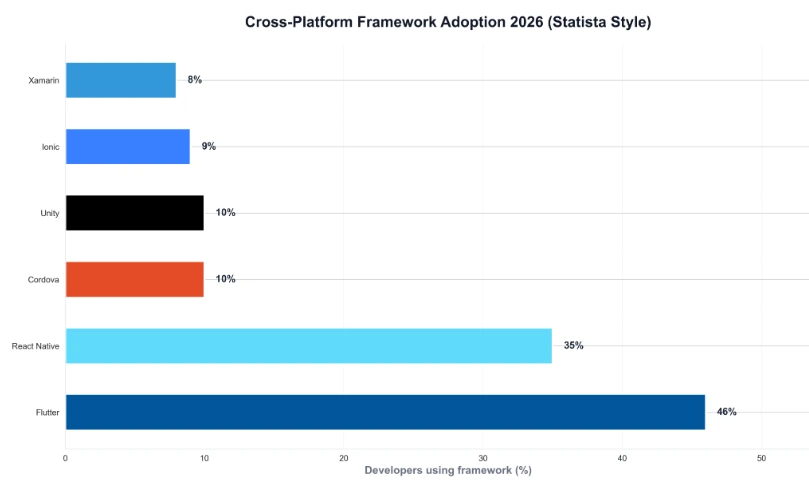
Flutter is not just growing. It is dominating the cross-platform ecosystem. The numbers clearly show a strong upward trajectory in adoption, usage, and enterprise trust.
- 46% of developers globally use Flutter
This makes Flutter the most used cross-platform framework worldwide. It has maintained a clear lead over alternatives like React Native. - 42%+ market share among cross-platform frameworks
Flutter continues to hold the largest share in the cross-platform segment. This reflects strong developer preference and business adoption. - 30% of new apps (iOS cross-platform category) use Flutter
A significant portion of newly built apps are powered by Flutter. This shows how fast companies are shifting toward a single codebase development. - 2M+ developers actively using Flutter
The growing developer ecosystem ensures continuous innovation, better libraries, and faster updates. - Projected 60% adoption trend by 2026
According to the latest reports, industry projections indicate strong future growth driven by performance, cost savings, and scalability.
(Source)
Key Benefits of Flutter App Development for Modern Businesses
Flutter app development is a process of building apps for mobile, web, and desktop using a single codebase. Unlike many cross-platform solutions, Flutter compiles directly to native ARM code for mobile and JavaScript for the web. This cross platform app development framework provides several benefits that fuel business growth.
- Faster Time-to-Market: Build apps for iOS and Android with a single codebase, helping you launch faster and capture opportunities before competitors.
- Cost Saving: Save up to 40-50% on Flutter app development costs by avoiding separate native teams, freeing resources for marketing and scaling.
- Near-Native Performance: Deliver smooth, responsive apps that feel native, improving user satisfaction and retention. Flutter app development allows you to provide seamless performance to your target audience.
- Consistent User Experience: Flutter’s customizable UI ensures a uniform look and feel across platforms, strengthening brand identity. Flutter development makes the application intuitive and attention-grabbing to keep the users engaged.
- Future-Ready Tech: With strong community support and backing from Google, Flutter is evolving rapidly, ensuring long-term stability and innovation. With the increasing number of Flutter developers, the future looks promising.
Your business can take advantage of Flutter application development after partnering with an experienced and reliable Flutter app development company. This partnership can help you build a best-in-class and intuitive app for multiple platforms.
How Flutter is Setting the App Development Trends in 2026?

After understanding Flutter and its benefits for businesses, it’s time to jump on the Flutter app development trends 2026. Exploring these trends is necessary to reach, engage, and retain customers. With mobile apps driving over 70% of digital traffic, staying updated on Flutter’s evolving capabilities can give companies a competitive edge. By understanding these trends, businesses can meet customers’ expectations.
1. AI-Powered Flutter Apps
Flutter AI is one of the top Flutter app development trends for 2026 that is gaining popularity in the era of generative AI. It uses natural language processing to create human-like chatbots. Applications use machine learning to read user behavior and user data patterns to recommend content.
Using Flutter AI can help businesses save costs and launch on multiple platforms. This trend is evolving the app world and allowing businesses to provide a personalized user experience with high-end performance. Businesses can work closely with a globally recognized AI development company to build advanced and tailored apps.
A popular example of Flutter AI is the fitness dancing app Vivafit, which utilizes this trend to suggest workout plans, elevating home fitness to new heights. Google Lens is also an example of implementing AI and computer vision to identify objects or human faces.
2. Augmented Reality (AR) and Virtual Reality (VR) Capabilities
Flutter’s growing compatibility with ARCore and third-party AR/VR tools enables the creation of immersive applications that blend virtual elements with real-world environments or create fully digital experiences. The use of Flutter in building AR/VR apps can open new possibilities in retail, entertainment, education, and healthcare.
This trend shows why Flutter is the future of app development, allowing businesses to engage users in novel and interactive ways, boosting customer retention and satisfaction. Also, Flutter reduces costs and time, eliminating the need for separate native AR/VR apps. Immersive experiences delivered using Flutter app development services create emotional connections that translate to brand loyalty and increased revenue streams.
Read Also: How Can Integration of AR/VR in Mobile Apps Increase Customer Engagement?
3. Expansion Beyond Mobile: Web and Desktop Apps
Flutter’s expansion beyond mobile is also one of the major Flutter app development trends 2026. Flutter allows developers to create aesthetically pleasing, high-performing desktop and interactive web applications. The capability of making desktop and web apps will grow in the following years because Flutter developers can reuse a large portion of the code.
The hot reload feature allows developers to see changes immediately after making them. All these features increase productivity and results, helping you incorporate animations, transitions, and effects.
This multi-platform capability enables businesses to deliver a consistent user experience across devices while maintaining a unified codebase. Google Ads is a popular application built with Flutter, available across both desktop and mobile platforms, showcasing its versatility.
4. Advanced Performance Optimization With Latest Flutter Updates
Flutter’s latest framework updates 2026 and Dart improvements focus on faster runtime, reduced app size, and better memory management. With enhancements like the Impeller rendering engine, apps now deliver smoother UI, lower latency, and improved battery efficiency. These upgrades make performance a key part of Flutter development trends. Especially for businesses targeting multi-platform scalability, often supported by advanced application modernization services to upgrade legacy systems into high-performing Flutter applications.
Improved flutter performance 2026 ensures responsive apps even on low-end devices and unstable networks. This helps businesses expand into emerging markets while maintaining a strong user experience. For startups and enterprises, performance optimization now plays a direct role in user retention, engagement, and long-term app success.
5. Stronger Focus on Security and Compliance
Cyber threats are increasing, and users expect advanced security to keep their data safe and secure. Looking at this necessity, Flutter is prioritizing improved security tools and compliance support to offer secure data storage, encrypted communication, and compliance readiness (HIPAA, GDPR).
For businesses handling sensitive data, this is one of the most useful Flutter app development trends. It strengthens trust and legal compliance, reducing the risk of breaches and penalties. Product managers can hire app developers skilled in Flutter to reassure users about privacy, boosting confidence and adoption. Security enhancements make Flutter more attractive for fintech, healthcare, and enterprise-grade apps.
6. IoT-Powered Flutter Apps
With the rise of IoT (Internet of Things), developers face pressure to build apps that enable users to perform simple tasks like retrieving data or managing devices remotely. Flutter has a widget-based architecture and expressive UI components, the best tools to use with Flutter app development trends, which allow developers to create apps that pair with IoT devices.
Flutter developers use Flutter Blue while building applications for businesses in the IoT industry. The Flutter Blue package allows apps to scan, connect, and communicate with Bluetooth devices such as sensors and wearables. Fluttery Raspberry PI is also used to build IoT-powered Flutter applications because it helps developers make unique embedded user interfaces and apps.
Read Also: IoT App Development: Useful Tips for Building Top-Notch IoT Apps
7. Low-Code and No-Code Flutter Solutions
Nowadays, some businesses don’t want to put a lot of effort into building mobile apps. This contributed to the rise of low-code and no-code solutions. These platforms developed over Flutter aim to fast-track app-building processes with minimal coding and act as a prototyping tool with direct involvement from non-developers in the production process.
The idea of this democratization of the app development process is to allow startups and SMEs to judge their ideas once in the market and do those things with fewer developer resources, and accelerate projects. Product managers will benefit from receiving quick feedback, and stakeholders in businesses will help define product functions actively so that it’s market-fit, thus avoiding expensive reworking.
8. Leveraging Flutter For Wearables
Among the other emerging technologies, wearable technology is also gaining popularity and opening doors of opportunities for businesses. As laptops and mobile devices lack sensors and scanning capabilities, wearables are now always needed. Building apps for these devices will accelerate the future technological revolution. Flutter can be used to build apps for wearables because it streamlines the integration alongside flexibility and adaptability.
This is one of the newest app development trends in the industry, and businesses need to partner with an experienced Flutter app development agency to leverage this. Businesses can use this cross platform development framework to lower costs and speed up innovation cycles.
9. Flutter-Powered Instant Apps
Instant apps allow users to experience parts of an app without fully installing it on their device. They offer on-demand access to specific functionalities through links or URLs, providing a native experience without the need for a complete installation.
In 2026, convenience will be a primary factor for businesses, and Flutter-powered instant apps have the power to load faster and have many versions for different OS to solve memory and performance problems. This speciality allows businesses to choose Flutter for MVP development, increasing audience reach and revenue.
For businesses, an immediate app is the most effective way to achieve growth and build strong relationships with customers. These apps will attract users across Android and iOS because they will take up less space and provide an extra advantage.
10. Expansion of Flutter’s Package Ecosystem
Since last year, the Flutter community has contributed to the growth of the package ecosystem with fresh plugins and SDKs for easy integration of payment gateways, analytics, social media logins, and everything in between.
This Flutter app development trend promotes fast development using proven, repeatable building blocks that reduce both the project risk and time-to-market. Therefore, Mobile app companies and startups have an arsenal of a broad range of tools to upgrade the app functionality and user engagement, promoting rapid experimentation and iteration.

How to Choose the Right Flutter Development Partner to Leverage Emerging Trends
As you explore the latest Flutter app development trends, selecting the right development partner becomes a strategic decision. The right team not only understands these evolving trends but also knows how to implement them effectively to deliver scalable and high-performing applications. A reliable partner helps you stay aligned with market demands, adopt the latest innovations, and build apps that stand out in a competitive landscape.
1. Proven Experience With Flutter App Development Trends
Your preferred Flutter app development company should have a strong track record and demonstrable experience in your industry. Check whether the team has worked on projects using FlutterFlow, Firebase integration, or embedded AI. Review their portfolio, case studies, and client success stories to see how they’ve handled projects similar to yours. You can partner with a mobile app development company in USA to get developers with next-level expertise using Flutter.
2. Transparency & Open Communication
Trust comes through honest and open communication. Get a company that will keep you in the loop as much as possible during the entire process, that will be upfront with you about pricing and timelines, and that will not shy from bringing a challenge to your attention. Transparent partners will always consult you in the decision-making, during mobile and web application development, instead of excluding you.
3. Check Client Testimonials & Reputation
A company’s reputation stands tall as the arbiter of its reliability. Explore client reviews on reputable platforms such as Clutch, G2, or Google Business and ask for references whenever possible. Positive reviews and a reputation suitable for long-term customer relationships are pillars for a dependable partner offering consistency and quality.
4. Focus On Scalability & Flexibility
As your business evolves, your development partner should adapt alongside it. This includes scaling teams, adopting new technologies, or adjusting strategies mid-project. Flexibility also involves ongoing application maintenance services to ensure your app stays updated, secure, and aligned with changing user needs. This approach helps keep your product relevant and prevents it from becoming obsolete as your business grows.
5. Technical Proficiency and Innovation
Technical skills alone aren’t enough to look for while outsourcing Flutter app development. The right partner stays updated with modern frameworks, tools, and methodologies, while also suggesting innovative ideas to future-proof your business. This ensures your investment delivers long-term value rather than becoming obsolete.
Final Thoughts
Flutter has moved beyond being an alternative. It is now a core technology shaping modern cross-platform development. The rise in flutter trends 2026 and continuous improvements in performance, AI integration, and scalability show where the ecosystem is heading. For businesses, this means faster development cycles, lower costs, and better user experiences across platforms.
By aligning your strategy with the latest Flutter app development trends, you position your product for long-term growth and market relevance. The next step is execution. With the right development partner like RipenApps, you can turn these trends into scalable, high-performing applications built to meet evolving user expectations and business goals.

FAQs
Q1. How do Flutter app development trends impact ROI for startups and enterprises?
Trends such as AI integration, modular architecture, and performance optimization contribute to a reduction in development cost, faster iteration, and better user acquisition. This helps companies scale faster, retain users better, and achieve maximum ROI.
Q2. What role do AI and ML play in the future of Flutter app development?
AI-powered personalization, prediction analytics, and natural language interfaces are increasingly being embedded into Flutter apps. This enables better user interfaces and greener grass for data-driven business decisions.
Q3. Will adopting Flutter trends make it easier to scale apps globally?
Absolutely. Major trends in localization support, lightweight UI, and better integration with cloud services make Flutter paramount for businesses with a global user base. It helps keep development consistent across markets.
Q4. Are Flutter apps secure enough for industries like fintech and healthcare?
Yes. Security in Flutter keeps getting enhanced through encryption libraries, API security practices, and compliance assistance. Many of the Flutter app development trends 2026 also put focus on making the apps compliant with data privacy and regulatory standards.
SHARE
WRITTEN BY

Ishan Gupta
CEO & Founder
Ishan Gupta is a seasoned entrepreneur and CEO with extensive 10+ years of experience in business and mobile app development landscape. He believes that the right digital product allows companies to focus on what they do best, while technology handles the rest. With deep exposure to global markets, he understands what makes an app succeed. His approach translates business needs into clear product strategies, ensuring that every feature contributes to measurable ROI.
View All Articles