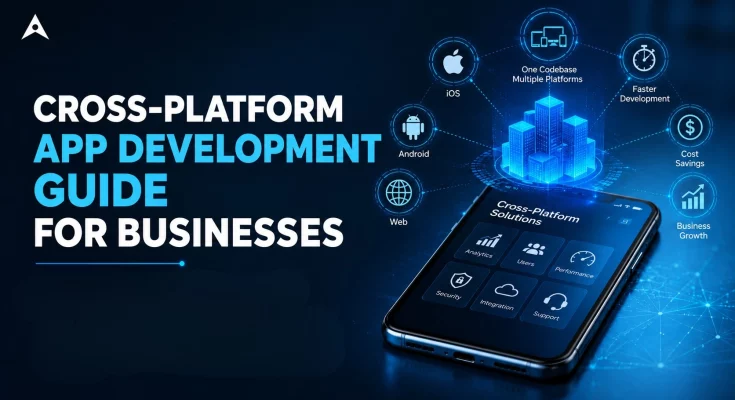



Cross-platform app development has unlocked ample opportunities for businesses with its robust single-code line feature. It’s the development strategy that is shaping how businesses capture diverse audiences faster and more cost-effectively.
With over 7.5 billion smartphone users worldwide in 2026 and consumer demand for seamless app experiences on multiple devices, the pressure on businesses to launch apps that work everywhere is at an all-time high.
For startups and enterprises alike, the question is no longer “Should we build cross-platform apps?” but rather “How can we make them faster, smarter, and more scalable than the competition?” That’s where market research comes into the picture. From tracking evolving frameworks like Flutter, React Native, and .NET MAUI to understanding user behaviour shifts, a clear data-backed strategy can help you lead the industry.
If you are an app owner planning to build or modernize a cross-platform application, partnering with a leading cross platform app development company can help you turn these insights into a practical development strategy. This blog breaks down key market insights, the latest statistics, and emerging trends to show where cross-platform app development is headed and what businesses can do to future-proof their strategy.
Key Takeaways
- Cross-platform development now powers 40 to 45% of new apps, becoming a default strategy for scalable product development.
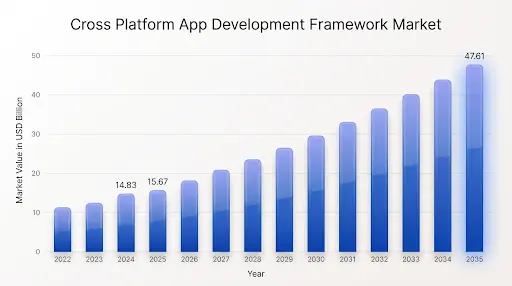
- The market is projected to grow from $15.67 billion in 2025 to $47.61 billion by 2035, signalling long-term adoption.
- Flutter leads with 46% developer adoption, while React Native remains strong for rapid development and ecosystem flexibility.
- Cross-platform approaches reduce development effort by up to 80% and accelerate delivery timelines by nearly 40%.
- Future-ready apps rely on AI-assisted development, modular architectures, and edge computing to deliver faster, scalable user experiences.
Table of Contents
Core Cross-Platform App Development Statistics
The cross-platform app development industry’s maturity has entered a new phase in 2026. The new data tells a story of rapid growth, shifting developers’ preferences, and a technology ecosystem.
From market valuations to framework-level adoption rates, this industry is expanding faster than ever. This is why you should look at the most important statistics related to the cross-platform app development industry:
Market Size & Growth Aspects
- The cross-platform app development framework market is projected to grow from $15.67 billion in 2025 to $47.61 billion by 2035. This rapid growth exhibits a compound annual growth rate (CAGR) of 11.75% during the forecast period 2025 to 2035.
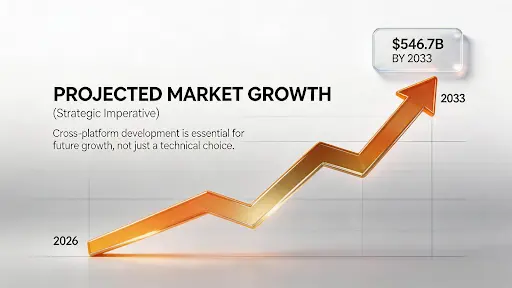
- By 2033, the overall cross-platform app development market is expected to surpass $546.7 billion. This reflects how central the cross-platform approach has become to global digital strategy.
- The cross-platform mobile development market reached $25.6 billion in 2026, with Flutter and React Native continuing to dominate the conversation.
Developer Adoption
- Flutter and React Native are the two leading cross-platform frameworks. Among these, Flutter is used by approximately 46% and React Native by 35% of experienced developers.
Now, quickly explore the forecasted data given below:
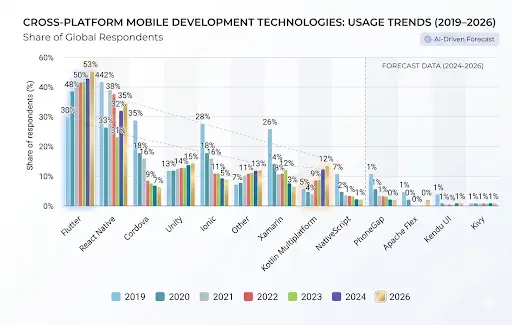
Pls note that this futuristic projected data is generated based on a combination of historical data and current developer adoption patterns in 2026. This projected data indicates that Flutter is likely to retain its leading position due to its expanding ecosystem, strong performance capabilities, and increasing enterprise adoption.
At the same time, React Native is expected to remain a dominant choice, particularly for businesses prioritising faster development cycles and strong community support.
- Stack Overflow’s 2025 data shows Flutter at 9.12% and React Native at 8.43% overall usage across all developers globally.
- 79% of developers expect AI to reshape app development in the next five years, further accelerating cross-platform workflows.
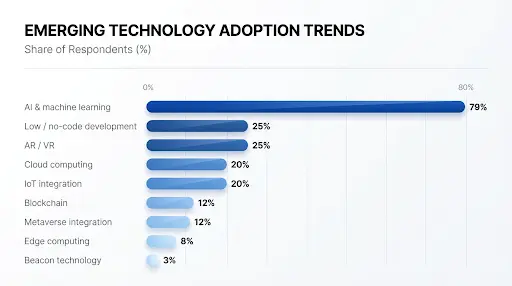
- More than 40 to 45% of new mobile applications now use cross-platform frameworks for at least part of their architecture.
Development Efficiency
- Cross-platform development can slash development effort by 50 to 80% and accelerate cycles by 30 to 40% compared to building separate native apps.
- Flutter MVPs typically launch in 12 to 16 weeks compared to 20 to 28 weeks for separate native apps, a difference that directly impacts product-market timing.
Country-Wise Market
The growth of cross-platform app development is not limited to global projections alone. Regional data shows how different countries are scaling adoption at a rapid pace, driven by enterprise digitisation, mobile-first strategies, and increasing demand for faster app deployment.
Projected CAGR (2025 to 2032)
The following table highlights the projected compound annual growth rate across key global markets. The data indicates a consistently strong growth range between 16.3% and 16.7%, reflecting widespread adoption across both developed and emerging economies.
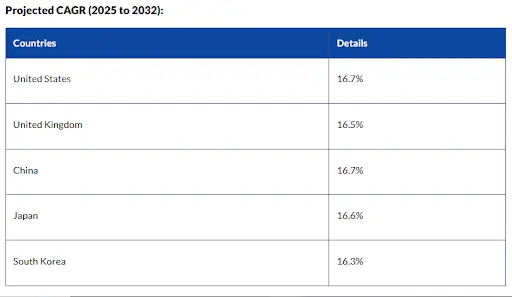
Major Insight:
The minimal variation in CAGR across countries suggests that cross-platform development is becoming a universally adopted strategy, rather than being limited to specific regions.
Market Value (2032)
The table below showcases the expected market size of cross-platform app development across major economies by 2032. Countries like China, the United States, and Japan are expected to lead in total market value.
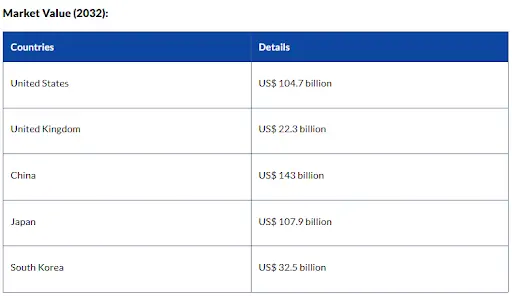
Major Insight:
China and the United States dominate in market value, highlighting their strong digital ecosystems and large-scale enterprise investments in cross-platform technologies.
Absolute Incremental Opportunity (2025 to 2032)
This table outlines the total incremental revenue opportunity expected to be generated between 2025 and 2032 across different countries.
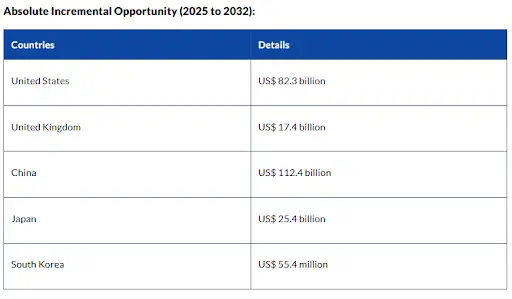
Major Insight:
The significant incremental opportunities, especially in China and the United States, indicate massive untapped potential for businesses investing in cross-platform app development solutions.
Why Cross-Platform Development Matters in 2026?
Over the past few years, cross-platform development has shifted from a cost-saving alternative to a strategic advantage. Moving ahead in 2026, with global smartphone users surpassing 7.5 billion and mobile app revenue projected to reach $781 billion, businesses must deliver across platforms without compromising quality.
1. Wider Reach with Faster Time to Market
Cross-platform frameworks like Flutter and React Native allow you to build once and launch everywhere. Thus, you save up to 50% in development time and reduce costs significantly. It results in allowing companies to launch products faster and capture market opportunities ahead of competitors.
2. Strong Market Growth & Investment Momentum
The market for cross-platform frameworks is growing rapidly, projected to climb from $389 billion in 2026 to $884.5 billion in 2030. This momentum positions them as sound long-term technology investments. In 2026, cross-platform technologies are emerging as long-term, scalable investments for businesses aiming to optimise development costs while maintaining performance.
3. Evolving Developer Preferences
Developer preferences are shifting toward modern frameworks that offer near-native performance and flexibility, aligning with broader trends in application modernization solutions. While traditional hybrid tools like Ionic and Cordova still have relevance, frameworks such as Flutter and React Native are increasingly preferred due to their performance efficiency, strong ecosystems, and ability to support complex, scalable applications. As organizations invest in application modernization solutions to enhance user experiences and accelerate innovation, these frameworks continue to gain traction among development teams.
4. Rising Demand for Multi-Platform Experiences
In 2026, users expect consistent experiences across mobile, web, desktop, and even wearable devices. Cross-platform development enables businesses to meet these expectations efficiently, ensuring uniform UI/UX and functionality across all touchpoints.
5. Faster Innovation with Scalable Architecture
Cross-platform frameworks now support advanced integrations, making it easier for businesses to scale applications, roll out updates quickly, and adapt to evolving user needs without rebuilding from scratch.
Top Cross-Platform Frameworks: A Deep Dive
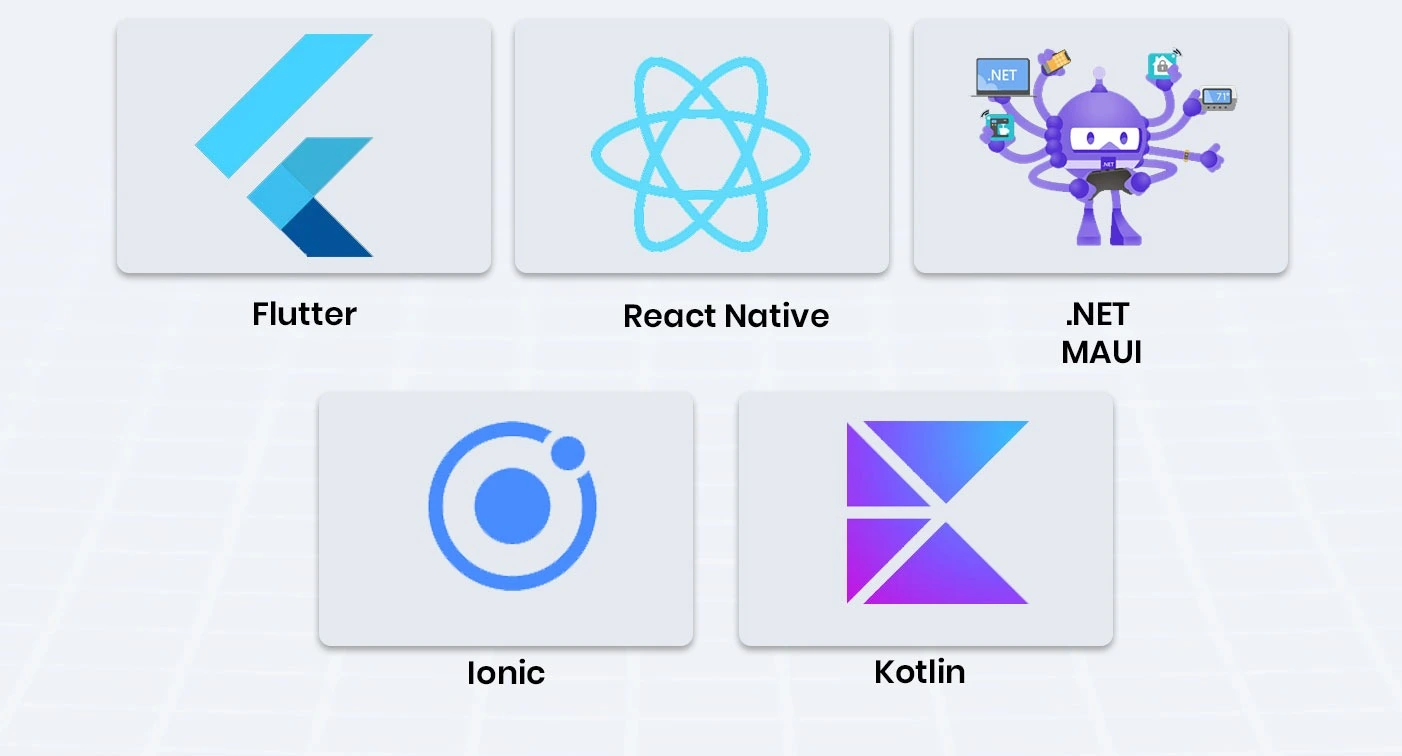
By 2033, the cross-platform app development market is expected to reach $546.7 billion. It showcases how popular the cross-platform app development approach will be in the future. Moving ahead, we will briefly discuss some of the top cross-platform frameworks and how they are performing in the market. Flutter, React Native, Ionic, etc., are the top ones on the list.
1. Flutter
Flutter is an open-source UI (User Interface) software development toolkit created by Google. It is used to build natively compiled applications for mobile, web, and desktop from a single codebase. Flutter is known for its fast development, expressive and flexible UI, and ability to create high-quality, visually appealing applications.
Here’s why Flutter matters:
- It leads the market: 46% of software developers chose Flutter in 2026. Thus, making it the most widely used cross-platform framework.
- Apps built with Flutter keep growing: 28% of all new apps launched on the iOS App Store today use Flutter.
The above stats show Flutter’s real momentum. It’s not just popular among developers, but it’s actively being chosen for new apps across platforms. For businesses aiming to scale faster, you need to leverage top Flutter app development services and stay ahead.
2. React Native
React Native is an open-source framework for building cross-platform mobile applications. It was developed by Facebook and is now maintained by a community of developers and organisations. React Native allows developers to create mobile apps for multiple platforms, such as iOS, Android, and even some web platforms, using a single codebase.
Here’s how it’s shaping up in 2026:
- Growing market share: The share of newly released apps using React Native rose from 4.73% in 2022 to 6.75% in 2025. This shows a steady adoption.
- Strong revenue contribution: In Q4 2025, apps built with React Native generated around $287 million in net revenue, nearly matching Flutter’s $283 million.
- Performance upgrades: The framework has cut startup times by up to 40%, delivered smoother UI performance, and boosted memory efficiency by around 20 to 30%.
React Native is holding solid in 2026. All thanks to these useful insights. It remains a compelling choice for businesses seeking fast, near-native performance with wide platform coverage.
Also Read: React Native VS Flutter: Which is Better For Your Business?
3. .NET MAUI
The .NET MAUI (Multi-platform App UI) is Microsoft’s modern cross-platform framework that allows developers to build native applications for iOS, Android, macOS, and Windows using a single codebase with C# and .NET.
Here’s how .NET MAUI is shaping up in 2026:
- Enterprise-driven adoption: Widely adopted by enterprises already invested in the Microsoft ecosystem.
- Unified development approach: Replaces Xamarin, offering a more streamlined and future-ready architecture.
- Strong tooling support: Deep integration with Visual Studio enhances productivity and debugging efficiency.
.NET MAUI is becoming a go-to choice for enterprise-grade applications, particularly for organisations that prioritise security, scalability, and seamless integration with Microsoft technologies. If you are a non-tech entrepreneur, you can also reach out to the best IT consultancy company to create apps using the best frameworks. The experts know well how to tailor the architecture, integrations and user interface to match your business needs.
4. Ionic
Ionic is an open-source framework for building cross-platform mobile and web applications using web technologies such as HTML, CSS, and JavaScript. It provides a set of tools, libraries, and components that enable developers to create high-quality, native-like user experiences for iOS, Android, and the web from a single codebase.
Here’s how Ionic stacks up in 2026:
- Still widely used: Over 5 million apps across 200 countries now run on Ionic.
- Developer base: About 3.5% of professional developers use Ionic, comparable to its market share among other frameworks.
- Installed app share: Ionic appears in approximately 3.7% of all mobile apps, holding its position among the top cross-platform tools.
Several experienced cross-platform app development companies in USA are also using the Iconic framework for building apps. It remains a compelling choice for teams that value web expertise, cross-platform reach, and ease of development, especially for PWAs and hybrid app deployments.
5. Kotlin Multiplatform (KMP)
Kotlin Multiplatform (KMP) is a modern cross-platform development technology that allows developers to share business logic across platforms while maintaining native UI experiences. It is backed by JetBrains and is gaining traction among Android-first teams.
Here’s how KMP is evolving in 2026:
- Growing developer interest: Increasing adoption among teams seeking flexibility beyond traditional cross-platform frameworks.
- Native-first approach: Enables shared code for logic while preserving platform-specific UI for better performance.
- Strong ecosystem backing: Supported by JetBrains and increasingly integrated into modern Android development workflows.
Kotlin Multiplatform is emerging as a powerful alternative for teams that want a balance between code reusability and native performance, especially for complex, performance-sensitive applications.
Top Apps Using Cross-Platform App Development Approach
Now that we have analysed the top cross-platform app development frameworks and the market statistics associated with them, it is time to check out the top players using this approach. We will analyse these top apps through the categorisation of the frameworks discussed in the previous section. This, in turn, will lead us to conclude the development of the cross-platform app.
Real-World Brands Using Flutter
Here are some of the globally recognised companies that are using Flutter:
1. Google Pay
Google rebuilt Google Pay in Flutter, migrating from 1.7 million lines of separate iOS and Android code to a unified codebase. A proof of concept built by just three engineers scaled to a 150+ engineer effort. The result was a 70% reduction in engineering effort and a 35% reduction in lines of code. To build a feature-rich platform like Google Pay, you can work closely with a top-rated mobile app development company. They will provide you with a complete guide.
2. BMW
BMW adopted Flutter to tackle the challenge of building applications for multiple platforms across diverse countries. Using a single codebase, Flutter eased the overall work of developers, reduced release cycles by 33%, and made the solution significantly more cost-effective.
3. eBay
The eCommerce giant achieved 98.3% shared code and 2x faster development compared to native solutions after adopting Flutter for its core product.
4. Tencent
Tencent’s Now Live app, developed using Flutter, reaches over 10 million daily active users. Across its portfolio, Tencent reported 80% increased debugging efficiency, 90% multi-platform code sharing, and a 33% reduction in development effort.
5. Dream 11
Flutter is now supporting 50 million fantasy sports users in India, with the platform using Flutter to deliver a new multiplatform solution that enables a faster, more innovative user experience.

Real-World Brands Using React Native
1. Microsoft Office
345 million people currently use Microsoft Office, which is built completely on React Native technology, making it arguably the highest-scale production deployment of the framework in existence.
2. Messenger Desktop
The application migrated from Electron to React Native, with the entire desktop application rebuilt on the framework. The result was a faster, more scalable, and higher-performance experience than the previous Electron-based approach. This showcases how brands can achieve faster, scalable, and high-performance desktop experiences when they partner with an experienced React Native app development company with strong technical expertise.
3. Discord
React Native helped Discord achieve near-native performance and a 4.8-star rating, with 99% of the app now crash-free, a credibility signal that matters enormously for a real-time communication platform where reliability is non-negotiable.
4. Shopify
Shopify is one of the most cited React Native success stories, reporting 10% faster Android launch times and noticeably smoother animations after adopting the New Architecture.
5. Flipkart
India’s largest e-commerce platform uses React Native to power an app with hundreds of millions of weekly interactions. The framework allowed Flipkart to fix delayed experiments and bug fixes that had long affected release velocity, resulting in meaningfully decreased development effort across their mobile team.
Also Read: Why choose React for Web Development- Features & Reasons?
Real-World Brands Using .NET MAUI
1. Alaska Airlines
Alaska Airlines uses Microsoft’s cross-platform ecosystem to deliver a unified mobile experience across platforms. This approach has improved application reliability and streamlined development processes.
2. UPS
UPS leverages .NET-based cross-platform technologies to power its logistics and tracking applications. This enables real-time updates, consistent performance, and scalability across global operations.
3. Siemens
Siemens utilises Microsoft-based frameworks to build enterprise-grade applications that require high performance and security. This ensures reliable cross-platform functionality across complex systems.
4. Delta Airlines
Delta Airlines adopts Microsoft’s cross-platform solutions to enhance both customer-facing and internal applications. This has helped improve operational efficiency and user experience.
5. ABB
ABB uses .NET-based cross-platform technologies to support industrial applications, enabling seamless integration, scalability, and consistent performance across platforms.
Real-World Brands Using Ionic
1. Sworkit
Sworkit leveraged Ionic to build a cross-platform fitness application that delivers a consistent user experience across devices. By using a single codebase, the company was able to roll out updates faster and maintain performance for millions of active users. The top-featured fitness app enhanced user experience for millions of users through a single codebase and the top-notch design flexibility of Ionic.
2. Instant Pot
Instant Pot developed its companion mobile application using Ionic to support its smart kitchen ecosystem. This enabled the brand to improve user engagement while maintaining a scalable and reliable app experience.
3. Shipt
Shipt adopted Ionic to power its grocery delivery platform, allowing the team to streamline development and deploy updates more efficiently. This resulted in improved app performance and faster feature releases.
4. MarketWatch
MarketWatch used Ionic to deliver a responsive financial news platform across mobile and web. The framework helped ensure faster load times and a consistent user experience across devices.
5. Diesel
Diesel implemented Ionic for its mobile commerce platform, enabling quicker development cycles and a unified shopping experience for users across different platforms.
Real-World Brands Using Kotlin Multiplatform (KMP)
1. Netflix
Netflix uses Kotlin Multiplatform for internal development and shared logic across platforms. This helps improve engineering efficiency while maintaining high-performance native experiences.
2. Cash App
Cash App adopted Kotlin Multiplatform to reduce code duplication across Android and iOS. This approach has accelerated development cycles and improved feature delivery speed.
3. VMware
VMware leverages Kotlin Multiplatform to streamline cross-platform development, improving code maintainability while ensuring flexibility for platform-specific features.
4. Philips
Philips uses Kotlin Multiplatform in selected applications to unify development workflows and deliver consistent user experiences across platforms.
5. 9GAG
9GAG adopted Kotlin Multiplatform to optimise development efficiency and maintain consistent app performance across mobile platforms.
Emerging Trends Shaping Cross-Platform Development
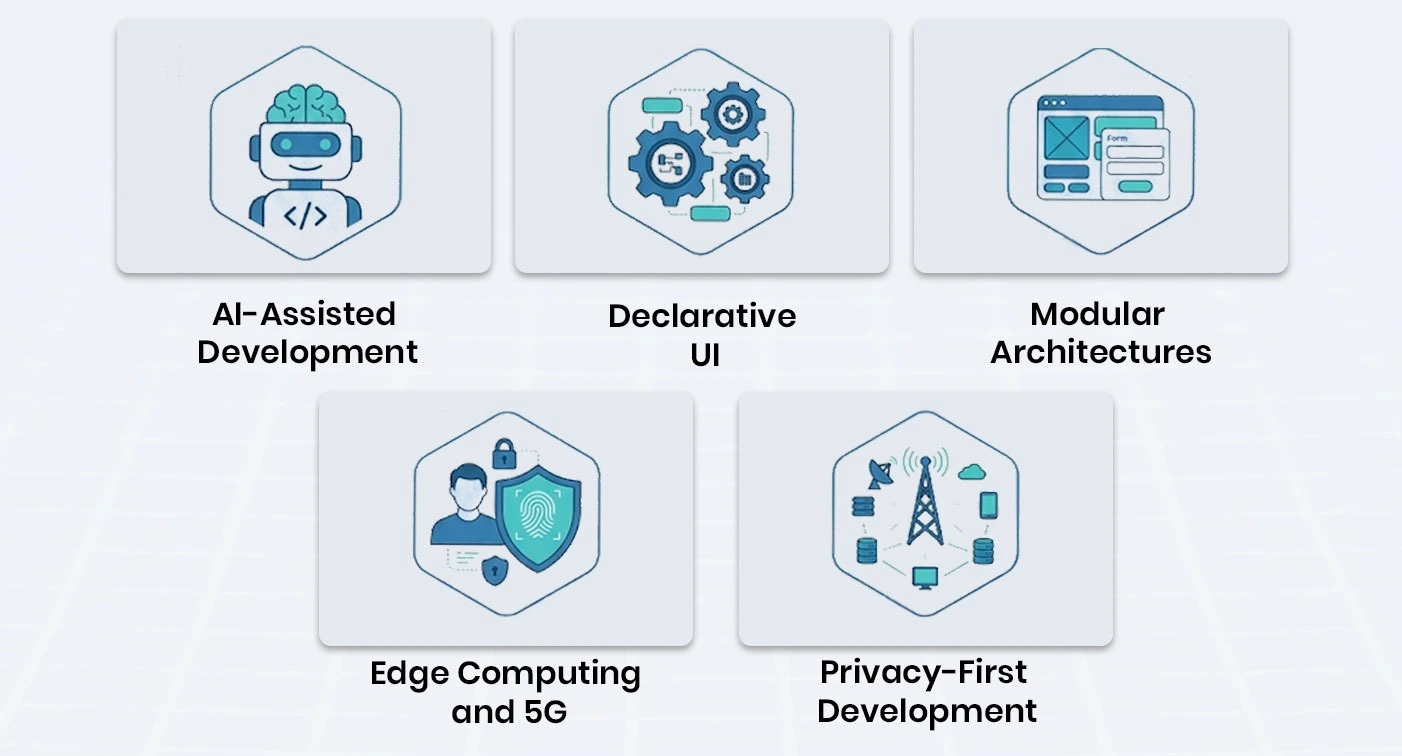
The cross-platform landscape is genuinely shifting in how developers build, what users expect, and what the underlying infrastructure makes possible. Currently, there are 5 forces that are reshaping cross-platform development:
1. AI-Assisted Development
This is the single biggest shift in how these cross-platform apps are built nowadays in 2026. Businesses are using AI coding tools as standard equipment within their development environments. 2 years ago, these AI tools were only a curiosity, but now they are reshaping what a cross-platform team can produce.
GitHub Copilot is used to generate boilerplate code, suggest bug fixes, and automate repetitive tasks. This helps your team to reduce development time while focusing more on mobile app architecture and product UI/UX design. Your team can also use Generative AI or Gen AI to build smart uI and thus generate micro-interactions in real workflows.
Critically, the AI integration experience is not equal across frameworks; that is, AI capability has become a first-order framework selection criterion. For example, Flutter’s AI story is rapidly improving as the Dart package provides idiomatic access to Gemini models directly in Flutter apps.
React Native, on the other hand, wins on LLM SDK integration due to its JavaScript foundation, thus giving it access to the entire JavaScript AI library ecosystem. The bottom line for businesses is that you are not just choosing a framework for how your app looks. You are choosing a framework for how your app thinks.
2. Declarative UI
This is another one of the significant cross-platform app development trends that is redefining how modern cross-platform applications are designed and maintained in 2026. Declarative UI development is different when compared to traditional imperative approaches. This method allows developers to describe what the interface should look like rather than how to build it step by step.
Frameworks like Flutter, SwiftUI on native iOS, and Compose on native Android and multiplatform all use this approach. This is where developers describe what the UI should look like for a given state, rather than imperatively issuing commands to update specific elements.
From a business perspective, this shift directly impacts product quality and speed. Teams can iterate on designs more quickly, experiment with features without rewriting large portions of code, and maintain consistency across platforms. It also reduces dependency on platform-specific UI logic, making cross-platform apps more scalable and easier to maintain.
Ultimately, declarative UI is not just a technical improvement. It is a fundamental change in how teams build user experiences, making applications more adaptable, maintainable, and aligned with modern user expectations.
3. Modular Architectures
Modular architecture is becoming a core foundation for how cross-platform applications are built and scaled in 2026. Instead of developing applications as a single, tightly coupled system, teams are now breaking them down into smaller and independent modules that can be developed, tested, and deployed separately.
This shift allows development teams to work in parallel across different features, thus significantly reducing time-to-market. Frameworks such as Kotlin Multiplatform and modern .NET-based ecosystems now support modular approaches in 2026. This enables you to share business logic across platforms while maintaining flexibility.
From a business standpoint, modular architectures reduce long-term maintenance costs and technical debt. They also make it easier to scale teams, as different teams can own different modules without creating dependencies that slow down development.
Ultimately, modular architecture is not just about cleaner code structure. It is about building applications that can evolve continuously, adapt quickly to market demands, and support long-term growth without requiring complete rewrites.
4. Edge Computing and 5G
The hardware and infrastructure layer is finally catching up to what cross-platform frameworks have been promising. In 2026, the combination of 5G maturity and edge computing adoption is enabling app experiences that were genuinely impossible at scale just two years ago.
According to Statista, the global edge computing market is expected to hit $317 billion by 2026, growing at more than 18% CAGR. 5G sits right on top of it, as ultra-low latency networks with as little as 1ms latency unlock features like instant cloud gaming, real-time translation, and multi-camera video calls that used to be impossible in 4G.
Cross-platform frameworks are increasingly adapting to this shift by supporting real-time data synchronisation, offline-first capabilities, and seamless backend integrations. This ensures that applications remain responsive even in varying network conditions, which is critical for global user bases.
Ultimately, edge computing and 5G are not just infrastructure upgrades. They are redefining what users expect from applications, pushing cross-platform development toward faster, smarter, and more immersive digital experiences.
5. Privacy-First Development
Privacy-first development has become a critical priority in 2026, driven by stricter regulations, rising user awareness, and increasing scrutiny around data handling practices. Modern applications are no longer evaluated only on performance and features, but also on how responsibly they collect, store, and process user data.
With regulations like GDPR, evolving global data protection laws, and platform-level privacy policies, businesses are required to embed privacy directly into the development lifecycle rather than treating it as an afterthought. This shift is pushing teams to adopt a “privacy by design” approach, where data minimisation, user consent, and secure data handling are built into the core architecture of applications.
For cross-platform development, this introduces new complexities as applications must maintain consistent privacy standards across multiple platforms while complying with region-specific regulations. Frameworks and tools are evolving to support secure storage, encrypted communication, and permission management across devices.
Ultimately, privacy-first development is no longer just a compliance requirement. It is a strategic necessity that influences user trust, brand reputation, and the long-term success of cross-platform applications in an increasingly data-conscious digital environment.
Read Also: Top Cross-Platform App Development Challenges and How to Solve Them
How to Choose the Right Cross-Platform Framework for Your Business
Choosing the right cross-platform framework is a strategic choice that directly influences your overall technical decision-making strategy. In the long term, it directly impacts your product’s performance, scalability, long-term maintenance, and time-to-market.
With multiple frameworks offering similar capabilities, businesses must evaluate their options based on specific use cases, growth plans, and technical requirements.
1. Define Your Product Requirements First
Start by identifying what your application truly needs. If your app requires high-performance animations, complex UI, or real-time interactions, frameworks like Flutter may be more suitable. For faster MVP development and web integration, React Native can be a strong choice.
The key is to align the framework with your product vision instead of forcing your product to fit the framework.
2. Consider Long-Term Growth and Scalability
Your framework should not only support your current requirements but also scale with your business. Consider how easily the framework can handle new features, increasing user loads, and future integrations.
Frameworks with strong ecosystems and regular updates are better suited for long-term growth.
3. Evaluate Talent Availability
Access to skilled developers is a crucial factor. Frameworks like React Native benefit from a large JavaScript developer community, while Flutter is rapidly growing with strong community support.
Choosing a framework with a strong talent pool reduces hiring challenges and speeds up development.
4. Assess User Experience Needs
While modern cross-platform app development services, including frameworks, offer near-native performance, there are still differences. For applications where performance is critical, such as gaming or real-time apps, you need to carefully evaluate rendering capabilities and responsiveness.
Balancing performance with development speed is key to making the right choice.
5. Think Beyond Mobile
In 2026, applications are no longer limited to mobile devices. Consider whether your framework supports web, desktop, and other platforms if your business requires a broader digital presence.
Frameworks that support multiple platforms from a single codebase offer better long-term value.
6. Analyse Backend Requirements
Consider how well the framework integrates with your existing systems, APIs, and third-party services. Some frameworks offer better compatibility with modern backend architectures, cloud services, and real-time data systems.
This becomes especially important for businesses building complex, data-driven applications.
Choosing a Cross-Platform App Development Partner: What the Statistics Tell You
The frameworks compared throughout this blog show what is technically possible. They do not build the app. Adoption share, community size, and release activity can indicate a framework’s health, but they do not show how well a development partner can execute it.
This distinction matters when moving from research to implementation. A popular framework does not mean every company using it has the same level of expertise. Some teams may have years of hands-on experience, while others may have only recently adopted the technology.
The same applies when choosing a development partner first. A company may have a strong portfolio, but that does not mean it is the right fit for your chosen framework. The framework decision and partner selection should therefore inform each other.
What Statistics Can and Cannot Tell You
Market data can help you understand adoption trends, ecosystem maturity, and developer interest. It can also indicate how a framework may evolve in the coming years.
However, statistics cannot show how a specific team handles architecture, testing, performance, or post-launch support. They also cannot tell you whether a company has experience with projects similar to yours.
This is where cross platform app development services can add value. An experienced team can assess your product requirements, technical priorities, and target platforms to determine whether a framework is suitable for your project.
When Should You Consider a Specialist Partner?
Choosing a specialist partner usually comes down to two questions. Does the team have current, hands-on experience with your chosen framework? Can your project timeline accommodate a learning curve if that expertise is missing?
For production-ready applications, these factors can affect development efficiency and long-term maintenance. An experienced team can make architecture decisions faster and identify potential implementation risks earlier.
When comparing top cross-platform app development companies, look at their experience with your chosen framework, relevant projects, technical capabilities, and approach to post-launch support. Framework expertise should be one of the key factors in your final decision.
The sequence matters. Use the statistics to understand the technology landscape first. Then evaluate development partners based on your chosen framework, product requirements, and delivery expectations.
Future of Cross-Platform App Development
We have researched enough dynamics to come up with the main question of the future of cross-platform app development. As you can see, the majority of brands have moved to a cross-platform app development approach to leverage maximum benefits.
Flutter has been taking over the market, with React Native coming later. Shortly, it is no doubt true that the majority of the apps will use cross-platform tech stacks. It is because the technology delivers a native experience, keeping the cost-effective, especially for startups. If you want to build a leading cross-platform app, we suggest you hire mobile app developers for your business. They will provide you with a complete roadmap and the best ideas to develop a competitive cross-platform app.
Final Thoughts
Cross-platform app development in 2026 is no longer about saving costs, but it’s more about reaching wider audiences faster, maintaining consistent experiences, and staying competitive in a rapidly shifting market. If you are a business leader, a practical cross-platform development guide can help you understand the latest statistics and future trends, identify where to invest, and align your app strategy with evolving user expectations.
Therefore, if you want your next app to perform across devices without compromising on quality, now is the time to act on the above useful insights and partner with the right cross platform mobile app development company. A trusted technology partner like RipenApps can help you translate these strategies into scalable, high-performance applications.
With deep expertise in frameworks like Flutter, React Native, and modern cross-platform architectures, RipenApps enables businesses to accelerate development, optimise costs, and deliver consistent user experiences across platforms.

Frequently Asked Questions
Q1. What makes cross-platform development essential in 2026?
Cross-platform development lets you use one codebase for multiple platforms. Therefore, it is one of the best approaches to save time and money. With rising smartphone usage, it’s now a strategic move to reach users faster and with consistent experiences.
Q2. Which framework leads the market right now?
Flutter holds the top spot in popularity among developers today, reflecting its performance and flexibility. Many new apps prefer Flutter for rapid feature delivery and visual consistency.
Q3. How big is the cross-platform app market right now?
The market is expanding rapidly, with forecasts placing it in the hundreds of billions by the next decade. That makes it a key domain for businesses planning long-term digital strategy.
Q4. What benefits do businesses get from using cross-platform app frameworks?
You get faster time-to-market, cost savings with a single codebase, consistent UI/UX, and simpler maintenance. It empowers teams to innovate instead of reinventing for each platform.
Q5. Can cross-platform apps match native performance?
Yes, modern frameworks like Flutter and React Native produce near-native performance. Many leading brands report development times cut in half without sacrificing speed or fluidity.
Q6. Can a development company help you choose the right cross-platform framework?
Yes. An experienced cross-platform app development company can evaluate your app’s features, performance requirements, target platforms, budget, and timeline to recommend a suitable framework. This can help you balance current project needs with long-term scalability and maintenance.
Q7. How should you evaluate a cross-platform app development company before hiring one?
Evaluate companies against your chosen framework and project requirements. Review their relevant portfolio, technical expertise, development approach, post-launch support, and pricing transparency. A framework-specific comparison can also help you identify teams with deeper expertise.
Q8. Should you choose an in-house team or a cross-platform app development company?
It depends on your team’s existing expertise, project timeline, and long-term requirements. If your team already has hands-on experience with the chosen framework, in-house development may work well. If not, a specialist development company can reduce the learning curve and provide experienced cross-platform developers.
Discuss your project and request for proposal
SHARE
WRITTEN BY

Prankur Haldiya
Chief Technical Officer
A tech innovator and engineering leader, Prankur Haldiya drives RipenApps’ product development strategy and oversees cutting-edge solutions in mobility, AI, and cloud ecosystems. He is passionate about building high-performance teams and helping brands launch secure, scalable, and user-centric digital products.
View All Articles