

Key Takeaways
- React Native supports cross-platform IoT applications that communicate with connected devices through BLE and exchange data with IoT platforms using MQTT, WebSockets, and cloud APIs.
- Its shared codebase can reduce development and maintenance effort across iOS and Android.
- Libraries such as react-native-ble-plx and react-native-ble-manager support Bluetooth device communication.
- React Native applications can integrate with AWS IoT Core and Azure IoT Hub through appropriate backend and messaging architectures.
- Background BLE operations, hardware-specific features, and platform restrictions may require native development.
- IoT app development can cost $15,000–$500,000+, depending on device complexity, integrations, security, and scalability requirements.
IoT applications connect smartphones to smart home appliances, wearables, industrial equipment, healthcare systems, and other connected products. Building these applications requires more than an intuitive interface. Businesses must consider device connectivity, real-time communication, data security, scalability, and compatibility across mobile platforms.
React Native offers a cross-platform approach to building IoT applications for iOS and Android. It allows businesses to share application logic while integrating native capabilities for Bluetooth Low Energy (BLE), device sensors, and other hardware interactions. However, its suitability depends on the connected devices, communication requirements, and background processing needs.
Businesses considering IoT app development with a React Native app development company should understand the framework’s architecture, available libraries, limitations, and development costs. These factors help determine whether React Native can meet their product’s technical requirements and long-term business goals.
Table of Contents
Why React Native Is a Practical Choice for IoT App Development?
IoT ecosystems involve multiple connected components, including physical devices, communication networks, cloud platforms, and mobile applications. Businesses need an application framework that can manage these interactions while delivering consistent experiences across mobile platforms.
React Native provides a shared development approach for iOS and Android applications. Instead of maintaining two entirely separate application codebases, businesses can reuse much of their application logic and interface components. Its suitability for IoT application development depends on the required hardware integrations and communication workflows.
1. Cross-Platform Development with a Shared Codebase
Building separate native applications for iOS and Android can increase development and maintenance requirements. React Native allows businesses to share application logic, user interface components, and business workflows across both platforms.
This approach is particularly useful for smart home applications, connected fitness products, and industrial monitoring platforms that need consistent mobile experiences. However, platform-specific functionality may still require native modules or separate implementations.
Businesses can explore cross-platform app development guide to understand more details about cross-platform product development.
2. Real-Time Communication with MQTT, WebSockets, and BLE
IoT applications frequently exchange data between connected devices, mobile interfaces, and cloud platforms. React Native applications can support different communication mechanisms depending on the device and network architecture.
- Bluetooth Low Energy (BLE): Connects smartphones directly with nearby devices such as fitness trackers, sensors, and smart accessories.
- MQTT: Enables lightweight publish-subscribe messaging between connected devices and IoT platforms.
- WebSockets: Supports persistent, bidirectional communication between applications and backend services.
- REST APIs: Allow applications to retrieve device information, manage configurations, and communicate with cloud services.
The choice depends on device capabilities, connectivity requirements, and whether communication happens locally or through a cloud platform.
One important distinction is that smartphones do not generally include native Zigbee radios. React Native applications interact with Zigbee-based devices through a compatible hub or gateway, which communicates with the mobile application or cloud backend.
3. Scalability Across Connected Devices
An IoT product may initially support a single connected device but eventually expand to multiple devices, locations, and user accounts. React Native can support this expansion through reusable components and shared application logic.
However, overall scalability depends on the complete architecture, including backend services, message brokers, databases, device management, and cloud infrastructure. Scalability should be evaluated early, particularly for industrial IoT and enterprise device management platforms.
4. Faster Product Development and Maintenance
React Native’s reusable components and shared codebase can reduce duplicated development work. When businesses introduce new features, update application interfaces, or improve existing workflows, teams can reuse much of the implementation across platforms.
This can simplify maintenance and help businesses allocate more resources toward device integrations, security, and product improvements. For businesses evaluating the development environment, top React Native IDEs and editors provide additional options for managing application development.
5. Integration with Native Device Capabilities
IoT applications often require access to Bluetooth, location services, notifications, sensors, and platform-specific APIs. React Native supports native integrations through its native modules and New Architecture capabilities, including TurboModules and Fabric.
The New Architecture became the default in React Native 0.76 and remains the foundation of newer releases. However, businesses must verify that their selected native libraries support the required architecture and platform versions.
How React Native Fits into an IoT Application Architecture
A connected application typically operates across four architectural layers. React Native primarily powers the mobile application layer while communicating with devices, gateways, and cloud services through appropriate interfaces.
| Architecture layer | Main components | Role of the React Native application |
| Device layer | Sensors, wearables, appliances, industrial equipment | Connects directly to supported BLE devices or displays device information |
| Edge layer | IoT gateways, local controllers, edge processors | Communicates with gateways through local networks or APIs |
| Cloud layer | IoT platforms, MQTT brokers, databases, analytics services | Retrieves telemetry, sends commands through backend services, and displays processed information |
| Application layer | iOS and Android interfaces, dashboards, notifications | Provides device controls, monitoring, configuration, and user management |
How the layers work together:
- Connected devices collect information through sensors and transmit it using supported communication protocols.
- An edge gateway processes or forwards device information when local connectivity or protocol conversion is required.
- Cloud infrastructure manages device identities, data storage, messaging, analytics, and business logic.
- The React Native application retrieves relevant information and provides interfaces for monitoring and controlling connected devices.
This architecture separates device communication from the mobile interface, allowing businesses to expand their connected ecosystems without overloading the application.
React Native vs Flutter vs Native Development for IoT
Choosing between React Native, Flutter, and native development depends on hardware requirements, team capabilities, performance expectations, and long-term maintenance. All three approaches can support IoT applications, but their integration ecosystems and platform-specific capabilities differ.
| Evaluation factor | React Native | Flutter | Native development |
| Development approach | JavaScript/TypeScript with native integrations | Dart with Flutter plugins and platform channels | Swift for iOS and Kotlin for Android |
| Cross-platform code reuse | High | High | Limited across platforms |
| BLE integration | react-native-ble-plx and react-native-ble-manager | Plugins such as flutter_blue_plus | Direct platform Bluetooth APIs |
| Hardware-specific features | Supported through native modules | Supported through plugins and platform channels | Direct access to platform APIs |
| Background processing | Subject to iOS and Android restrictions | Subject to iOS and Android restrictions | Greater control over platform-specific implementations |
| UI development | Native platform components | Flutter’s rendering framework | Platform-native interfaces |
| Maintenance | Shared application logic with platform-specific work where needed | Shared application logic with platform-specific work where needed | Separate platform implementations |
| Suitable use cases | Connected consumer apps, smart home interfaces, device dashboards | Cross-platform IoT interfaces and connected products | Complex hardware integrations and specialized background workflows |
When Should Businesses Choose React Native?
React Native is a suitable option when businesses need:
- A shared application codebase for iOS and Android.
- BLE connectivity for supported consumer and industrial devices.
- Cloud-connected dashboards and device management interfaces.
- Real-time notifications and monitoring.
- Faster cross-platform product development.
When Should Businesses Consider Flutter?
Flutter is worth evaluating when the product requires a highly customized interface and the available Flutter plugins adequately support its hardware integrations.
Its BLE ecosystem includes packages such as flutter_blue_plus. However, businesses should evaluate plugin licensing, platform coverage, maintenance, and hardware compatibility before making a decision.
Read Also: React Native VS Flutter: Which is Better For Your Business?
When Is Native Development More Appropriate?
Native development can be preferable when an application depends heavily on specialized hardware functionality, advanced background BLE workflows, NFC provisioning, or platform-specific APIs. It also provides more direct control over operating system capabilities, although businesses may need separate development and maintenance efforts for iOS and Android.
React Native is not automatically the best framework for every IoT product. Businesses should evaluate device communication requirements, background execution needs, integration ecosystems, and total cost of ownership before selecting a technology.
Key React Native IoT Libraries and Tools
Libraries and cloud platforms help connect React Native applications with physical devices and remote infrastructure. The right combination depends on the communication protocol, device capabilities, and application architecture.
| Library or platform | Primary purpose | Business application |
| react-native-ble-plx | Bluetooth Low Energy communication | Connecting mobile applications with nearby BLE devices |
| react-native-ble-manager | BLE device discovery and communication | Managing device connections and Bluetooth operations |
| MQTT.js | MQTT client messaging | Supporting MQTT-based communication where runtime and transport compatibility are validated |
| AWS IoT Core | Managed cloud IoT connectivity | Managing device messaging, authentication, and connected-device workflows |
| Azure IoT Hub | Cloud-based IoT device management | Connecting device ecosystems with cloud services and backend applications |
Bluetooth Connectivity with react-native-ble-plx and react-native-ble-manager
BLE is commonly used in applications that connect smartphones with nearby devices. The react-native-ble-plx library provides functionality for discovering devices, establishing connections, and interacting with BLE services and characteristics.
Similarly, react-native-ble-manager provides Bluetooth Low Energy integration with the underlying iOS and Android platforms.
These libraries can support applications such as:
- Fitness trackers and connected health devices.
- Smart locks and home automation products.
- Wireless sensors and monitoring equipment.
- Industrial device configuration applications.
Library selection should consider React Native version compatibility, New Architecture support, platform requirements, maintenance, and background operation needs.
MQTT Messaging with MQTT.js
MQTT is a lightweight messaging protocol commonly used in IoT ecosystems. It allows devices and services to exchange messages through a publish-subscribe model. A connected application can subscribe to relevant topics to receive updates or publish commands through an authorized communication architecture.
MQTT.js provides MQTT client functionality for Node.js and browser environments. For React Native projects, teams should validate runtime, WebSocket transport, and library compatibility before selecting it.
This approach is useful for applications that need to display device telemetry, receive status updates, and manage commands through an MQTT broker.
Connecting React Native Applications to AWS IoT Core
AWS IoT Core provides managed services for connecting devices with cloud infrastructure. React Native applications can integrate with AWS-backed IoT systems through secure backend APIs or supported MQTT over WebSocket connections.
AWS IoT Core supports MQTT over WebSocket Secure (WSS) with authentication options such as AWS Signature Version 4 and custom authorizers.
A production architecture should use appropriate identity management, short-lived credentials where applicable, and backend authorization. Long-lived cloud credentials should never be embedded in the mobile application.
Connecting with Azure IoT Hub
Azure IoT Hub supports device communication through MQTT, MQTT over WebSockets, AMQP, and HTTPS. Its MQTT over WebSockets option uses port 443, which can help applications operate in network environments where the standard MQTT port is restricted.
For mobile products, the application typically communicates with backend services that manage device identities, authorization, telemetry, and business operations.
Choose between AWS IoT Core and Azure IoT Hub based on the existing cloud environment, device ecosystem, security requirements, and infrastructure costs.
High-Impact IoT App Use Cases with React Native
React Native can support different IoT business applications when its hardware integration and performance requirements align with the product’s needs.
1. Smart Home Applications
Smart home applications allow users to control lighting, thermostats, security systems, connected appliances, and other devices through a centralized mobile interface.
React Native can power device dashboards, automation settings, user access controls, and real-time notifications. For Zigbee-based products, the application generally communicates with a compatible hub or gateway rather than directly accessing the Zigbee network through the smartphone.
Device interoperability, local network requirements, and cloud connectivity should be considered early when planning IoT smart home app development.
2. Healthcare and Wearable Applications
Connected health products collect information such as heart rate, activity levels, sleep patterns, and other health-related measurements. React Native can provide interfaces for displaying this information, managing user profiles, tracking trends, and delivering notifications.
Platform integrations may include:
- Apple HealthKit: Provides authorized access to health and fitness data stored within Apple’s health ecosystem.
- Wear OS Health Services: Provides health and fitness data through a native Wear OS companion app. A React Native phone application can access relevant synchronized data through an appropriate integration.
- BLE connectivity: Connects supported external monitoring devices and wearables with mobile applications.
- Health Connect: Allows Android applications to access authorized health and fitness data from supported apps and devices. React Native applications can integrate with it through compatible native libraries.
These integrations require appropriate permissions and platform-specific implementation. Healthcare products must also account for data privacy, security, and applicable regulatory requirements. Cross-platform compatibility and data access permissions should be validated against target wearable devices before development begins.
Businesses considering wearable app development should also evaluate the specific health data and device integrations their products require.
3. Industrial IoT Applications
Industrial IoT applications help businesses monitor equipment, track operating conditions, receive maintenance alerts, and visualize operational data.
React Native can support mobile dashboards that display equipment status, sensor readings, alerts, and maintenance information.
Applications involving continuous monitoring or safety-critical control should not rely exclusively on mobile background execution. Device firmware, edge systems, and backend infrastructure should manage essential operational processes.
4. Connected Automotive and Fleet Applications
Connected automotive applications can provide vehicle status information, location tracking, maintenance notifications, and fleet monitoring features.
React Native can power user-facing dashboards and management interfaces while backend services process incoming vehicle telemetry. The application architecture must account for connectivity interruptions, secure data transmission, and reliable synchronization across devices and vehicles.
5. Connected Retail Applications
Retail businesses can use IoT applications to monitor inventory, manage connected shelves, track equipment, and improve operational visibility.
React Native can power mobile dashboards that display inventory levels, connected shelf data, equipment status, and stock alerts. This gives retail teams a centralized interface for monitoring connected operations.
Businesses can explore IoT in Retail to understand how connected technologies support retail operations.
Challenges in IoT App Development with React Native
React Native can support many IoT application requirements, but businesses must account for technical limitations that affect reliability, security, and long-term performance.
1. Background BLE Processing Limitations
Background Bluetooth operations are among the most important considerations for IoT applications. iOS and Android restrict background execution to manage battery consumption and system resources. Although iOS supports specific Core Bluetooth background modes, applications must follow platform requirements and cannot assume unrestricted continuous execution.
Android also applies background service and execution restrictions that depend on the operating system version and application use case.
For applications that need continuous device monitoring, businesses may require native background services, platform-specific implementations, and device-level processing. These requirements should be evaluated before choosing React Native for the product.
2. Hardware and Library Compatibility
Different IoT devices use different Bluetooth characteristics, communication protocols, firmware versions, and hardware capabilities. A library that works with one device may not support another device’s specific requirements.
Validate hardware compatibility, native module support, and operating system behavior before finalizing the integration approach.
3. Performance and Real-Time Data Processing
IoT applications may receive frequent telemetry updates from multiple devices. Excessive updates can affect application responsiveness, battery consumption, and data synchronization.
React Native’s New Architecture, including Fabric and TurboModules, improves native integration capabilities. However, it does not automatically eliminate performance bottlenecks. Businesses should evaluate data processing requirements, message frequency, application rendering, and native integration performance.
4. Security and Data Privacy
IoT applications may handle device credentials, personal information, location data, and sensitive operational records. Security should cover the entire ecosystem, including device authentication, encrypted communication, API authorization, secure credential storage, and cloud infrastructure. Businesses should address IoT security challenges before designing connected applications.
5. Network Reliability and Data Synchronization
IoT devices may operate in locations with unstable internet connections or intermittent Bluetooth connectivity. Applications must handle connection interruptions, retry mechanisms, offline data storage, and synchronization when connectivity returns.
For industrial and enterprise products, edge processing can help maintain essential operations when cloud connectivity becomes unavailable.
6. Device Fragmentation and Testing
IoT ecosystems include different device manufacturers, firmware versions, mobile operating systems, and hardware configurations. Testing only on simulators or a limited set of devices can leave compatibility issues undetected.
Businesses should include representative physical hardware, different OS versions, connectivity conditions, and device failure scenarios in their testing strategy.
React Native for IoT App Development: Cost Breakdown
IoT app development can cost between $15,000 and $500,000+, depending on device integrations, application complexity, security, and infrastructure requirements. A basic companion application for one device requires a different investment from an enterprise platform managing thousands of connected devices.
| IoT application type | Estimated development cost | Main cost drivers |
| Basic single-device companion app | $15,000–$50,000 | Device pairing, BLE connectivity, basic controls, and user accounts |
| Multi-device connected application | $50,000–$150,000 | Multiple device integrations, cloud connectivity, dashboards, and notifications |
| Enterprise and industrial IoT platform | $150,000–$500,000 or more | Large-scale device management, advanced integrations, analytics, and enterprise security |
Factors That Influence IoT App Development Costs
- Hardware and Device Compatibility: Supporting multiple device models, custom protocols, and firmware configurations increases integration and testing effort.
- Communication Protocols: Integrating BLE, MQTT, WebSockets, and gateways adds implementation and testing requirements.
- Cloud Infrastructure and Backend Development: Device management, telemetry processing, authentication, and data storage influence infrastructure costs.
- Security and Compliance Requirements: Encryption, device authentication, access controls, and regulatory requirements add development effort.
- Application Features and Scalability: Advanced dashboards, predictive analytics, automation, and multi-user access increase development complexity.
Actual costs depend on hardware compatibility, firmware readiness, integrations, infrastructure, and project scope. Hardware manufacturing, device certification, and ongoing cloud consumption may require separate budgets. Businesses can review the React Native app development cost guide.
Best Practices for Building Reliable IoT Apps with React Native
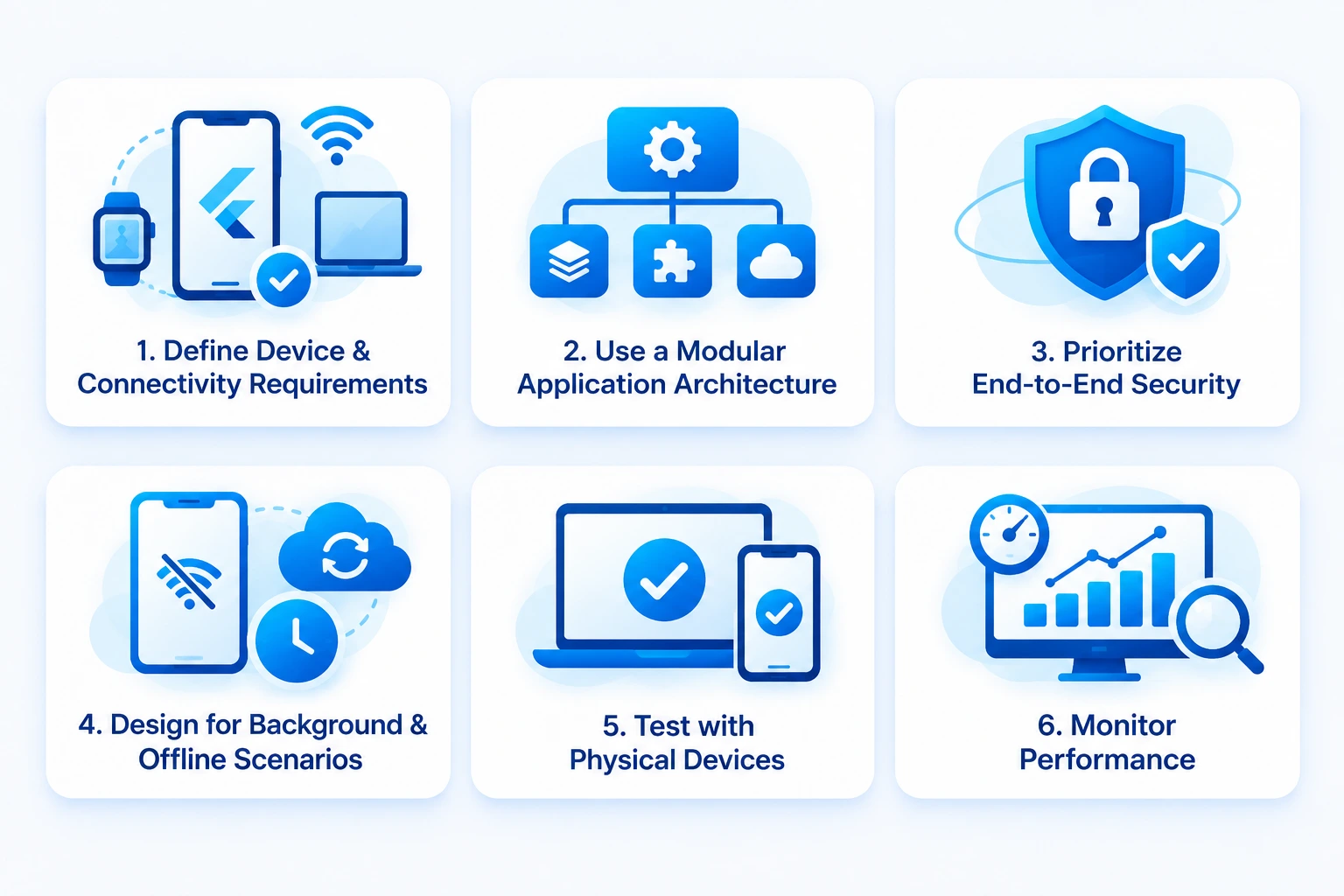
A successful IoT application requires more than framework selection. Businesses must establish an architecture that supports reliable device communication, secure data handling, and long-term maintenance.
1. Define Device and Connectivity Requirements Early
Identify supported device models, communication protocols, connection ranges, and expected data frequency before development begins.
This helps determine whether direct BLE connectivity, cloud messaging, or gateway-based communication is more appropriate.
2. Use a Modular Application Architecture
Separate the user interface, device communication, backend integrations, and business logic. This makes it easier to introduce new devices, update integrations, and maintain application functionality as the product expands.
3. Prioritize End-to-End Security
Use encrypted communication, secure authentication, appropriate device identity management, and protected data storage.
Avoid embedding sensitive credentials in the application or exposing device management operations without proper authorization.
4. Design for Background and Offline Scenarios
Determine which functions must operate when the application is minimized or disconnected. Use platform-supported background capabilities for essential mobile workflows, while assigning continuous device monitoring and critical processing to suitable device, edge, or backend systems.
5. Test with Physical Devices
Test BLE pairing, reconnection, device discovery, firmware compatibility, battery consumption, and network interruptions using actual hardware.
Physical device testing is particularly important because simulators cannot reproduce every Bluetooth and hardware interaction.
6. Monitor Application and Device Performance
Monitor application crashes, connection failures, message delivery, device availability, and synchronization issues. This helps businesses identify problems across the complete IoT ecosystem rather than focusing only on the mobile application.
Following these practices can help businesses build connected products that remain reliable as their device ecosystems grow. Experienced teams offering mobile app development services can also help evaluate application architecture, integrations, and long-term maintenance requirements.
Future Trends in React Native and IoT App Development
Advances in AI, edge computing, connectivity, and cloud-based device management are creating new opportunities for IoT applications.
1. AI-Powered IoT Applications
AI and machine learning can analyze device data to identify patterns, detect anomalies, and support predictive maintenance. For example, industrial applications can use equipment performance data to identify potential failures before they disrupt operations.
Businesses can explore Leveraging Machine Learning in React Native App Development to Build Smarter Apps to build smarter apps and understand how intelligent features can enhance mobile applications.
2. Edge Computing and Local Processing
Edge computing allows data to be processed closer to connected devices instead of sending every operation to the cloud. This can reduce communication delays and support selected operations during network interruptions.
React Native applications can display processed insights and device status while edge systems manage time-sensitive processing.
3. Improved BLE and Connected Device Ecosystems
Bluetooth Low Energy continues to support applications involving wearables, sensors, smart appliances, and connected accessories. As device ecosystems expand, application teams must prioritize interoperability, reliable pairing, and power-efficient communication.
4. Stronger Cloud-Based Device Management
Cloud IoT platforms are making it easier for businesses to manage connected devices, monitor telemetry, and coordinate device operations.
Integrations with platforms such as AWS IoT Core and Azure IoT Hub can support these workflows when combined with secure backend architecture.
5. More Capable Cross-Platform Frameworks
React Native and Flutter continue to evolve their native integration capabilities. However, framework improvements do not remove operating system restrictions or eliminate the need for native implementations in specialized hardware workflows.
Businesses should evaluate framework compatibility against actual device requirements rather than selecting a technology based only on general performance claims.
Relevant App Developed by RipenApps
RipenApps has experience developing mobile applications for businesses across different industries, including logistics and transportation. Its work reflects the importance of building applications that support real-time operations, reliable data exchange, and scalable user experiences. CargoMe, developed using React Native, is one example of its experience in building solutions for complex operational workflows.
CargoMe: Logistics platform
CargoMe is a logistics platform developed by RipenApps for the Tanzanian market. The application connects businesses with transporters and helps streamline delivery operations through a mobile-based platform. It was delivered in four months and supports transportation workflows as the platform grows.
The project has achieved:
- 10,000+ active transporters on the platform.
- 50,000+ deliveries completed.
- 26% monthly growth in platform activity.
CargoMe demonstrates RipenApps’ experience in building logistics applications that manage complex workflows and support growing operational demands. Its development reflects the mobile application expertise needed to support connected business ecosystems.
Conclusion
React Native offers a practical approach to building cross-platform applications for connected devices, smart homes, wearables, and industrial systems. Its shared codebase can simplify development and maintenance while supporting device and cloud integrations. An experienced IoT app development company can help businesses evaluate hardware compatibility, communication requirements, security, and scalability when planning such applications.
RipenApps helps businesses turn connected product ideas into reliable mobile applications through its IoT app development expertise, from selecting the right architecture to integrating devices and supporting long-term product growth.

FAQs
Q1. Can React Native use BLE in the background?
Partly. React Native BLE libraries can integrate with iOS background modes and Android background services, but both operating systems restrict background execution. Continuous monitoring may require native implementations and device-level processing.
Q2. Can I use BLE with Expo?
Yes. Expo applications can use BLE libraries such as react-native-ble-plx. However, BLE modules are not supported in Expo Go. You need an Expo development build with the required native configuration and permissions.
Q3. Is React Native or Flutter better for IoT app development?
Both frameworks support cross-platform IoT applications. React Native offers a JavaScript and TypeScript ecosystem, while Flutter provides its own UI framework and BLE packages. The right choice depends on hardware compatibility, background processing, team expertise, and maintenance requirements. Complex integrations may favor native development.
Q4. How much does it cost to develop an IoT application?
IoT app development can cost $15,000 to $500,000+, depending on device integrations, features, security, and infrastructure. Basic companion apps generally cost less than enterprise platforms. Hardware manufacturing and ongoing cloud expenses may require separate budgets.
Q5. How do I connect a React Native application to AWS IoT Core?
React Native applications can connect to AWS IoT Core through secure backend APIs or MQTT over WebSocket Secure. AWS supports authentication through AWS Signature Version 4 and custom authorizers. Implementations should include secure credentials, user authentication, and controlled access to MQTT topics.
Discuss your project and request for proposal
SHARE
WRITTEN BY

Vaibhav Sharma
Business Head
Vaibhav Sharma bridges product vision with real-world execution. He shares consultation with startups and enterprises to shape digital strategies, refine user journeys, and create app experiences that feel intuitive from day one. His strength lies in transforming early concepts into clear development roadmaps that set products up for long-term success.
View All Articles