

Key Takeaways
- Micro frontend architecture enables enterprise teams to develop, test, and deploy independent application modules with greater autonomy.
- Clear business boundaries and well-defined interfaces help reduce dependencies and simplify collaboration across distributed development teams.
- Integration patterns such as Module Federation, Single-SPA, and Web Components address different architectural and operational requirements.
- Micro frontends can improve scalability, but additional infrastructure, testing, monitoring, and governance increase implementation costs.
- Enterprises should evaluate application complexity, team structure, deployment needs, and long-term maintenance before adopting micro frontends.
As enterprise applications grow, frontend development becomes harder to coordinate. Multiple teams may work on the same codebase, share dependencies, and rely on a common release process. Consequently, even a small feature update can require extensive regression testing, cross-team coordination, and changes across several parts of the application.
Micro frontends offer an alternative by dividing a large frontend into smaller, independently managed applications. Each application can represent a business capability, such as customer accounts, payments, reporting, or product discovery. Teams can develop, test, and deploy these areas independently while maintaining a consistent user experience.
However, adopting this approach introduces new considerations around integration, performance, security, testing, and infrastructure costs. Before choosing this architecture, technology leaders must evaluate whether the benefits of team autonomy and independent releases justify the additional operational complexity.
Businesses planning a frontend transformation should assess how their architecture connects with APIs, backend systems, cloud infrastructure, and delivery workflows. Partnering with a full-stack web development company can help businesses evaluate these interconnected requirements and determine an appropriate approach to building scalable enterprise applications.
Table of Contents
What are Micro Frontends in Enterprise Web Development?
Micro frontends are an architectural approach that divides a large frontend application into smaller units that can be developed, maintained, and deployed independently when the implementation supports it.
The concept extends the principle of dividing software into manageable business capabilities to the user interface. Instead of requiring every feature to follow one shared frontend release process, organisations can assign specific areas of the product to different teams.
For example, an enterprise commerce platform might contain separate frontend applications for product discovery, customer accounts, checkout, and order management. Each team owns its functionality while following shared rules for navigation, authentication, accessibility, and design.
The result should still feel like one product to the user. Independent development does not mean creating disconnected interfaces or allowing teams to make incompatible technical decisions.
How Micro Frontends Differ From Traditional Frontend Development
A traditional frontend often shares one repository, dependency structure, build process, and release pipeline. This can simplify development because teams work within a consistent environment.
However, as the number of teams grows, shared dependencies and release coordination can become obstacles. A change in one area may affect unrelated functionality, and teams may need to wait for a common release window.
An independently managed frontend unit can have its own codebase, testing process, deployment pipeline, and release schedule. The degree of independence depends on the integration pattern and the boundaries established between teams.
Where Micro Frontends Fit in Enterprise Products
This architecture can be relevant to large SaaS platforms, enterprise dashboards, financial services portals, ecommerce marketplaces, and multi-product ecosystems.
These products often contain distinct business domains with different release requirements. Independent frontend ownership can help teams deliver changes without requiring every domain to follow the same development schedule.
Before choosing an approach, technology leaders should understand the broader web application architecture guide, including how frontend components interact with backend services, APIs, data layers, and security controls.
How Does Micro Frontend Architecture Work?
Micro frontend architecture defines how independently managed frontend applications are developed, integrated, deployed, and operated as a unified product.
The architecture typically includes a composition mechanism, routing rules, shared services, communication contracts, and delivery infrastructure. These elements determine how separate applications work together without becoming tightly coupled.
Core Components of Micro Frontend Architecture
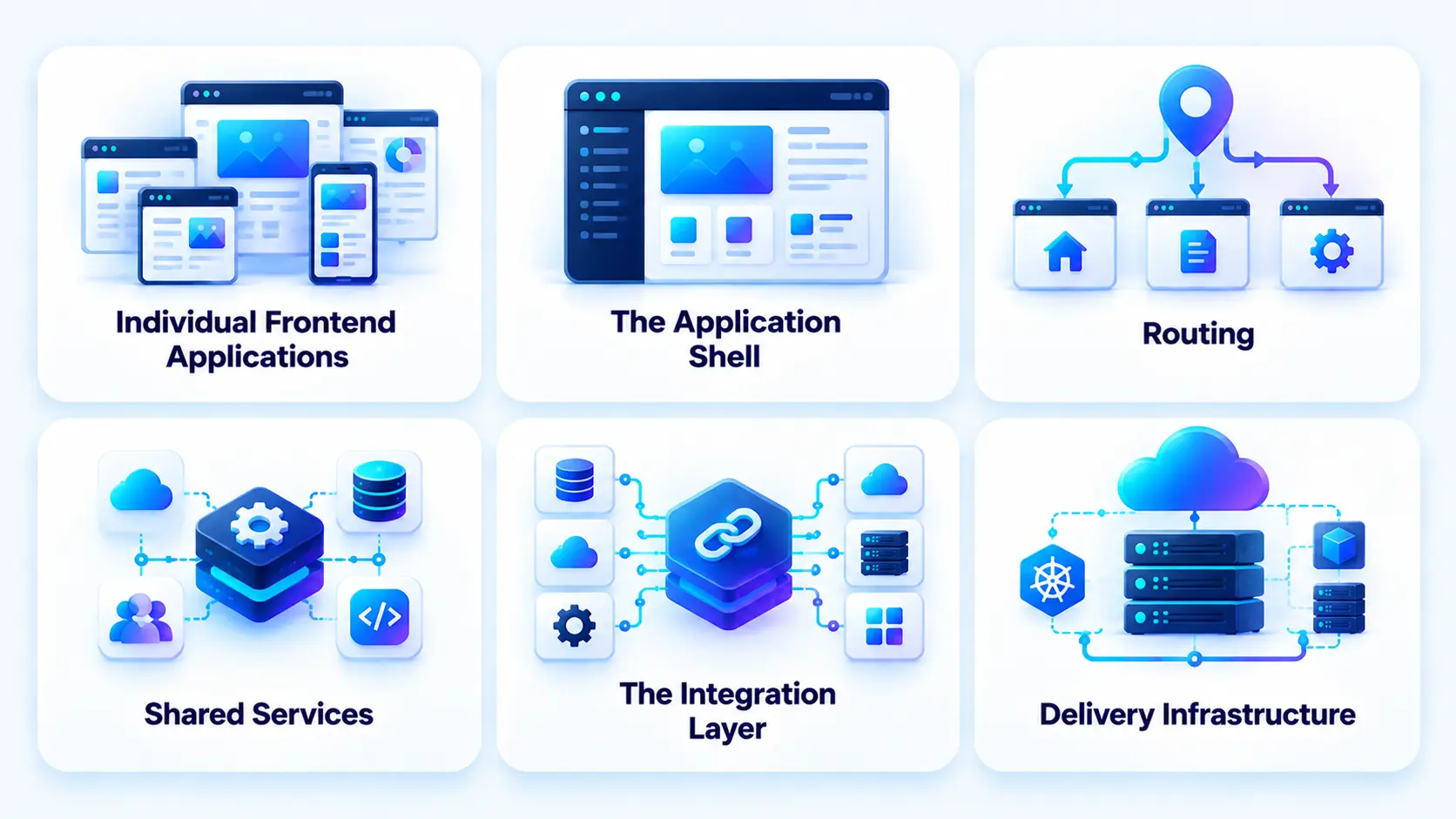
Micro frontend architecture divides a large frontend into smaller, independently managed applications that work together as a unified product. Each component has a specific responsibility, from rendering business functionality to managing navigation, sharing services, and supporting independent deployments.
1. Individual Frontend Applications
Individual frontend applications represent distinct business capabilities, such as customer accounts, payments, product catalogues, reporting, or order management. Each application can have its own codebase, development team, testing process, and release cycle.
These applications should have clearly defined boundaries so that teams can modify their modules without creating unnecessary dependencies on other parts of the system. For example, a team managing the checkout experience should be able to update payment-related interfaces without requiring the product catalogue team to release changes simultaneously.
2. The Application Shell
The application shell provides the shared structure that brings individual frontend applications together. It typically manages global navigation, page layouts, authentication flows, loading states, and the registration of frontend modules.
The shell also helps maintain a consistent experience across different sections of an enterprise application. However, it should avoid containing too much business logic. If every module depends heavily on the shell, it can become a bottleneck and reduce the independence that micro frontends are designed to provide.
3. Routing
Routing determines which frontend application or module appears when a user visits a particular URL. In a micro frontend environment, routing may be managed centrally by the application shell or delegated to individual modules for their internal navigation.
For example, an enterprise platform might route /accounts to the account management application and /reports to the reporting application. The routing strategy should support smooth navigation, preserve relevant user context, and handle invalid routes consistently.
Clear routing boundaries also help prevent conflicts when different teams develop new features or introduce changes to existing application paths.
4. Shared Services
Shared services provide common functionality that multiple frontend applications need. These may include authentication, analytics, feature flags, logging, error reporting, and user preference management.
Centralising selected services can reduce duplicated effort and improve consistency across the product. However, sharing too much application state or tightly coupling modules through common dependencies can undermine independent development.
Teams should determine which services need to be shared, define how applications access them, and establish clear ownership for updates and maintenance.
5. The Integration Layer
The integration layer determines how independently developed frontend applications are assembled into a working product. Depending on the architecture, integration can happen during the build process, at runtime in the browser, or on the server.
For example, a runtime integration approach can load separate frontend modules when users access particular sections of an application. This allows teams to deploy modules independently, provided that their interfaces and dependencies remain compatible.
The integration strategy should account for framework compatibility, module loading, error handling, and version management. Choosing an appropriate approach early can reduce integration problems as the number of frontend applications grows.
6. Delivery Infrastructure
Delivery infrastructure supports the development, testing, deployment, and monitoring of individual frontend applications. It typically includes CI/CD pipelines, automated testing, deployment environments, observability tools, and rollback mechanisms.
Each team should be able to validate and release its module without depending on a coordinated release of the entire frontend. Automated compatibility checks and monitoring can help identify issues before they affect users.
Infrastructure requirements should also account for the additional effort involved in maintaining multiple pipelines, tracking application performance, and managing releases across teams.
These components must work together through clearly defined responsibilities and interfaces. Without appropriate boundaries, the application shell can become a central bottleneck, shared services can create excessive dependencies, and teams may duplicate functionality across modules.
Common Integration Approaches
Several methods can be used to combine independently developed frontend applications.
- Build-time integration: Modules are combined during the build process. This can simplify runtime behaviour, but consumers may need to rebuild and redeploy when a dependency changes.
- Runtime integration: Applications load modules while the product is running. This supports independent releases but requires careful management of remote availability and compatibility.
- Server-side integration: Frontend fragments are composed on the server before the page is delivered to the browser. Rendering, caching, and failure handling need to be considered.
- Web Components: Browser-native custom elements can provide reusable integration boundaries between different implementations.
The appropriate approach depends on performance requirements, release independence, framework compatibility, and operational maturity.
How Independent Frontend Modules Communicate
Separate applications need a controlled way to exchange information. Common methods include custom browser events, explicit component properties, APIs, URL parameters, and carefully scoped shared state.
For example, a checkout application may need a customer identifier or cart reference. It should not require unrestricted access to every internal state variable maintained by the product catalogue.
Communication contracts should specify what information can be exchanged, which application owns the data, and how changes remain backward compatible. Excessive shared state can recreate the coupling that the architecture is intended to reduce.
Organisations planning legacy application modernization approach should assess how existing interfaces, dependencies, and communication patterns can be updated incrementally. This helps teams introduce micro frontends without disrupting critical business workflows or creating unnecessary dependencies between modules.
Micro Frontends vs Monolithic Frontend Architecture
A monolithic frontend typically uses one application structure and a coordinated release process. A micro frontend architecture separates selected business capabilities into independently managed applications.
Neither approach is universally better. The decision depends on team size, release requirements, application complexity, and the cost of maintaining additional infrastructure.
| Comparison factor | Monolithic frontend | Micro frontend architecture |
| Codebase structure | Centralised application | Multiple independently managed applications |
| Team ownership | Often shared across teams | Can be assigned to individual teams |
| Deployment | Typically coordinated | Can support independent deployments |
| Technology choices | Usually standardised | Can vary by application |
| Initial complexity | Generally lower | Generally higher |
| Testing | Shared regression testing | Local, integration, and end-to-end testing |
| Maintenance | Can become difficult as the codebase grows | Can isolate changes but adds integration overhead |
| Infrastructure | Usually simpler | Requires additional deployment and monitoring capabilities |
| Best suited for | Small to moderately complex products | Large products with autonomous teams and distinct domains |
When a Monolithic Frontend Is More Practical
A monolithic frontend can remain effective when a product has a small engineering team, limited domain complexity, and a predictable release process.
Teams can improve maintainability through modular code organisation, reusable components, clear interfaces, and automated testing without introducing independent runtime deployments.
This approach may also reduce infrastructure expenses and simplify debugging because fewer integration points need to be monitored.
Micro Frontends vs Modular Monolith
A modular monolith maintains one deployable application while enforcing internal boundaries between modules. Teams can work on separate business domains without necessarily creating independent runtime applications.
This can be a practical intermediate step for organisations that need clearer code ownership but do not require separate production release cycles. Independent frontend deployment becomes more compelling when shared releases repeatedly delay teams or when business domains have distinct operational requirements. Businesses should also compare enterprise apps vs microapps to understand when smaller, focused digital experiences are appropriate.
Micro Frontends vs Microservices
Micro frontends address frontend composition and ownership. Microservices address the decomposition of backend services into separately managed capabilities.
The two approaches can complement each other, but they are separate architectural decisions. An application may use multiple backend services with one frontend, or multiple frontend applications connected to a shared backend.
Organisations should align frontend and backend boundaries with business responsibilities rather than assuming that every frontend application requires a dedicated backend service.
Key Benefits of Micro Frontends for Enterprise Applications
The main benefit of independent frontend ownership is the opportunity to align development responsibilities with business capabilities. The value comes from reducing coordination friction, not simply from dividing an application into smaller parts.
Independent Development and Deployment
Teams can develop and release changes within their assigned domains without coordinating every update across the entire frontend. This can be useful when different business areas have different release priorities. A reporting team, for example, may need to introduce a dashboard enhancement while the account management team is working on a separate authentication improvement.
Independent delivery still requires compatibility rules, testing, and rollback procedures. A release should not break other applications that depend on its interfaces.
Improved Team Autonomy and Ownership
Clear domain ownership helps teams understand which functionality they are responsible for and where they should investigate issues. It can reduce ambiguity during incident response and make it easier to assign responsibility for maintenance, performance, accessibility, and feature delivery.
However, autonomy works best when teams follow shared standards. Without agreed conventions, separate teams may create inconsistent interfaces and incompatible dependencies.
Scalability for Complex Digital Products
Large products can expand individual business capabilities without continually increasing the responsibilities of one frontend team. A commerce organisation may need to enhance its catalogue, introduce new payment options, and improve customer account functionality simultaneously. Independent ownership can help these initiatives progress in parallel.
The benefit depends on the quality of the boundaries. Splitting tightly connected workflows into too many applications can increase communication and testing overhead.
Technology Flexibility
Different frontend applications can use different technologies when there is a clear technical or business reason. For example, an organisation may need to preserve a legacy interface while introducing a new application with a different framework.
Technology diversity should remain controlled because multiple frameworks can increase bundle size, onboarding effort, debugging complexity, and maintenance costs. Businesses planning a React-based implementation can evaluate their needs alongside ReactJS development services, particularly when deciding how to structure reusable components and maintain consistent engineering standards.
Better Fault Isolation and Maintainability
Separating applications can help teams identify which domain is responsible for a defect and limit the impact of some changes. However, isolation is not automatic. Shared dependencies, common authentication services, network failures, and integration problems can still affect the complete product.
Teams need consistent monitoring, error reporting, and fallback behaviour to make the architecture reliable.
Common Micro Frontend Architecture Patterns
The integration pattern determines how independent applications are composed. The right option depends on the existing tech stack for web app development, rendering requirements, and desired level of deployment independence.
Single-SPA Architecture
Single-SPA helps coordinate multiple frontend applications within a shared browser environment. It manages application lifecycles and determines when individual applications should become active. This can be useful when different teams maintain separate applications but need a common routing and integration structure. The organisation must still define how applications share authentication, styling, dependencies, and user context. Single-SPA provides an integration mechanism rather than a complete architecture or governance model.
Module Federation
Module Federation enables applications to expose and consume modules at runtime. A host application can load functionality from a remote application without necessarily rebuilding every consumer. This can support independently managed releases when the deployment model is designed for runtime loading. Teams need to manage remote entry points, shared dependency versions, compatibility, caching, and failure handling. They should also decide what users see if a remote application cannot be loaded.
Web Components-Based Architecture
Web Components provide browser-native standards for creating custom elements. They can help establish framework-neutral integration boundaries between applications. This approach can be useful when an organisation needs to combine different frontend implementations while maintaining stable component interfaces. Web Components do not automatically solve routing, authentication, state management, or deployment coordination. These concerns still require explicit design decisions.
Server-Side Composition
Server-side composition combines frontend fragments before delivering the resulting page to the browser. It can be useful when server-controlled rendering, initial page delivery, or integration with an existing server-rendered application is important.
The implementation must account for fragment availability, caching, rendering consistency, and failure handling. Teams should evaluate the operational complexity before selecting this approach. For teams evaluating JavaScript ecosystems and framework combinations, the MEAN vs MERN comparison can provide useful background on how different technology choices affect application development.
When Should Enterprises Adopt Micro Frontends?
Adoption should be based on measurable delivery constraints rather than architectural trends. Before approving a migration, technology leaders should identify the problem, estimate the value of solving it, and compare that value with the cost of additional complexity.
Signs Your Enterprise Has Outgrown a Monolithic Frontend
Several indicators may justify evaluating independent frontend delivery:
- Multiple teams regularly block one another because of shared releases.
- Changes to one feature frequently create regressions in unrelated areas.
- Different business domains have distinct roadmaps and accountable owners.
- Shared dependencies make routine updates difficult to coordinate.
- Release lead times are increasing as the application grows.
- A gradual migration is preferable to a complete rewrite.
- The organisation can support automated testing and deployment.
These indicators should be measured over several delivery cycles. A large codebase alone is not enough to justify a distributed architecture.
Business Scenarios Where Micro Frontends Make Sense
Large SaaS platforms may benefit when separate teams own billing, account management, analytics, and administration. Enterprise dashboards can use domain-based ownership when reporting, user management, and operational workflows follow different development schedules.
Ecommerce marketplaces may require independent changes to product discovery, checkout, seller management, and customer accounts. Financial services portals may have distinct onboarding, payments, and account servicing capabilities. For early-stage businesses, the architectural decision should reflect current product complexity and available engineering resources. The guidance in web development for startups can help frame why a simpler application structure may be more practical during initial product validation.
When Micro Frontends Are Not the Right Choice
A small application with one development team may gain little from separate deployment pipelines and runtime integration. Early-stage products may need to validate product-market fit before investing in complex architecture. A modular monolith can provide clear code boundaries while keeping deployment and maintenance simpler. Products with tightly coupled interfaces may also be difficult to divide into independently managed applications without extensive refactoring.
A Practical Decision Framework
| Decision factor | Consider micro frontends when | Prefer a monolith when |
| Team structure | Multiple teams own distinct domains | One small team owns the product |
| Release requirements | Modules need independent release cycles | Releases are coordinated and infrequent |
| Application complexity | The frontend has substantial complexity | The interface remains relatively simple |
| Technology strategy | Different stacks provide clear value | Standardisation is more valuable |
| Operational maturity | Teams can manage distributed delivery | Platform engineering resources are limited |
| Business value | Delivery delays have measurable costs | Expected benefits remain uncertain |
Organisations can score each factor from 1 to 5 to structure the decision. The score should support, rather than replace, engineering assessment and financial analysis. A low score in operational maturity deserves particular attention. Independent deployment introduces more moving parts, so adopting it before establishing reliable delivery practices can magnify existing problems.
How Much Do Micro Frontends Cost?
The cost of implementation depends on the number of applications, integration approach, state of the existing codebase, shared services, and engineering maturity.
A new product designed around independent frontend ownership has different requirements from a legacy application being migrated gradually. There is no universal development price that applies to every enterprise.
| Project scope | Illustrative budget | Typical scope |
| Small proof of concept | $10,000–$25,000 | One or two applications, basic integration, limited validation |
| Mid-sized implementation | $25,000–$75,000 | Several domains, shared shell, automated testing, deployment improvements |
| Complex enterprise migration | $75,000–$200,000+ | Legacy migration, multiple teams, advanced integration, observability, governance |
Actual costs may exceed these ranges for regulated systems, complex legacy applications, or products with extensive integration requirements.
Initial Development and Architecture Costs
Initial expenses can include architecture planning, application-shell development, routing, integration infrastructure, shared design systems, and the extraction of existing features. Discovery is particularly important when documentation is incomplete or business logic is deeply embedded in shared components.
Infrastructure and Deployment Costs
Independent delivery may require additional build pipelines, deployment environments, artifact storage, remote module delivery, monitoring, caching, and rollback mechanisms. These expenses should be estimated during architecture planning rather than treated as minor post-launch costs.
Maintenance and Long-Term Operational Costs
Recurring costs include dependency updates, security remediation, production support, integration testing, performance monitoring, and shared-library maintenance. As the number of applications increases, teams may spend more time maintaining compatibility and coordinating changes across boundaries.
Key Factors That Influence the Total Cost
The most important cost drivers include:
- Number of applications and their complexity.
- Condition and structure of the existing codebase.
- Integration strategy and runtime requirements.
- Team size and engineering rates.
- Framework diversity and dependency duplication.
- Performance, accessibility, and security requirements.
- Testing and deployment maturity.
- Legacy-system constraints and migration overlap.
A useful estimate separates discovery, integration, migration, testing, infrastructure, and ongoing maintenance rather than calculating the budget from the number of components alone.
Micro Frontends vs Monolithic Frontends: Cost Comparison
A monolithic frontend typically requires less initial infrastructure because development, testing, and deployment follow a more centralised process. This can make it a cost-effective option for applications with smaller teams, simpler workflows, and limited scaling requirements.
Micro frontends may require additional investment in deployment automation, monitoring, contract testing, and architectural governance. However, these costs can be justified when shared releases delay development teams, increase coordination overhead, or make application changes more difficult to manage.
To make an informed decision, businesses should compare the total cost of ownership rather than focusing solely on initial development expenses. This includes engineering effort, infrastructure, maintenance, production incidents, and the financial impact of delayed releases. Understanding the factors that influence enterprise app development cost can help businesses assess these expenses in the context of their application’s scope, technical requirements, team structure, and long-term operational needs.
How to Implement Micro Frontends in an Enterprise Environment
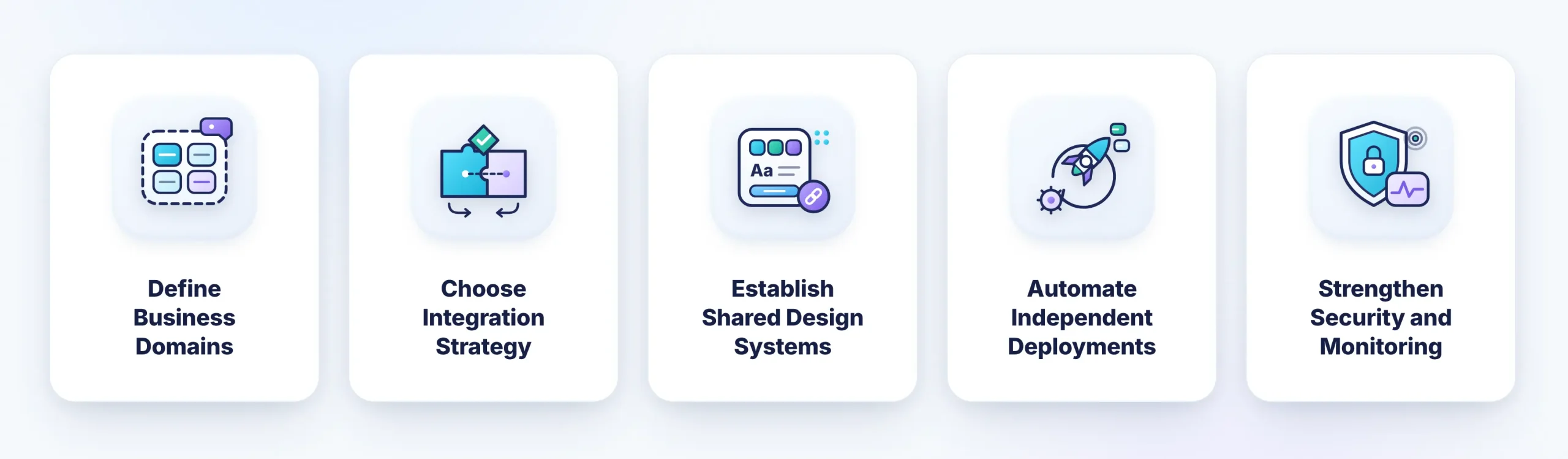
A phased implementation helps organisations validate the architecture before applying it to the entire product.
1. Identify Business Domains and Define Module Boundaries
Start by mapping the application around business capabilities with distinct responsibilities and relatively stable interfaces. Possible domains include account management, billing, inventory, analytics, or customer support. The boundaries should reflect business rules rather than arbitrary page groupings. Document ownership, data responsibilities, dependencies, and the interfaces each domain exposes to other applications.
2. Choose the Right Integration Strategy
Evaluate build-time integration, runtime loading, server-side composition, and Web Components. Consider release independence, rendering requirements, framework compatibility, performance, and operational maturity. The simplest pattern that satisfies the requirements is usually the strongest starting point. A more complex approach should be justified by a specific business or technical need.
3. Establish Shared Design Systems and UI Standards
Define common components, design tokens, accessibility expectations, navigation rules, and interaction patterns. A shared design system reduces duplication and helps independent applications provide a consistent user experience. The organisation should also establish a controlled process for changing shared components because updates may affect several teams.
4. Set Up Independent CI/CD Pipelines
Automated pipelines should build, test, validate, and deploy individual applications. Deployment controls should include environment configuration, compatibility checks, release validation, and rollback procedures. Teams should be able to identify which version of each application is running in production.
Strong delivery automation is particularly important when several teams manage independent release cycles. Organisations may evaluate DevOps consulting services to strengthen deployment automation, monitoring, and release governance.
5. Implement Security, Testing, and Monitoring
Security requirements should cover authentication, authorisation, dependency scanning, secure configuration, and sensitive data handling. Testing should include local unit tests, integration tests, contract tests, accessibility validation, and end-to-end checks for critical user journeys. Consistent error reporting and performance monitoring help teams investigate failures that cross application boundaries.

Common Challenges of Micro Frontend Architecture
Independent ownership can improve delivery, but it also creates new failure modes. Organisations should design controls around these risks from the beginning.
Increased Architectural and Operational Complexity
Each application may introduce its own pipeline, dependencies, configuration, and operational responsibilities.
How to address it: Standardise common delivery practices, keep the application shell focused, and avoid creating additional applications unless the benefits justify the overhead.
Performance Overhead and Duplicate Dependencies
Separate applications can load overlapping libraries or introduce additional network requests.
How to address it: Establish performance budgets, measure real-user metrics, optimise code splitting, and review dependency-sharing decisions. Sharing every dependency is not always desirable because it can create tighter coupling.
Inconsistent User Experience
Different teams may introduce inconsistent layouts, navigation, terminology, or accessibility behaviours.
How to address it: Maintain shared design standards and review complete user journeys across application boundaries. Assign clear ownership for common components.
Cross-Module Testing and Debugging
A user journey may cross several applications, making it harder to identify the origin of a defect.
How to address it: Use consistent logging, error reporting, trace identifiers, release metadata, and integration tests. Teams should be able to identify the responsible application and its deployed version.
Governance and Dependency Management
When multiple teams manage separate frontend modules, differences in library versions, framework choices, and shared functionality can introduce compatibility issues. Without clear ownership and coordination, these differences may increase maintenance effort and make integration more difficult.
How to address it: Establish lightweight architectural standards, document component ownership, and automate compatibility checks wherever practical. This approach helps maintain consistency without requiring central approval for every routine development decision.
Addressing these risks early is important because web application development challenges such as integration complexity, scalability limitations, and ongoing maintenance can affect the reliability and long-term sustainability of enterprise applications.
Best Practices for Building Scalable Micro Frontends
The following practices help organisations maintain independent delivery without losing control of the overall product.
- Define ownership boundaries around business domains. Each application should have a clear purpose and accountable team.
- Keep the application shell lightweight. Central orchestration should not become a bottleneck for routine feature changes.
- Minimise shared state. Prefer explicit communication contracts and clearly defined data ownership.
- Standardise design and accessibility. Shared standards help independent teams maintain a consistent user experience.
- Establish performance budgets. Monitor initial loading, script size, runtime requests, and Core Web Vitals.
- Automate testing and deployment. Validate local functionality, integration contracts, and complete user journeys.
- Manage dependencies deliberately. Define version policies and review the effect of shared-library changes.
- Centralise critical security controls. Maintain consistent identity, access, and data-handling requirements.
- Introduce changes incrementally. Begin with a pilot and expand only after the results demonstrate value.
- Review architecture boundaries regularly. Consolidate applications when independent deployment no longer provides sufficient benefit.
Cloud environments also influence how modules are deployed, monitored, and scaled. Businesses planning infrastructure for independently released applications can explore cloud architecture services to evaluate hosting, integration, reliability, and operational requirements.
The Future of Micro Frontends in Enterprise Web Development
Frontend architecture will continue to evolve alongside build tooling, browser capabilities, cloud infrastructure, and platform engineering practices.
Improved Module Federation Tooling
More mature tooling can make it easier to manage remote modules, validate dependencies, and coordinate runtime integration. However, teams will still need clear contracts and release policies.
Greater Emphasis on Platform Engineering
Central platform teams can provide reusable deployment pipelines, monitoring, security checks, and design-system tooling.
The objective is to make independent delivery easier without requiring every product team to solve the same infrastructure problems separately.
AI-Assisted Frontend Development
AI-assisted tools may help teams generate components, create tests, document interfaces, and identify potential code issues.
These tools do not remove the need for sound architecture. Teams must still validate generated code, enforce security standards, and ensure that changes remain compatible across applications.
More Deliberate Architectural Simplification
Mature organisations may find that some applications no longer require separate deployment pipelines or independent ownership. Consolidating these components can reduce infrastructure overhead, simplify maintenance, and improve coordination between development teams. The decision should depend on business requirements rather than a preference for architectural complexity.
The goal is not to maximise the number of independent components. It is to preserve the boundaries that continue to deliver business value while keeping the overall architecture manageable.
Organisations using Angular should evaluate framework updates against their existing codebase, compatibility requirements, and long-term maintenance plans. Understanding Angular v22 and its latest capabilities can help teams assess how framework improvements fit into their frontend roadmap and whether existing applications need architectural or technical changes.

Final Thoughts
Micro frontends can help large product teams manage frontend complexity by aligning ownership with business capabilities and enabling more independent delivery. Their value is strongest when teams have distinct release requirements, clear domain boundaries, and the operational maturity to manage distributed deployment.
However, the approach also introduces costs related to integration, testing, dependency management, infrastructure, performance, and governance. A modular monolith may remain the better choice when a product has limited complexity or does not require independent release cycles.
Before making the investment, assess the existing codebase, identify measurable delivery constraints, and estimate the full cost of implementation and maintenance. Start with a well-defined pilot, validate the results against a baseline, and expand only when the benefits justify the additional complexity. For organisations planning an Angular-based frontend or evaluating a gradual transition from legacy technologies, partnering with an experienced Angular development company like RipenApps can help assess implementation requirements and align architecture decisions with business goals.
FAQs
1. What Are Micro Frontends in Enterprise Web Development?
Micro frontends divide a large frontend into smaller applications that can be owned and maintained independently. Each application delivers a specific business capability while following shared standards for integration, navigation, security, and user experience.
2. How Can Organisations Modernise a Legacy Frontend Without Rebuilding Everything?
A gradual migration can begin by identifying a business capability with clear boundaries, extracting it into an independently managed application, and validating the integration approach. Teams can then expand the migration as they gain evidence about cost, performance, and maintainability. A structured application modernization strategy can help businesses plan the transition while managing technical debt and operational risk.
3. How Does Micro Frontend Architecture Work?
The application is divided into domain-oriented frontend units. An application shell or another composition mechanism connects them through defined interfaces. Depending on the design, integration may occur during the build, at runtime, or on the server.
4. How Much Does It Cost to Implement Micro Frontends?
A small proof of concept may require an illustrative budget of $10,000–$25,000, while a mid-sized implementation may cost $25,000–$75,000. Complex enterprise migrations can exceed $200,000. Actual costs depend on scope, legacy complexity, testing, infrastructure, and team rates.
5. Are Micro Frontends Better Than Monolithic Frontend Architecture?
They can be more suitable when several teams need independent release cycles and own distinct business domains. A monolithic frontend is often simpler and more economical for smaller products or teams that can coordinate releases effectively.
6. Which Frameworks and Tools Are Used to Build Micro Frontends?
Implementations may use React, Angular, Web Components, Single-SPA, Module Federation, or server-side composition. The right combination depends on integration requirements, developer skills, performance expectations, and long-term maintenance needs.
For organisations maintaining older AngularJS applications, this guide to AngularJS for web and mobile app development can provide background when evaluating existing framework dependencies and modernisation options.
7. What Are the Biggest Challenges of Micro Frontend Architecture?
Common challenges include integration complexity, duplicated dependencies, inconsistent user experiences, performance overhead, cross-application testing, and governance. Shared standards, automated testing, and clear ownership help manage these risks.
8. When Should a Business Avoid Micro Frontends?
Businesses should reconsider the approach when the application is small, the team is limited, the interface is tightly coupled, or independent releases provide little measurable value. A modular monolith may deliver better maintainability with less operational overhead.
Discuss your project and request for proposal
SHARE
WRITTEN BY

Ishan Gupta
CEO & Founder
Ishan Gupta is a seasoned entrepreneur and CEO with extensive 10+ years of experience in business and mobile app development landscape. He believes that the right digital product allows companies to focus on what they do best, while technology handles the rest. With deep exposure to global markets, he understands what makes an app succeed. His approach translates business needs into clear product strategies, ensuring that every feature contributes to measurable ROI.
View All Articles