
Quick Summary
Businesses need a scalable, secure, and cost-efficient IT infrastructure to support long-term growth. Addressing cybersecurity risks, outdated systems, cloud costs, and integration challenges requires strategic planning and continuous optimisation. With the right technology roadmap, organisations can improve operational efficiency, strengthen reliability, and prepare their digital infrastructure for evolving business demands.
Information technology has become central to how businesses operate, serve customers, manage data, and compete in changing markets. However, as technology ecosystems become more complex, organisations face growing concerns, including cybersecurity threats, rising infrastructure costs, outdated systems, talent shortages, and the need for continuous digital innovation.
For many organisations, IT challenges extend beyond technical teams and directly affect business performance. System downtime can interrupt daily operations, security breaches can damage customer trust, and inefficient infrastructure can increase expenses while slowing product development. These issues can also limit an organisation’s ability to respond to market changes, improve customer experiences, and maintain a competitive advantage.
Addressing these challenges requires a proactive approach to technology management. Businesses must regularly evaluate their existing systems, identify operational weaknesses, strengthen security measures, and ensure that technology investments align with their long-term objectives. Modernising legacy applications, improving data integration, optimising cloud resources, and adopting emerging technologies strategically can help organisations build more resilient IT environments.
Partnering with a mobile application development company can also help businesses develop reliable digital solutions that meet evolving customer expectations and support operational efficiency. External technology expertise can be particularly valuable when internal teams lack the resources or specialised skills required for complex projects.
This guide explores ten major IT challenges businesses face today, examines their impact on operations and growth, and explains practical strategies organisations can use to overcome them and build a more secure, scalable, and future-ready technology infrastructure.
Table of Contents
Understanding the Impact of IT Challenges on Businesses
Technology problems rarely exist in isolation. A legacy application may introduce security vulnerabilities, increase maintenance expenses, and prevent integration with modern platforms. Similarly, poor data management can affect reporting accuracy, customer experiences, and strategic decisions.
The consequences vary according to an organisation’s size, industry, and technology maturity. Small businesses may struggle with limited budgets and a lack of in-house expertise, while enterprises often face complex integrations, regulatory obligations, and infrastructure management across multiple locations.
These challenges can increase operational expenses, reduce employee productivity, expose sensitive information, and limit business agility. Unreliable applications may also frustrate customers, delay transactions, and undermine trust in digital services.
Understanding these consequences helps decision-makers prioritise technology investments according to business risk rather than reacting to individual technical issues without considering their wider impact.
Key Technology Issues Businesses Need to Address
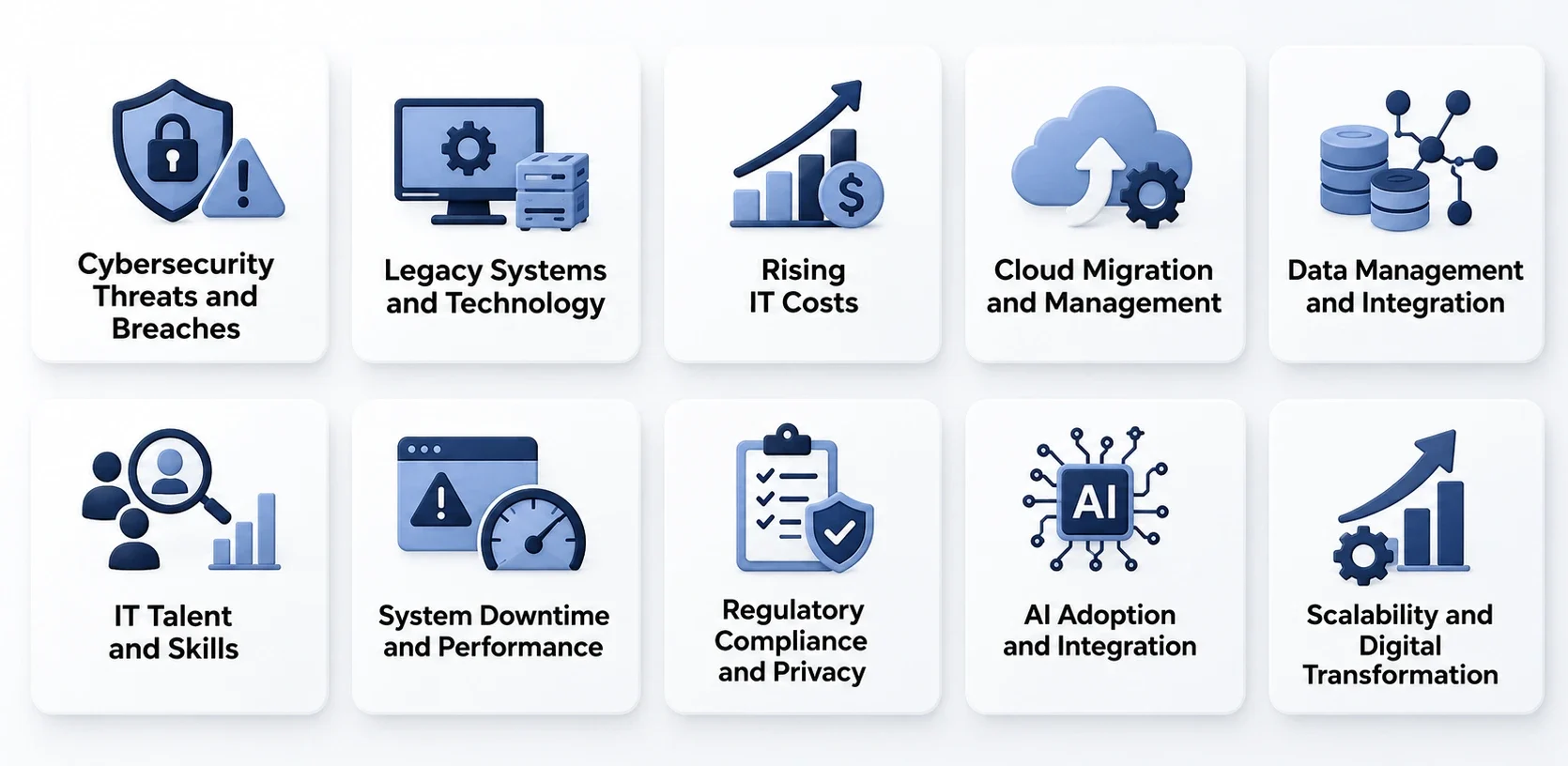
Businesses face a wide range of technology-related issues that can affect productivity, security, operational efficiency, and long-term growth. These challenges often stem from evolving cyber threats, outdated infrastructure, increasing data volumes, and the complexity of managing interconnected systems.
Understanding the root causes and potential consequences of these problems helps organisations prioritise investments, strengthen IT operations, and make informed technology decisions. The following sections examine ten key IT challenges businesses need to address and the practical steps they can take to overcome them.
1. Cybersecurity Threats and Data Breaches
Cybersecurity remains one of the most significant concerns for businesses that rely on digital systems. Organisations handle customer information, employee records, financial transactions, intellectual property, and confidential operational data. Each additional application, integration, and connected device can introduce potential vulnerabilities.
Cybercriminals use phishing, ransomware, credential theft, and malicious software to gain unauthorised access to business systems. Even organisations with established security measures can face risks when employees use weak passwords, software remains unpatched, or third-party services have inadequate controls.
A successful attack can disrupt operations, expose confidential information, trigger regulatory consequences, and damage a company’s reputation.
How to overcome this challenge
Businesses should implement a layered cybersecurity strategy that combines technical safeguards, employee awareness, and continuous monitoring. Multifactor authentication, role-based access controls, encryption, timely security patches, and regular vulnerability assessments can reduce exposure to common threats.
Organisations should also maintain tested backups and documented incident response procedures. Employee training is equally important because phishing attempts and social engineering frequently exploit human behaviour rather than technical vulnerabilities.
Security should be integrated into application planning, development, deployment, and maintenance. Businesses can explore enterprise application security to understand how security controls can protect business applications and sensitive information.
2. Legacy Systems and Outdated Technology
Legacy systems continue to support essential business functions across industries. However, applications built on outdated frameworks, unsupported software, or rigid architectures can become increasingly expensive and difficult to maintain.
These systems may lack compatibility with modern APIs, cloud platforms, analytics tools, and emerging technologies. Finding developers who understand older technologies can also become challenging, increasing the risk of operational disruption when experienced employees leave.
Continuing to rely on outdated systems may limit innovation while creating security and reliability concerns.
How to overcome this challenge
Businesses should assess their existing applications, infrastructure, dependencies, and operational requirements before deciding how to modernise them. Some systems may require targeted upgrades, while others may benefit from replatforming, refactoring, replacement, or retirement.
A phased modernisation approach can reduce disruption and make technology expenditure easier to manage. It also allows organisations to preserve critical business functions while gradually replacing components that restrict performance or integration.
Businesses should choose a modernisation approach based on their existing infrastructure, technical limitations, security requirements, and long-term objectives. Reviewing legacy application modernization strategies can help organisations evaluate different approaches, understand their potential benefits, and determine how to update outdated systems while minimising operational disruption.
3. Rising IT Costs and Budget Constraints
Technology investments can become difficult to manage when businesses lack clear visibility into spending. Software subscriptions, cloud infrastructure, licensing, maintenance, cybersecurity, and specialist resources all contribute to the overall IT budget.
Cloud services can introduce additional complexity because consumption-based pricing changes with usage. Unused resources, oversized instances, unnecessary data storage, and inefficient workloads can increase monthly bills without delivering additional business value.
For smaller organisations, these expenses can limit the resources available for innovation. Larger businesses may experience fragmented spending across departments and technology platforms.
How to overcome this challenge
Businesses should establish a clear view of total IT expenditure and connect spending decisions to measurable business outcomes. Regular audits can identify redundant applications, unused cloud resources, overlapping subscriptions, and inefficient workloads.
Organisations should also establish spending alerts, monitor infrastructure consumption, review vendor contracts, and forecast capacity requirements before major product launches. Tracking metrics such as cost per transaction or cost per active user can help determine whether technology investments deliver appropriate value.
Cloud spending should be reviewed regularly rather than addressed only when budgets are exceeded. Businesses can monitor resource usage, remove unused services, adjust computing capacity, and set spending alerts to prevent unnecessary expenses. A consistent approach to cost management helps organisations balance infrastructure performance with financial goals. By implementing practical cloud cost optimization strategies, businesses can identify spending inefficiencies, allocate resources more effectively, and maintain a cost-efficient cloud environment as their operational requirements grow.
4. Cloud Migration and Infrastructure Management
Cloud computing enables businesses to access flexible infrastructure, managed services, and scalable computing resources. However, moving applications and data to the cloud can introduce challenges involving architecture, security, compatibility, performance, and cost management.
Applications designed for on-premises environments may not perform efficiently after migration. Poorly planned transitions can also cause service interruptions, data inconsistencies, and unexpected expenses.
Once migration is complete, organisations must continue managing access permissions, backups, monitoring, resource allocation, and infrastructure changes.
How to overcome this challenge
A successful cloud strategy begins with evaluating application dependencies, business priorities, security requirements, and workload characteristics. Businesses should establish a migration roadmap that includes application discovery, dependency mapping, data validation, recovery planning, and performance testing.
Organisations must also select appropriate cloud services and deployment models based on their workloads rather than assuming every application should be migrated in the same way. Identity management, access controls, monitoring, and cost tracking should be incorporated into the process from the beginning.
Businesses should plan cloud migration carefully to avoid security gaps, data loss, and unexpected operational disruptions. Before moving workloads, organisations need to assess application dependencies, review access permissions, validate backup procedures, and establish clear recovery plans.
Following a cloud migration and data security checklist can help businesses identify potential risks early and ensure that critical data remains protected throughout the migration process. This preparation also makes it easier to maintain business continuity and establish a secure foundation for managing cloud infrastructure as operational requirements evolve.
5. Data Management and Integration Issues
Businesses increasingly depend on information collected from customer relationship management platforms, enterprise resource planning systems, websites, mobile applications, analytics platforms, and external services.
When these systems operate independently, data becomes fragmented. Different departments may maintain conflicting records, reports may contain outdated information, and employees may need to enter the same information repeatedly.
Poor data quality also affects decision-making. Incomplete, duplicated, or inconsistent records can undermine analytics, forecasting, personalisation, and automation initiatives.
How to overcome this challenge
Businesses need a structured approach to data governance, integration, and quality management. Clear data ownership, consistent validation rules, standardised formats, and appropriate access policies can help maintain reliable information across systems.
Integrating applications through suitable APIs and data pipelines can reduce manual data entry and improve information exchange. Organisations should also monitor data quality, resolve duplicate records, and establish appropriate retention policies.
A centralised data architecture can improve visibility, but the right solution depends on existing systems and business requirements. Organisations with specialised reporting or operational needs may benefit from custom data management software designed around their workflows.
6. IT Talent Shortages and Skills Gaps
Technology evolves rapidly, making it challenging for businesses to maintain all the technical skills required to manage modern IT environments. Organisations often need expertise in cloud computing, cybersecurity, artificial intelligence, data engineering, application development, and infrastructure automation.
Hiring specialists for every technology can increase costs and place additional pressure on internal teams. Businesses can address these gaps by investing in employee training, adopting suitable tools, and collaborating with external technology experts when needed. This approach helps organisations strengthen their technical capabilities, improve operational efficiency, and adapt to changing technology requirements without overburdening existing teams.
How to overcome this challenge
Businesses should identify the capabilities required to achieve their technology objectives and compare them with existing team strengths. Continuous training, professional certifications, and internal knowledge-sharing programmes can help employees develop relevant skills.
Automation can also reduce repetitive operational work, allowing teams to focus on higher-value responsibilities. When specialised expertise is required for a limited period, managed services or external technology partnerships may be more practical than permanent recruitment.
A custom application development company can help businesses address specific software requirements when internal teams lack the necessary development capacity. The right partnership should complement internal expertise, maintain clear accountability, and support knowledge transfer where appropriate.
7. System Downtime and Performance Issues
Application downtime and slow system performance can interrupt business operations, frustrate customers, and reduce employee productivity. For businesses that depend on digital transactions, even a brief outage may affect revenue and customer confidence.
Performance problems can arise from overloaded servers, inefficient database queries, network bottlenecks, software defects, configuration errors, or insufficient capacity planning.
Without effective monitoring, teams may only discover these issues after users report failures.
How to overcome this challenge
Organisations should establish a reliability strategy that combines proactive monitoring, performance testing, and structured incident management. Monitoring application availability, latency, and error rates can help teams detect problems before they significantly affect users.
Load and stress testing should be performed before major releases or anticipated increases in traffic. Automated alerts, tested backups, disaster recovery procedures, and controlled software deployments can further reduce the impact of service interruptions.
Regular maintenance is essential for keeping applications secure, compatible, and reliable. The application maintenance guide explains important considerations for maintaining software after deployment. Businesses should evaluate performance using measurable indicators rather than relying solely on user complaints or occasional manual checks.
8. Regulatory Compliance and Data Privacy
Businesses operating in regulated industries or handling personal information must meet applicable legal, contractual, and industry requirements. These obligations may relate to data collection, consent, access, retention, storage, processing, and breach reporting.
Requirements vary by jurisdiction and business activity. Organisations handling protected health information in the United States, for example, may need to comply with applicable HIPAA requirements, while businesses processing personal data in the European Union may be subject to the GDPR.
Compliance becomes more difficult when information flows across multiple applications, vendors, cloud environments, and international locations.
How to overcome this challenge
Businesses should identify which requirements apply to their operations and translate them into practical technical and organisational controls. Maintaining an inventory of sensitive data, documenting information flows, and applying appropriate access restrictions can improve visibility and accountability.
Encryption, audit logs, data retention policies, vendor assessments, and documented incident response procedures should be incorporated into operational processes. Organisations should also review compliance controls whenever applications, business processes, or regulatory obligations change.
Privacy and compliance requirements should be considered during product planning rather than added after development is complete. Periodic risk assessments and qualified legal or compliance advice can help businesses interpret their specific obligations.
9. AI Adoption and Emerging Technology Integration
Artificial intelligence, automation, and advanced analytics offer opportunities to improve productivity, customer experiences, and decision-making. However, adopting these technologies can be challenging when businesses lack reliable data, clear use cases, technical expertise, or suitable governance policies.
Some organisations invest in AI tools without defining the business problem they are expected to solve. Others underestimate integration complexity, ongoing inference costs, data privacy requirements, or the need for human oversight.
AI systems can also generate inaccurate outputs, expose sensitive information, or produce inconsistent results if they are not evaluated carefully.
How to overcome this challenge
Businesses should begin with a clearly defined problem rather than adopting technology simply because it is new. A small proof of concept can help validate feasibility before an organisation commits to a larger implementation.
The evaluation should consider data quality, accuracy, reliability, latency, integration effort, and total cost. Organisations should also establish appropriate governance for data use, model access, human review, and ongoing performance monitoring.
For example, businesses exploring intelligent features in customer-facing applications can review AI in mobile app development for relevant use cases and implementation considerations.
Cloud-based AI deployments also require careful attention to access permissions, data exposure, and application vulnerabilities. Businesses should evaluate security controls throughout implementation and monitor systems after deployment to ensure that emerging technologies remain reliable and appropriately governed.
The priority should be responsible adoption that delivers measurable improvements rather than experimentation without a defined business outcome.
10. Scalability and Digital Transformation
Business growth places new demands on technology. An application that performs well with a small user base may struggle when transaction volumes increase, new markets are introduced, or additional integrations become necessary.
Digital transformation can also become difficult when organisations attempt to replace multiple systems simultaneously without clear priorities. Poorly coordinated initiatives may create overlapping tools, inconsistent processes, employee resistance, and unnecessary expenditure.
Scalability therefore requires more than increasing server capacity. It involves preparing applications, infrastructure, data, and operational processes for future demands.
How to overcome this challenge
Businesses should connect digital transformation initiatives to specific objectives, such as improving customer retention, reducing processing time, or expanding into new markets. Existing applications and workflows should be assessed to identify bottlenecks and opportunities for improvement.
Modular architectures, automation, reliable integrations, and phased implementation can help organisations accommodate changing requirements. Employee training and clear communication are equally important because successful transformation depends on adoption as well as technical delivery. When planning digital transformation, businesses should assess their existing applications, identify operational bottlenecks, and prioritise improvements according to their growth objectives.
Understanding common enterprise application development challenges can help organisations anticipate integration issues, scalability limitations, and maintenance requirements before investing in new systems. This approach enables businesses to make informed technology decisions, reduce implementation risks, and build an IT infrastructure that can adapt to changing operational demands. Digital transformation is most effective when technology investments, business processes, and employee capabilities evolve together.
Best Practices for Building a Resilient IT Strategy
Addressing individual technology problems is important, but businesses also need a consistent strategy for preventing recurring issues. A resilient IT strategy establishes clear priorities, defines ownership, and ensures that technology investments support business goals.
1. Conduct Regular IT Assessments
Review applications, infrastructure, security controls, contracts, integrations, and operational processes. Identify systems that create excessive risk or cost, and prioritise improvements according to their business impact.
2. Align Technology Spending With Business Objectives
Every major investment should have a clear purpose. Establish measurable targets such as reduced downtime, lower operating costs, improved conversion rates, or faster processing times. Regular budget reviews can help decision-makers determine whether existing investments continue to deliver value.
3. Strengthen Security Across the Technology Lifecycle
Integrate security reviews into planning, development, deployment, and maintenance. Review access permissions, patching schedules, backup procedures, and third-party dependencies regularly to reduce the likelihood and impact of security incidents.
4. Standardise Monitoring and Incident Response
Use consistent monitoring practices to identify performance issues early. Assign clear responsibilities for responding to incidents and document lessons learned after service disruptions. This creates a repeatable process for improving system reliability.
5. Establish a Structured Maintenance Schedule
Keep software, dependencies, and infrastructure updated. Plan maintenance around business priorities, test changes before release, and maintain recovery options for critical systems. Proactive maintenance can reduce unexpected failures and the cost of emergency repairs.
6. Improve Integration and Data Governance
Define data ownership, integration standards, and quality controls. Reduce unnecessary duplication and ensure that teams can access accurate information when they need it. Consistent governance also supports more reliable analytics and automation.
7. Evaluate External Technology Partnerships
When internal resources are insufficient, assess potential partners based on technical expertise, relevant experience, security practices, communication, delivery processes, and post-launch support. Clear expectations and accountability help businesses make effective use of external capabilities.
8. Review Performance Continuously
Track a focused set of metrics, including availability, incident resolution time, infrastructure cost, security findings, and project delivery performance. Use these indicators to refine priorities, allocate budgets, and identify opportunities for improvement.
A resilient IT strategy is not a static document. It should evolve as the organisation grows, its risks change, and new technologies become relevant.
How to Prepare Your IT Infrastructure for Future Growth
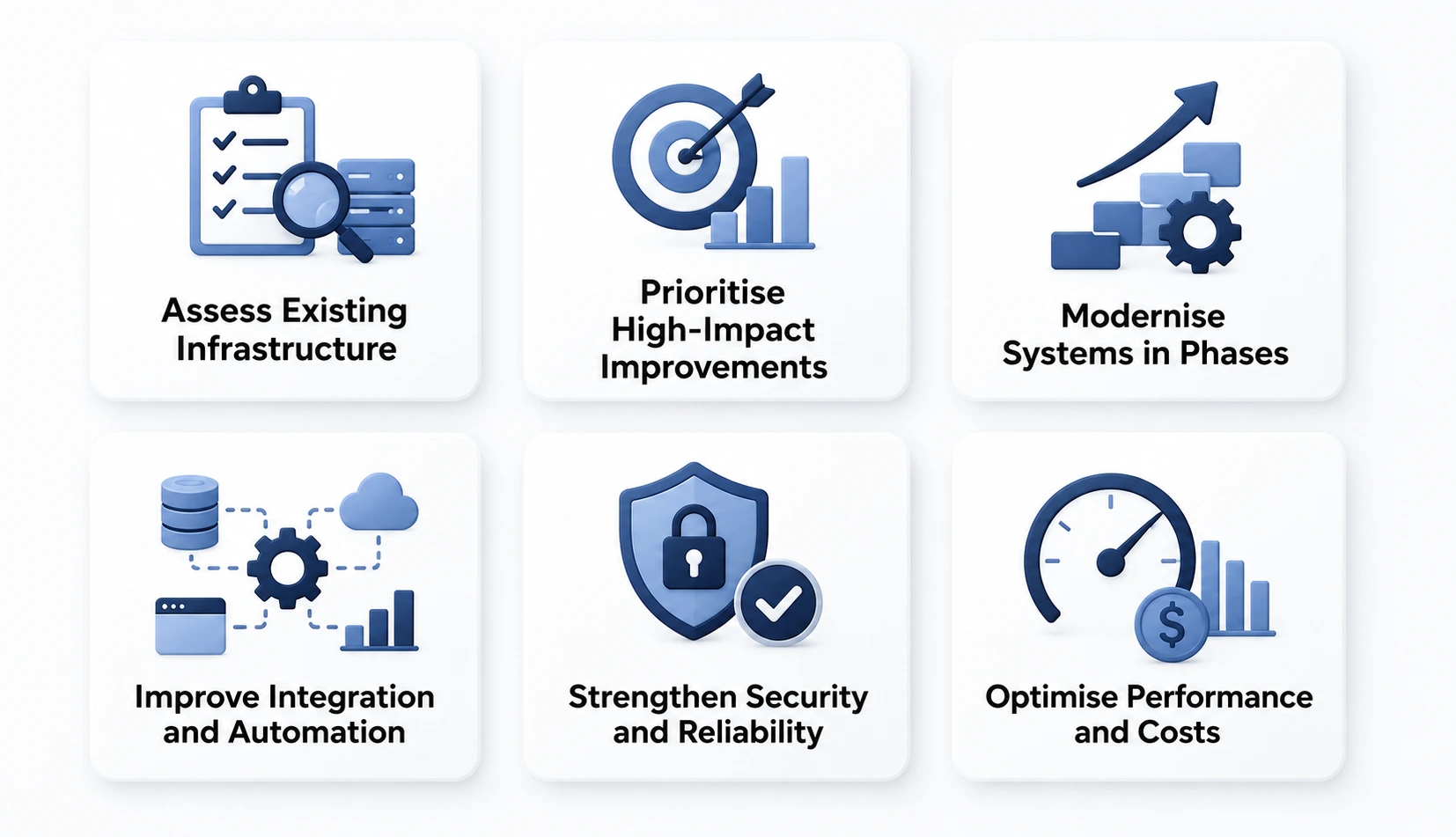
Preparing infrastructure for future growth requires businesses to balance current operational needs with long-term flexibility. Overinvesting in unused capacity can waste resources, while underinvesting can lead to performance problems and expensive emergency upgrades. At RipenApps, we help businesses plan scalable digital solutions that align with their current requirements while supporting future growth, operational efficiency, and evolving technology needs.
1. Assess Existing Infrastructure
Start by reviewing applications, hosting environments, integrations, data flows, and security controls. This assessment establishes a baseline for identifying outdated components, performance bottlenecks, and unnecessary operating expenses.
2. Prioritise Improvements by Business Impact
Not every system requires immediate modernisation. Businesses should evaluate the urgency of each issue according to security exposure, operational dependency, maintenance costs, and expected business value. Critical vulnerabilities and systems that regularly disrupt operations should receive appropriate priority.
3. Modernise Systems in Phases
A phased roadmap allows organisations to introduce changes without disrupting every business function simultaneously. Depending on the assessment, this may involve upgrading applications, migrating selected workloads, replacing unsupported technologies, or redesigning components that cannot meet future requirements.
4. Improve Integration and Automation
Connected systems reduce manual work and help teams access consistent information. Businesses should evaluate API integrations, workflow automation, and data management improvements according to their operational requirements and existing technology landscape.
As businesses expand, the right enterprise applications can help streamline workflows, improve collaboration, and support increasing operational demands. Enterprise applications for business growth can help organisations understand how software solutions support business processes, improve efficiency, and accommodate changing requirements.
5. Strengthen Security and Reliability
Future-ready infrastructure requires appropriate access controls, monitoring, backups, disaster recovery, and tested incident response procedures. These capabilities should be reviewed as workloads grow and applications become more interconnected.
6. Optimise Performance and Costs Continuously
Infrastructure needs change as customer demand, transaction volumes, and business priorities evolve. Regularly reviewing utilisation, performance, and spending helps organisations adjust resources without compromising service quality.
For organisations investing in connected digital experiences, custom applications for digital transformation explain how tailored applications can support business process improvements. The right infrastructure depends on workload characteristics, regulatory obligations, user demand, existing technology, and available resources. Businesses should evaluate these requirements before selecting specific tools or architectures.
Final Thoughts
IT challenges affect far more than technical operations. They influence business continuity, cybersecurity, customer satisfaction, operating costs, and an organisation’s ability to innovate. From managing outdated systems and controlling cloud expenses to addressing talent gaps and adopting AI responsibly, businesses need a structured approach to identifying risks and implementing improvements. Proactive security, regular maintenance, reliable data management, scalable architecture, and continuous performance monitoring can help organisations build more resilient technology environments.
Technology investments should be guided by measurable business objectives rather than the desire to adopt new tools without a clear purpose. Organisations should also review their IT strategy regularly to ensure that systems remain secure, efficient, and capable of supporting future requirements.
RipenApps helps businesses develop digital solutions that align with their operational needs and growth objectives. Organisations looking for tailored solutions can partner with a custom application development company to build solutions that streamline workflows, address specific business challenges, and support long-term growth.

FAQs
Q1. What are the biggest IT challenges businesses face today?
The biggest IT challenges include cybersecurity threats, legacy systems, rising technology costs, cloud management, data integration, skills shortages, system downtime, regulatory compliance, AI adoption, and scalability. Their impact depends on an organisation’s size, industry, infrastructure, and business objectives.
Q2. How can businesses overcome common IT challenges?
Businesses can address common IT problems by conducting regular technology assessments, strengthening cybersecurity, modernising outdated applications, improving data governance, monitoring infrastructure performance, and investing in employee training. External technology partners can also provide specialised expertise when internal resources are limited.
Q3. Why is cybersecurity important for businesses?
Cybersecurity protects business systems, confidential information, customer data, and critical operations from unauthorised access and cyberattacks. Effective security measures help reduce operational disruption, protect customer trust, support applicable compliance requirements, and limit the financial consequences of security incidents.
Q4. How can businesses reduce IT infrastructure costs?
Businesses can reduce infrastructure costs by removing unused resources, reviewing software subscriptions, monitoring cloud consumption, optimising application performance, and forecasting capacity requirements. Regular cost assessments help organisations identify unnecessary expenditure while maintaining the reliability and security of essential systems.
Q5. How does digital transformation help address IT challenges?
Digital transformation helps businesses replace inefficient processes, connect disconnected systems, automate repetitive tasks, and improve access to reliable data. When supported by clear objectives and effective change management, it can increase operational efficiency, improve customer experiences, and prepare organisations for future growth.
Discuss your project and request for proposal
SHARE
WRITTEN BY

Prankur Haldiya
Chief Technical Officer
A tech innovator and engineering leader, Prankur Haldiya drives RipenApps’ product development strategy and oversees cutting-edge solutions in mobility, AI, and cloud ecosystems. He is passionate about building high-performance teams and helping brands launch secure, scalable, and user-centric digital products.
View All Articles