

Key Takeaways
- Multiple revenue streams drive growth: DoorDash combines merchant commissions, consumer fees, subscriptions, advertising, and logistics services. It generated $13.7 billion in revenue in 2025, up 28% year over year.
- Instacart acquisition expands grocery capabilities: DoorDash agreed to acquire Instacart for approximately $17 billion in October 2026. The pending deal could combine DoorDash’s delivery network with Instacart’s grocery marketplace and enterprise technology.
- Marketplace scale depends on demand: DoorDash processed approximately 3.17 billion orders in 2025, up 23% year over year, reflecting growth in marketplace activity.
- Memberships strengthen retention: DoorDash had over 35 million combined DashPass, Wolt+, and Deliveroo Plus members at the end of 2025.
- Diversification supports platform growth: Grocery, retail, convenience, advertising, and merchant software extend DoorDash beyond restaurant delivery.
- Unit economics determine scalability: DoorDash reported a 13.6% Net Revenue Margin and Contribution Profit equal to 5.2% of contribution Profit as a percentage of Marketplace GOV. Although its margin improved sequentially, it remained below the 13.8% recorded a year earlier, partly reflecting the Deliveroo acquisition.
DoorDash makes money through a three-sided delivery marketplace, charging merchants 15–30% commissions and consumers delivery and service fees. It also generates revenue through memberships, advertising, white-label logistics, and merchant software. In Q4 2025, its Net Revenue Margin was 13.3%, representing $13.30 in recognized revenue for every $100 of Marketplace GOV.
DoorDash continued to expand in 2026. In Q3, it reported $33.9 billion in Marketplace GOV, $4.6 billion in revenue, and 993 million total orders. Revenue increased 34% year over year, while Marketplace GOV grew 36%. On October 29, 2026, the company also announced an agreement to acquire Instacart for approximately $17 billion. The proposed transaction would significantly expand its grocery capabilities and strengthen its position in local commerce. The deal remains subject to shareholder and regulatory approvals.
Beyond its revenue streams, DoorDash’s business model relies on strong merchant relationships, repeat customer demand, and efficient delivery operations. Its expansion into grocery, retail, and convenience categories also demonstrates how a food delivery platform can evolve into a broader local commerce marketplace. Businesses exploring similar opportunities can evaluate food ordering and delivery app development to understand the technology and infrastructure involved.
This guide examines DoorDash’s revenue model, operating structure, competitive positioning, and growth strategy. It also explores the technology requirements and business decisions founders should consider when building a similar on-demand marketplace.
Table of Contents
DoorDash at a Glance: The FY2025 Numbers
DoorDash’s FY2025 financial performance demonstrates how a delivery marketplace can generate substantial revenue by connecting consumers, merchants, and delivery partners. Its operations now extend beyond restaurant delivery into grocery, convenience, retail, advertising, and merchant technology.
The following figures come from DoorDash’s fourth-quarter and full-year 2025 financial results, released on February 18, 2026, and its FY2025 Form 10-K filed with the US Securities and Exchange Commission.
| Financial or operating metric | FY2025 / Q4 2025 figure |
| Annual revenue | $13.717 billion |
| Annual revenue growth | 28% |
| Marketplace Gross Order Value (GOV) | $102.018 billion |
| Marketplace GOV growth | 27% |
| GAAP net income attributable to common stockholders | $935 million |
| Contribution Profit | $4.840 billion |
| Adjusted EBITDA | $2.779 billion |
| Net cash from operating activities | $2.431 billion |
| Sales generated for local merchants | Nearly $75 billion |
| Dasher earnings | Over $20 billion |
| Monthly active users at year-end | Over 56 million |
| Combined DashPass, Wolt+ and Deliveroo Plus members | Over 35 million |
| Q4 total orders | 903 million |
| Q4 Marketplace GOV | $29.7 billion |
| Q4 revenue | $3.955 billion |
| Q4 Net Revenue Margin | 13.3% |
| Q4 GAAP net income | $213 million |
Source: DoorDash FY2025 financial results And DoorDash FY2025 Form 10-K.
- Revenue growth: DoorDash generated $13.717 billion in revenue in 2025, compared with $10.722 billion in 2024. This represents 28% year-over-year growth, supported by increased marketplace activity, international expansion, and a growing contribution from advertising.
- Marketplace scale: The company processed $102.018 billion in Marketplace GOV in FY2025. However, GOV is not recognized revenue. It represents the total value of completed marketplace orders, including applicable taxes, tips, and consumer fees. DoorDash reported $13.717 billion in revenue, reflecting the portion recognized from marketplace transactions and other services under its accounting policies.
- Profitability: GAAP net income increased from $123 million in 2024 to $935 million in 2025. Contribution Profit also increased from $3.474 billion to $4.840 billion, indicating improved economics after specified direct costs and sales and marketing expenses.
DoorDash also reported nearly $75 billion in sales generated for local merchants across more than 40 countries. Its growing international presence, including Wolt and Deliveroo, extends the marketplace beyond its original US restaurant-delivery business.
How the DoorDash Business Model Works: A Three-Sided Marketplace
The DoorDash business model operates through a three-sided marketplace connecting consumers, merchants, and Dashers. Each participant contributes to the transaction, while DoorDash provides the technology and operational infrastructure that coordinates the entire process.
Unlike a traditional restaurant delivery business, DoorDash does not need to own the restaurants or maintain a conventional delivery fleet. It creates value by connecting existing local businesses with consumers and coordinating fulfillment through its delivery network.
Consumers: What They Pay For
Consumers use DoorDash to discover restaurants, browse menus, place orders, and receive deliveries. The platform provides a centralized experience for finding local businesses and accessing different food and retail categories.
Consumers benefit from convenient ordering, broad selection, real-time tracking, and coordinated delivery.
- Delivery fees: Charges for arranging delivery, which can vary according to distance, merchant, and delivery conditions.
- Service fees: Platform-related charges associated with processing and managing transactions.
- Small-order fees: Additional charges that may apply when an order falls below a qualifying threshold.
- Membership fees: Recurring payments from customers subscribed to DashPass.
These charges vary by order and membership status. Membership eligibility, promotions, merchant arrangements, and local pricing conditions can change the final amount.
DashPass provides an additional reason for frequent customers to continue using the platform. Eligible members receive delivery-related benefits on qualifying orders, making repeat purchases more attractive.
Merchants: What They Get for 15–30%
Restaurants and other local businesses join DoorDash to access a larger customer base without independently developing an entire ordering and delivery infrastructure.
DoorDash provides merchant discovery, menu management, order acceptance, payment processing, delivery coordination, and promotional opportunities. DoorDash’s US marketplace currently offers three main delivery commission tiers.
| Merchant plan | Delivery commission | Pickup commission |
| Basic | 15% | 6% |
| Plus | 25% | 6% |
| Premier | 30% | 6% |
Source: Official DoorDash Merchant Pricing. US rates for eligible restaurant partners; actual terms may vary.
Higher-tier plans offer wider delivery coverage and additional promotional benefits, giving merchants different options for reaching customers.
Consider a qualifying $100 order subtotal. A merchant on the Basic delivery plan would pay $15 in commission, while a Premier merchant would pay $30.
The difference is not simply a higher platform fee. Merchants are also evaluating the incremental demand, customer access, and delivery infrastructure they receive. For DoorDash, merchant participation expands marketplace selection. More relevant merchants can attract more consumers, strengthening the overall network.
Dashers: Supply on Demand
Dashers provide the delivery capacity required to connect merchants with consumers. Instead of operating a conventional company-owned delivery fleet, DoorDash coordinates a flexible network of delivery workers who can accept eligible delivery requests. This approach helps the company adjust delivery capacity according to demand.
The Dasher application supports delivery requests, order information, navigation, status updates, and earnings visibility. The platform uses operational data to coordinate assignments and monitor fulfillment. Dashers receive earnings for completed deliveries, including applicable incentives and customer tips. DoorDash reported that Dashers earned more than $20 billion in 2025.
However, a flexible delivery network also requires continuous investment in worker availability, insurance, regulatory compliance, and delivery quality.
How DoorDash Coordinates All Three Sides
DoorDash connects all three participants through a centralized technology platform that manages ordering, merchant communication, payments, and delivery coordination.
The process generally follows this sequence:
- A consumer selects a merchant, places an order, and completes payment.
- DoorDash transmits the order to the merchant for acceptance and preparation.
- The platform coordinates an available Dasher for fulfillment.
- The Dasher collects the order and completes delivery.
- The platform updates the transaction and manages applicable settlements.
The marketplace creates value by coordinating all three groups. More merchants improve consumer choice. More consumers create additional order opportunities. More delivery capacity helps the platform fulfill demand across a wider range of locations and time periods. This interaction produces network effects, although those effects depend on achieving sufficient demand and supply within individual markets.
For a new delivery business, the important lesson is that a consumer ordering application alone does not create a sustainable marketplace. Merchant participation, delivery capacity, and transaction coordination must develop together.
DoorDash Business Model Canvas
The DoorDash business model canvas explains how the company creates value, delivers its services, and generates revenue through its marketplace.
Its nine building blocks reveal how technology, merchant relationships, consumer demand, and delivery operations work together.
| Business Model Canvas block | DoorDash’s approach |
| Customer Segments | Consumers, restaurants, grocery stores, retailers, and Dashers |
| Value Propositions | Convenient local commerce, merchant customer acquisition, delivery infrastructure, and flexible earning opportunities |
| Channels | DoorDash consumer app, website, merchant platform, Dasher app, and business integrations |
| Customer Relationships | Digital self-service, customer support, DashPass membership, merchant support, and personalized discovery |
| Revenue Streams | Merchant commissions, consumer fees, subscriptions, advertising, logistics services, and merchant technology |
| Key Resources | Marketplace technology, brand, consumer base, merchant network, delivery network, and operational infrastructure |
| Key Activities | Marketplace management, order matching, dispatch, payment processing, customer acquisition, and platform development |
| Key Partnerships | Restaurants, retailers, Dashers, payment providers, technology partners, and local commerce participants |
| Cost Structure | Delivery-related costs, insurance, marketing, research and development, customer support, technology, and administration |
DoorDash monetizes a coordinated local commerce network that extends beyond restaurant delivery. Its value proposition differs for each participant. Consumers receive convenience and selection, merchants gain additional distribution, and Dashers access flexible delivery opportunities.
Merchant commissions and consumer charges monetize marketplace transactions, while subscriptions, advertising, and logistics services create additional revenue opportunities. For founders, a similar business model requires more than a customer-facing application. It needs merchant tools, delivery coordination, payment infrastructure, and administrative controls.
Companies evaluating these requirements can explore marketplace app development before defining their product architecture and operational scope.
How Does DoorDash Make Money? Six Revenue Streams and Growth Opportunities
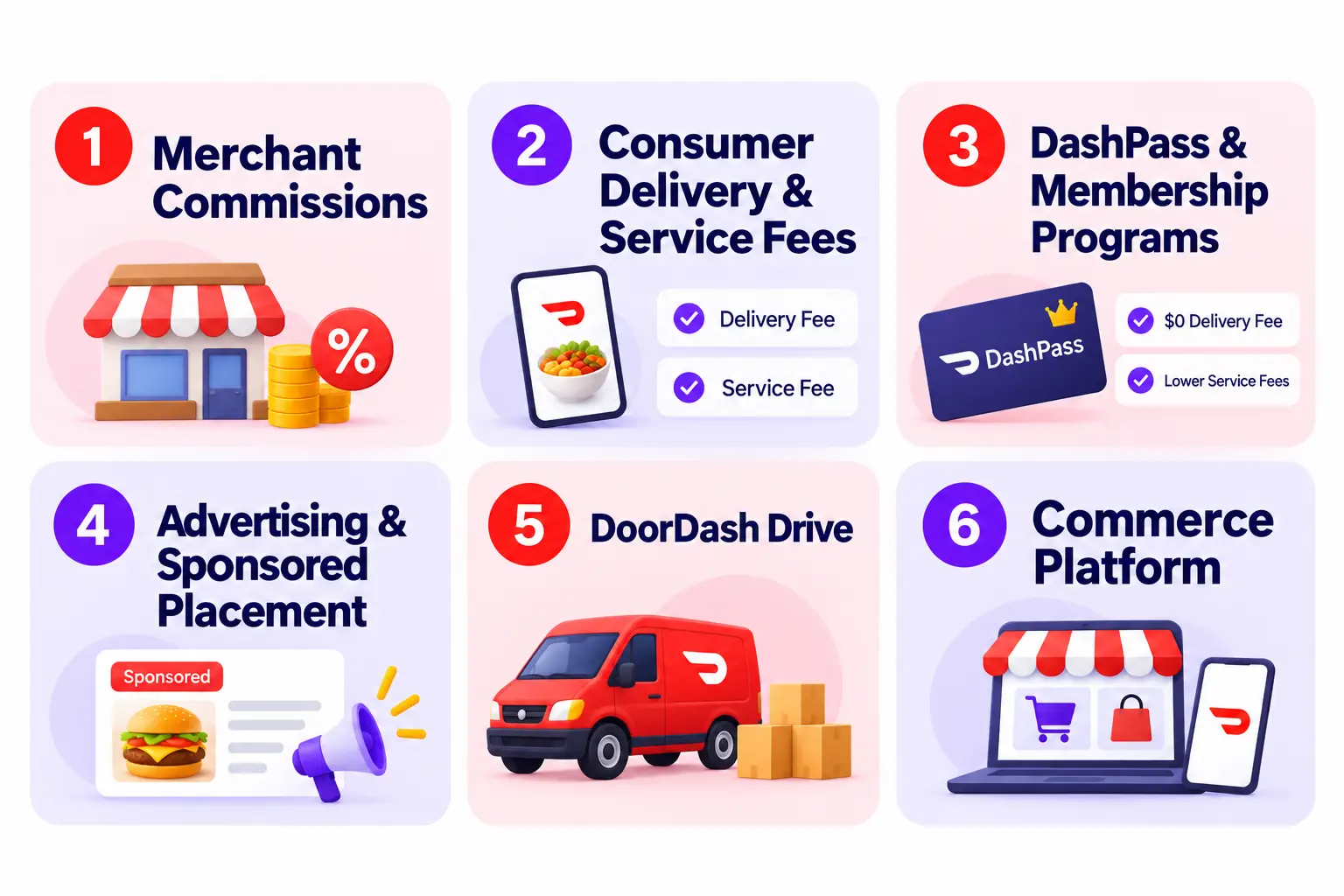 DoorDash generates revenue through six major mechanisms across its marketplace and commerce operations. Its expansion into grocery, retail, and convenience creates additional opportunities to apply these monetization models.
1. Merchant Commissions (15% / 25% / 30% tiers, plus ~6% on pickup)
Merchant commissions are a core revenue source in the DoorDash revenue model. Restaurants pay a percentage of qualifying order subtotals based on their merchant plan. For example, a $100 delivery order generates $15 in commission under the Basic plan and $30 under the Premier plan.
Pickup orders carry lower commissions, while higher delivery tiers offer additional marketplace exposure, wider delivery areas, and other benefits. This structure allows DoorDash to monetize merchant demand for customer access.
However, commissions are not pure profit. DoorDash must cover fulfillment, payment processing, customer support, technology, and other operating costs. Startups adopting this model should consider merchant margins, local purchasing power, competition, and the value their marketplace provides.
2. Consumer Delivery and Service Fees
DoorDash generates additional revenue through consumer delivery and service fees. Delivery fees cover fulfillment arrangements, while service fees contribute to marketplace operations.
Small-order fees may also apply. Charges vary based on delivery distance, location, merchant pricing, membership eligibility, and promotions.
Together with merchant commissions, these fees allow DoorDash to monetize the convenience of its ordering and delivery services. However, excessive charges can discourage purchases, reduce order frequency, and weaken retention.
Consumer fees and merchant commissions must be evaluated together to understand their combined effect on order economics.
3. DashPass and Membership Programs
At the end of 2025, DoorDash reported more than 35 million combined DashPass, Wolt+, and Deliveroo Plus members. These programs generate recurring revenue while encouraging repeat orders and strengthening customer retention. The figure represents combined membership across all three programs, not DashPass subscribers alone.
Membership benefits give frequent customers additional reasons to continue using the platform. For startups, subscriptions should follow demonstrated repeat demand, as premature discounts and benefits can put pressure on transaction economics.
4. Advertising and Sponsored Placement
Advertising monetizes consumer attention within the DoorDash marketplace. Restaurants and brands pay for sponsored placements and promotional campaigns to improve visibility during product discovery. This creates revenue opportunities beyond completed delivery transactions while helping merchants reach customers actively considering purchases.
DoorDash expanded these capabilities in June 2025 through an updated advertising platform and its acquisition of Symbiosys. As of June 2026, DoorDash, Wolt, and Deliveroo supported more than 400,000 advertisers across their advertising platforms, extending monetization beyond marketplace commissions. (Source: DoorDash Ads, June 2026)
Advertising allows DoorDash to generate revenue from merchant visibility in addition to transaction commissions.
5. DoorDash Drive: White-Label Logistics
DoorDash Drive extends the company’s delivery infrastructure to businesses that generate orders through their own channels. Restaurants can use their websites, applications, or direct ordering systems to acquire customers while relying on DoorDash for fulfillment.
Unlike marketplace transactions, these orders do not require customers to discover merchants through DoorDash. Instead, businesses pay per-order fees for delivery services. DoorDash’s FY2025 Form 10-K identifies Drive as the source of the majority of Commerce Platform revenue.
6. Commerce Platform: Merchant Software
DoorDash’s Commerce Platform extends its services beyond marketplace ordering by providing merchants with technology for direct digital commerce.
Its capabilities include:
- Online ordering through merchant websites.
- Digital storefronts and menu management.
- Order management and integrations.
- Payment processing.
- Delivery fulfillment through associated logistics services.
Unlike marketplace transactions, DoorDash’s Online Ordering offering is commission-free but carries applicable payment processing fees. Merchants can therefore manage direct orders without relying on DoorDash’s consumer marketplace.
Grocery, Retail and New Verticals
DoorDash’s expansion into Grocery, convenience, retail, and a grocery delivery app like Instacart increases its addressable market beyond restaurant delivery.
This expansion creates three potential operational benefits:
- More purchase occasions: Additional categories encourage customers to use the platform for different everyday needs.
- Greater merchant diversity: Grocery stores, retailers, and local businesses expand marketplace selection.
- Better network utilization: Additional orders can create delivery opportunities across different times and locations, depending on order density and fulfillment requirements.
DoorDash highlighted grocery and retail selection, quality, consumer retention, and order frequency as important priorities in its FY2025 results.
Its expansion through Wolt and Deliveroo further broadens its commerce ecosystem. For founders, the lesson is to introduce new verticals only when marketplace demand, merchant relationships, and operational capacity can support expansion.
Businesses exploring adjacent models can also study the quick commerce business model to understand how different fulfillment requirements influence product architecture.
The GOV Waterfall: Where Every $100 Order Actually Goes
Gross Order Value (GOV) represents the value of transactions processed through a marketplace under its reporting definition. DoorDash’s Marketplace GOV includes completed marketplace orders and specified transaction components, including taxes, tips, and consumer fees.
However, GOV is not company revenue, and company revenue is not profit.
DoorDash’s Net Revenue Margin was 13.3% in Q4 2025, declined to 12.8% in Q1 2026, and recovered to 13.5% in Q2 and 13.6% in Q3 2026. Despite the sequential improvement, Q3 2026’s margin remained below the 13.8% recorded in Q3 2025.
DoorDash attributed the year-over-year decline primarily to its Deliveroo acquisition, partly offset by increased advertising revenue and lower discounts and promotions as a percentage of Marketplace GOV. This means recognized revenue represented $12.80–$13.60 for every $100 of Marketplace GOV across the first three quarters of 2026.
The following illustration shows how Marketplace GOV differs from recognized revenue and profit.
Illustrative $100 Marketplace GOV waterfall
| Stage | Amount or treatment | Explanation |
| Marketplace GOV | $100.00 | Total reported marketplace value |
| Merchant settlement | Variable | Merchant proceeds depend on order terms, commissions, adjustments, and other applicable items |
| Dasher earnings | Variable | Delivery payments, incentives, and applicable tips |
| Taxes, refunds, and promotions | Transaction-dependent | Treatment varies according to the underlying transaction and accounting rules |
| Recognized DoorDash revenue | Approximately $13.30 | Revenue equivalent at Q4 2025 Net Revenue Margin |
| Operating expenses | Deducted from revenue | Technology, fulfillment-related costs, marketing, support, and administration |
| Net income | Not predetermined | Amount remaining after expenses and applicable accounting items |
This is an illustrative financial bridge, not a published settlement statement for a specific $100 restaurant order. DoorDash does not disclose one universal allocation of every $100 between merchant payouts, Dasher payments, refunds, and promotions.
The amounts vary according to order composition, location, tips, merchant agreements, delivery arrangements, and other transaction conditions.
The important distinction is that a 13.3% Net Revenue Margin does not mean DoorDash earns $13.30 in profit from every $100 of marketplace activity.
Its recognized revenue must still support the costs of operating the platform.
Founders evaluating a similar model should monitor four separate financial measures:
- GOV: Total marketplace transaction value.
- Revenue: Amount recognized by the platform.
- Contribution Profit: Profitability after specified direct costs and sales and marketing expenses under the company’s definition.
- Net income: The final accounting result after applicable expenses and other items.
Confusing these measures can produce unrealistic financial projections. A marketplace may generate substantial transaction volume while still struggling with delivery costs, incentives, customer acquisition, and operating expenses.
Is DoorDash Profitable? The Unit Economics Behind the Margin
Yes, DoorDash reported $935 million in GAAP net income attributable to common stockholders in FY2025, compared with $123 million in FY2024.
However, understanding DoorDash’s profit margin requires examining revenue conversion, contribution profit, and overall profitability separately.
| Financial metric | FY2024 | FY2025 |
| Revenue | $10.722B | $13.717B |
| Marketplace GOV | $80.231B | $102.018B |
| Net Revenue Margin | 13.4% | 13.4% |
| Contribution Profit | $3.474B | $4.840B |
| GAAP net income | $123M | $935M |
| Adjusted EBITDA | $1.900B | $2.779B |
Source: DoorDash FY2025 Form 10-K. Contribution Profit and Adjusted EBITDA are non-GAAP measures.
- Net Revenue Margin measures recognized revenue relative to Marketplace GOV. DoorDash maintained a 13.4% annual margin in both 2024 and 2025. Its Q4 2025 margin was 13.3%.
- Contribution Profit measures the profitability of the business after specified costs. DoorDash reported $4.840 billion in FY2025, compared with $3.474 billion in FY2024. The increase reflects stronger marketplace economics and the company’s ability to generate more contribution from its growing operations.
- GAAP Net Income represents the broader accounting outcome after operating expenses, depreciation, interest, taxes, and other applicable items.
The increase from $123 million to $935 million is particularly significant because it demonstrates that the company translated higher revenue into stronger reported profitability.
However, this does not mean every marketplace transaction is equally profitable. Delivery distance, order size, merchant terms, incentives, refunds, and local operating conditions all affect transaction economics.
Order-level and market-level profitability should guide expansion decisions. A strong revenue model cannot compensate for consistently unprofitable fulfillment.
What DoorDash’s Cost Structure Reveals
DoorDash’s cost structure demonstrates why operating a delivery marketplace requires substantial investment, even without owning a traditional delivery fleet.
Its FY2025 Form 10-K identifies several major expense categories.
| Cost category | FY2025 expense | What it supports |
| Cost of revenue, excluding depreciation and amortization | $6.738B | Transaction fulfillment and marketplace operations |
| Sales and marketing | $2.476B | Customer acquisition, promotions, and merchant growth |
| Research and development | $1.431B | Product engineering and technology development |
| General and administrative | $1.600B | Corporate, legal, administrative, and operational functions |
| Depreciation and amortization | $747M | Depreciation of assets and amortization of intangible assets |
| Restructuring charges | $2M |
Source: DoorDash FY2025 Form 10-K. Figures rounded to the nearest million.
Five expense categories deserve particular attention.
- Cost of delivery and transaction fulfillment: The platform must support the costs associated with completing orders. These include delivery-related payments, incentives, transaction operations, and other fulfillment expenses.
- Sales and marketing: DoorDash invests in customer acquisition, merchant participation, advertising, and promotions. These investments can strengthen marketplace demand but may pressure margins if acquisition costs remain high.
- Research and development: Technology is a core operating resource. The company needs continuous investment in ordering systems, dispatch, routing, payment infrastructure, data systems, and product improvements.
- Regulatory and legal expenses: Worker classification, insurance, consumer protection, payments, and local operating regulations create financial exposure. Requirements differ across jurisdictions and can affect operating costs.
- General and administrative expenses: Finance, compliance, legal, corporate operations, and other administrative functions support the company’s international business.
Application development is only one component of the investment; fulfillment, marketing, compliance, and ongoing operations also contribute to total costs.
How DoorDash Captured the Market: Four Density Levers
DoorDash’s growth strategy depends on building sufficient demand, merchant availability, and delivery capacity within individual markets. Four interconnected factors help explain how DoorDash builds marketplace density.
Suburban-First Expansion
DoorDash established a strong presence in suburban markets where restaurant delivery options were less developed than in some major urban areas.
This approach allowed the company to serve consumers looking for convenient access to local restaurants while developing merchant relationships and delivery capacity in specific communities. The strategic lesson is that geographic expansion should consider unmet demand and operational feasibility, not just population size.
For a new marketplace, launching across an entire country can create unnecessary complexity. A defined service area provides a more practical environment to validate customer demand, merchant participation, and delivery operations.
Dasher Liquidity and Order Batching
Delivery capacity becomes valuable when the marketplace can coordinate it with incoming demand. DoorDash’s dispatch operations connect eligible orders with available Dashers using operational information such as location, distance, and delivery requirements.
Order batching can improve efficiency when multiple compatible deliveries can be completed within a suitable route. However, batching is not automatically beneficial. Poorly matched orders can increase delivery times and affect customer experience.
The objective is to balance Dasher utilization, delivery efficiency, and order completion time. This requires reliable location information, dispatch logic, demand prediction, and real-time operational visibility. An initial platform can use basic order assignment before introducing advanced routing and batching. More advanced routing and batching should develop as transaction volume and delivery density increase.
Merchant Supply Depth
A marketplace becomes more useful when consumers have enough relevant options. DoorDash’s merchant network includes restaurants, grocery businesses, convenience stores, and retailers. This variety improves product selection and creates additional reasons for customers to return.
Merchant partnerships also provide opportunities for advertising, membership benefits, and additional logistics services.
However, supply growth should be relevant to actual customer demand. Adding merchants without sufficient consumer activity can increase onboarding and support costs without improving marketplace economics.
Founders should focus on merchant quality, menu availability, fulfillment reliability, and repeat customer demand rather than treating the number of registered merchants as the primary growth indicator.
Membership Lock-In
Membership programs encourage consumers to continue using the platform through recurring benefits. DashPass provides an example of how a subscription can strengthen customer relationships and create an incentive to place more eligible orders.
When customers regularly use a platform, membership benefits can improve retention and make switching to alternatives less attractive.
However, subscriptions must be supported by healthy transaction economics. Discounts, delivery benefits, and promotional costs can reduce margins if membership usage is not sufficiently frequent.
For startups, the right approach is to introduce membership programs after establishing repeat usage and a clear understanding of the cost of providing benefits.
These factors show why marketplace growth depends on local demand, merchant availability, and delivery capacity. Businesses developing similar models can explore on-demand app development to understand the technology required to coordinate demand, supply, and fulfillment.
DoorDash vs Uber Eats vs Grubhub vs Instacart: Business Model Comparison
DoorDash, Uber Eats, and Grubhub follow different strategies to compete in the online food delivery market. While all three connect customers with restaurants, they differ in monetization, delivery infrastructure, and platform expansion.
| Business model factor | DoorDash | Uber Eats | Grubhub | Instacart |
| Core model | Local commerce marketplace | Delivery marketplace integrated with Uber | Restaurant ordering and delivery marketplace | Grocery and retail marketplace |
| Revenue streams | Commissions, consumer fees, subscriptions, advertising, logistics | Merchant and consumer fees, subscriptions, advertising | Commissions, consumer fees, marketplace services | Transaction fees, advertising, enterprise technology |
| Membership | DashPass, Wolt+, Deliveroo Plus | Uber One | Grubhub+ | Instacart+ |
| Delivery network | Dasher network and DoorDash Drive | Uber delivery network | Grubhub delivery network and partners | Instacart Shopper network |
| Additional categories | Grocery, retail, convenience | Grocery, retail, convenience | Grocery, convenience | Grocery, retail |
| Key advantage | Local commerce and logistics infrastructure | Integration with Uber Mobility | Integration with Wonder | Grocery technology and retailer relationships |
DoorDash and Instacart remain separate companies while their proposed acquisition awaits regulatory and shareholder approvals. The comparison reflects their existing business models, not an already-integrated platform. This is a qualitative comparison, not a like-for-like market-share or commission-rate analysis.
Source: Instacart Q3 2026 financial results.
DoorDash: Local Commerce Expansion
DoorDash combines restaurant delivery with grocery, retail, convenience, advertising, and merchant software. Its strategy focuses on expanding marketplace selection and using its logistics network across multiple commerce categories.
Uber Eats: Cross-Platform Integration
Uber Eats leverages Uber’s existing consumer base, mobility ecosystem, and delivery network. This integration creates opportunities for cross-platform engagement and more efficient use of its delivery infrastructure.
Grubhub: Integration with Wonder
Wonder completed its acquisition of Grubhub in January 2025, bringing the restaurant marketplace into its broader food and commerce ecosystem. The combination connects Grubhub’s restaurant network with Wonder’s vertically integrated food operations.
Market-share comparisons should use consistent geography, reporting periods, and market definitions to avoid misleading conclusions.
The Instacart Acquisition: What It Means for DoorDash’s Business Model
DoorDash’s proposed acquisition of Instacart, announced on October 29, 2026, values the grocery marketplace at approximately $17 billion, or $65 per share. The deal would combine DoorDash’s restaurant and local commerce network with Instacart’s grocery marketplace and enterprise technology capabilities.
| Deal component | Details |
| Acquisition target | Maplebear Inc. (Instacart) |
| Deal value | Approximately $17 billion ($65 per share) |
| Consideration | At least 75% cash, up to 25% DoorDash stock |
| Expected closing | By the end of 2027 or during the first half of 2028, subject to required approvals. |
| Key conditions | Regulatory review and other required approvals |
| Post-acquisition plans | Retain Instacart’s brand, app, and enterprise products |
(Source: DoorDash’s acquisition announcement.)
Why the Acquisition Matters
- Faster grocery expansion: Instacart brings established grocery operations and retailer relationships, potentially accelerating DoorDash’s reach in the category.
- Complementary technology: Instacart’s marketplace and enterprise products could strengthen DoorDash’s merchant technology and fulfillment capabilities.
- Membership opportunities: Combining membership benefits could offer customers broader grocery and restaurant delivery options.
- Stronger local commerce presence: The deal could expand DoorDash’s position across restaurant, grocery, and retail markets, subject to regulatory approval.
The acquisition remains proposed, not completed. Both companies will operate independently until closing, expected in late 2027 or the first half of 2028. Instacart should therefore not be described as an existing DoorDash subsidiary.
Where the DoorDash Model Is Exposed: Regulation, Labor and Automation
Despite its scale, DoorDash faces structural risks that can affect profitability, operating flexibility, and long-term growth. Key challenges include:
- Antitrust and acquisition approval: The proposed $17 billion Instacart acquisition requires regulatory clearance, including US antitrust review and approvals in other jurisdictions. Competition authorities could examine its impact on grocery delivery, retailer relationships, pricing, and marketplace competition. The transaction is not guaranteed to close.
- Worker classification and labor regulation: Changes in contractor classification, minimum compensation, insurance, and employment protections can increase fulfillment costs.
- Commission and fee restrictions: Local regulations may cap merchant commissions or consumer fees, limiting revenue flexibility.
- Insurance and delivery liability: Accidents, injuries, and delivery-related claims can increase insurance expenses.
- Automation and delivery technology: Autonomous delivery and AI can improve fulfillment efficiency, but adoption depends on infrastructure, regulations, and deployment costs.
The Instacart transaction makes regulatory approval a specific strategic risk rather than simply a general industry consideration.
What Founders Can Learn: Five Transferable Model Decisions
DoorDash’s business model offers practical lessons for founders building local commerce and on-demand marketplaces:
- Validate demand before geographic expansion: Establish reliable merchant supply and delivery capacity in a focused service area before entering new markets.
- Diversify revenue strategically: Build a sustainable primary revenue stream first, then introduce subscriptions, advertising, or additional services as demand grows.
- Prioritize operational efficiency: Design order matching, delivery allocation, routing, and payment systems to control costs as transaction volumes increase.
- Build valuable merchant relationships: Help merchants reach customers, manage orders, and generate measurable business value rather than focusing only on merchant acquisition.
- Track contribution economics: Monitor revenue per order, fulfillment costs, customer acquisition expenses, refunds, incentives, and repeat purchases before scaling.
The industries using the on-demand business model provide further examples of how these principles apply across different business categories.
Building a Food Delivery Platform on These Economics
Building a DoorDash clone app requires more than replicating its consumer-facing features. A scalable food delivery marketplace needs coordinated systems for customers, merchants, delivery partners, and administrators.
Founders should prioritize four technology requirements:
- Multi-sided application architecture: Build separate interfaces for customers, merchants, delivery partners, and administrators, covering ordering, menu management, delivery updates, payments, and operational controls.
- Dispatch and delivery coordination: Implement order assignment, delivery partner availability, location tracking, and routing to manage fulfillment efficiently.
- Multi-party payment infrastructure: Support customer payments, merchant commissions, delivery partner earnings, refunds, settlements, and transaction reconciliation.
- Analytics and operational visibility: Track order volume, delivery times, merchant performance, customer retention, and service-area demand to guide expansion decisions.
What Can Be Reproduced at Startup Scale?
Startups can begin with essential marketplace workflows and introduce advanced logistics and analytics as order density increases.
| Platform layer | Startup-scale feasibility | Initial requirement |
| Consumer ordering | High | Customer app or responsive ordering |
| Merchant management | High | Merchant portal and order controls |
| Delivery coordination | High | Basic dispatch and location tracking |
| Payment settlement | High | Payment gateway and settlement workflows |
| Advanced analytics | Progressive | Historical order and demand data |
| Global multi-vertical logistics | Long-term | Significant investment and operational scale |
Conclusion
DoorDash’s business model shows how a delivery marketplace can generate revenue through merchant commissions, consumer fees, subscriptions, advertising, and logistics services. Its growth also highlights the importance of marketplace density, efficient fulfillment, and sustainable unit economics. Founders planning a similar platform need to validate demand, build reliable merchant and delivery networks, and invest in technology that supports long-term growth. Businesses exploring this opportunity can learn how to build a scalable platform through mobile app development services.
For startups, the key is to begin with essential marketplace capabilities and expand as customer demand and operational requirements grow. RipenApps helps businesses translate these requirements into functional digital products, drawing on its experience in developing marketplace, food delivery, and logistics solutions.
FAQs
1. How does DoorDash make money?
DoorDash makes money through merchant commissions, consumer delivery and service fees, DashPass memberships, advertising, white-label delivery services, and merchant software. These revenue streams allow the company to monetize marketplace transactions, customer subscriptions, merchant visibility, and delivery infrastructure across restaurant, grocery, and retail categories.
2. What is DoorDash’s commission rate for restaurants?
DoorDash’s US merchant delivery commission rates are 15% for Basic, 25% for Plus, and 30% for Premier. Pickup orders carry a 6% commission across these plans. Actual pricing depends on merchant eligibility, applicable terms, and the services selected.
3. Is DoorDash profitable?
Yes. DoorDash reported $935 million in GAAP net income attributable to common stockholders for FY2025, compared with $123 million in FY2024. Its annual revenue reached $13.717 billion, demonstrating improved profitability alongside continued marketplace growth.
4. What percentage of an order does DoorDash keep?
DoorDash reported a 13.3% Net Revenue Margin in Q4 2025, meaning recognized revenue represented approximately $13.30 per $100 of Marketplace GOV. This is not its profit or a fixed commission on individual orders. Fulfillment and operating expenses must still be accounted for.
5. How much of DoorDash’s revenue comes from DashPass?
DoorDash does not separately disclose the proportion of total revenue generated by DashPass. It reported over 35 million combined DashPass, Wolt+, and Deliveroo Plus members at the end of 2025. This figure includes multiple membership programs and is not a DashPass-only subscriber count.
6. What is DoorDash’s business model called?
DoorDash operates a three-sided, multi-sided marketplace business model. It connects consumers, merchants, and independent delivery workers through a digital platform. The company generates revenue by monetizing transactions, memberships, advertising, logistics services, and merchant technology offerings.
7. How much does it cost to build a food delivery app like DoorDash?
Building a food delivery app can cost approximately $25,000 to $250,000+ depending on an initial solution, depending on its features, application interfaces, and integrations. Read our guide to food delivery app development cost for a detailed breakdown of development expenses.
Discuss your project and request for proposal
SHARE
WRITTEN BY

Ishan Gupta
CEO & Founder
Ishan Gupta is a seasoned entrepreneur and CEO with extensive 10+ years of experience in business and mobile app development landscape. He believes that the right digital product allows companies to focus on what they do best, while technology handles the rest. With deep exposure to global markets, he understands what makes an app succeed. His approach translates business needs into clear product strategies, ensuring that every feature contributes to measurable ROI.
View All Articles