


Key Takeaways
- Define the business model and target audience before selecting features or technology.
- Prioritise secure account creation, market data, order management, payment workflows, and risk controls in the initial release.
- Evaluate regulatory obligations in every market where the product will operate before accepting customers.
- Compare custom development with white-label solutions based on control, flexibility, integration requirements, and long-term costs.
- Measure commercial performance through customer acquisition, user activation, retention, revenue per active trader, and operating expenses.
Launching a digital trading product requires more than an attractive interface. Businesses need reliable market data, secure transactions, responsive trading tools, scalable infrastructure, and a clear commercial strategy. The right development approach helps bring these elements together while keeping the product aligned with user expectations and applicable regulatory requirements.
Businesses planning a trading product can explore specialist development solutions to understand how an experienced team can help translate business requirements into a functional digital experience. Forex trading is a competitive financial services market in which speed, reliability, usability, and trust influence the customer experience. A well-planned forex trading app development strategy helps businesses determine which capabilities to build first, which integrations to prioritise, and how to prepare for future growth.
The investment depends on the product’s scope, the intended markets, the trading infrastructure, and the level of customisation required. A focused minimum viable product (MVP) may be suitable for validating demand, while a more advanced platform may need sophisticated analytics, multi-asset capabilities, automated workflows, and extensive operational controls.
This guide explains the business models, essential features, technology decisions, development process, cost considerations, revenue opportunities, and ROI metrics that businesses should evaluate before launching a forex trading application. It also explores how custom trading app development services can help businesses build secure, scalable trading solutions aligned with their operational goals and long-term growth plans.
Table of Contents
What is Forex Trading App Development?
Forex trading app development is the process of designing, building, testing, and maintaining a digital application that enables users to access foreign exchange markets through supported trading services. Depending on the business model, the application may allow users to monitor currency prices, analyse charts, place orders, manage funds, review trading activity, and access account support.
A forex application may serve individual traders, brokerage customers, proprietary trading businesses, or companies providing trading technology to other financial service providers. Its architecture and feature requirements depend on who owns the trading relationship, how orders are executed, and which services are delivered through the application.
Unlike a basic financial dashboard, a trading product may depend on external market data, broker connectivity, liquidity arrangements, identity verification services, payment providers, and regulatory controls. These dependencies must be considered early because they influence development scope, operating costs, performance, and launch readiness.
Why Businesses are Investing in Forex Trading Applications
Digital financial services have made mobile and web interfaces an important part of customer access. Traders expect convenient account management, understandable information, responsive interfaces, and timely notifications.
For businesses, an application can create a direct customer channel and make it easier to deliver account services, trading information, and support. It can also provide operational visibility through dashboards and reports.
However, launching an application does not guarantee customer acquisition or profitability. A credible market opportunity must be supported by a viable business model, appropriate regulatory planning, reliable trading infrastructure, and a clear reason for customers to choose the product.
Types of Forex Trading Apps Businesses Can Build
The most suitable application type depends on the intended customer, the services the business will provide, and the level of control required over the trading experience.
Retail Forex Trading Apps
Retail applications serve individual traders who want to access supported currency markets through mobile or web interfaces. Common capabilities include account access, live quotes, interactive charts, order placement, portfolio monitoring, and transaction history.
The interface should make complex information easier to understand without hiding material trading risks. Clear order confirmations, transparent pricing information, and accessible account support can help users navigate the product more confidently. Businesses planning a retail trading product can also explore how to build an app like Robinhood to understand the product features, technology requirements, and business considerations involved in developing an investment application.
Forex Broker Trading Applications
A broker application provides a digital channel for customers of a brokerage business. It may connect to existing trading infrastructure while offering branded onboarding, account management, funding workflows, trading interfaces, and customer support.
The required functionality depends on the broker’s operating model and the capabilities of its existing systems. Integration planning is especially important when account data, order status, and transaction information must remain consistent across multiple services.
Proprietary Trading Platforms
A proprietary trading platform may serve a firm’s internal traders, trading teams, or eligible customers under a specific operating model. Its requirements can include advanced charting, permissions, risk monitoring, reporting, and controls designed around the firm’s workflows.
These systems may require detailed operational testing because mistakes can affect trading activity, financial exposure, and reporting accuracy. Access restrictions and audit records should be considered part of the initial architecture.
Forex Copy Trading Apps
Copy trading applications allow users to follow or replicate selected trading strategies, subject to the product’s design and applicable rules. Users may review strategy information, compare historical performance, configure allocation limits, and monitor copied activity.
A responsible design should explain the limitations of historical performance and the risks of copying another trader. Users should also be able to understand the permissions they grant and the circumstances in which copying can be paused or stopped.
Forex Demo Trading Apps
Demo applications provide simulated trading experiences using virtual balances or other non-live environments. They can help businesses introduce users to the interface, test onboarding, and evaluate demand before enabling live trading services.
The application should clearly distinguish simulated activity from real transactions. Users should not mistake demo balances, simulated order execution, or hypothetical performance for actual market outcomes.
Essential Features of a Forex Trading App
The feature set should reflect the needs of the target audience and the services available through the underlying trading infrastructure. An MVP should focus on reliable core workflows before introducing advanced analytics or automation.
1. User Registration and Identity Verification
The registration process should collect the information required to create and manage an account. Depending on the business model and target market, this may include contact details, identity documents, address information, eligibility checks, and acceptance of relevant terms.
Identity verification should be integrated into the onboarding journey without making the process unnecessarily confusing. Users should receive clear instructions when documents are missing, verification is pending, or additional information is required.
2. Real-Time Forex Quotes and Currency Pairs
Users need access to the currency pairs supported by the business. The application should present prices, relevant timestamps, and other available market information in a clear and consistent format.
Market data requirements should be defined before choosing a provider. Consider the permitted use of the data, update frequency, geographic coverage, redistribution rights, historical data availability, and associated fees.
3. Interactive Trading Charts and Technical Indicators
Charts help users review price movements over different time intervals. Depending on the target audience, charting capabilities may include candlestick views, line charts, historical price data, trend indicators, and configurable timeframes.
The first release does not necessarily need every advanced indicator. Begin with the charting capabilities that are most relevant to the intended users, then expand based on validated demand and available data.
4. Buy and Sell Order Placement
Order placement is a core workflow that connects user intent with the trading infrastructure. The interface should clearly show the selected currency pair, order direction, trade size, applicable pricing information, and any relevant costs before the user confirms an order.
The application should also communicate the outcome of each request. Errors, rejected orders, connectivity issues, and pending states need understandable messages rather than ambiguous loading indicators.
5. Order Types, Stop-Loss, and Take-Profit
Depending on the connected trading service, users may be able to place market orders, pending orders, stop-loss instructions, and take-profit instructions.
The application must explain the supported order types and their limitations. For example, a stop instruction does not necessarily guarantee execution at the specified price during periods of market volatility or low liquidity. The interface should reflect the execution rules of the connected provider.
Advanced Features That Improve Forex Trading Experiences
Advanced functionality can help differentiate a product, but it should be prioritised according to user demand, technical feasibility, operational risk, and measurable business value.
1. AI-Powered Market Insights and Predictive Analytics
AI-supported features can help organise market information, summarise trends, detect unusual activity, or surface patterns for further analysis. Their usefulness depends on data quality, model evaluation, clear presentation, and ongoing monitoring.
AI-generated insights should not be presented as guaranteed predictions or personalised financial advice unless the business has assessed the relevant obligations and controls. Users need to understand the limitations of automated analysis, particularly when market conditions change rapidly. Businesses exploring intelligent trading experiences can review AI in stock trading apps for related use cases and implementation considerations.
2. Automated Trading and Strategy Execution
Automated trading features execute predefined instructions when configured conditions are met. These features may require strategy configuration, permission controls, execution monitoring, and clear records of automated actions. The system should include safeguards for unexpected behaviour, connectivity problems, rejected orders, and changes to market conditions. Users should be able to understand how a strategy operates and how to disable it when necessary.
3. Copy Trading and Social Trading
Social trading features may allow users to follow selected traders, review strategy information, or replicate trading activity where supported. Useful capabilities include strategy profiles, performance history, allocation controls, and activity notifications.
The product should communicate that past performance does not guarantee future results. It should also explain how fees, execution differences, account restrictions, and market conditions may affect copied trades.
4. Risk Management and Exposure Monitoring
Risk monitoring helps users and authorised staff understand account exposure, margin conditions, and other relevant indicators. The exact controls depend on the trading model and the capabilities of the connected provider.
The application should make critical risk information easy to find. Where the underlying infrastructure supports it, alerts can help communicate margin-related events or other conditions requiring attention. AI can further support these efforts by identifying unusual transaction patterns and flagging potentially suspicious activity for review. Using AI for fraud detection can help strengthen these monitoring processes.
5. Personalised Dashboards and Watchlists
Personalisation can help users organise currency pairs, view preferred account information, and configure relevant alerts. Saved settings should be managed securely and should behave consistently across supported devices.
Personalisation should remain transparent. Users should be able to edit or reset preferences, and the application should avoid making unsupported claims about what a trader is likely to do next. Interactive elements can also make financial applications more engaging when they serve a clear user purpose. Thoughtfully implemented gamification in fintech apps can encourage users to explore features and become more familiar with the platform without promoting unnecessary trading.
Admin Panel Features for Forex Trading Platforms
A forex trading platform needs an admin panel to manage accounts, monitor transactions, track trading activity, and oversee daily operations.
User and Account Management
Administrators can review account status, manage access, and resolve onboarding issues. Role-based permissions help prevent unauthorised actions.
KYC and Compliance Monitoring
The admin panel helps staff track identity verification, review pending documents, and manage compliance-related alerts.
Trading Activity and Order Monitoring
Teams can monitor order statuses, failed requests, and unusual activity to identify issues quickly.
Payment and Transaction Management
Administrators can track deposits and withdrawals, investigate failed payments, and maintain accurate transaction records.
Reports, Analytics, and Business Intelligence
Reports provide insights into user activity, transaction volumes, support requests, and business performance.
User Permissions, Audit Logs, and Operational Controls
Role-based access and audit logs help control administrative actions and maintain records for reviews and investigations.
Businesses can explore admin dashboard development services to plan an interface that supports these operational requirements.
Technology Stack for Forex Trading App Development
The technology stack should be selected according to performance needs, team expertise, integration requirements, maintainability, and long-term operating costs. No single framework or database is automatically best for every trading product.
Frontend Technologies for iOS, Android, and Web
Native iOS and Android development may be suitable when a product requires platform-specific capabilities, detailed performance control, or highly tailored device experiences. Cross-platform frameworks can be useful when businesses want to share parts of the application code across mobile platforms.
A web application can provide an accessible interface for account management, analysis, and administration. The decision should reflect the expected user experience, release strategy, device requirements, and available development resources.
Backend Frameworks and Trading Services
The backend manages business logic, authentication, account data, order requests, notifications, and connections to external services. The architecture should clearly separate the application layer from the systems responsible for market data and trade execution.
A business working through a backend and API development company can assess how to design secure interfaces, manage integrations, and support reliable communication between components. Backend services should handle timeouts, retries, duplicate requests, and partial failures carefully. A request should not be repeated blindly if doing so could create duplicate transactions or inconsistent order states.
Databases and Real-Time Data Processing
Different data stores may be appropriate for account records, transaction histories, operational logs, and time-sensitive market information. The choice depends on data volume, query patterns, consistency requirements, retention policies, and recovery needs.
Real-time processing may use event-driven services or streaming infrastructure where justified. Critical financial records need carefully designed consistency and reconciliation mechanisms, while market data systems may have different latency and storage priorities.
Cloud Infrastructure and Deployment
Cloud infrastructure can provide managed databases, scalable compute resources, monitoring, security controls, and deployment automation. Businesses must still design for availability, access control, backups, recovery, and cost management.
The deployment architecture should account for the impact of service interruptions. Critical components may need redundancy, while non-critical services can follow different availability requirements to avoid unnecessary complexity and expense.
APIs for Market Data and Broker Connectivity
Market data and broker APIs can supply prices, account information, order status, and execution capabilities. Integration planning should cover authentication, rate limits, data formats, connection reliability, error responses, and version changes.
Businesses should confirm that they have the required permissions and commercial agreements for the intended use of each integration. An API being technically accessible does not automatically mean it can legally or commercially be used in a customer-facing product.
Third-Party Integrations for Payments, KYC, and Notifications
Third-party services may support identity verification, payment processing, messaging, analytics, and customer support. Each integration adds dependencies that must be documented and tested.
Before choosing a provider, compare coverage, reliability, fees, data handling, support arrangements, and integration complexity. Establish fallback and escalation procedures for services whose failure could block onboarding, funding, or other critical workflows.

Security and Regulatory Considerations for Forex Trading Apps
Security and regulatory planning should begin during discovery, not after the application has been built. Requirements depend on the business model, the services offered, the locations of customers, and the entities responsible for providing financial services.
Data Encryption and Secure Authentication
Sensitive information should be protected in transit and, where appropriate, at rest. Authentication credentials, access tokens, API secrets, and other sensitive values should be managed using secure practices rather than embedded in application code.
The architecture should minimise the amount of sensitive information stored on user devices. Logging and analytics systems must also be configured so they do not unintentionally expose credentials or confidential account data.
Multi-Factor Authentication and Session Security
Multi-factor authentication can provide an additional layer of protection for account access and sensitive actions. Session controls should address token expiry, suspicious login activity, device changes, and secure sign-out.
Recovery workflows require particular attention. An account recovery process should not become an easier route for unauthorised access than the normal authentication process.
Identity Verification and Anti-Money Laundering Controls
Depending on the operating model and jurisdiction, businesses may need identity verification, customer due diligence, transaction monitoring, sanctions screening, or other controls.
These responsibilities should be established with qualified compliance and legal advisers. Software can support the required workflows, but it cannot independently determine every legal obligation or replace accountable compliance procedures.
Payment Security and Fraud Detection
Payment workflows should validate requests, prevent unauthorised transactions, and maintain accurate records. Features such as transaction limits, additional verification, and suspicious activity alerts can help protect users and their funds.
Following best practices in cybersecurity in fintech app development helps businesses build these protections into the application from the beginning. Regular security testing and monitoring can further help identify vulnerabilities before they lead to serious issues.
Audit Trails and Data Protection
Audit records help reconstruct important account, administrative, and transaction events. They should be protected from unauthorised modification and retained according to applicable requirements.
Data protection planning should define what information is collected, why it is needed, how long it is retained, who can access it, and how deletion or access requests are handled where applicable.
Regulatory Requirements Across Target Markets
Regulatory obligations vary by jurisdiction and by the activities performed by the business. A company that develops software for a licensed broker may have a different role from a company that solicits customers, holds client funds, or provides regulated trading services itself.
Businesses targeting the United States should obtain legal advice on applicable federal and state requirements before launch. Depending on the proposed activities, relevant considerations may include registration, licensing, customer eligibility, disclosures, recordkeeping, and restrictions on marketing or offering services.
Do not assume that using a third-party platform or white-label provider removes the business’s regulatory responsibilities. The parties’ actual roles, agreements, customer relationships, and activities determine which obligations may apply.
Security Testing and Ongoing Compliance Monitoring
Security reviews should cover application code, APIs, authentication, access permissions, data storage, payment workflows, and third-party integrations. Performance testing should also examine how the system behaves during heavy activity or partial service failures.
After launch, businesses need a process for patching dependencies, reviewing access, monitoring incidents, testing backups, and responding to newly identified vulnerabilities. Compliance requirements should be revisited when the product, business model, or target markets change.
How to Develop a Forex Trading App Step by Step
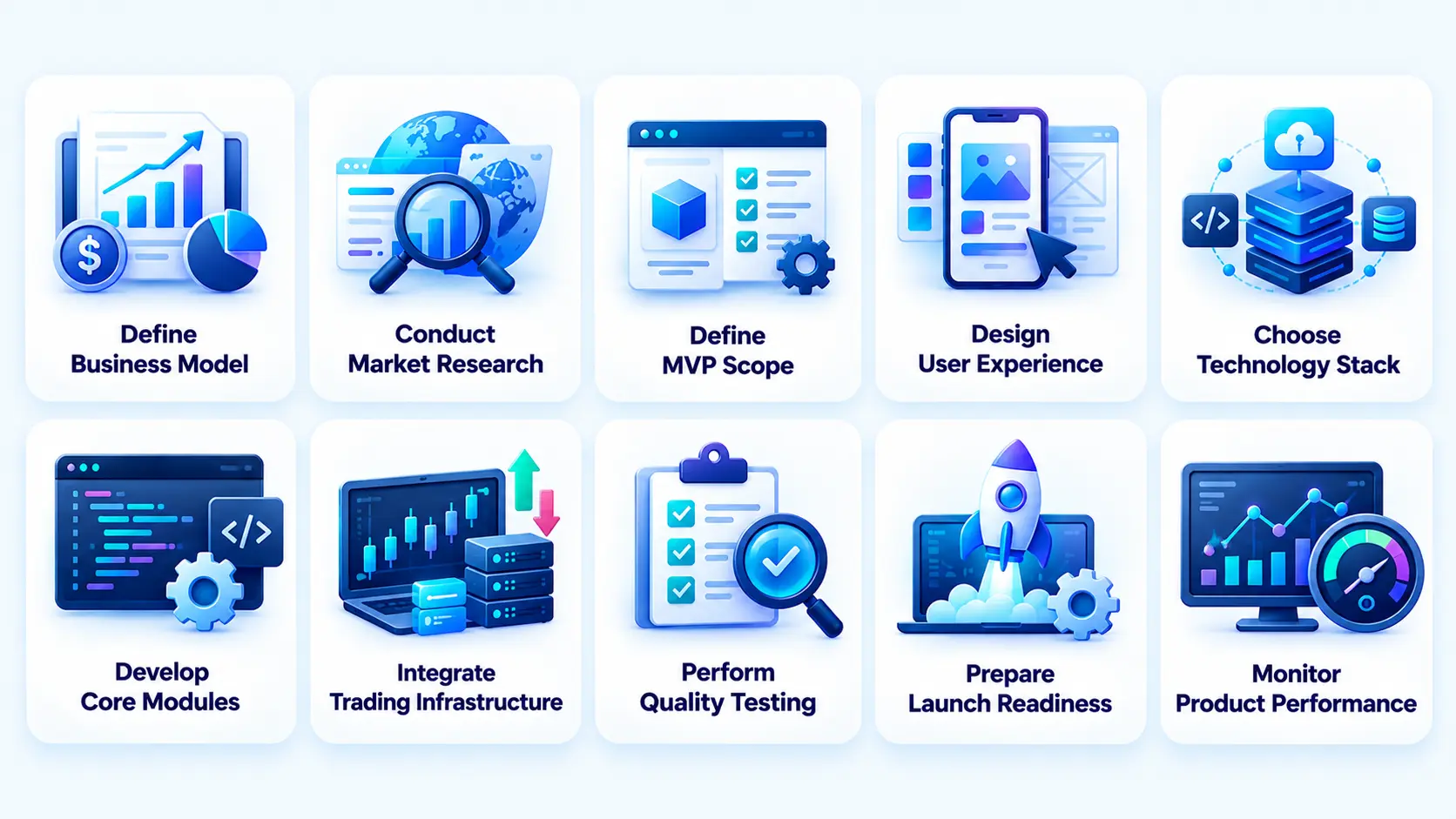
Step 1: Define the Business Model and Target Audience
Determine whether the product will serve retail traders, support an existing brokerage, provide proprietary trading tools, or deliver technology to business customers. Document the target audience, intended jurisdictions, core value proposition, and expected revenue sources.
Clarify who will provide brokerage services, who will handle customer funds, which entity will own customer relationships, and which responsibilities will remain with external partners.
Step 2: Conduct Market and Competitor Research
Review comparable products to understand their user experience, pricing approach, core features, onboarding process, and support model. Look for gaps that can be addressed through a more focused experience rather than simply copying a competitor’s feature list.
Research should also examine customer needs and operational constraints. Interviews, usability testing, and early concept validation can help determine whether the proposed product solves a meaningful problem.
Step 3: Define MVP Scope and Product Requirements
An MVP should contain enough functionality to validate the product’s central value proposition while meeting the minimum requirements for safe and reliable operation.
Prioritise onboarding, account access, market information, supported trading workflows, payment functions where applicable, essential risk controls, and customer support. Record which capabilities are mandatory for launch and which can be introduced later.
Step 4: Design the UI/UX and Trading Experience
Create user journeys for registration, identity verification, market discovery, order placement, account funding, and support. Identify points where users may misunderstand pricing, order status, risk, or account information.
Use prototypes and usability testing to evaluate the experience before committing to full implementation. Important financial actions should include clear summaries and confirmation steps.
Step 5: Choose the Technology Stack and Architecture
Select the mobile and web technologies, backend frameworks, data stores, infrastructure, and integration approach according to documented requirements. Consider the development team’s experience and the long-term cost of maintaining each component.
Define service boundaries, access permissions, data ownership, failure handling, monitoring, and recovery requirements before development progresses too far.
Step 6: Develop Trading, Account, and Payment Modules
Build the essential workflows in manageable stages. Account management, order handling, payment gateway integrations, notifications, and reporting should each have clear requirements and acceptance criteria.
Use test environments and controlled test data wherever possible. Keep sensitive credentials and production access separate from development environments.
Step 7: Integrate Market Data and Trading Infrastructure
Connect the application to approved market data sources and the selected broker or trading services. Test normal responses as well as rejected orders, timeouts, stale data, interrupted connections, and other failure conditions.
Confirm that the application accurately reflects the underlying system’s order and account states. Integration testing should cover the full user journey rather than only checking whether individual APIs return responses.
Step 8: Perform Functional, Performance, and Security Testing
Test core features across supported devices and operating systems. Validate calculations, account displays, order states, payment records, notifications, and reporting.
Performance testing should examine expected and peak activity, while security testing should assess access control, authentication, data exposure, and vulnerable dependencies. Document issues, fixes, and retesting results before launch.
Step 9: Complete Required Reviews and Launch Preparation
Confirm that the business has completed the legal, regulatory, operational, and third-party reviews required for its specific model. Prepare user disclosures, support processes, incident response procedures, and operational monitoring.
The application should not launch simply because development is complete. Launch readiness also depends on approved integrations, reliable operations, customer support, and the ability to respond to incidents.
Step 10: Deploy, Monitor, and Improve the Application
Release the product using a controlled deployment process. Monitor crashes, latency, failed requests, order status discrepancies, payment issues, and customer support demand.
Use feedback and measured product performance to guide improvements. Prioritise changes that increase reliability, improve task completion, address customer pain points, or support validated business goals.
How Much Does Forex Trading App Development Cost?
The cost of building a trading application depends on the product’s functionality, the amount of custom engineering required, and the systems it must connect to. A mobile interface connected to an established trading service has a different cost profile from a platform that requires extensive backend development, advanced analytics, complex operational workflows, and multiple integrations.
A reliable estimate should separate initial development from the costs of operating the product after launch. This makes it easier to compare proposals and understand the investment required to reach a commercially viable release.
Average Forex Trading App Development Cost by Complexity
The following ranges are indicative planning estimates in US dollars, not fixed quotations. Actual costs vary by development location, team composition, vendor rates, scope, integrations, security requirements, and delivery timelines.
| Product complexity | Indicative development cost | Typical scope |
| Basic MVP | $25,000 to $60,000 | Core account workflows, essential market information, basic trading integration, and limited administrative tools |
| Mid-level application | $60,000 to $150,000 | Expanded trading features, account and payment workflows, reporting, alerts, and broader integrations |
| Advanced trading platform | $150,000 to $350,000+ | Extensive custom functionality, advanced analytics, sophisticated risk monitoring, multi-asset capabilities, and complex infrastructure |
These estimates generally describe software development rather than the total capital required to operate a brokerage. They may exclude licensing, regulatory advice, market data agreements, liquidity arrangements, payment processing fees, and other third-party charges.
Cost of Building an MVP Forex Trading App
An MVP is intended to validate the core product proposition without building every possible feature. It may include registration, identity verification integration, a basic trading interface, supported market data, essential account information, transaction history, and a simple administrative dashboard.
The precise scope depends on whether the application connects to existing broker infrastructure or needs more substantial custom services. The team should confirm what the external provider already supplies before estimating development effort. An MVP also needs security testing, integration testing, error handling, monitoring, and launch preparation. Removing these activities to lower the initial quote can create greater costs later.
Cost of a Mid-Level Forex Trading Platform
A mid-level product may include a more refined trading interface, configurable alerts, expanded reporting, payment workflows, account management, and improved operational visibility. It may also support multiple user roles or additional customer journeys.
Costs rise when the project requires more complex integrations, customised business rules, additional testing, or coordination across multiple external providers. The estimate should identify which components are included and which will incur separate vendor or subscription charges.
Cost of an Advanced Forex Trading Application
An advanced application may support sophisticated charting, automated workflows, advanced analytics, multi-asset services, more extensive risk monitoring, and a greater degree of customisation.
Its architecture may need stronger resilience, more comprehensive monitoring, detailed audit records, and extensive performance testing. AI-enabled features can add further requirements for data preparation, model evaluation, monitoring, and user-facing explanations. A high feature count alone does not justify a larger investment. Advanced capabilities should be linked to specific user needs or business objectives and introduced when their expected value outweighs their development and operating costs.
Key Factors That Influence Development Costs
Several factors can materially change the final budget.
- Feature scope: Every additional workflow creates requirements for design, implementation, testing, and maintenance.
- Platform coverage: Supporting iOS, Android, and web may require additional work, even when some code can be shared.
- Integration complexity: Broker systems, market data feeds, identity verification, and payment services may have different technical and commercial requirements.
- Customisation: A highly branded experience with specialised workflows usually needs more custom engineering than a standard interface.
- Security and testing: Financial products require careful attention to access controls, sensitive data, transaction accuracy, and failure handling.
- Regulatory scope: Legal reviews, compliance procedures, and market-specific requirements can increase the time and cost of launch preparation.
- Infrastructure: Availability, performance, monitoring, data retention, and recovery requirements influence both development and recurring expenses.
- Team composition: Project management, product design, engineering, quality assurance, security expertise, and specialist integration work all contribute to delivery costs.
Businesses comparing financial product budgets can also review the fintech app development cost guide to understand broader cost drivers across digital financial services.
Forex Trading App Development Cost Breakdown by Phase
A phased budget helps business owners see where the investment is going and compare vendor proposals more effectively.
| Development phase | What the budget covers |
| Discovery and planning | Requirements, business model assessment, technical feasibility, and project scope |
| UI/UX design | User journeys, wireframes, interface design, and prototype validation |
| Frontend development | Mobile and web interfaces, navigation, charts, and user-facing workflows |
| Backend development | Account services, business logic, data handling, and application APIs |
| Integration | Market data, broker connectivity, payment services, identity verification, and notifications |
| Quality assurance | Functional, integration, device, performance, and security testing |
| Deployment | Production configuration, release preparation, monitoring, and launch support |
| Post-launch support | Maintenance, defect resolution, dependency updates, and planned improvements |
The proportion allocated to each phase depends on the project. A product with a standard interface and complex integrations may spend more on backend and integration work, while a highly customised customer experience may require more design and frontend effort.
Businesses considering a related financial trading product can use the stock trading app development cost guide as a reference for evaluating the cost structure of another trading application category.
How Forex Trading Apps Generate Revenue
A trading application can support several revenue models, but the available options depend on the business’s role, its customer agreements, and applicable regulations. Pricing should be transparent and designed to support a sustainable business rather than encourage unnecessary trading.
Spread-Based Revenue Models
In some brokerage models, revenue may be generated through the difference between the prices offered to customers to buy and sell a currency pair. The economics depend on the pricing model, liquidity arrangements, execution costs, and other contractual terms.
Businesses should not assume that every quoted spread becomes revenue. The actual commercial outcome depends on how prices are sourced, how trades are handled, and which costs or obligations apply.
Trading Commissions
Some businesses charge commissions on eligible transactions. Charges may depend on trading volume, account type, instrument, or other disclosed terms.
Commission structures should be understandable before a customer places an order. The business should also model how pricing affects customer acquisition, trading activity, operating costs, and retention.
Subscription and Premium Features
A subscription model may provide access to premium analytics, enhanced charting, additional research tools, advanced alerts, or other supplementary services. The value should be clear enough for users to understand what they are paying for.
Subscriptions can create more predictable income, but they also require ongoing product improvements and support. Businesses should track renewal rates, cancellations, and actual feature usage to determine whether the offering remains useful.
Withdrawal and Other Applicable Service Fees
Depending on the service model and applicable rules, businesses may charge certain disclosed service fees. These should reflect legitimate service costs and contractual arrangements rather than create unexpected barriers for customers.
All fees should be presented clearly, including when a third-party provider may charge separately. Businesses must assess applicable legal requirements before introducing or changing charges.
White-Label Licensing and B2B Revenue
A technology provider may generate revenue by licensing its platform to eligible business customers. Commercial agreements may include implementation charges, recurring licensing fees, support packages, or charges based on usage.
This model requires a product that can be configured and supported for multiple clients. Tenant separation, permissions, branding controls, integration flexibility, and support processes become important architectural considerations.
Premium Analytics and Trading Tools
Some products may offer supplementary analytical features or research tools as paid services. These could include advanced visualisations, customised reporting, or configurable monitoring capabilities.
Paid tools should have a clearly defined purpose and should not promise trading profits or guaranteed outcomes. Product teams should assess customer demand and ensure that the tools operate within applicable regulatory and contractual boundaries.
Businesses evaluating monetisation options should also understand the wider types of fintech apps and how different financial products align their services with revenue opportunities.
How to Calculate Forex Trading App ROI
Return on investment (ROI) helps businesses assess whether the revenue generated by a forex trading app justifies its development and operating costs. The calculation should consider revenue sources such as eligible transaction charges, subscriptions, and licensing, alongside expenses for development, infrastructure, marketing, customer support, compliance, and maintenance.
Key metrics include customer acquisition cost (CAC), customer lifetime value (LTV), monthly recurring revenue (MRR), revenue per active trader, user activation, and retention. Reviewing these indicators together provides a clearer picture of customer value, revenue stability, and the sustainability of business growth.
Break-even analysis helps estimate when revenue contributions may cover operating expenses and, eventually, the initial development investment. Businesses should test different scenarios, including slower customer acquisition, higher operating costs, lower retention, launch delays, and changes in third-party pricing. Long-term profitability also depends on application reliability, onboarding quality, customer trust, market conditions, regulatory changes, and competitive pressure.
Regularly reviewing these factors helps decision-makers refine product features, acquisition strategies, and future investment plans without relying on a single forecast or assuming a guaranteed financial return.
Common Challenges in Forex Trading App Development
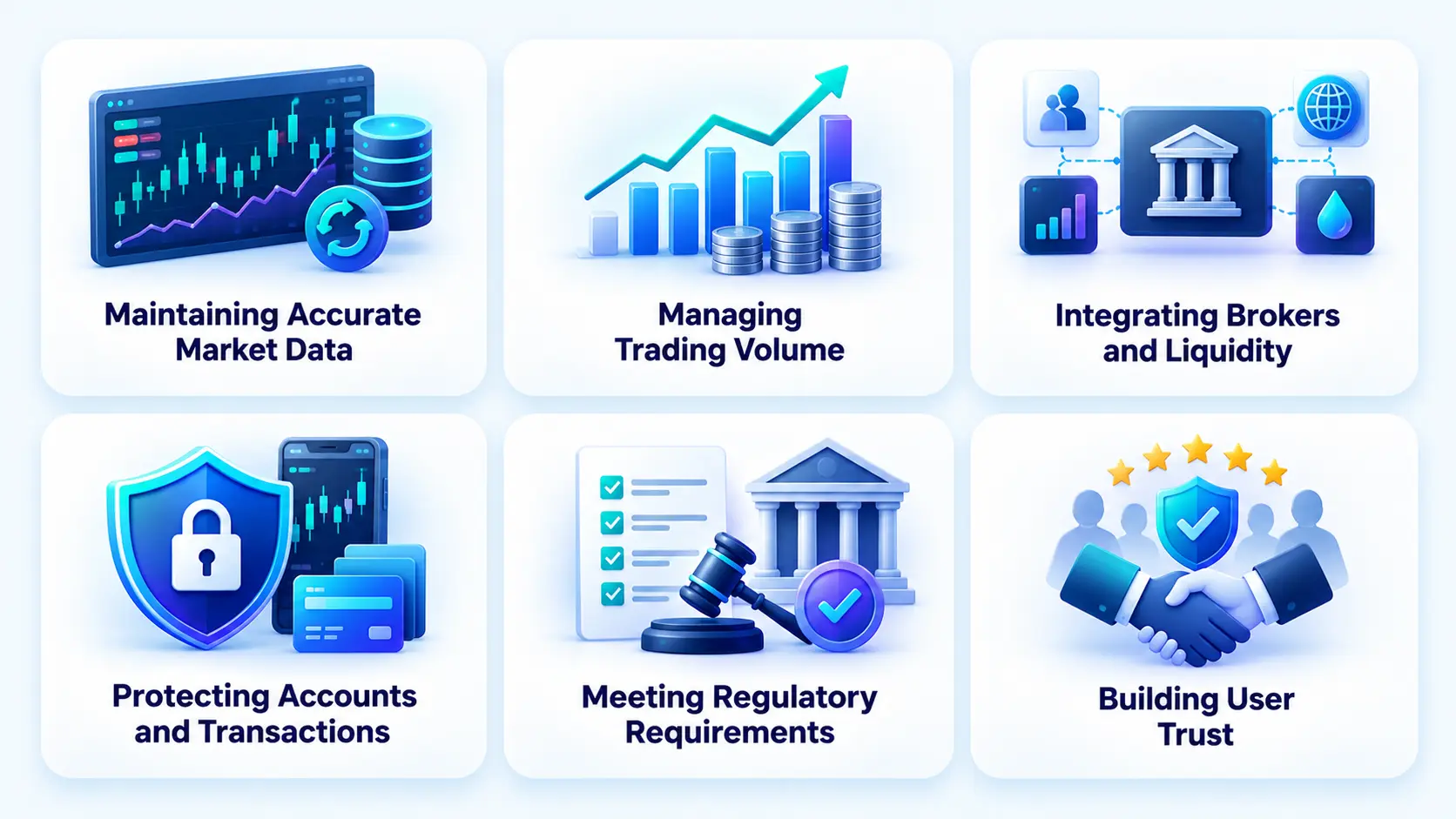
Forex trading app development involves technical, operational, and security challenges that can affect platform reliability, user trust, and long-term scalability. Common challenges include:
Maintaining Accurate, Low-Latency Market Data
Market data must be handled according to the provider’s specifications and the product’s intended use. Delayed updates, inconsistent timestamps, and connection interruptions can confuse users and affect the accuracy of the interface.
Businesses should define how stale data is detected, how connection failures are displayed, and when the application should prevent an action because the necessary information is unavailable.
Managing Trading Volume and System Availability
A product may experience uneven traffic during periods of high market activity. The architecture should be tested against expected demand and plausible peaks.
Capacity planning should cover critical services, databases, queues, and external dependencies. Monitoring and recovery procedures are important because scaling individual components does not automatically make the entire system resilient.
Integrating Brokers and Liquidity Providers
External trading systems may differ in their APIs, supported order types, account models, and operational procedures. Integration work must account for these differences rather than assuming that every provider behaves in the same way.
Businesses should establish clear agreements about service responsibilities, testing environments, incident escalation, and change notifications before relying on an integration in production.
Protecting User Accounts and Financial Transactions
Account compromise, payment errors, and unauthorised administrative actions can damage customer trust. Access control, authentication, transaction validation, monitoring, and incident response must be designed into the product.
Security should be reviewed throughout development and after launch. It is not a one-time checklist completed immediately before release.
Meeting Jurisdiction-Specific Regulatory Requirements
The business needs to understand the requirements associated with its actual activities and target markets. These may influence customer onboarding, product disclosures, data retention, transaction monitoring, marketing, and service availability.
Qualified legal and compliance advisers should help determine which obligations apply. Product teams can then translate the requirements into workflows, permissions, records, and controls that can be tested.
Building User Trust in a Competitive Market
Users need confidence that the application presents information clearly and handles their accounts responsibly. Confusing fees, unclear order states, inaccessible support, and inconsistent information can undermine trust.
Trust is supported by transparent communication, accurate account information, dependable service, appropriate security measures, and a consistent process for resolving issues.
Forex Trading App Development Trends to Watch
Forex trading app development is evolving with emerging technologies and changing trader expectations. The following trends highlight how businesses can improve trading experiences, strengthen platform capabilities, and prepare for future market demands.
AI-Assisted Trading Insights
AI can support the analysis and presentation of market information, including summarisation and pattern discovery. Its usefulness depends on data quality, evaluation, monitoring, and how clearly limitations are communicated to users.
Businesses should avoid treating AI output as inherently accurate. Features that influence important decisions need suitable testing, oversight, and controls.
Real-Time Analytics and Personalisation
Real-time analytics can help users review relevant information and help businesses understand how customers use the product. Personalisation can organise watchlists, dashboard layouts, and alerts around user preferences.
These capabilities should respect privacy choices and should not create misleading impressions about market certainty or future outcomes.
Cloud-Native Trading Infrastructure
Cloud-native design can support modular deployment, automated releases, managed services, and flexible resource allocation. These benefits depend on sound architecture, monitoring, cost controls, and recovery planning.
Not every product needs a highly distributed architecture from day one. The design should reflect the actual workload and operational requirements rather than follow a trend without a clear business reason.
Automated Risk Monitoring
Automated monitoring can identify conditions that warrant attention, including unusual account activity, failed integrations, or unexpected changes in system behaviour. The system should provide enough context for authorised staff to investigate alerts.
Monitoring rules need regular review to limit false positives and account for changes in the product or its operating environment.
Multi-Asset Trading Experiences
Some businesses may expand into additional asset classes to serve a wider range of customer needs. Such expansion should follow evidence of demand and an assessment of the technical, commercial, and regulatory implications.
A modular architecture can help manage the expansion, but the product still needs asset-specific data, order handling, reporting, and controls. Businesses planning a wider financial technology roadmap can consult the fintech software development guide for additional context on product planning and implementation.
How to Choose the Right Forex Trading App Development Company
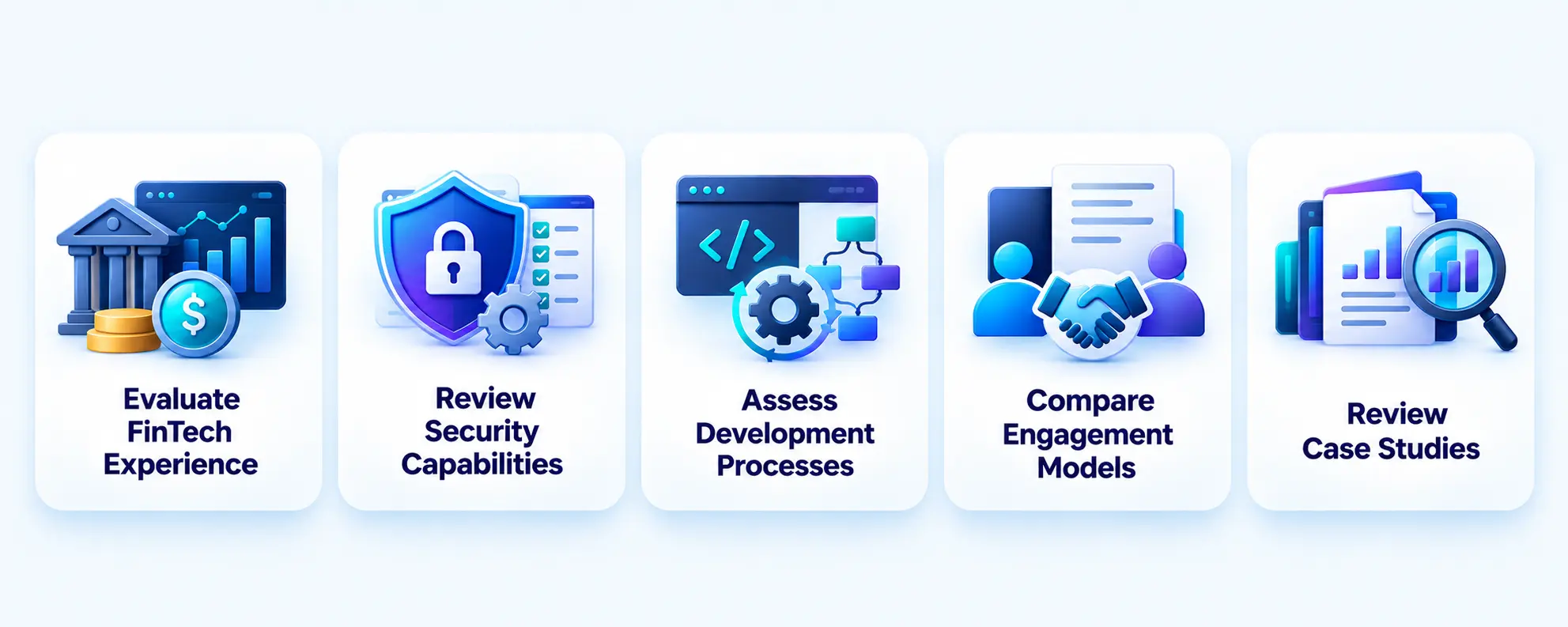
Selecting a development partner is an important decision because the quality of the implementation affects product reliability, integration complexity, ongoing maintenance, and the ability to respond to changing business requirements.
The evaluation should go beyond comparing hourly rates or delivery promises. Businesses need to understand how a prospective partner approaches financial product requirements, technical architecture, security, testing, and long-term support.
1. Evaluate FinTech and Trading Platform Experience
Look for a team that understands financial product workflows, account management, transaction handling, and third-party integrations. Experience with a related financial application can be useful, but the team should explain how that experience applies to the proposed project.
Ask for examples of completed work and clarify the team’s specific contribution. Distinguish between experience building customer-facing interfaces and experience implementing the backend services or integrations that support critical workflows.
If you are planning a broader trading product, reviewing a stock trading app development project can help you understand the key product and technical considerations involved in this category.
2. Review Security, Integration, and Scalability Capabilities
Ask how the team handles authentication, access permissions, sensitive data, integration failures, logging, and recovery. A capable partner should be able to explain these decisions in plain language and show how they will be tested.
The team should also identify external dependencies early. Market data, broker services, payment providers, and identity verification systems can influence both cost and delivery time.
Avoid relying on general assurances that an application will be secure or scalable. Request a documented approach covering requirements, architecture, testing, monitoring, and post-launch maintenance.
3. Assess Development Processes and Quality Assurance
A transparent development process should include documented requirements, agreed milestones, regular demonstrations, quality assurance, and a clear process for managing scope changes.
Ask how the team validates critical workflows, tests integrations, handles defects, and prepares releases. You should also understand which deliverables will be handed over at the end of the engagement.
A strong process makes it easier to identify issues early and reduces the risk of discovering fundamental gaps immediately before launch.
4. Compare Engagement Models and Project Transparency
The engagement model should match the maturity and complexity of the project. A fixed-scope arrangement may suit a clearly defined MVP, while a dedicated team can provide flexibility when requirements are expected to evolve.
Compare proposals on more than their headline price. Review team composition, assumptions, exclusions, payment milestones, change-request procedures, intellectual property terms, and support commitments.
The proposal should also explain how third-party charges will be handled and which costs fall outside the development agreement.
5. Review Case Studies and Verifiable Results
Case studies help businesses evaluate a development partner’s experience with relevant technologies, integrations, and product requirements. Review the original business challenge, the solution implemented, and any documented outcomes to understand the team’s capabilities.
For example, RipenApps’ Al Muzaini currency converter and money transfer solution offers a relevant reference for assessing experience with currency conversion and money transfer functionality. Businesses planning a forex trading app can use this example to explore related product capabilities while recognising that trading platforms may involve different technical, operational, and regulatory requirements.
Before selecting a development partner, ask for project details that closely match your intended scope, including integration complexity, security requirements, and measurable results where available. A previous project’s outcomes should be treated as a reference rather than a guarantee of similar results for a new product.

Conclusion
Forex trading app development involves a combination of product strategy, reliable engineering, external integrations, security controls, and commercial planning. Businesses need to define their objectives before deciding which features to build, which technologies to adopt, and how much to invest.
A focused MVP can help validate market demand and establish the core user experience, provided it meets essential reliability, security, and operational requirements. Advanced capabilities should be introduced when they address demonstrated user needs or support clear business goals. Cost planning should account for both initial development and ongoing operational expenses. Similarly, ROI should be evaluated through customer acquisition, retention, revenue contribution, service costs, and the time required to recover the investment.
Partnering with an experienced fintech product development company can help businesses assess technical requirements, plan integrations, and establish a scalable development roadmap. Before committing to a launch, confirm the technical dependencies, regulatory responsibilities, operating costs, and customer support arrangements.
RipenApps helps businesses plan and build digital products aligned with their requirements, user expectations, and long-term goals. A structured development approach can help turn a trading product concept into a reliable, scalable solution.
FAQs
1. How Much Does It Cost to Develop a Forex Trading App?
The cost depends on the feature set, platforms, integrations, customisation, security requirements, and development team’s rates. As an indicative planning range, a basic MVP may cost around $25,000 to $60,000, a mid-level application around $60,000 to $150,000, and a more advanced platform $150,000 to $350,000 or more. These estimates may exclude licensing, market data, third-party fees, and ongoing operating expenses.
2. How Long Does It Take to Build a Forex Trading App?
A basic MVP may take approximately three to five months, while a more complex application may require six to twelve months or longer. The timeline depends on scope, integration availability, regulatory reviews, testing requirements, and third-party dependencies. The most reliable estimate comes from a documented project scope and delivery plan.
3. What Features Are Essential for a Forex Trading App MVP?
An MVP generally needs secure registration, identity verification where required, supported currency prices, essential trading workflows, account information, transaction history, and customer support. Payment functionality and administrative tools should be included according to the business model. Security testing, error handling, and monitoring are also necessary before launch.
4. Can a Forex Trading App Integrate With Existing Brokers?
Yes. An application can connect to an existing broker or trading service if the provider offers suitable integration capabilities and the necessary commercial permissions are in place. The development team should validate API availability, supported order types, account data, execution status, error handling, and service limits before confirming the scope.
5. Which Technology Stack Is Best for Forex Trading App Development?
The best stack depends on the required user experience, performance, integration needs, team expertise, and long-term maintenance plans. Native development may suit platform-specific requirements, while cross-platform frameworks can help share code across mobile platforms. Backend technologies, databases, and cloud infrastructure should be selected according to the product’s data, availability, and security requirements.
6. How Do Forex Trading Apps Make Money?
Depending on the operating model and applicable rules, revenue may come from eligible spreads, commissions, subscriptions, premium tools, or business-to-business licensing. The appropriate model depends on the services provided and the contractual arrangements with customers and partners. Pricing should be transparent, and forecasts should account for operating costs and customer retention.
7. Is a Licence Required to Launch a Forex Trading App?
It depends on the business’s activities and the jurisdictions where it operates. Developing software for an existing provider is different from operating a brokerage, soliciting customers, or providing regulated financial services. Businesses should obtain qualified legal advice before launch to determine which registrations, licences, disclosures, and other obligations apply. For a US launch, do not assume that a technology provider’s existing arrangements automatically cover your business.
8. Can AI Be Integrated Into a Forex Trading Application?
Yes. AI can support features such as market information summaries, pattern analysis, personalised dashboards, customer support, and anomaly detection. Each use case requires suitable data, testing, monitoring, and clear communication of limitations. AI-generated insights should not be presented as guaranteed predictions of market performance.
Discuss your project and request for proposal
SHARE
WRITTEN BY

Prankur Haldiya
Chief Technical Officer
A tech innovator and engineering leader, Prankur Haldiya drives RipenApps’ product development strategy and oversees cutting-edge solutions in mobility, AI, and cloud ecosystems. He is passionate about building high-performance teams and helping brands launch secure, scalable, and user-centric digital products.
View All Articles