

Key Takeaways
- A scalable property management SaaS platform requires secure multi-tenant architecture, flexible workflows, and reliable data management.
- Core features should connect property, tenant, lease, payment, maintenance, document, communication, and reporting workflows.
- Security and compliance should be integrated into the platform architecture rather than treated as post-development requirements.
- An MVP approach helps validate essential property management workflows before investing in advanced AI, IoT, and analytics.
- Development costs vary based on features, integrations, architecture, security requirements, technology choices, and long-term scalability needs.
Property management has traditionally depended on spreadsheets, emails, paper-based records, and disconnected software systems. As property portfolios grow, these methods can make it difficult to coordinate tenants, leases, payments, maintenance, documents, and financial reporting from one place. A cloud-based SaaS platform can bring these workflows together while giving property owners and managers real-time access to operational data.
The SaaS model is particularly attractive because it allows a software provider to serve multiple property management businesses through a centralized application. Customers can subscribe to the platform, configure their portfolios, manage users, and access features without maintaining their own application infrastructure.
Modern property management software needs to go beyond basic property records. A competitive platform may need tenant portals, online payments, maintenance workflows, digital documents, analytics, role-based permissions, third-party integrations, automation, and AI-powered capabilities.
For businesses planning property management software development, architecture is as important as the feature set. Working with an experienced SaaS development company can help businesses design secure multi-tenant architecture, reliable data management, scalable infrastructure, external integrations, and configurable workflows across different property types and jurisdictions.
This guide explains how to build a property management SaaS platform, including its core features, architecture, technology stack, security requirements, compliance considerations, development process, monetization models, timeline, and cost.
Table of Contents
What is a Property Management SaaS Platform?
A property management SaaS platform is a cloud-based application designed to help property owners, landlords, property managers, tenants, vendors, and administrators manage property-related operations through a centralized system.
Unlike traditional property management applications that may be installed locally or maintained on dedicated infrastructure, SaaS platforms are generally accessed through the internet. The provider manages the application, infrastructure, updates, security, and ongoing improvements, while customers typically pay through a subscription or usage-based model.
A SaaS platform can manage relationships between properties, buildings, units, tenants, leases, payments, maintenance requests, vendors, documents, and financial records. This creates a shared operational environment instead of requiring users to move information between multiple applications. Custom web app vs SaaS can also help businesses understand the differences between these approaches when defining their product strategy.
Why Build a Property Management SaaS Platform?
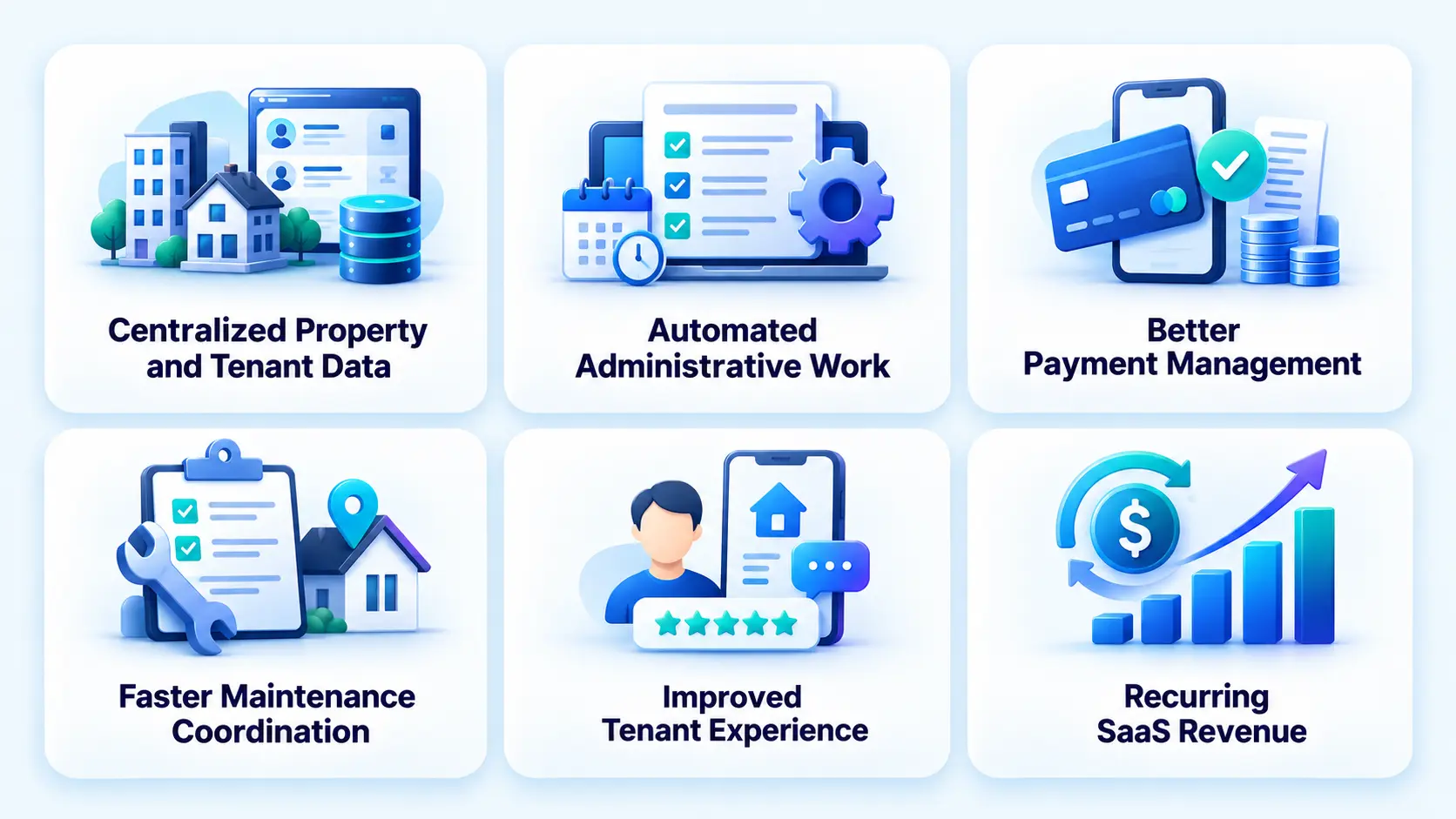
Property management involves numerous repetitive workflows that are well suited to digital automation. A centralized SaaS platform can bring these processes together, allowing property managers, owners, tenants, and vendors to access relevant information from a single system. This can reduce manual work, improve coordination, and make day-to-day property operations easier to manage.
A well-designed platform can also help property businesses streamline operations, improve customer experiences, centralize information, and introduce new technology-enabled services. Businesses looking to identify similar opportunities can explore how digital solutions can expand your real estate business through improved workflows, better accessibility, and connected services.
1. Centralized Property and Tenant Data
Property managers often need to access information about units, tenants, leases, payments, maintenance, and documents simultaneously. When this information exists across different spreadsheets and systems, employees may spend significant time searching for records and reconciling information.
A centralized application can create a common data model where related records are connected. A property can be associated with its units, tenants, leases, transactions, maintenance history, and documents.
2. Automated Administrative Work
Payment reminders, lease expiration notifications, maintenance assignments, document reminders, and recurring reports can all be automated.
Automation can reduce manual follow-ups while also creating a more consistent operating process. For example, when a lease reaches a defined period before expiration, the platform can automatically notify the appropriate property manager.
3. Better Payment Management
Online rent collection can make payment workflows more convenient for tenants while giving managers centralized transaction visibility. A platform can support recurring payments, invoices, receipts, late-fee calculations, payment reminders, transaction histories, and reconciliation workflows. Businesses planning this functionality can use the payment gateway integration resource to understand broader payment integration considerations.
4. Faster Maintenance Coordination
Maintenance requests often require communication between tenants, property managers, vendors, and internal teams. A digital work-order workflow can connect these participants and provide visibility into request status.
Instead of relying on email chains, a tenant can submit an issue, the manager can assign it to a vendor, the vendor can update progress, and the tenant can receive status notifications from the same system.
5. Improved Tenant Experience
Tenants increasingly expect digital access to everyday property services. A well-designed tenant portal can provide rent payments, maintenance requests, lease documents, announcements, and communication in one place.
This can also reduce the workload on property managers because tenants can access information without contacting staff for every routine request.
6. Recurring SaaS Revenue
The SaaS model creates several monetization opportunities. A platform can charge monthly or annual subscriptions, price according to properties or units, introduce usage-based fees, or create enterprise contracts.
The revenue model should be considered during product planning because billing architecture can influence customer accounts, subscriptions, entitlements, usage tracking, and reporting.
Core Features of a Property Management SaaS Platform
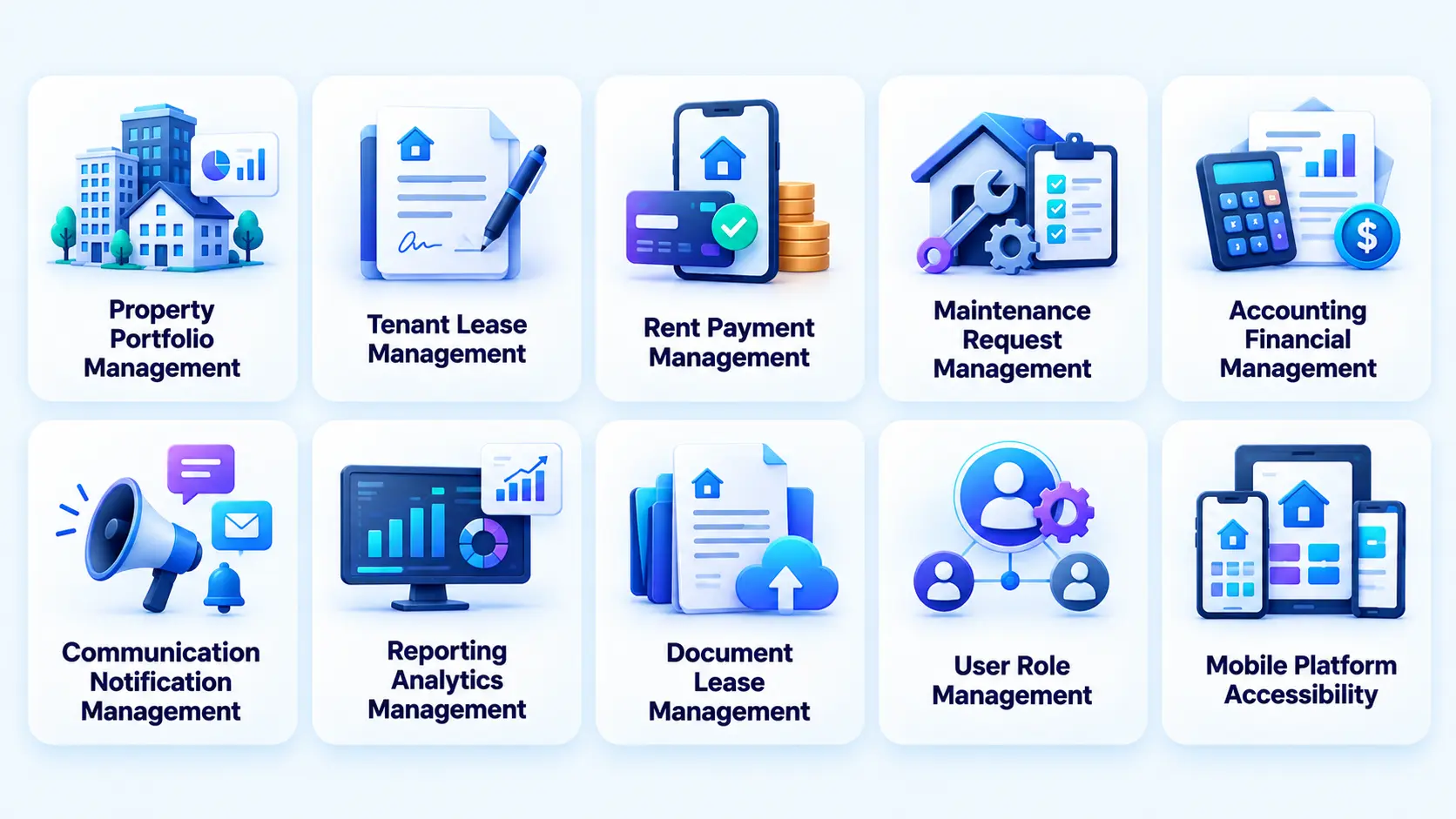
A well-designed property management SaaS platform should combine essential operational features that help businesses manage properties, tenants, finances, maintenance, and daily workflows efficiently.
1. Property and Portfolio Management
Property and portfolio management forms the foundation of the platform. Each property should have a structured profile containing information such as location, property type, ownership details, buildings, units, occupancy, documents, and operational records.
For organizations managing multiple properties, portfolio dashboards can provide a consolidated view of occupancy, rental income, expenses, maintenance activity, and other key indicators. The property data model should also establish relationships between buildings and units so that users can navigate from a portfolio to a property, from a property to a building, and from a building to individual units.
2. Tenant and Lease Management
Tenant management allows property managers to maintain profiles, contact information, onboarding records, lease details, communication history, and relevant documents. Lease management can cover lease creation, document storage, renewals, expiration reminders, and status tracking.
The platform should also make it easy to see which tenants are linked to specific units and which leases are active. These workflows can be expanded further by exploring how a real estate app development guide approaches broader property technology requirements.
3. Rent and Payment Management
Rent collection should provide a convenient experience for tenants and operational visibility for property managers. The payment module can support recurring payments, invoices, receipts, payment histories, late fees, refunds, transaction reconciliation, and payment notifications.
The application should avoid unnecessarily storing sensitive card information when a secure third-party payment provider can handle the payment credentials. The architecture should instead maintain transaction references and relevant financial records within the property management system.
4. Maintenance Management
Maintenance functionality should provide a complete workflow from issue submission to resolution. A tenant can submit a maintenance request through the portal, describe the issue, attach photographs, and select an appropriate category. The property manager can review the request, determine its priority, assign a vendor, create a work order, and monitor progress.
Over time, the system can build a historical record of maintenance requests, costs, response times, vendors, properties, and recurring issues. This information can later support predictive maintenance and property analytics.
5. Accounting and Financial Management
Financial functionality can include income and expense tracking, property-level financial records, owner statements, security deposits, expense categorization, and financial reporting.
The platform does not necessarily need to replace a full accounting system. Instead, it can provide property-specific financial workflows and integrate with established accounting platforms where more advanced accounting functionality is required. For broader enterprise financial functionality, the ERP software development features resource can provide additional context.
6. Communication and Notifications
Communication functionality can connect tenants, managers, owners, and vendors. The platform may provide in-app messaging alongside email, SMS, and push notifications. Notifications can be triggered by payment events, maintenance updates, lease deadlines, announcements, or administrative actions. Notification preferences should be configurable because different users may prefer different channels for different types of information.
7. Reporting and Analytics
Reporting allows users to transform operational records into useful business information. A property manager may need to understand occupancy levels, rental income, expenses, maintenance costs, outstanding payments, or lease expirations. Property owners may require portfolio-level performance summaries. Advanced analytics can introduce configurable dashboards, trend analysis, forecasting, benchmarking, and real-time operational indicators.
8. Document and Digital Lease Management
Property businesses manage leases, inspection reports, invoices, tenant records, disclosures, and other documents. A document management layer should support secure storage, access controls, metadata, versioning, document templates, and digital signatures where required. Documents should also be associated with the appropriate organization, property, unit, tenant, or lease to make retrieval easier.
9. User and Role Management
Different users require different permissions. A tenant should not have access to the same records as a property manager, while a platform administrator may require access to multiple customer organizations.
Role-based access control can define what each user can view, create, modify, approve, or delete. An administrative interface is therefore an important component of the overall system. Businesses planning this layer can reference admin dashboard development services for additional guidance.
10. Mobile Accessibility
The platform should be responsive enough for users who access it from smartphones and tablets. Tenants may use mobile devices primarily for rent payments, maintenance requests, notifications, and communication. Property managers may need mobile access to maintenance requests, tenant records, property information, and work orders while visiting properties. A responsive web application can be a practical starting point, with dedicated mobile applications introduced when usage patterns justify them.
Advanced Features to Consider
As the platform matures, advanced capabilities can improve automation, decision-making, user experience, and operational efficiency across property management workflows.
1. AI-Powered Property Management
AI can extend property management SaaS beyond basic workflow automation. An AI assistant could answer questions about portfolio information, summarize maintenance histories, classify incoming tenant requests, analyze lease documents, or help managers draft tenant communications. AI in real estate can also analyze historical information to identify trends in rental income, maintenance costs, occupancy, or tenant activity.
2. Smart Maintenance and Predictive Analytics
Maintenance data can become more valuable as the platform accumulates historical records. The system can identify properties with unusually high maintenance expenses, detect recurring issues, compare vendor response times, and identify equipment that repeatedly requires repairs.
Predictive models can eventually estimate the probability of future maintenance events, allowing property managers to plan maintenance rather than responding only after failures occur.
3. Smart Property and IoT Integration
IoT devices can provide real-time property information. Smart locks can provide access data, thermostats can provide environmental information, and sensors can detect leaks or unusual conditions.
The platform can process these signals and convert them into alerts or automated workflows. For businesses planning connected property experiences, IoT smart home app development can be considered when exploring how IoT devices and connected features can fit into the overall platform.
4. Automated Workflow Management
Workflow automation can handle processes such as tenant onboarding, lease renewals, payment reminders, vendor follow-ups, maintenance escalation, and compliance notifications. A configurable workflow engine can allow administrators to define triggers, conditions, actions, and approval steps without requiring developers to manually implement every new workflow.
Property Management SaaS Architecture
Architecture is one of the most important decisions when building a property management SaaS platform because the system needs to support multiple organizations while maintaining security and performance.
Multi-Tenant SaaS Architecture
There are several ways to implement multi-tenancy. A shared database and shared schema approach allows multiple customers to use the same tables, with tenant identifiers distinguishing records. This can provide infrastructure efficiency but requires strict application-level isolation.
A shared database with separate schemas provides another layer of logical separation. A separate database for each tenant offers stronger isolation but increases infrastructure and operational complexity. The appropriate approach depends on customer requirements, expected scale, compliance obligations, infrastructure budget, and enterprise expectations. Tenant isolation should be applied consistently across database queries, APIs, file storage, caching, background processing, reporting, and authentication.
Frontend Architecture
The frontend can contain several role-specific experiences, including an administrator dashboard, property manager portal, owner portal, tenant portal, and vendor interface. A component-based architecture can help maintain consistency while allowing different roles to access different workflows. Each interface should expose only the features and information relevant to that user’s responsibilities. Shared components can also simplify maintenance and ensure a consistent experience across the platform.
The frontend should also handle responsive layouts, accessibility, notifications, data visualization, form validation, and real-time updates where required. Clear navigation and reusable UI components can further improve usability across different user roles and devices. Efficient state management can keep information synchronized across different workflows. Performance optimization can also help maintain smooth interactions as the platform and its user base grow.
Backend Architecture
The backend is responsible for application logic, data processing, integrations, security, and workflow execution. A modular backend can separate responsibilities such as authentication, property management, tenant management, leases, payments, maintenance, documents, notifications, and reporting. This separation makes the system easier to maintain and allows individual modules to evolve without affecting unrelated functionality. Clear API boundaries can also simplify communication between the frontend, backend services, and third-party integrations.
For larger platforms, selected services can be separated based on independent scaling requirements. Background tasks such as notifications, payment processing, document processing, and report generation can run asynchronously to reduce pressure on core application services. This approach can improve reliability and allow the backend infrastructure to scale as property portfolios, users, transactions, and workflows increase.
Database Architecture
A relational database is often suitable for property management because many records have structured relationships. A typical data model can connect organizations with users, properties, buildings, units, tenants, leases, payments, maintenance requests, vendors, documents, and audit logs. This structure helps maintain data consistency and makes it easier to retrieve related information across different workflows.
Database indexing, query optimization, partitioning, and caching become increasingly important as transaction volume and reporting requirements grow. Well-designed database queries can improve application performance, while appropriate indexing can reduce response times for frequently accessed records. Regular monitoring can also help identify database bottlenecks before they affect the user experience.
Cloud Infrastructure
A production SaaS platform can require compute resources, managed databases, object storage, load balancing, content delivery, monitoring, logging, backups, and disaster recovery. Infrastructure should be designed around expected customer growth rather than simply current traffic. A well-planned cloud environment can also improve reliability, performance, and resource management as the platform scales.
The infrastructure should support automated deployments, secure access controls, environment separation, backup policies, and recovery procedures. Businesses can also explore cloud architecture consulting when planning the cloud environment and determining how infrastructure should support the platform’s scalability, security, and long-term requirements.
Third-Party Integrations
A property management platform can depend on external services for payments, accounting, e-signatures, communication, identity verification, property listings, analytics, and IoT. An integration layer should support authentication, API versioning, webhooks, retries, rate limits, error handling, and monitoring. A well-structured integration layer can also make it easier to add or replace third-party services without disrupting core platform functionality.
As the number of integrations grows, reusable API patterns can help keep the architecture consistent and easier to maintain. Standardized authentication, request handling, error management, and monitoring can also simplify future integrations. For complex API ecosystems, an experienced API Development Company can help design and implement scalable integration patterns.

Security Requirements for Property Management SaaS
Property management SaaS platforms handle sensitive tenant, lease, financial, and payment information. Authentication should include strong passwords, multi-factor authentication, secure sessions, account recovery, and single sign-on where required. Authorization should use role-based and tenant-level permissions so users can access only the properties and records relevant to their responsibilities.
Data should be protected during transmission and storage using encryption, secure key management, database access controls, protected file storage, and secure APIs. Applications should also implement input validation, API authorization, secure coding practices, dependency management, vulnerability assessments, and penetration testing to reduce security risks and prevent unauthorized access.
Continuous monitoring and auditing are equally important for maintaining security after deployment. Audit logs can capture authentication events, permission changes, financial transactions, administrative actions, document access, and sensitive record modifications, while monitoring can help detect unusual traffic, API failures, infrastructure issues, and potential security incidents. Cloud application security should also be considered as the platform grows to strengthen access controls, monitoring, and overall protection.
Compliance Requirements for a Property Management SaaS Platform
Compliance requirements depend on the markets, users, data, payment functionality, and property types supported by the platform. Depending on the target market, a property management platform may need to consider regulations such as GDPR and CCPA/CPRA, along with applicable payment security and housing regulations. The platform should include privacy controls, consent management, data access and deletion workflows, data retention policies, audit trails, and secure payment integrations from the beginning.
Compliance requirements can also vary across states, cities, and countries, particularly for leases, disclosures, security deposits, inspections, and tenant communications. A scalable platform should therefore use configurable, rules-based workflows that support jurisdiction-specific requirements rather than applying a single set of rules everywhere. This makes it easier to adapt document requirements, payment rules, notifications, approval processes, and retention policies as regulations change.
How to Build a Property Management SaaS Platform
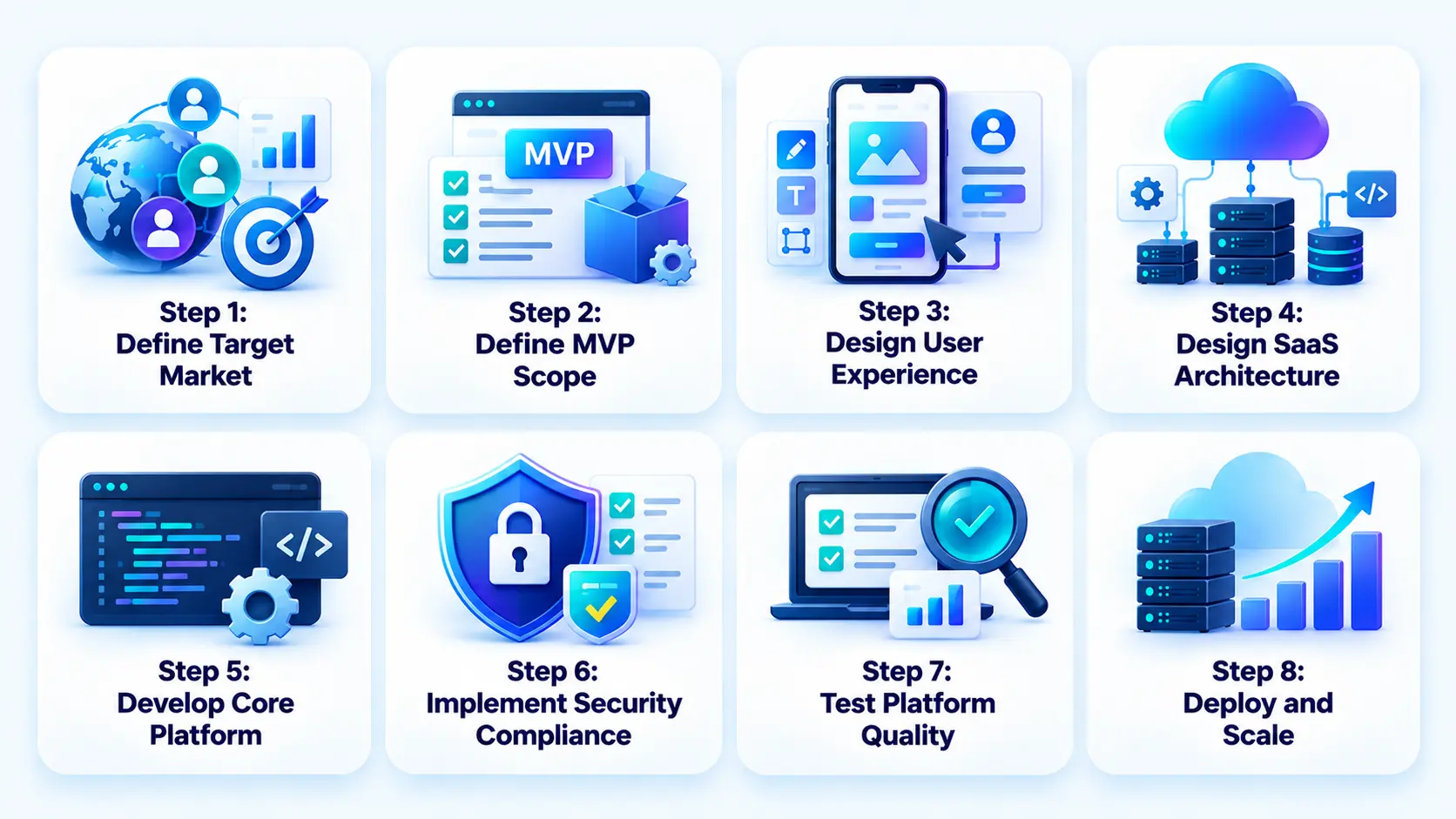
Building a property management SaaS platform requires a clear understanding of the target users, operational workflows, technical architecture, and long-term scalability requirements. The development process should move from defining the product scope and validating user needs to designing the architecture, developing core features, integrating third-party services, and preparing the platform for launch and growth.
Step 1: Define the Target Market and SaaS Model
The first step is to determine exactly who the product will serve. A platform designed for independent landlords may require a very different feature set from one designed for enterprise property management companies. Start by identifying the customer segment, property types, portfolio size, target geography, user roles, and operational challenges the platform will address.
The SaaS model should also be defined at this stage. Decide whether customers will be charged by property, unit, user, subscription tier, or usage. Consider which capabilities should be included in each plan and which features could become premium offerings.
If the product is intended to support the broader real estate ecosystem, the real estate app development company perspective can also help when evaluating related product requirements.
Step 2: Define the MVP Scope
The MVP should focus on the workflows that are essential to the target customer rather than attempting to include every possible feature. A first release may prioritize property and unit management, tenant records, lease management, payments, maintenance requests, notifications, and basic reporting.
Each feature should have a clear purpose and connection to a core customer workflow. Advanced AI, predictive analytics, IoT, extensive accounting functionality, and large integration ecosystems can be introduced after the core product has been validated. When planning the initial budget, understanding the factors that influence MVP development cost can help businesses determine which features to prioritize for the first release.
Step 3: Design the User Experience
User experience design should begin with the main workflows rather than isolated screens. Map how a property manager adds a property, creates units, adds tenants, creates leases, receives payments, manages maintenance requests, and generates reports. Each workflow should identify the information users need, the actions they can perform, and the outcomes they expect.
Different users will require different experiences. Property owners may need portfolio-level financial and occupancy information, while tenants may primarily need rent payments, maintenance requests, documents, and communication. The interface should make these workflows easy to complete without unnecessary navigation or complexity.
Prototypes and usability testing can help stakeholders identify confusing screens, unnecessary steps, missing information, and workflow gaps before engineering begins. This can reduce changes during development and provide developers with clearer requirements for each role-specific experience.
Step 4: Design the SaaS Architecture
Architecture planning should address multi-tenancy, database design, authentication, authorization, APIs, cloud infrastructure, file storage, integrations, monitoring, backups, and disaster recovery. The architecture should establish clear boundaries between organizations so that one customer’s users and data cannot accidentally interact with another customer’s information.
The team should also determine how the platform will handle growth. Decisions around relational databases, caching, asynchronous processing, API architecture, storage, and cloud services should be based on expected workloads rather than adding unnecessary infrastructure from the beginning.
For larger platforms, services with independent scaling requirements can be separated as usage increases. This allows the initial architecture to remain manageable while creating a path for supporting more users, properties, transactions, integrations, and background workloads over time.
Step 5: Develop the Platform
Development can proceed across the frontend, backend, database, infrastructure, and integrations. The frontend should provide role-specific experiences for administrators, property managers, owners, tenants, and vendors, while the backend should manage business logic, permissions, workflows, data processing, and integrations.
A modular implementation allows individual capabilities such as payments, maintenance, notifications, documents, and reporting to evolve without creating excessive dependencies between unrelated areas. Development should also follow version control, code review, documentation, and continuous integration practices to maintain consistency as the codebase grows.
Automated testing should be introduced alongside development rather than waiting until the end of the project. This allows the team to identify issues earlier and makes it easier to verify that changes to one part of the platform do not break existing workflows.
Step 6: Implement Security and Compliance
Security should be implemented alongside application development rather than treated as a final-stage activity. Authentication can include strong passwords, multi-factor authentication, session management, and single sign-on where required. Authorization should combine role-based permissions with tenant-level access controls.
Data should be encrypted during transmission and storage, while sensitive documents should use protected storage and controlled access. Audit logging can record important activities such as permission changes, financial transactions, document access, and administrative actions.
Compliance requirements should also be translated into configurable application controls and workflows where possible. Because property management requirements can vary across jurisdictions, the platform should allow relevant rules, permissions, documents, and workflows to be adapted without requiring major changes to the core application.
Step 7: Test the Platform
Testing should cover functional behavior, APIs, integrations, performance, security, responsiveness, and user acceptance. Each major workflow should be tested under normal and failure conditions to confirm that the system behaves correctly when payments fail, APIs become unavailable, documents cannot be uploaded, or users submit invalid information. Multi-tenant applications require additional security testing to ensure users cannot access records, files, reports, or API resources belonging to another organization.
Payment workflows should also be tested for successful transactions, failures, refunds, duplicate requests, and reconciliation. Performance testing can determine how the platform behaves as concurrent users, properties, transactions, and background processes increase. User acceptance testing can then confirm that the completed workflows meet the practical requirements of property managers, owners, tenants, and other intended users.
Step 8: Deploy and Scale
Once the application passes testing, it can be deployed to the selected cloud environment using a controlled release process. CI/CD pipelines can automate deployments, while monitoring and centralized logging can provide visibility into application performance, infrastructure health, API failures, and security events. Backup and recovery procedures should also be verified before the platform goes fully live.
Scaling should be based on actual usage patterns rather than assumptions. As customer and transaction volumes increase, the platform can introduce database optimization, caching, asynchronous processing, load balancing, and horizontal scaling. Regular performance reviews can help identify bottlenecks and determine when additional infrastructure or architectural changes are required.
Property Management SaaS Monetization Models
Subscription-based pricing allows customers to pay monthly or annually for defined platform functionality. Plans can vary based on properties, units, users, features, storage, automation, or support levels. This model provides predictable recurring revenue while giving customers flexibility to select a plan that matches their operational requirements.
Per-property pricing charges customers according to the number of properties they manage, making the pricing structure closely aligned with portfolio size. Per-user pricing instead calculates fees based on the number of property managers, administrators, or other professionals using the platform. The latter can be suitable when user volume is a stronger indicator of platform usage.
Usage-based pricing can generate additional revenue from specific activities such as payment transactions, SMS messages, document signing, API requests, or premium automation. These charges can be combined with a recurring subscription. Enterprise customers may receive custom pricing for requirements such as SSO, advanced integrations, dedicated infrastructure, custom reporting, higher support levels, and contractual service commitments.
How Much Does it Cost to Build a Property Management SaaS Platform?
The cost of developing a property management SaaS platform depends on factors such as product scope, technical architecture, integrations, security requirements, target geography, development team, and post-launch support. A focused MVP will generally require less investment than an enterprise platform with multiple property types, mobile applications, AI, accounting integrations, IoT capabilities, and multi-region compliance.
Businesses evaluating the investment can also look at the cost to develop a real estate app like Zillow to understand how features, integrations, platform complexity, and scalability can influence the budget for a large-scale real estate application.
Estimated Property Management SaaS Development Cost
| Platform Type | Estimated Development Cost |
| Basic MVP | 40,000–70,000 |
| Mid-Level SaaS Platform | 70,000–150,000 |
| Advanced SaaS Platform | 150,000–250,000+ |
| Enterprise Platform | $250,000+ |
These figures are planning ranges rather than fixed quotes. The final budget should be established after requirements, architecture, integrations, design, and deployment expectations have been defined.
Major Cost Factors
Feature complexity is one of the most significant cost drivers. A platform containing property profiles and basic tenant management requires considerably less engineering than one containing accounting, AI, predictive analytics, complex payment workflows, and multiple external integrations.
UI/UX complexity also affects development effort. Multiple portals for administrators, owners, property managers, tenants, and vendors increase design and frontend requirements.
Multi-tenancy can influence backend architecture, database strategy, authorization, billing, infrastructure, testing, and monitoring.
Integrations can introduce additional development effort because each external system has its own authentication methods, API structure, limits, error conditions, and maintenance requirements.
Security and compliance requirements can also increase costs because they may require specialized architecture, security testing, audit controls, encryption, identity management, and ongoing reviews.
AI functionality introduces additional considerations around model or API usage, data processing, evaluation, monitoring, prompt design, and optimization. Businesses planning to add AI capabilities should also consider the factors that influence AI integration cost when estimating the overall development budget.
Development Cost by Feature
| Feature | Complexity |
| Property management | Medium |
| Tenant management | Medium |
| Lease management | Medium |
| Online payments | Medium to High |
| Maintenance management | Medium |
| Accounting | High |
| Analytics | Medium to High |
| AI capabilities | High |
| Third-party integrations | Medium to High |
| Mobile applications | High |
Ongoing Costs After Launch
The development budget is only one component of the overall investment. After launch, businesses may need to budget for cloud infrastructure, database hosting, third-party APIs, payment processing, security monitoring, application maintenance, customer support, feature enhancements, compliance updates, backups, and disaster recovery. A SaaS product also requires ongoing product development because customers expect improvements, new integrations, performance enhancements, and security updates.
Common Challenges in Building Property Management SaaS
Multi-Tenant Data Isolation is a major challenge because every database query, API endpoint, file operation, background task, and reporting function must respect organizational boundaries. Property management platforms also need to integrate with payment providers, accounting systems, communication tools, e-signature services, property listing platforms, and IoT systems. These integrations require reliable API management, monitoring, version control, and error handling as external services evolve.
Regulatory Differences, Scalability, and Data Protection can create additional complexity as property management requirements vary across jurisdictions and customer segments. The platform should use configurable rules where possible while supporting growing database queries, API traffic, storage, transactions, and reporting workloads. Caching, asynchronous processing, optimized queries, load balancing, and horizontal scaling can support growth, while encryption and access controls help protect sensitive property and tenant information.
How to Choose a Property Management SaaS Development Company
Choosing the right development partner requires evaluating technical capabilities, SaaS experience, and domain understanding. The partner should have experience building multi-tenant applications with complex role-based permissions, along with expertise in cloud infrastructure, deployment automation, monitoring, backups, and scaling.
Experience with API integrations, payment systems, third-party services, security controls, and post-launch maintenance is equally important. Real estate technology experience can further reduce the learning curve around leases, tenants, units, payments, vendors, and maintenance. Businesses can also review real estate software development companies when evaluating potential partners.
A reliable development company should also follow a transparent process covering discovery, estimation, UI/UX design, engineering, testing, deployment, and ongoing maintenance. During evaluation, businesses should assess the partner’s previous SaaS projects, technical approach to tenant isolation, communication process, development methodology, documentation practices, and post-launch support. This helps ensure the selected team can manage both the technical complexity of the platform and the evolving operational requirements of property management businesses.
Property Management SaaS MVP vs Full-Scale Platform
| Area | MVP | Full-Scale Platform |
| Property Management | Core property and unit management | Advanced portfolio management |
| Tenant Management | Profiles and leases | Complete tenant lifecycle |
| Payments | Basic online payments | Automated financial workflows |
| Maintenance | Requests and work orders | Predictive maintenance |
| Analytics | Basic reports | Advanced BI and forecasting |
| AI | Optional | AI-powered automation |
| Integrations | Essential integrations | Extensive ecosystem |
| Compliance | Core controls | Multi-region controls |
The MVP should not attempt to reproduce every feature available in mature property management platforms. A better approach is to identify the smallest product capable of solving a meaningful customer problem and then use customer feedback to prioritize subsequent releases.
This approach can also reduce initial development risk and allow the business to validate pricing, workflows, user behavior, and demand before making larger technology investments.
Future Trends in Property Management SaaS
Property management SaaS is expected to evolve beyond basic digitization as AI, connected devices, automation, and data-driven workflows become more accessible. These technologies can help property managers reduce manual work, improve decision-making, and create more responsive experiences for owners and tenants.
AI-Powered Property Management
AI is likely to become increasingly integrated into property management workflows. Rather than functioning only as a standalone chatbot, AI can support document processing, maintenance triage, reporting, tenant support, and workflow automation, helping property managers handle routine tasks more efficiently.
Agentic AI Workflows
Agentic AI can potentially handle multi-step tasks based on predefined rules and permissions. For example, an agent could identify an overdue maintenance request, determine its priority, contact the assigned vendor, update the work order, and notify the property manager. High-impact actions can still require human approval.
Predictive Maintenance
Predictive maintenance can combine historical work orders, IoT signals, and property data to identify potential problems before they become major failures. This can help property managers anticipate maintenance needs, allocate budgets more effectively, and prioritize assets that require attention.
Embedded Payments
Embedded payments can create a more convenient payment experience by allowing tenants to complete transactions directly within the property management platform. For property managers, this can improve visibility into payment activity, simplify reconciliation, and connect financial workflows with other platform operations.
IoT-Enabled Properties
Connected devices can provide real-time information about access, temperature, energy consumption, water leakage, security, and equipment conditions. The property management platform can process these signals and turn them into notifications or automated workflows, helping property managers respond to issues more efficiently and monitor property conditions remotely.
Beyond connected devices, immersive technologies can also support property visualization, virtual tours, remote inspections, and interactive property experiences. Businesses exploring these capabilities can also see how AR/VR in real estate can be incorporated into modern real estate applications and property management experiences.
Automated Compliance
Compliance workflows can increasingly be automated through reminders, document tracking, configurable rules, approvals, and audit trails. These capabilities can help property managers maintain records and complete required tasks more consistently. However, automated compliance features should remain configurable and regularly reviewed because regulatory requirements can change across locations and over time.
Open APIs and Connected Property Ecosystems
Open APIs can allow property management platforms to become part of broader real estate technology ecosystems. Connections with accounting, payment, listing, IoT, communication, identity, and analytics systems can make the platform more useful without requiring every capability to be built internally.
Real-Time Analytics
Property owners and managers increasingly need current information rather than manually prepared reports. Real-time analytics can provide visibility into occupancy, revenue, expenses, maintenance activity, outstanding payments, and portfolio performance. For organizations planning the broader application layer, the web application features checklist can also help identify supporting functionality that should be considered during product planning.
Final Thoughts
Building a property management SaaS platform requires more than developing property and tenant management screens. The product needs an architecture capable of securely handling multiple organizations, users, properties, payments, leases, documents, maintenance workflows, and integrations.
A focused MVP can establish the foundation with core property management, tenant, lease, payment, and maintenance capabilities. As the customer base grows, the platform can progressively introduce advanced analytics, AI, predictive maintenance, IoT integrations, automation, and additional financial capabilities.
Security and compliance should be incorporated into the architecture from the beginning. Tenant isolation, role-based permissions, encryption, audit logging, secure integrations, and configurable regional workflows are particularly important for a platform handling sensitive property and tenant information.
The right technology partner can also influence how effectively the product moves from concept to scalable SaaS platform. RipenApps can support businesses across product discovery, SaaS architecture, application development, cloud infrastructure, integrations, AI capabilities, and post-launch improvements.
If you are planning to build a property management SaaS platform, the next step is to define your target users, core workflows, MVP scope, technology architecture, and development budget before moving into implementation. Businesses looking to incorporate intelligent capabilities can also explore AI feature integration services to connect AI functionality with their existing property management workflows and application architecture.
FAQs
1. How much does it cost to build a property management SaaS platform?
A basic property management SaaS MVP can cost approximately $40,000 to $70,000, while a mid-level platform may require $70,000 to $150,000. Advanced platforms can cost $150,000 to $250,000 or more, while enterprise products can require larger investments. The final cost depends on functionality, architecture, integrations, security, AI, mobile applications, compliance requirements, and development team location.
2. How long does it take to develop property management SaaS software?
A focused MVP can take around four to six months, including discovery, design, development, testing, and deployment. More complex products can take longer because of advanced integrations, mobile applications, AI, analytics, and multi-region requirements.
3. What features should a property management SaaS MVP include?
A practical MVP can include property and unit management, tenant profiles, leases, rent collection, maintenance requests, notifications, role-based access, and basic reporting. The exact MVP should depend on the target customer and the problem the product is designed to solve.
4. What technology stack is best for property management SaaS?
There is no universal technology stack. React, Angular, or Vue can support the frontend, while Node.js, Python, Java, or .NET can be used for backend development. PostgreSQL or MySQL can support relational property data, while Redis can provide caching. AWS, Azure, and Google Cloud are common cloud infrastructure choices.
5. How does multi-tenancy work in property management software?
Multi-tenancy allows multiple customer organizations to use the same SaaS application while keeping their data separated. The platform can use a shared database, separate schemas, or separate databases depending on its security, scalability, compliance, and enterprise requirements.
6. What compliance requirements apply to property management SaaS?
Requirements depend on the countries, states, cities, property types, and functionality supported. Privacy regulations such as GDPR and CCPA/CPRA may apply to personal data, while payment functionality may introduce PCI DSS considerations. Housing, rental, lease, and security deposit requirements can also vary by jurisdiction.
7. Can AI be integrated into a property management platform?
Yes. AI can support tenant assistance, document analysis, maintenance classification, reporting, forecasting, communication, and workflow automation. The appropriate AI implementation depends on the use case, data, privacy requirements, model strategy, and desired level of automation.
8. How can a property management SaaS platform generate revenue?
Common models include monthly subscriptions, annual subscriptions, per-property pricing, per-unit pricing, per-user pricing, usage-based fees, transaction fees, and enterprise contracts. A platform can combine multiple approaches depending on customer segments and the value delivered.
Discuss your project and request for proposal
SHARE
WRITTEN BY

Ishan Gupta
CEO & Founder
Ishan Gupta is a seasoned entrepreneur and CEO with extensive 8+ years of experience in business and mobile app development landscape. He believes that the right digital product allows companies to focus on what they do best, while technology handles the rest. With deep exposure to global markets, he understands what makes an app succeed. His approach translates business needs into clear product strategies, ensuring that every feature contributes to measurable ROI.
View All Articles