
Key Takeaways
- SaaS development budgets depend on product scope, architecture, integrations, security requirements, team composition, and the complexity of business workflows.
- An MVP helps validate demand with essential functionality before businesses commit capital to advanced features or enterprise-scale infrastructure.
- Initial development expenditure is only one part of the budget; cloud hosting, maintenance, and third-party services create recurring costs.
- Choosing the right development model requires comparing delivery control, technical expertise, hourly rates, project scope, and long-term operational responsibilities.
- A phased investment strategy, realistic cost estimation, and scalable architecture help businesses control expenditure while preparing for future growth.
Building a Software-as-a-Service (SaaS) product involves more than developing an application and deploying it to the cloud. Businesses must account for product discovery, architecture, user experience, integrations, security, infrastructure, and ongoing maintenance. Each decision influences the initial investment and the cost of operating the platform as the customer base grows.
For startups, the challenge is to validate a business idea without committing too much capital before finding product-market fit. Established businesses face different priorities, including integration with existing systems, data governance, performance requirements, and the ability to support thousands of users. Understanding these differences is essential when planning a realistic development budget.
The SaaS development cost depends on product complexity, feature requirements, technology choices, team expertise, and expected growth. A focused minimum viable product (MVP) may require a modest investment, while a multi-tenant enterprise platform with advanced analytics, extensive integrations, and stringent security requirements can demand a significantly larger budget. Businesses must also account for expenses that continue after launch.
This guide examines SaaS development costs, including development budgets, feature-level expenses, team engagement models, infrastructure, compliance, and long-term ownership. It explains how businesses can prioritise investments and plan for growth without unnecessary spending. RipenApps offers custom SaaS development services to help businesses build or expand platforms aligned with their technical requirements, commercial objectives, and long-term goals.
Table of Contents
Why are Businesses Investing in SaaS Development?
Software-as-a-Service has changed how businesses develop, distribute, and monetise software. Instead of requiring customers to purchase and install software on individual machines, SaaS providers deliver applications over the internet, usually through recurring subscriptions. Customers can access the product through a browser or compatible application, while the provider manages the underlying infrastructure, updates, and service availability.
For businesses, this model creates opportunities to build recurring revenue, serve geographically distributed customers, and improve products continuously. However, these benefits depend on a sustainable financial model. Companies must balance the cost of developing and maintaining the platform against subscription revenue, customer acquisition expenses, support requirements, and infrastructure consumption.
Recurring Revenue and Predictable Business Planning
Subscription-based pricing allows SaaS companies to generate revenue from monthly or annual customer payments. Depending on the pricing structure, revenue may increase as the business acquires more customers, encourages upgrades, or introduces additional usage-based plans.
This model can make revenue forecasting more structured, but it does not guarantee profitability. A SaaS company must understand how much it spends to acquire and serve each customer, how long customers remain subscribed, and how much engineering investment is required to maintain product quality.
For example, a business building a project management platform might introduce three subscription tiers. The entry-level plan could include task management and team collaboration, while higher tiers offer advanced reporting, automated workflows, and enterprise administration. The initial product budget must support the first release, while future development expenditure should be aligned with customer demand and revenue opportunities.
Faster Updates and Centralised Product Management
Traditional software deployments can require customers to install updates across multiple devices or coordinate upgrades with internal IT teams. SaaS products generally allow providers to release updates centrally, making it easier to deliver improvements, address defects, and respond to changing requirements.
Centralised delivery can reduce the complexity of distributing software, but it introduces operational responsibilities. Development teams must manage deployments, monitor application performance, protect customer data, and maintain service availability.
Consequently, businesses should budget for release automation, testing, monitoring, and maintenance rather than treating deployment as the final project milestone.
Wider Market Reach
A cloud-delivered application can serve customers across different locations without requiring a separate physical installation for every customer. This creates opportunities for startups targeting niche markets and enterprises modernising internal business systems.
However, broader market reach can increase infrastructure and compliance requirements. A platform serving customers across multiple jurisdictions may need regional hosting, additional privacy controls, localisation, or specialised payment integrations.
The financial objective is not simply to launch a product that can reach a large audience. It is to build a service that can acquire, support, and retain customers without allowing delivery and operating costs to grow faster than revenue.
What Should Businesses Decide Before Estimating SaaS Development Costs?
A useful estimate begins with business decisions, not a list of technologies. Without a defined audience, product scope, and operating model, estimates can vary substantially because different vendors may be pricing entirely different solutions.
Target Audience and Business Model
Identify who will use the product, who will pay for it, and which problem it needs to solve. A SaaS platform for individual consumers may require straightforward registration and self-service payments. An enterprise product may need organisation-level accounts, approval workflows, role-based access, custom contracts, and dedicated onboarding.
The business model matters as well. Monthly subscriptions, annual licences, usage-based charges, and transaction commissions create different billing and reporting requirements.
Product Scope and Feature Priorities
Separate essential launch functionality from features that can be introduced later. For an initial release, a customer portal, account management, core workflows, and basic reporting may be sufficient. Advanced analytics, AI capabilities, complex automation, and extensive integrations may be better suited to subsequent phases.
A prioritised scope allows development teams to estimate work more accurately and helps decision-makers understand which requirements are driving expenditure.
Expected Users and Growth Projections
Estimate the number of registered accounts, active users, simultaneous sessions, and transactions the platform is likely to support. These measures are more useful for technical planning than relying solely on a broad statement such as expecting thousands of users.
A platform serving 10,000 occasional users may have different infrastructure requirements from one processing thousands of transactions every minute. Forecasting should consider expected demand, peak usage, data growth, and realistic growth scenarios.
Security, Compliance, and Integration Needs
Identify the data the platform will collect, the systems it must connect to, and the security obligations that apply to its customers and industry. Requirements may include encryption, access controls, audit logs, identity management, data retention, regional hosting, or independent security assessments. Healthcare and financial services products may face additional legal, contractual, or regulatory obligations.
These decisions should be made early because adding them after the application has been built can require architectural changes, additional testing, and substantial rework.
Understand SaaS Development Costs
SaaS development budgets vary according to the product’s maturity, required functionality, technical architecture, and delivery model. A focused MVP designed to validate a single business workflow requires a different investment from a production-ready platform with subscriptions, multiple customer organisations, advanced analytics, and enterprise-grade security.
For initial planning, the following estimates illustrate broad development budget ranges.
| SaaS development stage | Indicative development cost (USD) | Typical scope |
| Lean MVP | $10,000–$40,000 | Core workflow, authentication, basic dashboard, essential administration |
| Production-ready SaaS | $40,000–$150,000 | Subscription management, multiple workflows, integrations, testing, monitoring |
| Advanced multi-tenant platform | $75,000–$200,000 | Multiple organisations, configurable permissions, advanced reporting, usage tracking |
| Complex enterprise platform | $150,000–$300,000+ | Extensive integrations, SSO, audit trails, high availability, advanced governance |
These ranges are indicative planning benchmarks, not a universal price list. Actual estimates can fall outside them depending on geography, engineering rates, existing assets, and project complexity. Some ranges overlap because an advanced platform and a production-ready product may have very different feature requirements.
SaaS MVP Development Cost
A SaaS MVP is the smallest usable version of a product that allows a business to test its core value proposition with real users. Its purpose is to validate demand and gather feedback before the company commits to a broader roadmap.
A lean MVP may include account registration, one primary workflow, a basic dashboard, limited administration, and simple notifications. If customers need to pay for access, the initial release may also require a payment integration or a basic subscription mechanism.
The SaaS MVP development cost increases when the product needs multiple user roles, organisation-level accounts, complicated business rules, external APIs, or specialised data processing.
A practical MVP budget should include:
- Product discovery and requirements definition.
- User experience and interface design.
- Frontend and backend implementation.
- Database configuration and essential integrations.
- Testing, deployment, and basic monitoring.
- Initial security controls and technical documentation.
Startups should also distinguish a prototype from a functional MVP. A clickable prototype can demonstrate a user journey without implementing a complete backend. An MVP must support the actual workflow being tested and should be reliable enough for its intended users.
Small Business SaaS Development Cost
A small business SaaS product typically serves a defined customer segment with a limited but commercially useful feature set. Examples include appointment management, inventory tracking, basic customer relationship management, or invoicing software.
The product may require several user roles, a customer-facing interface, administrative controls, payment handling, reporting, and a small number of third-party integrations.
The budget depends on whether the application serves individual accounts or multiple organisations. A single-business application can be simpler to implement, while a commercially distributed product needs appropriate tenant separation, account management, and customer onboarding.
Businesses should prioritise features that support acquisition, activation, retention, and payment. Complex workflow builders or extensive analytics may be postponed until customer behaviour demonstrates a clear need.
Mid-Market SaaS Platform Development Cost
Mid-market products generally support more complex workflows and a wider range of customer requirements. They may include multiple departments, advanced permissions, configurable dashboards, integrations with business systems, and more detailed reporting.
A growing SaaS business may also need usage metering, automated subscription changes, data export, audit logging, and improved support tooling.
At this stage, architecture and testing become more important budget considerations. Developers must ensure that new functionality does not interfere with existing workflows, that customer data remains appropriately separated, and that performance remains acceptable as usage grows.
The estimate should also account for deployment automation, staging environments, monitoring, and a maintenance plan. These capabilities reduce operational risk even though they may not be visible to customers.
Enterprise SaaS Development Cost
Enterprise SaaS products often support complex organisational structures, strict access policies, large datasets, demanding availability targets, and integration with established corporate systems.
Requirements may include single sign-on, identity-provider integration, granular permissions, detailed audit trails, data residency, disaster recovery, custom reporting, and contractual service-level commitments.
The engineering effort can increase substantially when the product must connect to several legacy systems or support customer-specific configurations without creating separate codebases.
Enterprise projects may also require formal threat modelling, security assessments, compliance documentation, load testing, and operational readiness reviews.
Rather than estimating these requirements as a percentage added to a basic application, businesses should scope each major capability and its acceptance criteria individually.
SaaS Development Cost by Product Type
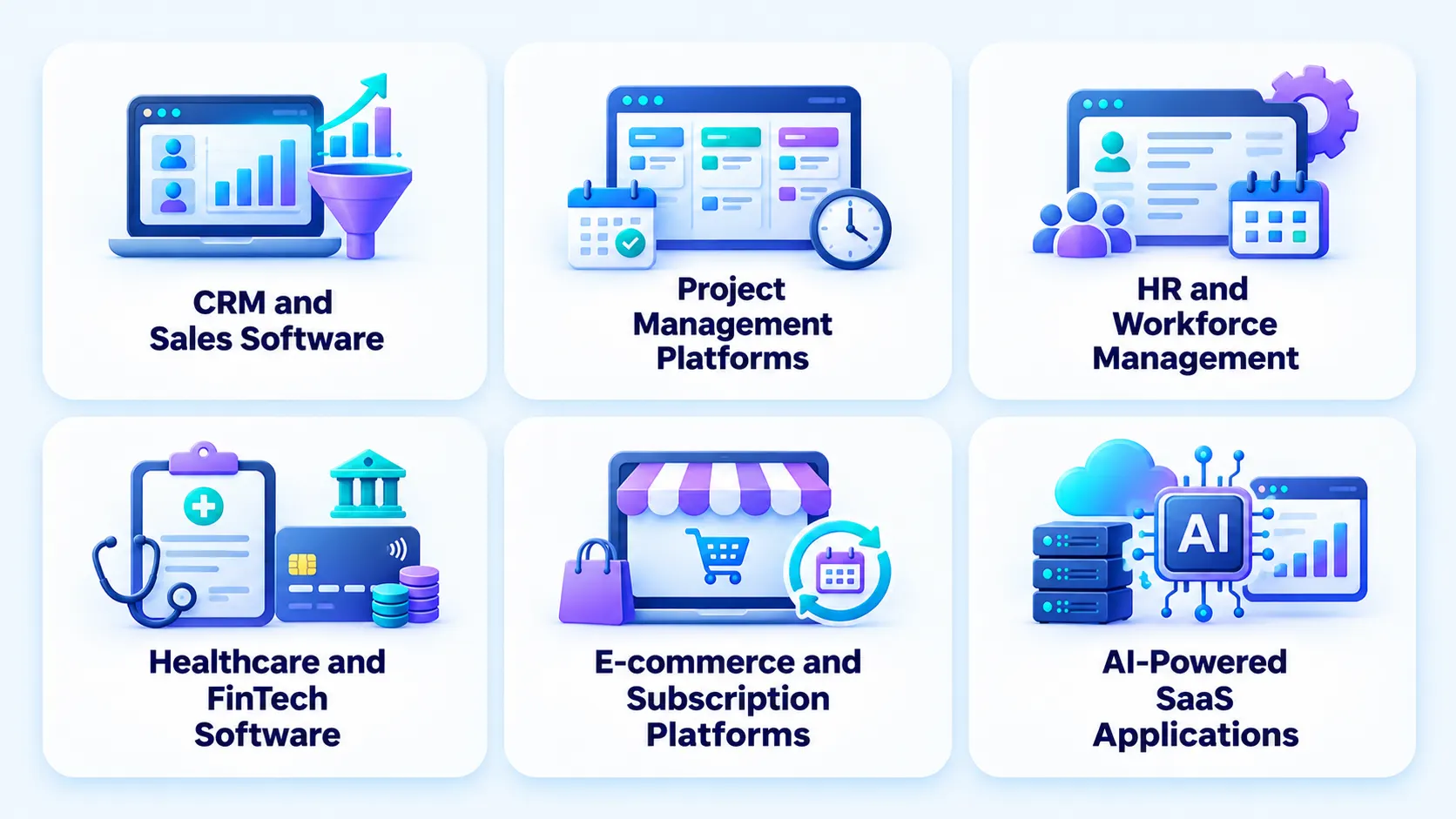
The category of SaaS product influences the development budget because different applications solve different problems and handle different types of data. Two products with a similar number of screens can require very different levels of engineering effort. The following estimates are illustrative planning bands for professionally developed products.
| SaaS product type | Indicative development budget (USD) | Major cost considerations |
| CRM and sales management | $20,000–$100,000 | Customer records, sales pipelines, permissions, reporting |
| Project management and collaboration | $25,000–$120,000 | Shared workspaces, real-time updates, notifications, file handling |
| HR and workforce management | $25,000–$150,000 | Employee data, approvals, payroll integrations, access controls |
| Healthcare and FinTech SaaS | $50,000–$250,000 | Sensitive data, auditability, integrations, applicable compliance requirements |
| E-commerce and subscription management | $25,000–$150,000 | Product catalogues, payments, orders, billing rules, third-party services |
| AI-powered SaaS applications | $30,000–$200,000 | Model integration, data pipelines, inference costs, evaluation and monitoring |
These categories overlap, and advanced enterprise implementations may cost considerably more. The estimates are intended to illustrate relative planning needs, not to establish standard market prices.
CRM and Sales Management Software
A CRM platform stores customer information, tracks sales opportunities, manages follow-ups, and helps teams understand their sales pipeline. A basic implementation may include contact management, lead assignment, deal stages, and activity tracking. More sophisticated products can introduce workflow automation, forecasting, communication integrations, custom reporting, and territory management.
The budget increases when the system needs to support complex sales hierarchies, multiple business units, detailed permissions, or integrations with email, telephony, marketing automation, and enterprise resource planning systems.
Project Management and Collaboration Platforms
Project management software may support task assignment, team workspaces, project timelines, document sharing, comments, notifications, and reporting. Basic task management is relatively straightforward compared with real-time collaboration, dependency management, workload forecasting, and custom workflow automation.
If users need live updates across devices, presence indicators, large file uploads, or complex permissions, developers must consider synchronisation, event handling, storage, and performance. These requirements can affect both development effort and recurring infrastructure costs.
HR and Workforce Management SaaS
HR platforms handle employee information, leave requests, onboarding, attendance, performance reviews, and workforce reporting. The budget depends on the business processes being automated and the sensitivity of the information involved. A leave-management product can have a narrower scope than a full HR platform that integrates with payroll, recruitment, benefits administration, and identity management.
Organisational permissions, data retention, auditability, and integrations should be included in the initial estimate rather than treated as optional enhancements.
Healthcare and FinTech SaaS
Healthcare and financial technology applications can require additional investment because they may process sensitive personal, clinical, or financial information. Depending on the product and the jurisdictions in which it operates, requirements may include strong authentication, detailed access logs, encryption, secure data exchange, retention controls, risk assessments, and independent testing.
Compliance is not a single feature that can be added at the end. It affects architecture, vendor selection, development practices, documentation, and ongoing operations. Businesses should identify applicable obligations with qualified legal, security, and compliance professionals before estimating the work.
E-commerce and Subscription Management Platforms
E-commerce SaaS products may support catalogues, inventory, orders, customer accounts, discounts, returns, payment processing, and fulfilment integrations. Subscription management platforms introduce additional complexity through recurring billing, plan changes, trials, usage measurement, invoices, failed-payment handling, and revenue reporting.
A platform that serves many merchants may also need tenant-specific settings, custom domains, separate payment configurations, and merchant-level analytics. Each additional capability should be assessed according to its effect on development effort and operational responsibilities.
AI-Powered SaaS Applications
AI-enabled SaaS products can incorporate document analysis, natural-language search, recommendations, prediction, content generation, or automated workflows. Costs depend on whether the product integrates an existing model through an API, uses a hosted model, or requires a more specialised model and data pipeline. The surrounding application still needs authentication, business logic, user interfaces, monitoring, and security.
AI introduces additional considerations, including evaluation datasets, output validation, data privacy, model selection, inference latency, and usage-based charges. A feature that performs well during a demonstration may need substantial additional work before it is reliable enough for production.
Businesses should estimate the AI integration cost separately from the recurring cost of running AI features. Initial expenses may include model selection, API integration, data preparation, testing, and workflow customisation. Ongoing costs depend on API usage, model pricing, infrastructure, monitoring, and the volume of user requests.
SaaS Development Cost Drivers: What Changes the Final Estimate?
Several factors influence the effort required to deliver a SaaS platform. Understanding them helps business owners identify which decisions are worth making before the SaaS development process begins.
Product Complexity and Feature Scope
Each feature introduces design, implementation, testing, and maintenance work. A simple profile page may require limited effort, while a configurable workflow engine may involve complex business rules, multiple permissions, exception handling, and extensive testing.
The number of features alone does not determine cost. A small number of technically demanding capabilities can require more effort than a larger set of straightforward screens. Businesses should document the expected behaviour of each core feature, including error states, permissions, validation rules, and dependencies. This gives developers a clearer basis for estimation.
Architecture and Integration Requirements
A SaaS product that operates independently may need fewer integration components than one that exchanges data with accounting software, CRM platforms, identity providers, payment gateways, and customer databases.
Each integration introduces potential costs related to authentication, API limitations, data mapping, retries, error handling, version changes, and testing. Architecture also influences the cost of future changes. A well-structured application can make it easier to introduce new features, whereas tightly coupled components may increase regression risk and maintenance effort.
Security, Compliance, and Scalability
Security and compliance requirements affect how data is stored, transmitted, accessed, monitored, and retained. The cost depends on the type of data, the product’s operating environment, contractual obligations, and applicable regulations.
Scalability requirements have a similar effect. A product with predictable, moderate usage may not need a distributed architecture at launch. A platform processing high-volume events or supporting strict availability targets may need more sophisticated infrastructure and testing. The objective is to implement controls proportionate to the actual risk and business requirements, while avoiding expensive redesigns caused by overlooking essential needs.
Team Expertise and Geographic Location
Development rates vary by location, seniority, specialist expertise, engagement model, and vendor operating structure. A senior architect may charge more per hour than a junior developer but can help avoid expensive technical decisions. Businesses should compare the total team cost and expected delivery effort rather than selecting a provider solely on the lowest hourly rate.
For example, offshore development teams may offer a lower blended rate than an equivalent team in the United States, but the final value depends on communication, delivery management, code quality, and the amount of rework required.
The estimate should also reflect the expertise needed for the project. A standard dashboard may not need a specialist data engineer, while a product with advanced analytics or AI workloads may benefit from one.
SaaS MVP vs. Full-Scale Product: Where Should You Invest First?
The choice between launching an MVP and building a complete product affects both the initial budget and the amount of financial risk a business assumes. An MVP focuses on proving a product’s central value proposition. A full-scale product supports a broader range of customer needs, operational requirements, and growth opportunities.
The right approach depends on what the business needs to learn or achieve at its current stage.
| Consideration | SaaS MVP | Full-scale SaaS product |
| Primary objective | Validate the problem and solution | Serve a broader market and mature customer needs |
| Feature scope | Essential workflows | Multiple workflows and advanced functionality |
| User management | Basic accounts and necessary roles | Advanced permissions and organisation controls |
| Integrations | Essential integrations | Broader ecosystem and enterprise integrations |
| Analytics | Basic usage and product metrics | Advanced reporting and business intelligence |
| Infrastructure | Appropriate for initial demand | Designed around larger or more demanding workloads |
| Investment approach | Staged, validation-led | Roadmap-driven, with ongoing product investment |
What Should an MVP Include?
A commercially useful SaaS MVP should support the primary task that customers are expected to pay for or adopt.
For example, an appointment scheduling platform might need provider availability, booking management, customer notifications, and a basic administrative interface. It may not need advanced forecasting, a marketplace, extensive integrations, or a mobile application at launch.
The MVP should still include essential security controls, reliable data handling, appropriate testing, and a deployment process. These are foundational requirements, not features that should automatically be deferred.
When Should You Expand the Product?
Expansion makes sense when user feedback, customer requests, usage patterns, or revenue opportunities demonstrate a clear need for additional functionality.
A business might first introduce advanced reporting, followed by third-party integrations and more sophisticated account management. Each phase should have a defined objective, budget, and measurable outcome.
This approach prevents development expenditure from becoming disconnected from customer value. It also creates opportunities to revise the roadmap when market conditions change.
SaaS Development Cost by Feature and Functionality
Feature-level estimation helps businesses understand where their budgets are likely to be concentrated. The figures below are illustrative estimates for individual capabilities in USD, assuming professional development. They represent planning ranges rather than independently priced modules that can always be purchased separately.
| Feature or capability | Indicative development cost (USD) | Complexity considerations |
| Authentication and basic access control | $1,500–$5,000 | Registration, password recovery, session management |
| Subscription billing and payments | $2,000–$8,000 | Plans, renewals, payment states, billing webhooks |
| Admin dashboard and analytics | $3,000–$12,000 | Reporting, filtering, permissions, data visualisation |
| Multi-tenant architecture | $5,000–$20,000 | Tenant isolation, organisation management, configuration |
| Workflow automation and notifications | $2,000–$10,000 | Rules, triggers, scheduled jobs, delivery handling |
The ranges are not additive estimates for a complete product. Features share infrastructure, design, and testing work, while advanced requirements may increase individual costs significantly.
User Authentication and Role-Based Access
Authentication confirms a user’s identity, while authorisation determines what that user can access or change.
A basic implementation may support registration, sign-in, password recovery, and session management. A business-oriented SaaS product may require administrators, managers, standard users, and read-only roles, each with different permissions.
More advanced requirements can include single sign-on, multifactor authentication, external identity providers, organisation-level policies, and detailed audit logs.
The key budgeting question is how much control the product needs over access. A simple role structure may be sufficient for an early release, whereas enterprise customers may expect more granular permissions and centralised identity management.
Subscription Billing and Payment Processing
Subscription billing involves more than connecting a payment gateway. The application must understand which plan a customer has purchased, when the subscription renews, which features the plan permits, and what happens when a payment fails.
Usage-based billing introduces additional work because the application must measure consumption, apply pricing rules, and generate accurate charges.
Businesses can use established billing services to avoid building every payment workflow from scratch. However, the integration still requires testing for cancellations, refunds, upgrades, downgrades, duplicate events, and failed transactions.
Admin Dashboards and Analytics
Administrative dashboards help internal teams manage users, review activity, investigate problems, and monitor business performance.
Basic administration may include account management, search, filters, and simple reports. More advanced dashboards can require custom metrics, scheduled exports, configurable charts, and access restrictions.
The complexity depends on the quality and volume of the underlying data. If metrics are calculated across multiple services or large datasets, developers may need additional data processing and optimisation work. Effective cloud cost optimisation can also help control expenses by improving resource utilisation and reducing unnecessary data-processing and infrastructure costs.
Multi-Tenant Architecture and Data Management
Multi-tenancy allows a SaaS provider to serve multiple customer organisations through a shared application environment. Each tenant may have its own users, records, preferences, billing configuration, and permissions.
The implementation must prevent unauthorised access across tenants and ensure that background jobs, reporting, exports, and APIs respect the same separation rules.
A shared database with tenant identifiers can suit some products, while others may require separate schemas or databases. The decision depends on isolation requirements, operational complexity, data volume, and customer commitments.
Choosing an architecture solely to minimise the first development quotation can create problems if the business later needs stronger isolation or customer-specific infrastructure.
Workflow Automation and Notifications
Automation can eliminate repetitive tasks by triggering actions when defined conditions are met. Examples include sending reminders, assigning work, escalating overdue tasks, or updating records after an external event.
Simple notifications may use established email or messaging services. Complex workflows can require rule configuration, scheduling, retries, failure handling, and monitoring.
Businesses should define which actions need automation and what should happen when an action fails. These requirements affect both development effort and the cost of operating the feature.
SaaS Technology Stack: Cost, Flexibility, and Long-Term Trade-Offs
The right technology stack influences development speed, hiring options, maintenance, and the availability of third-party tools. A sensible stack is one that meets the product’s requirements and can be supported throughout its lifecycle.
Frontend and Backend Technologies
Frontend technologies determine how users interact with the product, while backend technologies handle business rules, APIs, permissions, and data processing.
Frameworks such as React and Angular can support sophisticated web interfaces. Backend technologies such as Node.js, Python, Java, and .NET can support different types of business logic and application workloads.
The lowest-cost choice is not always the least expensive over time. Existing team expertise, library maturity, performance needs, and long-term maintainability should inform the decision.
Database and Storage Technologies
Database costs depend on data volume, performance requirements, backup policies, availability, and the level of management provided by the hosting service.
Managed database services can reduce administrative work but introduce recurring charges. Self-managed databases may provide more control while requiring additional engineering effort for upgrades, monitoring, backups, and recovery.
Storage planning should include file retention, data transfer, backup capacity, and growth projections rather than only the initial database size.
Cloud Infrastructure and Managed Services
Cloud providers offer compute, networking, storage, databases, identity services, and operational tools. The appropriate combination depends on the product’s workload and delivery requirements. Managed services can shorten implementation time and reduce operational responsibility, but each service needs to be evaluated for pricing, limits, portability, and vendor dependency.
An AWS vs Azure vs Google Cloud comparison can help businesses evaluate infrastructure pricing, managed services, scalability, security capabilities, and integration requirements. The best choice depends on the product’s architecture, existing technology stack, and expected usage. Businesses comparing providers should examine actual workload requirements instead of choosing a platform based only on general claims about cost or popularity.
Open-Source Software vs. Commercial Tools
Open-source components can reduce licensing expenditure and offer flexibility. However, the business may still need to fund setup, maintenance, security updates, and specialist support. Commercial services may provide managed functionality, technical support, and faster implementation, but can create recurring subscription costs or vendor lock-in. The comparison should include the total effort required to operate each option, not simply the licence price.
How Long Does SaaS Development Take, and How Does it Affect Cost?
Development duration depends on the complexity of the product, the team’s capacity, the availability of stakeholders, and the number of integrations and dependencies.
The following estimates provide broad planning ranges.
| Project type | Illustrative timeline |
| Clickable prototype or proof of concept | 2–6 weeks |
| Focused SaaS MVP | 8–16 weeks |
| Production-ready SaaS product | 3–6 months |
| Complex enterprise SaaS platform | 6–12 months or longer |
These ranges can overlap. A technically complex prototype may take longer than a simple MVP, while an enterprise project can require several releases over an extended period.
A larger team does not always reduce calendar duration proportionately. Some activities can run in parallel, but architecture decisions, integration dependencies, testing, and stakeholder approvals may still constrain delivery.
Rushed timelines can also increase costs when teams skip discovery, compress testing, or implement features before requirements are stable. A phased delivery plan gives stakeholders earlier opportunities to validate functionality while preserving time for quality assurance.
SaaS Development Cost vs. Total Cost of Ownership
Development cost measures the expenditure required to build and deliver the product. Total cost of ownership (TCO) considers the wider financial commitment involved in operating, maintaining, and evolving it over time.
A platform with a lower initial quotation may become more expensive if it requires substantial rework, expensive infrastructure, or ongoing manual intervention. Conversely, a higher initial investment can be justified when it reduces operational risk or supports important business requirements.
A practical TCO model should account for initial development, infrastructure, maintenance, third-party services, security and compliance, product improvements, and ongoing operations.
For example, consider a SaaS product with an initial development budget of $50,000.
Assume the business spends $1,500 per month on infrastructure and external services, $2,000 per month on maintenance and engineering support, and $500 per month on other operational expenses.
| Expense | Year 1 | Three-year total |
| Initial development | $50,000 | $50,000 |
| Infrastructure and external services | $18,000 | $54,000 |
| Maintenance and engineering support | $24,000 | $72,000 |
| Other operating expenses | $6,000 | $18,000 |
| Total | $98,000 | $194,000 |
This hypothetical example assumes constant monthly expenditure and excludes inflation, taxes, major feature expansions, and changes in usage. Actual costs may increase or decrease over time.
The lesson is that development expenditure should be evaluated alongside the cost of operating the product. Businesses should compare ownership costs over a consistent period when evaluating custom development, existing software, and alternative delivery models.
How to Calculate Your SaaS Development Budget
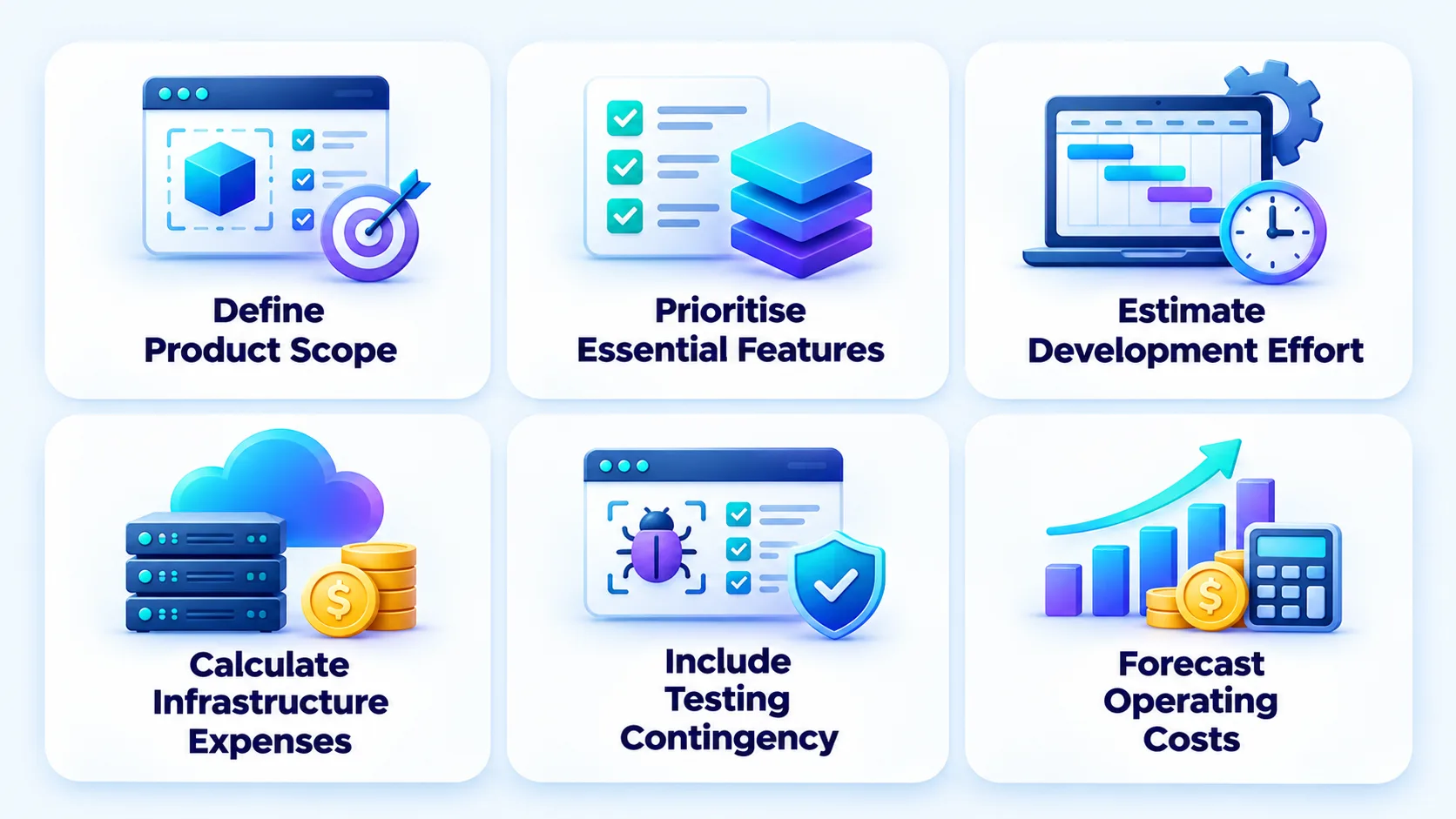
A reliable estimate connects business requirements with development effort and operating expenditure. The following framework can help decision-makers prepare a preliminary budget before requesting vendor proposals.
Step 1: Define Product Scope and Business Requirements
Document the problem the application will solve, its intended users, the primary workflows, and the expected business outcome. Specify whether the product will support individual accounts, multiple organisations, subscription payments, external integrations, or sensitive data. A clear scope reduces ambiguity and gives development teams a consistent basis for estimation.
Step 2: Prioritise Features by Business Value
Divide requirements into three groups:
- Essential capabilities required for the first release.
- Improvements that can follow after initial customer validation.
- Advanced capabilities that depend on future demand or revenue.
Prioritisation should consider customer value, implementation effort, risk, and dependencies. This helps prevent the initial budget from absorbing the entire long-term roadmap.
Step 3: Estimate Development Effort and Team Rates
Break the scope into workstreams such as discovery, design, frontend development, backend development, integrations, testing, and deployment. For each workstream, estimate the required effort and multiply it by the relevant blended team rate.
For example, if a project requires 1,000 hours at a blended rate of $40 per hour, the estimated labour cost is $40,000. This is a simplified estimate; the actual budget should account for all required roles, project complexity, and additional work.
Step 4: Calculate Infrastructure and Integration Expenses
Estimate the recurring cost of hosting, databases, storage, monitoring, external APIs, licences, and payment processing. Use expected usage rather than assuming that free tiers will remain sufficient. Where demand is uncertain, create low, expected, and high-usage scenarios.
Step 5: Include Testing, Deployment, and Contingency
Allow for functional testing, integration testing, security checks, performance testing, release preparation, and deployment. Add a contingency allowance based on project uncertainty. A defined-scope project with proven components may need less contingency than a project involving unfamiliar technology or poorly understood integrations. The contingency should be a transparent planning decision, not a substitute for estimating the actual work.
Step 6: Forecast Post-Launch Operating Costs
Prepare a monthly operating forecast that includes infrastructure, maintenance, support, licences, and expected product improvements. Combine the initial development budget with the first-year operating forecast to calculate the funding needed to reach and support the first commercial release. Businesses should also estimate the runway required to continue development while acquiring customers and validating the business model.
How to Reduce SaaS Development Costs Without Limiting Growth
Cost reduction should focus on avoiding unnecessary work and making better technical decisions. Selecting the cheapest provider or removing essential engineering activities can increase risk rather than improve financial performance.
Start With a Clearly Scoped MVP
A focused MVP reduces the number of features that must be designed, developed, and tested before the business can validate its assumptions. Identify the central customer problem and build the minimum set of capabilities needed to address it. Keep the roadmap separate from the launch scope so that future ideas do not automatically become current requirements.
Prioritise High-Value Features
Rank features according to customer demand, business impact, implementation effort, and strategic importance. For example, reliable subscription billing may be more important to an early commercial launch than advanced reporting. The priority should reflect the product’s actual value proposition rather than the perceived sophistication of individual features. Review priorities as customer evidence becomes available.
Reuse Proven Components and Managed Services
Using established authentication, payment, email, and monitoring services can reduce the effort needed to implement common capabilities. However, the decision should account for subscription fees, vendor dependency, data protection, and future migration requirements. Custom development is more appropriate when the capability creates meaningful differentiation or when existing services cannot satisfy essential requirements.
Automate Testing and Deployment
Automated testing and continuous integration can reduce repetitive manual work and identify defects earlier. Deployment automation also improves release consistency, making it easier to deliver changes without relying on error-prone manual procedures. The initial setup requires engineering time, but the benefits can accumulate as the product grows and releases become more frequent.
Avoid Premature Overengineering
Design for known requirements and credible growth scenarios rather than hypothetical demand. For example, a startup may not need a complex distributed architecture before it has established consistent usage. It may, however, need sound tenant separation and security controls if those are fundamental to its business model. Good architecture balances the cost of today’s requirements with the cost and risk of future change.
Common SaaS Budgeting Mistakes That Increase Project Costs
Poor budgeting can increase SaaS development costs through unclear requirements, excessive features, and underestimated operating expenses. Businesses should define project scope, prioritise essential capabilities, and account for infrastructure, maintenance, security, and compliance before development begins. Choosing vendors solely on hourly rates can also lead to quality issues and expensive rework.
Another common mistake is overlooking integration expenses and accepting unclear vendor proposals. Third-party services may introduce additional costs through API limitations, authentication requirements, and ongoing maintenance. Businesses should ensure proposals clearly define deliverables, exclusions, assumptions, payment terms, and change-control procedures to prevent unexpected charges during development.
Finally, treating the launch budget as the complete investment can create financial pressure after release. Hosting, monitoring, customer support, and product improvements require ongoing funding. Businesses should also include technical documentation, knowledge transfer, and contingency planning in their budgets to maintain operational continuity and support long-term product growth.
Build vs. Buy vs. Custom SaaS Development: Which Makes Financial Sense?
Businesses do not always need to build a new SaaS product from scratch. Depending on their requirements, they may purchase an existing platform, customise an available solution, or commission a fully custom application.
The best decision depends on how closely existing products match the required workflows and whether the software creates a competitive advantage.
| Consideration | Buy existing software | Custom SaaS development | Customise an existing platform |
| Initial investment | Usually lower | Usually higher | Varies by platform and scope |
| Time to deployment | Often faster | Depends on complexity | Depends on customisation |
| Control over functionality | Limited by vendor capabilities | High within the agreed scope | Moderate to high, subject to platform limits |
| Maintenance | Shared with or managed by vendor | Business funds ongoing maintenance | Depends on platform and agreement |
| Differentiation | Limited to available features | Greater opportunity for unique workflows | Depends on customisation flexibility |
| Vendor dependency | Often substantial | Depends on architecture and third-party services | Can be substantial |
| Best fit | Standard business needs | Distinctive requirements or product opportunities | Existing platform meets most requirements |
When Should You Buy Existing Software?
Buying makes sense when an established product meets most requirements and the business does not need to differentiate through proprietary functionality.
It can reduce implementation time and shift some maintenance responsibilities to the provider. However, recurring fees, usage limits, integration costs, and data portability should be evaluated over the expected ownership period.
When Is Custom Development Worth the Investment?
Custom development may be justified when the application supports a distinctive business model, enables a new revenue stream, or automates workflows that existing tools cannot accommodate.
The business gains greater control over the product roadmap but also assumes responsibility for funding development, security, maintenance, and future improvements.
A custom build should have a clear business rationale rather than being selected simply because a company prefers to own its software.
How Should Businesses Evaluate the Options?
Compare the total cost of ownership over a consistent period, such as three years. Include subscriptions, implementation, integrations, internal administration, customisation, maintenance, and migration risk.
When evaluating web app vs SaaS, consider the level of control, scalability, and ongoing operational responsibility each approach offers. The right choice should align with your budget, business requirements, and long-term growth plans.
When Should You Hire a SaaS Development Company?
Hiring a development partner can be valuable when the business lacks the internal capacity to design, build, or scale its product. An experienced team can help clarify requirements, evaluate architecture, estimate delivery effort, and establish a realistic roadmap.
The decision should be based on the expertise required and the value the partner can deliver, rather than on a fixed company size or funding milestone.
Evaluate Relevant SaaS Experience
Review the provider’s experience with products that have similar workflows, integrations, data requirements, or customer structures.
Ask how the team approaches discovery, architecture, testing, deployment, and maintenance. Request examples of relevant work and clarify which responsibilities were handled by the provider.
Compare Proposals on a Consistent Scope
Ask each vendor to estimate the same requirements and identify assumptions, exclusions, dependencies, and optional features.
Compare team composition, estimated effort, delivery milestones, code ownership, documentation, and post-launch support alongside the total price.
A transparent proposal should explain why the recommended approach fits the product’s current requirements and how future changes will be managed.
Plan for Post-Launch Collaboration
Determine who will handle defects, security updates, infrastructure monitoring, and future releases after launch.
If the business expects frequent product improvements, a continuing engagement may be more suitable than a one-time implementation contract.
RipenApps offers solutions for businesses planning new SaaS products or expanding existing platforms. The scope should be established around the product’s requirements, technical constraints, and commercial objectives.

Conclusion
SaaS development costs depend on more than the number of features or the hourly rate of a development team. Product complexity, architecture, integrations, security, delivery choices, and ongoing operations all influence the investment required to build and maintain a commercially useful platform.
The most effective budgeting approach starts with a clearly defined customer problem, prioritises the essential functionality, and separates the initial build from the ongoing cost of ownership. Startups can use an MVP to validate demand, while established businesses can plan staged investments around operational requirements and growth opportunities.
Before approving a development budget, compare proposals using the same scope, assess the total cost of ownership, and reserve funding for maintenance and future improvements. This creates a more realistic financial plan and reduces the risk of committing capital to unnecessary functionality.
If you are planning a new SaaS product or modernising an existing platform, RipenApps can help you evaluate the technical scope and development approach. Explore our cloud application development services to understand the infrastructure and engineering considerations involved in building a cloud-delivered product.
FAQs
1. How much does it cost to develop SaaS software?
A focused SaaS MVP may require approximately $10,000–$40,000, while a production-ready platform may cost $40,000–$150,000 or more. Complex enterprise platforms can exceed $300,000. These are indicative planning ranges; the final estimate depends on features, integrations, architecture, team rates, and compliance requirements.
2. What is the minimum budget required to build a SaaS MVP?
There is no universal minimum. A prototype designed to validate a workflow can cost substantially less than a production-ready MVP. The budget should cover the essential functionality, appropriate security, testing, deployment, and any integrations needed to validate the business proposition.
3. How much does enterprise SaaS development cost?
Enterprise SaaS development may cost $150,000–$300,000 or more when the platform requires complex integrations, granular permissions, SSO, audit trails, high availability, and extensive testing. The scope and applicable compliance requirements determine the final estimate.
4. How long does it take to develop a SaaS product?
A focused MVP may take around 8–16 weeks, while a production-ready product can require three to six months. Complex enterprise platforms may take six to twelve months or longer. Timelines depend on scope, team capacity, integration dependencies, and testing requirements.
5. What are the ongoing costs of running a SaaS application?
Ongoing expenses include cloud infrastructure, databases, monitoring, third-party services, maintenance, security, and customer support. The monthly cost depends on usage, reliability requirements, service selection, and the amount of engineering support needed.
6. Is outsourcing SaaS development more affordable than hiring in-house?
Outsourcing can reduce recruitment and permanent staffing commitments while providing access to specialist skills. However, the total value depends on the provider’s rates, delivery efficiency, communication, and quality. Businesses should compare the complete cost of delivery rather than hourly rates alone.
7. How much should businesses budget for SaaS maintenance?
Maintenance budgets should reflect the application’s complexity, release frequency, security requirements, and support commitments. Some businesses use an annual percentage of initial development expenditure as an early planning assumption, but this can be misleading when infrastructure, major upgrades, or specialist support costs vary significantly. A work-based estimate is preferable.
8. How can businesses reduce SaaS development costs?
Businesses can control costs by defining a focused MVP, prioritising high-value features, using proven components, automating testing and deployment, and avoiding premature overengineering. Comparing vendor proposals on a consistent scope and budgeting for maintenance also helps reduce unexpected expenditure.
Discuss your project and request for proposal
SHARE
WRITTEN BY

Ishan Gupta
CEO & Founder
Ishan Gupta is a seasoned entrepreneur and CEO with extensive 10+ years of experience in business and mobile app development landscape. He believes that the right digital product allows companies to focus on what they do best, while technology handles the rest. With deep exposure to global markets, he understands what makes an app succeed. His approach translates business needs into clear product strategies, ensuring that every feature contributes to measurable ROI.
View All Articles