


Key Takeaways
- FinTech APIs connect financial services, applications, and platforms to accelerate digital product development and innovation.
- API integration reduces development effort while enabling businesses to add payments, banking, lending, and financial capabilities.
- Security, compliance, authentication, data privacy, and monitoring remain essential when integrating financial APIs into digital products.
- A scalable API strategy helps businesses support growth, improve flexibility, manage providers, and optimize financial technology infrastructure.
- Choosing suitable APIs and development partners can help businesses build secure, connected, and future-ready financial products.
Financial services are becoming increasingly connected. Payments, banking, lending, investments, identity verification, fraud prevention, and financial analytics no longer need to operate as isolated capabilities. Businesses can connect these functions through application programming interfaces, commonly known as APIs, and build financial experiences directly into websites, mobile applications, and digital platforms.
A FinTech API acts as a connection layer between different software systems. It allows applications to securely exchange data or access specific financial functionality without requiring businesses to develop every capability internally. For example, an ecommerce platform can connect a payment API to accept cards and digital wallets, while a lending platform can use banking and identity APIs to support account verification and customer onboarding.
This approach is changing how companies develop financial products. Instead of spending years building every banking, payment, or compliance component from scratch, businesses can integrate specialized services and focus their engineering resources on their core product experience. For companies evaluating an API for FinTech, the opportunity extends beyond integration. Well-designed APIs can shorten development cycles, support new revenue models, improve customer experiences, and make financial products easier to scale.
As embedded finance, open banking, real-time payments, artificial intelligence, and connected financial ecosystems continue to develop, APIs are becoming an important foundation for digital financial services. Businesses can also work with a backend API development company to design secure API architectures, manage complex integrations, and build scalable backend systems that support evolving FinTech requirements.
Table of Contents
What are FinTech APIs?
A FinTech API is a software interface that allows two or more applications or systems to communicate with each other and exchange information or functionality related to financial services.
In simple terms, an API acts like a controlled bridge between software systems. A business does not necessarily need to build an entire payment infrastructure, banking connection, identity verification system, or investment platform internally. Instead, it can connect to a specialized API provider and use the required functionality within its own product.
For example, imagine a personal finance application that needs to display a customer’s bank account information. Rather than building separate integrations with hundreds of banks, the application can connect with a financial data API that provides standardized access to supported institutions. The same principle applies to payments, lending, KYC, investment services, insurance, fraud detection, and other financial capabilities. This makes APIs particularly valuable for companies that want to develop financial products while keeping their technology architecture flexible.
How FinTech APIs Work
A typical API interaction follows a request-and-response model. A customer’s application sends a request to an API endpoint. The API authenticates and authorizes the request, validates the information, communicates with the underlying financial service, and returns a response to the application. This approach highlights the role of API in app development, where APIs enable mobile and web applications to connect with external financial services without building every capability internally.
For example, a payment workflow may look like this:
- Customer
- Mobile App
- Payment API
- Payment Processor
- Bank/Card Network
- Response
Authentication mechanisms such as API keys, OAuth, tokens, and other authorization methods help control access. Encryption protects data while it moves between systems, while logging and monitoring help businesses identify errors, unusual activity, or potential security issues. Depending on the provider and use case, APIs may use REST, GraphQL, webhooks, or other integration mechanisms.
Webhooks are especially useful for financial applications because some events happen asynchronously. For example, a payment status may change after the original request has been completed. A webhook can notify the application when the payment succeeds, fails, is refunded, or requires additional action.
Common Types of FinTech APIs
| API Type | Purpose | Common Business Use |
| Payment APIs | Process digital payments | Checkout and payment platforms |
| Banking APIs | Connect banking services | Account access and transactions |
| Open Banking APIs | Access financial data | Account aggregation |
| Lending APIs | Support lending workflows | Loan applications and credit checks |
| Investment APIs | Connect investment services | Trading and wealth platforms |
| Identity APIs | Verify customer identity | KYC and onboarding |
The appropriate API depends on the product’s financial functionality, target geography, regulatory environment, customer base, and technical architecture.
Why Businesses Are Adopting FinTech APIs
Businesses are increasingly using FinTech APIs because financial functionality can be complex, highly regulated, and expensive to build independently. A company working with a FinTech app development company may need to integrate payment processing, identity verification, account connectivity, transaction monitoring, reporting, and other capabilities. Building all these systems internally can increase development time and create significant maintenance responsibilities.
APIs provide access to specialized financial functionality through defined technical interfaces. This allows businesses to focus more engineering effort on the product features that differentiate them.
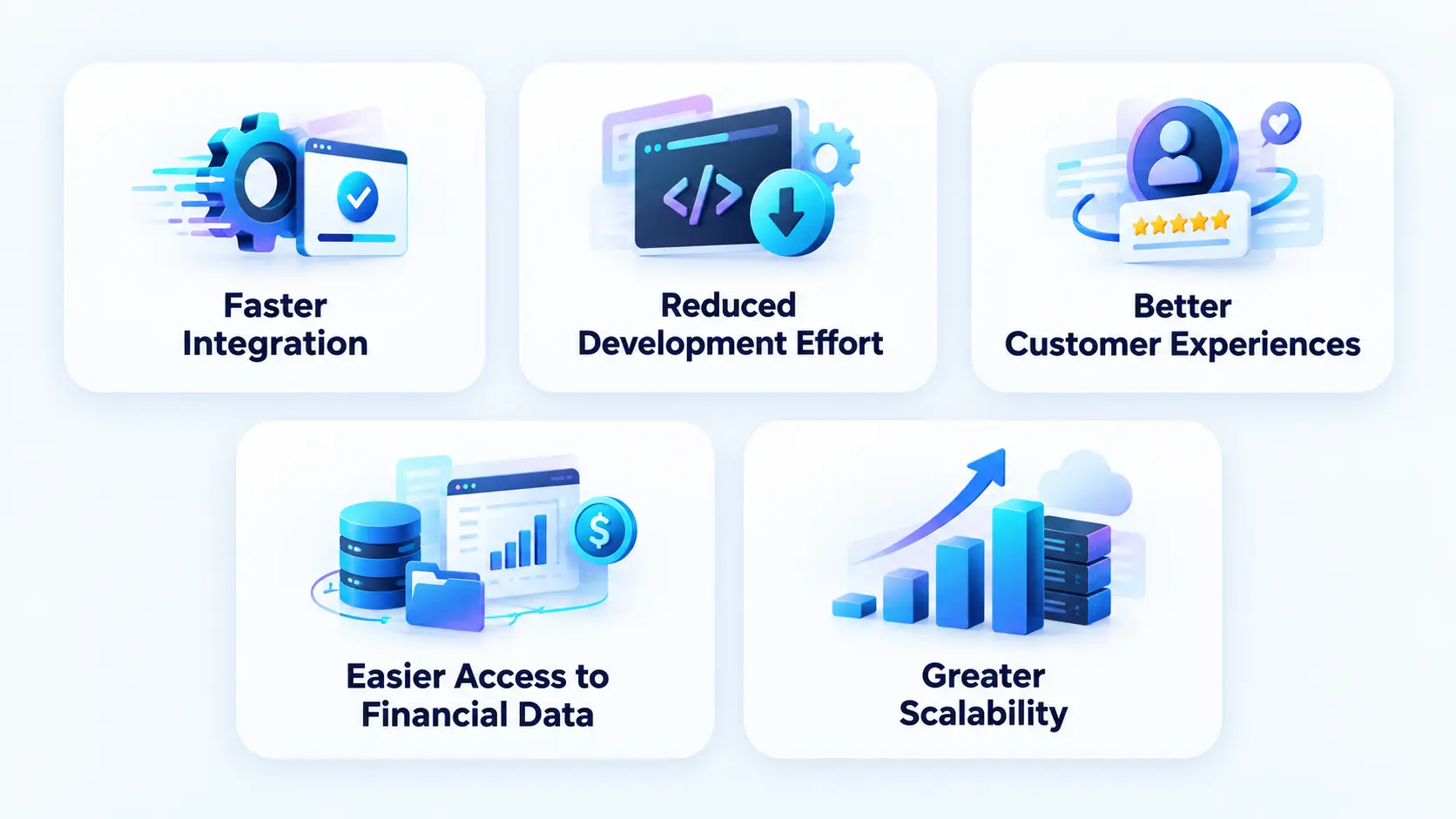
1. Faster Integration
FinTech APIs allow businesses to connect payments, banking services, identity verification, financial data, and other capabilities without building each system from the ground up. This can help teams integrate financial functionality more quickly and accelerate product launches.
2. Reduced Development Effort
Building financial infrastructure internally requires significant engineering resources, testing, maintenance, and ongoing updates. APIs reduce this burden by providing ready-to-integrate functionality, allowing development teams to focus on core product features rather than recreating existing financial capabilities.
3. Better Customer Experiences
APIs can help businesses create smoother financial experiences by connecting multiple services within a single product. Customers can benefit from features such as faster payments, account connectivity, real-time transaction information, and streamlined verification processes. For example, businesses looking to create a money lending app can use FinTech APIs to connect services such as borrower verification, bank account data, credit information, and payment processing, helping streamline the lending journey.
4. Easier Access to Financial Data
FinTech APIs can make it easier for applications to securely access and exchange financial data. With the right permissions and security controls, businesses can use connected financial information to support account aggregation, transaction analysis, personalized services, reporting, and other data-driven experiences.
5. Greater Scalability
As businesses grow, their financial infrastructure needs to support increasing transaction volumes, users, integrations, and product requirements. API-based architectures can make it easier to expand financial capabilities without rebuilding the entire technology stack.
However, API adoption does not eliminate the need for technical expertise. Businesses still need to evaluate security, compliance, data architecture, provider reliability, integration complexity, and long-term operational costs.
How FinTech APIs Drive Business Growth
FinTech APIs can support business growth in several ways, from faster product development to new revenue opportunities and improved customer experiences.
1. Accelerating Product Development
One of the biggest advantages of APIs is the ability to add financial capabilities without developing every underlying component internally. For example, a company building a digital marketplace could integrate payment APIs instead of creating its own payment processing infrastructure. A lending platform could connect to identity, credit, banking, and payment APIs to automate different parts of the lending journey.
This modular approach allows product teams to assemble capabilities according to business requirements. It also makes experimentation easier. A company can test a new financial feature, measure customer adoption, and determine whether the capability should become a permanent part of its product ecosystem.
Businesses looking to understand the broader technology foundation behind these integrations can also explore the FinTech software development process, particularly when API integrations are part of a larger financial product.
2. Expanding Revenue Opportunities
APIs can also contribute to new business models. Embedded finance is one example. A non-financial platform can integrate payments, lending, insurance, banking, or other financial services into its existing customer journey.
A marketplace could offer financing at checkout. A business management platform could provide payment acceptance. An ecommerce application could offer buy-now-pay-later functionality. A wealth platform could integrate investment services. These capabilities can create additional revenue through transaction fees, subscriptions, commissions, referral models, or premium financial features.
This also explains why questions such as “how does FinTech make money” and “how do FinTechs make money” have become increasingly relevant. Financial technology companies may combine transaction revenue with subscriptions, interest income, service fees, partnerships, interchange-related revenue, or other monetization models depending on their product and regulatory structure.
Major Use Cases of FinTech APIs
FinTech APIs can support almost every stage of a digital financial experience.
| Use Case | APIs Involved | Business Impact |
| Digital Payments | Payment APIs | Faster transactions |
| Digital Banking | Banking APIs | Connected financial services |
| Lending | Credit and lending APIs | Faster loan processing |
| Personal Finance | Financial data APIs | Personalized insights |
| Investment | Investment APIs | Easier portfolio access |
| KYC | Identity APIs | Faster customer onboarding |
| Fraud Prevention | Risk APIs | Improved transaction monitoring |
1. Digital Payments
Payment APIs enable applications to accept and manage transactions without developing an entire payment processing infrastructure. Depending on the provider, businesses may support cards, bank transfers, digital wallets, recurring payments, refunds, payouts, and other payment methods. Payment gateway integration can help connect these capabilities with an application’s broader payment architecture, allowing businesses to streamline transaction processing while maintaining a smoother customer experience.
For companies building payment-heavy applications, choosing the right payment infrastructure can significantly affect checkout performance and customer experience. Businesses can also review how payment gateway integration fits into a broader application architecture.
Read More: Develop A P2P Payment App Like Cash App
2. Digital Banking
Banking APIs can connect applications to account information, balances, transaction histories, transfers, and other banking functions. These integrations can help FinTech platforms provide customers with consolidated financial information without requiring users to switch between multiple applications.
3. Lending
Lending APIs can support loan applications, identity checks, income verification, credit assessment, document processing, disbursement, and repayment workflows. A lending platform can combine multiple APIs to automate parts of the borrower journey while maintaining appropriate controls around risk and compliance. For businesses exploring this model, a P2P lending app may require several API integrations across identity, credit, payments, notifications, and financial data.
4. Personal Finance
Personal finance applications can use financial data APIs to aggregate account information and provide customers with consolidated views of their financial activity. These integrations can support budgeting, spending categorization, financial insights, and personalized recommendations. Common features of expense tracking apps include automated expense categorization, spending limits, budget tracking, transaction history, recurring expense monitoring, and financial reports. The goal is not simply to collect data but to turn connected information into useful customer experiences.
5. Investment and Wealth Management
Investment APIs can connect applications to brokerage, market data, portfolio management, or trading infrastructure. For example, a wealth management application may use APIs to retrieve portfolio information, display market data, or execute supported investment transactions. Businesses developing investment-focused products can explore the architecture and functionality involved in stock trading app development.
6. KYC and Identity Verification
Identity APIs help businesses verify customer information during onboarding. Depending on the provider, these APIs may support document verification, identity checks, biometric verification, address validation, or other onboarding requirements. Automating these processes can reduce manual effort while helping businesses establish consistent verification workflows.
7. Fraud Prevention
Risk and fraud APIs can provide information or signals that help businesses identify potentially suspicious transactions or customer activity. When combined with machine learning and behavioral analysis, these integrations can support more sophisticated fraud detection strategies. Businesses can explore AI for fraud detection to understand how AI can complement traditional financial security mechanisms.
Key Benefits of FinTech API Integration
FinTech API integration can influence both the technical foundation and commercial performance of a financial product.
1. Faster Time to Market
APIs provide pre-built financial capabilities that can accelerate the development and launch of new features. Businesses can integrate payments, banking connectivity, identity verification, and other services without developing each capability from scratch.
2. Cost Efficiency
Building financial infrastructure internally can require significant engineering resources, testing, maintenance, and compliance efforts. APIs can reduce this development burden and allow businesses to allocate resources toward their core products.
3. Scalability
API-based architecture can support increasing transaction volumes, users, and financial operations as a business grows. Instead of rebuilding the entire system, companies can expand or upgrade individual capabilities as requirements evolve.
4. Flexibility
FinTech APIs make it easier to connect different platforms, services, and financial providers. This modular approach gives businesses greater flexibility when changing providers, adding new capabilities, or entering new markets.
5. Personalization
Access to financial data through APIs can support more personalized digital experiences. Businesses can use permitted data to understand customer behavior, deliver relevant services, and create more tailored financial products.
6. Innovation
APIs allow businesses to experiment with new financial capabilities without making large investments in an entire financial infrastructure. This can support faster testing and deployment of services such as embedded payments, financial analytics, account aggregation, and automated financial workflows.
These benefits are particularly valuable for startups and digital businesses operating under pressure to validate products quickly. Instead of creating a monolithic financial system, teams can use APIs as modular building blocks, making individual components easier to update or replace as requirements change.
For example, a business could initially use one payment provider and later introduce another provider for geographic expansion or additional payment methods. A modular API architecture can make these changes more manageable without requiring major changes to the entire application.
FinTech APIs and Digital Innovation
FinTech APIs are becoming more than integration tools. They are increasingly part of the infrastructure businesses use to create embedded financial experiences. Through APIs, a business management platform can allow users to send invoices and receive payments without leaving the application, while other businesses can integrate lending, insurance, cards, banking, or payment capabilities into existing customer journeys. This approach turns financial services from a separate destination into features that can be accessed directly within digital products.
APIs also support open banking and connected financial ecosystems by allowing authorized applications to access supported account information and services. This creates opportunities for budgeting apps, financial management platforms, lending products, and other data-driven services. APIs can also power real-time or near-real-time experiences such as payment confirmations, balance updates, transaction notifications, and automated workflows. However, businesses must carefully manage customer consent, authentication, data privacy, regional regulations, and provider-specific requirements when implementing these capabilities.
Security and Compliance Considerations
Financial APIs operate in an environment where security is particularly important. They may handle payment information, transaction records, identity data, account information, and other sensitive customer information. Security therefore needs to be considered at the architecture level rather than treated as a final development step.
| Consideration | Why It Matters |
| Authentication | Prevents unauthorized access |
| Encryption | Protects sensitive data |
| API authorization | Controls access to resources |
| KYC/AML | Supports regulatory compliance |
| Data privacy | Protects customer information |
| Monitoring | Helps identify suspicious activity |
Businesses should also consider rate limiting, secure credential management, audit logs, vulnerability testing, access controls, API versioning, incident response, and secure development practices. The regulatory requirements will depend on the type of financial service, customer data involved, transaction model, and geographic markets served. Businesses building FinTech products can also refer to cybersecurity in FinTech app development for a broader view of application-level security considerations.
How to Choose the Right FinTech API
Selecting a FinTech API should involve more than comparing features or pricing. The right solution needs to fit the product’s business model, technical architecture, geographic requirements, compliance obligations, expected transaction volume, and long-term FinTech app development growth strategy.
1. Evaluate API Functionality
First, determine exactly what the API needs to accomplish. Consider whether it supports the financial capabilities, geographic coverage, currencies, payment methods, financial institutions, transaction types, and integrations required by the product. A payment API that works well for domestic card transactions may not be suitable for a global marketplace that requires multiple currencies, local payment methods, recurring billing, and international payouts.
2. Assess Security and Compliance
Review authentication mechanisms, encryption practices, authorization controls, data handling policies, compliance certifications, and regulatory responsibilities. Businesses should understand which compliance responsibilities remain with the API provider and which remain with the business integrating the API.
3. Review Developer Experience
Developer experience can have a significant impact on integration time. Consider:
- Documentation quality
- Sandbox availability
- Pricing structure
- Scalability
- Reliability
- Developer support
- Geographic coverage
- Integration requirements
- SDK availability
- API versioning
- Webhook support
- Error handling
A technically capable API can still create unnecessary development challenges if its documentation is unclear or its testing environment is limited.
4. Evaluate Total Cost
API pricing can vary significantly. Some providers charge per transaction, while others use subscription models, usage tiers, percentage-based pricing, minimum commitments, or combinations of these structures.
Businesses should calculate the expected cost at different stages of growth rather than evaluating only the initial development cost. For a broader understanding of financial application budgets, businesses can also review FinTech app development cost.
Common Challenges of FinTech API Integration
Although APIs simplify financial development, they introduce their own technical and operational challenges.
1. Legacy System Integration
Many financial institutions continue to operate systems that were developed long before modern cloud-native applications became common. Connecting modern APIs to legacy infrastructure can therefore require additional middleware, transformation layers, custom connectors, or asynchronous processing.
Data formats and transaction models may also differ between systems. Businesses need an integration architecture capable of handling these differences without creating unnecessary dependencies across the application.
2. Regulatory Complexity
Financial regulations can differ according to geography, product type, customer segment, transaction model, and financial activity. A product operating in multiple markets may therefore need different compliance workflows or API providers. Businesses should establish regulatory requirements during product discovery rather than attempting to address them after the technical architecture has already been finalized.
3. Third-Party Dependency
Using third-party APIs means that some functionality depends on an external provider. Potential issues can include:
- Service outages
- Rate limits
- Provider pricing changes
- API version changes
- Deprecation of endpoints
- Changes to supported markets
- Changes in compliance requirements
- Vendor lock-in
A strong integration strategy should account for these risks. For critical functionality, businesses may consider redundancy, provider abstraction, fallback mechanisms, monitoring, and clear service-level expectations.
Best Practices for Building a FinTech API Strategy
A successful API strategy requires both technical planning and business alignment.
- Define clear business and technical requirements. Identify the financial capabilities the product actually needs before selecting providers.
- Select APIs based on functionality and reliability. Evaluate performance, coverage, documentation, support, pricing, and provider track record.
- Prioritize security from the beginning. Build authentication, authorization, encryption, monitoring, and secure data handling into the architecture.
- Build scalable integration architecture. Use modular services and appropriate abstraction layers so individual providers can be changed without rebuilding the entire application.
- Establish API monitoring and governance. Track availability, response times, error rates, usage, and unusual activity.
- Test integrations thoroughly before launch. Use sandbox environments and test successful, failed, delayed, duplicate, and edge-case transactions.
- Continuously review API performance and business impact. Evaluate whether each integration continues to support product objectives, customer needs, and financial performance.
The API strategy should evolve as the product grows. An architecture that works for an MVP may need additional abstraction, observability, redundancy, and governance at enterprise scale.
FinTech APIs and Emerging Technologies
APIs are increasingly acting as the connection layer between traditional financial infrastructure and emerging technologies.
1. AI-Powered Financial Services
AI can make connected financial data more useful. When financial APIs provide access to appropriate transaction or account information, AI systems can analyze patterns, generate insights, categorize spending, support customer service, detect suspicious behavior, and personalize financial experiences.
For example, an expense management application could combine transaction APIs with AI to automatically categorize expenses and identify unusual spending patterns. AI can also support fraud prevention by analyzing behavioral signals and transaction patterns. However, financial AI systems require careful consideration of data quality, privacy, explainability, security, and regulatory requirements.
2. Blockchain and Digital Assets
APIs can also connect applications with blockchain networks and digital asset infrastructure. Depending on the use case, APIs may provide access to wallet functionality, blockchain data, transaction monitoring, asset information, or supported digital asset services. This allows businesses to integrate blockchain-related capabilities without building every underlying infrastructure component independently. The same API principle applies: specialized infrastructure becomes accessible through standardized software interfaces.
How Businesses Can Build a FinTech API Strategy
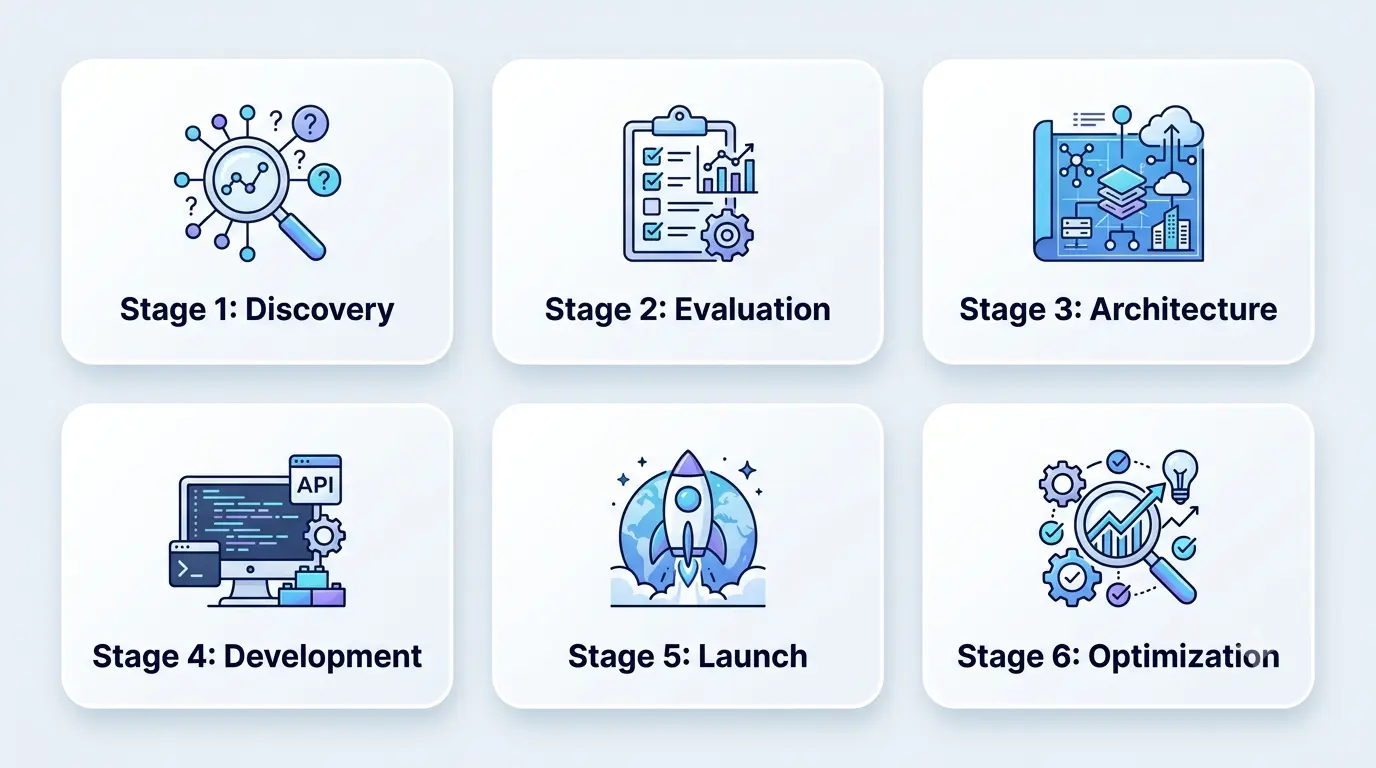
A structured approach can help businesses move from an initial idea to a production-ready API ecosystem.
Stage 1: Discovery
Start by mapping the financial workflows that the application needs to support. Identify exactly where financial functionality appears in the customer journey and determine which capabilities are essential for the initial product release.
For example, a fintech application may require account verification, payment processing, bank account connectivity, transaction history, identity verification, or automated notifications. Not every capability needs to be developed internally. Businesses should determine which functions can be handled through external APIs and which should remain within their own infrastructure because they represent core product logic or provide strategic differentiation.
This stage should also consider user journeys, compliance requirements, expected transaction volumes, target markets, financial partners, data requirements, and business objectives. Understanding these factors early can prevent teams from selecting an API provider that works technically but does not support the product’s long-term requirements.
Stage 2: Evaluation
Once the required capabilities are defined, businesses can create an API evaluation framework for comparing potential providers. Functionality is important, but it should not be the only consideration. Teams should evaluate pricing, security controls, geographic availability, supported financial institutions, documentation quality, reliability, scalability, authentication methods, webhooks, SDK availability, and technical support.
Pricing should also be examined beyond the initial integration cost. Some providers charge per API request, while others may use transaction-based, subscription-based, or volume-based pricing. Businesses should estimate expected usage and calculate how API costs could change as transaction volumes increase.
Provider reliability is another important consideration. Teams should review service-level commitments, historical availability where available, incident communication processes, sandbox environments, and mechanisms for handling outages. Choosing a provider based solely on the number of available endpoints can create problems if those capabilities are difficult to integrate, poorly documented, or unavailable in the target market.
Stage 3: Architecture
The integration architecture should define how external APIs communicate with the application’s frontend, backend, databases, authentication services, event systems, and other components. Sensitive API credentials should generally remain on secure backend infrastructure rather than being exposed through client-side applications.
Businesses should also consider how their application will handle authentication, data synchronization, webhooks, retries, logging, failures, and API version changes. A well-structured integration layer can prevent external provider logic from becoming deeply embedded throughout the application’s core codebase.
A modular architecture can also reduce dependency on a single provider. For example, if payment functionality is isolated behind an internal service layer, the business may have greater flexibility to introduce another payment provider later. Businesses looking for a deeper technical foundation can explore microservices-based architecture when evaluating how independent services can support complex application ecosystems.
Stage 4: Development
Developers can begin implementation using the selected provider’s APIs, SDKs, documentation, authentication mechanisms, endpoints, and testing environments. Development should initially take place in a sandbox or test environment wherever the provider offers one, allowing teams to validate integration logic without processing real financial transactions.
Error handling should be designed from the beginning rather than added after the primary integration is complete. Financial systems need to distinguish between temporary failures, permanent failures, duplicate requests, rejected transactions, pending transactions, and successful transactions.
For example, a temporary network failure may require a controlled retry, while a rejected payment should not be repeatedly submitted without understanding the reason. Idempotency mechanisms are also important for operations where accidentally sending the same request twice could result in duplicate transactions. Webhook handling should similarly account for delayed, repeated, or out-of-order events.
Stage 5: Launch
Before launch, teams should test API integrations under realistic operating conditions. Functional testing should verify that transactions, account connections, authentication flows, data synchronization, and notifications work as expected across different scenarios.
Testing should also cover high transaction volumes, network failures, delayed responses, invalid credentials, duplicate requests, partial failures, webhook events, API rate limits, and provider downtime. Security testing should examine authentication, authorization, sensitive data handling, access controls, and potential vulnerabilities.
Monitoring should be active from the first production release. Teams should be able to identify failed transactions, API errors, unusual response times, webhook failures, and provider outages quickly. Clear escalation and incident-response procedures can help reduce the impact when an external financial service becomes unavailable.
Stage 6: Optimization
Once the system is live, businesses should continuously evaluate both API performance and its business impact. Integration performance can change as transaction volumes increase, providers update their APIs, or customers use financial features in unexpected ways.
Useful technical metrics may include API response time, error rate, transaction success rate, integration uptime, webhook delivery rate, and cost per transaction. Business metrics can include customer conversion rate, feature adoption, transaction volume, customer retention, and revenue generated through API-enabled features.
These measurements can reveal opportunities to improve the integration. For example, a high API error rate may indicate an integration or provider issue, while increasing API costs may justify renegotiating pricing or evaluating alternative providers. Similarly, low adoption of an integrated financial feature may indicate that the underlying customer journey needs to be redesigned.
Optimization should therefore be treated as an ongoing process rather than the final step of development. Regular provider reviews, API version updates, security assessments, performance monitoring, and cost analysis can help ensure that the FinTech API ecosystem continues to support both technical requirements and business growth.
Why Businesses Need the Right FinTech Development Partner
Selecting an API provider is only one part of building a successful financial product. Businesses also need to determine how APIs should fit into the overall application architecture, how financial data should flow between services, how security controls should be implemented, and how the system should scale as transaction volumes increase.
An experienced development partner can support these decisions across the product lifecycle. This can include API discovery and selection, technical architecture, backend development, authentication, payment integration, financial data integration, testing, security implementation, cloud deployment, monitoring, and application maintenance.
For businesses building complex financial products, evaluating FinTech app development companies can help them identify a partner capable of connecting product strategy with engineering execution. RipenApps can help businesses build secure and scalable FinTech applications by combining product engineering, API integration, backend architecture, security, and ongoing technical support.
Whether the requirement involves payment infrastructure, banking connectivity, lending workflows, investment functionality, or financial data integration, the API strategy should be designed around the product’s long-term requirements rather than a short-term integration objective.
Final Thoughts
FinTech APIs are changing how businesses build and expand digital financial services. By connecting applications with payments, banking, lending, investment, identity, financial data, and risk infrastructure, APIs make it possible to introduce sophisticated financial capabilities without developing every underlying system from scratch.
Their value extends beyond faster integration. A well-planned API strategy can support faster product development, new revenue opportunities, better customer experiences, scalable architecture, and greater flexibility as business requirements change.
At the same time, financial API integration requires careful attention to security, compliance, data privacy, reliability, vendor dependency, and long-term architecture. Businesses that approach APIs as strategic technology building blocks rather than simple connectors can create more adaptable financial products and connected digital experiences.
If you are planning a FinTech product or looking to modernize an existing financial platform, RipenApps can support API selection, FinTech product development, backend architecture, integration, security, testing, and scalability with Node.Js Development Services that support reliable and scalable financial applications. Discuss your FinTech product requirements with RipenApps and plan a secure, scalable API-driven financial solution.

FAQs
1. What Are FinTech APIs?
FinTech APIs are software interfaces that allow applications to communicate with financial services and exchange data or access functionality. They can connect applications with payments, banking, lending, investments, identity verification, financial data, and other financial infrastructure.
2. How Do FinTech APIs Help Businesses?
FinTech APIs help businesses integrate financial capabilities without building every underlying system internally. They can reduce development effort, accelerate product launches, improve connectivity, support new financial features, and create more personalized customer experiences.
3. What Are the Most Common FinTech API Use Cases?
Common use cases include digital payments, banking connectivity, open banking, lending, investment services, personal finance, KYC, identity verification, fraud prevention, financial analytics, and embedded finance.
4. Are FinTech APIs Secure?
FinTech APIs can be secured using authentication, authorization, encryption, access controls, monitoring, rate limiting, audit logging, and other security mechanisms. However, security depends on both the API provider and how the business implements and manages the integration.
5. How Much Does FinTech API Integration Cost?
FinTech API integration costs vary according to the number and complexity of APIs, application architecture, financial functionality, security requirements, geographic markets, compliance requirements, development resources, and expected transaction volume. Businesses should evaluate both development costs and ongoing API usage costs when creating a financial product budget.
6. How Long Does It Take to Integrate a FinTech API?
The integration timeline depends on API complexity, documentation quality, authentication requirements, existing application architecture, testing requirements, and compliance considerations. The timeline should therefore be estimated after reviewing the product requirements, existing technology stack, API documentation, and required financial workflows.

SHARE
WRITTEN BY

Ishan Gupta
CEO & Founder
Ishan Gupta is a seasoned entrepreneur and CEO with extensive 8+ years of experience in business and mobile app development landscape. He believes that the right digital product allows companies to focus on what they do best, while technology handles the rest. With deep exposure to global markets, he understands what makes an app succeed. His approach translates business needs into clear product strategies, ensuring that every feature contributes to measurable ROI.
View All Articles




 India
India USA
USA Australia
 Canada
 UK
UK UAE
UAE