


Key Takeaways
- FinTech apps span multiple categories, including digital banking, payments and wallets, personal finance, investment and trading, lending, InsurTech, and crypto applications.
- Each FinTech app type has different requirements for compliance, integrations, security, features, and technical complexity, making product classification an important first step.
- A focused MVP helps control development scope by prioritizing the core financial workflow while retaining essential security and compliance controls.
- FinTech app growth depends on more than user acquisition, with onboarding, trust, personalization, meaningful engagement, and data-driven product expansion influencing long-term retention.
- Successful FinTech products evolve in stages, using customer behavior and product metrics after launch to validate new features and expand into adjacent financial services.
FinTech application development is the process of creating digital products that deliver financial services through mobile, web, or connected platforms. These applications can support banking, payments, personal finance, investing, lending, insurance, or digital assets. The right development approach depends on the product type, target market, compliance requirements, integrations, security controls, and core user workflow.
The FinTech landscape now covers far more than digital banking and online payments. Businesses are building applications for personal finance, investment and trading, lending, insurance, remittances, digital wallets, and blockchain-based financial services. Each category comes with different customer expectations, integration requirements, compliance considerations, and levels of technical complexity.
For founders and product teams, choosing the right FinTech app category is only the starting point. The next challenge is deciding what to include in the MVP, how to sequence development, and how to build a product that users continue to trust and use. Working with a fintech product development company can help teams align product strategy, technical execution, compliance considerations, and scalability from the early stages. This guide explores the major types of FinTech apps, the key stages involved in taking an idea to launch, and practical growth strategies for scaling a financial product.
Table of Contents
Why FinTech Apps Matter Today
FinTech is no longer limited to mobile banking or digital payments. Businesses now use financial technology to deliver banking, lending, investing, insurance, money transfers, personal-finance management, and other financial experiences through digital products.
The market opportunity is significant. McKinsey’s 2026 report, The Next Age of Fintech, estimates that the global FinTech market generated approximately $650 billion in revenue in 2025, growing about 21% year over year. The report also highlights a shift toward scalability, profitability, and regulatory maturity across the industry.
These numbers show why FinTech remains an active product category. But market opportunity does not remove the complexity of financial products. A FinTech application must balance:
- User experience: Financial workflows need to be simple without hiding important information.
- Trust: Users need confidence when sharing identity, financial, and payment information.
- Compliance: Regulatory requirements can influence onboarding, payments, data handling, and reporting.
- Integrations: Banking, payment, identity, credit, investment, and insurance systems frequently depend on external APIs.
- Security: Authentication, authorization, transaction controls, monitoring, and fraud prevention need to be considered from the beginning.
- Scalability: Transaction-heavy applications must remain reliable as customers and transaction volumes increase.
For founders evaluating finance app development, mobile app development for finance, or fintech mobile app development, a practical fintech app development guide can help define the right product model, technology approach, and growth priorities.
Key Types of FinTech Apps
FinTech applications can be grouped into several major categories. Each category has different customer needs, integrations, compliance considerations, and technical complexity. The following comparison provides a starting point for product scoping.
| FinTech app type | Core compliance burden | Build complexity | Typical MVP scope |
| Digital banking | High | High | Onboarding, accounts, transfers, transactions |
| Payments & wallets | High | High | Wallet, payments, transfers, transaction history |
| Personal finance | Medium–High | Medium | Account aggregation, budgeting, expense tracking |
| Investment & trading | Very High | Very High | Onboarding, market data, portfolio, trading |
| Lending & BNPL | Very High | High | Application, verification, eligibility, repayment |
| InsurTech | High | High | Quotes, policies, payments, claims |
| Crypto & blockchain | High | High | Wallet, assets, transfers, transaction history |
Comparing fintech app types at this stage helps founders prioritize the right financial workflow before defining the MVP. The actual requirements depend on the jurisdiction, business model, licenses, financial activities, data flows, and third-party services involved.
Digital Banking Apps
Digital banking applications allow customers to access and manage financial accounts without relying on traditional branch-based interactions. A digital banking MVP may include:
- Account registration and onboarding
- Identity verification
- Account and balance management
- Money transfers
- Transaction history
- Card controls
- Notifications
- Customer support
- Authentication and security controls
Compliance burden: High; digital banking products can involve KYC, AML, privacy, payments, licensing, consumer-protection, and banking requirements depending on the operating model and market.
Build complexity: High; banking applications commonly require integrations with banking infrastructure, payment systems, identity providers, cards, notifications, and other financial services.
The main product-scoping challenge is deciding what belongs in the first release. Instead of reproducing every banking service, an MVP can focus on a small number of high-value workflows such as onboarding, account visibility, transfers, and transaction management.
Payments and Digital Wallet Apps
Payments and wallet applications enable customers to send, receive, store, or use money digitally. Common features include:
- Digital wallet
- Payment processing
- Peer-to-peer transfers
- Bank-account linking
- Transaction history
- QR payments
- Payment notifications
- Refund management
- Transaction monitoring
- Fraud controls
Compliance burden: High; depending on the payment model, requirements may include KYC/AML obligations, payment regulations, licensing, data protection, and payment-card security requirements.
For applications handling applicable payment-card data, PCI DSS is an important security standard. The PCI Security Standards Council published PCI DSS v4.0.1 in June 2024 as a limited revision to the standard.
Build complexity: High; payment products must account for transaction reliability, external payment APIs, reconciliation, failed transactions, refunds, authentication, and fraud controls.
For teams considering a peer-to-peer payment product, the guide on how to develop a P2P payment app like Cash App provides additional product context.
Personal Finance Apps
Personal finance applications help users understand their income, spending, budgets, savings, and broader financial position. An MVP can include:
- Expense tracking
- Budget creation
- Spending categories
- Financial goals
- Account aggregation
- Cash-flow summaries
- Bill reminders
- Savings tracking
- Financial dashboards
Compliance burden: Medium to high; the burden depends heavily on whether the product simply provides financial-management tools or also moves money, provides financial advice, or performs another regulated activity.
Build complexity: Medium; the interface and basic budgeting functions may be relatively straightforward, but account aggregation, transaction categorization, synchronization, data security, and personalized insights add complexity.
A focused MVP can start with account aggregation, expense categorization, budgeting, and reporting before introducing advanced recommendations or financial products.
Investment and Trading Apps
Investment and trading applications allow users to research markets, monitor portfolios, and potentially buy or sell financial assets.
Typical functionality includes:
- Account onboarding
- Identity verification
- Market data
- Watchlists
- Portfolio dashboard
- Buy and sell workflows
- Order tracking
- Portfolio analytics
- Notifications
- Statements and reporting
Compliance burden: Very high; securities regulations, investor-protection requirements, identity verification, reporting obligations, licensing, and market-specific rules can all affect product design.
Build complexity: Very high; real-time market data, brokerage integrations, order execution, portfolio calculations, authentication, transaction records, and security controls create a demanding architecture.
Because this category has distinct technical and regulatory requirements, teams can also explore stock trading app development when defining the product scope.
Lending and BNPL Apps
Lending and buy-now-pay-later applications digitize parts of the borrowing and repayment journey. Common features include:
- Borrower registration
- Identity verification
- Loan application
- Document upload
- Eligibility assessment
- Credit evaluation
- Loan offers
- Repayment schedules
- Payment processing
- Notifications
Compliance burden: Very high; requirements vary by jurisdiction and product but can involve lending licenses, consumer protection, disclosures, credit reporting, privacy, interest-rate rules, and responsible-lending requirements.
Build complexity: High; underwriting, credit scoring, risk assessment, repayment processing, collections, and external data integrations can create complex workflows.
The best MVP scope usually focuses on one lending product and one clearly defined customer journey rather than attempting to automate every credit operation at launch.
InsurTech Apps
InsurTech applications use digital workflows to improve insurance discovery, purchasing, policy administration, claims, or customer service. Potential features include:
- Customer onboarding
- Insurance quotes
- Policy discovery
- Document management
- Premium payments
- Policy dashboards
- Claims submission
- Claims tracking
- Notifications
- Customer support
Compliance burden: High; insurance is heavily regulated, and requirements vary according to jurisdiction, insurance category, licensing structure, and operating model.
Build complexity: High; integrations with insurers, underwriting systems, claims platforms, payment providers, identity services, and policy systems can make the architecture complex.
A focused MVP can target a single insurance category or high-friction workflow, such as digital claims submission or quote comparison.
Crypto and Blockchain Apps
Crypto and blockchain applications can support digital-asset wallets, exchanges, payments, custody, tokenized assets, or other blockchain-based financial services. Potential features include:
- Digital wallets
- Asset balances
- Asset transfers
- Buy and sell workflows
- Transaction history
- Market data
- Identity verification
- Security controls
- Blockchain integrations
Compliance burden: High and jurisdiction-dependent. Requirements vary based on the asset, service, custody model, licensing structure, and countries in which the product operates.
Build complexity: High; wallet security, blockchain connectivity, transaction confirmation, custody, asset management, external services, and regulatory requirements all need to be addressed.
The application should therefore be designed around a clearly defined asset and transaction model instead of treating crypto as a generic product category.
Stages of FinTech App Development
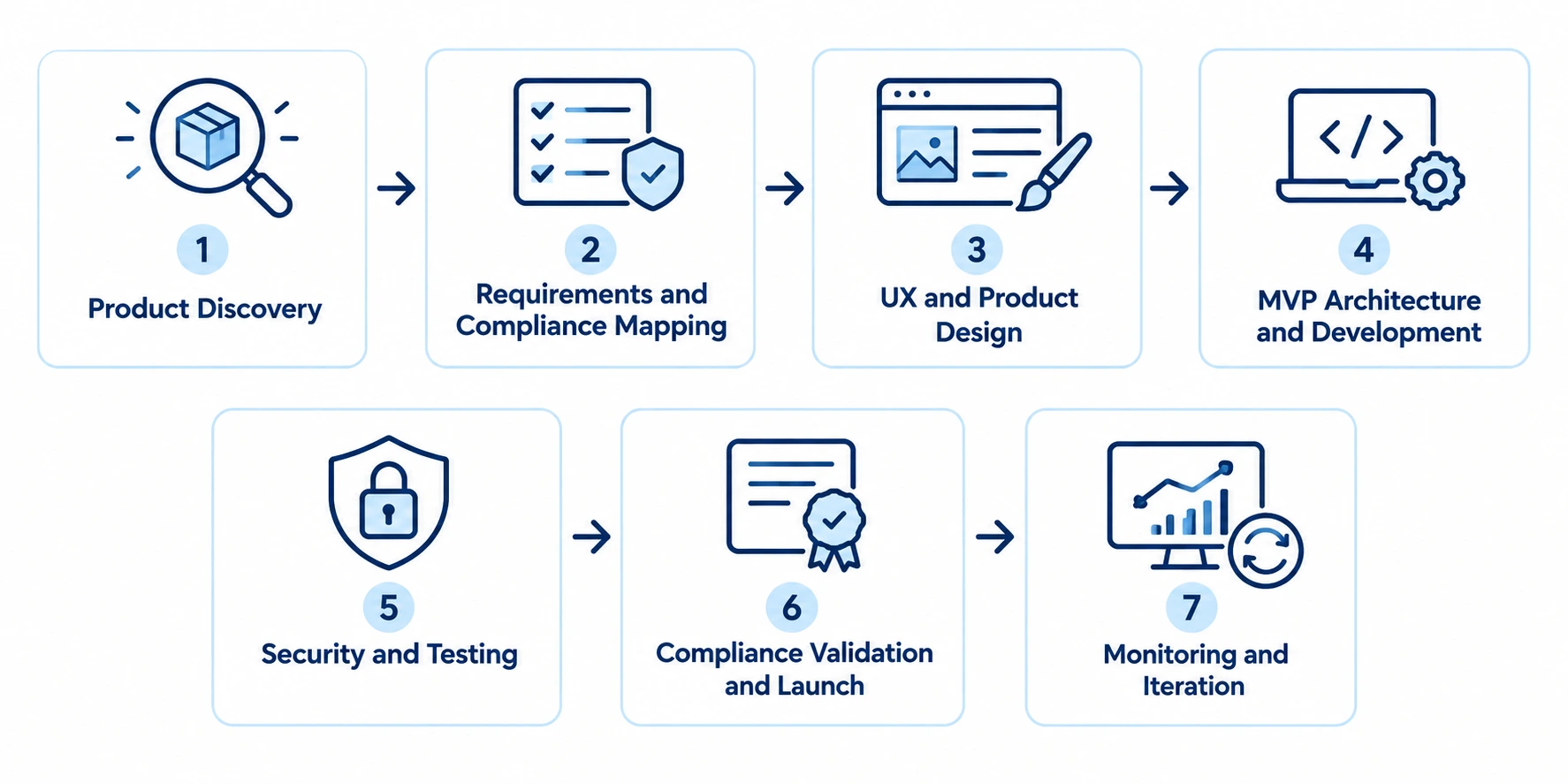
Once the product category is clear, the next step is to sequence development around the most important financial workflow. A practical seven-stage process looks like this.
1. Product Discovery
Start by defining the target customer, financial problem, market, business model, competitive landscape, and intended product category. Identify the primary workflow the application must solve and separate essential MVP functionality from later-stage features. Working with experienced MVP development services can help businesses validate the core product scope while avoiding unnecessary features and costs.
For a regulated financial product, discovery should also identify the countries and financial activities involved because these factors can materially change product requirements.
2. Requirements and Compliance Mapping
Translate the product concept into functional, technical, security, data, and compliance requirements. Map areas such as customer verification, transaction monitoring, privacy, payments, data retention, authentication, reporting, and third-party integrations.
FATF’s Recommendations provide an international AML/CFT framework that countries adapt to their own legal and regulatory systems. The FATF framework was updated again in June 2026, reinforcing the need to evaluate applicable local requirements rather than applying one generic compliance checklist to every FinTech product.
3. UX and Product Design
Design the critical journeys before development begins. These may include registration, verification, account setup, payment, transfer, investment, borrowing, claims, or support.
For financial applications, design should pay particular attention to confirmation states, transaction details, error handling, authentication, consent, notifications, and recovery flows. The objective is to make complex financial processes understandable without hiding material information from users.
4. MVP Architecture and Development
Build the minimum product around the core financial workflow. Depending on the application, this may include mobile or web interfaces, backend services, databases, authentication, APIs, payment or banking integrations, notification systems, and monitoring.
These technical requirements also influence the fintech app development cost, particularly when the MVP involves complex integrations, security controls, or financial infrastructure.
The MVP should minimize unnecessary product breadth while retaining the technical and operational controls required for its intended financial activity.
5. Security and Testing
Test the application across functional, integration, performance, security, and failure scenarios. Critical areas include authentication, authorization, API security, transaction handling, data protection, third-party integrations, error recovery, and monitoring.
Security should not be postponed until the end of development. For a deeper treatment of the topic, see the guide to cybersecurity in FinTech app development.
6. Compliance Validation and Launch
Before launch, validate the product against the requirements applicable to its target market and financial activities. This can include regulatory obligations, contractual requirements, security standards, privacy requirements, operational controls, and third-party provider requirements.
The goal is not simply to confirm that the application works technically. The business must also establish that the intended product model can operate appropriately in its target market.
7. Monitoring and Iteration
Launch should begin a measurement cycle rather than end product development. Monitor onboarding completion, verification drop-off, transaction success, transaction failures, fraud signals, customer support issues, feature adoption, and retention.
Use these signals to prioritize the next release instead of expanding the roadmap based only on assumptions. For the full process, technology, cost, and compliance discussion, see the FinTech software development guide.
Build an MVP Around One Core Financial Workflow
An MVP does not mean removing essential security or compliance controls. It means reducing the business and feature scope of the first release.
For example:
- A wallet can begin with one payment flow and one target market.
- A personal finance app can start with account aggregation and budgeting.
- A lending product can launch with one loan category.
- An investment product can initially focus on a specific investment workflow.
- An insurance product can target one policy category.
This approach lets product teams validate demand and usage before increasing integrations, financial products, and operational complexity.
Growth Strategies That Turn FinTech Apps Into Market Leaders
Effective fintech app growth strategies depend on more than acquiring users. The product must help users complete onboarding, trust the platform, perform meaningful financial actions, and continue returning.
Reduce Onboarding Friction
Financial onboarding can require identity information, documentation, verification, and additional checks. The goal is to make these requirements easier to complete rather than simply removing steps.
Use progressive onboarding, clear instructions, automated validation, save-and-resume functionality, and transparent explanations for verification requests.
Measure: Track onboarding completion and identify the exact step where users abandon registration.
Make Trust Visible
Security is a product experience as well as a technical requirement. Users should receive clear transaction confirmations, recognizable authentication flows, security notifications, understandable error messages, and accessible support.
For sensitive actions, explain what is happening and why. This reduces uncertainty at the moments when customers are most likely to question whether the product is safe.
Measure: Monitor failed transactions, support contacts related to security, authentication completion, and successful completion of sensitive workflows.
Personalize Financial Experiences
Personalization can make financial information more useful by helping users identify relevant actions. Examples include:
- Spending summaries
- Savings goals
- Transaction categorization
- Personalized alerts
- Relevant financial insights
- Contextual recommendations
Personalization should be tied to an actual customer need rather than added simply because the technology is available.
Measure: Compare engagement, feature adoption, activation, and retention for personalized experiences.
Use AI Where It Improves Financial Outcomes
AI can support fraud detection, transaction categorization, customer support, risk analysis, financial insights, and operational automation. For example, an AI-assisted fraud system can identify unusual transaction patterns for additional review, while automated categorization can reduce the manual effort involved in organizing financial activity.
The important consideration is the outcome being improved. A fraud system should be evaluated through measures such as detection quality, false-positive rates, and investigation efficiency rather than simply the number of AI features deployed. For more detail, see our AI for fraud detection and prevention in FinTech apps guide.
Encourage Meaningful Engagement
Some financial applications naturally have low-frequency usage. A customer may not need to open an investment, insurance, or savings application every day. Useful engagement mechanics can include:
- Financial goals
- Savings milestones
- Progress indicators
- Educational content
- Personalized reminders
- Rewards for meaningful financial behaviors
- Relevant financial challenges
Gamification should reinforce useful behavior rather than encourage unnecessary transactions. For more ideas, see the article on the role of gamification in FinTech apps.
Measure: Track repeat usage, goal completion, feature adoption, and retention rather than raw app opens alone.
Expand the Product in Layers
A FinTech product does not need to launch with every possible financial service. A controlled expansion model can look like:
Core financial workflow – adjacent feature – complementary product – broader ecosystem
For example, a wallet may begin with payments, add peer-to-peer transfers, introduce bill payments, and later expand into additional financial services.
This approach lets the team validate demand and infrastructure capacity before increasing product complexity. For B2B financial products, SaaS can provide another expansion path. See the guide to FinTech SaaS app development for more context. These practices can strengthen fintech user retention by reducing friction, improving trust, and giving customers clear reasons to return.
How RipenApps Builds FinTech Products
FinTech products require a combination of product strategy, financial workflow design, integrations, security, and scalable engineering.
Al Muzaini: FinTech Product Experience
Al Muzaini demonstrates RipenApps’ experience in building transaction-focused FinTech products for Kuwait’s leading exchange house. The Android and iOS application supports cross-border remittance and currency exchange, with 100K+ Google Play installs and 1.87K reviews.
The product combines AI-powered KYC onboarding, three-factor authentication with biometric login, domestic and international transfers, beneficiary management, real-time FX rates, Western Union integration, and multi-language support.
The project highlights the complexity behind a streamlined financial workflow, where identity verification, secure authentication, transaction management, exchange-rate information, and external financial integrations need to work together seamlessly.
Wrapping Up
FinTech app development covers a broad range of products, including digital banking, payments and wallets, personal finance, investment and trading, lending, InsurTech, and crypto applications. The right starting point is not a large feature list. It is a clear understanding of the financial problem, target customer, product category, market, compliance environment, and core workflow.
From there, teams can build a focused MVP, validate real user behavior, and expand the product in controlled stages. Growth should focus on reducing onboarding friction, building trust, improving personalization, using automation where it creates measurable value, encouraging meaningful engagement, and expanding the product based on validated demand. If you are evaluating which type of FinTech application to build, start with the comparison table above and define the smallest useful version of the product. Once the product scope is clear, businesses can evaluate mobile app development services USA alongside FinTech expertise, compliance capabilities, technical experience, and the ability to support the product beyond its initial launch.

FAQs
Q1. How much does it cost to develop a FinTech app?
FinTech app development costs depend on the product type, features, platforms, integrations, security requirements, and compliance scope. A focused personal-finance MVP generally has a different scope from a banking, lending, payments, or trading platform. See this guide to app development costs for the major cost factors.
Q2. How long does it take to develop a FinTech app?
The timeline depends on the application category, MVP scope, integrations, platforms, testing requirements, and compliance work. A focused MVP may take several months, while complex banking, trading, lending, or payment products can require substantially longer. Defining one core financial workflow can help control the initial delivery scope.
Q3. What technology stack is used for FinTech apps?
A FinTech application can use native iOS or Android development, cross-platform frameworks, backend technologies such as Node.js, Java, or .NET, relational or distributed databases, cloud infrastructure, API gateways, authentication systems, and third-party financial APIs. The right stack depends on transaction volume, integrations, security requirements, scalability, and product architecture.
Q4. What compliance requirements apply to FinTech apps?
Requirements depend on the product, jurisdiction, financial activities, and operating model. Common considerations can include KYC and AML controls, PCI DSS for applicable payment-card environments, privacy obligations such as GDPR where applicable, and sector-specific financial regulations. FATF provides an international AML/CFT framework that countries adapt to their own legal systems. PCI DSS v4.0.1 is the current published PCI DSS version listed by the PCI Security Standards Council.
Q5. How can I improve FinTech app user retention?
Focus on reliable transactions, simple onboarding, clear financial insights, relevant personalization, transparent security controls, useful notifications, and responsive support. Track onboarding completion, activation, transaction frequency, feature engagement, and retention to identify where users drop off and which product improvements have the strongest effect.
Q6. Which type of FinTech app should I build first?
Choose the category that best matches your target customer, financial problem, business model, target market, and regulatory environment. Use the comparison table above to evaluate compliance burden, technical complexity, and MVP scope. A focused product built around one validated financial workflow is usually a better starting point than launching multiple financial services simultaneously.
Discuss your project and request for proposal
SHARE
WRITTEN BY

Ishan Gupta
CEO & Founder
Ishan Gupta is a seasoned entrepreneur and CEO with extensive 10+ years of experience in business and mobile app development landscape. He believes that the right digital product allows companies to focus on what they do best, while technology handles the rest. With deep exposure to global markets, he understands what makes an app succeed. His approach translates business needs into clear product strategies, ensuring that every feature contributes to measurable ROI.
View All Articles