

Key Takeaways
- Astrology apps can combine personalized readings, content, consultations, reports, and community experiences.
- A two-sided astrology marketplace needs separate experiences for users and astrologers.
- Accurate birth data and reliable astrological calculations are central to user trust.
- AI can support personalized readings, conversational assistants, recommendations, and content generation when implemented with appropriate controls.
- UX should make complex astrological information easy to understand and navigate.
- Subscription plans, paid consultations, premium reports, and in-app purchases provide multiple monetization opportunities.
- An MVP allows businesses to validate the core concept before investing in advanced AI and marketplace capabilities.
- Development cost depends on features, platforms, integrations, AI capabilities, security, and product complexity.
Astrology apps have moved beyond basic daily horoscope content. Users now expect personalized birth charts, compatibility insights, consultations, detailed reports, reminders, and conversational experiences from a single platform. For businesses, this creates opportunities to build products that combine content, personalization, expert services, and recurring monetization.
A successful astrology app development strategy starts with understanding what users want from the platform and how the business plans to generate revenue. The product could focus on automated readings, connect users with professional astrologers, sell personalized reports, or combine all these experiences.
The challenge is turning these ideas into a reliable and engaging mobile experience. Businesses need accurate astrological calculations, intuitive navigation, secure payments, real-time consultations, strong personalization, and a scalable backend.
This astrology app development guide explains how to plan, design, build, monetize, and scale your platform, covering essential features, AI opportunities, development processes, technology choices, estimated costs, and common challenges. Working with an experienced mobile app development company in USA can also help you turn these requirements into a reliable and market-ready astrology app.
Table of Contents
What Is an Astrology App?
An astrology app is a mobile platform that provides astrology-related content, calculations, personalized insights, or access to professional astrologers. Depending on the business model, it can function as a content platform, personalized digital service, consultation marketplace, or combination of these models.
At its simplest, an app can provide daily horoscopes and zodiac information. More advanced products can generate birth charts using a user’s date, time, and location of birth, provide compatibility analysis, offer personalized reports, and connect users with astrologers through chat or video consultations.
The scope of astrology app development therefore depends on the intended audience and business model. A consumer horoscope app will have a different architecture from a marketplace where thousands of astrologers manage profiles, appointments, payments, and consultations.
Why Businesses Are Investing in Astrology Apps?
The appeal of an astrology platform comes from its ability to turn personalized content into a recurring digital experience. Instead of users opening the app once to read a horoscope, businesses can create daily, weekly, and event-based interactions around personalized information.
1. Personalized User Experiences
Users can enter their birth details once and receive content based on their zodiac sign, birth chart, planetary positions, preferences, or selected areas of interest. Personalization can extend to relationship compatibility, career readings, financial themes, wellness-oriented content, reminders, and recommended consultations.
2. Recurring Engagement
Daily horoscope notifications, planetary updates, personalized recommendations, and new reports give users reasons to return regularly. This makes astrology particularly suitable for products designed around habitual engagement rather than one-time transactions.
3. Multiple Revenue Opportunities
Businesses can combine free content with premium reports, subscriptions, paid consultations, one-time purchases, and other services. The right monetization model depends on whether the platform is primarily content-driven, consultation-driven, or built as a marketplace.
4. Expert-Led Services
A platform can connect users with astrologers for personalized consultations. Users can browse profiles, check expertise, compare pricing, view availability, and book sessions through the app. This creates a service marketplace alongside the digital content experience.
Types of Astrology Apps Businesses Can Build
Before starting development, define what type of astrology product you want to create. The choice affects features, architecture, user flows, and monetization.
1. Daily Horoscope Apps
These apps focus on short-form zodiac content delivered daily or weekly. Users select their zodiac sign and receive horoscope updates, notifications, and related content. This model is relatively simple to launch but requires strong content planning and engagement features to encourage regular usage.
2. Birth Chart and Personalized Reading Apps
These platforms collect birth date, time, and location to generate personalized charts and interpretations. The product can offer free basic information and charge users for detailed reports covering relationships, career, personality, compatibility, or other themes.
3. Astrologer Consultation Apps
These apps connect users with professional astrologers through chat, audio, or video consultations. The platform typically needs two separate experiences. Users need discovery, booking, payment, and consultation features, while astrologers need profile management, availability, earnings, appointments, and communication tools.
4. Astrology Marketplace Apps
A marketplace model brings multiple astrologers onto one platform and allows users to discover and book services according to their needs. This is where marketplace app development becomes particularly relevant. The platform needs provider onboarding, profiles, ratings, availability, bookings, payments, commissions, dispute handling, and administrative controls.
5. AI-Powered Astrology Apps
AI can add conversational and personalized experiences to an astrology product. Users can ask questions in natural language and receive responses based on their selected astrology information and the product’s defined interpretation framework. AI should complement the underlying astrology logic and content rather than replace the core calculation layer.
Real-World Case Study of Astrology App Development
Astrology apps are increasingly combining personalized guidance with live access to professional astrologers. A real-world example is Vedic Meet Astrology, an Android-based astrology consultation marketplace that brings astrology, numerology, holistic healing, and community support into one platform.
Vedic Meet Astrology
Vedic Meet Astrology has crossed 100K+ installs on Google Play with a 4.0★ rating and remains actively maintained. RipenApps developed the platform in 3 months, bringing live astrologer consultations together with personalized astrological insights, numerology analysis, holistic healing therapies, and community-focused experiences.
The key focus was to bring multiple astrology and wellness services into a streamlined consultation platform while supporting live interactions between users and professionals. The result is a focused Android experience that has reached 100K+ installs and continues to serve users seeking personalized guidance and consultation services.
How Does an Astrology App Work?
A typical astrology platform follows a simple user journey, although the underlying architecture can be much more complex.
Step 1: User Creates a Profile
The user signs up through email, phone number, or supported social login methods.
The app can then request relevant information such as:
- Date of birth
- Exact or approximate birth time
- Birthplace
- Zodiac preferences
- Areas of interest
- Language preference
Step 2: The App Processes Birth Information
The backend uses the submitted birth information to generate the required astrological calculations. This stage requires reliable calculation logic and appropriate handling of time zones, locations, and date-related information.
Step 3: Personalized Content Is Generated
The app presents information such as birth charts, horoscope readings, compatibility insights, or personalized reports. The interface should explain complex information in a way that users can easily understand.
Step 4: Users Explore Premium Services
Depending on the business model, users can purchase reports, subscribe to premium content, book an astrologer, or access AI-based experiences.
Step 5: The Platform Builds Ongoing Engagement
Notifications, saved readings, consultation reminders, personalized content, new reports, and recommendations encourage users to return.
Must-Have Features for an Astrology App
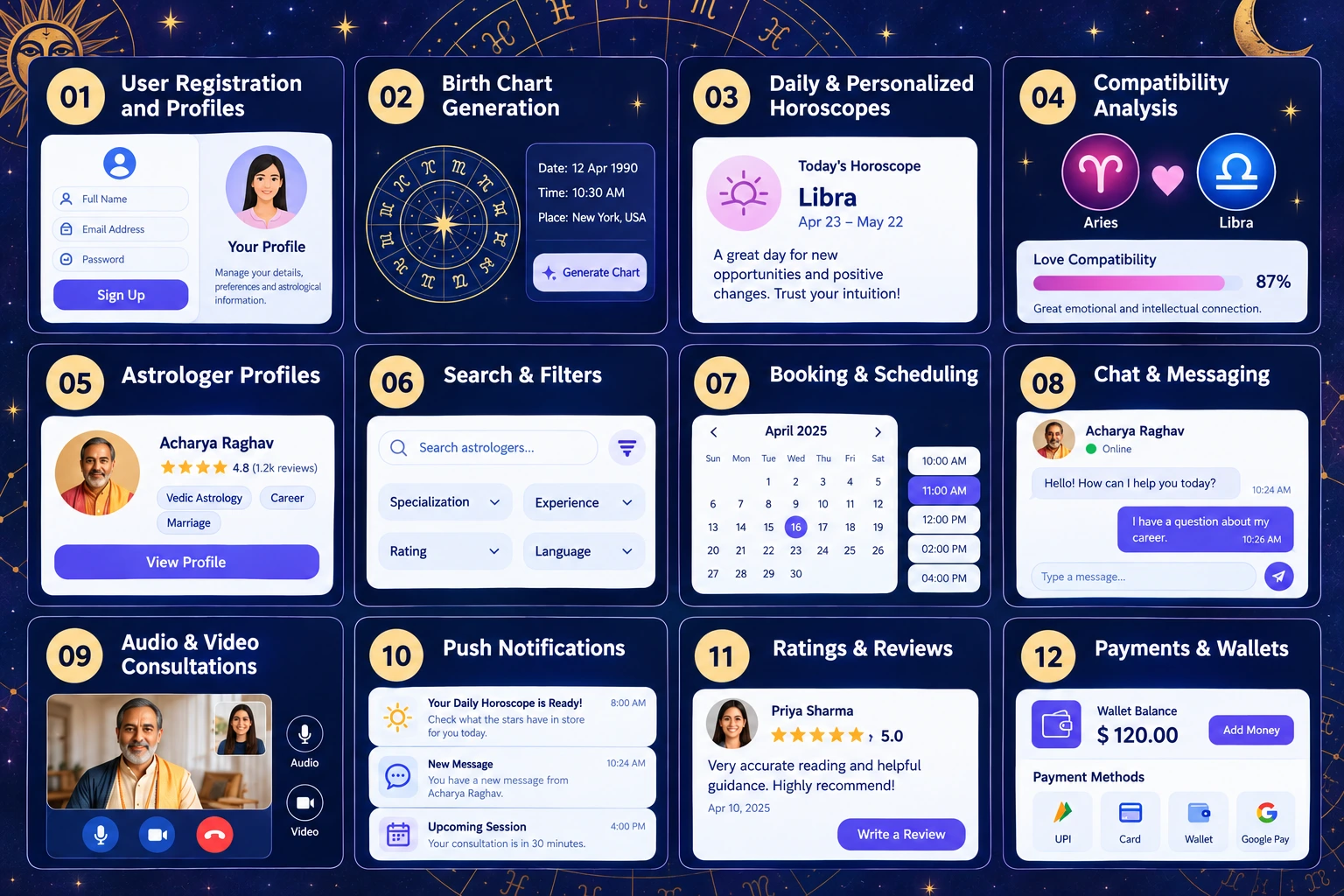
The feature set should reflect the product model rather than copying every feature available in competing apps. The following capabilities provide a strong foundation for most astrology platforms.
1. User Registration and Profiles
Users should be able to create and manage their profiles easily. Birth information should be stored securely because it forms the foundation for personalized astrology experiences. Allow users to edit their information where appropriate and provide clear controls for managing account data.
2. Birth Chart Generation
Birth chart generation is one of the core functionalities for personalized astrology platforms. The feature should allow users to enter birth information and view relevant planetary positions, houses, signs, and other chart elements supported by the chosen astrology system.
3. Daily and Personalized Horoscopes
Users can receive horoscope content based on their zodiac sign or individual birth information. Businesses can offer free daily content while reserving deeper interpretations, reports, or specialized insights for premium users.
4. Compatibility Analysis
Compatibility features can compare information between two users and generate insights around selected relationship themes. The experience can include compatibility scores, detailed interpretations, charts, and premium reports.
5. Astrologer Profiles
For consultation-based products, each astrologer should have a detailed profile containing relevant information such as:
- Name and profile photo
- Areas of expertise
- Experience
- Languages
- Consultation format
- Availability
- Pricing
- Ratings and reviews
Clear profiles help users choose an astrologer based on relevant information rather than relying only on price.
6. Search and Filters
A marketplace needs effective discovery. Users should be able to search and filter astrologers by expertise, language, availability, consultation format, pricing, and ratings.
7. Booking and Scheduling
Users should be able to select an available time slot, confirm the consultation, make payment, and receive reminders. Astrologers should have control over their availability and appointment schedules.
8. Chat and Messaging
In-app messaging allows users and astrologers to communicate before or during consultations. The platform can also support asynchronous paid consultations where users submit questions and receive responses within a defined period.
9. Audio and Video Consultations
Live consultations require reliable audio and video communication, session controls, notifications, and appropriate privacy measures. Businesses planning these experiences should consider video integration in mobile apps when evaluating their technical architecture and third-party communication options.
10. Push Notifications
Notifications can support daily horoscopes, consultation reminders, new reports, subscription renewals, special content, and personalized recommendations. Notification frequency should be controlled carefully. Too many messages can reduce engagement rather than improve it.
11. Ratings and Reviews
Users should be able to rate completed consultations and leave feedback where appropriate. Reviews can improve transparency and help users evaluate astrologers before booking.
12. Payments and Wallets
The app can support secure payments for subscriptions, reports, consultations, and other premium services. A wallet system can also be useful for platforms that use credits or prepaid balances for consultations.
For broader feature planning, businesses can also refer to must-have mobile app features, while prioritizing only those capabilities that directly support the astrology product.
UX Design Principles for an Astrology App
Astrology involves concepts that can become difficult for new users to understand. The interface should simplify the experience rather than overwhelm users with technical terminology and complicated charts.
1. Keep Personalization Visible
The home screen should quickly show information relevant to the user. This could include today’s horoscope, upcoming planetary events, saved reports, consultation appointments, or recommended content.
2. Make Birth Chart Information Easy to Understand
Charts can look complex to users who are new to astrology. Use clear labels, explanations, tooltips, visual hierarchy, and progressive disclosure to introduce information gradually.
3. Reduce Friction in Consultations
Booking an astrologer should involve as few unnecessary steps as possible. Users should be able to see availability, pricing, consultation format, and booking details before making a decision.
4. Design for Different User Intentions
One user may want a five-minute daily horoscope while another wants a detailed birth chart or one-hour consultation. The interface should accommodate both without making either journey difficult. A dedicated ui ux design agency can help translate these different user journeys into clear navigation, interfaces, and interaction patterns.
For the broader principles behind interface and experience decisions, the difference between UI and UX design is also worth considering during product planning.
AI in Astrology Apps
AI is becoming an important layer in personalized digital experiences. In astrology apps, it can help transform static readings into more interactive experiences. The opportunity for astrology app development lies in using AI where it improves personalization, discovery, and engagement without compromising the underlying product logic.
1. AI-Generated Personalized Readings
AI can generate personalized explanations based on structured astrological information, predefined interpretation rules, and user preferences. For example, instead of displaying a generic description of a planetary placement, the app can generate a more conversational explanation based on the user’s selected area of interest.
2. AI Astrology Chatbot
An AI assistant can allow users to ask questions in natural language.
Instead of navigating multiple sections, users could ask questions such as:
- What does my current planetary period indicate?
- Tell me more about this birth chart placement.
- What should I explore in my relationship reading?
- Explain this chart in simple language.
The response should be grounded in the app’s defined astrology framework and available user data.
3. Personalized Recommendations
AI can analyze user interactions and recommend relevant reports, content, consultations, or features. For example, a user repeatedly exploring relationship content could receive recommendations related to compatibility reports or relevant consultation categories.
4. AI-Based Content Generation
AI can assist internal teams with generating content variations for daily horoscopes, notifications, educational content, and other editorial formats. Human review and defined content guidelines remain important for maintaining consistency and quality.
Businesses exploring broader AI applications can refer to AI in mobile app development for relevant implementation possibilities.
How to Use AI for Astrology Apps
Businesses should first define the specific problem AI needs to solve. Adding an AI chatbot without a clear use case can increase complexity without improving the user experience.
A practical approach is to connect AI with structured astrology data and predefined product rules. The system can then use AI to explain, summarize, personalize, or conversationally present information.
For businesses exploring how to use AI for astrology, important considerations include the quality of the underlying data, prompt design, model selection, response evaluation, privacy controls, monitoring, and cost management.
The question of what is the best AI for astrology also does not have one universal answer. Model selection should depend on the required response quality, latency, context size, privacy requirements, integration options, and operating cost.
Monetization Models for Astrology Apps
An astrology platform can use one or multiple revenue models depending on its audience and service structure.
Freemium Model
Offer basic horoscopes, zodiac information, or limited readings for free while charging for advanced features. This lowers the entry barrier and gives users an opportunity to experience the product before purchasing.
Subscription Plans
Premium subscriptions can provide access to:
- Detailed readings
- Ad-free experiences
- Advanced compatibility reports
- Premium forecasts
- AI conversations
- Exclusive content
- Personalized recommendations
Paid Consultations
For marketplace products, businesses can earn through commissions on astrologer consultations. The platform can charge a percentage of each transaction or use other commercial arrangements.
Paid Reports
Users can purchase one-time reports covering selected topics such as relationships, career, compatibility, or other personalized areas.
In-App Purchases
Credits, tokens, premium content, and additional readings can be offered through in-app purchases depending on the platform and applicable store policies.
The right mix should be planned as part of broader mobile app monetization strategies rather than added after development.
How to Build an Astrology App MVP?
Launching every possible feature at once increases development time, cost, and operational complexity. An MVP gives businesses a way to validate the core product before expanding it.
A practical first version could include:
- User registration
- Birth profile
- Basic horoscope
- Birth chart
- Personalized readings
- Astrologer profiles
- Search and filters
- Booking
- Payments
- Push notifications
- Admin dashboard
AI chatbot, live video, advanced analytics, loyalty programs, multilingual experiences, and sophisticated recommendation systems can be introduced after the core product has been validated.
An MVP development guide can help businesses structure the initial product around essential user journeys rather than an oversized feature list.
Astrology App Development Process
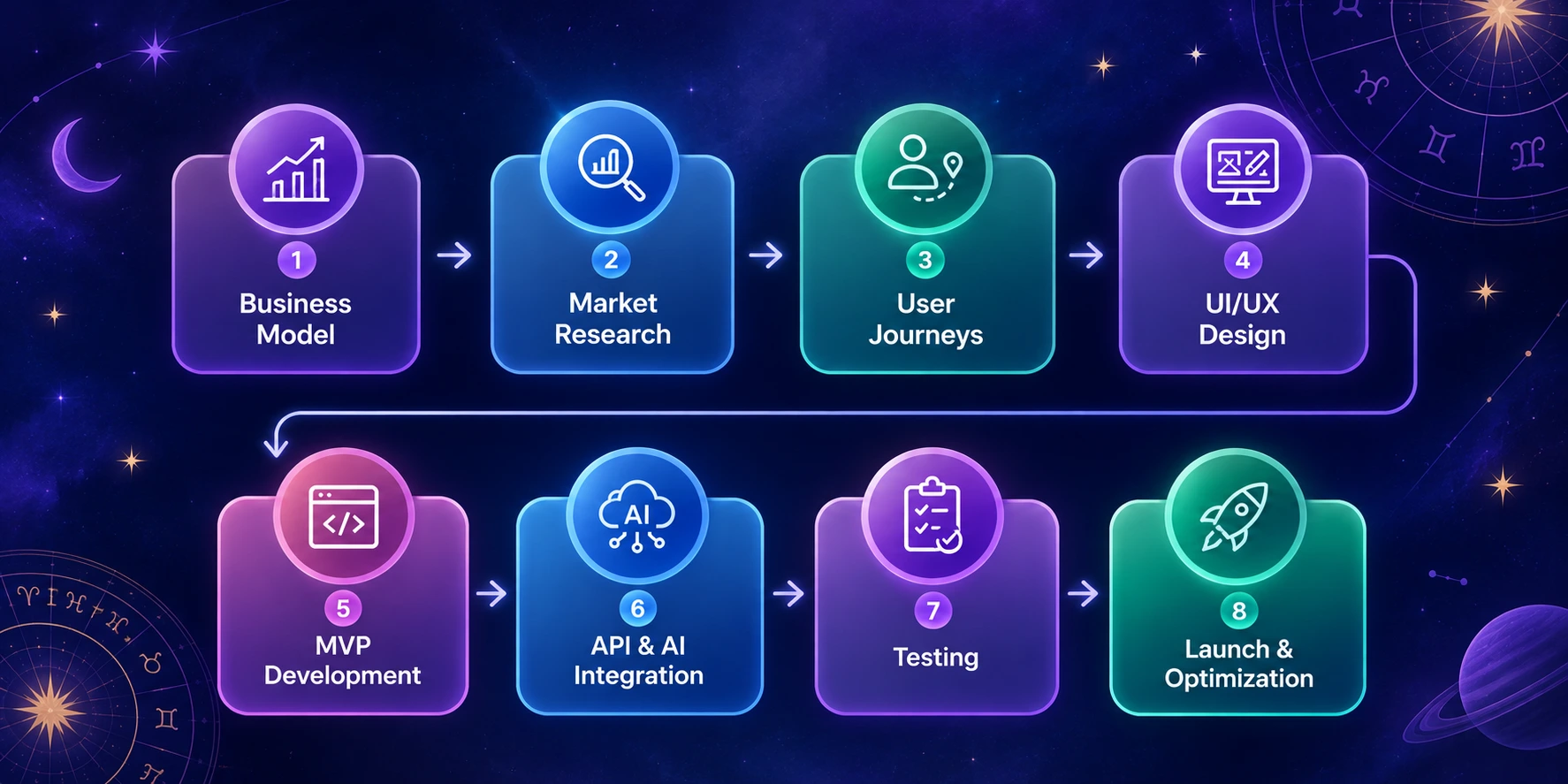
A structured development process helps businesses move from an initial concept to a scalable product while controlling scope and technical risks.
1. Define the Business Model
Start by deciding whether the app will focus on content, personalized readings, consultations, a marketplace, subscriptions, or a combination. This decision influences almost every later product and technical decision.
2. Conduct Market and User Research
Identify the target audience, competing products, user expectations, pricing patterns, preferred consultation formats, and key pain points. Businesses should also define the regions they want to serve because language, payment methods, cultural expectations, and platform preferences can vary.
3. Define User Journeys
Map the major journeys for users, astrologers, and administrators.
For example:
User → Sign Up → Add Birth Details → View Reading → Explore Astrologer → Book Consultation → Pay → Attend Session → Review
The astrologer journey will be different and should be mapped separately.
4. Design the Product
Create information architecture, wireframes, prototypes, and high-fidelity screens. The mobile app design process should focus on making complex astrology information understandable while keeping important actions easy to access.
5. Develop the MVP
Build the selected core features, backend, APIs, database, authentication, payment system, and admin panel with the support of an experienced MVP development service provider. At this stage, businesses should prioritize stable core workflows over advanced features that do not directly contribute to initial product validation.
6. Integrate Astrology APIs and Services
If the product relies on third-party astrology calculation services, evaluate their accuracy, API reliability, supported systems, response time, pricing, documentation, and scalability. The architecture should also allow the business to replace or upgrade a provider when requirements change. Once the core product is stable, AI assistants, personalized recommendations, automated content, and other intelligent features can be introduced.
7. Test the Product
Testing should cover:
- Registration
- Birth data handling
- Astrology calculations
- Payments
- Booking
- Notifications
- Chat
- Video
- AI responses
- Security
- Performance
- Different screen sizes
8. Launch and Monitor
After launch, monitor user behavior, retention, conversion, consultation bookings, subscription activity, technical errors, and user feedback. The mobile app development process provides a broader framework for taking a mobile product from planning through launch and post-launch improvement.
Technology Stack for Astrology App Development
The technology stack should be selected according to product complexity, platform requirements, integrations, and expected scale.
Frontend
Possible options include:
- Flutter
- React Native
- Native Android
- Native iOS
Cross-platform development can be suitable when the business wants to launch on Android and iOS while sharing a significant portion of the application code.
Backend
Possible backend technologies include:
- Node.js
- Python
- Java
- PHP
- .NET
The backend should support authentication, user profiles, astrology calculations, content, bookings, payments, notifications, and integrations.
Database
Depending on the architecture, businesses can use relational or NoSQL databases to store user profiles, consultation records, content, transactions, preferences, and other application data.
Cloud Infrastructure
Cloud infrastructure can support scalable APIs, databases, storage, notifications, analytics, and AI workloads.
Third-Party Integrations
An astrology platform may require integrations for:
- Astrology calculations
- Maps and location
- Payment gateways
- Push notifications
- Video consultations
- Analytics
- Authentication
- AI models
- Customer support
Custom vs Ready-Made Astrology App Solutions
Businesses have two broad approaches. They can use an existing white-label or ready-made solution, or build a product around their own requirements.
| Factor | Ready-Made Solution | Custom Solution |
| Initial launch | Faster | Requires more planning |
| Custom workflows | Limited | Fully configurable |
| UI/UX | Template-based | Brand-specific |
| Integrations | Depends on platform | Built around requirements |
| AI capabilities | Depends on provider | Tailored to use cases |
| Scalability | Vendor-dependent | Designed around growth |
| Data control | Depends on provider | Greater control |
| Long-term flexibility | Limited | Higher |
Ready-made platforms can work for businesses that want to test a basic concept quickly. However, businesses planning differentiated experiences, complex marketplace workflows, proprietary AI capabilities, or long-term product expansion often need custom astrology app development.
A broader custom app development approach can help businesses evaluate architecture, ownership, scalability, integrations, and long-term product control.
How to Improve User Engagement and Retention
An astrology app needs more than accurate readings to keep users returning. The product should create useful reasons to revisit without overwhelming users with notifications.
- Personalized Daily Content: Show users content based on their profiles and interests instead of presenting identical information to everyone.
- Smart Notifications: Send relevant reminders for daily readings, saved reports, upcoming consultations, and new personalized insights.
- Streaks and Habit Features: Daily horoscope products can use streaks, reading history, saved content, and other lightweight engagement mechanisms to encourage consistent usage.
- Personalized Recommendations: Recommend reports, astrologers, topics, or content based on user activity and preferences.
- Consultation Follow-Ups: After a consultation, users can receive session summaries, reminders, related reports, or follow-up recommendations.
These approaches should form part of broader user engagement strategies rather than relying only on push notifications.
Security and Privacy Considerations
Astrology apps collect personal information such as birth date, birth time, birthplace, contact information, payment details, and consultation records. Businesses should therefore treat privacy and security as core product requirements.
Important measures include:
- Secure authentication
- Encryption in transit and at rest
- Role-based access
- Secure payment processing
- API security
- Access logging
- Secure storage of birth information
- Regular security testing
- Backup and recovery
- Privacy controls
- Secure third-party integrations
Astrologer platforms should also restrict access to user information according to legitimate business and consultation requirements. If the product operates across multiple countries, the business should review applicable privacy, consumer protection, payment, and platform requirements before launch.
Common Challenges in Astrology App Development
Building an astrology platform involves several challenges that businesses should address during planning rather than after launch.
Maintaining Calculation Accuracy
Personalized astrology depends on accurate birth information and calculation logic. Errors in time zones, locations, or calculation systems can affect the output. The technical architecture should therefore use reliable calculation sources and validate inputs carefully.
Balancing AI With Human Expertise
AI-generated readings can improve personalization, but users seeking consultations may still expect human astrologers. The product should define where AI adds value and where human expertise remains central.
Building Trust
Users share personal information and may spend money on consultations and reports. Transparent pricing, clear astrologer profiles, secure payments, reviews, and understandable content can help build confidence.
Managing a Two-Sided Marketplace
If the app connects users and astrologers, the business needs to balance supply and demand. Astrologer onboarding, availability, quality controls, commissions, cancellations, refunds, and dispute management all become important.
Controlling Feature Scope
It is easy to add birth charts, compatibility, AI chat, live video, reports, community features, subscriptions, and other capabilities before validating the core product. A phased roadmap keeps development focused and gives the business room to learn from real users.
How Much Does Astrology App Development Cost?
Astrology app development typically costs around $30,000 to $150,000+, depending on the product scope and complexity. A basic horoscope or personalized reading app may fall toward the lower end, while an advanced platform with astrologer marketplace functionality, live consultations, AI, subscriptions, complex admin workflows, and multiple integrations can require a significantly higher investment. Understanding the factors that shape app development cost helps businesses set a realistic budget before development begins.
The major factors affecting astrology app development cost include:
- Number of platforms
- UI/UX complexity
- User and astrologer features
- Astrology calculation integrations
- AI capabilities
- Chat and video consultations
- Payment integration
- Subscription functionality
- Admin dashboard
- Third-party APIs
- Security requirements
- Cloud infrastructure
- Testing and maintenance
Businesses should also account for post-launch costs such as hosting, third-party API usage, AI model consumption, payment processing, maintenance, security updates, and feature enhancements.
A detailed estimate based on your actual requirements is more useful than a fixed market average. Get a requirement-based estimate to understand the investment involved in building and launching your astrology app.
How to Measure Astrology App Success
App downloads alone do not show whether the product is working. Businesses should track metrics connected to engagement, monetization, and retention.
User Metrics
- Daily and monthly active users
- New registrations
- Profile completion rate
- Reading frequency
- Session duration
- Retention rate
Engagement Metrics
- Daily horoscope views
- Reports opened
- Notifications opened
- AI conversations
- Saved readings
- Consultation interactions
Monetization Metrics
- Subscription conversion
- Average revenue per user
- Consultation bookings
- Paid report purchases
- In-app purchase revenue
- Customer lifetime value
Marketplace Metrics
For platforms with astrologers, monitor:
- Active astrologers
- Booking conversion
- Consultation completion rate
- Cancellation rate
- Average consultation value
- Repeat bookings
- Astrologer retention
These metrics help businesses identify which features contribute to sustainable growth.
Future Trends in Astrology App Development
The next generation of astrology apps is likely to focus on deeper personalization and more interactive experiences.
1. Conversational Astrology
Users increasingly expect to interact with digital products through natural language. AI assistants can make astrology content easier to access by allowing users to ask questions instead of navigating through multiple screens.
2. Hyper-Personalized Experiences
Instead of offering the same horoscope to everyone within a zodiac sign, platforms can combine individual profiles, preferences, behavior, and relevant astrology data to create more personalized experiences.
3. AI-Assisted Consultations
AI can support astrologers with summaries, customer context, appointment preparation, and post-consultation content while keeping the astrologer in control of the actual consultation.
4. Multilingual Experiences
Astrology businesses serving multiple regions can use multilingual interfaces and localized content to expand their reach.
5. Voice-Based Experiences
Voice interfaces can allow users to listen to horoscopes, ask questions, and interact with AI assistants without navigating the app manually.
6. Integrated Wellness Experiences
Businesses may connect astrology content with journaling, meditation, mindfulness, reminders, and other lifestyle features. These additions should remain clearly positioned and should not make unsupported health claims.
How to Choose an Astrology App Development Partner?
The right development partner should understand both mobile product development and the business model behind the astrology platform.
Evaluate potential partners based on:
- Relevant mobile app experience
- UI/UX capabilities
- Backend and API expertise
- AI development experience
- Marketplace development knowledge
- Payment integration experience
- Security practices
- Cross-platform development capabilities
- Testing and QA processes
- Post-launch support
Ask how the team plans the MVP, manages third-party integrations, handles user and astrologer workflows, structures the backend, and prepares the architecture for future AI and marketplace expansion. Moreover, a strong partner should also provide a clear roadmap covering discovery, UX, development, testing, launch, analytics, and post-launch optimization.
Conclusion
An astrology app can become much more than a digital horoscope platform. With personalized readings, birth charts, consultations, AI-powered interactions, subscriptions, and marketplace functionality, businesses can create a product that supports multiple user journeys and revenue streams.
Successful astrology app development starts with a clear business model and focused MVP. From accurate birth-data processing and intuitive UX to secure payments, astrologer management, AI capabilities, and scalable architecture, every part of the product should support the intended user experience.
RipenApps, a leading custom application development company, helps businesses turn astrology app concepts into reliable mobile platforms with product discovery, UI/UX design, development, AI integration, marketplace functionality, testing, and post-launch support.
FAQs
Q1. How much does it cost to develop an astrology app?
An astrology app can cost roughly $30,000 to $150,000+, depending on features, platforms, AI capabilities, integrations, marketplace functionality, and complexity. Advanced products with live consultations and AI can require a larger investment.
Q2. What features should an astrology app have?
Core features can include user profiles, birth chart generation, personalized horoscopes, compatibility analysis, astrologer profiles, search, booking, payments, chat, notifications, reports, and an admin dashboard.
Q3. Can AI be integrated into an astrology app?
Yes. AI can support personalized readings, conversational astrology assistants, content generation, recommendations, and user engagement. The implementation should be connected to reliable astrology data and clearly defined product rules.
Q4. How long does it take to build an astrology app?
A focused MVP can take a few months, while a larger platform with marketplace functionality, AI, live consultations, multiple integrations, and advanced administration can require considerably more time.
Q5. Should I build an astrology app for Android or iOS first?
The decision should depend on your target market, audience behavior, monetization strategy, and launch goals. Businesses can also launch on both platforms using cross-platform technologies when the product requirements support that approach.
Q6. How do astrology apps make money?
Common models include subscriptions, paid consultations, premium reports, in-app purchases, freemium plans, and commissions from astrologer bookings.
Q7. Can an astrology app connect users with professional astrologers?
Yes. A marketplace-based product can allow astrologers to create profiles, manage availability, receive bookings, conduct consultations, and earn through the platform.
Discuss your project and request for proposal
SHARE
WRITTEN BY

Ishan Gupta
CEO & Founder
Ishan Gupta is a seasoned entrepreneur and CEO with extensive 10+ years of experience in business and mobile app development landscape. He believes that the right digital product allows companies to focus on what they do best, while technology handles the rest. With deep exposure to global markets, he understands what makes an app succeed. His approach translates business needs into clear product strategies, ensuring that every feature contributes to measurable ROI.
View All Articles