

Key Takeaways
- Start with one life stage or core health problem instead of building an all-in-one women’s health platform immediately.
- An MVP can include health tracking, reminders, personalized dashboards, educational content, and privacy controls.
- AI can support pattern analysis and personalization, but health predictions should not be presented as diagnoses or clinically certain outcomes without appropriate validation.
- Reproductive and health data require privacy-by-design controls covering collection, storage, access, sharing, retention, and deletion.
- HIPAA does not automatically apply to every women’s health app. FTC requirements and state privacy laws can still apply to consumer health products.
- Wearable and health-platform integrations increase engineering, synchronization, permissions, and testing requirements.
- Development cost depends more on product scope, integrations, user roles, AI, security, and compliance requirements than on the number of screens.
A women’s health tracker app can cost $50k-$300k to develop, depending on the app type, features, AI, wearables, integrations, and privacy requirements. The strongest products start with one life stage or health use case, minimize sensitive data collection, and build privacy into the architecture from the beginning.
For founders planning a custom product, mobile app development services can help define the product scope, technical architecture, development roadmap, and investment required to take the app from concept to launch.
This guide covers the types of women’s health apps, essential and advanced features, AI and wearable integrations, privacy and compliance considerations, development steps, technology choices, monetization models, and ongoing costs. It also explains how to scope the product based on its target users and health use case before development begins.
Table of Contents
Women’s Health App Market: What’s Driving FemTech Demand
Women’s health is a broad digital-health opportunity spanning reproductive health, chronic conditions, menopause, pregnancy, mental wellness, preventive care, and everyday health management.
The need is significant. A McKinsey Health Institute and World Economic Forum report found that women spend 25% more time in poor health than men on average. The research estimated that closing the women’s health gap could add at least $1 trillion to global GDP annually by 2040.
The opportunity is not limited to building another period tracker. Digital products can help users collect health information, understand personal patterns, access educational resources, communicate with healthcare professionals, or participate in structured wellness programs.
The commercial opportunity also extends beyond direct-to-consumer subscriptions. Employer wellness programs, healthcare organizations, clinics, and health plans can create B2B2C opportunities when the product has an appropriate business and privacy model.
A focused MVP is usually easier to validate, secure, and operate than an application attempting to cover every stage of women’s health from launch. For products that need broader healthcare workflows, a healthcare app development guide can provide additional context on architecture, integrations, and product planning.
Types of Women’s Health Tracking Apps by Life Stage
A women’s health tracking app should be scoped around the user’s specific health journey. The life stage determines the data collected, features required, content strategy, integrations, and potentially the regulatory considerations.
| Life stage/focus | Core use | Key features | Monetization fit |
| Menstrual health | Track cycles, symptoms, and patterns | Cycle calendar, symptom logs, predictions, reminders | Subscription, premium features |
| PCOS | Track symptoms and lifestyle factors | Cycle tracking, symptom logging, activity and nutrition inputs, educational content | Subscription, clinic partnerships |
| Fertility | Support conception planning | Cycle history, fertile-window estimates, reminders, health logs | Subscription, provider partnerships |
| Pregnancy | Support users throughout pregnancy | Pregnancy timeline, educational content, appointments, symptom logs, reminders | Subscription, provider partnerships |
| Postpartum | Support recovery and new-parent needs | Recovery logs, mood tracking, reminders, educational resources | Subscription, B2B2C |
| Menopause | Track symptoms and lifestyle patterns | Symptom logs, sleep, mood, hot-flash tracking, education | Subscription, employer or clinic partnerships |
| Women’s wellness | Support broader health goals | Fitness, nutrition, sleep, mental wellness, health tracking | Subscription, employer wellness |
A founder building a PCOS app, for example, does not necessarily need fertility or pregnancy features in the first release. The MVP can focus on symptom tracking, cycle history, lifestyle inputs, educational resources, and personalized trends.
Similarly, a menopause product may prioritize symptom patterns, sleep, mood, educational content, and personalized recommendations instead of adding a complete reproductive-health feature set. This focused approach also reduces unnecessary data collection and keeps the initial product easier to test and refine.
Essential Features of a Women’s Health Tracking App
The right feature set depends on the health problem, target audience, business model, and intended product claims. A cycle-tracking MVP should not have the same scope as a patient-and-practitioner healthcare platform.
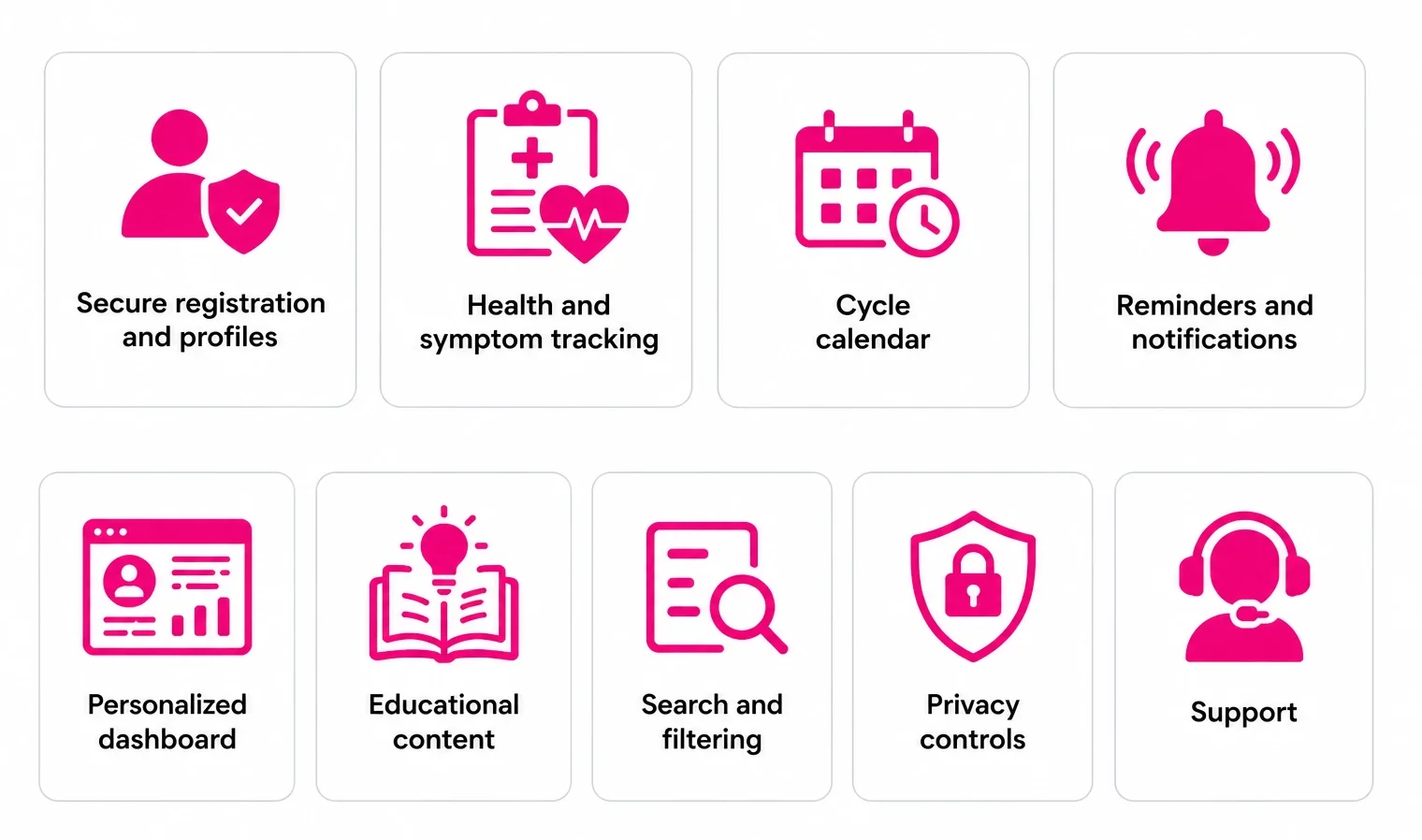
A practical women’s health tracking app mainly include:
- Secure registration and profiles: Provide account creation, authentication, profile management, and appropriate privacy settings.
- Health and symptom tracking: Allow users to record relevant information such as cycle dates, symptoms, pain, mood, sleep, medication, or lifestyle factors.
- Cycle calendar: For menstrual-health products, provide historical cycle information, period tracking, and user-entered events.
- Reminders and notifications: Support configurable reminders for periods, medications, appointments, symptom logging, or other relevant activities.
- Personalized dashboard: Turn collected information into simple trends and summaries rather than overwhelming users with raw data.
- Educational content: Provide relevant, appropriately reviewed health information based on the product’s intended audience.
- Search and filtering: Help users locate educational content, historical records, symptoms, or other relevant information.
- Privacy controls: Allow users to manage consent, account settings, connected data sources, and appropriate deletion requests.
- Support: Give users a secure channel to report problems, ask product questions, or contact support.
The MVP should collect only the information needed to deliver its stated functionality. Adding health fields simply because they might become useful later creates additional privacy, security, retention, and governance requirements.
A two-sided patient-and-practitioner platform requires separate roles, permissions, workflows, and data-access rules. It should therefore be planned as a platform architecture rather than simply adding a second interface later. If teleconsultation is part of the roadmap, the product should account for the additional requirements involved in telemedicine app development.
AI Features: Symptom Patterns, Predictions, and Personalization
AI can help a women’s health app turn large volumes of user-entered information into more useful experiences.
Potential applications include:
- Symptom-pattern analysis
- Personalized content recommendations
- Natural-language health journaling
- Cycle-pattern analysis
- Personalized reminders
- User-specific summaries
- Practitioner-facing summaries
- Engagement and behavioral insights
- Conversational health education
For example, instead of displaying dozens of separate symptom entries, an AI feature could summarize recurring patterns and highlight changes that the user may want to discuss with a healthcare professional.
However, AI output must match the product’s intended use. A cycle estimate should not be presented as a medical certainty, and a symptom pattern should not be presented as a diagnosis unless the product has the necessary evidence, validation, and regulatory basis.
AI architecture should also consider model monitoring, data governance, evaluation, versioning, access controls, and protection of sensitive health information. Founders planning AI-heavy products can also review AI in healthcare app development before finalizing the AI roadmap.
Wearable and Health Platform Integrations
Wearable and health-platform integrations can reduce manual data entry and provide additional signals for personalized experiences. Depending on the product, integrations may include:
- Apple HealthKit
- Android Health Connect
- Smartwatches
- Fitness trackers
- Sleep data
- Heart-rate data
- Activity data
- Temperature-related measurements
- Compatible connected health devices
The required integrations should follow the product’s use case. A fertility-focused product may need different data from a menopause or general wellness platform.
These integrations also increase development complexity. Teams need to handle permissions, revoked access, synchronization failures, inconsistent data, background updates, device differences, and incomplete records.
Privacy, Security, and Compliance for Women’s Health Apps
Privacy should be treated as a product requirement, not a legal section added immediately before launch.
Women’s health apps can collect information about menstruation, fertility, pregnancy, symptoms, medications, diagnoses, reproductive decisions, and other highly sensitive areas. A privacy failure can therefore damage user trust and create regulatory exposure.
A privacy-first product begins by defining what data is necessary, why it is collected, who can access it, where it goes, how long it is retained, and when it should be deleted.
When HIPAA Applies (and When It Doesn’t)
HIPAA does not automatically apply to every women’s health or FemTech application.
The law applies to covered entities such as certain healthcare providers, health plans, and healthcare clearinghouses, as well as applicable business associates. A standalone consumer app may fall outside HIPAA while still being subject to other privacy and consumer-protection requirements.
Therefore, founders should map:
- Who collects the information
- Who controls the information
- Whether the business is working for a HIPAA-covered entity
- Which third parties process the information
- What data is exchanged with healthcare organizations
- Which other federal and state requirements apply
Calling an application “HIPAA compliant” simply because it uses encryption is not enough. The product’s organizational relationships and actual data flows determine the applicable requirements.
HHS also states that HIPAA’s Privacy Rule governs the use and disclosure of protected health information by covered entities and, to some extent, business associates. For a deeper technical treatment, see the HIPAA-compliant app development guide.
FTC Rules and State Health-Data Laws
A consumer health app can face FTC requirements even when HIPAA does not apply. The FTC’s Health Breach Notification Rule applies to certain vendors of personal health records, related entities, and their service providers. The FTC’s 2024 amendments clarified the rule’s application to health apps and similar technologies.
For covered businesses, a breach involving unsecured personal health information can trigger notification obligations to affected individuals, the FTC, and in some circumstances the media.
The product’s privacy practices also need to match its public statements. If an app says health data will not be shared for a particular purpose, its analytics, advertising, SDK, and backend architecture should support that statement.
State requirements add another layer. Depending on the user’s location, the type of information collected, and the business model, state privacy and health-data laws may impose additional obligations. This makes a state-by-state legal review important for a US women’s health product rather than relying on HIPAA as a universal compliance framework.
Reproductive Data Privacy by Design
A reproductive-health product should minimize sensitive data collection from the beginning.
A practical privacy-by-design approach can include:
- Collecting only information necessary for the stated product purpose
- Encrypting sensitive information in transit and at rest
- Using strong authentication and authorization
- Restricting administrative access
- Separating sensitive information from unnecessary identifiers where practical
- Providing clear consent controls
- Supporting appropriate account and data deletion
- Reviewing third-party SDKs before integration
- Limiting analytics data collection
- Maintaining access and security logs
- Preparing a documented incident-response process
- Evaluating on-device storage where appropriate
Third-party analytics and advertising tools deserve particular scrutiny. A sensitive health event can potentially become exposed through data flows that the product team did not consider part of its core health database.
The FTC’s guidance makes clear that developers need to understand the data their health applications collect, how it is used, and how it is shared. For reproductive-health products, therefore, simply describing data as “anonymous” is not an adequate privacy strategy. Data minimization, controlled sharing, clear user choices, and careful third-party review are more fundamental.
When a Women’s Health App Becomes a Medical Device
Not every women’s health app is a medical device. A product designed for general wellness, education, tracking, or self-management can have a different regulatory profile from software intended to diagnose, treat, prevent, or make patient-specific clinical decisions.
The FDA’s current software guidance is function-specific. Its oversight focuses on software functions that meet the definition of a medical device and could pose a risk to patient safety if they fail to work as intended.
For example, the FDA identifies software that performs patient-specific analysis and provides specific outputs for diagnosis or treatment as a category that may be subject to regulatory oversight. That means founders should define the product’s intended use and claims before implementing advanced clinical functionality.
If the app only helps users record symptoms, provides general education, or supports self-management without specific treatment recommendations, its regulatory pathway may differ from an application making clinical decisions or controlling a medical device. When the product approaches the medical-device boundary, obtain appropriate regulatory and clinical advice before development and commercialization.
GDPR for EU Users
If the application serves users in the European Union, health and reproductive information requires additional protection under the GDPR.
The European Commission identifies data concerning health, genetic data, biometric data used for identification, and information concerning sex life or sexual orientation as special categories of personal data. Processing these categories is generally restricted and may require an applicable condition such as explicit consent.
A women’s health app serving EU users should therefore account for:
- Lawful processing
- Explicit consent where required
- Purpose limitation
- Data minimization
- Data retention
- User access and deletion rights
- Processor agreements
- International data transfers
- Privacy notices
- Security controls
The GDPR requirements should be mapped to the actual product architecture and user journey rather than copied from a generic checklist.
Women’s Health App Privacy Checklist
- Define every category of health and reproductive data collected
- Document why each category is necessary
- Minimize collection and retention
- Encrypt sensitive information
- Implement role-based access
- Review third-party SDKs and analytics
- Build consent controls into the product
- Support appropriate data deletion
- Prepare a breach-response process
- Review HIPAA, FTC, state, FDA, and GDPR requirements where applicable
Important: Regulatory requirements can change, and applicability depends on the product, organization, users, and data flows. This section is a product-planning guide, not legal advice.
How to Develop a Women’s Health Tracking App
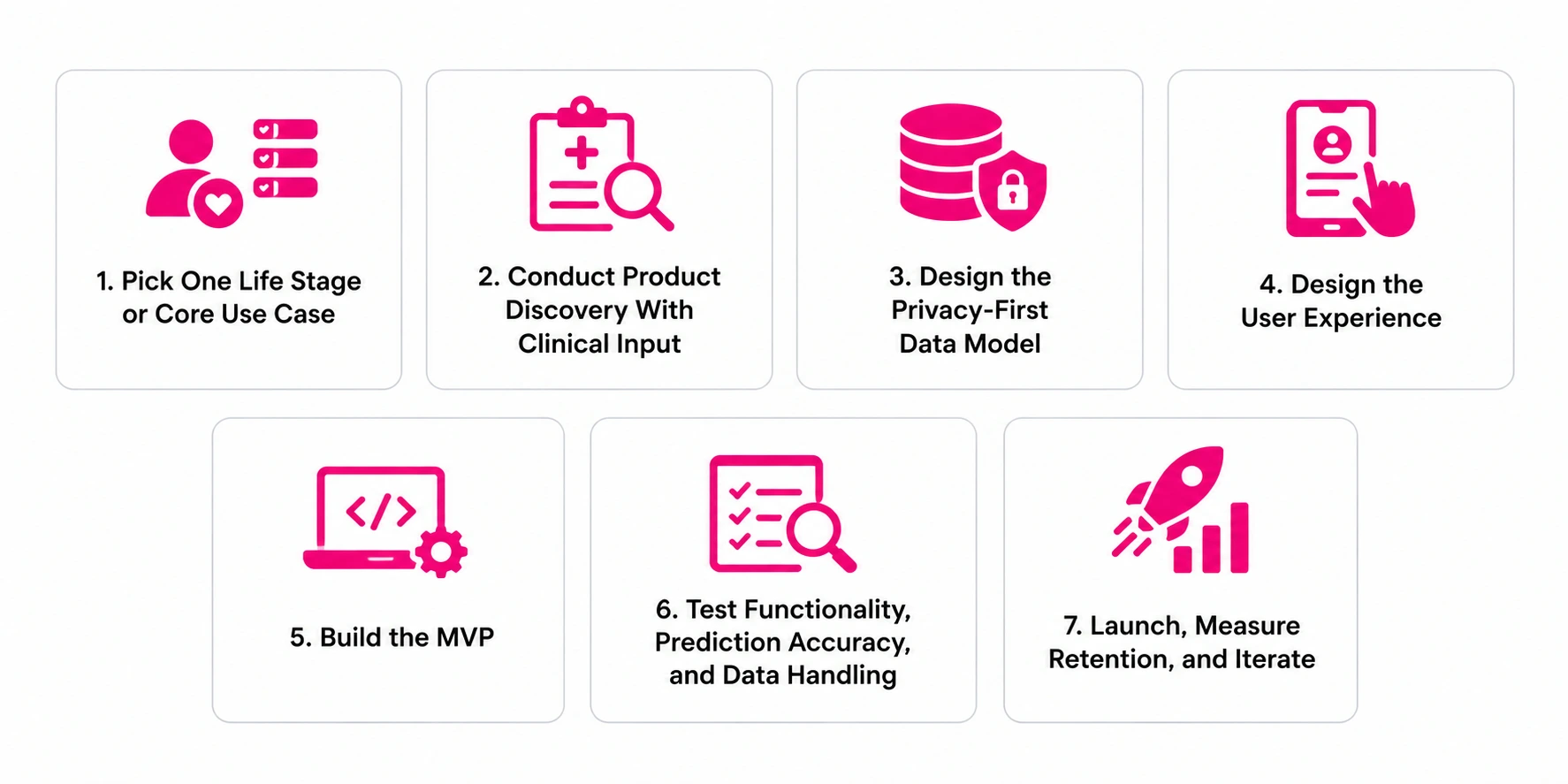
A successful women’s health tracking application should be planned from product scope through privacy architecture before development begins.
1. Pick One Life Stage or Core Use Case
Choose the specific user and problem the MVP will serve. A founder might start with menstrual health, PCOS, fertility, pregnancy, postpartum recovery, menopause, or another clearly defined use case.
Avoid combining every life stage into the first release unless the business case and product research justify the added complexity.
2. Conduct Product Discovery With Clinical Input
Validate the problem with target users and, where appropriate, qualified healthcare professionals. Map the user journey, health information involved, product claims, clinical boundaries, integrations, and potential regulatory requirements. This stage should produce a prioritized product roadmap rather than a long feature list.
3. Design the Privacy-First Data Model
Map every data field before implementation.
Define:
- What information is collected
- Why it is required
- Who can access it
- How it is encrypted
- How long it is retained
- How it can be deleted
- Which third parties receive it
- Which consent controls apply
This step can prevent expensive architectural changes later.
4. Design the User Experience
Create flows for onboarding, health-data entry, dashboards, insights, reminders, permissions, privacy settings, and account management.
Health products should make data requests understandable. Users should know what information the app is asking for and why it is needed.
5. Build the MVP
Develop the mobile experience, backend, authentication, database, APIs, notifications, analytics, and required integrations.
If the product includes practitioner workflows, implement role-based access and separate user journeys from the beginning rather than adding them after the consumer app is complete.
6. Test Functionality, Prediction Accuracy, and Data Handling
Testing should cover both normal product functionality and sensitive health-data workflows.
Validate:
- Authentication and authorization
- Encryption
- Consent behavior
- Data deletion
- API security
- Third-party integrations
- Notification privacy
- AI outputs
- Prediction performance against the intended use case
- Device compatibility
- Synchronization
- Incomplete or inconsistent health data
AI features should be evaluated for inappropriate outputs, unexpected behavior, and performance limitations before they are presented to users.
7. Launch, Measure Retention, and Iterate
After launch, measure whether users continue to engage with the core health journey.
Depending on the product, useful metrics can include:
- Activation
- Recurring tracking
- Feature adoption
- Retention
- Subscription conversion
- Provider engagement
- User-reported satisfaction
- Support volume
- Data-quality issues
Use those findings to prioritize subsequent features instead of expanding the product based only on assumptions.
Women’s Health App Development Cost
The cost to develop a women’s health app depends primarily on scope. A simple cycle-tracking MVP has a very different cost profile from an AI-powered application that synchronizes wearable data and supports both patients and clinicians.
Cost by App Complexity
| App Complexity | Features Included | Estimated Cost |
| Basic | Cycle tracking, notifications, simple analytics | $50,000–$100,000 |
| Moderate | Advanced analytics, wearable integrations | $100,000–$200,000 |
| High | AI insights, multi-platform support, custom design | $200,000–$300,000+ |
The final estimate can vary based on:
- Number of platforms
- Number of user roles
- Backend complexity
- AI functionality
- Wearable integrations
- Health-platform integrations
- Telemedicine
- Practitioner workflows
- Security requirements
- Regulatory scope
- Third-party APIs
- Content management
- Analytics
- Localization
- Testing requirements
What Drives the Cost Up
Several factors can significantly increase women’s health app development costs.
- Multiple user roles: A patient application plus clinician dashboard introduces separate workflows, permissions, interfaces, and testing requirements.
- AI: AI features require model selection, data pipelines, evaluation, monitoring, and ongoing optimization.
- Wearables: HealthKit, Health Connect, and device integrations require permissions, synchronization, normalization, error handling, and device testing.
- Healthcare integrations: Connecting with external healthcare systems can introduce additional API, security, data-mapping, and testing requirements.
- Clinical functionality: Features that cross into clinical decision support or medical-device functionality may require additional validation and regulatory planning.
- Privacy and security: Sensitive health information requires stronger access controls, security testing, monitoring, and governance than a typical consumer application.
- Multiple platforms: Supporting native iOS and Android experiences or additional web and practitioner applications increases development and testing effort.
Ongoing Costs After Launch
The initial development budget is not the full cost of ownership.
Founders should also plan for:
- Cloud infrastructure: Covers servers, hosting, computing resources, backups, and scaling as user demand grows.
- Database and storage: Pays for storing user profiles, health records, media, logs, and application data securely.
- AI model usage: Covers API calls, inference, model hosting, monitoring, and optimization for AI-powered features.
- Third-party APIs: Includes recurring fees for services such as payments, maps, messaging, identity verification, or health data.
- Wearable-platform maintenance: Covers updates and compatibility work for Apple Health, Health Connect, Fitbit, or other connected platforms.
- Security monitoring: Supports threat detection, vulnerability monitoring, access controls, and security incident response.
- Bug fixes: Covers identifying, resolving, and testing issues discovered after the product goes live.
- OS updates: Keeps the app compatible with new iOS and Android versions, devices, and platform requirements.
- Compliance reviews: Supports periodic assessments of privacy, security, regulatory, and data-handling requirements.
- Content updates: Includes refreshing educational resources, health information, notifications, and other in-app content.
- Customer support: Covers user assistance, issue resolution, account queries, and support operations.
- Analytics: Supports tracking product usage, user engagement, retention, and other business metrics.
- Continuous product development: Funds new features, integrations, performance improvements, and product enhancements based on user feedback and business goals.
Health applications should also budget for recurring security reviews because threats, dependencies, operating systems, APIs, and privacy expectations change over time.
Recommended Tech Stack
The technology stack should follow the product’s requirements rather than being selected independently of the business and privacy model.
| Layer | Suitable technologies/options |
| Mobile | Swift, Kotlin, React Native, Flutter |
| Backend | Node.js, Python, Java, or another suitable backend framework |
| Database | PostgreSQL, MySQL, MongoDB, depending on the data model |
| Cloud | AWS, Azure, Google Cloud |
| AI / ML | Python-based ML frameworks, commercial AI APIs, or specialized models |
| Authentication | OAuth 2.0, OpenID Connect, secure token-based authentication |
| Health integrations | Apple HealthKit, Android Health Connect, approved device APIs |
| Notifications | Apple Push Notification service, Firebase Cloud Messaging |
| Analytics | Privacy-conscious analytics selected according to the product’s data policy |
For a sensitive health product, maintainability, access control, auditability, security, and integration reliability should take priority over choosing the newest technology.
How Women’s Health Apps Make Money
Women’s health apps can use several monetization models without making sensitive health information the primary revenue source.
- Subscription: Charge users monthly or annually for premium tracking, advanced insights, personalized programs, educational resources, or integrations.
- Freemium: Offer core tracking for free while charging for advanced analytics, personalization, reports, and integrations.
- B2B2C: Let employers, health plans, wellness organizations, or institutions sponsor app access for their employees or members.
- Clinic and Provider Partnerships: Partner with clinics and healthcare organizations to support patient engagement, education, monitoring, communication, and related workflows.
- Paid Health and Wellness Programs: Monetize structured programs, coaching, educational content, or other health and wellness services based on the product’s scope.
Healthcare Apps RipenApps Has Built
RipenApps has experience building digital products in the women’s health and wellness space, including AI-powered health tracking and wellness management platforms.
Holypills
RipenApps built Holypills, an AI-powered women’s health tracker designed to support women across PCOS, endometriosis, menopause, and postpartum health. The platform combines health tracking with AI-based suggestions, personalized wellness support, period and symptom tracking, online consultations, and access to women’s health professionals.
The platform allows users to track cycles, symptoms, mood, pain levels, weight, and other health patterns while providing personalized insights based on their information. It also supports online consultations and personalized wellness plans, extending the product beyond basic tracking.
emmyHealth
RipenApps has also built emmyHealth, a wellness management and benefits platform. The project provides additional capability proof for developing digital wellness products that support user engagement and health-related workflows.
For founders evaluating development partners, relevant experience should still be assessed against the product’s specific requirements, integrations, privacy obligations, clinical scope, and intended market.
Final Thoughts
Women’s health app development requires a careful balance of product value, privacy, scalability, and responsible health communication. Start with one clearly defined life stage or health use case, validate the core product, and expand based on user needs. AI and wearable integrations can add meaningful value, but they should strengthen the core experience rather than make the MVP unnecessarily complex.
For founders building a women’s health product, RipenApps can help translate the product vision into a practical development roadmap covering features, architecture, integrations, privacy requirements, and scalability. A strong technical foundation also makes it easier to introduce AI, connected health data, and new user workflows as the product evolves. Privacy should remain embedded throughout the product lifecycle rather than treated as a post-launch requirement. Depending on the product, HIPAA, FTC requirements, state privacy laws, GDPR, and FDA oversight may apply, making privacy and regulatory considerations important from the earliest planning stages.

FAQs
Q1. How long does it take to develop a women’s health app?
A focused women’s health MVP typically takes 3–5 months to develop, while products with AI, wearable integrations, practitioner dashboards, or healthcare integrations can take 6–12 months or longer. The final timeline depends on the number of platforms, features, integrations, user roles, testing requirements, and regulatory scope.
Q2. How much does it cost to develop a women’s health app?
Women’s health app development cost depends on the product’s scope, features, integrations, AI, security requirements, and user roles. A focused cycle-tracking MVP costs less than an AI-powered patient-and-clinician platform. The most reliable estimate comes from a detailed feature and technical specification.
Q3. What are the essential features of a women’s health tracker app?
Core features can include secure registration, health profiles, cycle or symptom tracking, reminders, personalized dashboards, educational content, notifications, privacy controls, and data management. The exact MVP should depend on the target life stage, such as menstrual health, PCOS, fertility, pregnancy, postpartum care, or menopause.
Q4. Is user data safe in a women’s health app?
A women’s health app can protect user data through data minimization, encryption, strong authentication, access controls, consent management, secure integrations, retention policies, and deletion workflows. However, no application should promise absolute security. The product’s actual data practices should match its privacy commitments and applicable requirements.
Q5. Does a women’s health app need HIPAA?
Not automatically. HIPAA generally applies to covered entities and applicable business associates, rather than every consumer health application. A standalone app may fall outside HIPAA while still being subject to FTC requirements, state privacy laws, or other rules. Applicability depends on the business model, relationships, and data flows.
Q6. Can AI reliably predict cycle irregularities?
AI can analyze historical information and identify patterns, but cycle predictions should not automatically be treated as medically reliable or diagnostic. Accuracy depends on data quality, the model, the population, and the intended use. Health-related predictions should be validated appropriately and communicated with clear limitations.
Q7. How do women’s health apps make money?
Women’s health apps can generate revenue through subscriptions, freemium plans, employer or health-plan partnerships, clinic relationships, and paid wellness programs. A privacy-first business should avoid relying on sensitive reproductive-health data as an advertising asset and instead monetize the value delivered through the product.
Discuss your project and request for proposal
SHARE
WRITTEN BY

Prankur Haldiya
Chief Technical Officer
A tech innovator and engineering leader, Prankur Haldiya drives RipenApps’ product development strategy and oversees cutting-edge solutions in mobility, AI, and cloud ecosystems. He is passionate about building high-performance teams and helping brands launch secure, scalable, and user-centric digital products.
View All Articles