
Quick Summary
Embedded software enables electronic devices to perform specialised functions reliably and efficiently. This guide covers development tools, programming languages, system architecture, security, industrial applications, IoT integration, and costs. It also explains how entrepreneurs can evaluate development partners, manage technical risks, modernise existing systems, and prepare embedded products for long-term success in 2027.
Embedded software powers the devices businesses rely on every day, from industrial machinery and smart home systems to connected vehicles and healthcare equipment. As products become more intelligent and connected, the software running inside them increasingly determines their performance, reliability, security, and commercial value.
For entrepreneurs, investing in embedded technology involves more than selecting hardware and writing code. It requires decisions about product architecture, real-time performance, connectivity, cybersecurity, manufacturing, maintenance, and long-term scalability. Businesses planning specialised digital products can explore custom software development services to evaluate how tailored software can support their product requirements and broader business objectives.
This guide explains embedded software, its development process, essential tools, industry applications, security requirements, costs, and the decisions entrepreneurs should make before investing in an embedded product.
Table of Contents
What is Embedded Software?
Embedded software is a specialised program designed to operate within a hardware device and control its functions. Unlike general-purpose software, which can perform many different tasks, embedded programs are typically developed for a defined purpose, such as regulating temperature, controlling a motor, monitoring a sensor, or managing communication between electronic components.
For example, the software inside a smart thermostat reads temperature sensors, processes measurements, and activates heating or cooling according to configured rules. Similarly, embedded software in manufacturing equipment coordinates sensors, actuators, and controllers to maintain operational accuracy.
The phrase what is embedded software refers to software that works closely with a physical device to deliver a specific function under defined hardware and operating constraints. Depending on the application, an embedded system may run a simple control loop, a real-time operating system (RTOS), or a more capable operating system such as embedded Linux. Its architecture depends on processing requirements, memory capacity, power consumption, connectivity, and the consequences of system failure.
Why Embedded Software Matters to Entrepreneurs
Embedded technology enables businesses to differentiate physical products through intelligence, automation, connectivity, and data-driven functionality. Entrepreneurs can use it to:
- Automate repetitive industrial processes and reduce manual intervention.
- Develop connected products that collect operational data.
- Improve product performance through sensor-based monitoring.
- Enable remote diagnostics and device configuration.
- Introduce predictive maintenance and connected service models.
- Deliver specialised functionality without requiring constant cloud connectivity.
Embedded software can also support recurring revenue opportunities. For example, a manufacturer may offer remote monitoring, premium device features, or predictive maintenance subscriptions alongside its hardware products. These benefits depend on the product’s requirements, implementation quality, and the reliability of its supporting infrastructure.
Embedded Software vs. Traditional Software
Both embedded and traditional software follow software engineering principles, but they differ in their execution environments, constraints, and operational responsibilities.
| Comparison Factor | Embedded Software | Traditional Software |
| Primary purpose | Controls a dedicated device or hardware function | Supports broader computing or business tasks |
| Execution environment | Microcontrollers, specialised processors, or embedded computers | Desktops, servers, browsers, and mobile devices |
| Resource constraints | Often operates with limited memory, processing capacity, and power | May have access to comparatively larger resources |
| Timing requirements | May require deterministic responses or strict deadlines | Often prioritises functionality, throughput, and user experience |
| Hardware dependency | Usually closely coupled with specific hardware components | May operate across multiple compatible hardware environments |
| Updates | May require firmware releases, secure remote updates, or physical servicing | Often updated through application stores, deployment pipelines, or central servers |
| Testing | Includes hardware integration, timing, electrical interfaces, and fault testing | Commonly focuses on application logic, integrations, performance, and usability |
These differences influence project planning. An embedded product may require hardware prototypes, device drivers, board-level debugging, and environmental testing before its software is ready for production.
Traditional applications may be easier to update independently of hardware, whereas embedded products can face constraints when components are difficult to access or when software changes require recertification. Entrepreneurs should assess software and hardware as interconnected parts of a single product rather than treating software development as an isolated activity.
Types of Embedded Systems
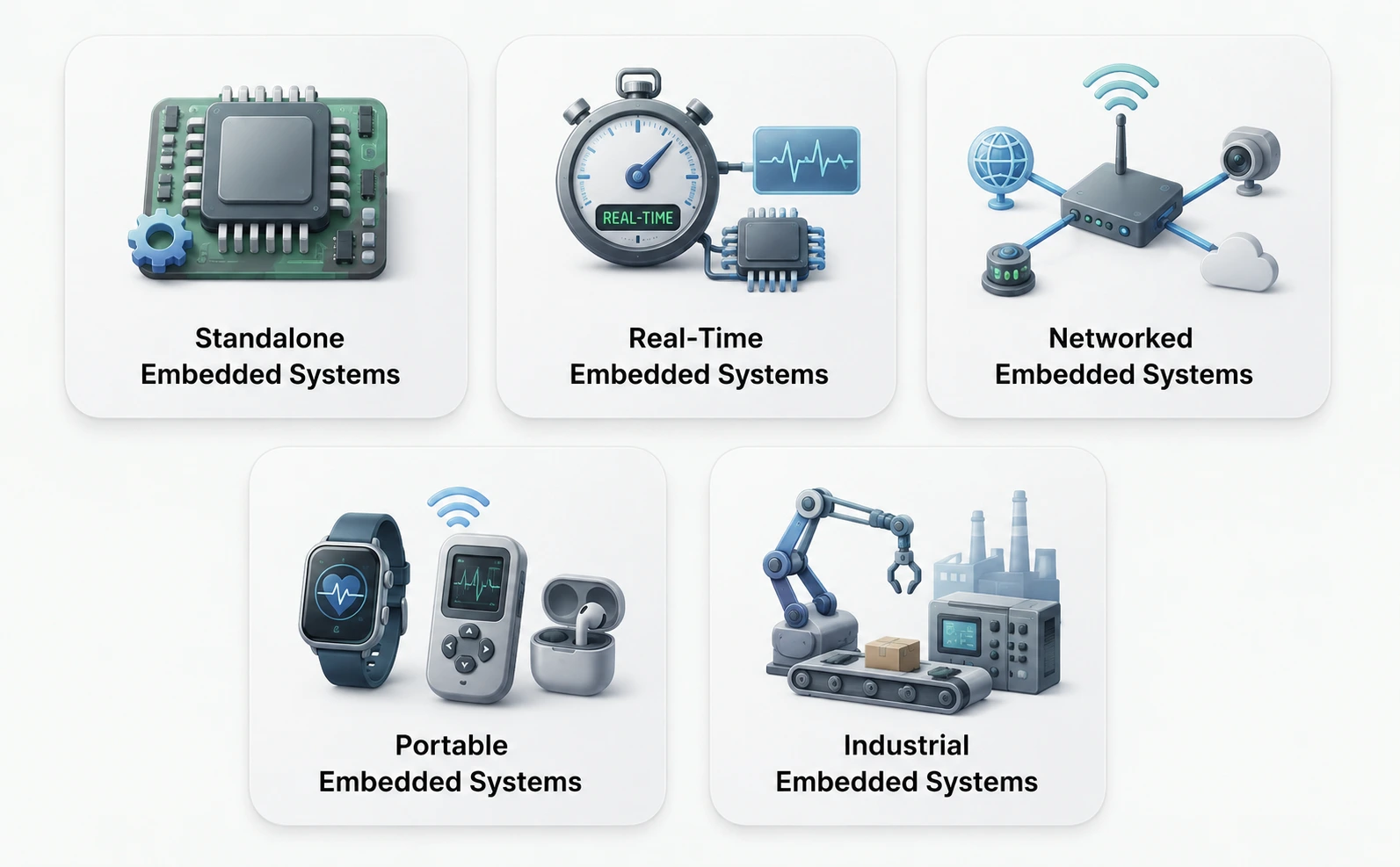
Embedded systems can be classified by their complexity, response requirements, and operating environment.
1. Standalone Embedded Systems
Standalone systems perform specific functions without depending on a continuous connection to another computer or network. Examples include digital weighing scales, basic electronic controllers, and certain household appliances. These systems are useful when a product needs predictable operation, simple controls, and minimal connectivity.
2. Real-Time Embedded Systems
Real-time systems must respond to inputs within defined time limits. Missing a deadline may affect product performance or safety, depending on the application. Examples include industrial motion controllers, automotive control systems, and specialised medical equipment. Hard real-time applications have deadlines that must not be missed, while soft real-time systems can tolerate occasional delays with degraded performance.
3. Networked Embedded Systems
Networked devices communicate with other systems through wired or wireless connections. Examples include connected industrial sensors, smart building controllers, and remote monitoring devices.
These products may exchange information with mobile applications, enterprise platforms, gateways, or cloud services. Network connectivity introduces additional requirements for authentication, secure communication, device identity, and remote maintenance.
4. Mobile and Portable Embedded Systems
Portable embedded devices are designed around constraints such as battery life, size, weight, and thermal performance. Examples include wearable devices, portable diagnostic equipment, tracking devices, and handheld measurement instruments. In these applications, engineers must balance functionality with power consumption and the physical limitations of the device.
5. Industrial Embedded Systems
Industrial systems support manufacturing, process automation, energy management, logistics, and equipment monitoring. They may need to operate continuously in environments exposed to vibration, temperature changes, electrical interference, or restricted network access. For an entrepreneur building connected industrial products, reliability, serviceability, and integration with existing operational technology are particularly important.
Read Also: IoT in Manufacturing: Benefits, Examples, and Challenges
Embedded System Software Architecture
Embedded architecture defines how software components communicate with hardware, process inputs, manage resources, and deliver device functionality. A well-designed architecture makes the product easier to test, maintain, and extend. A poorly planned architecture can increase debugging time, complicate hardware replacement, and make future feature development more expensive.
Hardware Abstraction Layer
The hardware abstraction layer provides a consistent interface between higher-level software and the underlying hardware. It reduces the need for application components to interact directly with low-level registers and hardware-specific implementation details. This separation can simplify maintenance when compatible hardware components change.
Device Drivers
Device drivers allow software to communicate with peripherals such as sensors, displays, communication modules, storage devices, and motor controllers. Driver quality affects device compatibility, performance, and reliability. Hardware documentation and interface specifications are essential for implementing and validating these components.
Operating System or Scheduler
Simple devices may use a superloop architecture, in which tasks execute repeatedly in a defined sequence. More complex products may use an RTOS to schedule concurrent tasks and manage communication, synchronisation, and timing. Embedded Linux may be appropriate when the product needs advanced networking, filesystems, user interfaces, or application frameworks.
Application Logic
The application layer implements the product’s intended behaviour. It processes inputs, applies control rules, manages device states, and communicates with external systems. For example, a connected energy monitor may calculate consumption, detect abnormal readings, store measurements, and transmit data to a monitoring platform.
Connectivity and Cloud Integration
Connected products may require communication protocols, device provisioning, secure APIs, and integration with cloud infrastructure. Cloud services can support device management, analytics, fleet monitoring, and remote configuration. However, safety-critical or time-sensitive functions should not depend on cloud connectivity when local execution is required.
When planning these capabilities, cloud app development approach becomes an important consideration, as it helps businesses understand how cloud-based applications can connect devices, process data, and support scalable digital products.
The Embedded Software Development Process
A structured embedded software development process helps businesses identify technical risks before they become expensive manufacturing or deployment problems. The exact workflow depends on product complexity, industry regulations, and hardware availability.
Define Business Goals and Product Requirements
Begin by identifying the problem the product needs to solve and the outcomes the business expects to achieve. Document the intended users, operating environment, required functions, expected production volume, connectivity requirements, and performance targets.
Technical requirements should also define memory limits, power consumption, response times, supported interfaces, security expectations, and recovery behaviour. For example, a battery-powered asset tracker may prioritise low-power operation and reliable wireless communication. An industrial controller may place greater emphasis on deterministic response times and fault handling. Clear requirements create a shared understanding between business stakeholders, hardware engineers, and software developers.
Select the Hardware Platform
Hardware selection affects software architecture, performance, power requirements, peripheral support, and product cost. The team should evaluate whether the product needs a microcontroller, microprocessor, system-on-module, or single-board computer. The decision depends on computational complexity, peripheral requirements, operating system support, and expected production scale.
Entrepreneurs should also consider component lifecycle, supplier reliability, development-board availability, and the consequences of hardware shortages. Selecting components solely on initial purchase price can create long-term costs if the platform lacks sufficient processing capacity or becomes difficult to source.
Design the Software Architecture
After the hardware direction is established, engineers define the software modules, communication interfaces, task scheduling, memory management, and error-handling mechanisms.
Architecture decisions should address which functions run locally, which require network access, and how the system behaves when a sensor, peripheral, or communication channel fails. Modular design helps teams test components independently and reduces the risk that a change in one subsystem will affect the entire product.
Develop Firmware and Application Components
Firmware provides the low-level instructions that initialise hardware and control device behaviour. Depending on the product, development may include bootloaders, peripheral drivers, communication stacks, control algorithms, diagnostics, and application logic.
Engineers often work with C or C++ for performance-sensitive components. Rust may also be appropriate for some projects, depending on hardware support, tooling maturity, and team expertise. Code should be reviewed against agreed coding standards, memory constraints, error-handling requirements, and security expectations.
Integrate Hardware and Software
Once individual components are available, engineers integrate them with the target board and peripherals. Integration testing checks whether sensors produce valid readings, communication interfaces behave correctly, actuators respond as expected, and software operates within hardware constraints.
This stage often reveals issues that are not visible in isolated software tests, such as timing conflicts, electrical interface problems, driver incompatibilities, and resource contention. Early access to representative hardware can reduce delays and avoid late-stage redesign.
Test Performance, Reliability, and Security
Testing should cover normal operating conditions, edge cases, invalid inputs, resource exhaustion, power interruptions, and communication failures. Depending on the product, teams may perform unit testing, integration testing, hardware-in-the-loop testing, stress testing, environmental testing, and fault-injection testing.
Security validation should assess authentication, access controls, secure boot where supported, cryptographic key management, update integrity, and communication security. The cloud application security guide provides additional context on securing connected application environments and protecting data throughout its lifecycle.
Deploy, Monitor, and Maintain
Deployment may involve manufacturing-line programming, device configuration, installation, provisioning, and operational validation. After launch, businesses need a plan for defect investigation, firmware updates, security patches, component obsolescence, and technical support.
Connected devices may support over-the-air updates, but the update process must include integrity verification, failure recovery, compatibility checks, and protection against unauthorised installation. The development lifecycle continues after launch because the device may remain in service for years.
Essential Embedded Software Development Tools
The right tooling helps engineering teams write, compile, debug, test, and maintain software for hardware-constrained environments. The choice depends on the processor architecture, operating system, programming language, communication interfaces, and testing requirements.
Integrated Development Environments and Toolchains
Integrated development environments (IDEs) provide tools for editing code, managing projects, compiling software, and debugging applications. Common options include Visual Studio Code with suitable extensions, vendor-specific IDEs, and specialised embedded development environments. The compiler and toolchain must support the target processor and required language standards.
When evaluating embedded software development tools, businesses should check hardware compatibility, debugging support, documentation, licensing, and the maturity of the surrounding ecosystem.
Compilers and Build Systems
Compilers translate source code into executable instructions for the target processor. Cross-compilation is common because engineers frequently build software on a desktop or workstation for execution on a different hardware architecture.
Build systems help manage dependencies, compiler settings, generated files, and reproducible releases. For production devices, controlled build configurations and version tracking are important for troubleshooting field issues and reproducing previously released firmware.
Debuggers and Hardware Debugging Interfaces
Debugging tools help engineers inspect execution, examine memory, set breakpoints, and investigate faults. Depending on the platform, teams may use hardware debugging interfaces such as JTAG or SWD, along with logic analysers, oscilloscopes, and serial consoles. These tools are particularly valuable when software interacts directly with peripherals or exhibits timing-dependent problems.
Version Control and Continuous Integration
Version control systems help teams manage code changes, review contributions, and maintain release history. Continuous integration pipelines can automatically compile firmware, run tests, and detect build failures. Not every embedded project can fully automate hardware testing, but a repeatable build and test process improves consistency and reduces avoidable integration problems.
Commonly Used Embedded Development Tools
| Tool or Platform | Primary Purpose | Suitable Use Cases |
| GCC and compatible cross-compilers | Compile source code for supported target architectures | Embedded C/C++ development |
| CMake | Configure and manage software builds | Cross-platform embedded projects |
| PlatformIO | Manage embedded projects, libraries, and supported development boards | Prototyping and supported microcontroller platforms |
| STM32CubeIDE | Develop, compile, and debug supported STM32 applications | STM32-based products |
| ESP-IDF | Develop applications for supported ESP32 devices | Connected and wireless embedded products |
| Zephyr RTOS | Build applications for supported embedded hardware | Resource-constrained connected devices |
| FreeRTOS | Provide real-time scheduling and related services | Microcontroller-based real-time applications |
| GDB | Debug supported target applications | Source-level debugging |
| Git | Track source code and collaborate on changes | Version control and release management |
Tool availability, licensing, and hardware support can change, so teams should confirm current compatibility before committing to a development stack.
Programming Languages Used in Embedded Development
Programming language selection influences performance, memory usage, development speed, maintainability, and access to hardware-specific features. There is no single language that suits every embedded product. The decision should reflect the processor, runtime environment, safety requirements, available libraries, and engineering team’s experience.
1. C
C is widely used in embedded development because it provides low-level memory access, predictable execution characteristics, and broad support across microcontrollers and toolchains. It is frequently used for device drivers, peripheral interfaces, bootloaders, and firmware that must operate within tight resource constraints. However, manual memory management and pointer operations require careful coding and testing to reduce the risk of memory corruption and related defects.
2. C++
C++ offers abstraction mechanisms, object-oriented programming, templates, and reusable components while retaining support for low-level development. It can be useful for complex embedded products that need modular architecture, reusable libraries, and sophisticated application logic. Teams should establish suitable language standards and coding guidelines because certain features may introduce additional runtime, memory, or verification considerations.
3. Rust
Rust provides memory-safety features designed to prevent several categories of common programming errors. Its ownership model can help teams manage memory and concurrency more safely. It is an option for embedded applications where supported hardware, toolchains, libraries, and team expertise align with the project’s needs. Before choosing Rust, entrepreneurs should assess ecosystem maturity for the target platform and the availability of engineers who can maintain the codebase.
4. Python and MicroPython
Python is often used for test automation, manufacturing tools, prototyping, and hardware-control scripts. MicroPython can run on supported microcontrollers, making it useful for selected lightweight applications. However, interpreted execution and runtime requirements may make it unsuitable for tightly constrained devices or systems that need strict timing guarantees.
5. Assembly Language
Assembly provides direct access to processor instructions and can support highly specialised optimisation or low-level hardware operations. It is generally reserved for situations where instruction-level control is necessary, rather than being used as the primary language for an entire product. For most businesses, the goal should be to select a maintainable language and use lower-level optimisation only where measured requirements justify it.
Embedded Operating Systems: Bare Metal, RTOS, and Embedded Linux
The operating environment determines how software schedules tasks, manages memory, handles interrupts, and communicates with hardware. Choosing an unnecessarily complex operating system can increase development and maintenance costs. Selecting an overly limited environment can make future features difficult to implement.
Bare-Metal Development
Bare-metal software runs directly on the hardware without a general-purpose operating system. A simple main loop and interrupt handlers may be sufficient for devices with a small number of well-defined tasks.
Potential benefits include low overhead, a small runtime footprint, and direct control over execution. The trade-off is that developers must manage task coordination, timing, and shared resources carefully as system complexity increases.
Real-Time Operating Systems
An RTOS provides scheduling and synchronisation facilities for tasks that must meet defined timing requirements. It can help engineers organise concurrent activities such as sensor acquisition, control processing, communications, and diagnostics.
RTOS selection should consider scheduling behaviour, interrupt latency, memory requirements, supported hardware, licensing, and the project’s verification needs. Using an RTOS does not automatically guarantee that a product is real-time capable. Engineers must analyse worst-case execution times, task priorities, interrupt behaviour, and system-level timing constraints.
Embedded Linux
Embedded Linux is suited to products requiring advanced networking, storage, graphical interfaces, application frameworks, or extensive software integration. Examples include industrial gateways, smart displays, connected kiosks, and certain edge-computing devices.
It generally requires more memory and processing resources than a simple microcontroller application. Businesses should also plan for operating system updates, security maintenance, boot performance, and long-term software support.
How to Choose the Right Environment
| Requirement | Potentially suitable approach |
| Simple, low-power control function | Bare metal |
| Multiple tasks with defined timing requirements | RTOS |
| Advanced networking and application frameworks | Embedded Linux |
| Complex local processing and a graphical interface | Embedded Linux or another capable platform |
| Very limited memory and processing capacity | Bare metal or a lightweight RTOS |
These are starting points rather than universal rules. The final decision should be based on measured requirements, hardware capabilities, and product risk.
Embedded Software Applications Across Industries
Embedded technology supports a wide range of industries. Its business value depends on how effectively software translates hardware capabilities into useful, dependable product functionality.
Manufacturing and Industrial Automation
Embedded controllers regulate machinery, collect sensor measurements, coordinate production equipment, and monitor operational conditions. When connected to industrial networks, these systems can help businesses identify equipment abnormalities, improve visibility into production, and support predictive maintenance initiatives.
Integration with existing machinery requires attention to communication protocols, operational technology security, and downtime constraints.
Automotive and Transportation
Automotive embedded systems support functions such as engine management, driver assistance, braking, infotainment, and vehicle diagnostics. Different functions have different safety and performance requirements. Engineers must account for hardware constraints, real-time behaviour, fault handling, and applicable automotive standards.
Connected vehicles may also use embedded software to exchange diagnostic information and support remote service capabilities.
Healthcare and Medical Devices
Medical devices may use embedded software to collect measurements, regulate device functions, display information, or communicate with clinical systems. Examples include monitoring equipment, diagnostic instruments, and selected wearable devices.
Healthcare projects require careful consideration of patient safety, data protection, validation, usability, and applicable regulatory requirements. The required controls depend on the intended purpose and classification of the device.
For businesses maintaining established healthcare platforms, the legacy healthcare app modernization cost article offers additional context on evaluating the financial implications of modernising older healthcare software.
Smart Homes and Building Automation
Smart thermostats, access-control systems, connected lighting, and environmental sensors use embedded software to monitor conditions and automate actions. These devices may communicate with home hubs, mobile applications, or cloud platforms. Reliable local operation remains important when internet access is unavailable.
Read Also: IoT Smart Home App Development: Everything You Need To Know
Agriculture and Environmental Monitoring
Embedded systems can monitor soil conditions, temperature, humidity, water levels, and equipment performance. Connected sensors can help farmers make informed irrigation decisions and monitor conditions across distributed locations. Devices deployed outdoors must be designed for environmental exposure, power limitations, connectivity gaps, and practical maintenance.
Smart Cities and Infrastructure
Embedded controllers and connected sensors can support traffic monitoring, street lighting, energy management, and infrastructure monitoring, making IoT in smart cities an important part of modern urban infrastructure. These deployments often involve large fleets of devices and require coordinated device provisioning, network management, security updates, and data integration.
Embedded Systems and the Internet of Things
The Internet of Things (IoT) connects physical devices so they can exchange information with other systems. Embedded software frequently provides the local intelligence that makes these devices useful.
An IoT product may include sensors, a microcontroller, a connectivity module, firmware, a mobile application, and a cloud service. Each component has a different responsibility. The embedded device collects data and performs time-sensitive actions. The network transports information. The cloud platform may store and analyse data, manage device fleets, and coordinate remote operations. The application provides users with controls, insights, and notifications.
Edge Computing and Local Intelligence
Not every device needs to send all its data to the cloud. Edge computing allows selected processing to take place close to the data source. This can reduce communication delays, lower bandwidth consumption, and support operation when connectivity is intermittent.
For example, an industrial sensor may detect a threshold violation locally and trigger an immediate response while sending summaries to a remote monitoring platform.
Integration With Mobile Applications and Dashboards
A mobile application can act as the user-facing layer of an embedded product. It may support device pairing, configuration, live monitoring, notifications, and firmware update management. Businesses can also use custom dashboard development to provide operators with a consolidated view of device health, sensor readings, system alerts, and performance metrics.
However, the application should not become a single point of failure for functions that must operate independently. Critical control behaviour should remain on the device or another appropriately engineered local controller. Entrepreneurs building connected products should plan the embedded and application layers together so that device capabilities, communication protocols, and user workflows remain consistent.
Embedded Software Development Cost in 2027
The cost of building an embedded product depends on its technical complexity, hardware requirements, software architecture, testing scope, and expected production environment. A simple sensor-based prototype and a safety-critical industrial controller require very different levels of engineering effort.
Entrepreneurs should estimate the cost of the complete product lifecycle rather than budgeting for firmware development alone. Understanding the custom software development cost also helps businesses account for application development, system integration, testing, maintenance, and future upgrades when planning their overall product budget.
Key Factors That Influence Development Cost
- Hardware complexity: Custom circuit boards, specialised processors, sensor integration, and custom electronics can increase engineering and prototyping expenses.
- Software requirements: Basic device control generally requires less effort than products involving real-time scheduling, complex communication protocols, advanced algorithms, or multiple operating environments.
- Connectivity and integration: Connecting devices to mobile applications, cloud services, enterprise systems, or industrial equipment introduces additional development and testing requirements.
- Security and compliance: Secure boot, encrypted communication, update mechanisms, safety analysis, and industry-specific verification can increase project scope.
- Testing and certification: Hardware-in-the-loop testing, environmental testing, reliability assessments, and applicable regulatory processes contribute to the overall budget.
- Maintenance and support: Firmware updates, vulnerability remediation, component replacements, and long-term technical support create ongoing costs after launch.
Embedded Software Development Cost Breakdown
The following estimated costs provide a general budgeting reference for embedded software projects in 2027. Actual costs vary depending on hardware complexity, project scope, engineering rates, testing requirements, and regulatory obligations.
| Cost component | What the budget covers | Estimated cost (USD) |
| Requirements and feasibility | Product specifications, technical research, and risk assessment | $2,000–$10,000 |
| Hardware design and prototyping | Component selection, PCB design where required, and prototype boards | $5,000–$30,000 |
| Firmware development | Device drivers, control logic, communication, and hardware interfaces | $10,000–$60,000 |
| Application and cloud integration | Mobile interfaces, APIs, device management, and data processing where needed | $5,000–$40,000 |
| Testing and validation | Functional, performance, reliability, and security testing | $3,000–$20,000 |
| Deployment and production readiness | Manufacturing integration, device provisioning, and release preparation | $2,000–$15,000 |
| Maintenance and updates | Bug fixes, security patches, compatibility changes, and technical support | $1,000–$5,000+ per month |
Note: These are indicative planning estimates, not verified market quotations. Costs are in USD and may overlap depending on project scope. Hardware manufacturing at scale, certification, specialised safety testing, and component procurement may require separate budgets. The total should be calculated from project-specific requirements rather than by simply adding every range.
Cloud-connected embedded products may also incur ongoing infrastructure expenses. Businesses can evaluate these through the cloud cost optimization guide, which discusses approaches to monitoring and controlling cloud expenditure.
Common Challenges in Embedded Software Development
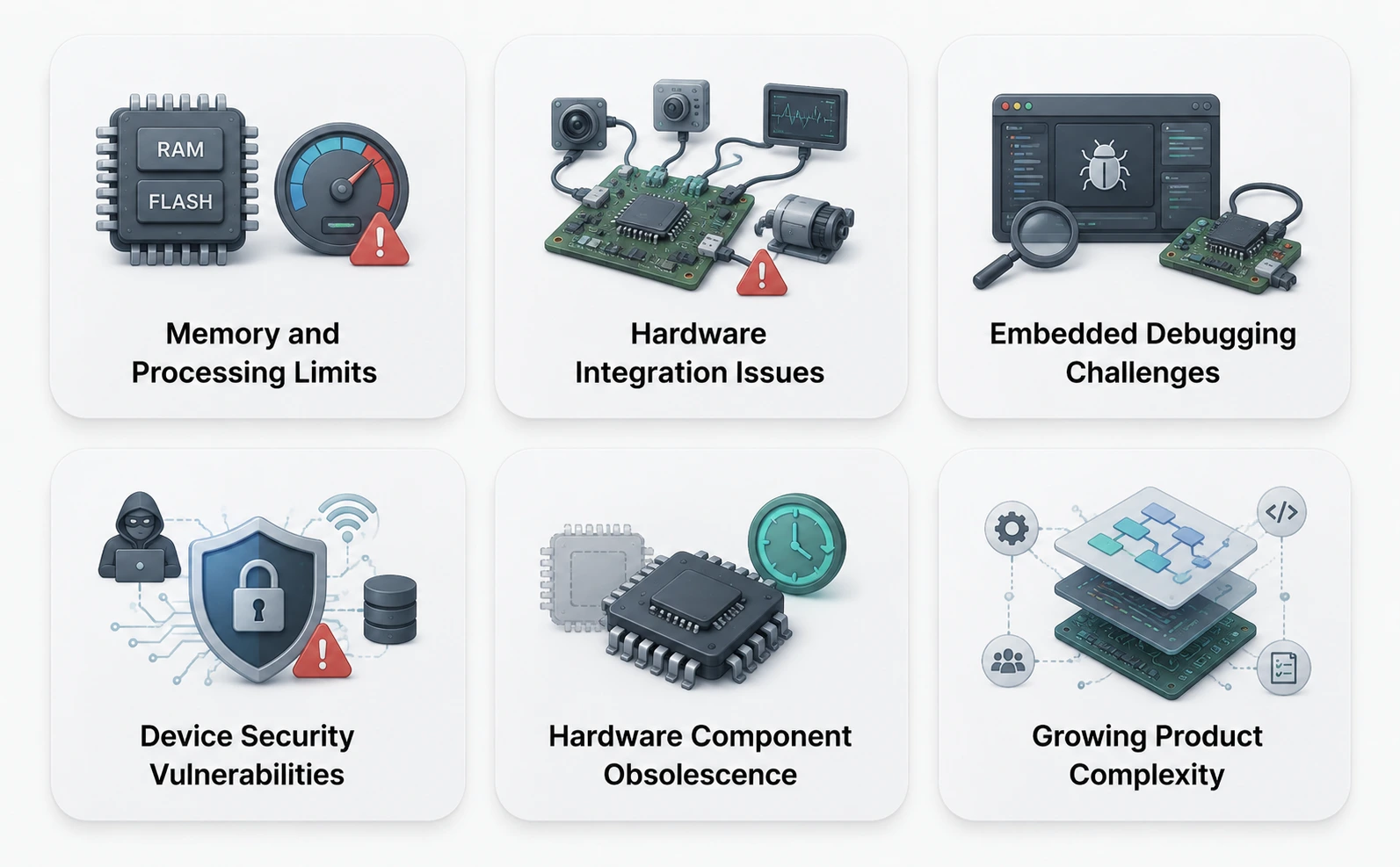
Embedded projects involve constraints that may not appear in conventional application development. Recognising these challenges early helps entrepreneurs plan realistic timelines and avoid expensive late-stage changes.
1. Limited Memory and Processing Capacity
Microcontrollers often have strict limits on RAM, flash storage, and processing performance. Developers must manage resources carefully and evaluate the impact of additional features.
How to address it: Establish resource budgets during architecture design, measure actual usage, and profile performance on representative hardware.
2. Hardware and Software Integration Issues
A driver may work in isolation but fail when combined with other components because of timing conflicts, electrical characteristics, or incorrect interface assumptions.
How to address it: Validate hardware interfaces early, use representative development boards, and integrate components incrementally.
3. Difficult Debugging Conditions
Some faults occur only under particular timing conditions, temperatures, workloads, or power states. These issues can be difficult to reproduce with software-only testing.
How to address it: Use hardware debugging tools, diagnostic logs, repeatable test procedures, and automated regression tests wherever practical.
4. Security Vulnerabilities
Connected devices can remain deployed for years, making outdated dependencies and unpatched firmware long-term risks.
How to address it: Build a threat model, minimise exposed interfaces, protect device credentials, and establish a reliable update and vulnerability-response process. For cloud-connected products, follow a structured approach to cloud migration and data security to protect data flows between devices and backend systems.
5. Component Obsolescence
Hardware suppliers may discontinue components or change availability during a product’s lifetime.
How to address it: Assess component lifecycle commitments, identify potential alternatives, and design interfaces that make supported hardware substitutions easier where feasible.
6. Increasing Product Complexity
New features can introduce dependencies across firmware, hardware, mobile applications, and cloud services. Without clear ownership, changes become harder to test and maintain.
How to address it: Use modular architecture, documented interfaces, version control, and a controlled change-management process.

Cloud Deployment Models and Embedded Products
Connected embedded devices may rely on cloud infrastructure to store telemetry, coordinate device fleets, deliver analytics, and support remote configuration. Selecting the right deployment architecture can influence data governance, operating costs, availability, and security.
Businesses should assess whether a public, private, or hybrid environment best matches their requirements. The cloud deployment models guide explains the differences and considerations involved in selecting an appropriate model.
Platform selection also matters when the product depends on managed cloud services, analytics, storage, and device-management capabilities. Entrepreneurs can compare AWS vs Azure vs Google Cloud to understand how the major providers differ in their offerings and suitability for business workloads. The final choice should account for security requirements, existing infrastructure, operational expertise, availability needs, and the expected volume of connected devices.
Improving Performance and Modernising Existing Systems
Embedded products are often expected to remain operational for many years. Over time, their supporting applications, cloud services, and management platforms may become difficult to maintain or unable to meet changing requirements. A structured application modernization strategy can help businesses evaluate which components should be retained, refactored, replatformed, or replaced.
Performance also requires attention across the complete product ecosystem. Cloud-connected devices may generate large volumes of telemetry, making efficient data processing, streamlined data flows, and backend performance improvements essential for maintaining responsiveness and delivering a reliable user experience. Modernisation should be based on measurable business and technical needs rather than adopting new technology simply because it is available.
How to Choose an Embedded Software Development Company
Selecting a development partner is an important decision because embedded products combine software, hardware, operational constraints, and long-term maintenance obligations.
Entrepreneurs should evaluate a provider based on demonstrated technical capability, relevant experience, engineering processes, and the ability to support the product beyond its initial release.
Assess Relevant Technical Experience
Ask whether the team has worked with the required microcontrollers, processors, RTOS platforms, communication protocols, and development tools.
Experience with a similar application is useful, particularly when the project has strict timing, power, reliability, or security requirements.
Evaluate the Development and Testing Process
A capable partner should be able to explain how it manages requirements, architecture, code reviews, integration, debugging, and release validation.
Ask how defects are documented, how builds are reproduced, and what evidence is provided to demonstrate that the software meets agreed requirements.
Review Security and Maintenance Capabilities
Check whether the team can implement secure update mechanisms, manage dependencies, investigate vulnerabilities, and support devices after deployment.
For products expected to operate for many years, confirm how maintenance responsibilities and support commitments will be handled.
Clarify Deliverables and Ownership
The contract should specify source-code ownership, repository access, technical documentation, build instructions, testing records, third-party licences, and responsibility for production deployment. It should also clarify the cloud deployment models supported by the product to ensure the chosen environment aligns with business requirements.
This reduces the risk of becoming dependent on a provider that cannot transfer the product to another team.
Consider the Complete Product Ecosystem
An embedded device may need a companion mobile application, cloud backend, analytics dashboard, or enterprise integration.
Working with a team that understands the broader product architecture can improve coordination between these layers. However, specialist hardware engineering or certification may still require dedicated partners.
The Role of Product Discovery in Embedded Development
Product discovery helps businesses validate what they need to build before investing heavily in implementation. This is particularly valuable for embedded projects because hardware decisions can be expensive to reverse. A feature that appears simple in a product concept may require a different sensor, additional processing capacity, more power, or a new communication interface.
A structured discovery phase should establish the product’s intended use, essential features, operating conditions, technical constraints, and measurable acceptance criteria. The team can then identify the riskiest assumptions and test them through technical prototypes or feasibility experiments.
For example, a startup developing a connected agricultural sensor may need to validate wireless coverage, battery life, environmental resistance, and measurement accuracy before committing to a production design. Businesses can use software product discovery workshops to establish priorities, validate assumptions, and clarify the technical scope before development begins.
Embedded Software Development Trends to Watch in 2027
Several technology trends are influencing how businesses design, deploy, and maintain connected products. Their relevance depends on the product’s requirements rather than their popularity alone.
1. Edge AI and On-Device Intelligence
Edge AI allows supported devices to run selected machine-learning models locally. Potential applications include anomaly detection, image classification, predictive maintenance, and sensor-data interpretation.
Local inference can reduce dependence on network connectivity and limit the need to transmit raw data. However, model size, processor capability, memory, power consumption, and update management must be evaluated. Not every embedded product needs AI. Conventional rules-based control may remain more appropriate when requirements are simple, predictable, and easy to validate.
2. More Connected and Interoperable Devices
Businesses increasingly expect connected products to integrate with mobile applications, enterprise platforms, and other devices. This increases the importance of documented interfaces, compatible communication protocols, device identity, and lifecycle management.
Interoperability should be considered early because changing a communication architecture after deployment can affect firmware, applications, infrastructure, and customer workflows. For businesses working with older systems, legacy application modernization can help improve compatibility with modern technologies and simplify integration with connected devices and digital platforms.
3. Security Throughout the Device Lifecycle
Security is increasingly treated as an ongoing engineering responsibility rather than a final testing stage. Device manufacturers need processes for secure provisioning, software updates, vulnerability handling, component tracking, and support planning. The specific obligations depend on the market, industry, and applicable regulations, so businesses should validate requirements before finalising their product architecture.
4. Energy-Efficient Computing
Battery-powered and remotely deployed devices benefit from efficient processor use, low-power communication, and appropriate sleep-state management. Engineers can profile energy consumption under realistic workloads to identify which activities contribute most to battery drain. Energy efficiency should be measured at the system level because a more powerful processor may complete a task faster but consume more energy overall, depending on the workload and implementation.
5. Digital Twins and Predictive Maintenance
Digital twins and operational models can combine device telemetry with system information to help businesses understand equipment behaviour. When supported by reliable data, these approaches may improve maintenance planning, anomaly investigation, and performance optimisation. Their usefulness depends on data quality, integration effort, and whether the resulting insights lead to actionable operational improvements.
Conclusion
Embedded technology gives businesses a way to turn physical products into intelligent, connected, and increasingly automated solutions. However, successful implementation depends on more than writing firmware. It requires thoughtful hardware selection, a suitable software architecture, rigorous testing, secure connectivity, and a realistic maintenance strategy.
Entrepreneurs should begin by validating the product’s requirements and technical feasibility, then select development tools and engineering partners based on the constraints of the intended application. Planning for security, component availability, and long-term support from the beginning can help reduce operational risk.
Businesses with ageing applications or connected-product platforms should also assess whether modernisation can improve maintainability, compatibility, and scalability. RipenApps offers software product modernization services to help businesses evaluate and improve existing software systems in line with evolving product and operational needs.

FAQs
Q1. What is embedded software used for?
Embedded software controls the functions of specialised electronic devices, including industrial controllers, smart appliances, vehicles, medical equipment, and connected sensors. It enables hardware to process inputs, execute instructions, communicate with other systems, and respond to operating conditions.
Q2. What programming languages are used for embedded development?
C and C++ are widely used because they support low-level hardware access and efficient execution. Rust is another option for suitable platforms. Python and MicroPython are used in selected prototyping, automation, and embedded applications, while assembly is generally reserved for specialised low-level tasks.
Q3. What are the main embedded software development tools?
Common tools include cross-compilers, IDEs, debuggers, version-control systems, build systems, static-analysis tools, and automated testing frameworks. Examples include GCC, CMake, Git, GDB, PlatformIO, and platform-specific development environments. The appropriate combination depends on the target hardware and software architecture.
Q4. How long does embedded software development take?
The timeline depends on product complexity, hardware readiness, integration requirements, testing scope, and regulatory obligations. A small prototype may require substantially less time than a production-ready connected device with custom hardware, security requirements, and extensive validation. A detailed estimate should follow requirements and feasibility assessment.
Q5. What is the difference between embedded software and firmware?
Firmware is a common type of embedded software that provides low-level control and supports hardware operation. The terms overlap, but embedded software can also include higher-level applications running on embedded operating systems. The distinction depends on the product architecture and how the development team defines its software components.
Q6. Is embedded software development suitable for startups?
Yes. Startups can use embedded technology to build connected devices, automation products, monitoring systems, and specialised hardware solutions. They should validate the technical feasibility, target users, production costs, and support requirements before investing in a full product build.
Q7. How can businesses reduce embedded software development costs?
Businesses can control costs by defining requirements early, validating hardware assumptions, prioritising essential features, selecting suitable components, and testing continuously. Planning for security updates and hardware availability can also reduce long-term maintenance expenses.
Q8. What is the role of an embedded software development company?
An embedded software development company may help with requirements engineering, architecture, firmware development, device integration, testing, debugging, and maintenance. The exact scope varies, so businesses should verify hardware expertise, testing capabilities, deliverables, and lifecycle support before selecting a provider.
Discuss your project and request for proposal
SHARE
WRITTEN BY

Prankur Haldiya
Chief Technical Officer
A tech innovator and engineering leader, Prankur Haldiya drives RipenApps’ product development strategy and oversees cutting-edge solutions in mobility, AI, and cloud ecosystems. He is passionate about building high-performance teams and helping brands launch secure, scalable, and user-centric digital products.
View All Articles