

Quick Summary
Software development outsourcing helps growing businesses access skilled developers, manage costs, and accelerate product delivery without expanding their in-house teams for every project. From choosing the right engagement model to managing security, communication, and quality, a strategic approach helps businesses scale technology with confidence. Discover the key benefits, potential risks, and best practices for choosing the right outsourcing partner.
Growth brings new opportunities, but it also puts pressure on your technology, teams, and budget. As customer expectations rise and competitors introduce new digital experiences, businesses need to build better software, launch features faster, and keep existing systems running smoothly. However, hiring developers for every new requirement can be expensive, time-consuming, and difficult to sustain as business priorities change.
Imagine having a promising product idea but lacking the developers to bring it to market. Your internal team might already be managing daily operations, maintaining existing applications, and resolving technical issues. Recruiting additional specialists takes time, while delaying development could mean missing valuable market opportunities. Growing businesses need a way to access the right expertise without letting resource limitations slow their progress.
This is where outsourcing becomes a strategic option. Instead of building a large in-house engineering team, businesses can collaborate with external specialists for specific projects, technical skills, or ongoing product development. The right partnership offers flexibility, helps fill skill gaps, and allows internal teams to focus on core business priorities. However, success depends on selecting a suitable engagement model, setting clear expectations, and maintaining visibility into project progress, quality, and costs.
Partnering with a custom software development company can help growing businesses turn their requirements into scalable digital solutions while accessing the technical expertise needed at each stage. In this guide, we’ll explore why software development outsourcing is a smart move, the key benefits and potential challenges, the engagement models available, and the practical steps to choose a reliable partner for long-term business growth.
Table of Contents
What Is Software Development Outsourcing?
Software development outsourcing is the practice of hiring an external company or team to handle some or all of your software development activities. These activities can include product planning, UI/UX design, web and mobile app development, quality assurance, cloud integration, maintenance, and ongoing technical support.
Instead of recruiting every specialist internally, a business works with an external partner that provides the skills and resources needed for a particular project. The engagement might cover an entire product, a specific development phase, or additional engineers who work alongside the internal team.
For example, a growing retail business might outsource the development of its mobile shopping app while its internal team manages sales, marketing, and customer relationships. This arrangement allows the business to access technical expertise without building a complete engineering department from scratch.
Businesses exploring custom software development can use this approach to plan a solution around their workflows, customer needs, and growth objectives while choosing how much development work to manage internally.
Why Growing Businesses Are Turning to Outsourcing?
As businesses grow, their technology requirements often become more complex. They might need to launch a new digital product, integrate existing systems, modernise an outdated platform, or introduce features that require specialised expertise. Recruiting for every new requirement can slow progress and increase fixed operating costs.
Software development outsourcing gives businesses another way to access the capabilities they need. Rather than expanding the permanent team for every project, they can bring in external specialists for defined goals, timelines, and deliverables.
This approach is particularly useful when the business needs to move quickly but is not ready to commit to a larger internal engineering team. The key is to treat outsourcing as a strategic decision based on business objectives, rather than simply a way to reduce development expenses.
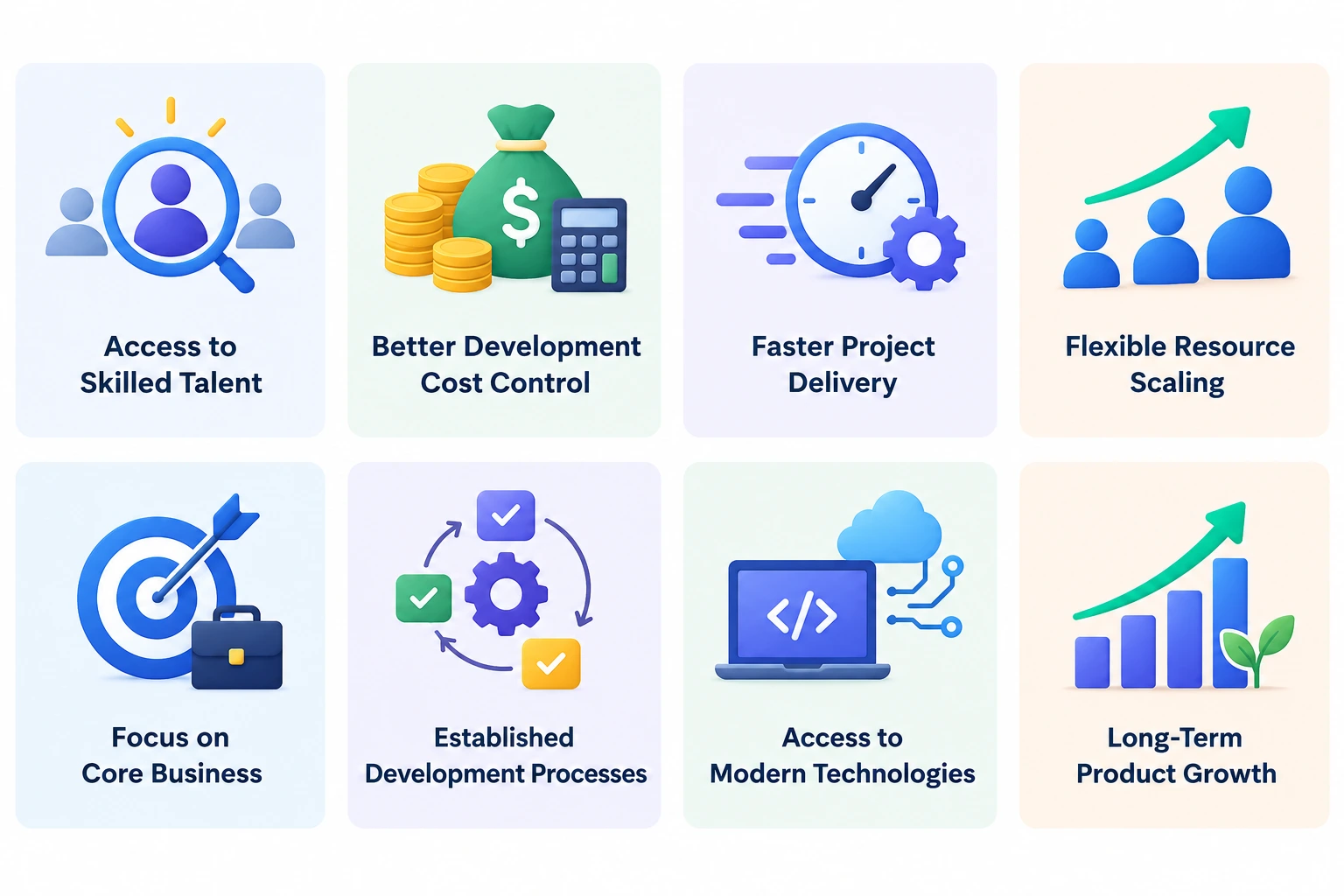
8 Key Benefits of Outsourcing Software Development
1. Access to a Wider Talent Pool
Growing businesses do not always have access to specialists in areas such as cloud architecture, cybersecurity, AI integration, DevOps, or automated testing. Hiring these professionals locally can take time, particularly when their skills are in high demand.
External development partners offer access to a broader talent pool with varied technical backgrounds and project experience. This allows businesses to find the right expertise for specific requirements without recruiting every specialist as a permanent employee.
2. Better Control Over Development Costs
Building an internal team involves more than salaries. Recruitment, onboarding, employee benefits, software licences, infrastructure, and ongoing training all contribute to the overall investment. These expenses can be difficult to justify when technical requirements fluctuate.
With software development outsourcing, businesses can select an engagement model that aligns with their scope, timeline, and available budget. They still need to account for project management, communication, and potential change requests, but they can avoid some of the fixed costs associated with maintaining a larger permanent team.
3. Faster Project Initiation and Delivery
Recruiting developers, evaluating candidates, and onboarding new employees can delay project execution. An established development partner can often assemble a suitable team more quickly because it already has recruitment processes, technical specialists, and delivery workflows in place.
This can help businesses begin development sooner and move through planning, design, implementation, and testing with fewer resource gaps. Actual delivery speed still depends on project complexity, requirements, decision-making, and the availability of the chosen team.
4. Greater Flexibility as Business Needs Change
A growing company might need a small team to validate an idea today and a larger engineering team after the product gains traction. Maintaining the same permanent headcount through every stage can create unnecessary costs or leave the business short of resources.
Outsourcing allows companies to adjust team size and expertise as priorities evolve. They can bring in additional specialists for integrations, testing, or new features and reduce external involvement when those needs are met.
5. More Focus on Core Business Activities
Business leaders need to focus on customer acquisition, revenue, operations, partnerships, and market expansion. Managing every technical task internally can divert attention from these priorities, especially when the company has a small leadership team.
Delegating defined development responsibilities allows internal employees to concentrate on their core roles while the external team handles agreed technical deliverables. Successful collaboration still requires internal product ownership, timely feedback, and clear business decisions.
6. Access to Established Development Processes
Experienced development partners often work with structured planning, code reviews, testing, documentation, and release management practices. These processes help teams identify issues early, track progress, and maintain consistency as a project grows.
Businesses should assess how a potential partner handles requirements, quality assurance, deployment, and reporting before signing an agreement. Established processes are valuable when they are transparent and adapted to the project’s needs, rather than applied without considering the business context.
7. Easier Access to Modern Technologies
New technical requirements can emerge as a business expands. An existing application might need cloud migration, improved security, API integrations, automation, or a more scalable architecture. Building every capability internally can require considerable recruitment and training.
External specialists can help businesses evaluate and implement suitable technologies without requiring permanent in-house expertise for every task. For businesses with legacy platforms, professional software product modernization services can help assess outdated components, improve architecture, and prepare existing products for future requirements.
8. Support for Long-Term Product Growth
A software product rarely remains unchanged after launch. Customer feedback, changing business priorities, new integrations, and increased usage often create a need for regular improvements.
A suitable external partner can support ongoing development, maintenance, performance optimisation, and feature expansion. This gives businesses a way to continue improving their products while deciding which technical capabilities should eventually become part of their permanent internal team.
Common Software Development Outsourcing Models
Choosing the right engagement model helps you balance flexibility, budget, and project ownership. The best option depends on whether you have a clearly defined scope, need ongoing development, or want to extend your existing team.
Project-Based Outsourcing
In this model, the external provider manages an agreed project scope, deliverables, and timeline. It works well when requirements are reasonably clear, and the business wants a defined outcome, such as a customer portal or a new mobile application.
The contract should specify deliverables, acceptance criteria, milestones, change requests, and responsibilities. If requirements change frequently, the agreement needs a clear process for reviewing the impact on time and budget.
Dedicated Development Team
A dedicated team works on your product over an extended period. Depending on the agreement, it may include developers, designers, QA engineers, project managers, and other specialists who collaborate closely with your business.
This model suits companies with ongoing development plans, evolving requirements, or a product roadmap that extends beyond a single release. You should still define reporting arrangements, decision-making responsibilities, and expectations for team continuity.
Staff Augmentation
Staff augmentation adds external specialists to your existing team. Your internal managers generally retain day-to-day direction, while the provider handles the employment and administrative arrangements for its professionals.
It is useful when your team already has technical leadership but lacks capacity or a specific skill set. Before choosing this option, confirm how external engineers will access systems, follow coding standards, and coordinate with internal employees.
Time-and-Materials Engagement
Under this model, the business pays for the time and resources used to complete agreed work. It is suitable for projects where requirements are likely to evolve as the team learns more through development and testing.
To maintain budget visibility, establish a spending limit or regular review process, prioritise tasks, and track progress against agreed milestones. The model offers flexibility, but it still needs active oversight.
Read More: Outsource Mobile App Development: Cost, Benefits & In-House vs Outsourcing
In-House Development vs. Outsourcing
Neither approach is right for every business. The choice depends on how much technical work you need, how frequently your requirements change, and whether you need permanent internal knowledge or temporary access to specialist skills.
| Factor | In-house development | Outsourced development |
| Hiring | Requires direct recruitment and onboarding | Provider supplies agreed specialists |
| Cost structure | Salaries and ongoing employment expenses | Contract-based fees and related project costs |
| Team flexibility | Changes can take time | Team size can often be adjusted by agreement |
| Direct oversight | Day-to-day management stays internal | Oversight depends on the engagement model |
| Technical knowledge | Builds within the company | Must be documented and transferred effectively |
| Best suited for | Core, continuous technical capabilities | Defined projects, specialist skills, or extra capacity |
When assessing in-house vs outsourcing software development, consider the long-term value of retaining expertise internally against the flexibility of external support. Many growing businesses choose a hybrid approach, keeping product ownership and critical technical knowledge in-house while outsourcing selected development tasks.
For startups working with limited resources, software development for startups offers further context on planning technical work around early-stage priorities and growth.
What Are the Pros and Cons of Outsourcing Software Development?
Although outsourcing offers flexibility and access to expertise, it also introduces risks that need to be managed. Understanding both sides helps you set realistic expectations before entering an agreement.
Pros
- Access to specialist skills: Bring in expertise that is difficult or expensive to hire permanently.
- Flexible resourcing: Scale external involvement based on project demands.
- Potential cost efficiency: Avoid some fixed recruitment and employment expenses.
- Faster team setup: Start with an established provider rather than building every role internally.
- More internal focus: Keep employees focused on business priorities and product direction.
Cons
- Less direct control in some models: You may have less visibility into daily work unless reporting and communication are clearly defined.
- Communication gaps: Differences in time zones, working practices, or expectations can slow decisions.
- Changing costs: Unclear requirements and scope changes can increase the final budget.
- Security and IP concerns: Sharing source code and sensitive data requires appropriate safeguards.
- Vendor dependency: Limited documentation or knowledge transfer can make switching providers difficult.
The pros and cons of outsourcing software development depend heavily on the provider, contract, and management approach. Clear ownership, documented decisions, regular reviews, and a planned handover reduce many of the common risks.
When Should a Business Outsource Software Development?
Outsourcing is most useful when it addresses a specific business constraint. Before choosing a provider, identify what is slowing your progress and determine whether an external team can solve that problem more effectively than hiring or reallocating internal resources.
Consider outsourcing when:
- You need to launch sooner: Your business has a clear opportunity but lacks the development capacity to meet its target timeline.
- You need specialised expertise: The project requires skills that your current team does not have.
- Your internal team is overloaded: Existing employees need to focus on core systems while an external team handles additional work.
- You are testing a new product idea: You want to validate the scope and feasibility before making a larger hiring commitment.
- Your existing product needs modernization: The application requires architecture upgrades, better performance, or new integrations.
- Your workload changes over time: Development demand rises during launches and falls after major releases.
Businesses considering outsourcing software development for startups should pay particular attention to product validation, the MVP scope, and the cost of ongoing maintenance. A smaller, well-defined first release often provides better learning than committing to a large feature set before customer needs are validated.
Before development begins, software product discovery workshops can help clarify business goals, prioritise features, map user journeys, and identify technical risks. This gives both parties a clearer basis for estimating effort and planning delivery.
How to Choose the Right Software Development Outsourcing Company?
The right partner should understand your business objectives, communicate clearly, and demonstrate the technical ability to deliver the agreed scope. Avoid making the decision based on the lowest quote alone.
1. Define Your Requirements and Outcomes
Document the business problem, target users, core features, expected integrations, and success measures. If you do not have detailed specifications, define the essential outcomes and work with the provider to clarify the scope before development starts.
A clear brief helps providers estimate effort more accurately and makes proposals easier to compare.
2. Review Technical Expertise and Relevant Experience
Look for projects that demonstrate experience with your required technology, industry, and level of complexity. Ask what the provider built, which challenges arose, and how the team handled them.
A portfolio should help you understand the provider’s actual contribution, rather than relying only on broad claims about experience.
3. Assess Communication and Project Management
Ask who will manage delivery, how often you will receive updates, and how blockers or changing requirements will be handled. Confirm the tools used for task tracking, documentation, meetings, and issue escalation.
If you are considering offshore outsourcing software development, pay particular attention to overlapping work hours, response expectations, and the arrangements for urgent decisions.
4. Check Quality Assurance and Security Practices
Ask how the provider tests code, reviews changes, manages environments, and handles production issues. Discuss data access, secure development practices, confidentiality, and the handling of sensitive information.
For regulated or data-intensive products, establish applicable compliance requirements before work begins.
5. Compare Proposals Beyond the Quoted Price
Review the proposed team, scope, assumptions, exclusions, timeline, payment terms, and post-launch support. An unusually low estimate may exclude testing, documentation, deployment, or maintenance.
Ask providers to explain the assumptions behind their estimates and how they will manage scope changes. This makes it easier to assess overall value rather than comparing headline prices alone.
6. Establish Ownership and Exit Terms
The agreement should clarify ownership of source code, intellectual property, project documentation, and deliverables. It should also cover confidentiality, access permissions, termination, and the process for transferring work to another team.
These arrangements help protect business continuity if the engagement ends or your needs change.
What Software Development Tasks Can You Outsource?
Businesses can outsource a complete product build or specific activities based on their internal capabilities. The goal is to fill gaps without losing control of product priorities, quality, or business direction.
Common tasks include:
- Product planning and design: Requirements analysis, prototyping, user research, and UI/UX design.
- Web and mobile development: Customer-facing applications, internal business tools, and digital platforms.
- Backend and API development: Databases, integrations, authentication, and business logic.
- Quality assurance: Manual testing, automated testing, performance testing, and regression checks.
- Cloud and DevOps: Deployment pipelines, cloud infrastructure, monitoring, and release automation.
- Maintenance and modernization: Bug fixes, security updates, performance improvements, and legacy system upgrades.
Businesses can also outsource selected parts of a larger programme while retaining architecture decisions, product management, and critical domain knowledge internally. This is particularly useful when different teams need to work together across several systems.
For complex enterprise projects, review common enterprise app development challenges early. Integration dependencies, changing requirements, and coordination across systems can affect delivery if responsibilities are not clearly defined.
How to Make Software Development Outsourcing Successful?
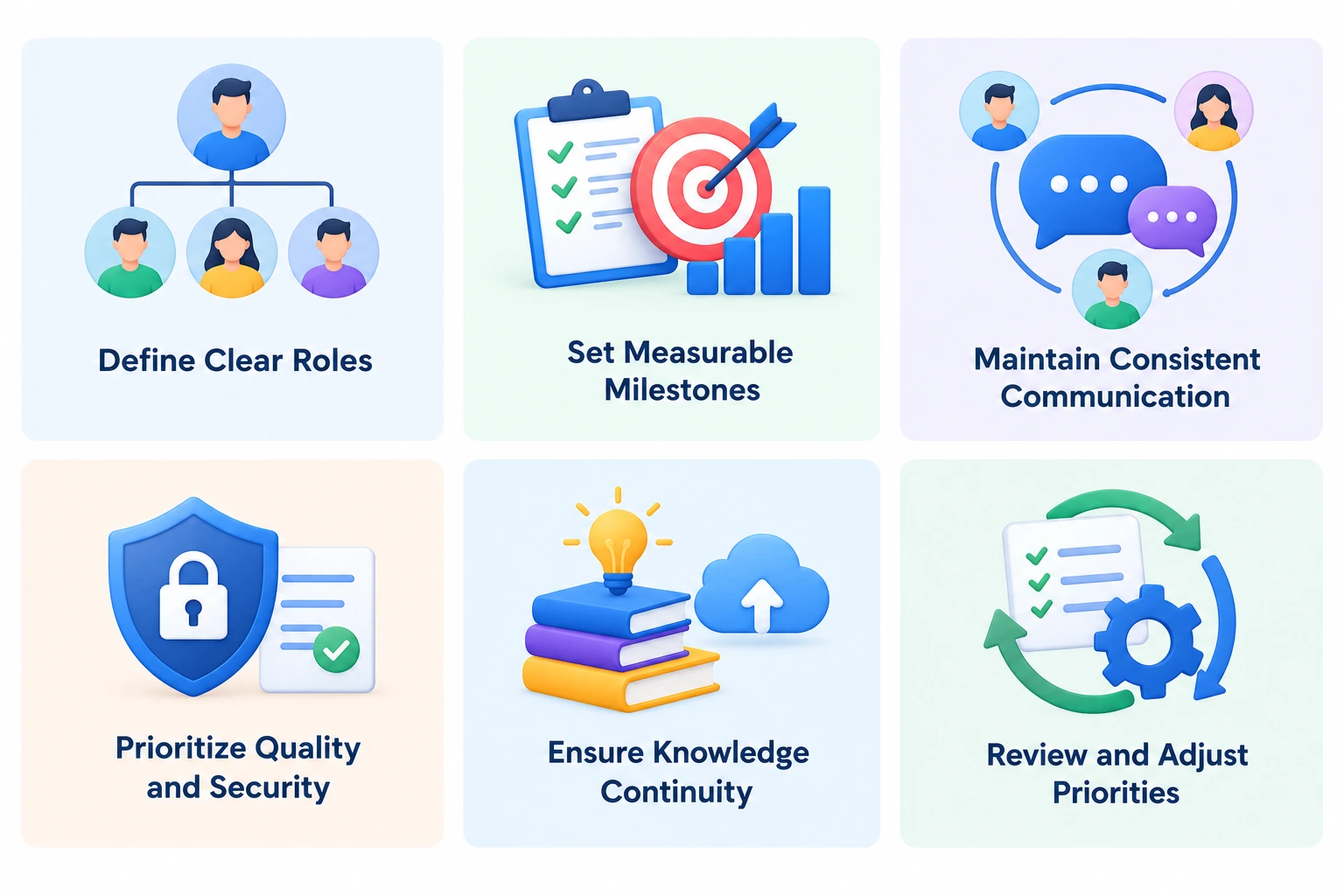
Selecting a provider is only the beginning. Strong results depend on how the engagement is planned, managed, and reviewed throughout the project.
Define Roles and Responsibilities
Assign a clear point of contact on both sides. The business should retain ownership of product priorities and key decisions, while the provider should be accountable for the agreed engineering work and delivery commitments.
Set Measurable Milestones
Break the work into manageable phases with defined deliverables, review points, and acceptance criteria. Track progress through completed functionality, testing results, unresolved issues, and release readiness rather than relying on activity reports alone.
A documented software development life cycle helps establish a shared understanding of requirements, design, development, testing, deployment, and maintenance. It also makes responsibilities and approval points easier to track.
Keep Communication Consistent
Schedule regular progress reviews and document important decisions, blockers, and changes. Use shared project management tools so internal stakeholders can see current priorities and understand what requires their input.
Plan for Quality and Security From the Start
Define coding standards, review practices, testing expectations, access controls, and release procedures before development begins. Security and quality should be part of every phase rather than checks added only before launch.
Protect Knowledge and Continuity
Maintain current technical documentation, architecture diagrams, setup instructions, and deployment procedures. Ensure your business retains the access and information needed to maintain the product if team members change or the contract ends.
Review Results and Adjust Priorities
Evaluate progress against agreed business goals, not only deadlines. Regularly review feedback, defects, performance, and upcoming requirements, so the team can adapt without allowing scope to expand without approval.
A clear software product development strategy helps connect these delivery decisions with long-term product goals, feature priorities, and future investment.
How Much Does Software Development Outsourcing Cost?
The cost of software development outsourcing depends on project complexity, required expertise, technology stack, team size, and engagement model. As a broad estimate, outsourcing software development can cost around $20–$50 per developer per hour, while rates in North America and Western Europe are often higher. A small application might cost $10,000–$30,000, while a more complex business platform can exceed $50,000–$150,000 or more. These figures are indicative estimates, not fixed quotes, and actual costs vary by scope and provider.
To manage costs effectively, define your project scope, prioritize essential features, and agree on a clear pricing structure before development begins. Compare proposals based on expertise, deliverables, quality standards, and long-term value rather than choosing a partner solely on the lowest quote. Include ongoing maintenance, testing, security, and future updates in your budget to avoid unexpected expenses.

Common Mistakes to Avoid When Outsourcing
Even a technically capable provider can struggle if the engagement begins with unclear expectations. Avoid these common mistakes to improve collaboration and reduce unnecessary rework.
- Choosing on price alone: Compare expertise, delivery approach, security, and support alongside the estimate.
- Starting without clear requirements: Agree on priorities, deliverables, and acceptance criteria before committing to a timeline.
- Expecting the provider to make every business decision: Keep product ownership and strategic direction within your organisation.
- Ignoring documentation: Require clear records of architecture, code changes, deployment, and important decisions.
- Overlooking maintenance: Plan for updates, monitoring, bug fixes, and future enhancements after launch.
- Allowing scope to expand without review: Assess how every major change affects cost, effort, and delivery dates.
- Failing to plan the handover: Ensure your team can access source code, documentation, environments, and other essential assets.
Is Software Development Outsourcing Right for Your Business?
Software development outsourcing services can be a practical choice when your business needs specialist skills, additional delivery capacity, or a faster route from planning to implementation. It is especially useful when technical requirements change over time and maintaining a large permanent team would be difficult to justify.
However, outsourcing is not automatically the best option. Products that require constant internal collaboration, deep proprietary knowledge, or immediate day-to-day technical control might benefit from a strong in-house team. A hybrid model can provide a balance by retaining core expertise internally and using external specialists for defined projects or skills gaps.
Before making a decision, assess your roadmap, internal capabilities, security requirements, budget, and desired level of control. Choose the arrangement that supports your business goals rather than outsourcing simply because it appears less expensive.
Conclusion
For growing businesses, software development outsourcing offers a flexible way to access technical expertise, manage development capacity, and build digital products without expanding the permanent team for every new requirement. Its success depends on choosing the right engagement model, defining responsibilities, and maintaining clear communication throughout the project.
Before committing, align your product roadmap with your business objectives and evaluate the expected software development cost, ongoing maintenance, and long-term ownership requirements. RipenApps helps businesses plan, build, and evolve digital products through tailored engineering expertise. A clear strategy and the right development partnership can help you move forward with greater confidence while keeping future growth in view.

FAQs
Q1. Why do US companies outsource software development?
Many US companies outsource software development to access specialised talent, add delivery capacity, and reduce the time required to recruit a complete internal team. It also allows them to work with external specialists when a project requires skills that are not available in-house.
Q2. Is software development outsourcing suitable for small businesses?
Yes. Small businesses can outsource specific tasks, such as building an MVP, developing a mobile app, or testing an existing product. Starting with a clearly defined scope helps keep the engagement manageable and aligned with available resources.
Q3. How do I choose a software development outsourcing company?
Review the provider’s relevant portfolio, technical expertise, communication practices, quality assurance process, security standards, and client feedback. Compare proposals based on scope, team composition, deliverables, and support rather than price alone.
Q4. What are the main risks of outsourcing software development?
Common risks include communication gaps, unclear requirements, unexpected expenses, security concerns, and dependence on a single provider. Clear contracts, regular progress reviews, documented code, and defined intellectual property ownership help manage these risks.
Q5. What is the difference between offshore and nearshore outsourcing?
Offshore outsourcing involves working with a provider in a more distant country, often with a larger time-zone difference. Nearshore software development outsourcing involves a provider in a nearby country or region, which can make real-time collaboration and overlapping working hours easier.
Q6. How much does software development outsourcing cost?
The cost depends on product complexity, team size, technology requirements, engagement model, and project duration. A small MVP generally requires a different investment from a feature-rich enterprise platform. Request an itemised estimate that includes development, testing, deployment, and ongoing maintenance.
Q7. How can I maintain control over an outsourced project?
Set clear deliverables, assign internal decision-makers, establish reporting schedules, and use shared project management tools. Regular demonstrations, code reviews, milestone approvals, and documentation give you visibility without requiring you to manage every daily task.
Discuss your project and request for proposal
SHARE
WRITTEN BY

Ishan Gupta
CEO & Founder
Ishan Gupta is a seasoned entrepreneur and CEO with extensive 10+ years of experience in business and mobile app development landscape. He believes that the right digital product allows companies to focus on what they do best, while technology handles the rest. With deep exposure to global markets, he understands what makes an app succeed. His approach translates business needs into clear product strategies, ensuring that every feature contributes to measurable ROI.
View All Articles