
A mobile app idea often starts with a business opportunity. You might want to improve customer engagement, simplify an existing service, automate internal operations, or launch a new revenue stream. But turning that idea into a successful product requires more than choosing features and hiring developers. Decisions made before development begins influence the budget, user experience, launch timeline, and the app’s ability to grow with your business.
Many businesses run into problems because they start building before confirming what users need, which features matter most, or how the product will generate value. Unclear requirements, unsuitable technology choices, and underestimated maintenance costs can lead to delays and expensive rework. A structured approach helps you identify these risks before they affect your investment.
Understanding the mobile app development lifecycle helps you evaluate the complete journey, from validating an idea to supporting a live application. It also gives you a framework for deciding what to build first, how to allocate resources, and when to refine your product based on user feedback.
Partnering with a team that offers reliable mobile app development services can help you turn your business requirements into a practical development roadmap. In this guide, we’ll cover the key decisions to make before investing, the stages involved in building an app, common mistakes to avoid, and ways to prepare your product for long-term success.
Table of Contents
What is the Mobile App Development Lifecycle?
The mobile app development lifecycle is a structured framework for turning an initial idea into a working application and improving it after launch. It includes planning, validation, design, development, testing, deployment, and ongoing maintenance. Each stage helps teams make informed decisions before moving to the next.
The lifecycle is not always a straight line. User feedback, testing results, technical limitations, or changes in business priorities can require teams to revisit earlier decisions. This is particularly common in iterative projects, where the product evolves through regular releases.
It is also useful to distinguish the lifecycle from the broader mobile app development process. The process focuses on the activities involved in building the application, while the lifecycle considers the product’s full journey, including its launch, maintenance, and continued improvement.
Why Understanding the Lifecycle Matters Before Investing?
Understanding the stages helps you identify risks before they become expensive problems. Rather than approving a large development budget based on an initial idea, you can break the investment into decisions, milestones, and measurable outcomes.
- Better budget planning: Estimate the resources required at each stage.
- Clearer product scope: Separate essential features from future enhancements.
- Fewer costly changes: Validate requirements before development progresses too far.
- Improved user experience: Test user journeys before committing to the final design.
- Lower technical risk: Plan for security, integrations, and scalability early.
- More informed decisions: Use feedback and performance data to guide future investment.
A well-defined lifecycle also makes it easier to compare development proposals. You can evaluate whether a potential partner has accounted for discovery, design, testing, release, and maintenance rather than focusing only on coding costs.
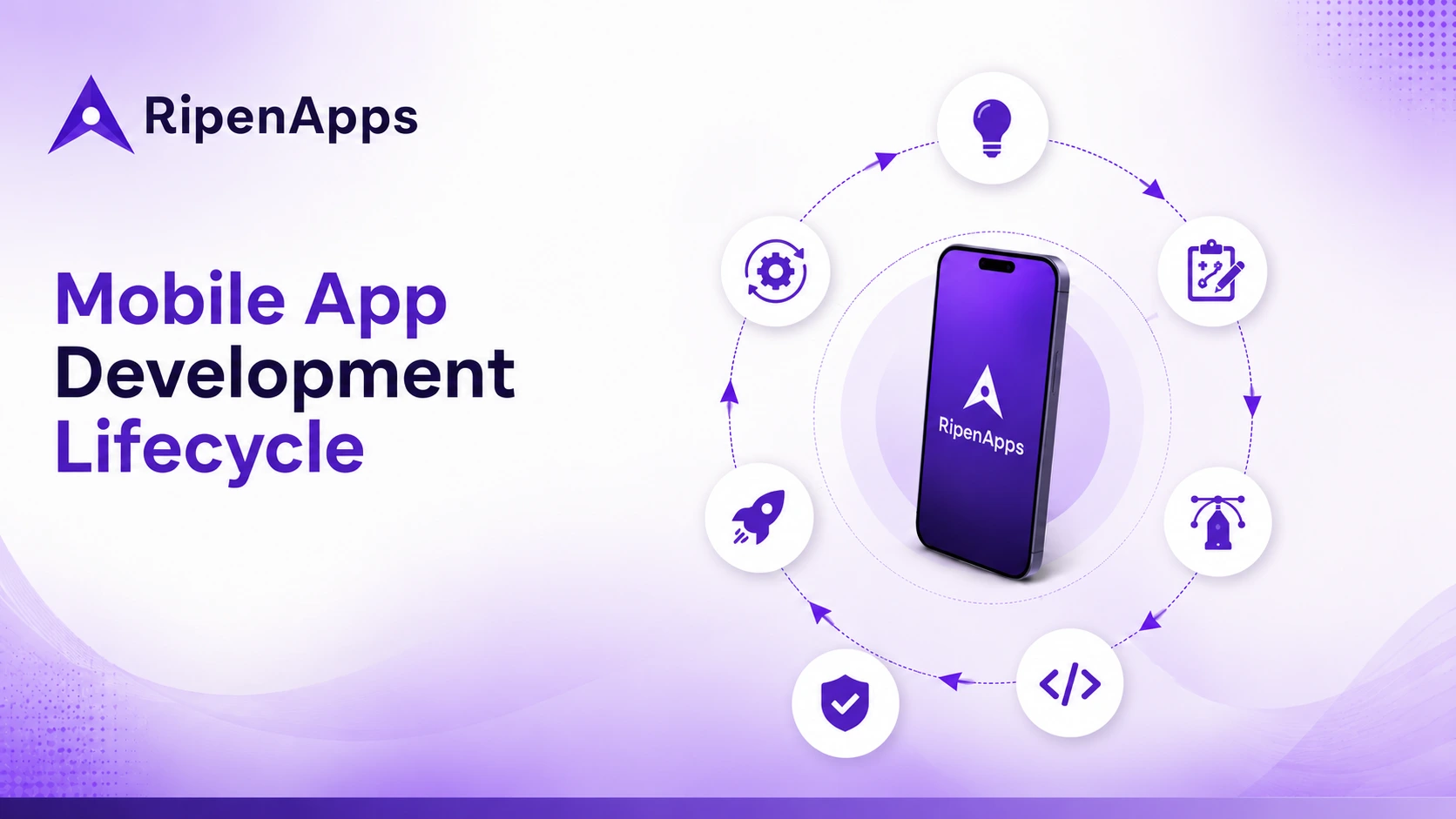
7 Key Stages of the Mobile App Development Lifecycle
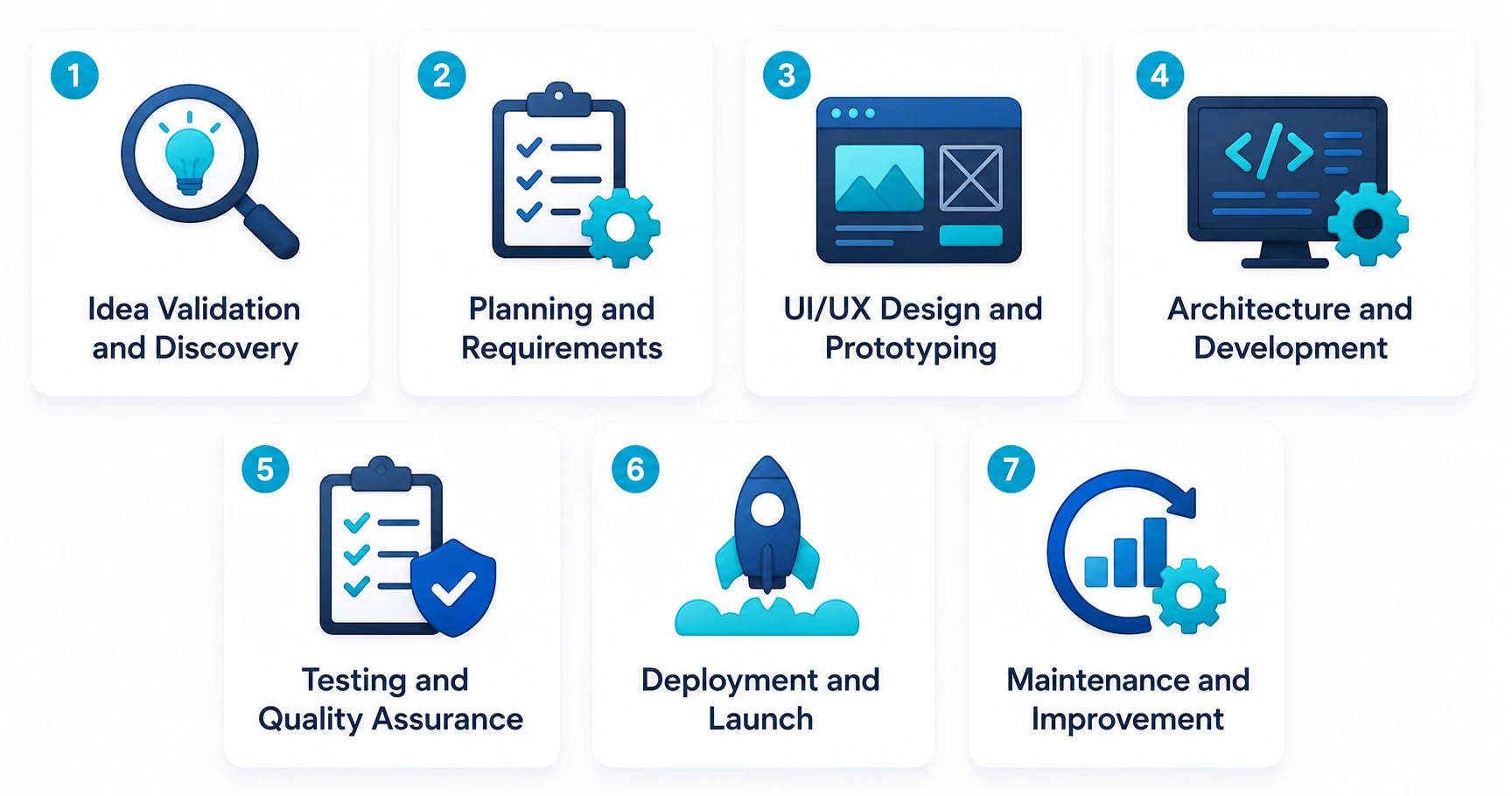
The exact stages vary by project, but most mobile applications follow seven broad phases. The important part is understanding the decisions required at each stage and what you should have ready before moving forward.
Stage 1. Validate the Idea Before Building
Before investing in development, establish why the app needs to exist and who will use it. Start by defining the problem, speaking with potential users, researching competing solutions, and identifying what your application will do differently.
A structured product discovery workshops engagement can help teams validate assumptions, prioritize user needs, and turn an early idea into a development-ready plan. This is especially valuable when stakeholders have different opinions about which features matter most.
Before moving ahead, answer these questions:
- What specific problem will the app solve?
- Who experiences this problem most often?
- How do users currently solve it?
- Is there evidence of demand for a better solution?
- What result would make the investment worthwhile?
If these questions remain unanswered, consider conducting interviews, surveys, a prototype test, or a small market experiment before committing to a full build.
Stage 2. Define Requirements and Prioritize Features
Once the idea has been validated, document what the first version needs to accomplish. Identify the core user journeys, essential functionality, integrations, user roles, and business rules. This helps developers estimate effort more accurately and gives stakeholders a shared understanding of the product.
For many businesses, starting with availing professional MVP app development services is a practical way to test the core value proposition before investing in a larger feature set. An MVP should be small enough to control cost and scope, but complete enough to solve a meaningful user problem.
A useful way to organize requirements is to divide features into three groups:
- Must-have: Required for the app’s primary user journey.
- Should-have: Important improvements that can follow if time and budget allow.
- Future enhancements: Features to consider after early feedback or traction.
Create a clear scope document and define success metrics before approving the development budget. Depending on your product, these metrics might include completed transactions, active users, repeat usage, conversion rates, or reduced processing time.
For more detail on choosing the right scope, you can also explore the MVP development guide. It can help you think through what to validate first and which features can wait until the product has real-world feedback.
Stage 3. Plan the User Experience and Interface
An app must be easy to understand and use, not merely functional. Before finalizing visual design, map the user journey from the first interaction to the main task’s completion. Identify potential friction points, unnecessary steps, and places where users might abandon the process.
The relationship between UI and UX design matters here. User experience focuses on how effectively people complete tasks, while user interface design shapes the visual elements and interactions they use along the way. Both should support the same product goals.
Before approving the design, consider:
- Is the main action easy to find?
- Can users complete important tasks without confusion?
- Are navigation and labels consistent?
- Does the design account for accessibility?
- Has the prototype been tested with representative users?
A detailed mobile app design guide can help stakeholders understand the design decisions involved before development begins. At this stage, the objective is not to perfect every screen. It is to validate the main journeys and resolve usability problems while changes are still relatively inexpensive.
Stage 4. Choose the Platform, Technology, and Architecture
Your technical choices influence development effort, performance, security, maintenance, and the ability to introduce new features later. Decide whether you need an iOS app, an Android app, or both, based on your audience, device usage, business goals, and available budget.
A comparison of native vs hybrid vs web app approaches can help you evaluate the trade-offs. Native apps offer platform-specific capabilities, cross-platform approaches can share much of the codebase across platforms, and web apps can provide mobile access without the same app-store distribution model. The best choice depends on your requirements rather than a universal rule.
Next, determine how to choose a technology stack based on your product’s functional requirements, integration needs, development team, expected traffic, and long-term maintenance plans.
Architecture also deserves early attention. A clear mobile app architecture plan defines how the app’s interface, backend services, databases, APIs, and external systems work together. This is particularly important for products that process payments, synchronize real-time data, or need to scale as usage grows.
Before approving the technical plan, confirm that the proposed solution supports your essential features, meets security requirements, fits the budget, and can accommodate likely future changes.
Stage 5. Estimate the Budget and Development Timeline
A realistic budget should cover more than the initial coding effort. Consider discovery, design, development, third-party services, testing, deployment, maintenance, and future enhancements. The total investment depends on feature complexity, platform choices, integrations, team composition, and the level of security and reliability required.
Review the likely MVP development cost before deciding how much functionality to include in the first release. This helps you compare a focused launch against a more extensive build and identify where phased delivery could reduce upfront risk.
When planning the timeline, ask for milestone-based estimates rather than a single launch date. Discovery, design approval, development, testing, and store review can each affect delivery. Also allow room for feedback, integration dependencies, and unexpected technical issues. The goal is to approve a budget that supports a useful, reliable first release, with a clear plan for future spending.
Read Also: How Much Does It Cost to Develop an App? A Detailed Guide
Stage 6. Develop, Test, and Refine the App
Once requirements, design, and technical architecture are approved, the development team builds the application in manageable increments. Each release should deliver a defined set of features, allowing stakeholders to review progress and provide feedback before the team moves forward.
An effective agile methodology supports this approach through short development cycles, regular reviews, and adjustments based on changing requirements. It is especially useful when the product needs to evolve through user feedback or when all requirements cannot be finalized upfront.
Testing should happen throughout development rather than being postponed until the end. Strong quality assurance in app development helps identify functional errors, usability issues, performance problems, and compatibility gaps before they reach users.
Security must be part of the development plan as well. Appropriate app security measures help protect user information, authentication credentials, transactions, and communication between the app and its backend systems.
Before approving a release, confirm that the core user journeys work as intended, critical defects are resolved, and the application meets the agreed acceptance criteria. The team should also document any known limitations and outstanding issues.
Stage 7. Launch, Monitor, and Improve
Launching the application is the beginning of its life in the market, not the end of development. Before release, prepare app store listings, screenshots, descriptions, privacy information, and the required technical configurations. Allow time for platform review and resolve any issues that arise during submission.
After launch, monitor crash reports, performance, user feedback, feature adoption, retention, and conversion metrics. These signals help you understand whether the app is delivering the intended value and where improvements are needed.
Use real user behavior to guide future updates. For example, frequent abandonment during registration might indicate a confusing onboarding flow, while repeated support requests could point to a feature that needs clarification. Prioritize improvements based on user impact, business value, and implementation effort.
The design process should also continue beyond the initial release. New insights may reveal that users need simpler navigation, more accessible controls, or a more efficient way to complete common tasks.
As your product matures, review relevant UI design trends selectively. Adopt visual or interaction changes when they improve usability or support user expectations, rather than changing the interface simply to follow trends.
A successful app requires ongoing ownership of performance, compatibility, security, and user experience. Budgeting for these responsibilities from the start helps protect the value of the initial investment.
Key Decisions to Make Before Investing in a Mobile App
Understanding the stages is useful, but the more important question is what you need to decide before committing your budget. These decisions shape the project’s scope and influence how effectively your team moves through development.
| Decision | What to evaluate | Why it matters |
| Business objective | Problem, target audience, expected outcome | Keeps development tied to a clear business need |
| Feature scope | Essential features and future additions | Prevents unnecessary complexity and cost |
| Platform | iOS, Android, cross-platform, or web | Influences reach, functionality, and maintenance |
| Design | User journeys, accessibility, navigation | Helps users complete tasks effectively |
| Technology | Architecture, integrations, security, scalability | Supports reliability and future changes |
| Budget | Initial build, launch, maintenance, third-party costs | Creates realistic financial expectations |
| Delivery model | Milestones, team structure, communication | Helps manage progress and accountability |
| Success metrics | Adoption, retention, conversion, business outcomes | Shows whether the investment is delivering value |
Your decision-making should also reflect the wider app development process. A project can meet its technical specifications and still fail to deliver business value if it solves the wrong problem or targets the wrong users.
Should You Build a Custom App or Choose a White-Label Solution?
The right approach depends on your differentiation needs, budget, launch timeline, and control requirements. A white-label solution can be suitable when standard functionality meets most of your needs and speed is a priority. Custom development is worth evaluating when your workflows, integrations, user experience, or competitive advantage require more flexibility.
This comparison of custom development versus white-label explains the trade-offs to consider before choosing an approach. Instead of comparing initial costs alone, assess ownership, customization limits, integration needs, ongoing fees, and vendor dependency.
Which Features Should Your First Release Include?
A strong first release solves the main user problem without trying to cover every possible use case. Start with the features needed to complete the core user journey, then use feedback and usage data to prioritize further development.
Review the mobile app features relevant to your product category, but evaluate each one against user needs and business objectives. Features such as authentication, search, payments, notifications, and analytics should be included only when they support the product’s actual use cases.
Who Will Build and Maintain the App?
Your team structure should match the product’s complexity and your internal capabilities. You might use an in-house team, work with an external development partner, or combine internal product ownership with outsourced design and engineering.
Understanding the benefits of hiring app developers can help you evaluate the expertise, flexibility, and delivery support an external team provides. Consider technical experience, communication, quality practices, and post-launch support together.
If your project requires sustained collaboration across design, engineering, and quality assurance, a dedicated development team may provide greater continuity than engaging individual specialists for disconnected tasks.
For early-stage businesses, choosing a suitable startup app development company can also help align feature prioritization, technical planning, and delivery milestones with limited resources and evolving product needs.
Common App Development Lifecycle Models
Not every project follows the same development model. The right model depends on how clearly you understand the requirements, how often they are likely to change, the level of risk involved, and how quickly you need feedback.
Waterfall Model
The Waterfall model follows a sequential approach. Teams typically complete requirements, design, development, and testing in defined stages before moving to the next phase.
It works best when requirements are stable, deliverables are well documented, and changes are expected to be limited. However, discovering major problems late in the project can lead to expensive revisions.
Agile Model
Agile development divides work into smaller iterations. Teams deliver selected functionality, review progress, gather feedback, and adjust priorities as the product evolves.
This model suits products with changing requirements, uncertain user expectations, or a need for frequent releases. It still requires clear priorities, regular communication, and disciplined scope management.
DevOps and Continuous Delivery
DevOps connects development and operational practices to improve collaboration, automate repetitive tasks, and support more reliable releases. Automated builds, testing pipelines, monitoring, and controlled deployments can help teams deliver updates consistently.
This approach is particularly relevant to products that need frequent improvements, rapid issue resolution, or ongoing integration with backend services.
For many businesses, a hybrid approach works well. Teams can establish firm approval points for budget and scope while using iterative development to refine the product through feedback.
How to Choose the Right App Development Partner
Your development partner influences product quality, delivery predictability, technical decisions, and the experience you receive after launch. Look beyond portfolios and hourly rates to assess how a team approaches planning, communication, testing, and long-term product support.
During discussions, ask who will manage your project, how requirements will be documented, how changes will be priced, and what happens if a release fails to meet expectations.
Before signing an agreement, confirm the following:
- Relevant experience: Has the team delivered products with similar requirements or complexity?
- Transparent estimates: Does the proposal explain assumptions, deliverables, exclusions, and payment milestones?
- Clear ownership: Will you retain access to source code, documentation, accounts, and product assets?
- Quality and security: Are testing, code reviews, data protection, and release checks built into the plan?
- Communication: Are progress updates, decision-makers, and escalation paths clearly defined?
- Post-launch support: Does the agreement cover maintenance, bug fixes, updates, and future enhancements?
Ask for a proposed roadmap with defined milestones and acceptance criteria. This gives you a clearer basis for comparing providers and helps prevent misunderstandings once development begins.
Read Also: How to Hire the Right Mobile App Development Company: A Practical Guide
Common Mistakes to Avoid Before Investing
Even a promising app idea can become expensive when important decisions are delayed. Avoid these common mistakes to improve your chances of delivering a product that meets user needs and business goals.
Building Before Validating Demand
An idea that sounds useful internally may not solve a problem users are willing to address. Conduct research, speak with potential customers, and test important assumptions before approving a full build.
Adding Too Many Features at Launch
A large initial feature set increases development effort and creates more work for testing and maintenance. Prioritize features that support the core user journey, then expand based on evidence.
Choosing Technology Based Only on Price
The cheapest proposal may leave out essential security, scalability, documentation, or maintenance requirements. Compare the complete solution and long-term ownership costs, not only the initial quote.
Treating Testing as a Final Step
Waiting until development is complete to test the app allows defects and usability problems to accumulate. Include testing throughout the project and define clear criteria for release readiness.
Ignoring Maintenance and Security
Apps need updates as operating systems change, dependencies become outdated, user expectations evolve, and new vulnerabilities emerge. Plan for monitoring, backups, bug fixes, and security updates before launch.
Measuring Success Only by Downloads
Downloads indicate initial interest but do not prove that the app creates value. Track metrics such as active usage, retention, task completion, conversions, revenue, or operational efficiency based on the purpose of your product.
How Much Does Mobile App Development Cost?
There is no single price for building a mobile app. Costs depend on the number and complexity of features, platform choices, design requirements, backend architecture, integrations, security needs, and the team’s location and expertise.
As a preliminary planning guide, a relatively simple app might cost around $10,000–$30,000, while a more complex application can cost $50,000–$150,000 or more. These are broad illustrative estimates, not verified quotes or fixed market rates. Your actual budget will depend on the product scope and delivery requirements.
To estimate your investment more accurately, define the minimum feature set, identify required integrations, decide which platforms to support, and include testing, deployment, and post-launch maintenance. A phased release can help spread investment over time, provided the initial version still delivers meaningful value.
Conclusion
The mobile app development lifecycle gives businesses a structured way to move from an initial idea to a reliable, user-focused product. The most important work often happens before coding begins: validating demand, setting priorities, choosing the right technology, estimating costs, and defining how success will be measured. These decisions help reduce avoidable risks and keep development aligned with business goals.
Working with an experienced custom application development company can help you make these decisions with greater clarity, from discovery and planning to launch and ongoing improvements. RipenApps supports businesses in turning product ideas into scalable applications through structured planning, design, development, and testing. With the right roadmap and a clear understanding of your users, you can invest with greater confidence and build a product that is prepared to evolve.
FAQs
Q1. What are the 7 stages of app development?
The seven broad stages are idea validation, planning and requirements, UI/UX design, architecture and development, testing, deployment, and maintenance. The order and depth of each stage vary according to the app’s complexity and business needs.
Q2. How long does the mobile app development lifecycle take?
The timeline depends on the product’s scope, design complexity, integrations, team size, and testing requirements. A focused MVP may take a few months, while a complex application can take considerably longer. Discovery and requirements planning help teams develop a more realistic estimate.
Q3. Can I skip the planning stage to reduce costs?
Skipping planning can create unclear requirements, rework, and avoidable delays. A focused discovery phase helps identify the core problem, prioritize features, assess technical feasibility, and prepare a more reliable budget before development starts.
Q4. Is an MVP necessary for every mobile app?
No. An MVP is useful when you need to validate demand or test key assumptions with limited functionality. However, products with strict regulatory requirements or functionality that depends on a complete system may need a different validation approach.
Q5. Which development model should I choose?
Waterfall can suit projects with stable, clearly defined requirements. Agile works well when priorities may change, and feedback is important throughout development. DevOps practices can strengthen release automation and ongoing maintenance. Your choice should reflect the product’s risks, delivery needs, and team structure.
Q6. What should I budget for after the app launches?
Plan for bug fixes, security patches, operating system compatibility, infrastructure, third-party service fees, monitoring, customer support, and future improvements. The amount depends on the app’s complexity, usage, and required service levels.
Q7. How do I know whether my app is successful?
Measure performance against the goals defined before development. Depending on your business model, useful indicators may include active users, retention, conversion rates, completed transactions, customer satisfaction, revenue, or time saved on internal workflows.
Discuss your project and request for proposal
SHARE
WRITTEN BY

Ishan Gupta
CEO & Founder
Ishan Gupta is a seasoned entrepreneur and CEO with extensive 10+ years of experience in business and mobile app development landscape. He believes that the right digital product allows companies to focus on what they do best, while technology handles the rest. With deep exposure to global markets, he understands what makes an app succeed. His approach translates business needs into clear product strategies, ensuring that every feature contributes to measurable ROI.
View All Articles