
Key Takeaways
- Leading telemedicine platforms use different revenue models, including insurance partnerships, employer contracts, subscriptions, and direct patient payments.
- Specialist healthcare platforms can differentiate themselves by addressing specific patient needs, such as mental health, women’s health, and medication management.
- About 1 in 5 commercially insured patients had a telehealth claim in 2026 (18.3% in Q2, according to FAIR Health), with mental health conditions accounting for more than half of telehealth patients.
- AI-assisted workflows, EHR integration, and remote patient monitoring can improve patient engagement and healthcare delivery.
- Startups must consider HIPAA obligations, state licensing requirements, provider partnerships, and operational costs before launching a telemedicine platform.
Telemedicine apps have changed how Americans access primary care, mental health services, specialist consultations, and prescription management. Platforms such as Teladoc, Amwell, and Talkspace demonstrate how digital healthcare businesses can combine virtual consultations, patient engagement, and ongoing care.
The latest industry data also highlights the continued use of virtual healthcare in the United States. According to FAIR Health’s Q2 2026 report, 18.3% of commercially insured patients had a telehealth claim during the quarter. Mental health conditions accounted for 53.7% of patients with telehealth claims, making them the leading diagnostic category. This steady demand creates opportunities for startups working with an experienced telemedicine app development company to build solutions for specific healthcare needs.
For startups, these platforms offer valuable lessons in product positioning, technology, and revenue generation. This guide compares 15 leading telemedicine platforms in the USA, examining their features, business models, and opportunities for businesses entering the digital healthcare market.
Table of Contents
How We Selected These Telemedicine Apps
We selected these platforms based on their relevance to the US healthcare market, product capabilities, business models, and market presence.
Our evaluation considers four primary factors:
- US market presence: Availability of services across the United States and accessibility through insurance, employers, or direct payments.
- Product experience: Mobile functionality, consultation options, appointment management, and patient engagement.
- Business performance: Company presence, funding, revenue disclosures, commercial partnerships, and ownership.
- Product innovation: Use of AI, remote monitoring, EHR integration, specialist care, and digital health workflows.
This is a general comparison rather than a clinical-quality ranking. The selection considers each platform’s US market presence, product capabilities, business model, and market relevance.
Comparison of the Top 15 Telemedicine Apps in the USA
This comparison highlights 15 leading telemedicine apps in the USA, covering their primary healthcare services, target audiences, business models, and supported platforms.
| App | Best for | Business model | Platforms |
| Teladoc Health | Primary and urgent care | Employer, payer, DTC | iOS, Android, Web |
| Amwell | Enterprise virtual care | Employer, payer, provider | iOS, Android, Web |
| MDLIVE | Insurance-based virtual care | Payer, employer, DTC | iOS, Android, Web |
| Doctor On Demand | Virtual consultations | Employer, payer, DTC | iOS, Android, Web |
| PlushCare | Online primary care | Insurance, membership, DTC | iOS, Android, Web |
| HealthTap | Online doctor consultations | Membership, insurance, DTC | iOS, Android, Web |
| Amazon One Medical | Membership-based primary care | Membership, employer, insurance | iOS, Android, Web |
| Circle Medical | Virtual-first primary care | Insurance, self-pay | iOS, Android, Web |
| Talkspace | Online therapy | Insurance, employer, subscription | iOS, Android, Web |
| BetterHelp | Online therapy | Subscription, eligible insurance | iOS, Android, Web |
| Maven Clinic | Women’s and family healthcare | Employer, health plan | iOS, Android, Web |
| Midi Health | Menopause and midlife care | Insurance, self-pay | iOS, Android, Web |
| healow | Patient engagement and provider connectivity | Provider licensing | iOS, Android, Web |
| Hims & Hers | Direct-to-consumer healthcare | DTC, subscription | iOS, Android, Web |
| Lemonaid Health | Online medical consultations | DTC, consultation fees | Web |
Top Telemedicine and Telehealth Apps in the USA
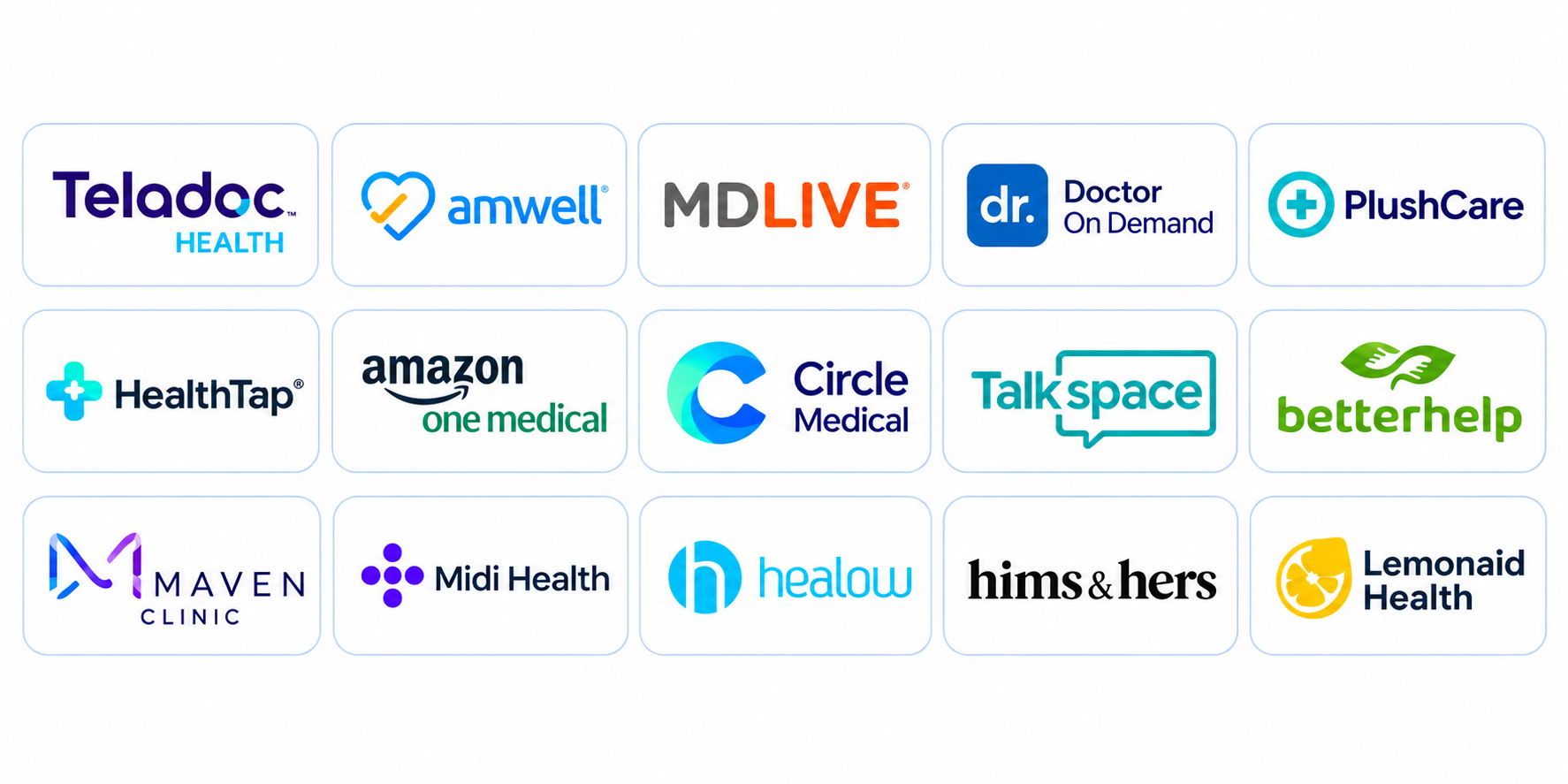
Some of the leading telemedicine apps in the USA include Teladoc Health, Amwell, MDLIVE, Doctor On Demand, and PlushCare. These platforms offer virtual primary care, urgent care, specialist consultations, and behavioral healthcare through different payment and service models.
Understanding their product strategies and revenue models helps startups identify opportunities in the growing digital healthcare market.
1. Teladoc Health
Teladoc Health is one of the most established virtual healthcare platforms in the United States. It connects patients with healthcare professionals through virtual consultations and offers services across primary care, mental health, chronic condition management, and specialist care.
Key features
- 24/7 access to general medical consultations.
- Virtual primary care and specialist consultations.
- Mental health services through BetterHelp.
- Chronic condition management.
- Prescription-related services.
- Health coaching and personalized care programs.
What stands out: Teladoc combines virtual consultations with ongoing healthcare management. Its two principal reporting segments, Integrated Care and BetterHelp, demonstrate how a healthcare company can operate different digital care models under one business.
Teladoc reported $605.1 million in Q3 2026 revenue, down 3% year over year. Integrated Care contributed $398.5 million, while BetterHelp generated $206.6 million, down 13% year over year. (Source: Teladoc Health Reports Third Quarter 2026 Results)
Lesson for startups: Structure different care services as distinct business segments to measure performance, pricing, and profitability separately.
2. Amwell
Amwell provides virtual healthcare technology to health systems, health plans, employers, and patients. Its platform supports organizations that want to deliver remote healthcare services through connected digital experiences.
Key features
- On-demand virtual consultations.
- Scheduled appointments.
- Behavioral healthcare services.
- Patient-provider communication.
- Virtual care programs for healthcare organizations.
- Integration with existing healthcare workflows.
What stands out: Amwell’s enterprise-oriented platform supports healthcare organizations rather than operating only as a standalone consumer application. Its approach demonstrates the importance of integrating virtual consultations into existing healthcare delivery systems.
Lesson for startups: Build around healthcare organizations’ existing workflows to make enterprise adoption easier.
3. MDLIVE
MDLIVE provides virtual healthcare services through its digital platform. Patients can access medical consultations, behavioral healthcare, and selected specialist services depending on their coverage and location.
Key features
- Urgent-care consultations.
- Virtual primary care.
- Dermatology services.
- Therapy and psychiatry.
- Appointment scheduling.
- Secure patient-provider communication.
What stands out: MDLIVE demonstrates how telemedicine platforms can connect consumer-facing applications with insurance networks and healthcare delivery systems.
Lesson for startups: Insurance partnerships can expand patient access, but require strong eligibility and billing workflows.
4. Doctor On Demand by Included Health
Doctor On Demand operates under Included Health and provides virtual medical and behavioral healthcare. It gives eligible members access to clinicians through employer-sponsored and health plan arrangements, alongside self-pay options.
Key features
- Virtual urgent-care appointments.
- Primary-care consultations.
- Mental and behavioral healthcare.
- Follow-up consultations.
- Secure patient-provider communication.
What stands out: The platform demonstrates how virtual consultations can be integrated into broader healthcare benefits. Its connection with Included Health provides access to a wider healthcare navigation and member-support ecosystem. Read our guide to on-demand doctor app development for more insights.
Lesson for startups: Integrate virtual consultations with broader healthcare benefits to create a more connected patient experience.
5. PlushCare
PlushCare provides virtual primary-care services, urgent-care consultations, and prescription-related support. Patients can book appointments, consult healthcare professionals, and receive follow-up guidance through its platform.
Key features
- Online doctor appointments.
- Primary-care consultations.
- Prescription management.
- Follow-up communication.
- Laboratory test coordination.
- Insurance-supported visits.
What stands out: PlushCare combines appointment scheduling, virtual consultations, membership management, and follow-up communication in one patient experience.
Lesson for startups: Combine scheduling, consultations, and follow-up services to support continuity of care.
6. HealthTap
HealthTap connects patients with healthcare professionals through virtual medical consultations. Its model combines individual appointments, membership benefits, and insurance-supported services.
Key features
- Virtual primary-care consultations.
- Urgent-care appointments.
- Doctor messaging.
- Appointment scheduling.
- Prescription-related services.
- Membership-based consultation discounts.
What stands out: HealthTap demonstrates how pricing flexibility can be incorporated into a digital healthcare product. Patients can choose between insurance, individual payments, and membership options.
Lesson for startups: Offer flexible payment options to serve patients with different coverage and affordability needs.
7. Amazon One Medical
Amazon One Medical combines digital primary-care services with in-person healthcare access. Its mobile application allows members to manage appointments, communicate with care teams, and access selected healthcare services.
Key features
- Virtual primary-care appointments.
- In-person healthcare access.
- Appointment scheduling.
- Secure messaging.
- Prescription renewal requests.
- Access to medical records.
- On-demand care options.
What stands out: Its membership model connects digital healthcare access with an established network of physical clinics, creating multiple ways for patients to access primary care.
Lesson for startups: Connecting digital services with physical care can create a more comprehensive healthcare experience.
8. Circle Medical
Circle Medical provides primary-care services through virtual appointments and selected in-person locations. Its platform supports ongoing patient relationships rather than focusing exclusively on one-time urgent-care consultations.
Key features
- Virtual primary-care consultations.
- Appointment scheduling.
- Prescription management.
- Laboratory test coordination.
- Ongoing care plans.
- Access to medical records.
What stands out: Circle Medical illustrates how a virtual-first product can support broader primary-care workflows, including follow-ups and laboratory coordination.
Lesson for startups: Build for ongoing primary care rather than relying only on one-time consultations.
9. Talkspace
Talkspace is a digital mental healthcare platform that connects patients with licensed therapists and psychiatric providers. It offers different consultation formats, including messaging and live video sessions.
Key features
- Therapist matching.
- Asynchronous messaging.
- Live video therapy.
- Psychiatric consultations.
- Medication management.
- Progress tracking and ongoing communication.
What stands out: Talkspace uses digital intake and matching workflows to connect patients with suitable mental healthcare professionals. It also supports multiple consultation formats, allowing users to choose how they communicate with providers. Explore our mental health app development guide for more information.
Lesson for startups: Offer messaging alongside video consultations to give patients flexible ways to stay connected with providers.
10. BetterHelp
BetterHelp provides online counseling through a network of licensed therapists. Its subscription-based model allows users to communicate with therapists through messaging and scheduled sessions.
Key features
- Therapist matching.
- Secure messaging.
- Live video sessions.
- Phone-based sessions.
- Therapist profile selection.
- Ongoing communication.
What stands out: BetterHelp demonstrates how therapist discovery, matching, scheduling, and recurring communication can be combined into a subscription-based digital healthcare experience.
Lesson for startups: Simplify therapist discovery and ongoing communication to support a consistent subscription experience.
11. Maven Clinic
Maven Clinic is a digital healthcare platform focused on women’s and family health. It connects members with healthcare professionals across fertility, pregnancy, parenting, pediatrics, and menopause.
Key features
- Fertility support.
- Pregnancy and postpartum care.
- Parenting resources.
- Pediatric consultations.
- Menopause support.
- Virtual specialist consultations.
- Care navigation.
What stands out: Maven’s platform combines virtual consultations, specialist access, educational resources, and personalized care journeys. Its specialization helps connect different stages of family healthcare within one product.
Lesson for startups: Specializing in a defined patient segment can help build a differentiated healthcare platform.
12. Midi Health
Midi Health focuses on women’s health during perimenopause and menopause. Its virtual care model connects patients with clinicians who specialize in midlife healthcare needs.
Key features
- Virtual menopause consultations.
- Perimenopause support.
- Hormone-related care.
- Treatment planning.
- Prescription management.
- Follow-up consultations.
What stands out: Midi demonstrates how a specialist telehealth platform can combine virtual consultations with personalized treatment plans and ongoing patient engagement.
Lesson for startups: Addressing an underserved specialty can create a clear market position and support specialized care offerings.
13. healow
healow is a patient-facing healthcare platform developed by eClinicalWorks. It connects patients with participating healthcare providers and allows them to access selected medical services through a mobile application.
Key features
- Appointment scheduling.
- Access to patient records.
- Lab result viewing.
- Medication information.
- Secure provider communication.
- TeleVisits.
- Appointment reminders.
What stands out: The main differentiator for healow is its connection with healthcare provider systems. Patients can access information and services made available by their participating medical practices.
Lesson for startups: Integrating with existing provider systems can make a patient application more useful to healthcare practices.
14. Hims & Hers
Hims & Hers is a digital healthcare company offering online consultations, personalized treatment plans, and prescription-related services. Its platform focuses on areas such as sexual health, dermatology, mental health, and weight management.
Key features
- Online health assessments.
- Clinician consultations.
- Personalized treatment plans.
- Prescription management.
- Medication fulfillment.
- Ongoing treatment support.
What stands out: Hims & Hers combines digital patient intake, clinician review, personalized recommendations, subscription management, and medication fulfillment.
Lesson for startups: Connect digital intake, clinician review, treatment plans, and fulfillment into one patient journey.
15. Lemonaid Health
Lemonaid Health provides online medical assessments and access to clinician-reviewed treatment for selected health conditions. Its model focuses on making certain healthcare services accessible without requiring every patient to begin with an in-person appointment. Bambu Ventures acquired the business in 2025.
Key features
- Online medical assessments.
- Clinician-reviewed treatment.
- Prescription services for eligible conditions.
- Patient intake forms.
- Treatment-related follow-up.
- Medication fulfillment.
What stands out: Lemonaid illustrates how structured digital intake and clinician review can support specific healthcare workflows. It also demonstrates the importance of building a product around clearly defined treatment categories.
Lesson for startups: A focused direct-to-consumer model needs sustainable customer acquisition and a resilient business strategy.
What Business Models Do Telemedicine Apps Use in the USA?
A telemedicine application’s business model determines how the company acquires patients, generates revenue, and sustains its healthcare operations.
The leading platforms use several monetization approaches. Some charge patients directly, while others work with employers, insurance companies, and healthcare providers.
1. Employer-Sponsored Model
In this model, employers pay a healthcare technology company to provide virtual care access to employees. The arrangement may include primary care, mental health support, chronic disease management, and wellness programs.
Examples: Teladoc Health, Maven Clinic, and Included Health.
How it generates revenue: Recurring business-to-business contracts based on covered employees, eligible members, or agreed service arrangements.
This model can provide predictable revenue and access to an established patient population through employer benefits.
2. Insurance-Based Model
Insurance-supported telemedicine applications work with health plans to provide eligible virtual consultations and related services. Patients may pay a copay or deductible, while healthcare providers and platform operators receive payment according to their contractual and reimbursement arrangements.
Examples: MDLIVE, Amwell, Teladoc, PlushCare, and Circle Medical.
How it generates revenue: Reimbursement and contractual payments for covered healthcare services.
Startups entering this segment must account for payer relationships, provider credentialing, eligibility verification, billing, and claims workflows.
3. Subscription-Based Model
Subscription-based platforms charge users recurring fees for access to digital healthcare services or ongoing communication. Some platforms include consultations in the membership, while others charge additional fees for individual appointments.
Examples: BetterHelp, Talkspace, HealthTap, and Amazon One Medical.
How it generates revenue: Monthly or annual membership fees, sometimes combined with consultation charges.
A subscription model can create recurring revenue, but the platform must offer sufficient ongoing value to retain members.
4. Pay-Per-Consultation Model
This model allows patients to pay for individual virtual appointments without committing to a recurring subscription. It can work well for urgent care, specialist consultations, and selected medical services.
Examples: Circle Medical, HealthTap, and Doctor On Demand.
How it generates revenue: Consultation fees, with potential additional revenue from eligible follow-up services. The platform must manage provider availability and consultation capacity to maintain service quality and operational efficiency.
5. Direct-to-Consumer Prescription Model
Direct-to-consumer platforms combine online health assessments, clinician evaluations, treatment recommendations, and medication fulfillment. Patients pay for consultations, treatment plans, subscriptions, or medications, depending on the service.
Examples: Hims & Hers and Lemonaid Health.
How it generates revenue: Consultation fees, recurring treatment programs, and medication-related sales.
These businesses must maintain appropriate clinical oversight and comply with applicable prescribing and pharmacy requirements.
6. Platform and Enterprise Licensing Model
Some telemedicine companies license their technology to healthcare providers, hospitals, and health systems instead of operating only as patient-facing platforms.
Examples: Amwell and healow.
How it generates revenue: Platform licensing fees, enterprise subscriptions, implementation charges, or recurring technology agreements, depending on the contract.
This model can help startups serve healthcare organizations that want to offer virtual care through their existing systems.
Choosing the Right Model for a Telemedicine Startup
The best business model depends on the healthcare service, target patient group, and operational requirements.
For example, a specialist women’s health application may benefit from employer partnerships and insurance coverage. A medication management platform may combine consultation fees with recurring patient engagement services.
Startups should also evaluate the technology required to support their chosen model. Insurance integrations, billing systems, provider management, and patient records can significantly affect the product’s development scope.
Healthcare Apps Developed by RipenApps
Building a telemedicine application requires more than adding video consultations to a mobile product. It involves patient workflows, healthcare professional access, secure communication, medication-related features, and reliable backend infrastructure.
At RipenApps, our experience with healthcare and wellness applications includes building products for patient engagement, digital health tracking, and healthcare service delivery.
Mednovate Connect
Mednovate Connect is a telehealth application designed to connect patients with licensed clinical pharmacists through virtual consultations and medication management workflows. The platform focuses on helping patients manage medication-related needs through digital healthcare interactions.
Key features include:
- Virtual consultations with licensed clinical pharmacists.
- Drug interaction checks.
- Medication dosage checks.
- Medication reminders.
- In-app patient-professional communication.
- Blood pressure and blood sugar tracking.
emmyHealth
emmyHealth is a wellness management and benefits platform developed for Android and iOS in three months. It combines mental and physical health tracking, stress-management tools, supplemental benefits, and claims management.
Key features include:
- Health learning quizzes.
- Flexible benefits management.
- Claim management.
- Real-time mental and physical health tracking.
- Stress-management tools.
- Personalised health dashboards.
Holypills
Holypills is an AI-driven women’s healthcare platform focused on conditions such as PCOS, endometriosis, and menopause. It combines homeopathy with AI-powered health insights through separate patient and practitioner applications.
Key features include:
- AI-guided health insights.
- Symptom and cycle tracking.
- Online homeopathy consultations.
- Personalised care plans.
- Practitioner-side online consultations.
- Care-plan builder and AI decision support for practitioners.

What Features Do Leading Telemedicine Apps Have in Common?
Although telemedicine applications serve different healthcare needs, successful platforms share several foundational capabilities. Startups should prioritize features based on their service model, patient workflows, and clinical requirements.
- Patient Registration and Profiles: Allow patients to create accounts and manage essential personal, medical, and contact information.
- Appointment Scheduling: Enable patients to find providers, check availability, book consultations, and manage appointments.
- Secure Video Consultations: Support reliable audio and video sessions with secure access and virtual waiting rooms.
- EHR Integration: Connect with participating healthcare systems to access authorized patient histories, prescriptions, diagnoses, and consultation records.
- Secure Messaging: Let patients communicate with healthcare professionals about follow-ups, care instructions, and clinical updates.
- Prescription Management: Allow authorized clinicians to create and manage prescriptions and coordinate with pharmacy systems.
- Notifications and Reminders: Send alerts for appointments, medication schedules, follow-ups, and important healthcare updates.
- Remote Patient Monitoring: Support the tracking of health measurements such as blood pressure, glucose levels, and heart rate, a core requirement for many senior-care products. Explore our elderly care app development guide for more insights.
- Payment and Insurance Management: Help patients pay for consultations, review billing details, and access insurance-related services.
- AI-Assisted Healthcare Workflows: Use AI for patient intake, appointment routing, general assistance, and provider matching.
Businesses can work with an AI app development company to integrate AI-assisted features while keeping clinical decisions under the supervision of qualified healthcare professionals.
Regulatory Requirements for Telemedicine Apps in the USA
Launching a telemedicine application in the United States requires careful consideration of healthcare regulations, patient privacy, and state-level medical licensing.
Three important areas deserve attention during product planning.
1. HIPAA Compliance and Patient Data Protection
The Health Insurance Portability and Accountability Act (HIPAA) sets rules for safeguarding protected health information (PHI) handled by covered entities and their business associates.
For telemedicine platforms working with covered healthcare providers or health plans, HIPAA compliance in application development involves implementing appropriate privacy and security safeguards.
Important technical considerations include:
- Encryption for data transmission and storage.
- Secure authentication and authorization.
- Role-based access controls.
- Audit logs and access monitoring.
- Secure video consultations and messaging.
- Appropriate business associate agreements with technology vendors.
- Data backup and recovery procedures.
Not every consumer health application automatically falls under HIPAA. Applicability depends on the organization’s role and its relationship with covered entities and business associates. Other federal and state privacy laws may also apply.
2. State Medical Licensing Requirements
Healthcare professionals generally need authorization to practice in the state where the patient is located during a telemedicine consultation.
Requirements vary across states and may involve licensing, registration, credentialing, and professional practice rules.
Startups planning nationwide services should establish processes to verify provider credentials and control service availability based on patient location.
3. Medicare Telehealth Flexibilities Through 2027
The Consolidated Appropriations Act, 2026, signed on February 3, 2026, extended several Medicare telehealth flexibilities through December 31, 2027.
These provisions include:
- Expanded geographic and originating-site eligibility for applicable Medicare telehealth services.
- Continued access to eligible telehealth services from patients’ homes.
- Broader participation by eligible Medicare practitioners.
- Continued participation by federally qualified health centers and rural health clinics as distant-site providers for applicable services.
- Temporary continuation of certain audio-only telehealth provisions.
- Extension of specified flexibilities around in-person requirements for Medicare behavioral health telehealth.
However, this extension does not mean that every virtual consultation is automatically covered by Medicare. Coverage still depends on the service, provider eligibility, and applicable Medicare requirements. Startups building Medicare-facing products should monitor HHS telehealth policy updates and Medicare telehealth coverage when planning billing and eligibility workflows.
How to Build a Telemedicine App Like These Platforms
Building a telemedicine application requires a structured approach that connects healthcare workflows with reliable technology.
Startups should consider the following stages before development begins.
1. Identify the Healthcare Niche
Start by defining the healthcare problem your application will solve. Decide whether the platform will focus on primary care, mental health, women’s health, chronic condition management, medication management, or another specialist area. A focused product scope can make validation and initial development more manageable.
2. Define the Business Model
Choose how the platform will generate revenue. Evaluate employer contracts, insurance reimbursement, subscriptions, consultation fees, or direct-to-consumer treatment models.
The selected model will influence payment systems, provider relationships, and operational workflows.
3. Define the MVP Features
Identify the essential capabilities needed to deliver the first version of the product.
For many telemedicine MVPs, these may include:
- Patient registration and profiles.
- Provider profiles and availability.
- Appointment scheduling.
- Secure video consultations.
- Patient-provider messaging.
- Payment processing.
- Basic medical record management.
- Notifications and reminders.
Additional capabilities can be introduced after validating user demand and operational requirements.
4. Choose the Technology Stack
Select technologies according to the platform’s functionality, scalability, integration requirements, and security needs.
A typical technology architecture may include:
- Mobile development: Swift, Kotlin, or cross-platform frameworks.
- Backend: Node.js, Python, or other suitable server-side technologies.
- Database: PostgreSQL, MongoDB, or an appropriate healthcare data architecture.
- Cloud infrastructure: AWS, Microsoft Azure, or Google Cloud.
- Video communication: A suitable secure real-time communication solution.
- Integrations: EHR, payment, pharmacy, and remote monitoring systems.
Technology choices should be evaluated against applicable privacy, security, and interoperability requirements.
5. Implement Security and Compliance Controls
Plan privacy and security requirements from the beginning rather than treating them as final development tasks. Establish access controls, encryption, audit logging, backup procedures, vendor agreements, and secure data handling practices.
The compliance approach should reflect the actual services, business relationships, and regulatory obligations of the platform.
6. Test the Application Before Launch
Test the complete patient and provider experience across supported devices. Validate appointment booking, video sessions, messaging, payments, notifications, access permissions, and integration workflows.
Security testing and operational readiness checks are especially important before a healthcare application goes live. For a detailed breakdown of the development process, see our telemedicine app development guide.

Conclusion
The leading telemedicine platforms in the USA demonstrate how digital healthcare businesses can succeed through virtual consultations, specialist services, insurance partnerships, and subscription models. Building a competitive platform requires the right healthcare app development services to support its business goals, patient needs, and regulatory requirements.
For startups, the opportunity is not to replicate an established platform feature by feature. The key is to identify an underserved healthcare need and build around the patients, providers, and payment model behind it. RipenApps helps businesses turn these ideas into secure, scalable digital healthcare products.
Frequently Asked Questions
1. What is the most used telemedicine app in the USA?
Teladoc Health is among the largest and most established virtual healthcare platforms in the United States. It serves patients through employer-sponsored programs, health plans, and direct-to-consumer services. However, there is no single definitive public ranking of the most-used telemedicine apps based on active US patients across every healthcare category. Usage varies by service type, insurance coverage, and patient demographics.
2. Which telehealth apps accept insurance?
Several telehealth platforms accept insurance for eligible services. Examples include Teladoc Health, Amwell, MDLIVE, Doctor On Demand, PlushCare, HealthTap, Circle Medical, Talkspace, and Midi Health. Coverage depends on the patient’s insurance plan, provider network, location, and type of consultation. Patients should confirm benefits and expected out-of-pocket costs before booking.
3. What app do doctors use for telemedicine?
Doctors use different telemedicine platforms depending on their healthcare organization and practice requirements. Examples include Amwell for enterprise virtual care, MDLIVE for health-plan-connected services, and healow for patient engagement and EHR-connected workflows. Some healthcare providers also use custom telemedicine applications integrated with their existing electronic health record systems.
4. What is the difference between telehealth and telemedicine apps?
Telehealth is a broader term that covers remote healthcare services, including clinical consultations, health education, remote monitoring, and administrative support. Telemedicine is more specifically associated with delivering clinical healthcare services remotely through technologies such as video consultations, messaging, and digital communication. A telemedicine app generally focuses on connecting patients with healthcare professionals, while a broader telehealth application may include wellness tracking, education, and remote monitoring.
5. How do telemedicine apps make money?
Telemedicine apps generate revenue through several business models:
- Employer-sponsored healthcare contracts.
- Insurance reimbursements and payer partnerships.
- Patient subscriptions and memberships.
- Pay-per-consultation fees.
- Direct-to-consumer treatment and prescription programs.
- Healthcare technology licensing.
6. How much does it cost to build an app like Teladoc?
The cost of developing an application like Teladoc depends on its feature set, supported platforms, integrations, security requirements, and operational complexity. A focused telemedicine MVP may cost approximately $30,000 to $40,000, while a comprehensive virtual healthcare platform with multiple specialties, insurance integrations, chronic care management, and remote monitoring may require a significantly larger investment. For a detailed breakdown of development expenses, read our telemedicine app development cost guide.
Discuss your project and request for proposal
SHARE
WRITTEN BY

Manish Kumar
Technical Content Writer
Manish is a Senior Technical Content Writer at RipenApps. He has over 7+ years of experience and holds immense tech knowledge. His educational background in science and expertise in the IT domain has made him an expert writer. He has authored various tech blogs and guest posts for leading sites. When he is not writing, he researches on the latest market trends and reads sci-fic novels.
View All Articles