

A delayed product launch, recurring bugs, poor code quality, and expensive rewrites often have one thing in common: the wrong hiring decision.
Building an Android application isn’t just about finding someone who can write code. You’re choosing the people who will shape your product’s performance, security, user experience, and long-term scalability. A developer with strong technical skills but little experience in architecture or product thinking can leave you with mounting technical debt before your app even reaches the Google Play Store.
The hiring process has also become more complex in 2026. Businesses can choose from freelancers, dedicated Android developers, in-house engineers, outsourced development teams, and global agencies. Each option comes with different costs, collaboration models, and levels of expertise. The right choice depends on your product goals, budget, timeline, and the level of involvement you expect throughout development.
This guide is designed for founders, CTOs, product managers, and business leaders who want to hire Android app developers with confidence. Instead of offering another generic company list, it walks you through the complete decision-making process, from choosing the right hiring model and evaluating technical skills to understanding costs, comparing development partners, and avoiding common hiring mistakes.
Whether you’re launching your first MVP or expanding an enterprise-grade Android product, choosing the right Android app development services is a critical decision. This guide will help you reduce hiring risks, make informed decisions, and maximize your development investment.
Table of Contents
Is Hiring Android App Developers the Right Choice?
Hiring Android developers isn’t always the first answer. Before posting a job description or contacting a development partner, determine whether Android aligns with your product strategy and whether building internally or outsourcing will deliver better business outcomes.
The best hiring decisions begin with product requirements, not technology preferences.
When Does Hiring Android Developers Make Sense?
Android remains the world’s largest mobile operating system, powering billions of active devices across hundreds of manufacturers. For businesses targeting broad market reach, Android often becomes the primary platform because of its extensive user base and device diversity.
Hiring Android developers is typically the right decision when your business aims to:
- Launch a consumer-facing mobile application with maximum market reach.
- Build solutions for industries where Android dominates, such as logistics, healthcare, retail, education, fintech, or field services.
- Modernize legacy business applications with native mobile experiences.
- Develop enterprise apps for internal teams using Android-based devices.
- Scale an existing Android application with new features and long-term maintenance.
If Android represents a significant share of your target audience, investing in experienced developers early can reduce future maintenance costs and improve product stability.
Should You Build an In-House Team or Outsource?
This is one of the first questions companies face.
The answer depends less on company size and more on hiring urgency, available technical leadership, and long-term product goals.
An in-house Android team provides direct collaboration, cultural alignment, and full operational control. However, recruiting experienced Android engineers can take months, particularly in competitive hiring markets. Salaries, onboarding, employee benefits, infrastructure, and retention further increase the overall investment.
Working with an outsourced Android development partner offers immediate access to an established team of developers, designers, QA engineers, DevOps specialists, and project managers. Instead of building capabilities from scratch, businesses can begin development quickly while maintaining predictable costs and flexible scaling.
Many startups and growing businesses also choose a dedicated Android development team, a model that combines the commitment of an in-house team with the flexibility of outsourcing. Developers work exclusively on your product while the technology partner manages recruitment, infrastructure, administration, and team scaling.
Hire vs. Build: Which Model Fits Your Business?
| Decision Factor | In-House Team | Dedicated Android Team | Freelancers |
| Hiring speed | Slow | Fast | Very Fast |
| Team scalability | Moderate | High | Low |
| Technical management | Internal | Shared | Self-managed |
| Long-term maintenance | Excellent | Excellent | Depends on availability |
| Cost predictability | Lower | High | Variable |
| Best suited for | Mature product companies | Startups, SMEs, growing businesses | Small projects, prototypes |
Rather than asking, “Should we outsource?”, ask:
“Which hiring model gives us the right expertise with the least delivery risk?”
For many businesses, that answer is a dedicated Android development team because it balances flexibility, scalability, and access to experienced specialists without the long recruitment cycle.
Signs You’re Ready to Hire Android App Developers
Not every business needs developers immediately. However, these indicators usually suggest it’s time to start evaluating Android talent:
- Your product roadmap has been validated and development needs to begin.
- Existing engineering resources lack Android expertise.
- The internal team is overloaded with other priorities.
- You need to accelerate product delivery to meet market demand.
- Maintaining quality and security requires specialized Android experience.
- Your application roadmap includes continuous feature releases after launch.
Waiting too long to hire often delays product releases, while hiring too early can increase unnecessary costs. Defining your product requirements before selecting developers leads to better hiring outcomes.
What Type of Android Developer Do You Need?
Not every Android project requires the same kind of developer.
Hiring decisions often fail because companies search for a “good Android developer” without first defining the expertise their product actually requires. An MVP built for market validation has different technical needs than an enterprise platform expected to serve millions of users.
Before evaluating candidates, identify the type of Android expertise your project demands.
Native Android Developers vs. Cross-Platform Developers
One of the first decisions is whether your application should be built natively or using a cross-platform framework. The choice between these approaches directly influences the developers you should hire, so having a clear understanding of Native vs Cross-Platform App Development can help you make a more informed hiring decision.
Native Android Development
Native Android developers primarily work with Kotlin, Google’s preferred programming language for Android development. They use Android Studio, Jetpack libraries, Material Design components, and platform-specific APIs to build applications optimized for Android devices.
Native development is often the preferred option when your application requires:
- High-performance user experiences.
- Advanced hardware integrations.
- Offline capabilities.
- AI or machine learning features.
- Secure financial transactions.
- Enterprise-grade scalability.
- Long-term Android platform optimization.
If Android is your primary business platform, hiring experienced native Android app developers usually delivers stronger performance, better maintainability, and easier access to new Android platform updates.
Cross-Platform Developers
Cross-platform developers use frameworks such as Flutter or React Native to build applications that run on both Android and iOS from a shared codebase.
This approach works well when:
- The budget is limited.
- Time-to-market is critical.
- Feature requirements are relatively consistent across platforms.
- Both Android and iOS users must be supported simultaneously.
However, applications with heavy animations, hardware integrations, or platform-specific functionality may still benefit from native Android expertise.
The choice isn’t about which technology is better—it’s about which one aligns with your product goals.
Junior, Mid-Level, or Senior Android Developer?
Experience directly influences delivery quality, architecture decisions, and development speed.
| Experience Level | Best For |
| Junior Developer | Bug fixes, maintenance, and small feature development |
| Mid-Level Developer | MVPs, feature expansion, and independent module ownership |
| Senior Android Developer | Complex architecture, enterprise products, scalable systems, and technical leadership |
Hiring only based on hourly rates often becomes expensive later. Senior developers may charge more initially, but their architectural decisions can significantly reduce maintenance costs over the product’s lifecycle.
Should You Hire One Developer or a Complete Team?
A common misconception is that one experienced developer can handle an entire mobile product.
While this may work for simple applications, production-ready products typically require expertise beyond coding.
A dedicated Android development team often includes:
- Android Developers
- UI/UX Designers
- QA Engineers
- Project Managers
- Business Analysts
- DevOps Specialists
This collaborative structure reduces bottlenecks, improves release quality, and enables parallel development, testing, and deployment.
For startups validating a simple MVP, hiring one experienced Android developer may be sufficient. For scalable products with ongoing releases, a dedicated team usually provides faster delivery, stronger quality assurance, and more predictable outcomes.
Skills to Look for When You Hire Android App Developers
A polished portfolio can create a strong first impression, but it doesn’t tell you how well a developer writes maintainable code, handles complex integrations, or collaborates with a product team. The real evaluation begins when you look beyond completed apps and assess the skills that directly impact your project’s success.
Whether you’re hiring a freelance Android developer, a dedicated development team, or an agency, these are the key capabilities to prioritize.
Strong Kotlin Expertise Should Be Non-Negotiable
Google has positioned Kotlin as the preferred language for Android development, and most modern applications are built around it. While many developers still understand Java, relying solely on Java experience may limit your application’s future scalability and compatibility with the latest Android updates.
An experienced Android developer should demonstrate proficiency in:
- Kotlin Coroutines for asynchronous programming
- Kotlin Flow for reactive data handling
- Extension functions
- Null safety
- Functional programming concepts
Instead of simply asking, “Do you know Kotlin?”, ask candidates how they’ve used it to improve application performance, reduce crashes, or simplify code maintenance. Practical experience often reveals more than a technical checklist.
Experience with Jetpack Compose and Modern Android Development
Android UI development has undergone significant evolution over the past few years. Google’s Jetpack Compose framework has become the preferred approach for building modern, responsive interfaces with less boilerplate code.
Developers familiar with Compose can often build interfaces faster while creating more maintainable UI components.
Look for experience with:
- Jetpack Compose
- Material Design 3
- Navigation Compose
- State management
- Responsive layouts
- Accessibility best practices
If your application will receive regular feature updates, choosing developers who already work with modern Android frameworks can reduce future redevelopment efforts.
Understanding of Clean Architecture
Applications rarely remain the same after launch. New features, integrations, and business requirements continue to evolve, making software architecture one of the most valuable technical skills.
Experienced Android developers should understand architectural patterns such as:
- MVVM (Model-View-ViewModel)
- MVI (Model-View-Intent)
- Repository Pattern
- Dependency Injection using Hilt or Dagger
- Modular project structures
Well-structured architecture doesn’t just make development easier—it also reduces debugging time, improves scalability, and enables multiple developers to work on the same project without creating unnecessary dependencies.
API Integration and Third-Party Services
Most mobile applications rely on external systems to function. Payment gateways, authentication services, maps, analytics, cloud storage, chat platforms, and AI services all require reliable API integration.
When evaluating Android app developers, ask about their experience integrating:
- REST APIs
- GraphQL APIs
- Firebase services
- Google Maps SDK
- Payment gateways
- Push notifications
- Social login providers
- AI APIs such as OpenAI or Gemini
Developers who have solved real-world integration challenges are usually better equipped to anticipate issues before they affect your product timeline.
Security Should Never Be an Afterthought
Android applications increasingly handle sensitive customer information, financial transactions, healthcare records, and business data. Security mistakes can damage customer trust long before they become technical problems. That’s why following Android application security best practices are essential for building secure and reliable mobile applications.
Strong Android developers understand practices such as:
- Secure API authentication
- Encrypted local storage
- Android Keystore
- Data encryption
- Certificate pinning
- OWASP Mobile Security Guidelines
- Secure session management
Rather than asking whether they “know security,” discuss a real security challenge they’ve addressed in previous projects.
Google Play Store Deployment Experience
Building an application is only part of the job. Successfully publishing and maintaining it on Google Play requires additional expertise.
Developers should be familiar with:
- Play Console
- App signing
- Internal testing
- Closed and open testing tracks
- Release management
- Play Store compliance policies
- Performance monitoring after launch
Experience with app publishing often saves considerable time during deployment and reduces approval-related delays.
Communication and Product Thinking Matter as Much as Coding
Many hiring decisions focus entirely on technical skills, yet projects often fail because of poor communication rather than poor programming.
The best Android developers don’t simply implement requirements—they ask questions that improve the product.
Look for professionals who:
- Explain technical concepts in simple language.
- Identify potential product risks early.
- Suggest better technical alternatives.
- Estimate work realistically.
- Provide regular progress updates.
- Collaborate effectively with designers, QA teams, and stakeholders.
Strong communication reduces misunderstandings, speeds up decision-making, and creates a healthier working relationship throughout the project.
Android Developer Skills Evaluation Checklist
| Skill Area | Why It Matters |
| Kotlin | Modern Android development |
| Jetpack Compose | Faster, maintainable UI |
| Clean Architecture | Long-term scalability |
| REST & GraphQL APIs | Backend connectivity |
| Firebase | Authentication, notifications, analytics |
| Security | Protects user data and business assets |
| Google Play Console | Smooth app deployment |
| Version Control (Git) | Team collaboration |
| CI/CD Pipelines | Faster releases |
| Communication | Better collaboration and product outcomes |
Hiring Tip: A developer with strong technical expertise but weak communication can still slow your project. Aim for a balance of engineering skills, business understanding, and a collaborative mindset.
Where & How to Hire Android App Developers
One of the biggest hiring mistakes is assuming every engagement model delivers the same outcome. It doesn’t.
The right hiring model depends on your product complexity, internal resources, budget, and how much control you want throughout development. A startup validating an MVP has very different needs from an enterprise expanding an existing Android platform.
Understanding these options before signing a contract can save months of delays and significant development costs.
Hiring Freelance Android Developers
Freelancers are often the quickest option for small projects, bug fixes, or short-term development needs. Platforms like Upwork, Toptal, and Freelancer provide access to developers worldwide, making it relatively easy to find specialized talent.
Freelancers are a practical choice when you need:
- Minor feature enhancements
- UI improvements
- Maintenance tasks
- Prototype development
- Short-term technical support
However, freelancers usually work independently. You’ll often be responsible for project management, quality assurance, testing, documentation, and coordinating timelines. If your application grows in complexity, managing multiple freelancers can become challenging.
Best for: Startups building simple MVPs, proofs-of-concept, or businesses with an experienced internal technical lead.
Hiring an In-House Android Developer
Building an internal Android team gives you complete control over development priorities, workflows, and company culture. Developers become deeply familiar with your product and can collaborate closely with other departments.
The trade-off is the investment required. Beyond salaries, you’ll need to account for recruitment costs, employee benefits, training, equipment, office infrastructure, and long-term retention.
Recruiting experienced Android engineers can also take several weeks or even months in competitive markets.
Best for: Companies with continuous development needs, established engineering teams, and long-term product roadmaps.
Hiring a Dedicated Android Development Team
A dedicated development team combines many advantages of outsourcing with the consistency of an in-house team. Instead of hiring individuals, you work with a group of specialists, including Android developers, designers, QA engineers, project managers, and business analysts who focus exclusively on your project.
This model offers greater flexibility because teams can scale up or down as project requirements change. It also reduces administrative overhead, allowing you to focus on business strategy while your technology partner manages recruitment, infrastructure, and team operations.
For businesses planning long-term Android development, hiring a dedicated team often provides the best balance between cost, expertise, and delivery speed.
Best for: Startups preparing for growth, SMEs, and enterprises requiring ongoing feature development and product maintenance.
Partnering with an Android App Development Agency
An experienced Android development agency offers more than coding expertise. Agencies typically provide end-to-end services, including product discovery, UI/UX design, architecture planning, quality assurance, deployment, maintenance, and strategic consulting.
This approach works particularly well for organizations without an internal engineering department or businesses launching complex digital products that require multidisciplinary expertise.
When evaluating agencies, don’t focus solely on portfolios. Review case studies, client testimonials, communication processes, industry experience, and post-launch support.
An experienced Android app development partner should demonstrate how they’ve solved business problems, not just built applications.
Comparison: Which Hiring Model Is Right for You?
| Criteria | Freelancer | In-House Developer | Dedicated Team | Development Agency |
| Cost Predictability | Medium | Low | High | High |
| Scalability | Low | Medium | High | High |
| Project Management Support | No | Internal | Yes | Yes |
| Design & QA Included | No | Internal Hiring Required | Yes | Yes |
| Best for Long-Term Projects | Limited | Excellent | Excellent | Excellent |
| Suitable for MVPs | Yes | Sometimes | Yes | Yes |
| Enterprise Readiness | Limited | High | High | High |
There is no one-size-fits-all answer. The best model depends on your project’s goals, timeline, and internal capabilities.
- Freelancers work well for small, short-term tasks.
- In-house developers suit companies with ongoing engineering needs and the resources to build a permanent team.
- Dedicated Android development teams offer flexibility, scalability, and access to specialized expertise without lengthy recruitment.
- Development agencies are ideal for businesses seeking end-to-end product development, strategic guidance, and long-term support.
Before making a decision, evaluate not only the cost of hiring but also the value each model brings in terms of speed, quality, scalability, and risk reduction.
Cost to Hire Android App Developers in 2026
Budget is one of the biggest factors influencing any hiring decision, but focusing only on hourly rates often leads to expensive mistakes. A developer charging $25 per hour may cost far more than one charging $70 per hour if the project requires multiple rewrites, suffers from poor code quality, or misses launch deadlines.
Instead of asking, “Who offers the lowest rate?”, ask, “Who can deliver the best value for my product?”
If you’re planning your budget, understanding the android app development cost can help you set realistic expectations based on your business goals and technical requirements. The cost to hire Android app developers varies depending on several factors, including experience level, project complexity, hiring model, geographic location, and the technologies involved. Understanding these variables will help you estimate a realistic budget and avoid unexpected expenses later in the project.
What Influences the Cost of Hiring Android Developers?
Two Android developers with the same job title may charge significantly different rates because their responsibilities and expertise differ.
Some of the biggest cost drivers include:
Developer Experience
A junior developer may be suitable for bug fixes or maintaining an existing application, while a senior developer can design scalable architecture, solve complex technical challenges, and mentor other team members.
Higher experience generally means:
- Faster development cycles
- Better code quality
- Fewer production issues
- Lower long-term maintenance costs
Project Complexity
Building a simple appointment booking application is very different from developing a fintech platform with biometric authentication, payment gateways, AI recommendations, and real-time synchronization.
Features that typically increase development costs include:
- AI-powered functionality
- Real-time messaging
- Video streaming
- IoT integrations
- Blockchain
- Wear OS support
- Offline synchronization
- Enterprise-grade security
- Multi-language support
Technology Stack
Applications built using the latest Android technologies may require developers with specialized expertise.
For example:
- Kotlin
- Jetpack Compose
- Firebase
- GraphQL
- Clean Architecture
- Android Automotive
- Google ML Kit
Developers with experience across these technologies often command higher rates due to their specialized skills.
Engagement Model
The hiring model also affects your overall investment.
- Freelancers usually have lower upfront costs but may require additional project management.
- In-house teams involve salaries, recruitment costs, infrastructure, and employee benefits.
- Dedicated development teams provide predictable monthly costs while offering greater flexibility.
- Development agencies typically bundle project management, design, quality assurance, and maintenance into a single engagement.
Looking at the total cost of ownership rather than hourly rates provides a more accurate picture.
Average Hourly Rates to Hire Android App Developers (2026)
The table below shows public industry benchmarks based on regional market averages. Actual rates vary depending on expertise, project requirements, and engagement model.
| Region | Average Hourly Rate (USD) |
| India | $20–50 |
| Eastern Europe | $35–80 |
| Latin America | $30–70 |
| Southeast Asia | $20–45 |
| Western Europe | $70–130 |
| United Kingdom | $80–140 |
| United States | $100–200+ |
| Australia | $90–170 |
Note: These ranges are based on publicly available industry benchmarks and should be treated as indicative estimates rather than fixed pricing.
Estimated Hiring Costs by Developer Experience
| Experience Level | Typical Hourly Rate |
| Junior Android Developer | $20–35 |
| Mid-Level Android Developer | $35–60 |
| Senior Android Developer | $60–100+ |
| Android Architect / Technical Lead | $90–150+ |
Experience alone shouldn’t determine your hiring decision. A senior developer who delivers a scalable product in half the time may provide a better return on investment than hiring multiple junior developers.
Hidden Costs Many Businesses Overlook
The hourly rate is only one part of the overall investment. Businesses often underestimate additional costs associated with software development.
These may include:
- Product discovery workshops
- UI/UX design
- Quality assurance and testing
- DevOps and cloud infrastructure
- API licensing fees
- Third-party integrations
- Google Play Store deployment
- Maintenance and feature updates
- Security audits
- Documentation and knowledge transfer
Accounting for these expenses early helps create a more realistic project budget.
Should You Choose the Cheapest Android Developer?
Not necessarily.
Low-cost developers can be suitable for small maintenance tasks, but complex applications often require experienced professionals who understand architecture, performance optimization, and security.
Before making a decision, evaluate:
- Relevant Android project experience
- Technical expertise
- Communication skills
- Delivery process
- Client reviews
- Code quality
- Post-launch support
A slightly higher upfront investment can significantly reduce maintenance costs and accelerate your product launch.
Cost vs. Value: A Better Hiring Perspective
Instead of comparing developers solely by hourly rates, compare them across the factors that directly influence business outcomes.
| Evaluation Criteria | Low-Cost Hire | Experienced Android Partner |
| Initial Cost | Lower | Higher |
| Product Quality | Variable | Consistent |
| Scalability | Limited | High |
| Security | Basic | Advanced |
| Communication | Varies | Structured |
| Delivery Risk | Higher | Lower |
| Long-Term Maintenance | Higher | Lower |
For businesses building customer-facing products, evaluating long-term value often leads to better hiring decisions than focusing exclusively on short-term savings.
Questions to Ask When Interviewing Android Developers
A portfolio can show what a developer has built, but an interview reveals how they think, solve problems, and collaborate with a team.
Instead of relying only on coding assessments, ask questions that uncover technical expertise, decision-making ability, and real project experience.
Here are some of the most effective questions to include in your hiring process.
1. Can You Walk Me Through an Android Project You’re Most Proud Of?
This question encourages candidates to discuss their role, technical decisions, challenges, and measurable outcomes.
Look for answers that explain:
- Business objectives
- Technical architecture
- Individual responsibilities
- Challenges faced
- Results achieved
Developers who clearly explain both technical and business decisions often communicate more effectively during projects.
2. Why Would You Choose Kotlin Over Java for This Project?
Most experienced Android developers should be able to explain when Kotlin offers advantages and when Java may still be appropriate.
Strong answers usually mention:
- Null safety
- Coroutines
- Reduced boilerplate code
- Better maintainability
- Google’s long-term support
Rather than looking for textbook definitions, evaluate whether candidates can relate these concepts to real development scenarios.
3. How Do You Ensure an Android App Remains Scalable?
Scalability becomes increasingly important as applications grow.
Experienced developers often discuss topics such as:
- Clean Architecture
- MVVM or MVI
- Modularization
- Dependency Injection
- Code reviews
- Automated testing
These responses provide insight into how candidates think beyond immediate feature delivery.
4. Tell Me About a Difficult Bug You Solved
This question helps assess analytical thinking.
Pay attention to:
- How they approached debugging
- The tools they used
- Root cause analysis
- Preventive measures
Developers who describe a structured troubleshooting process generally perform better under pressure.
5. How Do You Stay Updated with Android Development?
Android evolves rapidly. Candidates should demonstrate continuous learning.
Look for references to:
- Google I/O announcements
- Android Developers Blog
- Jetpack libraries
- Kotlin releases
- Technical communities
- Open-source contributions
A commitment to learning often translates into better long-term project outcomes.
6. How Do You Collaborate with Designers and QA Teams?
Successful applications depend on cross-functional collaboration.
Strong candidates explain:
- Sprint planning
- Requirement clarification
- Design reviews
- QA feedback
- Agile workflows
- Communication tools
Their answers can reveal whether they’ll integrate smoothly into your existing app development process.
7. What Steps Do You Take Before Publishing an App to Google Play?
Deployment experience is often overlooked during interviews.
An experienced Android developer should mention activities such as:
- Testing across devices
- Performance optimization
- Security checks
- App signing
- Play Console configuration
- Compliance with Google Play policies
- Monitoring after release
This demonstrates familiarity with the complete development lifecycle rather than coding alone.
8. Can You Share References or Client Feedback?
Technical ability matters, but reliability is equally important.
Ask for:
- Case studies
- Client testimonials
- App Store links
- GitHub repositories (where applicable)
- References from previous engagements
Verifiable work helps reduce hiring risk.
Interview Evaluation Scorecard
Rather than making decisions based on intuition, evaluate every candidate against the same criteria.
| Evaluation Area | Weight |
| Android Technical Skills | 30% |
| Problem-Solving Ability | 20% |
| Communication Skills | 15% |
| Architecture Knowledge | 10% |
| Portfolio & Case Studies | 10% |
| Security & Best Practices | 10% |
| Cultural Fit | 5% |
Using a structured scorecard makes it easier to compare candidates objectively, especially when interviewing multiple developers or evaluating several Android development partners.
Android App Developers Hiring Checklist 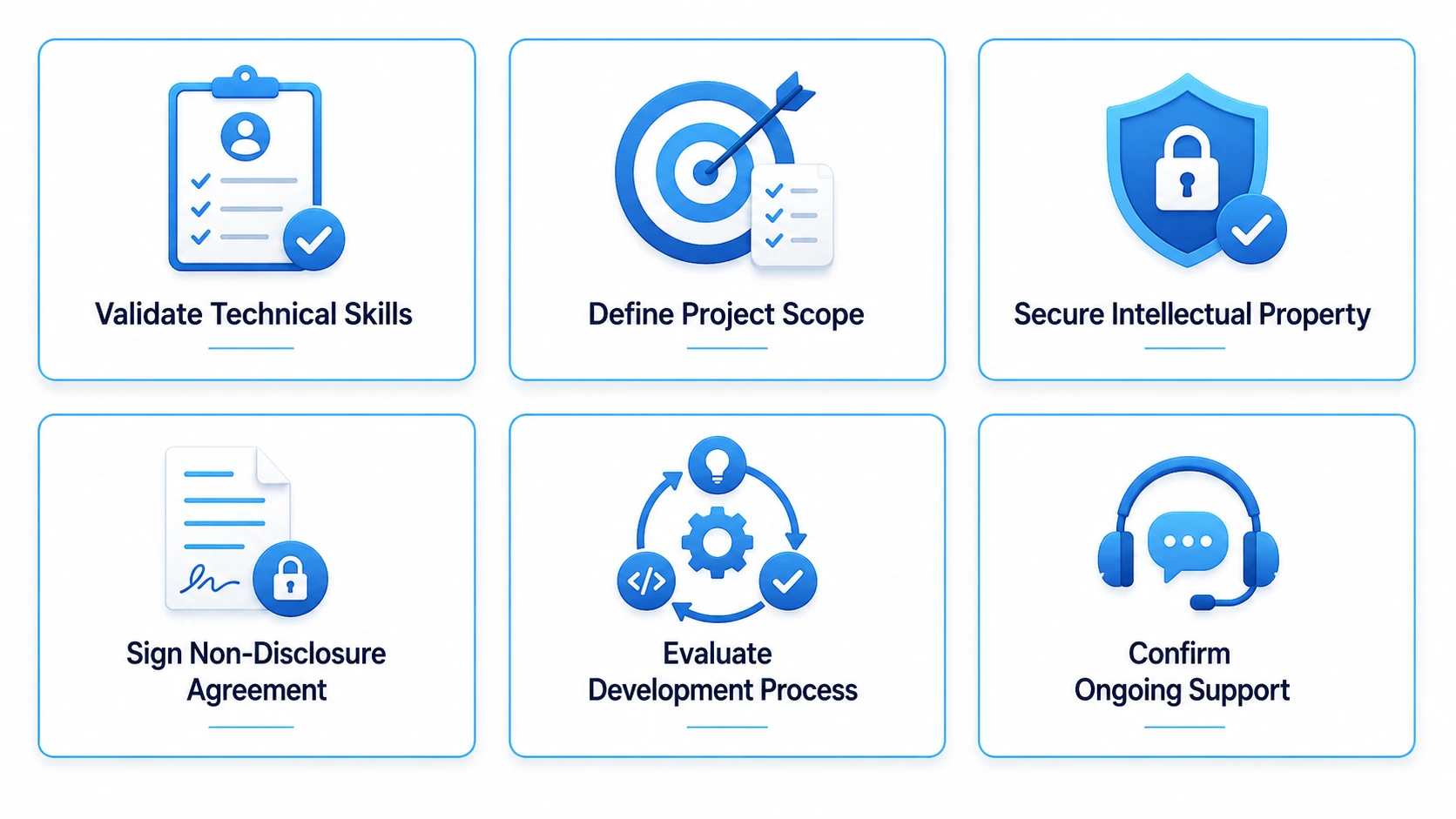
Choosing an Android developer isn’t just about technical expertise. Once you’ve shortlisted candidates or development partners, it’s time to evaluate the commercial and operational aspects of the engagement.
Many projects run into trouble not because developers lack technical skills, but because expectations around ownership, communication, timelines, and support were never clearly defined. A structured pre-contract review can significantly reduce these risks.
Use the checklist below before signing any agreement.
1. Confirm Technical Expertise with Real Evidence
A polished portfolio should never be the only deciding factor. Ask for evidence that demonstrates the developer or team has successfully delivered Android applications similar to yours.
Verify:
- Published Android apps on Google Play
- Industry-specific experience (Healthcare, FinTech, Retail, Logistics, etc.)
- Case studies with measurable business outcomes
- Experience building apps of similar complexity
- Client testimonials and third-party reviews
- Familiarity with your required technology stack
If possible, install one or two of their published apps. Evaluate startup speed, user experience, navigation, stability, and recent updates. An outdated application may indicate limited long-term maintenance capabilities.
2. Clarify Project Scope Before Development Begins
Many budget overruns occur because project requirements evolve without proper documentation.
Before work begins, ensure both parties agree on:
- Project objectives
- Core features
- Milestones
- Deliverables
- Timeline
- Acceptance criteria
- Change request process
A clearly documented scope reduces misunderstandings and makes project progress easier to measure.
3. Protect Your Intellectual Property
Your application idea, source code, business logic, and customer data are valuable assets. Ownership should be clearly defined before development starts.
Your agreement should specify:
- Complete IP ownership transfers to your business after payment.
- Source code repositories belong to you or are shared transparently.
- Design assets and documentation are included.
- Third-party licenses are disclosed.
- Confidential business information remains protected.
Never assume ownership automatically transfers unless it’s explicitly written into the contract.
4. Sign an NDA Before Sharing Sensitive Information
If your application involves proprietary business processes, innovative technology, or confidential customer data, a Non-Disclosure Agreement (NDA) should be signed before sharing detailed requirements.
An NDA helps protect:
- Product ideas
- Business strategies
- Customer information
- Revenue models
- Technical documentation
- Future product roadmap
While an NDA cannot eliminate every risk, it establishes clear legal obligations around confidentiality.
5. Understand the Development Process
Experienced Android development teams follow structured workflows rather than jumping directly into coding.
Ask how they handle:
- Product discovery
- Sprint planning
- Requirement validation
- Weekly progress reporting
- Quality assurance
- User Acceptance Testing (UAT)
- Release management
- Post-launch maintenance
A transparent development process usually leads to more predictable delivery and better communication throughout the project.
6. Discuss Post-Launch Support Early
Launching an app isn’t the end of the development journey.
After deployment, you’ll likely need:
- Bug fixes
- OS compatibility updates
- Performance improvements
- Feature enhancements
- Security updates
- Google Play policy compliance
Clarify whether maintenance is included, billed separately, or available through an ongoing support agreement.
Common Red Flags to Watch Before Hiring
Some warning signs don’t appear until development has already started. Recognizing them early can save significant time, budget, and frustration.
1. Unrealistically Low Pricing
If one proposal is dramatically cheaper than every other estimate, ask why.
Low pricing may indicate:
- Limited Android expertise
- Reused codebases
- Hidden charges
- Poor quality assurance
- Junior-only development teams
The cheapest proposal often becomes the most expensive once delays and rework are factored in.
2. Guaranteed Delivery Without Requirements
Be cautious of developers who promise exact timelines or fixed costs before understanding your product requirements.
Experienced Android professionals typically ask detailed questions about:
- Features
- User flows
- Backend systems
- Integrations
- Security
- Scalability
If these discussions never happen, the estimate may not reflect the actual project scope.
3. No Defined Development Process
If a vendor cannot explain how they manage projects, communicate progress, or handle testing, expect challenges later.
A mature Android development partner should have documented workflows for:
- Planning
- Development
- QA
- Deployment
- Maintenance
4. Poor Communication During Sales
The hiring experience often reflects the working relationship you’ll have after signing the contract.
Watch for:
- Slow responses
- Vague answers
- Missed meetings
- Inconsistent communication
- Lack of transparency
If communication is already difficult before development begins, it rarely improves later.
5. No Code Ownership or Repository Access
Your business should always understand who owns the final product.
Avoid agreements where:
- Source code ownership is unclear.
- Repository access is restricted.
- Documentation isn’t provided.
- Critical infrastructure remains under the vendor’s exclusive control.
These situations can make future maintenance or vendor transitions unnecessarily difficult.
6. Limited Proof of Android Expertise
A general software company may not always have deep Android experience.
Before hiring, verify that the team has worked with technologies such as:
- Kotlin
- Jetpack Compose
- Android Studio
- Firebase
- Google Play Console
- Android Architecture Components
Relevant expertise reduces technical risks and accelerates development.
How to Compare & Choose the Right Android Development Partner?
Once you’ve shortlisted a few Android developers or agencies, avoid making a decision based solely on price or portfolio. A structured evaluation framework helps compare vendors objectively and reduces the influence of marketing claims.
Instead of asking, “Which company looks the best?”, ask, “Which partner is most likely to deliver a successful product?”
Build a Vendor Evaluation Scorecard
Assign a score to each potential partner across the criteria that matter most to your project.
| Evaluation Criteria | Weight | Company A | Company B | Company C |
| Android Technical Expertise | 20% | |||
| Relevant Industry Experience | 15% | |||
| Portfolio Quality | 15% | |||
| Client Reviews & Reputation | 10% | |||
| Communication & Transparency | 10% | |||
| Development Process | 10% | |||
| Security & Compliance | 10% | |||
| Scalability & Team Strength | 5% | |||
| Pricing & Commercial Fit | 5% | |||
| Post-launch Support | 10% |
Note: This framework helps you compare partners using consistent criteria rather than relying on subjective impressions.
Look Beyond the Portfolio
An impressive portfolio demonstrates experience, but successful partnerships are built on much more than visual design.
The right Android development partner should combine:
- Strong technical capabilities
- Transparent communication
- Proven delivery processes
- Long-term product thinking
- Reliable post-launch support
- A collaborative approach to solving business challenges
Ultimately, the goal isn’t simply to hire mobile app developers, it’s to choose a partner capable of supporting your product from the first line of code through future growth.
Questions to Ask Before Making Your Final Decision
Before selecting an Android development partner, confirm that you can confidently answer the following:
- Have they built products similar to mine?
- Can they scale the team if requirements change?
- Do they provide dedicated project management?
- How frequently will progress be shared?
- What happens if priorities change mid-project?
- Who owns the source code and intellectual property?
- What support is available after launch?
- Are client reviews independently verifiable?
If any of these questions remain unanswered, continue your evaluation before signing a contract.
Top 10 Android App Development Companies in India (2026)
Choosing the right Android development partner requires more than comparing portfolios. Independent third-party directories can provide an additional layer of confidence by evaluating companies based on verified reviews, technical expertise, delivery performance, and market reputation.
| Rank | Company | Why Consider Them |
| 1 | Uplogic Technologies Pvt Ltd | Known for custom mobile app development and enterprise software solutions with experience across multiple business domains. |
| 2 | RipenApps | Best suited for startups and growing businesses seeking an experienced Android development partner with strong product consulting, end-to-end development, and post-launch support. |
| 3 | Young Decade IT Software Solution | Focuses on Android and cross-platform app development with experience delivering scalable digital products for startups and SMEs. |
| 4 | Konstant Infosolutions | Established software company offering Android app development, enterprise mobility solutions, and digital transformation services. |
| 5 | Junkies Coder | Provides custom Android application development with expertise in startup-focused mobile solutions and agile delivery. |
| 6 | MobileCoderz Technologies | Specializes in Android, iOS, and emerging technology solutions, including AI, IoT, and blockchain-powered mobile applications. |
| 7 | TechBuilder | Focuses on Android app development, AI-powered solutions, and scalable mobile applications for startups and growing businesses. |
| 8 | SDLC Corp | Offers Android development alongside cloud, AI, and enterprise software services for businesses across multiple industries. |
| 9 | Appinventiv | Recognized globally for large-scale mobile application development, digital product engineering, and enterprise transformation projects. |
| 10 | Quytech | Delivers Android app development services along with AI, AR/VR, and custom software solutions for startups and enterprises. |
Transparency Note: The companies below are listed according to the GoodFirms Leaders Matrix for Android App Development Companies in India (Industry Leaders quadrant), as of July 2026. The rankings are based on GoodFirms’ proprietary evaluation methodology, which considers Core Competencies and 360° Performance. RipenApps is ranked #2 among Industry Leaders, while Uplogic Technologies Pvt Ltd holds the #1 position.
1. Uplogic Technologies Pvt Ltd
Ranked #1 in the GoodFirms Industry Leaders Matrix, Uplogic Technologies has built a strong reputation for delivering Android applications, enterprise software, and custom digital solutions. The company serves businesses across industries with a focus on scalable technology implementations and mobile-first products.
2. RipenApps
Ranked #2 among Industry Leaders in the GoodFirms Leaders Matrix for Android App Development Companies in India (Core Competencies: 76 | 360° Performance: 58), as of July 2026, RipenApps has established itself as a trusted technology partner for startups, SMEs, and enterprises looking to build high-quality Android applications.
What sets RipenApps apart is its product-first approach. Instead of simply developing applications, the team works closely with clients from product discovery and UI/UX design to development, quality assurance, deployment, and long-term support. Its experience spans industries such as healthcare, fintech, logistics, eCommerce, education, travel, and on-demand services.
Businesses looking to hire Android app developers also benefit from flexible engagement models, including dedicated Android developers, managed development teams, and end-to-end product development services. This makes RipenApps particularly suitable for companies that expect their products to evolve after launch.
Industry Recognition
- ⭐ GoodFirms: 5.0/5 rating based on 31 verified reviews (Leaders Matrix listing).
- ⭐ Clutch: 4.9/5 rating from 44 verified client reviews.
3. Young Decade IT Software Solution
Young Decade IT Software Solution is recognized for developing Android and cross-platform applications for startups and growing businesses. The company focuses on building scalable mobile products while supporting clients throughout the development lifecycle.
4. Konstant Infosolutions
Konstant Infosolutions is an established software development company with extensive experience in Android application development, enterprise mobility, and digital transformation. Its broad service portfolio makes it a suitable choice for businesses with complex technology requirements.
5. Junkies Coder
Junkies Coder specializes in custom Android application development, helping startups and businesses transform ideas into mobile products. The company is known for agile development practices and delivering tailored digital solutions.
6. MobileCoderz Technologies
MobileCoderz Technologies develops Android applications alongside AI, IoT, blockchain, and enterprise software solutions. Its multidisciplinary capabilities make it a suitable option for organizations building technology-driven products.
7. TechBuilder
TechBuilder is a technology partner helping startups, SMEs, and enterprises to build high-quality Android applications. Its Android development services combine modern technologies, scalable architecture, AI integration, and user-focused design to support businesses developing secure, high-performance mobile products. These solutions are tailored to different industries and evolving business goals.
8. SDLC Corp
SDLC Corp provides Android app development, enterprise software, cloud solutions, and AI-driven digital products. Its experience spans startups as well as enterprise organizations undergoing digital transformation initiatives.
9. ToXSL Technologies Pvt Ltd
ToXSL Technologies Pvt Ltd is a software and mobile app development company that specializes in Android app development, custom software, AI-powered solutions, cloud services, and enterprise applications. Founded in 2012, the company serves startups, SMEs, and enterprises globally, with expertise in building scalable Android applications across industries such as healthcare, eCommerce, fintech, education, and logistics.
10. Quytech
Quytech develops Android applications alongside emerging technology solutions such as artificial intelligence, augmented reality, virtual reality, and custom software development. Its diverse technology expertise supports businesses building next-generation digital products.
Why Choose RipenApps for Android App Development?
Building an Android application requires more than writing code for a single device. Businesses need to account for device diversity, operating system compatibility, performance, security, Google Play requirements, and ongoing updates. RipenApps follows a product-first development approach that covers discovery, UI/UX design, implementation, quality assurance, deployment, and post-launch support. Its experience across fintech, healthcare, eCommerce, education, and other industries helps teams plan around different user expectations and business requirements.
The value of this approach lies in supporting the product beyond its initial release. A reliable Android application needs consistent testing, maintenance, and improvements as user needs and platform requirements evolve. RipenApps offers flexible engagement models, including dedicated developers, managed teams, and end-to-end product development, giving businesses options that fit their internal capabilities and delivery goals.
Wrapping Up
Hiring Android app developers is more than filling a technical role; it’s about choosing a partner who can transform your vision into a scalable, secure, and high-performing mobile application. By understanding the right engagement model, evaluating technical expertise, comparing costs, and following a structured selection process, you can minimize hiring risks and make confident decisions. Whether you’re building an MVP or an enterprise-grade solution, partnering with a trusted custom app development company can help accelerate development, improve product quality, and create long-term business value.
The right development partner should bring more than technical expertise; they should understand your business objectives, recommend the right technology approach, and support your product beyond its initial launch. Taking the time to evaluate experience, communication, delivery processes, and long-term support will help you make a confident hiring decision and build an Android application that’s designed for sustainable growth.
FAQs
Q1. How much does it cost to hire Android app developers in 2026?
The cost to hire Android app developers typically ranges from $20–$50 per hour in India, while developers in North America and Western Europe may charge $100–$200+ per hour. Pricing depends on factors such as developer experience, project complexity, engagement model, technology stack, and the level of expertise required.
Q2. Should I hire a freelance Android developer or a dedicated development team?
Freelancers are ideal for small projects, maintenance tasks, or MVPs with limited budgets. If you’re building a scalable product that requires design, development, QA, and ongoing support, hiring a dedicated Android development team provides better collaboration, predictable delivery, and long-term value.
Q3. What skills should I look for before hiring Android app developers?
Look for developers with expertise in Kotlin, Jetpack Compose, Android Studio, Clean Architecture, REST APIs, Firebase, Google Play Console, and mobile security best practices. Strong communication, problem-solving, and experience delivering similar Android applications are equally important.
Q4. How long does it take to hire Android app developers?
Hiring timelines depend on the engagement model. Freelancers can often start within a few days, while recruiting an in-house Android developer may take several weeks. Partnering with an experienced Android app development firm or dedicated team usually reduces onboarding time and accelerates project kickoff.
Q5. Do I need a native Android developer or a cross-platform developer?
If Android is your primary platform or your app requires high performance, advanced device integrations, or long-term scalability, hiring a native Android developer is the better choice. Cross-platform development works well when you want to launch both Android and iOS apps using a shared codebase. Also, understanding the differences between Android vs iOS App Development can also help you determine whether a native Android approach or a cross-platform solution best aligns with your business goals and target audience.
Q6. How can I verify an Android developer’s experience?
Review their portfolio, published Google Play apps, case studies, client testimonials, and third-party ratings on platforms like GoodFirms and Clutch. During interviews, ask about real projects, technical challenges they’ve solved, and the technologies they used to deliver successful Android applications.
Q7. Is it safe to outsource Android app development?
Yes, outsourcing is a reliable option when you work with a reputable development partner. Before signing a contract, ensure you have an NDA, clear intellectual property ownership, transparent communication processes, defined milestones, and post-launch support terms to protect your business interests.
Q8. Can I hire a single Android developer instead of a complete team?
Yes, for smaller projects, prototypes, or maintenance work, hiring a single Android developer may be sufficient. However, if your project requires UI/UX design, quality assurance, backend integration, and continuous feature development, a dedicated team is often a more efficient and scalable choice.
Q9. How do I choose the best Android app development partner?
Compare companies based on their Android expertise, industry experience, verified client reviews, development process, communication, technical capabilities, and post-launch support. Looking beyond pricing and evaluating overall business value helps you choose the right long-term development partner.
Q10. Why should I hire Android app developers from India?
India has become one of the leading destinations for Android app development due to its large talent pool, competitive pricing, strong technical expertise, and experience delivering mobile solutions for startups, SMEs, and global enterprises. Businesses can access skilled developers while maintaining cost efficiency and high-quality outcomes.
Discuss your project and request for proposal
SHARE
WRITTEN BY

Mohit Singh
Technical Content Writer
Mohit is a writer who makes technology easy to understand. He uses clear and simple words to explain technology for techy and non techy people who may not know much about tech. Mohit wants everyone to get how technology works without it being confusing. He's really good at turning complicated ideas into simple articles that anyone can read and enjoy. Mohit's goal is to help people see that tech isn't so hard to understand – it's for everyone!
View All Articles