

Key Takeaways
- Fitness apps are evolving into predictive health platforms using AI, biometrics, and real-time data personalisation.
- The global fitness app market is projected to reach $9.12 billion in 2026, signalling strong startup opportunities.
- Wearable integrations like smart rings and CGMs are shifting apps from tracking tools to continuous health intelligence systems.
- Gamification, community features, and AI coaching can strengthen engagement by giving users more reasons to return and continue their fitness routines.
- Building a scalable fitness app in 2026 requires balancing AI complexity, compliance requirements, and multi-device ecosystem integration.
A strong fitness app idea in 2026 solves a specific user problem through personalised experiences, connected data, convenient workouts, or meaningful engagement. The most promising concepts combine clear audience needs with practical technology, scalable monetisation, strong privacy controls, and a focused MVP rather than trying to replicate every feature of a large fitness platform.
Fitness apps are moving beyond basic activity tracking and generic workout plans. AI, connected devices, and immersive technologies are enabling personalised coaching, real-time biometric insights, adaptive fitness programs, and more engaging workout experiences. As these technologies increasingly intersect with healthcare solutions and services, fitness platforms are also moving toward a more connected and holistic approach to personal wellness.
For startups, the opportunity is less about adding every emerging technology and more about choosing the right product direction. In this guide, we’ll explore 25 fitness app ideas across workouts, wellness, social experiences, and gamification, along with the trends, features, costs, and MVP considerations startups should evaluate before development.
Table of Contents
Why Is the Popularity of Fitness Apps Growing?
Fitness apps have become a convenient way for consumers to exercise, track progress, manage nutrition, and build healthier routines without depending entirely on physical locations or fixed schedules. As smartphones, wearables, and connected health platforms become more integrated, users increasingly expect fitness experiences to be personalised, accessible, and data-driven.
With just a click, users can check important fitness metrics, review their progress, and adjust their fitness routines accordingly. The growing adoption of connected fitness experiences is creating opportunities for startups to build more personalised and data-driven products. According to Statista, the global fitness apps market is projected to generate $9.12 billion in revenue in 2026 and reach $15.45 billion by 2031, representing a 11.12% CAGR from 2026 to 2031.
According to Statista, the US is expected to generate approximately $2.52 billion in fitness app revenue in 2026, making it the largest national market by revenue. Statista also projects 26% user penetration in 2026, rising to 43.06% by 2031, while average revenue per user is expected to reach $4.45.
All these mobile app industry statistics indicate continued demand for digital fitness experiences, particularly products that offer personalised guidance, connected-device insights, or specialised wellness experiences. For startups, the opportunity lies in identifying a specific user problem and building a focused product around it.
Modern fitness users increasingly expect more than basic activity tracking. They want fitness apps to reduce the effort involved in planning workouts, understanding progress, and maintaining consistency. This has shifted expectations from simple logging toward personalised recommendations, connected-device insights, flexible workout formats, and social accountability.
For startups, this creates an opportunity to compete on experience rather than feature volume. A focused app can serve a specific need, such as helping busy professionals complete short workouts, helping runners optimise training, or helping older adults maintain mobility. The strongest products make the user’s next action clear instead of overwhelming them with dashboards and metrics.
Several changes are contributing to this growth.
1. Fitness Is Becoming More Context-Aware
Fitness apps are increasingly adapting to when, where, and how users exercise. Instead of offering the same workout every day, a product can recommend a session based on available time, equipment, recent activity, recovery, and user goals.
This creates opportunities for startups to build focused experiences such as 15-minute office workouts, hotel-room training, equipment-free sessions, or recovery-focused routines.
Convenience is no longer only about access. It is also about reducing decision-making. Instead of asking users to decide what to do every day, an app can recommend a suitable workout based on their goals, schedule, previous activity, and recovery status.
2. Personalised Fitness Like Never Before
Generic fitness programs are giving way to adaptive experiences. AI can analyse information such as workout history, preferences, goals, sleep patterns, and wearable data to adjust recommendations.
Google Health Coach, for example, is designed to adapt fitness plans and day-by-day workouts around individual routines and goals. For startups, this means personalisation can become a core product differentiator rather than a secondary feature.
3. Affordable Alternatives to Traditional Training
Personal training can be expensive and difficult to schedule consistently. Fitness apps can make structured guidance available through subscriptions, freemium models, digital classes, or specialised coaching.
This does not mean an app has to compete directly with personal trainers. A startup can instead create a hybrid product that combines digital guidance with human coaching, community support, or expert-reviewed programs.
4. Integration With Wearable Technology
Wearables have transformed the amount of health and activity data available to consumers. Smartwatches, smart rings, heart-rate monitors, and other devices can provide information about activity, heart rate, sleep, recovery, and other metrics. In 2026, the ecosystem is becoming broader still, with platforms increasingly combining wearable data with other health information.
Google has announced support for connecting CGMs through Health Connect, allowing users to explore how workouts or meals affect glucose levels. This opens opportunities for fitness apps that turn raw data into understandable recommendations rather than simply displaying more numbers.
5. Growing Focus on Holistic Wellness
Fitness is no longer limited to exercise. Users increasingly associate a healthy lifestyle with sleep, nutrition, stress management, recovery, mindfulness, and sustainable habits. This creates space for products that combine physical activity with broader wellness goals.
The opportunity for startups is to define a clear problem within this wider category instead of attempting to build an all-purpose health platform from day one.
Top Fitness App Ideas That Will Dominate the Market
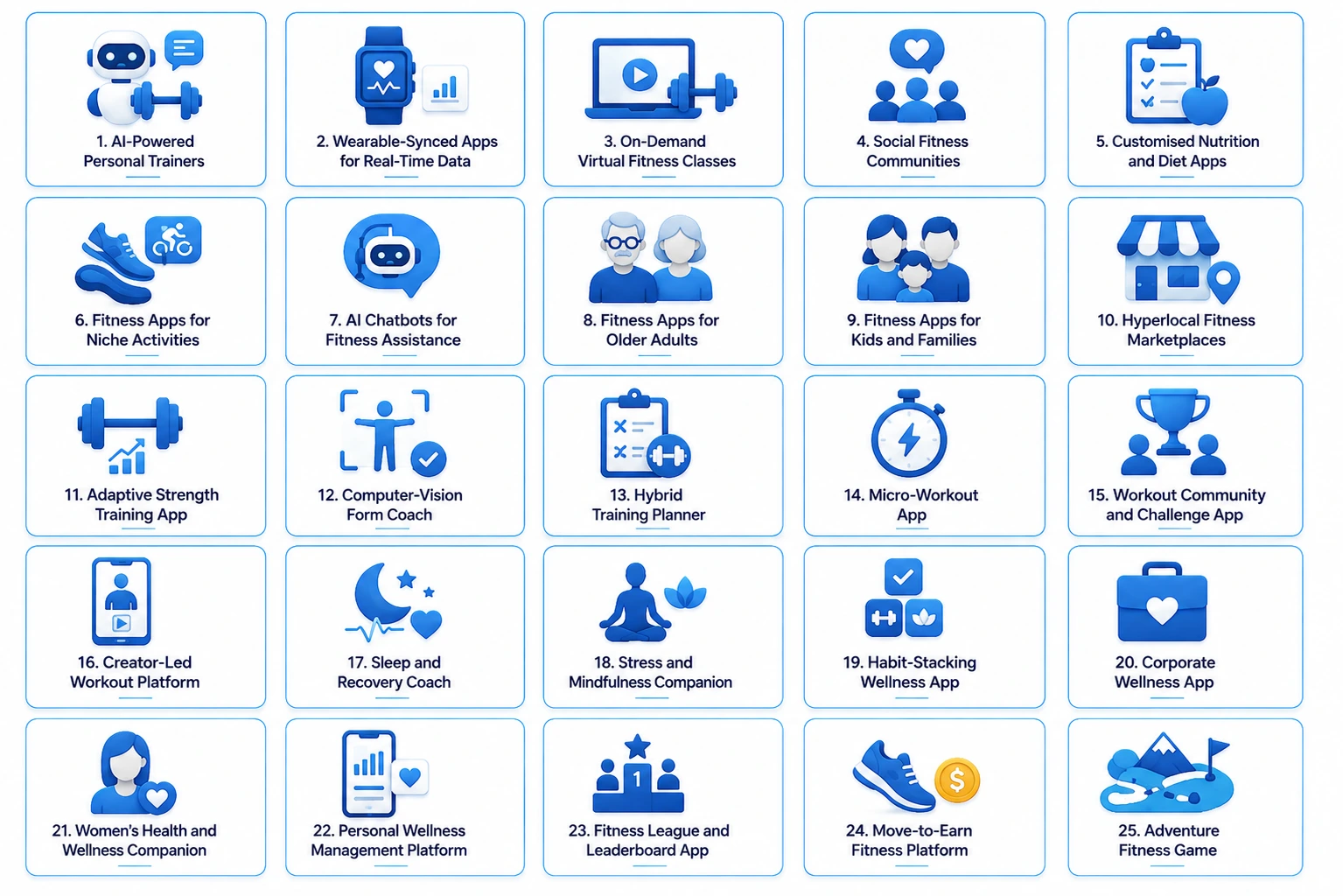
Before selecting a fitness app concept, startups should evaluate more than market popularity. The idea should address a recurring user problem, have a clearly identifiable audience, and offer a reason for users to return. Founders should also consider the availability of data, integration requirements, monetisation potential, regulatory considerations, and the level of competition in the category. A concept that requires expensive AI or wearable integrations may have strong differentiation but could be difficult to validate as an MVP. Starting with the smallest version of the core experience can help test demand before introducing advanced capabilities.
1. AI-Powered Personal Trainers
An AI-powered personal trainer can provide personalised workout guidance without requiring users to schedule sessions with a human trainer. The app can start by asking users about their fitness level, goals, available equipment, workout frequency, preferred activities, and time available per session.
It can then create a training plan and adjust it based on completed sessions and user feedback. The key differentiator should be adaptation. A static workout generator is easy to replicate. A system that understands a user’s behaviour and adjusts training recommendations over time provides a stronger reason to keep using the app.
- Target user: Beginners and intermediate users who want personalised guidance.
- Core functionality: Personalised plans, adaptive workouts, progress analysis, conversational coaching, and goal management.
- Differentiator: Training recommendations that evolve with the user.
For deeper technical considerations, link the first mention of this concept to the existing AI fitness app development guide rather than duplicating the development discussion here.
2. Wearable-Synced Apps for Real-Time Data
A wearable-synced fitness app can connect data from smartwatches, rings, heart-rate monitors, and other devices. The product could focus on converting raw data into actionable recommendations. Potential experiences can include daily readiness summaries, training recommendations, activity trends, recovery insights, goal alerts, and performance reports.
The product should avoid becoming a dashboard with dozens of numbers. The real value lies in explaining what those numbers mean. For startups building deeper activity-tracking functionality, the fitness tracking app development guide covers the technical considerations in more detail.
- Target user: Wearable owners who want more actionable fitness insights.
- Core functionality: Device integration, data synchronisation, analytics, recommendations, and progress dashboards.
- Differentiator: Turning multiple data streams into simple fitness decisions.
3. On-Demand Virtual Fitness Classes
An on-demand fitness platform can provide users with access to classes whenever they want. Instead of competing purely on content volume, startups can specialise in a particular audience or format. For example, startups can offer beginner strength classes, low-impact workouts, family fitness programs, mobility sessions, short office workouts, and post-work recovery sessions.
A recommendation engine can then help users find the right class based on their goals and previous activity.
- Target user: Users who want flexible access to guided workouts.
- Core functionality: Video classes, search, recommendations, instructor profiles, progress tracking, and subscriptions.
- Differentiator: Specialised content and discovery rather than an oversized generic library.
4. Social Fitness Communities
Social fitness apps can make exercise more engaging by combining workouts with community interaction. Users can create groups, share progress, participate in challenges, follow trainers, and work toward shared goals. The important distinction is that social features should support fitness behaviour. A general-purpose social feed is unlikely to create a strong fitness product on its own.
- Target user: Users who are motivated by accountability and community.
- Core functionality: Profiles, groups, challenges, messaging, activity sharing, and community goals.
- Differentiator: A fitness-first social network built around accountability, peer interaction, and everyday activity sharing rather than structured training programs or competitive leagues.
5. Customised Nutrition and Diet Apps
Fitness and nutrition often influence each other, making personalised nutrition an attractive extension of fitness products. An app could provide personalised meal recommendations based on fitness goals, dietary preferences, allergies, calorie targets, meal schedules, and activity levels.
A fitness startup could also integrate nutrition recommendations directly into workout planning. For example, a user preparing for a long-distance event could receive training and nutrition guidance within the same experience.
- Target user: Users who want fitness and nutrition guidance together.
- Core functionality: Meal planning, nutrition logging, food recommendations, grocery planning, and progress tracking.
- Differentiator: Connecting nutrition recommendations with fitness goals.
Read Also: How to Create the Best Nutrition Tracking App: Business Model, Tech Stack & ROI Tips
6. Fitness Apps for Niche Activities
Generic fitness platforms are not always the best option for users with specialised interests. A niche product can provide specialised programs, terminology, progress metrics, communities, and educational content.
Startups can build fitness products around activities such as boxing, Pilates, swimming, climbing, cycling, dance, martial arts, and mobility training.
- Target user: Enthusiasts of a specific fitness activity.
- Core functionality: Activity-specific training plans, progress tracking, educational content, and community features.
- Differentiator: Deep expertise in one activity instead of shallow coverage of many.
7. AI Chatbots for Fitness Assistance
An AI chatbot can act as an always-available fitness assistant. Users could ask the app for personalised guidance, such as what workout to do today, how to structure their week, how to adjust after missing a session, or a quick 20-minute bodyweight workout.
The chatbot can become more useful when connected to the user’s goals and approved fitness data rather than operating as a generic question-answering tool. However, startups should clearly distinguish fitness guidance from medical advice.
- Target user: Users who want instant fitness assistance.
- Core functionality: Conversational guidance, workout suggestions, FAQs, goal support, and personalised recommendations.
- Differentiator: Context-aware assistance based on the user’s fitness journey.
8. Fitness Apps for Older Adults
Older adults have different fitness requirements from younger users. A dedicated product could focus on balance, mobility, strength, flexibility, low-impact exercise, fall-risk awareness, and consistent fitness habits.
The interface should prioritise accessibility, clear instructions, large touch targets, simple navigation, and appropriate pacing.
- Target user: Older adults and their families or caregivers.
- Core functionality: Guided exercises, progress tracking, reminders, accessibility features, and optional caregiver tools.
- Differentiator: An experience designed specifically around ageing-related fitness needs.
9. Fitness Apps for Kids and Families
Family fitness apps can encourage parents and children to become active together. The product could include family challenges, age-appropriate activities, outdoor missions, parent-managed profiles, activity goals, and reward systems. Privacy and parental controls should be central to the design when children are involved.
Depending on the product’s geography and data practices, startups may also need to consider child-privacy requirements and age-appropriate design.
- Target user: Families seeking shared physical activities.
- Core functionality: Family accounts, age-appropriate workouts, challenges, parental controls, and progress tracking.
- Differentiator: Fitness as a shared family activity rather than an individual routine.
10. Hyperlocal Fitness Marketplaces
A hyperlocal fitness marketplace can connect consumers with nearby gyms, studios, trainers, running groups, yoga instructors, and fitness classes. Users could search for fitness options based on location, activity, price, availability, and experience level. Providers could manage schedules, bookings, payments, and customer relationships.
- Target user: Local fitness consumers and independent fitness providers.
- Core functionality: Discovery, profiles, booking, payments, reviews, and scheduling.
- Differentiator: Combining local fitness discovery with digital booking.
Workout App Ideas
The market for specialised exercise experiences creates room for workout app ideas that focus specifically on how users train, improve technique, and stay consistent.
11. Adaptive Strength Training App
An adaptive strength app can create and adjust training programs according to a user’s experience, goals, equipment, and performance. Instead of assigning the same progression to everyone, the system could use completed workouts and feedback to adjust future sessions.
For example, if a user completes all prescribed sets comfortably, the app might increase the next session’s intensity. If performance declines repeatedly, it could reduce volume or suggest additional recovery.
- Target user: Beginners and intermediate strength trainees.
- Core functionality: Progressive programs, exercise library, workout logging, performance analysis, and adaptive programming.
- Differentiator: A strength plan that responds to actual performance.
12. Computer-Vision Form Coach
A computer-vision workout app can use a smartphone camera to analyse exercise movement and provide visual or audio feedback. Potential use cases include analysing squat alignment, push-up form, lunge positioning, range of motion, and repetition counting. The app should frame this as fitness coaching and avoid making unsupported medical claims.
- Target user: Home exercisers who want technique guidance.
- Core functionality: Camera-based movement analysis, exercise recognition, feedback, and repetition tracking.
- Differentiator: Bringing elements of trainer-style form feedback to users exercising independently.
13. Hybrid Training Planner
Hybrid athletes often combine strength, running, cycling, swimming, mobility, or other forms of training. A hybrid training planner can coordinate these activities into a single program. For example, a user training for a running event while maintaining strength could receive a weekly plan that balances both objectives instead of treating them as separate routines.
- Target user: Athletes combining multiple training disciplines.
- Core functionality: Multi-activity planning, calendars, training load management, progress tracking, and recovery recommendations.
- Differentiator: One training system for multiple fitness disciplines.
14. Micro-Workout App
A micro-workout app is designed for users who cannot consistently dedicate 45–60 minutes to exercise. The app can generate workouts based on the user’s available time, offering 5-, 10-, 15-, or 20-minute sessions. It can also use context. A user sitting at a desk all day might receive a mobility session, while someone with limited time before work could receive a short full-body workout.
- Target user: Busy professionals, parents, and users with unpredictable schedules.
- Core functionality: Time-based workouts, contextual recommendations, reminders, and progress tracking.
- Differentiator: Making exercise fit into small windows of time.
15. Workout Community and Challenge App
This concept combines structured workouts with community-led challenges. Users could join a 30-day strength challenge, a mobility challenge, or a weekly consistency competition. Coaches or creators could host programs and interact with participants. The community becomes part of the motivation loop.
- Target user: Users who struggle with consistency in structured workout programs.
- Core functionality: Challenges, groups, leaderboards, workout programs, progress sharing, and coach interaction.
- Differentiator: Cohort-based workout programs where users complete structured training together through time-bound challenges and shared progress.
16. Creator-Led Workout Platform
Fitness creators can have strong audiences but often rely on fragmented tools for content, payments, community, and coaching. A creator-led workout platform can bring these capabilities together, allowing creators to publish workout programs, offer subscriptions, host live classes, run challenges, communicate with members, and track engagement.
- Target user: Fitness influencers, trainers, coaches, and their audiences.
- Core functionality: Creator profiles, programs, subscriptions, live sessions, community tools, and analytics.
- Differentiator: Giving fitness creators the infrastructure to package their expertise into paid programs, memberships, live sessions, and communities.
RipenApps example: FitZure developed by RipenApps shows how a digital fitness platform can help fitness influencers turn their expertise into structured, monetisable experiences for their audiences. The platform has reached 1M+ users, generated $2M+ in revenue, and achieved a 46% increase in user engagement, demonstrating the potential of creator-focused fitness platforms.
Wellness App Ideas
Exercise is only one part of a healthy lifestyle. The growing connections among physical activity, sleep, recovery, stress, habits, and lifestyle create opportunities for specialised wellness app ideas.
Wellness apps can vary significantly in scope, from habit-building tools to platforms that combine sleep, activity, nutrition, and stress management. Startups should avoid trying to cover every aspect of wellness from the beginning. A more focused approach is to identify one behaviour or outcome that users struggle to manage consistently. For example, a sleep product could focus on recovery routines, while a habit app could focus on building sustainable movement and mindfulness routines. A narrow initial use case makes it easier to define the MVP, measure engagement, and determine whether users are willing to pay for the experience.
17. Sleep and Recovery Coach
A sleep and recovery app can help users understand how their recovery relates to their daily routines and exercise. The app could combine permitted wearable data with user feedback to provide personalised recommendations, such as prioritising sleep, choosing a lower-intensity workout, scheduling recovery activities, or maintaining a consistent bedtime. The goal is to help users understand patterns rather than simply display a sleep score.
- Target user: Fitness users who want to improve recovery.
- Core functionality: Sleep tracking, recovery insights, trends, routines, and recommendations.
- Differentiator: Connecting recovery information with fitness decisions.
18. Stress and Mindfulness Companion
A stress and mindfulness app can provide short interventions that users can access throughout the day. Features could include guided breathing, meditation, journaling, mindfulness sessions, stress check-ins, and relaxation exercises.
The experience can become more useful when recommendations are contextual. Instead of asking users to browse hundreds of sessions, the app could suggest a five-minute breathing exercise after a stressful check-in.
- Target user: Professionals and consumers seeking everyday stress-management support.
- Core functionality: Guided sessions, check-ins, journaling, reminders, and wellness trends.
- Differentiator: Contextual wellness recommendations rather than a static content library.
Example: Mind Alcove, a wellness-focused platform developed by RipenApps, has achieved 50K+ app downloads and a 4.1/5 App Store rating. Its features include mood tracking, eight customised diaries, mood insights, journal prompts, and an anonymous community, showing how wellness apps can combine personalised experiences with mindfulness and everyday mental well-being.
19. Habit-Stacking Wellness App
Many wellness goals fail because users try to introduce too many new behaviours simultaneously. A habit-stacking app could help users connect small actions to routines they already follow.
For example:
Wake up – drink water – stretch for five minutes – prepare breakfast – take a short walk.
- Target user: People who struggle to maintain healthy routines.
- Core functionality: Habit sequences, reminders, streaks, routine planning, and progress insights.
- Differentiator: Connecting several small behaviours into sustainable routines.
20. Corporate Wellness App
Corporate wellness creates a B2B opportunity within the fitness market. A platform could help companies support employee wellness through movement challenges, wellness education, mindfulness sessions, activity goals, team competitions, and recovery resources.
Employers could access aggregated engagement information while maintaining appropriate privacy protections around individual health information.
- Target user: Employers, HR teams, and distributed workforces.
- Core functionality: Employee profiles, challenges, wellness content, team activities, administrative dashboards, and reporting.
- Differentiator: Personalised wellness experiences combined with organisation-level engagement.
21. Women’s Health and Wellness Companion
Women’s health creates opportunities for fitness and wellness products designed around specific life stages and user needs. Depending on the scope, a product could combine fitness planning, recovery, nutrition, cycle-related tracking, educational content, and wellness support for pregnancy, postpartum, and menopause.
Health-related data requires careful handling, and the product should be designed around consent, privacy, security, and applicable requirements from the beginning.
- Target user: Women seeking more personalised fitness and wellness experiences.
- Core functionality: Personalised fitness, wellness tracking, educational resources, and goal management.
- Differentiator: Designing around women’s specific contexts instead of adapting a generic fitness product.
Read Also: Women Health Tracker App Development: A Strategic Guide for Modern Businesses
22. Personal Wellness Management Platform
A personalised wellness management platform can act as a daily orchestration layer across multiple wellness goals. Instead of simply displaying health metrics, the app could combine user goals, activity patterns, sleep information, habits, and permitted device data to create a practical daily wellness plan.
For example, the platform could recommend a lighter workout after poor sleep, prompt a short mindfulness session after a stressful check-in, or adjust a user’s daily goals based on recent activity.
- Target user: Consumers who want a unified approach to lifestyle wellness.
- Core functionality: Goal setting, progress monitoring, recommendations, wellness plans, and integrations.
- Differentiator: Bringing several wellness behaviours into one coherent experience.
Example: EmmyHealth, a wellness management platform developed by RipenApps, was built for Android and iOS in just 3 months, combining real-time mental and physical health tracking, stress-management tools, supplemental benefits, and personalised dashboards. This demonstrates how startups can launch a focused wellness platform that brings multiple health goals and resources into one connected digital experience without attempting to build a full healthcare ecosystem from day one.
Gamified Fitness App Ideas & Best Examples
Gamification should be designed around the behaviour a startup wants to reinforce. Streaks can encourage consistency, challenges can create short-term goals, and team-based mechanics can strengthen accountability. Competitive mechanics can work well for experienced users, while beginners may respond better to progress milestones and achievable rewards.
Startups should also avoid making competition the only motivation. Leaderboards based purely on distance or workout volume can favour highly active users and discourage beginners. A more inclusive system could reward consistency, personal improvement, completed sessions, or participation. This makes gamification relevant to a wider range of users while reducing the pressure to exercise excessively.
The strongest gamified fitness apps in 2026 use mechanics such as challenges, achievements, leaderboards, stories, streaks, and community goals to reinforce specific behaviours such as consistency, goal completion, competition, and accountability.
Best Gamified Fitness Apps 2026: What Can Startups Learn?
Strava uses challenges, leaderboards, trophies, segments, and community participation. Its current challenge system supports individual and group goals and can include distance, elevation, time, or activity-frequency targets.
Nike Run Club uses individual and community challenges, achievements, trophies, personal bests, and streaks. This combination connects competition with progress and social participation.
Zombies, Run! takes a different approach. It turns running into an interactive story where users complete missions, collect supplies, rebuild a virtual community, and respond to narrative events. The concept shows how narrative progression can give users a reason to return beyond simply recording another workout.
These examples demonstrate an important principle: gamification works best when it gives the user a reason to continue performing the desired behaviour.
Fitness App Gamification Trends 2026
The biggest fitness app gamification trends in 2026 are moving beyond simple badges and streaks toward challenges, leagues, narrative progression, team competition, and real-world rewards.
| Gamification mechanic | Example app | Behaviour it can encourage |
| Streaks | Nike Run Club | Consistent activity |
| Challenges | Strava | Short- and medium-term goal completion |
| Leaderboards | Strava | Competition and accountability |
| Achievements | Nike Run Club | Progress recognition |
| Narrative progression | Zombies, Run! | Continued participation |
| Team goals | Strava / Nike Run Club | Social accountability |
| Virtual rewards | Fitness challenge platforms | Milestone-driven participation |
Startups should also think carefully about fairness. Strava’s ongoing investment in machine-learning systems for detecting anomalous activity demonstrates why competitive fitness products need reliable activity validation. If users can manipulate activity data easily, leaderboards and rewards lose their credibility.
23. Fitness League and Leaderboard App
A fitness league app can organise users into competitive groups. Participants could compete based on completed workouts, active minutes, running distance, strength milestones, consistency, and overall team contribution. Leagues could reset weekly or monthly, giving users repeated opportunities to compete.
- Target user: Competitive fitness communities.
- Core functionality: Rankings, leagues, challenges, achievements, and progress dashboards.
- Differentiator: A recurring competitive system with leagues, rankings, seasons, and promotion-style progression rather than one-off challenges.
24. Move-to-Earn Fitness Platform
A move-to-earn product can reward verified activity with practical incentives. Rewards could include partner discounts, premium access, digital collectibles, challenge rewards, and exclusive membership benefits. The model should be designed carefully so that rewards encourage healthy behaviour rather than excessive exercise or unsafe activity.
- Target user: Users motivated by tangible incentives.
- Core functionality: Activity verification, reward tracking, challenges, partner offers, and achievement systems.
- Differentiator: Connecting physical activity with useful rewards.
25. Adventure Fitness Game
An adventure fitness game can turn exercise into a progression system. Users could walk, run, cycle, or complete workouts to unlock missions, explore virtual locations, collect items, build characters, complete quests, and unlock story chapters. Zombies, Run! demonstrates how narrative can transform running from a repetitive activity into an immersive experience.
- Target user: Users who find traditional fitness tracking repetitive.
- Core functionality: Activity tracking, missions, rewards, narrative progression, achievements, and virtual worlds.
- Differentiator: Making physical activity part of a larger game experience.
Fitness App Innovation: What’s Changing in 2026
Fitness apps innovation in 2026 is moving toward products that interpret data, personalise recommendations, and connect multiple aspects of the user’s fitness journey.
The biggest opportunity is not simply adding more technology. It is using technology to reduce friction and make the experience more useful.
1. AI-Personalised Coaching
AI coaching is moving beyond generic chatbot functionality. WHOOP’s AI-powered WHOOP Coach uses individual biometric data, goals, behaviours, and performance science to provide personalised fitness and performance guidance, illustrating how AI coaching is becoming more context-aware. Google is also positioning Health Coach around adaptive health and fitness guidance.
This signals a broader shift: users increasingly expect fitness products to understand context. A startup does not necessarily need to build a general-purpose AI coach. A specialised coach for runners, strength trainees, older adults, or workplace wellness may have a clearer value proposition.
2. Wearable and CGM Data Convergence
Wearable data is becoming only one part of the connected health ecosystem. Smartwatches and rings can provide activity, heart rate, sleep, and recovery information. Continuous glucose monitors can provide another stream of physiological data.
Google’s 2026 updates explicitly discuss connecting a continuous glucose monitor through Health Connect and asking the coach how a workout or meal affects glucose levels. For fitness startups, the opportunity is to become an interpretation layer that turns connected health data into practical fitness decisions rather than another dashboard of isolated metrics.
Instead of building another dashboard, a product could answer practical questions:
- How did my activity affect my recovery?
- What training pattern is associated with better sleep?
- How does my activity change after different meals?
- When am I most consistent with exercise?
This also increases the importance of data privacy and permission management.
3. GLP-1-Adjacent Fitness Companions
GLP-1 medications have created new conversations around weight management, nutrition, exercise, and preserving healthy body composition. This creates an adjacent opportunity for fitness products that support lifestyle behaviours around these users without presenting themselves as medical treatment.
A fitness companion could focus on:
- Strength training
- Protein and nutrition logging
- Activity consistency
- Recovery
- Habit formation
- Progress tracking
The product should be designed with appropriate clinical boundaries and should not provide unsupported medical guidance. The opportunity is to address the practical fitness and lifestyle needs that can accompany changing weight-management journeys.
4. Social and Creator-Led Fitness
Fitness creators are increasingly becoming product distributors. Instead of relying exclusively on large fitness brands, startups can create platforms where trainers and creators can build communities, publish programs, run challenges, host live sessions, and monetise expertise.
This creates a two-sided opportunity:
- For creators: tools to build and monetise a fitness business.
- For users: structured programs and community access from people they already follow.
The strongest creator-led products should combine content with progression. A collection of videos is easy to replace. A personalised program, community, progress history, and creator relationship create stronger retention.
5. AR/VR and Immersive Fitness
AR and VR in fitness training can make workouts more interactive and engaging by creating immersive fitness experiences. Potential concepts include:
- Virtual boxing environments
- Immersive cycling experiences
- AR movement guidance
- Interactive home workouts
- Virtual fitness competitions
- Gamified movement environments
However, AR/VR should not be added simply because the technology is impressive. The product should clearly define what problem immersion solves. If it improves motivation, makes instruction more engaging, or creates a stronger sense of presence, AR/VR has a clear product purpose.
Fitness App Business Plan: What to Include
Before turning a fitness app idea into a product, startups should outline a simple fitness app business plan covering the target audience, user problem, core features, competitive differentiation, monetization strategy, development costs, and growth strategy. The plan should also define how the app will acquire and retain users and which metrics will measure its performance. Validating these factors early can help founders prioritize the right features and determine whether their fitness app idea has a viable path to market.
How to Choose the Right Fitness App Idea
Choosing the right fitness app idea requires balancing user demand with technical feasibility and business potential. Startups should begin by identifying a specific audience and the problem they experience frequently. The next step is to determine whether the problem is significant enough for users to change their behaviour or pay for a solution.
Founders should then evaluate the competitive landscape, available data, required integrations, monetisation options, and MVP complexity. Custom app development services can help translate validated requirements into a focused product while keeping the architecture flexible for future growth. An idea that depends on multiple wearables, computer vision, AI models, and real-time processing may require considerably more investment than a focused workout platform. Validating the core user experience first can help determine whether the additional technology is justified.
Key Features for Building a Modern Fitness App
The right features depend on the concept. A fitness marketplace does not need the same architecture as an AI coaching platform, and a wellness app does not require every possible wearable integration.
Still, several capabilities are increasingly important.
1. AI Personalisation Engine
An AI personalisation engine can analyse user preferences, goals, activity history, and other permitted data to generate relevant recommendations. Potential applications include:
- Workout recommendations
- Training-plan adjustments
- Class recommendations
- Progress analysis
- Recovery suggestions
- Conversational assistance
The system should have a defined purpose. AI should improve the product’s core experience rather than exist as a standalone chatbot.
2. Wearable and IoT Device Sync
Connected devices can make a fitness app more useful by providing continuous activity and health-related data. Potential integrations include:
- Smartwatches
- Smart rings
- Heart-rate monitors
- Connected gym equipment
- Health platforms
On iOS, HealthKit provides a central repository for health and fitness information, with users controlling which data an app can access. The product should request only the data it actually needs.
3. Social and Community Layer
Community features can include:
- Groups
- Challenges
- Leaderboards
- Messaging
- Activity sharing
- Team goals
- Creator communities
The social experience should support the core fitness behaviour instead of becoming a separate social network.
4. Offline Functionality
Users may exercise in places where connectivity is weak or unavailable. Offline functionality can allow them to:
- Access downloaded workouts
- Log activity
- Continue guided sessions
- Save progress
- Synchronise later
This is particularly important for running, outdoor training, travel, and gym environments with unreliable connectivity.
5. Privacy, HIPAA & GDPR Considerations
Fitness and wellness apps can handle sensitive information, but not every fitness app is automatically subject to the same regulatory requirements.
HIPAA applicability depends on the app’s relationship with covered entities and business associates and how health information is handled. GDPR requirements can also depend on the user’s location, the organisation, and the data being processed.
Therefore, founders should perform a proper legal and compliance assessment rather than assuming that adding a fitness feature automatically makes an app HIPAA-covered. Privacy should nevertheless be treated as a core product requirement. Important controls may include:
- Explicit consent
- Data minimisation
- Secure authentication
- Encryption
- Access controls
- Audit logging
- Data retention policies
- User deletion controls
- Transparent privacy policies
HealthKit also requires apps to obtain user permission for relevant health data and clearly explain how that information is used.
6. Gamification Elements
Gamification can include:
- Streaks
- Badges
- Challenges
- Levels
- Leaderboards
- Achievements
- Team competitions
- Rewards
The mechanic should reinforce a useful behaviour. For example, a streak can encourage consistency, while a team challenge can encourage accountability.
The goal should be sustainable engagement rather than addictive design patterns or unsafe exercise behaviour.
How Much Does It Cost to Build a Fitness App in 2026?
Understanding how to make fitness applications starts with defining the target user, core problem, MVP scope, technology requirements, integrations, security needs, and post-launch roadmap. For an idea-stage startup, the goal is not to build every feature immediately but to determine which capabilities are essential to validating the product.
For early planning, startups can consider the following broad ranges:
| Fitness app type | Indicative development cost | Typical scope |
| Basic MVP | $40,000–$70,000 | Accounts, workout library, basic tracking, dashboard |
| Mid-level app | $70,000–$150,000 | Personalisation, payments, social features, integrations |
| Advanced platform | $150,000–$250,000+ | AI, wearables, analytics, subscriptions, community |
| Complex AI/AR/VR platform | $250,000–$400,000+ | AI coaching, computer vision, immersive technology, multiple integrations |
These figures are planning ranges, not fixed quotations. The final cost depends on product scope, design complexity, platform selection, integrations, security requirements, development location, testing, and post-launch maintenance.
Startups should also evaluate how the app will generate revenue through subscriptions, freemium plans, paid programs, or marketplace commissions. Explore these fitness app monetization models to compare suitable approaches.
Factors That Affect Fitness App Development Cost
Fitness app development costs depend on factors such as features, platform, technology stack, integrations, design complexity, and development team location.
Feature Complexity
A workout library is relatively straightforward compared with AI-generated training programs, computer-vision coaching, or real-time connected-equipment integrations.
The more decision-making and data processing the product performs, the more architecture and testing it requires.
Platform Selection
Building for iOS and Android can increase development effort. A startup should decide whether native development, cross-platform development, or a hybrid approach makes the most sense based on the product’s technical requirements.
Third-Party Integrations
Fitness apps may integrate with:
- Health platforms
- Wearables
- Payment gateways
- Video platforms
- Social login providers
- Connected equipment
Every integration adds development, testing, maintenance, and dependency considerations.
AI Requirements
AI costs vary significantly. A recommendation engine is different from:
- A conversational AI coach
- Computer-vision movement analysis
- Predictive analytics
- Personalised content generation
Founders should define the exact AI use case before estimating costs.
UI/UX Complexity
Interactive dashboards, gamified interfaces, video experiences, live classes, and AR/VR environments require additional design and development work.
Security and Privacy
Apps that collect health or wellness information require careful data architecture and security controls.
Security should not be treated as a post-launch feature. It should be considered during requirements, architecture, development, testing, and deployment.
How Startups Can Control Development Costs
The most effective approach is to avoid building the complete vision immediately. For an AI strength-training platform, the MVP could focus on user registration, goal selection, fitness-level assessment, personalised workout generation, an exercise library, workout logging, and a progress dashboard. This focused approach helps startups validate their fitness app idea before investing heavily in advanced features.
Startups can postpone resource-intensive features such as computer vision, advanced wearable integrations, social leagues, live classes, AR/VR, and predictive analytics. This allows them to test the core product with a controlled investment and introduce advanced technology only after validating user demand.
Final Thoughts
The fitness app market is no longer limited to step counters, calorie trackers, and generic workout libraries. AI is making coaching more adaptive, wearables are making health and activity data more continuous, and wellness products are expanding into sleep, stress, recovery, and habits. Social, creator-led, and gamified experiences are also creating new ways for users to stay engaged.
But technology alone does not make a strong product. The best fitness app ideas start with a specific user problem and a clearly defined audience. A strength-training startup might focus on adaptive programming, a wellness startup on sleep and recovery, a creator on a community-based workout platform, or a corporate wellness company on team challenges. Start with the problem, validate the concept, define the MVP, and introduce advanced capabilities only where they create measurable value. Once the concept is validated, an experienced mobile application development services provider can help turn it into a scalable product roadmap and production-ready application.
FAQs
Q1. Which fitness app idea is most profitable for startups to build?
There is no single fitness app idea that guarantees profitability. The strongest opportunity depends on the target audience, problem, differentiation, acquisition strategy, and monetisation model. AI-powered coaching, specialised workout platforms, wellness management, creator-led fitness, and niche communities can all become viable businesses when they solve a clear user problem.
Q2. What are some workout app ideas for startups?
Some promising workout app ideas include adaptive strength-training apps, computer-vision form coaches, hybrid training planners, micro-workout platforms, workout challenge communities, and creator-led workout platforms. The right idea depends on the audience and the problem the startup wants to solve.
Q3. How long does it take to build a fitness app from scratch?
The development timeline depends on complexity. A focused MVP may take a few months, while an advanced platform with AI, wearable integrations, real-time features, computer vision, or AR/VR can take considerably longer. The timeline should be estimated after defining the feature scope, platforms, integrations, design requirements, and testing strategy.
Q4. Do fitness apps need to be HIPAA and GDPR compliant?
Not every fitness app is automatically subject to HIPAA or GDPR in the same way. Applicability depends on the type of information collected, how it is processed, the user’s location, and the organisations involved. However, fitness apps should still implement strong privacy and security practices, particularly when handling sensitive health-related information.
Q5. What makes a fitness app stand out in a crowded market?
A clear target audience and strong value proposition matter more than a long feature list. A fitness app can differentiate itself through specialised training, meaningful personalisation, strong community features, useful gamification, creator-led experiences, or a unique wellness outcome.
Q6. Is it necessary to integrate AI into a fitness app?
No. AI should be included when it solves a real product problem. Useful applications include personalised workout recommendations, adaptive training plans, progress analysis, conversational assistance, and computer-vision form feedback. A focused fitness app can succeed without AI if its core experience provides clear value.
Q7. How do fitness apps make money?
Common fitness app monetisation models include subscriptions, freemium upgrades, paid workout programs, in-app purchases, trainer subscriptions, marketplace commissions, corporate wellness licensing, and brand partnerships.
Q8. What are some wellness app ideas for startups?
Promising wellness app ideas include sleep and recovery coaches, stress and mindfulness companions, habit-stacking platforms, corporate wellness apps, women’s health and wellness companions, and personal wellness management platforms. The strongest concepts focus on a specific audience or measurable wellness outcome.
Q9. How do you choose fitness app names?
A strong fitness app name should be memorable, relevant to the target audience, easy to pronounce, and broad enough to support future product expansion. Startups should also check domain availability, trademarks, app-store naming conflicts, and social handles before finalising a name.
Q10. What are the biggest fitness app innovation trends in 2026?
Major fitness app innovation trends include AI-personalised coaching, wearable and CGM data integration, creator-led fitness, immersive AR/VR experiences, adaptive workouts, and connected wellness platforms.
SHARE
WRITTEN BY

Ishan Gupta
CEO & Founder
Ishan Gupta is a seasoned entrepreneur and CEO with extensive 10+ years of experience in business and mobile app development landscape. He believes that the right digital product allows companies to focus on what they do best, while technology handles the rest. With deep exposure to global markets, he understands what makes an app succeed. His approach translates business needs into clear product strategies, ensuring that every feature contributes to measurable ROI.
View All Articles