

Quick Summary
Custom mobile app development enables startups to build scalable, secure, and business-specific solutions that drive long-term growth. From delivering personalized user experiences to supporting AI integration and operational efficiency, custom apps provide greater flexibility than ready-made software. For startups building technology-driven businesses, custom development offers a sustainable competitive advantage.
Key Takeaways
- Custom mobile app development gives startups greater flexibility, scalability, and ownership, enabling products to evolve alongside changing business needs.
- Investing in a custom app helps businesses create differentiated user experiences that strengthen customer engagement and long-term competitive advantage.
- Custom applications support seamless AI integration, automation, and advanced third-party integrations, making them better prepared for future innovation.
- Although custom development requires more planning, it reduces technical debt and provides stronger security, performance, and long-term business value.
- Successful startups often choose custom app development because it creates scalable technology foundations that support sustainable growth and operational efficiency.
Custom mobile app development gives startups the flexibility, scalability, and competitive advantage they need to build products around their business goals instead of forcing their business to fit software limitations. Unlike off-the-shelf applications, custom solutions are designed to support unique workflows, deliver personalized customer experiences, and evolve as the company grows.
The decision to invest in custom mobile app development has become increasingly strategic as digital markets continue to expand. According to Statista, the global app market is projected to generate approximately US$475.84 billion in in-app purchase revenue by 2026, with the United States alone accounting for nearly US$317.39 billion. This growth highlights the immense opportunity for startups to differentiate themselves with mobile applications designed around their unique business models rather than relying on standardized solutions. Partnering with a custom app development company can further help startups translate these opportunities into scalable, well-architected digital products.
As digital transformation accelerates across industries, more startups are investing in custom mobile applications to create differentiated products, integrate AI, and build lasting competitive advantages. Knowing when custom development makes sense helps founders make smarter technology decisions that support growth instead of limiting it.
Table of Contents
What is a Custom Mobile App?
A custom mobile app is a software application designed and developed specifically for a business’s unique goals, users, and operational requirements. Instead of relying on standardized functionality from commercial software, a custom app is built from the ground up to solve specific business problems.
This approach gives startups far more flexibility than template-based solutions. They can shape the user experience, define the feature set, choose the backend architecture, and connect the app to the systems they already use. That level of control is especially valuable for businesses that need to stand out in crowded markets.
Custom mobile apps are often used in fintech, healthcare, logistics, marketplaces, SaaS, and other industries where the product itself is a core part of the business model. In those cases, the application is not just a support tool. It becomes a strategic asset.
Characteristics of a Custom Mobile App
A custom mobile app is typically built around specific business goals, which means the product is designed to support the company’s exact workflows rather than forcing teams to adapt to generic software. It also offers fully customizable features, scalable architecture, stronger security, and ownership of source code and intellectual property.
Another major advantage is integration. Custom apps can connect more seamlessly with existing systems, whether that includes CRM platforms, payment gateways, analytics tools, or cloud infrastructure. That flexibility makes it easier to improve performance and continue innovating over time.
Instead of compromising business processes to match software capabilities, startups can build technology that supports their vision from day one.
When is Custom Mobile App Development the Right Choice for Startups?
Custom development is not always the right first step. For some startups, validating an idea with no-code tools or off-the-shelf platforms is the smarter move. But once a business begins to scale, custom development often becomes a strategic necessity rather than an optional investment.
McKinsey’s The State of AI in 2025 report says that 88% of organizations now regularly use AI in at least one business function, up from 78% the previous year. As AI, automation, and personalized user experiences become competitive expectations, startups need flexible, future-ready applications that can evolve with changing market demands. For many founders, this is the point where custom mobile app development becomes a strategic investment rather than simply a technology choice.
The shift usually occurs when the product begins to meaningfully influence revenue, retention, or operational efficiency. At that point, limitations in generic software become harder to ignore. The same principles also apply to custom app development for small or medium-sized businesses, where scalable and business-specific applications help organizations improve efficiency while preparing for long-term growth.
The Custom-Fit Threshold
A startup is usually ready for custom development when the application is central to the business model, when unique features are required, or when the user experience itself is part of the competitive advantage. At this stage, many founders choose to partner with a product development company to transform their vision into a scalable digital product while reducing technical risks.
The same is true when AI, automation, or analytics are expected to become part of the product strategy. In those cases, building on a flexible foundation from the beginning is often more efficient than trying to retrofit capabilities later.
Key Benefits of Custom App Development for Startups
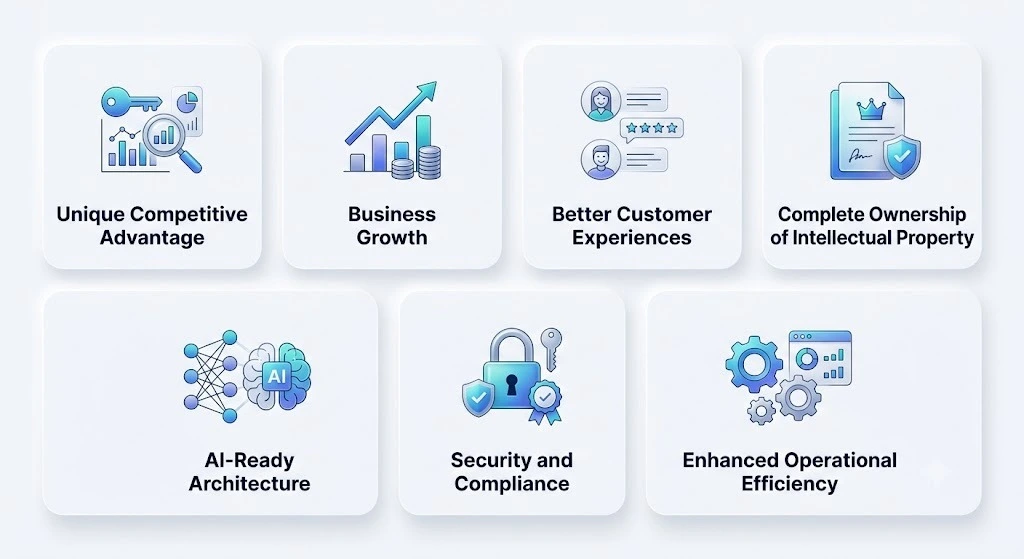
1. Creates a Unique Competitive Advantage
Every successful startup solves a problem in a slightly different way. A custom application allows founders to turn that difference into a product experience that competitors cannot easily copy.
Instead of relying on the same templates and workflows used by everyone else, startups can build proprietary features, smarter user journeys, and more memorable interactions. That kind of differentiation matters in markets where customers have many alternatives and little patience for generic experiences.
Over time, this advantage becomes part of the brand itself. The product feels more aligned with the company’s mission, and that alignment can strengthen positioning in the market. This is one of the clearest examples of how custom app development can boost your business by helping create differentiated digital experiences that competitors cannot easily replicate.
2. Scales with Business Growth
Growth often exposes the weaknesses of off-the-shelf software. What works for a small user base may struggle once traffic, transactions, or integrations increase.
Custom applications are built with scalability in mind. That means the architecture can support more users, faster performance, cloud expansion, and more advanced functionality without forcing a complete rebuild. For startups planning to grow quickly, that flexibility can save both time and money.
Instead of replacing software every few years, teams can continue improving the same product foundation as the business expands.
3. Delivers Better Customer Experiences
Customer expectations are higher than ever. Users want fast loading times, simple navigation, seamless onboarding, and personalized interactions. If an app feels clunky or generic, they move on quickly.
The business impact of poor experiences is significant. According to PwC’s 2025 Customer Experience Survey, 52% of consumers stopped using or buying from a brand because of a bad experience with its products or services, while 29% stopped due to poor customer experiences online or in person. These findings highlight how user experience directly influences customer retention and revenue.
Custom mobile app development enables startups to design every aspect of the customer journey around user needs rather than the limitations of pre-built software. Working with a UI UX design company can further help startups create intuitive interfaces, optimize user journeys, and improve customer engagement from the very first interaction. From personalized onboarding and streamlined workflows to faster performance and AI-driven recommendations, custom applications help businesses create experiences that keep users engaged. As competition increases across digital markets, delivering a superior customer experience is no longer a differentiator; it’s a business necessity.
4. Provides Complete Ownership of Intellectual Property
Custom mobile app development ensures startups fully own their source code, business logic, data, and product roadmap. This ownership gives complete control over innovation, scalability, and future product direction without third-party restrictions.
It also strengthens long-term business value and reduces dependency on external vendors whose pricing or policies may change. According to IBM’s Cost of a Data Breach Report 2025, intellectual property is the most expensive data type to lose at $178 per record, highlighting its strategic importance. For startups, owning intellectual property is not just a legal benefit but a critical factor in protecting innovation and maintaining a competitive advantage.
5. Supports AI-Ready Architecture
The growing role of AI in custom app development is transforming how startups personalize experiences, automate workflows, and make data-driven decisions..
Custom applications make it easier to integrate AI assistants, recommendation engines, predictive analytics, intelligent automation, machine learning models, natural language processing, and computer vision. When the architecture is designed with AI in mind, startups can add these capabilities without major redevelopment later.
That flexibility is especially valuable for companies that want to personalize experiences, automate repetitive tasks, or make smarter decisions based on data.
6. Improves Security and Compliance
Security is a major concern for startups handling customer data, financial information, or regulated workflows. Generic platforms often provide broad protections, but they may not be enough for businesses with specific compliance requirements.
Custom applications allow teams to implement role-based access, encryption, secure authentication, API protection, infrastructure monitoring, and cloud security controls that match the business environment.
That level of control is especially important in industries like healthcare, finance, insurance, and legal services. When security is built into the product from the beginning, the business is better prepared for growth and risk management.
7. Increases Operational Efficiency
Custom apps are not only useful for customer-facing experiences. They can also streamline internal operations and reduce manual work across the business.
A well-designed application can automate workflows, sync inventory, manage employees, connect CRM systems, generate reports, and simplify approvals. These improvements reduce friction for teams and free up time for higher-value work.
For startups operating with lean teams, operational efficiency can have a direct impact on productivity and profitability.
Best Practices to Maximize Custom App Development Benefits
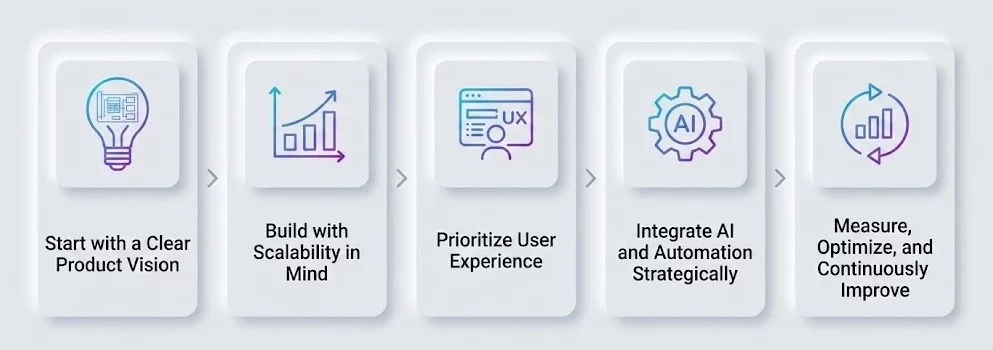
The benefits of custom app development don’t come automatically; they depend on strategic planning, the right technology decisions, and continuous optimization. By following these best practices, startups can maximize scalability, improve user experiences, and generate greater long-term business value from their investment.
1. Start with a Clear Product Vision
Define your business goals, target audience, and core features before development begins. A well-defined product roadmap reduces scope changes, accelerates development, and ensures the app solves real customer problems.
Successful custom mobile app development strategies begin with clear business objectives, validated user needs, and a scalable product roadmap.
2. Build with Scalability in Mind
Design your app architecture to support future growth. A scalable foundation makes it easier to accommodate increasing users, new features, third-party integrations, and expanding business operations without costly redevelopment.
If your product roadmap includes an iOS application, partnering with an iOS app development company can help implement scalable architecture and platform-specific best practices from the outset.
3. Prioritize User Experience
Even the most feature-rich app will struggle without an intuitive user experience. Focus on seamless navigation, fast performance, and user-centric design to improve engagement, retention, and customer satisfaction.
4. Integrate AI and Automation Strategically
Incorporate AI-powered features and workflow automation where they deliver measurable value. Whether it’s personalized recommendations, intelligent chatbots, or predictive analytics, these capabilities can enhance efficiency and create a competitive advantage.
Keeping pace with emerging custom app development trends, including AI, automation, and cloud-native architecture, helps startups remain competitive as user expectations evolve.
5. Measure, Optimize, and Continuously Improve
Treat your mobile app as an evolving product rather than a one-time project. Monitor user behavior, gather customer feedback, and regularly release updates to improve performance, security, and functionality as business needs change.
Real Examples of Custom Mobile App Development in Startups
One of the biggest benefits of custom mobile app development is the ability to build a product around a unique business model instead of adapting it to the limitations of pre-built software. Many of today’s most successful startups took this approach, investing in custom applications that supported innovation, scalability, and long-term growth.
While every startup has different needs, these examples show how custom development can become a powerful competitive advantage. Developing products with this level of scalability, performance, and flexibility is one reason businesses often work with a mobile app development company in USA for complex mobile application projects.
Airbnb: Custom Development Enabled Scalable Marketplace Growth
Airbnb built a custom marketplace platform to connect hosts and travelers through a seamless mobile experience.
Instead of relying on generic marketplace software, it developed proprietary features such as secure payments, messaging, search, reviews, and trust mechanisms. This flexibility allowed the platform to evolve with changing customer expectations and scale globally.
Uber: Custom Technology Powered Real-Time Innovation
Uber’s business model depended on capabilities that standard applications couldn’t provide. Its custom mobile app combined real-time GPS tracking, intelligent route optimization, dynamic pricing, payment processing, and driver management into a single platform.
The ability to continuously improve these features played a significant role in Uber’s rapid expansion.
Slack: Custom Architecture Created a Better User Experience
Slack developed a custom collaboration platform designed specifically for workplace communication. Its tailored architecture enabled channel-based messaging, extensive third-party integrations, workflow automation, and enterprise scalability.
These capabilities helped Slack differentiate itself in a highly competitive productivity software market.
Spotify: Custom Development Delivered Personalized Experiences
Spotify invested in custom mobile app development to deliver personalized music streaming at scale. Features like AI-powered recommendations, curated playlists, offline listening, and seamless cross-device synchronization were built to create a highly engaging user experience that generic streaming solutions could not match.
Robinhood: Custom Apps Enabled Secure, Mobile-First Investing
Robinhood created a custom mobile-first investment platform focused on simplicity, speed, and accessibility. By designing its own user experience and backend infrastructure, the company simplified stock trading for first-time investors while supporting secure, real-time financial transactions.
Stoklo: Scalable Custom App Development for B2B Commerce by RipenApps
Stoklo demonstrates how custom app development can support scalability in niche B2B industries. Built by RipenApps, the platform connects pharmacies and healthcare retailers with manufacturers through a streamlined digital marketplace. Instead of relying on generic marketplace software, the custom solution simplifies inventory sourcing, order management, and supplier communication within a single ecosystem.
By developing an application tailored to the pharmaceutical supply chain, RipenApps enabled Stoklo to improve operational efficiency, enhance the buyer experience, and create a scalable platform capable of supporting business growth. It highlights how a scalable custom mobile app can help startups streamline complex workflows while preparing for future expansion.
ByteEdge: AI-Ready Custom App Development by RipenApps
ByteEdge showcases the value of building an AI-ready custom mobile app for modern digital learning. Developed by RipenApps, the platform delivers personalized microlearning experiences that help users acquire business and professional skills through engaging, bite-sized content.
Its custom architecture supports intelligent content delivery, personalized recommendations, and seamless scalability as the platform grows. Rather than adapting to the limitations of an existing learning management system, ByteEdge was designed around its unique business model. This demonstrates how custom app development enables startups to integrate AI capabilities, improve user engagement, and create differentiated digital experiences.
The custom solution eliminated the need for multiple disconnected tools, enabling users to streamline workflows, reduce manual effort, and make faster business decisions. This project demonstrates one of the most significant benefits of custom app development: building software that aligns with specific operational requirements while creating a strong foundation for long-term productivity and business growth.
Conclusion
Custom mobile app development gives startups the ability to build technology that reflects their vision, supports long-term scalability, and creates meaningful competitive differentiation. Instead of adapting business processes to fit standardized software, founders gain the flexibility to innovate, integrate emerging technologies, strengthen security, and deliver better customer experiences. A well-structured custom app development guide can help frame this process, from planning to execution, in a more strategic way. Although custom development requires more commitment upfront, it often produces stronger business outcomes through intellectual property ownership, scalable architecture, operational efficiency, and future-ready capabilities.
For startups that want to build sustainable products instead of temporary solutions, custom development can be one of the most valuable strategic decisions they make. If your startup is preparing to scale, launch a technology-driven product, or modernize its digital capabilities, partnering with an experienced custom app development team can help turn your vision into a secure, scalable, and high-performing mobile solution built for long-term success.

FAQs
Q1. Why do startups choose custom mobile app development?
Startups choose custom mobile app development because it offers flexibility, scalability, complete ownership, stronger security, personalized user experiences, and the ability to build unique features that support long-term growth.
Q2. What are the biggest benefits of custom app development?
The biggest benefits include business-specific functionality, improved customer experience, intellectual property ownership, AI readiness, enhanced security, operational efficiency, seamless integrations, and scalable architecture. These advantages also demonstrate the role of customization in mobile app development, enabling businesses to build applications that align closely with their operational and customer needs.
Q3. Is custom mobile app development better than ready-made solutions?
It depends on the business goal. Ready-made solutions are useful for basic needs and fast deployment, while custom mobile apps offer greater scalability, flexibility, ownership, security, and long-term return on investment.
Q4. When should a startup invest in a custom mobile app?
A startup should consider custom development when the app is central to the business model, requires unique functionality, expects rapid growth, needs advanced integrations, or plans to use AI, automation, and analytics as competitive advantages.
Q5. Can custom mobile apps support future technologies?
Yes. Custom applications can be designed with flexible architectures that support artificial intelligence, machine learning, cloud computing, IoT, automation, advanced analytics, and future technology integrations without major redevelopment. They are also well-suited for innovations like on-device AI in Next-Gen custom mobile apps, enabling intelligent features with improved privacy, speed, and offline functionality.

SHARE
WRITTEN BY

Ishan Gupta
CEO & Founder
Ishan Gupta is a seasoned entrepreneur and CEO with extensive 8+ years of experience in business and mobile app development landscape. He believes that the right digital product allows companies to focus on what they do best, while technology handles the rest. With deep exposure to global markets, he understands what makes an app succeed. His approach translates business needs into clear product strategies, ensuring that every feature contributes to measurable ROI.
View All Articles



 India
India USA
USA Australia
 Canada
 UK
UK UAE
UAE