


Key Takeaways
- Cloud modernization should align technology investments with business goals, application complexity, scalability requirements, and long-term product strategy.
- Rehosting offers speed, while replatforming balances modernization benefits with manageable changes and refactoring enables deeper architectural transformation.
- The 6 Rs framework helps businesses evaluate whether applications should be rehosted, replatformed, refactored, repurchased, retained, or retired.
- A phased modernization roadmap reduces technical risk by combining application assessment, prioritization, architecture planning, migration, testing, and continuous optimization.
- Successful modernization requires ongoing attention to cloud costs, security, scalability, application performance, infrastructure efficiency, and evolving business requirements.
Cloud adoption is no longer simply about moving applications from physical servers to a cloud provider. For businesses operating digital products, the bigger opportunity is to improve scalability, application performance, deployment speed, security, resilience, and long-term operating efficiency. This is where cloud modernization becomes an important business decision rather than just an IT initiative.
A successful cloud modernization strategy does not mean rebuilding every application from scratch. Some workloads may only need infrastructure changes, while others may require architectural transformation. The right decision depends on the application’s technical condition, business criticality, growth expectations, security requirements, and strategic value.
For business leaders, the challenge is determining how much change is actually necessary. Rehosting may be appropriate for an application that needs to move quickly, while replatforming may deliver better cloud benefits without the risk of a complete rewrite. Refactoring can make sense when the existing architecture is actively preventing scalability or product innovation. When these decisions need to be translated into production environments, cloud implementation services can help businesses move from modernization planning to structured execution.
This guide explains how to evaluate these options, understand the 6 Rs of cloud migration, compare rehosting with deeper modernization approaches, create a practical roadmap, and determine when professional cloud expertise can help reduce technical and financial risk.
Table of Contents
What is Cloud Modernization?
Cloud modernization is the process of updating an application’s infrastructure, architecture, technology stack, development practices, and operational model so the product can take better advantage of modern cloud capabilities.
Unlike a basic migration, modernization can involve changes to application architecture, databases, deployment processes, observability, security controls, integration patterns, and infrastructure management. The goal is not simply to move an existing workload to a different hosting environment.
A business might initially move a monolithic application to a cloud virtual machine. That decision may solve an infrastructure problem, but it does not necessarily solve scalability, deployment, maintainability, or performance challenges. Modernization can take the next step by introducing managed services, automated deployment, containers, improved monitoring, or modular architecture.
The appropriate level of modernization depends on the product’s requirements. A stable internal system with limited growth expectations may not justify extensive architectural change. A customer-facing platform experiencing rapid growth may benefit from deeper transformation.
Cloud Migration vs Modernization: What Is the Difference?
Cloud migration primarily focuses on moving workloads from one environment to another. Modernization goes further by changing how applications are built, deployed, operated, secured, and scaled.
| Factor | Cloud Migration | Cloud Modernization |
| Primary objective | Move workloads | Improve applications and infrastructure |
| Application changes | Often limited | Moderate to extensive |
| Architecture | May remain unchanged | Often improved |
| Cloud-native capabilities | Optional | Frequently adopted |
| Scalability | Depends on approach | Usually a major objective |
| Long-term optimization | Limited | Continuous |
| Business impact | Cloud adoption | Agility, efficiency, resilience, and innovation |
The distinction is important because an organization can complete a migration without actually solving the problems that made modernization necessary. For example, moving a legacy application to a cloud server may eliminate physical infrastructure management while leaving the same monolithic architecture, deployment bottlenecks, database limitations, and scaling challenges.
Why Cloud Modernization Has Become a Business Decision
Digital products are expected to handle increasing traffic, integrate with more systems, support faster releases, and remain secure as the business grows. Architecture that worked when a product had a smaller customer base can eventually become a constraint. The problem is often not visible as a single technical failure. Instead, organizations may experience slower releases, increasing infrastructure expenses, frequent performance issues, difficult integrations, or growing maintenance requirements.
Modernization provides an opportunity to address these limitations systematically. Instead of treating infrastructure, application development, security, and operations as separate concerns, businesses can redesign the technology foundation around their future product requirements. Organizations evaluating complex architecture requirements may work with a cloud architecture company to define a scalable and flexible target environment.
The business case can also extend beyond infrastructure. A more flexible architecture can allow product teams to introduce new capabilities faster, respond to customer demand, and experiment without making extensive changes to the entire application. However, modernization requires investment. Businesses need to determine whether the expected operational and strategic benefits justify the time, cost, and risk associated with changing an existing system.
Understanding the Difference Between Moving and Modernizing
Cloud migration and modernization are often used interchangeably, but they describe different levels of change. Migration generally focuses on moving an application, data, or workload from one environment to another. Modernization considers what should change within that workload once the organization has evaluated its architecture and future requirements.
| Factor | Cloud Migration | Modernization |
| Primary objective | Move workloads | Improve technology capabilities |
| Application changes | Often limited | Moderate to extensive |
| Architecture | May remain unchanged | May be redesigned |
| Cloud-native capabilities | Optional | Often considered |
| Scalability | Depends on migration approach | Usually a key consideration |
| Automation | May remain unchanged | Frequently improved |
| Long-term optimization | Limited | Continuous |
The distinction matters because moving an inefficient application to the cloud can preserve many of the problems that existed before migration.
For example, a monolithic application can continue to have slow deployment cycles after being moved to cloud infrastructure. Similarly, an overprovisioned workload can continue generating unnecessary expenses even after the hosting environment changes.
A modernization program asks a broader question: what should the application and its infrastructure look like to support the next stage of the business?
What Makes a Digital Product a Strong Candidate for Modernization?
Not every application needs architectural transformation. Some workloads remain stable and cost-effective for years without requiring major changes. A stronger modernization candidate is usually an application where technology is beginning to affect business performance. This could happen when customer growth creates scaling challenges or when product teams cannot deliver features quickly enough because of architectural dependencies.
Other signals may appear through operations. Frequent incidents, difficult recovery procedures, limited monitoring, or manual infrastructure management can indicate that the existing environment is becoming increasingly expensive to operate.
Security requirements can also change the equation. An architecture that was acceptable at an earlier stage may become difficult to manage when the business enters regulated markets or begins handling more sensitive information. The expected lifespan of the product is another important consideration. Investing heavily in an application approaching retirement may not be economically sensible, while a strategic platform expected to support the business for many years may justify deeper transformation.
The Business Outcomes Modernization Should Deliver
A modernization initiative should have clearly defined outcomes before technology choices are made. The expected results might include improved application availability, faster deployment cycles, greater scalability, lower operational effort, or stronger security.
The cloud modernization benefits should therefore be measured against business and product metrics rather than simply counting how many workloads were moved. For example, a company might define success as reducing deployment time from several hours to minutes. Another organization might focus on supporting a significant increase in concurrent users without proportionally increasing infrastructure management effort.
Cost can also be measured in relation to business activity. Instead of looking only at the total monthly infrastructure bill, leaders can evaluate infrastructure spending per transaction, customer, API request, or active user. This makes modernization easier to justify because the organization can demonstrate how technology investment contributes to measurable outcomes.
The 6 Rs of Cloud Migration and Modernization
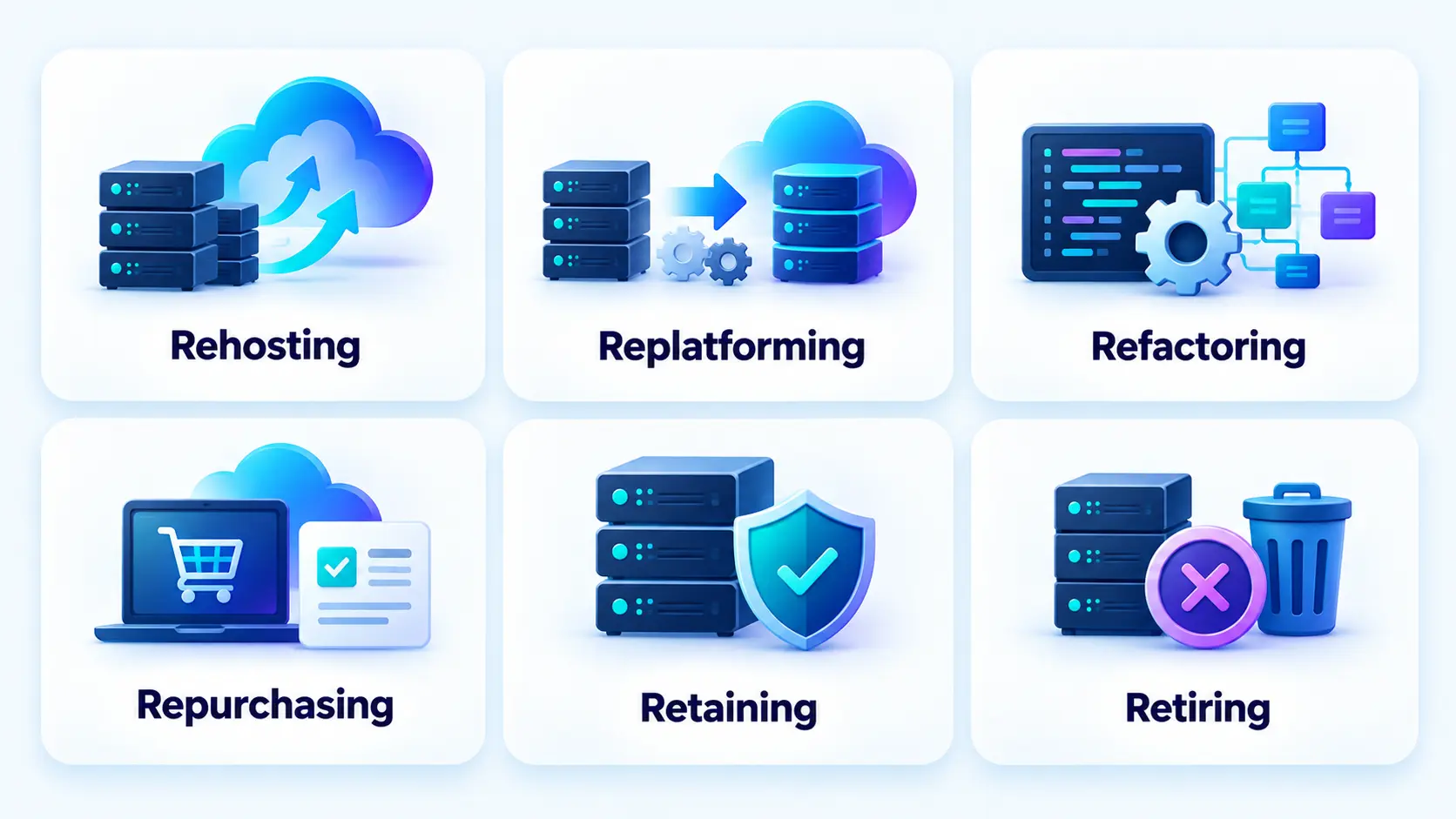
The 6 Rs of cloud migration provide a practical framework for deciding what should happen to each application or workload. The approaches are rehost, replatform, refactor, repurchase, retain, and retire. The framework should not be applied uniformly across an organization’s entire portfolio. Different applications can require different decisions depending on their business value, technical condition, and future role.
For example, a business could rehost a stable reporting system, replatform an internal operations platform, refactor a customer-facing transaction engine, and retire an outdated application during the same modernization programme.
1. Rehosting: When Lift and Shift Makes Sense
Lift and shift cloud migration involves moving an application to cloud infrastructure while making minimal changes to its existing architecture.
The main advantage is speed. Organizations can move workloads without undertaking a large-scale application redesign. This can be useful when a business needs to exit a data centre, consolidate infrastructure, or establish an initial cloud environment quickly.
However, rehosting does not automatically unlock all the benefits associated with cloud-native architecture. An application can continue to have the same scaling limitations, deployment processes, dependencies, and operational inefficiencies after migration.
For that reason, rehosting is often best viewed as a tactical decision. It can provide a fast transition while giving the organization more time to plan deeper modernization.
2. Replatforming: A Practical Middle Ground
Replatforming involves making targeted changes to an application so it can benefit from cloud services without completely redesigning its architecture.
A product might move from a self-managed database to a managed database service, adopt containers, introduce automated scaling, or use managed infrastructure components while preserving most of its application logic.
This approach can deliver meaningful improvements without the cost and risk of a complete rewrite. It is particularly useful when the core application remains strategically valuable but its infrastructure creates operational limitations.
The objective of cloud replatforming is therefore to achieve better performance, scalability, resilience, maintainability, or operational efficiency without unnecessarily changing components that are already working well.
Application replatforming can be especially effective for products that have stable business logic but depend on infrastructure that is becoming expensive or difficult to maintain.
3. Refactoring: When the Architecture Needs to Change
Refactoring represents a deeper level of modernization. Instead of making limited infrastructure improvements, teams redesign selected parts of the application to create a more scalable and maintainable architecture.
This can involve breaking a monolithic application into modular components, introducing event-driven processing, adopting containers, implementing APIs, automating deployment pipelines, or redesigning data flows.
The advantage is greater long-term flexibility. Teams can independently evolve components, scale specific workloads, and introduce new technologies without changing the entire application.
The trade-off is investment and risk. Refactoring requires more engineering effort, stronger architectural planning, comprehensive testing, and careful migration sequencing.
For a strategic digital product with substantial growth expectations, however, the long-term benefits can justify the additional investment.
4. Repurchasing: When Replacing the Application Makes More Sense
Repurchasing involves replacing an existing application with a commercial software product or SaaS solution instead of continuing to maintain and modernize the current system.
This approach can make sense when the existing application provides a capability that is already available through a mature third-party platform. Instead of investing heavily in custom development, the business can adopt a solution that provides the required functionality with ongoing vendor updates and support.
The decision should consider licensing costs, integration requirements, data ownership, customization needs, security, compliance, and the long-term vendor relationship. A commercially available solution is not automatically the better choice if it creates significant integration or operational constraints.
Repurchasing is particularly useful for non-differentiating business functions where building and maintaining a custom application does not provide a meaningful competitive advantage.
5. Retaining: When Staying With the Existing Environment Is Practical
Retention means keeping an application or workload in its current environment because immediate modernization does not provide enough business value to justify the investment.
This does not necessarily mean the application will never be modernized. A business may retain a workload temporarily because it has complex dependencies, limited usage, regulatory constraints, or a planned replacement in the near future.
Retention can also be appropriate when an application is stable, secure, inexpensive to operate, and unlikely to require significant changes. In such situations, forcing modernization simply to achieve cloud adoption can introduce unnecessary cost and risk.
Business leaders should periodically reassess retained workloads because changing business requirements, technology constraints, or infrastructure costs can eventually make modernization more valuable.
6. Retiring: When Removing the Application Is the Better Decision
Retirement involves permanently removing an application or workload that no longer provides sufficient business value.
Large organizations often accumulate redundant systems over time. Some applications may have been created for temporary business requirements, while others may have been replaced by newer platforms but continue operating because no one has formally decommissioned them.
Keeping unnecessary applications can create hidden costs through infrastructure consumption, licensing, maintenance, security monitoring, backups, and specialist support requirements.
Before retirement, teams should identify application dependencies, archive required data, confirm compliance obligations, communicate with affected users, and establish a controlled decommissioning process.
Retirement can therefore be one of the simplest ways to reduce complexity within a modernization programme because businesses do not have to spend resources transforming applications that no longer need to exist.
When a Simple Move is the Right Choice
Rehosting involves moving an application to a new infrastructure environment while making relatively few changes to its existing architecture. A lift and shift cloud migration can be appropriate when speed is the immediate priority. Organizations may use this approach when they need to leave a data center, consolidate infrastructure, or establish a cloud presence without first redesigning the application.
The main advantage is reduced application-level disruption. Teams do not need to modify every component before the workload can be moved. The limitation is that architectural weaknesses generally remain. An application with tightly coupled components will still have tightly coupled components after relocation. For this reason, rehosting can be viewed as a tactical step rather than a complete modernization strategy. It may create a foundation for later optimization without forcing the organization to undertake every transformation simultaneously.
When Targeted Changes Offer a Better Balance
Replatforming sits between basic relocation and deep architectural transformation. It involves making selected changes that allow an application to use cloud capabilities more effectively without redesigning the entire product.
A typical example could involve moving from a self-managed database to a managed database service. Other changes might include containerization, automated scaling, improved deployment pipelines, or managed cloud services that reduce infrastructure administration.
The appeal of replatforming is that it can provide measurable improvements while preserving much of the existing application logic. This approach is particularly useful when the application architecture remains fundamentally sound but the infrastructure around it creates unnecessary operational limitations. The decision should still be based on measurable outcomes. Introducing managed services simply because they are available can add complexity without producing meaningful business value.
When the Product Needs Deeper Architectural Change
Refactoring involves significant changes to the way an application is structured. It may include decomposing a monolith, redesigning data flows, introducing event-driven components, separating independently changing domains, or creating new API boundaries.
The objective is to remove architectural limitations that prevent the product from meeting future requirements. This makes refactoring more appropriate for strategic applications where the current architecture is actively restricting growth, scalability, development speed, or reliability.
However, deeper transformation also creates more execution risk. Teams need stronger architecture planning, testing, dependency analysis, data migration strategies, and release controls. The right decision is therefore not to choose the most advanced architecture available. It is to determine whether deeper change will generate enough long-term value to justify the investment.
How to Decide Between Rehosting, Replatforming, and Refactoring
The rehost vs replatform vs refactor decision should begin with the product’s future requirements rather than the technology team’s preferred architecture. A workload that needs to move quickly may benefit from rehosting. An application that has a stable core but inefficient infrastructure may be better suited to replatforming. A strategic product with substantial growth expectations may justify refactoring if its existing architecture cannot support future scale.
| Business Situation | Potential Approach |
| Immediate infrastructure exit | Rehost |
| Existing architecture is usable but infrastructure needs improvement | Replatform |
| Architecture limits future growth | Refactor |
| Application has little remaining business value | Retire |
| Commercial alternative provides stronger economics | Repurchase |
| Migration offers limited immediate value | Retain |
The framework should not be treated as permanent. A workload that is rehosted today may be replatformed later once the organization has more time and data to evaluate its long-term requirements.
Evaluating the Financial Case
Modernization costs can include architecture assessment, application changes, infrastructure, testing, data migration, security improvements, monitoring, training, and ongoing operations. The business case should therefore look beyond initial development expenses. Organizations should compare these costs with potential gains from improved productivity, reduced downtime, better infrastructure utilization, faster releases, and increased capacity.
A useful financial model also considers opportunity cost. If developers spend substantial time maintaining an outdated architecture, that effort represents capacity that could otherwise be used for new product capabilities. Businesses evaluating this dimension can also review cloud cost optimization to understand how infrastructure consumption can be monitored and improved.
Building a Cloud Modernization Roadmap
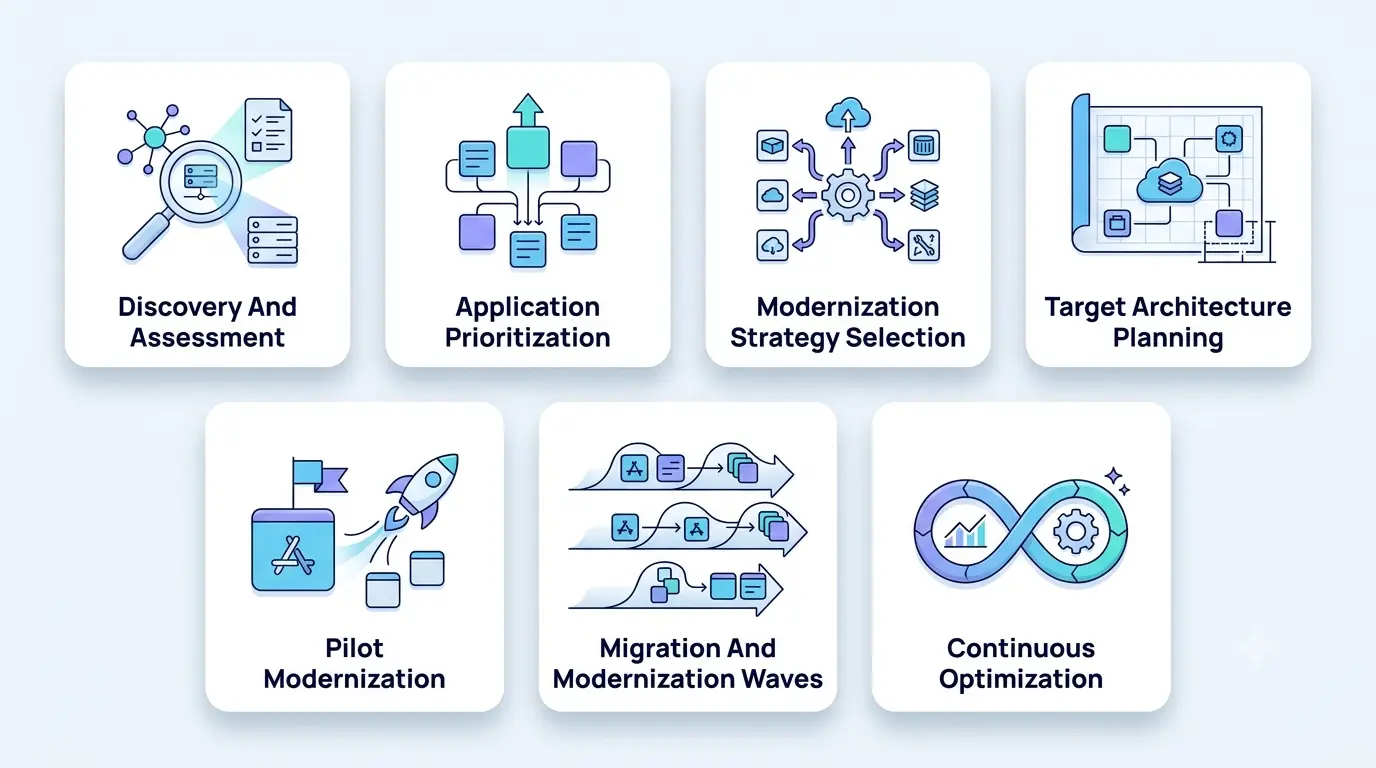
A cloud modernization roadmap should translate strategic technology decisions into a structured execution plan. Rather than moving applications to the cloud without a defined direction, organizations should establish clear stages for assessment, prioritization, architecture, migration, validation, and optimization. This helps technology and business teams understand what needs to change, why it needs to change, and how progress will be measured.
The roadmap should also remain flexible enough to accommodate changing business priorities and technical findings. Modernization rarely follows a perfectly linear path because application dependencies, legacy constraints, security requirements, and operational challenges can emerge during implementation. A phased roadmap gives teams the control needed to adapt while maintaining a clear long-term modernization objective.
Phase 1: Discovery and Assessment
The first phase should establish a complete understanding of the existing technology environment. Teams should document applications, infrastructure, databases, integrations, dependencies, users, workloads, data flows, and critical business processes. This assessment should also identify technical debt, outdated components, performance bottlenecks, security weaknesses, licensing requirements, and infrastructure dependencies that could affect modernization decisions.
The objective is to create a reliable baseline before committing to migration or architectural changes. Without this visibility, organizations may underestimate dependencies or migrate workloads that require significant remediation. The assessment should therefore combine technical analysis with business context, identifying which applications support critical operations, generate revenue, serve customers, or depend on other systems.
Phase 2: Application Prioritization
Once the existing environment has been assessed, applications should be prioritized according to business value and modernization requirements. Factors such as revenue impact, customer importance, technical risk, security exposure, infrastructure cost, modernization complexity, scalability requirements, and expected return can help determine which workloads should be addressed first.
Prioritization prevents organizations from treating every application equally. A business-critical application with high infrastructure costs may deserve earlier attention than a low-value internal system. Similarly, an application with significant dependencies may require additional preparation before modernization begins. Creating a structured scoring framework helps stakeholders make these decisions objectively rather than relying solely on technical preference.
Phase 3: Modernization Strategy Selection
Each prioritized application should then be evaluated against the six common modernization approaches, often referred to as the 6 Rs: rehost, replatform, refactor, repurchase, retire, and retain. The appropriate strategy depends on the application’s business importance, technical condition, future requirements, modernization budget, and expected lifespan.
The selected approach should be supported by a documented business and technical rationale. Teams should define the expected outcome, estimated investment, major risks, dependencies, timeline, and success criteria before implementation begins. This creates accountability around each modernization decision and helps stakeholders understand why a particular workload is being migrated, redesigned, replaced, or retained.
Phase 4: Target Architecture
The target architecture should describe what the modernized environment needs to look like once transformation is complete. This includes application architecture, infrastructure, networking, databases, identity and access management, security controls, observability, integration patterns, deployment processes, disaster recovery, and scalability requirements.
Architecture decisions should be based on the product’s expected future state rather than simply reproducing the existing environment in the cloud. For example, moving a tightly coupled legacy application to cloud infrastructure without addressing architectural limitations may reduce some infrastructure constraints but leave the underlying scalability and maintainability problems unresolved. The target architecture should therefore balance modernization goals with practical business and technical requirements.
Phase 5: Pilot Modernization
A pilot modernization provides an opportunity to validate the proposed architecture, tools, processes, and migration approach before committing significant resources to a broader transformation. The pilot should represent meaningful technical or business requirements while remaining sufficiently controlled to limit potential disruption.
During the pilot, teams can evaluate deployment processes, application performance, security controls, integrations, observability, infrastructure costs, and operational workflows. Lessons from the pilot should be incorporated into the broader roadmap. If the chosen architecture or migration approach creates unexpected challenges, organizations can address them before they affect a large number of production workloads.
Phase 6: Migration and Modernization Waves
After the pilot has validated the approach, workloads can be modernized through controlled implementation waves. Instead of transforming the entire application portfolio simultaneously, organizations can group workloads according to dependencies, business importance, technical complexity, or shared infrastructure requirements.
Each modernization wave should have defined entry criteria, testing requirements, rollback procedures, security validation, performance benchmarks, and business acceptance criteria. Teams should also establish clear ownership for technical decisions and production readiness. A wave should only move forward when the required technical and business conditions have been satisfied.
Phase 7: Continuous Optimization
Modernization does not end when an application reaches production. Cloud environments can change continuously as workloads grow, usage patterns shift, applications evolve, and new cloud capabilities become available. Organizations therefore need ongoing processes for reviewing infrastructure utilization, application performance, cloud costs, security posture, deployment frequency, reliability, and operational efficiency.
Continuous optimization can also identify opportunities that were not visible during the initial modernization program. Teams may discover underutilized resources, unnecessary infrastructure costs, performance bottlenecks, or opportunities to improve automation. Regular reviews allow organizations to make incremental improvements rather than allowing the newly modernized environment to gradually develop the same limitations that affected the legacy architecture.
What the Modernization Roadmap Should Measure
A roadmap becomes more useful when every stage has measurable success criteria. For infrastructure, organizations may monitor availability, resource utilization, recovery performance, and operating costs. For development, teams can measure deployment frequency, lead time, release failure rates, and time required to recover from incidents.
For the product itself, businesses can monitor response times, transaction capacity, user activity, and feature delivery. These measurements help leaders determine whether modernization is producing the expected business outcomes instead of simply confirming that technical work has been completed.
Designing the Target Architecture
Architecture decisions should be based on application requirements rather than technology trends. Modern environments can combine containers, managed databases, APIs, serverless services, event-driven systems, automated deployment, and centralized observability. Not every product needs all of these capabilities. A smaller product may benefit from a modular architecture without introducing a highly distributed system.
A large platform with independently changing business domains may have a stronger case for more distributed components. The target architecture should balance scalability, reliability, security, maintainability, developer productivity, and cost. Organizations can use a detailed cloud infrastructure guide when evaluating the infrastructure components that support modern digital products.
Connecting Architecture With Application Development
Modernization and application development should not operate as separate initiatives. Changes to infrastructure often create opportunities to improve the application itself. For example, introducing APIs can make integrations easier, while modular components can allow teams to develop features independently. Businesses planning new cloud-native capabilities can also refer to a cloud app development guide when evaluating development considerations for cloud environments. The important principle is to keep architecture aligned with actual product requirements. Technology should support the product roadmap rather than becoming the roadmap itself.
Making Security Part of the Transformation
Security needs to be considered before applications are moved or redesigned. Modernization can change identities, data flows, infrastructure boundaries, APIs, storage systems, and third-party dependencies. Organizations should evaluate access controls, encryption, secrets management, network security, vulnerability management, monitoring, backup, recovery, and incident response.
Security requirements may also affect architecture choices. Applications handling sensitive information can require additional controls around data access, logging, storage, and network communication. Businesses can review cloud application security best practices for additional guidance when designing security controls across the modernized environment.
Choosing the Right Cloud Platform
Cloud provider selection should be based on workload requirements rather than popularity alone. Businesses should evaluate infrastructure services, geographic availability, security capabilities, pricing models, managed services, developer tooling, and existing technical expertise. Different products can have different priorities. A data-intensive platform may value particular analytics capabilities, while a globally distributed application may prioritize regional infrastructure availability.
Businesses comparing providers can use AWS vs Azure vs Google Cloud to evaluate the major platforms against their business and technical requirements. The selected platform should also fit the organization’s long-term operating model. A technically strong provider can still create unnecessary complexity if internal teams lack the skills required to operate the environment effectively.
Managing Costs After the Transformation
Cloud environments can become expensive when businesses do not establish ownership and visibility around infrastructure consumption. Modernization should therefore include cost monitoring from the beginning. Teams should understand spending across compute, storage, databases, networking, monitoring, and other managed services. The goal should not simply be to minimize the cloud bill. Excessive cost reduction can negatively affect reliability or performance.
Instead, businesses should aim for efficient infrastructure that delivers the required product performance at an economically sustainable level. Cost should also be evaluated against business activity. A higher infrastructure bill may be acceptable if the product is handling substantially more customers and transactions.
Keeping the Product Ready for Future Capabilities
Modernization can also prepare digital products for capabilities that may not have been part of the original architecture. Artificial intelligence, real-time analytics, automation, connected devices, and advanced personalization can introduce new infrastructure and integration requirements.
Businesses considering these capabilities should think about data accessibility, APIs, processing capacity, security, and integration architecture before implementation begins. An organization developing an AI roadmap can also explore an AI strategy for digital products to understand how intelligent capabilities can fit within broader product planning. The objective is not to build infrastructure for every possible future technology. It is to avoid architectural decisions today that unnecessarily prevent future options.
Common Mistakes That Increase Modernization Risk
Modernization programs can lose momentum when businesses attempt to transform everything simultaneously. Large application portfolios usually contain workloads with very different technical and business requirements. Another common mistake is selecting technology before defining the problem. Choosing microservices, containers, or serverless architecture without a clear business need can introduce complexity without sufficient return.
Data dependencies are also frequently underestimated. Legacy applications may connect to reporting platforms, databases, external services, and internal systems that are not immediately visible.
Security can become another source of risk when teams focus primarily on migration speed. Modernization should include security architecture, access controls, monitoring, and data protection from the beginning. Finally, modernization should not be treated as a one-time project. Applications, infrastructure, security requirements, and business priorities continue to change after the initial transformation.
When External Expertise Can Add Value
Businesses with complex legacy environments may need specialist support when internal teams do not have sufficient cloud architecture experience or capacity. External expertise can be particularly useful when a product has multiple integrations, strict security requirements, complicated data dependencies, or aggressive modernization timelines.
The right partner can help assess the existing environment, identify dependencies, prioritize workloads, design the target architecture, and establish a practical implementation sequence. Organizations moving from strategy into execution may consider external technical support when they need help translating architecture decisions into production-ready environments. A structured approach can reduce the risk of making large technical investments before the organization has validated its assumptions.
Managing Complex Migration Programs
Large application portfolios can make migration difficult because dependencies need to be understood before workloads are moved. A structured migration process can help teams identify application relationships, sequence workloads, plan data movement, test environments, coordinate production cutovers, and establish rollback procedures.
Businesses dealing with complex environments may seek additional technical expertise when greater support is required to manage these activities. Migration planning should also distinguish between technical completion and business readiness. An application may be successfully deployed in a new environment while still requiring performance validation, security testing, or user acceptance.
Supporting the Environment After Launch
Modernization does not end when a workload reaches production. Infrastructure needs to be monitored, optimized, secured, and adjusted as usage changes. Teams need visibility into application performance, infrastructure utilization, incidents, security events, and resource consumption.
Organizations that need ongoing operational support can seek external expertise to help maintain infrastructure and improve operational consistency. The ongoing model should still include internal ownership. Business and product teams need visibility into infrastructure performance and cost even when some operational responsibilities are handled externally. Strengthen the transition to external supportClarify ongoing operational responsibilities
Modernizing Existing Products and Building New Capabilities
Some modernization programs also create opportunities to introduce new application capabilities. Businesses may redesign selected components while developing new customer experiences around them. This approach can be useful when modernization is directly connected to product growth. Instead of treating the transformation as an isolated infrastructure program, organizations can align technical changes with the next stage of product development.
Companies developing new or redesigned cloud-based products can work with a cloud app development company when application engineering and cloud architecture need to be coordinated. The key is to ensure that new development supports the modernization objectives rather than creating another disconnected technology layer.
Making Architecture Decisions That Last
Complex modernization programs benefit from clear architecture ownership. Decisions around data, infrastructure, APIs, application boundaries, security, and deployment need to remain consistent as different workloads are transformed.
Organizations evaluating complex architecture requirements may need specialized support for designing the target environment. Architecture should also remain flexible. Business requirements can change during a multi-year modernization program, so the design should allow components to evolve without forcing the organization to repeat the entire transformation.
Keeping Modernization Connected to Digital Transformation
Modernization should not exist independently from the broader digital strategy. Technology investments are more valuable when they support customer experience, operational efficiency, revenue growth, innovation, and competitive differentiation. Businesses reviewing broader transformation priorities can refer to the 6 pillars of digital transformation strategy when connecting modernization initiatives with wider organizational objectives.
This perspective also helps executives decide where not to modernize. Not every application contributes equally to the organization’s future, and resources should be directed toward areas where technology can create meaningful business value.
What the Future Holds for Cloud Modernization
The next phase of modernization will increasingly focus on continuous improvement rather than one-time migration programs. AI-assisted development can help teams analyze legacy code, identify dependencies, generate tests, and accelerate some modernization activities.
Platform engineering is also becoming more relevant as businesses look for standardized ways to provision infrastructure, manage deployments, enforce security policies, and improve developer productivity. Financial governance will remain important as organizations become more sophisticated about linking infrastructure consumption with business outcomes.
Sustainability is another consideration. Efficient resource utilization, autoscaling, workload optimization, and appropriate infrastructure selection can help businesses reduce unnecessary consumption. With software product modernization services, organizations can also evolve legacy applications to meet changing business needs, improve maintainability, and support long-term scalability. The broader trend is toward digital products that can continuously adapt rather than applications that remain architecturally unchanged for long periods.
How Business Leaders Should Make the Final Decision
The right modernization approach depends on the application’s current condition and future business role. Rehosting can be appropriate when the organization needs speed and minimal disruption. Replatforming can provide a balanced option when the existing application remains viable but needs better infrastructure capabilities. Refactoring is more suitable when architecture has become a direct barrier to scalability, development velocity, reliability, or future product capabilities.
Repurchasing can be practical when a commercial or SaaS solution provides better value than maintaining an aging internal system. Retirement is often the most efficient decision when an application no longer provides sufficient business value. Retention can also be a valid strategy when migration creates greater risk than benefit at the current stage. The strongest modernization programs therefore avoid a one-size-fits-all approach. They evaluate each workload independently and select the level of change that best supports the business case.
How RipenApps Can Support Cloud Modernization
Modernization works best when application architecture, cloud infrastructure, security, and business objectives are considered together. RipenApps approaches cloud transformation by helping businesses assess existing environments, define modernization priorities, design cloud architectures, migrate workloads, optimize infrastructure, and support ongoing improvements.
The objective is not to modernize technology simply because it is old. The objective is to create a technical foundation that supports the product’s next stage of growth. A business may therefore choose to rehost selected workloads, replatform others, and refactor only those systems where deeper architectural change creates measurable value. This portfolio-based approach can reduce unnecessary engineering investment while allowing strategic products to evolve.
For businesses introducing AI into existing products, modernization can also provide the scalability, data accessibility, integration capabilities, and infrastructure required to support intelligent features.
Future Trends in Cloud Modernization
Cloud modernization is increasingly becoming a continuous discipline rather than a one-time transformation. AI-assisted development is expected to help engineering teams analyse legacy code, identify technical debt, generate documentation, automate testing, and accelerate modernization planning.
Platform engineering is also becoming increasingly important as organizations create internal platforms that standardize infrastructure provisioning, deployment, observability, security, and developer workflows. FinOps will continue to influence architecture decisions as organizations become more focused on the relationship between cloud consumption and business value.
Sustainability is another important consideration. Efficient architectures, workload optimization, autoscaling, and improved infrastructure utilization can reduce unnecessary resource consumption. Application modernization trends are also moving toward greater automation, cloud-native architecture, platform engineering, AI-assisted development, and continuous optimization. The broader direction is clear: successful modernization will increasingly combine application architecture, cloud infrastructure, security, automation, cost management, and product strategy.
Conclusion
Cloud modernization is ultimately a business decision supported by technology. Moving an application to the cloud may solve an infrastructure problem, but modernization creates the opportunity to address deeper issues around scalability, architecture, security, development velocity, cost, and long-term product growth.
The most effective strategy begins with an assessment of the existing environment and a clear understanding of the desired business outcome. From there, organizations can determine whether individual workloads should be rehosted, replatformed, refactored, replaced, retained, or retired.
The goal is not to modernize everything. It is to modernize the right things, at the right depth, for the right business reasons. For business leaders planning a transformation, RipenApps can help evaluate application requirements, define modernization priorities, design the target architecture, and provide cloud migration services to support implementation and build a roadmap that connects cloud investment with measurable digital product outcomes.
FAQs
1. What is cloud modernization?
Cloud modernization is the process of updating an application’s architecture, infrastructure, technology stack, and operational practices to better use modern cloud capabilities. It can improve scalability, performance, security, deployment speed, resilience, and long-term maintainability.
2. What is the difference between cloud migration and modernization?
Cloud migration primarily focuses on moving applications, data, or workloads from existing infrastructure to a cloud environment. Cloud modernization goes further by improving application architecture, infrastructure, deployment processes, security, scalability, and operational efficiency to support future business requirements.
3. What are the 6 Rs of cloud migration?
The 6 Rs of cloud migration are rehost, replatform, refactor, repurchase, retain, and retire. Businesses use this framework to determine whether each application should be moved with minimal changes, optimized, redesigned, replaced, kept unchanged, or removed based on its business value and technical condition.
4. What is the difference between rehosting, replatforming, and refactoring?
Rehosting moves an application to the cloud with minimal modifications, making it suitable when speed is the primary objective. Replatforming introduces targeted improvements without significantly changing the architecture, while refactoring involves deeper architectural changes for products that require greater scalability, flexibility, or long-term performance.
5. When should a business choose replatforming?
Businesses should consider replatforming when an application’s existing architecture is generally suitable but its infrastructure creates limitations in performance, scalability, deployment, or maintenance. It provides a middle ground that delivers cloud benefits without the cost and risk of completely rebuilding the application.
6. How do businesses create a cloud modernization roadmap?
A cloud modernization roadmap typically begins with application discovery and assessment, followed by workload prioritization and modernization strategy selection. Businesses then define the target architecture, conduct a controlled pilot, execute migration or modernization in phases, and continuously optimize cost, security, performance, and infrastructure utilization.
7. How much does cloud modernization cost?
Cloud modernization costs vary depending on application complexity, technical debt, architecture, data migration requirements, development effort, cloud infrastructure, security needs, testing, and the selected modernization approach. Rehosting generally requires less investment, while extensive refactoring can require significantly more engineering effort.
8. When should a business work with a cloud modernization partner?
A business may benefit from a modernization partner when its applications have complex dependencies, significant technical debt, security or compliance requirements, limited internal cloud expertise, or large-scale transformation needs. An experienced partner can help assess workloads, select the right approach, design the architecture, and manage modernization execution.
Discuss your project and request for proposal
SHARE
WRITTEN BY

Ishan Gupta
CEO & Founder
Ishan Gupta is a seasoned entrepreneur and CEO with extensive 10+ years of experience in business and mobile app development landscape. He believes that the right digital product allows companies to focus on what they do best, while technology handles the rest. With deep exposure to global markets, he understands what makes an app succeed. His approach translates business needs into clear product strategies, ensuring that every feature contributes to measurable ROI.
View All Articles