


Key Takeaways
- Flutter supports application development across multiple platforms from a shared Dart codebase, which can reduce duplicated engineering work.
- Flutter app development cost typically ranges from $15,000 to $200,000+, depending on product complexity and scope.
- UI/UX requirements, integrations, app category, team expertise, development location, and backend complexity are major cost drivers.
- Hidden expenses can come from app-store requirements, scaling, third-party services, monitoring, security updates, and post-launch enhancements.
- A realistic Flutter budget should account for the initial build, launch, ongoing maintenance, and future product expansion.
Flutter app development cost typically ranges from $15,000 to $200,000+, depending on product complexity, features, backend requirements, integrations, and team location. A basic MVP may cost $15,000–$40,000, a medium-complex app $40,000–$90,000, and an enterprise application $90,000– $ 200,000+.
Flutter itself does not determine the project price. Its shared-code approach can reduce duplicated development work across platforms, but the product still requires design, backend engineering, testing, infrastructure, security, deployment, and maintenance.
For businesses planning a cross-platform product, choosing the right development partner can also influence the overall budget and delivery outcome. Experienced teams offering Flutter app development services can help define the MVP scope, select the right architecture, estimate integration requirements, and plan testing and deployment from the beginning. This can reduce avoidable rework and create a more predictable development roadmap.
Table of Contents
Understanding the Flutter Framework
Flutter is Google’s open-source UI toolkit for building applications across mobile, web, desktop, and other supported platforms using Dart. Its main economic advantage is that teams can share a substantial amount of application code instead of creating completely separate implementations for iOS and Android.
That does not mean every part of an application is automatically shared. Platform-specific APIs, native integrations, testing, deployment, backend services, and specialized functionality can still require additional engineering. For businesses estimating cost, the shared-code model can reduce duplicated implementation, but the actual savings depend on the product architecture and platform-specific requirements.
Flutter can be a strong fit when:
- You want to launch on iOS and Android together.
- Consistent UI and behavior across platforms are important.
- Your product roadmap includes additional platform support.
- You want to validate an MVP before investing in a larger product.
- You want to share engineering resources across multiple platforms.
Flutter’s official production showcase includes products and organizations such as Google Pay, Google Earth, Google Ads, BMW, eBay, Toyota, SoFi, and others. For teams that need broader cross-platform context, the cross-platform app development guide provides additional background on architecture and technology choices.
Why Businesses Choose Flutter App Development
The business case for Flutter usually comes down to development efficiency, multi-platform coverage, consistent UI, and the ability to maintain a shared codebase. A company building separate native applications may need platform-specific implementation and maintenance for the same product features. Flutter can reduce some of that duplicated work, although the amount of savings depends heavily on application architecture and platform-specific functionality.
According to Flutter’s Q2 2026 user survey, 93% of more than 3,500 respondents reported positive satisfaction with Flutter. The potential effect on Flutter development cost therefore comes less from the framework itself and more from how efficiently the team can deliver and maintain the product. Businesses commonly choose Flutter because of:
- Shared development: A common codebase can reduce duplicated implementation across iOS and Android.
- Faster iteration: Hot reload allows developers to see many code and UI changes quickly during development.
- Consistent interfaces: Flutter’s widget-based architecture supports a consistent visual and interaction system.
- Multi-platform potential: The technology can support mobile and, where appropriate, web and desktop applications.
- Production adoption: Flutter is used in documented products including Google Pay, BMW, eBay Motors, and Alibaba’s Xianyu.
According to Google’s Flutter case study, the Google Pay migration resulted in a 35% smaller codebase, while the team estimated 60%–70% savings in engineering time. This case study demonstrates the potential efficiency benefits of Flutter for a large production application, but the results should not be treated as a universal benchmark.
The practical takeaway is that Flutter can improve development efficiency for suitable products, but businesses should calculate expected savings from their own feature scope, platform requirements, team structure, and architecture.
Factors Affecting the Flutter App Development Cost
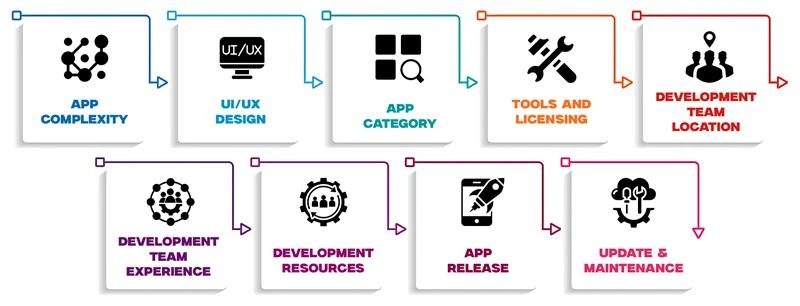
The cost of building a Flutter application depends on the amount of design, engineering, backend, testing, infrastructure, and integration work involved. Nine factors have the biggest impact on the final budget. These considerations are also important when estimating the cost to develop an app, as each can significantly influence the total development investment.
1. App Complexity
The cost to develop a Flutter app varies significantly by product complexity, feature scope, backend requirements, integrations, and security needs.
| App complexity | Typical cost | Typical timeline | Common scope |
| Basic | $15,000–$40,000 | 3–5 months | Authentication, profiles, forms, basic API integration, notifications |
| Medium | $40,000–$90,000 | 5–8 months | Advanced workflows, payments, messaging, integrations, custom backend |
| Complex | $90,000–$200,000+ | 8–12+ months | Real-time systems, advanced security, complex APIs, multiple integrations, large-scale infrastructure |
A simple service application with authentication, listings, booking, notifications, and an admin panel is very different from a fintech platform with payments, transaction processing, fraud controls, compliance requirements, analytics, and real-time updates. The cost estimate should therefore start with product scope rather than Flutter alone.
2. UI/UX Design
UI/UX design affects both design and development effort. A product using standard layouts and a limited number of screens requires less work than an application with custom interactions, advanced animations, personalization, and complex navigation.
Costs can increase with requirements such as:
- Custom transitions and animations
- Interactive components
- Advanced micro-interactions
- Personalized experiences
- Complex navigation
- Accessibility requirements
- Multiple device and screen-size variations
- Extensive design-system documentation
A reliable estimate should define the number of screens, user journeys, design states, responsive behavior, accessibility expectations, and interaction requirements before development begins. For example, a five-screen MVP and a 40-screen enterprise application may both technically use Flutter, but their design and implementation effort will be dramatically different.
3. App Category
The application category influences cost because different products require different technical capabilities.
A basic service application may need authentication, listings, forms, bookings, and notifications. A fintech, healthcare, eCommerce, social networking, marketplace, or on-demand application may require additional security, payments, real-time processing, location services, complex backend infrastructure, or specialized workflows. For example, a social application can require:
- User profiles
- Follow and connection systems
- Real-time messaging
- Media uploads
- Push notifications
- Content moderation
- Search and recommendations
- Analytics
- Admin controls
A marketplace can add payments, provider workflows, order management, ratings, commissions, and dispute handling. The category therefore affects not just the frontend but also the backend architecture, infrastructure, testing strategy, and operational requirements. For a product-specific example, the social media app development guide can help teams understand why feature scope affects development effort.
4. Tools and Licensing
Flutter is free for commercial use, but a production application may still require third-party services, integrations, and development tools that contribute to the overall Flutter app development cost. For example, businesses may use payment gateways, authentication services, analytics platforms, cloud infrastructure, push notifications, maps and location APIs, external business APIs, crash reporting, and performance monitoring when building advanced cross-platform apps.
These services enable capabilities such as secure transactions, user authentication, real-time data processing, location-based features, and application monitoring. Depending on usage and provider, they may involve one-time integration costs, recurring subscriptions, or usage-based charges.
App-store distribution also has separate account requirements. Apple currently lists the Apple Developer Program at $99 per membership year.
Therefore, the cost impact usually comes less from Flutter itself and more from the integrations, infrastructure, third-party services, and engineering effort required to implement, maintain, and scale them. Businesses should evaluate these requirements early to balance functionality, performance, scalability, and development costs.
5. Development Team Location
Flutter app development cost in India is often lower than comparable development rates in the United States, Canada, Western Europe, and Australia. This makes India a common option for startups and businesses seeking access to engineering talent at comparatively lower hourly rates.
However, hourly rate should not be the only basis for selecting a development partner.
A lower rate can become more expensive if it leads to repeated rework, weak architecture, inadequate testing, delayed communication, or poor documentation. A more experienced team may charge more per hour but complete complex work faster and reduce downstream technical debt.
For US businesses evaluating an India-based Flutter team, compare:
- Flutter and Dart expertise
- Seniority of assigned developers
- Backend and API capabilities
- QA and automated testing practices
- Security processes
- Project management
- Communication and time-zone overlap
- Architecture ownership
- DevOps and cloud capabilities
- Post-launch support
Typical planning ranges are:
| Region | Typical hourly range |
| India | $15–$50/hr |
| Eastern Europe | $40–$100/hr |
| Western Europe | $70–$150/hr |
| US/Canada | $100–$250/hr |
Businesses should therefore compare the total cost of delivery, including rework, maintenance, communication overhead, and long-term support, rather than evaluating vendors solely by hourly rates.
6. Development Team Experience
Team experience affects both hourly rates and delivery efficiency. Experienced Flutter developers generally command higher rates, but they may also bring stronger knowledge of:
- Flutter architecture
- State management
- Native integrations
- API design
- Performance optimization
- Automated testing
- Security
- CI/CD
- Production troubleshooting
A less experienced team may offer a lower initial estimate but create additional costs through rework, technical debt, delays, or avoidable production issues. When evaluating vendors, look beyond the number of developers. Ask who will own architecture, who will review code, how QA is handled, and how production incidents will be managed.
7. Development Resources
Businesses generally choose among freelancers, in-house teams, outsourced development companies, or dedicated-team arrangements.
| Model | Cost profile | Best suited for |
| Freelancer | Lower initial overhead | Small projects and limited MVPs |
| In-house team | Higher fixed overhead | Products requiring permanent internal ownership |
| Outsourced agency | Variable project cost | Businesses needing specialized delivery expertise |
| Dedicated team | Ongoing monthly investment | Continuous product development and scaling |
Freelancers can work well when the scope is narrow and the technical requirements are straightforward. An in-house team provides greater direct control but introduces recruitment, salaries, benefits, equipment, management, and retention costs.
An outsourced agency can provide product, design, engineering, QA, and project-management capabilities without requiring the company to build every function internally. A dedicated team is useful when the roadmap extends beyond the initial launch, and the product requires continuous feature development, maintenance, testing, and optimization. For a broader comparison of internal and outsourced development models, see the mobile app development in-house vs outsourcing guide.
8. App Release in Stores
App-store distribution creates additional launch-related requirements. Businesses should budget for:
- Developer accounts
- Store listing preparation
- Screenshots and promotional assets
- App privacy information
- Submission preparation
- Testing
- Compliance-related changes
- Release management
- Future store updates
Apple currently charges $99 per year for its standard Apple Developer Program membership. The higher cost is usually the engineering and QA time required to prepare the application for review and maintain compliance over time.
Platform commissions may also apply to certain in-app purchases or subscriptions, depending on the business model and applicable store rules. These should be treated as operating or transaction costs rather than Flutter development costs. For release-related requirements, the app submission guidelines resource can be used during launch planning.
9. Update and Maintenance
Launching the application is not the end of development. Ongoing work can include:
- Bug fixes
- OS compatibility updates
- Security updates
- Performance improvements
- UI/UX changes
- New features
- Dependency updates
- Third-party API changes
- Backend maintenance
A common planning assumption is to reserve 15%–20% of the initial development budget annually for maintenance and ongoing improvements. This is a budgeting guideline rather than a universal industry rate.
For example, a $60,000 application might require a preliminary annual maintenance reserve of $9,000–$12,000. A product with frequent releases, complex infrastructure, compliance requirements, or rapid growth may require substantially more.
Hidden Costs in Flutter App Development
The initial development quotation does not always represent the complete cost of ownership. Hidden costs of Flutter app development can appear during launch, scaling, or long-term operation.
1. App Store Compliance Changes
App stores can introduce new submission, privacy, security, or platform requirements. An application may need design, development, testing, or documentation changes to remain compliant.
These costs are difficult to predict precisely because platform requirements can change after the original project scope has been approved.
2. Post-Launch Feature Enhancements
Real users often reveal requirements that were not visible during initial product planning. Feedback may lead to:
- New workflows
- Additional user roles
- New payment methods
- Better onboarding
- Advanced reporting
- New integrations
- Personalization
- Additional platforms
Maintaining a separate enhancement budget prevents new requirements from disrupting the original launch budget.
3. Performance Optimization and Scaling
An application that works well with 5,000 users may require architectural changes at 500,000 users. Scaling costs can include:
- Database optimization
- Caching
- API optimization
- Load balancing
- Cloud infrastructure
- Background processing
- CDN configuration
- Application performance optimization
The actual requirement becomes clearer after real traffic patterns are available.
4. Third-Party Service Upgrades
Many applications depend on third-party services for payments, authentication, analytics, maps, messaging, notifications, and customer support. As usage increases, businesses may need to move from free or entry-level plans to paid tiers.
Third-party APIs can also change. When an API version is deprecated, developers may need to modify, test, and redeploy the application.
5. User Support and Monitoring Tools
Post-launch operations may require:
- Crash reporting
- Analytics
- Customer support
- Application performance monitoring
- Infrastructure monitoring
- Security monitoring
- Error tracking
These tools are operational expenses, but they can be essential for maintaining application quality. A realistic Flutter app development cost breakdown should therefore distinguish between initial engineering costs and recurring operating costs.
Flutter vs React Native vs Native: Cost Comparison
When comparing Flutter vs React Native cost, the biggest differences usually come from team expertise, existing codebase knowledge, platform-specific requirements, and long-term maintenance rather than from the framework alone. Both Flutter and React Native can reduce duplicated implementation for multi-platform products, while native development can provide deeper platform-specific control.
| Criteria | Flutter | React Native | Native |
| Illustrative cost for medium-complex app | $40K–$90K | ~$40K–$90K | ~$72K–$207K |
| Relative cost | 1.0× | ~1.0× | ~1.8–2.3× |
| Initial build | Shared code can reduce duplicated work | Shared approach can reduce duplicated work | Separate iOS and Android implementations |
| Maintenance | 1 shared codebase for common functionality | 1 shared codebase for common functionality | 2 platform codebases |
| Time-to-market | Well suited to simultaneous multi-platform launches | Well suited to simultaneous multi-platform launches | Parallel platform development may be needed |
| Team requirements | Cross-platform team | Cross-platform team | iOS + Android expertise |
The lowest initial Flutter vs react native cost development estimate is not automatically the cheapest long-term option. Native development can make more sense when a product depends heavily on platform-specific APIs, specialized hardware, advanced platform capabilities, or highly customized native behavior.
Flutter or React Native can be attractive when a business prioritizes simultaneous multi-platform delivery and wants to share engineering effort. The right decision should therefore consider product requirements, expected scale, platform-specific functionality, team availability, maintenance expectations, and total cost of ownership.
Flutter App Development Cost Breakdown
A practical cost breakdown depends on the development model, team experience, region, product complexity, and delivery scope.
The complexity-based table above estimates cost according to the product’s scope, while the following table shows how team experience and engagement model can influence the budget for a similar level of functionality.
Flutter App Development Cost by Development Team Experience
| Team experience | Hourly rate | Project estimate | Typical timeline | Ideal for |
| Freelance beginners | $15–$30/hr | $8,000–$20,000 | 3–5 months | Simple MVPs and limited functionality |
| Mid-level freelancers / small teams | $ 30–$ 60/hr | $20,000–$45,000 | 4–7 months | Moderately complex applications |
| Experienced agencies in Asia / Eastern Europe | $40– $80/hr | $30,000–$80,000 | 4–8 months | Scalable apps with custom UI, APIs, and backend |
| Top-tier global agencies | $100–$ 200+/hr | $80,000–$200,000+ | 6–12 months | Enterprise applications and complex multi-platform products |
These figures are planning ranges rather than fixed quotations. Team size, utilization, project management, QA, architecture, and scope can materially change the final budget.
Country-Wise Flutter App Development Cost
| Region | Freelancer rate | Company rate | Common fit |
| India & South Asia | $20–$ 60/hr | $ 40–$ 80/hr | Startups, MVPs, and cost-conscious product development |
| Eastern Europe | $ 35–$ 80/hr | $ 50–$110/hr | Mid-scale applications and technically demanding products |
| South America | $ 30–$ 70/hr | $ 45–$ 120/hr | Flexible collaboration with US-friendly time zones |
| Western Europe | $ 70– $ 130/hr | $ 100–$180/hr | High-compliance and enterprise projects |
| Australia | $ 60–$ 110/hr | $ 80– $150/hr | Businesses requiring regional teams |
| North America | $ 50–$ 80/hr | $ 120– $250/hr | Enterprise products and large-scale digital initiatives |
Use these ranges to create an initial budget, not to select a vendor solely on price. Businesses can also estimate their budget with an app cost calculator before requesting a detailed project assessment.
What Does a Real Project Actually Cost?
Real project pricing depends on the feature set, backend architecture, integrations, platform requirements, team composition, and expected scale. The following scenarios illustrate how scope can change both cost and timeline. Working with the right custom app development company can also help align technical scope, team structure, and budget with your product goals.
Scenario 1: Simple Service App
Consider a booking application with:
- User registration and login
- Service listings
- Search and filtering
- Appointment scheduling
- Push notifications
- Basic payment integration
- User profiles
- Basic admin panel
A mid-level development team in India could build this type of application for approximately:
Estimated cost: $25,000– $40,000
Timeline: 4–5 months
A typical team could include a Flutter developer, backend developer, UI/UX designer, QA engineer, and part-time project manager. The estimate would increase if the product required advanced scheduling logic, multiple provider roles, real-time availability, complex payments, or a large administrative system.
Scenario 2: On-Demand Marketplace
A two-sided marketplace requires significantly more functionality. The product may include:
- Customer and provider accounts
- Provider onboarding
- Listings
- Search and filtering
- Real-time tracking
- In-app payments
- Ratings and reviews
- Order or booking management
- Push notifications
- Provider management
- Admin dashboard
An experienced agency in Asia or Eastern Europe could deliver this type of application for approximately:
Estimated cost: $60,000–$ 90,000
Timeline: 6–8 months
The budget can increase further when the marketplace requires sophisticated matching algorithms, complex commissions, multi-region payments, real-time chat, advanced analytics, or large-scale infrastructure.
Scenario 3: Enterprise Multi-Platform Product
An enterprise application deployed across iOS, Android, and web can require substantially more architecture, security, testing, and infrastructure work.
Consider a product with:
- SSO authentication
- Role-based access control
- Complex dashboards
- Offline functionality
- Advanced reporting
- Enterprise integrations
- Audit logging
- Security controls
- Cloud infrastructure
- Multiple deployment environments
A product of this scope could cost approximately:
Estimated cost: $120,000– $200,000+
Timeline: 9–14 months
The timeline includes discovery, UX, architecture, development, integrations, QA, security testing, deployment, and stabilization.
How to Reduce Flutter App Development Costs (Without Cutting Quality)
The goal should not be to find the cheapest development team. It should be to reduce avoidable engineering effort while protecting product quality. The following five cost-control strategies focus on scope control, reusable components, staged delivery, team efficiency, and responsible use of development automation.
1. MVP-First Scoping
Start with the smallest feature set capable of validating the product’s core value. Separate:
- Must-have launch features
- Important post-launch features
- Future roadmap features
This prevents businesses from paying for functionality before it has been validated by real users.
2. Reuse of pub.dev Packages
Flutter’s package ecosystem can reduce the amount of functionality developers need to build from scratch. Packages may help with authentication, state management, payments, maps, notifications, networking, analytics, and other capabilities.
However, packages should be evaluated for:
- Maintenance activity
- Compatibility
- Security
- Documentation
- Community adoption
- Flutter and Dart version support
- Long-term project fit
Using a package simply because it reduces initial development time can create future maintenance costs.
3. Phased Rollout
Divide the product roadmap into releases. A business might launch:
Phase 1: Core user journey
Phase 2: Payments and advanced workflows
Phase 3: Analytics and personalization
Phase 4: Additional platforms and enterprise functionality
This approach allows teams to collect real user feedback before committing the full budget. For startup teams, the Flutter for MVP development guide provides additional context on using Flutter during early product validation.
4. Dedicated-Team Model
A dedicated team can provide continuous development capacity without requiring a company to recruit every engineering role internally. This model can work well when the product needs:
- Continuous feature development
- Dedicated QA
- Long-term maintenance
- Cloud and DevOps support
- Product iterations
- Technical ownership
The model should be evaluated against the expected product roadmap rather than selected solely because of an hourly rate.
5. AI-Assisted Development
AI-assisted development can support:
- Repetitive coding tasks
- Documentation
- Test generation
- Debugging assistance
- Code explanation
- Refactoring support
- Development research
AI should complement experienced engineers rather than replace architecture decisions, code review, security assessment, testing, or production accountability. Together, these five tactics support budget-friendly Flutter app development without treating quality as the first item to cut.
Final Thoughts
The cost typically ranges from $15,000 to $200,000+, but the right budget depends on the product scope rather than the framework alone. Features, app complexity, UI/UX requirements, backend infrastructure, third-party integrations, security, team expertise, development location, and post-launch support can all influence the final investment. Businesses planning to hire app developers should evaluate technical expertise, project experience, communication, and long-term support alongside pricing to build a realistic budget without compromising the product’s scalability.
A practical budget should account for more than the initial build. Businesses should also plan for testing, deployment, maintenance, updates, security improvements, infrastructure, and future feature enhancements. With RipenApps, businesses can improve cost predictability by defining requirements early, prioritizing essential features, and accounting for maintenance, infrastructure, security, and future enhancements before development begins.

FAQs
Q1. How much does Flutter UI cost?
Flutter UI design and development costs vary based on the number of screens, interaction complexity, responsive requirements, animations, and design-system needs. A simple interface may require a few thousand dollars, while complex enterprise UI can cost substantially more.
Q2. Is Flutter more cost-effective than other frameworks for app development?
Flutter can be cost-effective when a business needs iOS and Android applications and can benefit from a shared codebase. This can reduce duplicated implementation and some maintenance effort.
However, the cost advantage depends on the product. Applications with extensive platform-specific functionality may require additional native development, while simpler cross-platform products may gain more from shared development.
Q3. Does Flutter reduce app development cost compared to native development?
Flutter can reduce development costs when the same product needs to be delivered across multiple platforms because a substantial portion of the codebase can be shared.
Native development can require separate iOS and Android implementations and platform-specific expertise. However, native development may be more appropriate for applications that depend heavily on specialized platform capabilities or highly customized native behavior. The right choice should be based on the application’s technical requirements and total cost of ownership rather than the framework alone.
Q4. How much does it cost to maintain a Flutter app post-launch?
A common planning range is 15%–20% of the initial development cost per year, although actual maintenance costs vary. Maintenance typically covers bug fixes, OS compatibility, dependency updates, performance improvements, security updates, infrastructure changes, and minor enhancements.
Q5. How long does it take to develop a Flutter app?
A basic Flutter application can take approximately 3–5 months, a medium-complex application around 5–8 months, and a complex enterprise product 8–12 months or longer.
The timeline depends on the number of platforms, feature count, backend complexity, integrations, design requirements, testing scope, team size, and approval cycles.
Q6. Is Flutter suitable for startups and MVP development?
Yes. Flutter can be a practical choice for startups that need to validate an application across multiple platforms. A shared codebase can help teams avoid building completely separate iOS and Android implementations during the initial release. Startups can also use phased development to launch the core product first and add lower-priority functionality after validating demand.
Q7. How accurate are online Flutter cost calculators?
Online cost calculators are useful for generating an initial budget range, but they cannot replace a detailed technical assessment. A calculator can help estimate costs from features, platforms, integrations, and other inputs, while a technical assessment is needed for architecture, security, scalability, and delivery planning. Businesses can also estimate their budget with our app cost calculator before requesting a detailed project estimate.
SHARE
WRITTEN BY

Ishan Gupta
CEO & Founder
Ishan Gupta is a seasoned entrepreneur and CEO with extensive 10+ years of experience in business and mobile app development landscape. He believes that the right digital product allows companies to focus on what they do best, while technology handles the rest. With deep exposure to global markets, he understands what makes an app succeed. His approach translates business needs into clear product strategies, ensuring that every feature contributes to measurable ROI.
View All Articles