


Key Takeaways
- EV charging apps support station discovery, charging sessions, payments, fleet management, home charging, and charging network operations.
- EV charging app development can cost $15,000–$45,000 for a station finder MVP, while a feature-rich enterprise charging ecosystem can cost $150,000–$450,000 or more.
- A basic station finder may take 2–4 months to develop, while a complete charging ecosystem can require 8–12 months or longer.
- OCPP connects charging stations to management systems, OCPI enables charging network roaming, and ISO 15118 supports vehicle-to-charger communication and Plug & Charge.
- NEVI, California charging standards, and EU AFIR introduce requirements for charger uptime, payment accessibility, pricing transparency, and data sharing.
- Successful EV charging app development requires careful planning around charger compatibility, network integrations, regulatory compliance, and long-term scalability.
Electric vehicle adoption is increasing demand for accessible charging infrastructure and connected charging services. Drivers expect to locate compatible stations, check availability, compare prices, and manage charging sessions through a single application.
For operators, EV charging app development can support several business models, from a station discovery platform to a complete charging network with payment processing and remote charger management.
However, developing an EV charging app involves more than building a mobile interface. You must account for charger compatibility, communication protocols, payment infrastructure, real-time data, and regulatory requirements. Partnering with an experienced EV charging app development company can help you integrate these components into a scalable application architecture. IoT app development services can further support connected charging infrastructure and real-time data exchange.
This guide explains how to build an EV charging app, covering application types, essential features, technical architecture, development costs, and monetization opportunities.
Table of Contents
What is an EV Charging App and How Does It Work?
An EV charging app is a digital platform that helps electric vehicle owners discover charging stations, access charging services, monitor sessions, and make payments. Depending on its purpose, it can also connect charging operators with their infrastructure through a centralized management system.
The main components of an EV charging ecosystem include:
- Electric vehicle: Connects to a compatible charging station and receives electricity.
- Charging station: Supplies electricity and reports its operational status and charging data.
- Charge Point Management System (CPMS): Monitors chargers, manages charging sessions, configures tariffs, and processes operational data.
- Application backend: Connects the driver and operator applications with the CPMS, payment gateways, maps, and other external services.
- External charging networks and services: Support roaming, payment processing, navigation, and other connected capabilities.
How EV Charging App Architecture Works
When a driver selects a charging station and starts a session, the application sends an authorization request to the backend. The backend forwards it to the CPMS, which communicates with the charging station through OCPP to authorize and initiate charging.
Once charging begins, the station sends session data, including charging status, energy consumption, and transaction details, to the CPMS. The backend processes these updates and displays relevant information in the driver app, such as charging progress, duration, and estimated cost. After the session ends, the system calculates the final amount and processes the payment.
Finder apps vs. charging apps: A station finder helps drivers locate compatible charging stations, check availability, and plan routes. A charging app adds operational capabilities, including user authentication, session control, payments, and charging history. Combining both models supports EV industry digitalization by connecting drivers, charging infrastructure, and network operators through a unified platform.
Types of EV Charging Apps
The application type determines its architecture, integrations, features, and development budget.
| App type | Target users | Core features |
| Charging station finder | EV drivers | Maps, filters, station details, reviews, route planning |
| Driver charging and payment app | EV drivers and charging networks | Authentication, charging controls, payments, session tracking |
| CPMS and operator dashboard | Charging station operators | Charger monitoring, remote control, tariffs, reporting |
| EV fleet charging app | Fleet operators | Vehicle management, charging schedules, cost tracking |
| Home charger app | Residential EV owners | Charger pairing, scheduling, energy monitoring |
| Enterprise charging ecosystem | Large charging networks | Driver app, CPMS, roaming, fleet management, analytics |
1. Charging Station Finder Apps
A charging station finder helps EV drivers identify nearby charging locations and determine whether a station supports their vehicles. EV charging app development for this model focuses on station discovery rather than direct charger management.
Platforms such as PlugShare provide station discovery, location information, connector filters, and community-driven reviews. Essential capabilities include interactive maps, charging-speed filters, station availability, route planning, and user reviews. This model suits companies building EV discovery platforms without directly operating charging infrastructure.
2. Driver Charging and Payment Apps
Driver charging apps connect customers with charging networks and allow them to manage charging sessions. Platforms such as ChargePoint and EVgo combine station discovery with charging access, payment processing, and session monitoring.
Typical capabilities include account registration, charger authentication, remote start and stop, payment management, charging history, and receipts. These applications require deeper integration with charging hardware and a CPMS than basic finder platforms.
3. Charge Point Management Systems (CPMS)
A CPMS provides centralized control over charging infrastructure. It allows operators to monitor connected chargers, manage transactions, and improve station performance.
Its main components include charger connectivity, remote controls, diagnostics, energy and tariff management, firmware management, billing, and operational analytics. Operators managing multiple charging stations generally need a CPMS, either as a standalone platform or integrated with their driver application.
4. EV Fleet Charging Apps
Fleet charging applications help companies manage charging requirements across multiple electric vehicles. They coordinate charging schedules, monitor energy consumption, allocate charging costs, and identify vehicles that need charging. Typical users include logistics companies, delivery operators, corporate transportation businesses, and commercial fleet owners.
5. Home Charger Apps
Home charging applications allow EV owners to manage charging equipment installed at their residences. Drivers can schedule charging sessions, monitor energy usage, set charging limits, and control compatible chargers remotely.
Integrations with smart meters, home energy management systems, and electricity tariffs can help reduce household charging expenses.
6. Enterprise EV Charging Ecosystems
Enterprise charging platforms combine driver applications, CPMS functionality, fleet management, network roaming, and energy management within a unified system. They help large charging operators coordinate multiple locations, manage infrastructure, monitor transactions, and analyze network performance.
This model suits organizations operating large charging networks or integrating public, workplace, and fleet charging infrastructure.
Must-Have EV Charging App Features
Driver-facing applications and operator platforms require different features. An experienced EV charging app development company can help define the right feature set, balancing station discovery and charging access for drivers with infrastructure and transaction management for operators.
Driver App Features
- Interactive Charging Station Map: Displays nearby charging stations with addresses, operating hours, connector types, charging speeds, and pricing.
- Connector and Charging-Speed Filters: Helps drivers find compatible chargers by connector type, AC/DC charging, power output, network provider, and availability.
- Real-Time Station Availability: Shows individual port statuses, such as available, occupied, reserved, or out of service, with update timestamps.
- Route Planning: Identifies compatible charging stations along a journey based on vehicle range, battery level, charging speed, and estimated charging time.
- QR Code Scanning and Charger Authentication: Lets drivers identify charging ports and authenticate sessions through QR codes, app accounts, or RFID credentials.
- Remote Start and Stop: Allows drivers to initiate or end charging sessions through the app, with commands routed through the CPMS.
- Live Charging Session Tracking: Displays charging duration, energy delivered, charging speed, estimated cost, and current session status.
- Payments and Digital Wallet: Supports secure card payments, digital wallets, and local payment options while displaying applicable rates and fees.
- Charging History and Receipts: Stores transaction details, energy consumption records, payment history, and downloadable receipts.
- Notifications and Reviews: Sends charging status alerts and lets drivers share feedback about station reliability and accessibility.
CargoMe: Fleet and Logistics Solutions
EV fleet applications often require reliable location tracking, booking workflows, payment processing, and real-time operational visibility.
RipenApps developed CargoMe, a cargo transportation platform connecting cargo owners and transporters in Tanzania. The project demonstrates experience in building location-based applications and coordinating vehicle availability through connected digital systems.
- 4-month development timeline
- 10K+ app downloads
- 10,000+ active transporters
- 50,000+ successful deliveries
- 26% monthly growth rate
The platform incorporates AI-powered matching, live GPS tracking, automated pricing, and scalable cloud infrastructure.
Operator Dashboard Features
An operator dashboard provides centralized visibility into the charging network.
| Feature | Business purpose |
| Charger monitoring | Track charger status, availability, and connectivity |
| Remote charger control | Start, stop, restart, and troubleshoot supported chargers |
| Pricing and tariffs | Configure charging rates and applicable fees |
| Firmware management | Manage supported firmware updates and configurations |
| User management | Manage driver accounts, permissions, and access |
| Billing and transactions | Review payments, refunds, and charging records |
| Uptime reporting | Monitor charger reliability and operational performance |
| Analytics and reporting | Evaluate energy consumption, utilization, revenue, and network performance |
Cilio: Workflow Management Platform Development
Cilio is a mobile and web-based business operations management platform developed by RipenApps for contractors and installation companies.
The platform centralizes lead management, quoting, payment processing, scheduling, and billing. It also integrates with major retailer installer portals, including Lowe’s, Home Depot, and Costco.
The project demonstrates experience in developing configurable management platforms with complex third-party integrations and automated workflows.
- Android and iOS platforms
- 3-month development timeline
- 10K+ contractors
- 100K+ installations
- 50% reduction in manual tasks
- 100% reported user satisfaction
Its automated workflow builder, role-based access controls, and retailer integrations demonstrate relevant capabilities for developing operational dashboards and connected management platforms.
Advanced Features
As charging networks expand, operators can introduce additional capabilities.
- Smart Charging and Load Balancing: Distribute available electrical capacity across connected chargers to prevent excessive demand and improve energy utilization.
- Plug & Charge: Allow compatible vehicles to authenticate automatically when connected to compatible charging stations using certificate-based communication.
- Dynamic Pricing: Adjust charging rates according to demand, time of day, electricity tariffs, or network conditions, subject to applicable regulations.
- Loyalty and Rewards: Introduce membership benefits, charging credits, referral incentives, and rewards for frequent customers.
- CarPlay and Android Auto: Provide access to compatible charging station discovery, navigation, and relevant charging information through supported in-vehicle interfaces. Platform eligibility, supported templates, and approval requirements must be considered during implementation.
- AI-Based Predictions: Analyze historical charging patterns and network data to estimate station demand, predict availability, and identify potential equipment failures. Predictions should supplement live charger status rather than replace it.
For more advanced predictive capabilities, AI app development services can help integrate machine learning models into charging applications.
EV Charging Protocols and Standards Explained
Charging protocols determine how different components communicate within an EV charging ecosystem. Understanding these standards during EV charging app development helps reduce integration challenges and improve interoperability across chargers, vehicles, and charging networks.
| Protocol or standard | Primary purpose | Business application |
| OCPP 1.6J | Charger-to-management communication | Monitoring, authorization, transactions, and smart charging |
| OCPP 2.0.1 | Advanced charger-to-management communication | Security, device management, transactions, and ISO 15118 support |
| OCPP 2.1 | Extended charging management | Bidirectional charging and distributed energy management |
| OCPI 2.2.1 | Communication between charging networks | Roaming, station information, tariffs, and billing records |
| OCPI 2.3.0 | Updated network interoperability | EU National Access Point data, payment terminal, and booking capabilities |
| ISO 15118 | Vehicle-to-charger communication | Vehicle authentication and Plug & Charge |
| SAE J3400 | Physical charging connector standard | NACS connector compatibility in North America |
OCPP 1.6J vs. OCPP 2.0.1 and 2.1
The Open Charge Point Protocol (OCPP) enables communication between charging stations and their central management systems.
OCPP 1.6J is widely deployed and supports essential charging operations, including authorization, transaction management, charger status, diagnostics, and smart charging. The J designation refers to its JSON over WebSocket implementation.
OCPP 2.0.1 introduces an advanced device model, improved security, enhanced transaction handling, and support for ISO 15118-related functionality.
OCPP 2.1 builds on OCPP 2.0.1 with additional capabilities, including bidirectional power transfer, distributed energy resource management, improved smart charging, and expanded payment options.
OCPP 1.6 and 2.0.1 are not backward-compatible. OCPP 2.1 extends the 2.0.1 functionality, but operators must still verify the exact version and features supported by their hardware and backend.
For existing networks, OCPP 1.6J may be necessary to support deployed chargers. New infrastructure should evaluate OCPP 2.0.1 or 2.1 based on hardware availability, interoperability requirements, and future charging capabilities.
OCPI 2.2.1 and 2.3.0
The Open Charge Point Interface (OCPI) enables communication between charge point operators (CPOs) and e-mobility service providers (eMSPs). It supports the exchange of charging station locations, availability, tariffs, authorization information, charging sessions, and charge detail records.
OCPI 2.2.1 supports established roaming workflows and remains relevant to existing integrations and US federal interoperability requirements. OCPI 2.3.0 is the latest official release and adds capabilities such as EU National Access Point data, payment terminal integration, booking, and additional vehicle information.
For new projects, operators should evaluate OCPI 2.3.0 while retaining compatibility with 2.2.1 where required by existing partners, tenders, or regulations.
For example, a driver using one charging network’s application can access stations operated by another network through an OCPI-based roaming arrangement.
ISO 15118 and Plug & Charge
ISO 15118 defines communication between electric vehicles and charging equipment. One of its important applications is Plug & Charge, which allows compatible vehicles to authenticate automatically when connected to compatible charging stations.
The process uses digital certificates and secure communication instead of requiring drivers to scan a QR code or use an RFID card. Implementing Plug & Charge requires compatible vehicles, chargers, certificate infrastructure, and supporting backend integrations. It is not simply a mobile application feature.
SAE J3400 and EV Connector Compatibility
SAE J3400 standardizes the North American Charging Standard (NACS) connector. An EV charging application should support connector-based discovery rather than assuming every vehicle uses the same charging interface.
Common connector types include:
- CCS: Combined Charging System, commonly used for DC fast charging.
- NACS (SAE J3400): A North American connector supporting AC and DC charging.
- CHAdeMO: A DC fast-charging connector used by certain EV models.
The application should maintain accurate connector information at the individual charging-port level. It should also account for compatible adapters where relevant, rather than assuming connector availability automatically guarantees vehicle compatibility.
Compliance Requirements: NEVI, California, and EU AFIR
EV charging applications must account for regulations governing public charging infrastructure, customer payments, pricing transparency, data sharing, and operational reliability.
Requirements differ by jurisdiction, funding source, infrastructure type, and operator responsibilities. The following examples are particularly relevant to companies targeting the US and European markets.
1. NEVI Requirements in the United States
The National Electric Vehicle Infrastructure (NEVI) program establishes standards for federally supported public EV charging infrastructure.
The NEVI program’s implementation was paused on February 6, 2025, following changes to federal guidance. On August 11, 2025, the Federal Highway Administration issued revised Interim Final Guidance, allowing states to submit updated deployment plans under a more flexible implementation framework.
Under applicable federal requirements:
- Charging ports must achieve average annual uptime of greater than 97%.
- Covered charging stations must provide secure payment options, including contactless payment accepting major debit and credit cards, and a toll-free phone or SMS payment option.
- Membership cannot be mandatory for using covered charging stations.
- Pricing must be displayed before charging begins and include applicable additional fees.
- The price displayed at the start of a session cannot change during that session.
- Required station, port, connector, power, pricing, payment, and real-time availability information must be accessible through APIs to third-party software developers.
- Chargers and charging networks must support applicable interoperability and communication standards.
The federal rule also specifies OCPP 2.0.1, OCPI 2.2.1, and ISO 15118 requirements for covered infrastructure. They apply to infrastructure covered by the federal rule, not automatically to every private or independently funded charger.
2. California EV Charging Requirements
California has additional charging infrastructure data-sharing and reliability requirements. The California Energy Commission’s standards include a 97% uptime requirement for applicable publicly or ratepayer-funded DC fast chargers installed on or after January 1, 2024.
The September 28, 2026, implementation milestone is now in effect. Applicable networked, publicly or ratepayer-funded chargers installed on or after this date must meet specified OCPP 2.0.1 certification and communication requirements.
The standards also require hourly reliability reporting for applicable networked chargers installed on or after this date. Uptime is measured at the port level, rather than treating an entire station as one unit. Operators should account for these requirements when selecting charger hardware and developing their CPMS.
3. EU Alternative Fuels Infrastructure Regulation (AFIR)
The EU’s Alternative Fuels Infrastructure Regulation (AFIR) establishes requirements for publicly accessible charging infrastructure.
Important requirements include:
- Ad hoc charging access without requiring users to register or enter into a long-term contract with the charging operator or mobility service provider.
- Secure electronic payment options through accepted payment terminals or devices.
- Transparent and comparable pricing information.
- Clear display of applicable charging costs before a session begins.
- Access to relevant infrastructure information through electronic data systems.
Payment requirements that affect app design:
For publicly accessible charging points deployed from April 13, 2024, ad hoc payment must be supported through accepted electronic payment methods.
For charging points rated at 50 kW or above, operators must provide a payment card reader or a contactless payment device capable of reading payment cards. An app-only payment route or QR-based payment page is not sufficient for these installations.
For charging points below 50 kW, secure internet-based payment methods, including QR-code payment, are permitted. From January 1, 2027, publicly accessible charging points rated at 50 kW or above along the TEN-T road network or in safe and secure parking areas must meet the card-reader or contactless-payment requirements, including applicable existing installations.
AFIR also establishes data accessibility requirements for charging infrastructure operators. Operators should evaluate OCPI 2.3.0 and applicable National Access Point data requirements when designing European charging platforms.
What These Regulations Mean for Your App
Operators should account for compliance requirements during product architecture planning.
- Payment flexibility: Support contactless and alternative payment methods required by the target market. For applicable EU installations, provide the required card-reader or contactless payment option rather than relying exclusively on in-app or QR-based payments.
- Pricing transparency: Display applicable charging rates and additional fees before a session begins.
- Uptime monitoring: Maintain port-level operational records and generate reports for applicable regulatory requirements.
- Data accessibility: Make station locations, connector details, pricing, and availability accessible through required APIs.
- Cybersecurity: Protect payment information, user accounts, charger communications, and operational data through appropriate security controls.
- Offline operation: Support charging continuity and transaction synchronization during temporary connectivity interruptions where required.
How to Build an EV Charging App: Step-by-Step 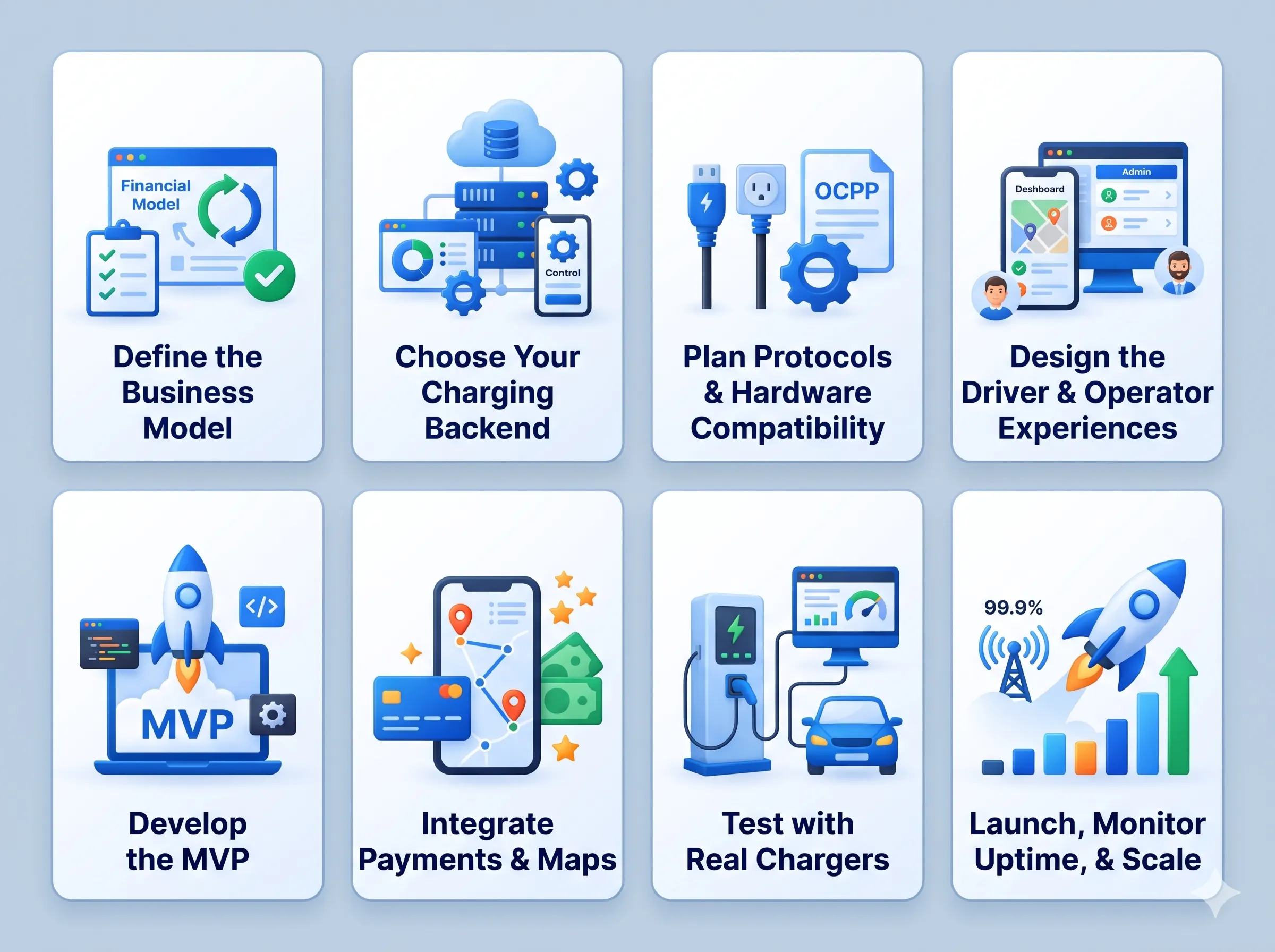
Developing an EV charging application requires coordinated planning across product strategy, hardware integration, backend engineering, and testing.
1. Define the App Type and Business Model
Start by identifying the primary purpose of the application. Determine whether you need a station finder, driver charging application, CPMS, fleet management platform, or a combination of these products.
Define the target customers, charging network requirements, expected revenue model, and launch geography. These decisions establish the initial feature scope and development budget.
2. Choose Your Charging Backend
The charging backend determines how the application communicates with charging infrastructure.
You generally have three options:
- Build a custom CPMS: Maintain control over charger communication, transactions, and operational data.
- Integrate an existing CPMS: Use available APIs to reduce backend development requirements.
- Adopt a white-label platform: Launch faster with prebuilt driver and operator functionality.
Evaluate supported OCPP versions, hardware compatibility, API availability, security, data ownership, and scalability before selecting a backend.
3. Plan Protocols and Hardware Compatibility
Identify the charger manufacturers and models your platform needs to support. Review their OCPP versions, supported features, connector configurations, firmware requirements, and communication capabilities.
If you plan to offer network roaming, assess OCPI compatibility and the relevant commercial agreements. Protocol compatibility does not guarantee that every optional feature is implemented by every charger. Validate the required functions against actual hardware specifications.
4. Design the Driver and Operator Experiences
Create separate user journeys for drivers and charging operators. The driver experience should prioritize station discovery, compatibility, payments, and charging session visibility.
The operator experience should focus on charger monitoring, pricing configuration, remote controls, transactions, and performance reporting. Develop wireframes and interactive prototypes to validate essential workflows before beginning full development.
5. Develop the MVP
The MVP should include the core capabilities required to validate the selected business model. Experienced providers offering MVP development services can help prioritize essential features and keep the initial scope aligned with business goals.
For a station finder, the initial scope may include:
- User registration and authentication.
- Charging station map and filters.
- Station details and connector compatibility.
- Basic availability information.
- Route planning and navigation.
A driver charging MVP requires additional capabilities. If you use an existing CPMS through its APIs, you may include QR-based authentication, start and stop charging, payments, session tracking, and transaction history without developing the entire charger communication layer yourself.
For a custom driver charging backend, prioritize OCPP integration, charger connectivity, authorization, session management, and transaction processing. For an operator platform, prioritize charger connectivity, monitoring, basic remote controls, and transaction management. Advanced AI, loyalty, and dynamic pricing features can be introduced after validating the core charging experience.
6. Integrate Payments, Maps, and Roaming
Connect the application with payment gateways, mapping services, and relevant external charging networks. Payment integration should support authorization, transaction processing, refunds, and receipts.
Map integration should provide accurate station locations, route planning, and location-based search. For roaming, implement the required OCPI modules and establish agreements with participating networks. Validate tariff exchange, authorization, session synchronization, and charge detail records.
7. Test with Real Chargers and Simulators
EV charging applications require hardware-level testing alongside standard mobile application testing. Use OCPP simulators and conformance testing tools to validate charger communication, authorization, transaction events, remote commands, and error handling.
Simulator testing cannot replace tests with physical chargers. Test representative charger models to identify issues involving firmware differences, communication interruptions, charging states, and payment synchronization.
Also test poor cellular connectivity at charging locations. The application and backend should handle timeouts, duplicate requests, interrupted sessions, and delayed status updates without producing incorrect transaction records.
Test offline charging behavior separately. Where supported, chargers should be able to complete sessions during temporary network interruptions and synchronize transaction records after connectivity returns.
8. Launch, Monitor Uptime, and Scale
Launch with a controlled group of charging stations before expanding the network. Monitor charger connectivity, session success rates, payment failures, port availability, and application performance.
Use operational analytics to identify recurring hardware issues and improve the charging experience. As the network grows, optimize backend capacity, introduce automated monitoring, expand charger compatibility, and implement advanced energy management capabilities.
Tech Stack for EV Charging App Development
The technology stack should support real-time communication, secure transactions, location services, and scalable infrastructure.
| Component | Recommended technologies | Purpose |
| Mobile application | React Native, Flutter, Swift, Kotlin | Cross-platform or native driver applications |
| Backend | Node.js, Java | APIs, authentication, charging workflows |
| Database | PostgreSQL | Users, chargers, sessions, and transactions |
| Caching | Redis | Frequently accessed and real-time application data |
| Cloud infrastructure | AWS, Microsoft Azure | Hosting, scalability, and infrastructure management |
| IoT communication | OCPP, MQTT, WebSockets | Charger communication and real-time updates |
| Maps and navigation | Google Maps, Mapbox | Station discovery and route planning |
| Payments | Stripe, Adyen | Payment processing and transaction management |
| Notifications | Firebase Cloud Messaging | Charging alerts and application notifications |
| Analytics | Cloud monitoring and analytics services | Usage, uptime, and performance tracking |
Native vs. Cross-Platform Development
React Native and Flutter allow companies to build iOS and Android applications using a shared codebase, reducing duplicated development effort and simplifying maintenance. They are suitable for many driver-facing features, including station discovery, account management, payments, and charging history.
Native development with Swift and Kotlin offers greater control over platform-specific capabilities, performance-sensitive workflows, and deeper operating system integrations. The right approach depends on the required device features, integration complexity, user experience, and long-term maintenance costs. For additional guidance, see our guide to React Native for IoT app development.
EV Charging App Development Cost
EV charging app development costs depend on application type, feature complexity, charger integrations, backend architecture, and regulatory requirements.
A station finder generally costs less than a platform that controls charging sessions, processes payments, and manages multiple charging networks.
Cost by App Type
| Application type | Estimated cost | Development timeline |
| Station finder / basic MVP | $15,000–$45,000 | 2–4 months |
| Driver charging MVP using an existing CPMS | $30,000–$75,000 | 3–6 months |
| Driver charging app with custom backend | $60,000–$120,000 | 4–6 months |
| CPMS and operator dashboard | $80,000–$180,000 | 5–8 months |
| Fleet charging application | $60,000–$140,000 | 4–7 months |
| Home charging application | $35,000–$75,000 | 3–5 months |
| Enterprise charging ecosystem | $150,000–$450,000+ | 8–12+ months |
These are indicative custom software development budgets, not independently verified industry averages. They exclude physical chargers, electrical infrastructure, installation, and electricity procurement.
A custom backend for an electric vehicle charging station application that supports multiple charger manufacturers, complex payments, roaming, and compliance reporting requires a larger investment. An enterprise solution combining driver applications, CPMS, fleet management, network roaming, and advanced energy management may require a substantially higher investment.
Feature-Level Development Cost
Individual features also influence the total project budget.
| Feature | Indicative development budget |
| User registration and authentication | $2,000–$5,000 |
| Interactive map and station discovery | $4,000–$10,000 |
| Connector and charging-speed filters | $1,500–$4,000 |
| Real-time charger availability | $4,000–$10,000 |
| Route planning | $3,000–$8,000 |
| Payment gateway integration | $3,000–$8,000 |
| QR-based charger authentication | $2,000–$5,000 |
| OCPP integration | $10,000–$25,000 |
| OCPI roaming integration | $8,000–$20,000 |
| Operator dashboard | $8,000–$20,000 |
| Charging session tracking | $3,000–$8,000 |
| Smart charging and load balancing | $8,000–$20,000 |
These figures represent preliminary engineering allowances for defined feature scopes. They are not fixed add-on charges. Some features share backend components, so their costs should not simply be added together to calculate the final project budget.
What Factors Affect EV Charging App Development Cost?
- Application Complexity: Advanced features such as charger control, payment processing, and network roaming increase backend development effort.
- Charger and Protocol Compatibility: Supporting multiple charger manufacturers, OCPP versions, and protocol features requires additional integration and testing.
- Payment Infrastructure: Payment authorization, refunds, digital wallets, and transaction reconciliation increase development and integration costs.
- Network Roaming: Connecting multiple charging networks requires OCPI integrations, tariff synchronization, and authorization workflows.
- Compliance and Security: Data protection, payment security, accessibility, uptime monitoring, and regulatory reporting add engineering and testing requirements.
- Platform Requirements: Building separate native iOS and Android apps may cost more than using a shared cross-platform approach.
Ongoing Costs After Launch
Development is only one part of the investment. You must also budget for recurring operational expenses.
- Maintenance: Bug fixes, operating system compatibility, security updates, and application improvements.
- Cloud infrastructure: Server hosting, database operations, storage, monitoring, and data transfer.
- Payment processing: Transaction fees charged by payment providers.
- Maps and location services: Usage-based fees for mapping, geocoding, and navigation APIs.
- Protocol maintenance: Compatibility updates, charger firmware changes, and protocol version support.
- Customer support: Assistance with payment disputes, charging failures, and account issues.
- Compliance and certification: Applicable security reviews, hardware certification, and regulatory reporting costs.
How Do EV Charging Apps Make Money?
EV charging platforms can generate revenue through charging transactions, subscriptions, licensing, and business partnerships.
- Per-kWh Markup: Add a service margin to electricity prices and earn revenue from every charging session.
- Subscription Plans: Offer optional memberships with benefits such as discounted charging, priority reservations, and fleet management features.
- Idle and Reservation Fees: Charge users for occupying charging ports beyond session completion or reserving charging slots, subject to applicable regulations.
- White-Label Licensing: License the charging application or management platform to other operators through recurring agreements.
- Advertising and Partnerships: Generate revenue through sponsored station listings, relevant advertisements, and EV industry partnerships.
- Fleet Software Subscriptions: Charge companies recurring fees for vehicle monitoring, charging coordination, energy reports, and expense management.
Build vs. Buy vs. White-Label: Which Approach Should You Choose?
You do not always need to develop an entire EV charging ecosystem from scratch. The right approach depends on customization requirements, launch timelines, infrastructure ownership, and available resources.
| Approach | Advantages | Limitations | Best suited for |
| Custom development | Full control over features, architecture, branding, and integrations | Higher initial cost and longer development time | Companies building differentiated charging platforms |
| Buy or integrate an existing CPMS | Faster backend deployment and established charger integrations | Dependence on vendor capabilities and API limitations | Charging operators needing existing infrastructure management |
| White-label platform | Faster launch with prebuilt driver experiences and standard features | Limited customization and vendor dependency | New charging networks validating a market |
Platforms and ecosystem providers such as Hubject can support specific interoperability, roaming, and Plug & Charge requirements. White-label driver applications can also reduce the time needed to launch a branded customer experience.
However, evaluate pricing, data ownership, supported protocols, API access, scalability, and exit options before selecting a provider. Custom development makes more sense when the charging platform needs proprietary workflows, differentiated customer experiences, or specialized fleet and energy management capabilities.
Challenges in EV Charging App Development and How to Solve Them
EV charging applications depend on several interconnected systems. Problems in hardware, connectivity, payments, or data synchronization can directly affect the charging experience.
1. Charger Fragmentation
Different manufacturers implement different OCPP versions, optional features, and firmware configurations.
Solution: Create a hardware compatibility matrix, validate supported OCPP features, and test integrations with representative charger models before expanding the network.
2. Inaccurate Availability Data
Delayed status updates can show a charger as available when it is occupied or out of service.
Solution: Use real-time charger events, timestamped status records, automated synchronization, and clear indicators for outdated data.
3. Poor Connectivity at Charging Sites
Weak cellular or internet connectivity can interrupt communication between chargers and backend systems.
Solution: Support local charging authorization where appropriate, retry mechanisms, secure message buffering, and transaction synchronization after connectivity returns.
4. Payment Failures
Payment authorization errors, interrupted transactions, and duplicate requests can create billing disputes.
Solution: Implement idempotent transaction processing, payment reconciliation, clear failure states, and reliable refund workflows.
5. Uptime and Reliability Management
Charger downtime can affect customer satisfaction, network revenue, and regulatory compliance.
Solution: Introduce automated health monitoring, fault alerts, diagnostic logs, maintenance workflows, and port-level uptime reporting.
Conclusion
Building an EV charging app requires a clear understanding of the target business model, charging infrastructure, and customer requirements. A station finder, driver charging application, and CPMS have different technical and operational requirements, which directly influence development costs and timelines. Mobile app development services can help you address these requirements through tailored solutions that prioritize charger compatibility, reliable communication protocols, secure payments, real-time availability, and regulatory compliance.
Starting with an MVP and expanding capabilities based on operational needs can help control the initial investment. RipenApps can help translate your requirements into a reliable EV charging application with the right development architecture and integration strategy.
FAQs
1. How much does it cost to build an EV charging app?
Developing an EV charging app can start at $15,000 for a focused station finder MVP. A station finder generally costs $15,000–$45,000, while a driver charging MVP using an existing CPMS can cost $30,000–$75,000. A feature-rich enterprise charging ecosystem can cost $150,000–$450,000 or more.
2. How long does it take to develop an EV charging app?
A focused station finder MVP may take 2–4 months. A driver charging MVP using an existing CPMS can take 3–6 months, while a driver app with a custom backend may take 4–6 months. A CPMS and operator dashboard can require 5–8 months. An enterprise charging ecosystem can take 8–12 months or longer, depending on integrations and feature complexity.
3. What is OCPP, and do I need it?
OCPP is an open communication protocol that connects EV charging stations with central management systems. It enables charger monitoring, authorization, remote controls, transaction management, and smart charging. Applications controlling charging hardware generally need OCPP integration or an existing CPMS that provides the required capabilities.
4. Can I build an app like PlugShare or ChargePoint?
Yes. You can develop applications with similar capabilities, including station discovery, connector filters, real-time availability, route planning, payments, and charging session management. The required architecture depends on whether your product only displays charging locations or also connects to charging infrastructure.
5. Should I build a custom EV charging app or use a white-label platform?
Custom development is suitable when you require complete control over features, branding, integrations, and backend architecture. White-label platforms are useful when faster deployment and standard charging functionality are priorities. Consider customization, ownership, scalability, and long-term costs before deciding.
6. Does my EV charging app need to meet NEVI or AFIR requirements?
Compliance depends on the countries where your charging network operates and the infrastructure covered by the relevant regulations. NEVI requirements apply to specified federally supported US charging infrastructure, while AFIR governs publicly accessible alternative fuels infrastructure in the EU. Assess payment, pricing, uptime, interoperability, and data-sharing requirements before launch.
Discuss your project and request for proposal
SHARE
WRITTEN BY

Vaibhav Sharma
Business Head
Vaibhav Sharma bridges product vision with real-world execution. He shares consultation with startups and enterprises to shape digital strategies, refine user journeys, and create app experiences that feel intuitive from day one. His strength lies in transforming early concepts into clear development roadmaps that set products up for long-term success.
View All Articles