

Key Takeaways
- AI agents are goal-oriented systems that can reason, plan, use tools, and execute multi-step tasks with varying levels of autonomy.
- AI chatbots primarily focus on conversational interactions, answering questions, guiding users, and assisting with predefined tasks.
- Large language models are the underlying AI models that understand and generate human-like language and can power both chatbots and AI agents.
- Chatbots are suitable for structured customer interactions, while AI agents are better suited to dynamic workflows requiring decisions and actions.
- Combining LLMs, chatbots, and AI agents can create intelligent digital products that support both communication and operational automation.
Artificial intelligence is changing how businesses build digital products, automate operations, and interact with customers. From answering customer questions to managing complex workflows, AI-powered capabilities are becoming an important part of modern applications. However, as new technologies emerge, businesses often face a fundamental question: should they build an AI agent, integrate a chatbot, or use a large language model (LLM)?
The confusion is understandable because these technologies often overlap. An application might use an LLM to generate responses, a chatbot to communicate with users, and an AI agent to execute tasks across multiple business systems. Although they can work together, they serve different purposes and offer different levels of intelligence, automation, and autonomy.
Understanding AI agents vs chatbots is particularly important when defining an AI product strategy. Businesses considering a conversational solution can work with a custom AI chatbot development company to build tailored experiences for customer support, query resolution, and business process automation. However, an AI agent or an LLM may be more suitable when the requirements involve complex reasoning, decision-making, or executing tasks across multiple systems.
Choosing the wrong technology can increase development costs, introduce unnecessary complexity, and create an experience that does not solve the actual business problem. This guide explores the differences between AI agents, chatbots, and LLMs, including their architecture, business applications, development considerations, costs, and implementation strategies. It also explains when businesses should choose one technology over another and when combining them can deliver better results.
Table of Contents
What are Large Language Models (LLMs)?
A large language model is an artificial intelligence model trained on extensive datasets to understand, process, and generate human language. It learns statistical patterns and relationships between words, sentences, and other information, allowing it to respond to questions, summarise documents, generate content, explain concepts, and assist with reasoning-oriented tasks.
Models such as GPT, Claude, and Gemini are examples of LLM-powered technologies. Unlike traditional rule-based systems, LLMs can interpret natural language rather than depending entirely on predefined commands. A user can ask the same question in different ways, and the model can still understand the underlying intent.
For example, consider an ecommerce application where a customer asks:
“I ordered a pair of shoes last week. Can you tell me when they will arrive?”
An LLM can interpret the customer’s question, understand that the user wants order information, and generate a relevant conversational response if the necessary information is provided in its context.
However, an LLM does not automatically have access to the customer’s order history. It cannot independently retrieve the latest delivery status or update the order unless the surrounding application provides the appropriate integrations and permissions. This distinction is important because language generation and real-world task execution are different capabilities.
How Does an LLM Work?
An LLM processes input through a neural network architecture, commonly based on transformers. These models use mechanisms such as attention to identify relationships between different parts of the input and generate contextually relevant outputs. A simplified LLM workflow includes:
- Input processing: The user submits a question, instruction, document, or other supported input. The model converts the input into tokens that it can process.
- Context understanding: The model analyses relationships between tokens, considers the available conversation context, and identifies patterns relevant to the request.
- Response generation: Based on its learned parameters and supplied context, the model predicts and generates an appropriate sequence of output tokens.
- Output delivery: The application presents the generated response to the user or passes it to another component for additional processing.
The quality of the response depends on several factors, including the model’s capabilities, prompt quality, available context, data freshness, and any external tools connected to the application.
What Can an LLM Do?
LLMs support a broad range of language-related and multimodal capabilities.
| Capability | Business Application |
| Text generation | Creating product descriptions, reports, emails, and marketing content |
| Text summarisation | Condensing long documents, reports, and customer conversations |
| Question answering | Responding to queries using supplied information |
| Translation | Supporting multilingual customer experiences |
| Code generation | Assisting developers with code and documentation |
| Sentiment analysis | Identifying customer opinions and emotional patterns in text |
| Information extraction | Extracting relevant details from documents and messages |
| Content classification | Categorising support tickets, feedback, and business records |
For example, a healthcare application can use an LLM to summarise medical documents, while a financial application can use it to explain complex financial information in simpler language. However, these applications still require appropriate data access, validation, security controls, and domain-specific implementation.
What are AI Chatbots?
An AI chatbot is a software application that interacts with users through text or voice conversations. It is designed to understand user questions, provide relevant answers, guide users through processes, and support specific interactions.
Traditional chatbots generally rely on predefined rules, decision trees, keywords, and scripted responses. Modern AI chatbots can use NLP, machine learning, and LLMs to understand more complex questions and generate flexible responses.
For example, an online banking application may include a chatbot that helps customers check account information, understand transaction categories, find answers to banking questions, or navigate different services.
The chatbot acts as the communication layer between the customer and the application. Unlike a basic FAQ system, an AI chatbot can interpret variations in language, maintain conversational context, and provide more natural interactions. When connected to business APIs, it can also retrieve information or execute selected operations.
However, the level of functionality depends on its underlying architecture. A chatbot that only answers questions is different from one that can access customer records, initiate transactions, or coordinate workflows.
How Does an AI Chatbot Work?
An AI chatbot typically follows a conversational processing workflow.
- User input: The user submits a message through a website, mobile application, messaging platform, or voice interface.
- Intent recognition: The chatbot analyses the message to identify what the user wants to accomplish.
- Context retrieval: It accesses relevant conversational history, predefined knowledge, or connected information sources.
- Response generation: Depending on its implementation, the chatbot selects a predefined response or uses an LLM to generate a context-aware answer.
- Response delivery: The answer is presented to the user, who can continue the conversation or follow the recommended action.
A more advanced chatbot may also connect with CRM software, payment gateways, booking systems, or customer support platforms. For instance, if a customer asks about an existing travel reservation, the chatbot may retrieve booking details through an API and display the current status.
The important distinction is that a chatbot generally manages conversations and the interactions it has been designed to support. It does not necessarily decide how to independently complete a broader, open-ended business objective. Businesses looking to build more advanced conversational experiences can leverage generative AI development services to create context-aware chatbots that understand user intent, generate relevant responses, and support more dynamic interactions.
Types of AI Chatbots
Businesses can implement different chatbot architectures depending on their customer experience and operational requirements.
Rule-Based Chatbots
Rule-based chatbots follow predefined instructions, conditions, and decision trees. They provide responses based on specific user inputs or selected options. They are useful for simple interactions such as checking business hours, collecting contact details, and answering frequently asked questions. Their main advantage is predictability. However, they may struggle when users ask questions outside their predefined conversational paths.
AI-Powered Chatbots
AI-powered chatbots use NLP and machine learning to understand user intent and generate more flexible responses. They can handle variations in language and support more natural conversations. They are useful for customer support, product discovery, and conversational assistance.
LLM-Powered Chatbots
LLM-powered chatbots use large language models to understand complex instructions, generate contextual responses, and maintain more natural conversations. They can also use retrieval-augmented generation (RAG) to retrieve relevant information from company documents, knowledge bases, and other approved data sources.
Hybrid Chatbots
Hybrid chatbots combine rule-based logic with AI-powered responses. They can use predefined flows for sensitive or predictable interactions and LLMs for open-ended questions. This architecture is useful when businesses need both conversational flexibility and operational control.
What Can AI Chatbots Do?
AI chatbots can support several business functions.
| Function | Example |
| Customer support | Answering product and service questions |
| Lead qualification | Collecting customer requirements and contact information |
| Appointment scheduling | Helping users select available appointment slots |
| Product recommendations | Suggesting products based on user preferences |
| Order assistance | Retrieving order and delivery information |
| Employee assistance | Answering internal HR and policy questions |
| Banking assistance | Explaining transactions and account-related information |
| Healthcare assistance | Providing general information and helping users navigate services |
The effectiveness of an AI chatbot depends on its knowledge sources, integrations, conversation design, and ability to recognise when a human representative should take over.
What are AI Agents?
AI agents are intelligent software systems designed to pursue specific goals by interpreting information, making decisions, selecting tools, and executing tasks with varying degrees of autonomy.
Unlike a conventional chatbot that primarily responds to user messages, an AI agent can determine what steps are required to accomplish a task and perform those steps through connected tools and systems.
For example, imagine a customer asks an ecommerce application:
“I want to return the shoes I purchased last week and replace them with a larger size.”
A conventional chatbot might explain the return policy and provide a link to the return page. An AI agent could potentially:
- Retrieve the customer’s order information.
- Check the applicable return policy.
- Verify whether the product is eligible for return.
- Check the availability of the requested size.
- Initiate the return process.
- Generate a replacement request.
- Update the customer about the outcome.
These actions depend on the agent’s permissions, connected APIs, business rules, and approval requirements. The defining characteristic is not simply that the system can generate intelligent responses. It is that the system can manage a goal-oriented process and interact with its environment to make progress.
How Does an AI Agent Work?
An AI agent generally operates through an iterative process involving input, reasoning, planning, tool execution, and feedback.
- Goal identification: The agent receives an objective from the user or an authorised system trigger.
- Context gathering: It retrieves relevant information from databases, APIs, knowledge repositories, or other connected sources.
- Planning: It determines the steps required to complete the objective and identifies the tools needed for each step.
- Tool selection: The agent selects an appropriate tool, such as a CRM API, payment gateway, booking system, or document retrieval service.
- Action execution: It performs an authorised operation through the selected integration.
- Result evaluation: It checks the outcome and determines whether the task has been completed or whether additional steps are necessary.
- Task completion: It provides the user with an outcome, requests approval, or escalates the task when required.
This process may involve multiple reasoning and execution cycles.
Core Components of an AI Agent
An AI agent requires more than an LLM connected to a user interface. Its architecture typically includes several components that work together.
| Component | Role |
| LLM or reasoning model | Interprets instructions and supports decision-making |
| Tools and APIs | Allow the agent to retrieve information and execute actions |
| Memory and context | Maintain relevant information across task steps |
| Planning mechanism | Breaks objectives into manageable steps |
| Orchestration layer | Coordinates tasks, tool calls, and agent execution |
| Knowledge sources | Provide access to relevant business information |
| Guardrails | Restrict unauthorised, unsafe, or out-of-scope actions |
| Monitoring and evaluation | Track performance, errors, and task completion |
For instance, a sales operations agent may use an LLM to understand a sales manager’s instructions, a CRM integration to retrieve lead information, a scheduling API to arrange follow-ups, and a monitoring layer to record completed actions.
Types of AI Agents
AI agents can be designed with different levels of complexity and autonomy.
Simple Reflex Agents
These agents respond to specific conditions using predefined rules. They do not require extensive planning or long-term memory. For example, an application may trigger an automated notification when a payment is overdue.
Model-Based Agents
Model-based agents maintain an internal representation of relevant information about their environment. This helps them make decisions using both current inputs and previously gathered context. A warehouse monitoring agent could use inventory levels, order information, and delivery updates to determine when stock replenishment is required.
Goal-Based Agents
Goal-based agents select actions based on a defined objective. They evaluate possible steps and determine which actions are likely to move them closer to the desired outcome. A travel booking agent that identifies flights matching a customer’s requirements is one example.
Utility-Based Agents
Utility-based agents evaluate different possible outcomes using defined priorities or utility measures. They can balance factors such as chatbot development cost, speed, quality, and resource availability. For example, a logistics agent may compare delivery routes based on travel time, fuel consumption, and delivery commitments.
Learning Agents
Learning agents improve their behaviour using feedback and experience. Depending on their implementation, they may adapt recommendations, strategies, or decision-making processes based on observed results. Not every AI agent learns automatically or modifies its underlying model. Learning capabilities require specific mechanisms, training processes, and governance.
AI Agents vs Chatbots vs LLMs: Key Differences
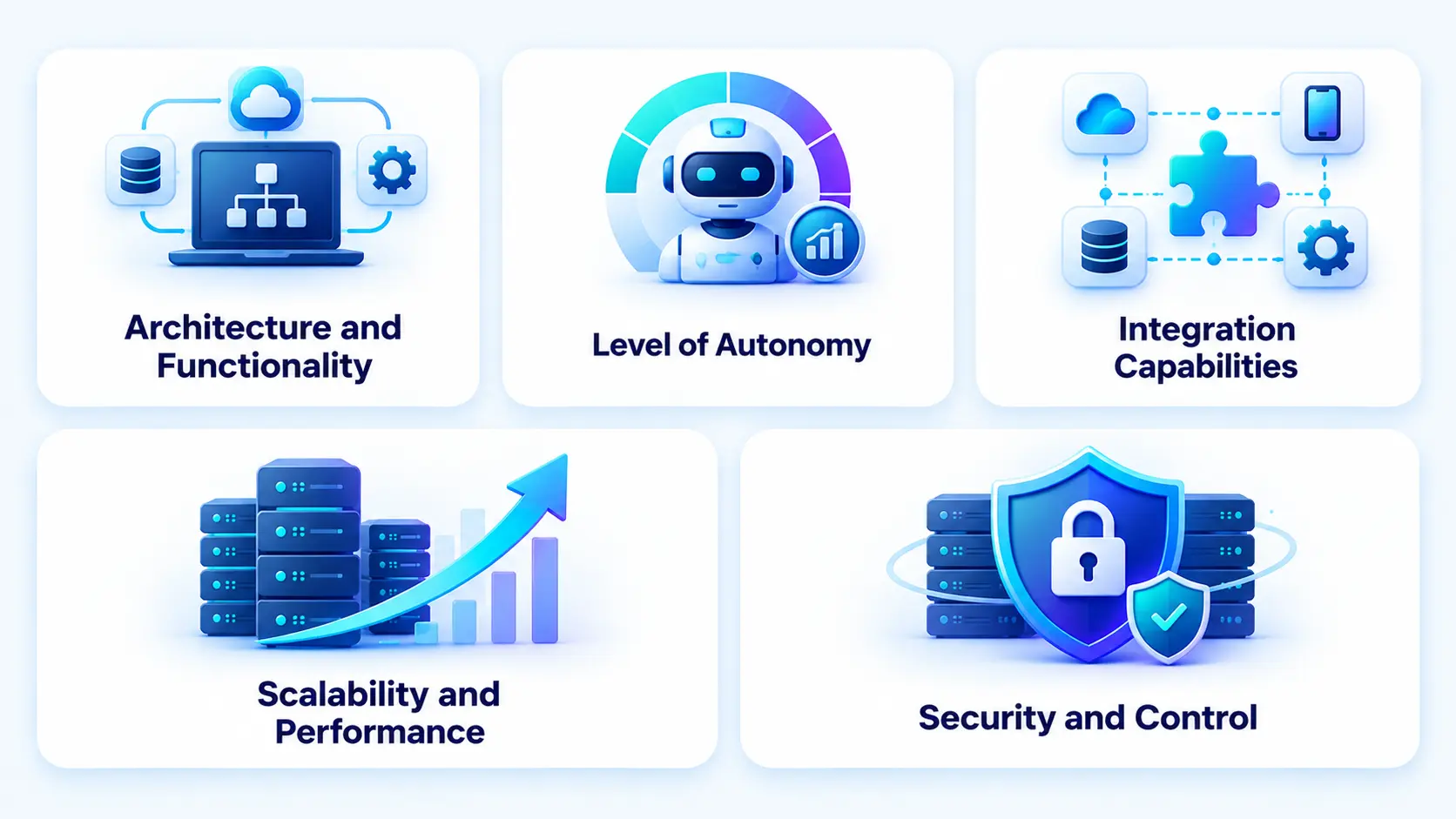
Now that the three technologies are defined, the next step is to understand how they differ in terms of architecture, functionality, autonomy, integrations, scalability, and business value.
1. Architecture and Functionality
An LLM is the underlying model that processes information and generates responses. It does not automatically include a complete application architecture. A chatbot adds an interaction layer around an AI model or predefined conversational logic. It manages how users communicate with the system and receive information.
An AI agent adds an execution and orchestration layer. It can use an LLM, retrieve information, select tools, and perform multiple actions based on a goal. For example, a company developing an internal employee assistant may use an LLM to interpret policy-related questions, a chatbot interface to communicate with employees, and an AI agent to process approved leave requests through its HR management system.
2. Level of Autonomy
Autonomy is one of the most important differences between these technologies. An LLM generates an output based on the available input and context. A chatbot responds to user messages according to its conversational design. An AI agent can determine the next action required to achieve an objective.
However, autonomy is not an all-or-nothing characteristic. Agents can operate with different levels of independence. A low-autonomy agent may recommend actions and wait for human approval. A more advanced agent may complete routine tasks independently while escalating sensitive decisions. Businesses should define the appropriate level of autonomy according to the consequences of an incorrect action.
3. Integration Capabilities
LLMs can be connected to external information sources through retrieval systems, APIs, and other tools. However, the model itself does not automatically have access to business systems. Chatbots commonly integrate with customer support platforms, CRM systems, booking services, and databases to retrieve information during conversations.
AI agents can use multiple integrations as part of a broader execution process. They may retrieve information from one system, evaluate it, and perform an authorised action in another. For example, a retail agent could retrieve inventory data, check customer preferences, calculate an applicable discount, and update an order through connected services.
4. Scalability and Performance
The scalability requirements differ according to the technology being implemented. An LLM-powered application must account for model availability, token consumption, inference latency, and request volume. A chatbot must additionally manage concurrent conversations, session state, response times, and customer support integrations.
An AI agent requires more extensive orchestration because one user request may trigger several model calls, tool executions, database operations, and validation steps. As a result, a single agent task may consume more resources than a simple chatbot interaction. Businesses must evaluate performance at the task level rather than comparing only the response time of individual models.
5. Security and Control
Security requirements also increase with the level of access and autonomy provided to the system. An LLM-based content assistant may only need access to approved information. A customer-facing chatbot may require user authentication and controlled access to customer records.
An AI agent that can update financial records, issue refunds, or modify business information requires stricter permission management. Important controls include role-based access control, API authentication, data encryption, human approval for sensitive operations, input and output validation, activity logs, rate limits, and monitoring. The objective is to ensure that the AI system can only access information and perform operations that are explicitly permitted.
Read Also: How to Build a ChatGPT-like App in 2026: Complete Development Guide
Agentic AI vs Conversational AI: Understanding the Difference
Agentic AI and conversational AI are closely related but serve different objectives. Conversational AI focuses on enabling machines to understand and respond to human communication. It includes chatbots, virtual assistants, voice assistants, and other interactive systems.
Agentic AI focuses on systems that can pursue goals, make decisions, and execute actions using available tools and information. A conversational AI system may answer a customer’s questions about an insurance policy. An agentic AI system may analyse the customer’s request, retrieve policy details, check eligibility, prepare a claim, and route it for approval.
The two technologies can work together. A conversational interface can act as the entry point for an agentic system, allowing users to describe objectives in natural language while the agent handles the underlying workflow.
How Agentic AI Extends Conversational AI
Traditional conversational systems generally depend on predefined dialogue structures or response-generation logic. Agentic systems introduce additional capabilities:
- Goal-oriented execution: Instead of responding only to individual questions, the system works towards a defined outcome.
- Dynamic planning: It can determine the next steps based on the information available at each stage.
- Tool orchestration: It can interact with multiple systems through authorised tools and APIs.
- Feedback-based execution: It can inspect the outcome of an action and decide whether another step is required.
- Conditional escalation: It can request human intervention when it encounters uncertainty, policy restrictions, or sensitive decisions.
This makes agentic AI useful for processes where the next action cannot always be determined in advance.
AI Agents for Business Use Cases
The practical value of an AI technology depends on the problem it solves. While chatbots and LLMs are widely used for information-based interactions, AI agents can support more complex workflows across departments. The following examples explain where AI agents can contribute to business operations.
AI Agents in Ecommerce and Retail
Ecommerce businesses manage multiple interconnected operations, including product discovery, order processing, inventory, returns, payments, and customer support. AI agents can help coordinate these processes by accessing relevant information and executing authorised actions.
- Intelligent shopping assistance: An agent can understand a customer’s budget, preferences, and product requirements before comparing available products.
- Cart abandonment recovery: An agent can identify eligible abandoned-cart customers, evaluate approved incentives, and trigger personalised follow-ups through connected marketing systems.
- Inventory coordination: An agent can monitor inventory information, identify stock shortages, and prepare replenishment requests.
- Order management: It can retrieve order details, investigate delivery exceptions, and initiate approved customer support workflows.
- Returns and refunds: It can check return eligibility, retrieve order information, and prepare or initiate authorised refund operations.
The phrase agentic AI shopping assistant vs chatbot cart abandonment research describes an important difference in ecommerce automation. A conventional chatbot may ask customers why they abandoned their carts and offer a predefined discount. An agentic shopping assistant can potentially evaluate customer behaviour, check inventory, identify an approved incentive, and coordinate a personalised recovery workflow.
However, marketing decisions should follow consent requirements, customer communication preferences, and company policies.
AI Agents in Banking and FinTech
Financial institutions handle information-intensive processes that require accuracy, security, and strict regulatory controls. AI agents can support selected operational workflows while leaving sensitive financial decisions under appropriate human or rule-based supervision.
- Customer onboarding: Agents can collect required information, check document completeness, and coordinate onboarding steps.
- Fraud monitoring support: They can gather transaction information, identify suspicious patterns using approved detection systems, and prepare cases for investigation.
- Loan application processing: Agents can organise application documents, retrieve relevant records, and identify missing information.
- Customer service operations: They can investigate account-related queries and coordinate approved service requests.
- Financial reporting: They can collect information from authorised sources and prepare structured summaries for review.
For example, a lending platform may use an agent to collect application information, verify whether mandatory documents are available, and route the application to the appropriate review team. The agent should not independently approve loans or make regulated financial decisions without the necessary authorised decision framework.
Businesses exploring conversational financial assistance can also consider how AI chatbots in banking & FinTech are used to improve customer interactions.
AI Agents in Healthcare
Healthcare applications can use AI agents to support administrative processes, clinical information management, and patient engagement. However, healthcare systems require stronger controls because inaccurate information or unauthorised actions can affect patient safety and privacy. Potential use cases include:
- Appointment coordination: Agents can check appointment availability, schedule bookings, and send reminders.
- Patient intake: They can collect preliminary information and organise it for healthcare professionals.
- Medical documentation: They can assist with retrieving, summarising, and organising clinical documents for authorised users.
- Insurance administration: They can check documentation completeness and coordinate claim-related workflows.
- Healthcare operations: They can help staff retrieve information from approved systems and prepare operational reports.
For instance, an AI agent integrated with a healthcare application may collect appointment requirements, check available slots, and schedule an appointment after confirming the patient’s selection. Clinical diagnosis, treatment recommendations, and other high-impact medical decisions require appropriate professional oversight and regulatory compliance.
Conversational interfaces can also make healthcare applications easier to navigate by allowing patients to ask questions, access relevant information, and interact with digital health services through natural language. This is where conversational AI in healthcare apps can improve patient interactions and simplify access to healthcare services.
AI Agents in Travel and Hospitality
Travel businesses coordinate multiple suppliers, bookings, schedules, payments, and customer requirements. AI agents can simplify these processes by connecting with authorised travel systems.
- Travel itinerary planning: Agents can gather destination preferences, compare travel options, and prepare itineraries.
- Booking coordination: They can retrieve flight and hotel availability and assist with booking workflows.
- Reservation management: Agents can investigate changes, cancellations, and booking-related requests.
- Travel assistance: They can provide contextual information about schedules, destinations, and travel arrangements.
- Customer support: They can coordinate service requests across connected booking and support platforms.
For example, a customer may request a three-day business trip with a specific budget. An agent can gather flight and accommodation options, compare them against the requirements, and prepare a suitable itinerary for approval.
AI Agents in Real Estate
Real estate businesses manage large amounts of property information, customer enquiries, appointments, and documentation. AI agents can help improve operational efficiency by connecting customer-facing and internal systems.
- Lead qualification: Agents can evaluate customer requirements, budget, and location preferences.
- Property matching: They can compare available listings against customer requirements.
- Site visit scheduling: They can check agent availability and coordinate appointments.
- Document assistance: They can retrieve approved property information and organise relevant documents.
- Sales pipeline coordination: They can update CRM records and prepare follow-up tasks.
A real estate agent could receive a request to find residential properties within a specific budget and location. The AI agent can retrieve matching listings, organise the results, and schedule a site visit after customer confirmation.
AI Agents in SaaS and Enterprise Applications
SaaS businesses can use AI agents to support internal workflows and provide more intelligent product experiences.
- Customer onboarding: Agents can guide new users through setup requirements and coordinate account configuration.
- Customer success: They can identify accounts requiring attention based on approved usage signals.
- IT service management: Agents can classify incidents, retrieve troubleshooting information, and create support tickets.
- Business intelligence: They can retrieve information from connected databases and prepare reports.
- Workflow automation: They can coordinate repetitive activities across project management, CRM, HR, and communication platforms.
For example, an enterprise employee may ask an internal agent to prepare a project status report. The agent can retrieve relevant task updates, collect approved project information, identify delays, and generate a structured report.
When to Use AI Agents vs Chatbots vs LLMs
Choosing the right technology requires evaluating what the product is expected to accomplish. A common mistake is selecting an AI architecture because it is trending rather than because it addresses a genuine business requirement. A better approach is to start with the user problem, define the required outcome, and identify the minimum technical capabilities needed to deliver it.
When Should You Use an LLM?
Choose an LLM when the primary requirement involves understanding, generating, summarising, or transforming information. An LLM-based solution is suitable when:
- The application needs intelligent text generation.
- Users need to summarise large documents.
- The product must extract information from unstructured content.
- The application requires multilingual language processing.
- Users need natural-language access to information.
- The system needs to classify or analyse text-based data.
For example, a business intelligence platform can use an LLM to convert complex reports into easy-to-understand summaries. In this situation, introducing a conversational chatbot or autonomous agent may not be necessary.
When Should You Use an AI Chatbot?
Choose a chatbot when the primary requirement is to improve communication between users and the application. A chatbot is appropriate when:
- Customers frequently ask similar questions.
- Users need assistance navigating an application.
- The business wants to automate basic customer support.
- Customers need product or service recommendations.
- Employees require access to internal information through conversation.
- The product needs an interactive voice or text assistant.
For example, a healthcare application may use an AI chatbot to answer general service questions, explain appointment procedures, and guide users through registration. The chatbot can integrate with backend systems where required, but it does not need an autonomous planning architecture if its responsibilities remain predictable.
When Should You Use an AI Agent?
Choose an AI agent when the product needs to accomplish objectives involving multiple steps, decisions, and external operations. An AI agent is suitable when:
- A task involves several interconnected systems.
- The required steps depend on changing information.
- The system needs to evaluate different actions.
- Users want to automate repetitive operational workflows.
- Tasks require dynamic planning and tool selection.
- The application needs to coordinate multiple authorised operations.
For example, an enterprise application may use an AI agent to investigate a customer complaint, retrieve relevant transaction information, create a support ticket, and assign the case to the correct team. In this scenario, a simple conversational response would not be enough to achieve the desired business outcome.
When Should Businesses Combine AI Agents, Chatbots, and LLMs?
These technologies do not need to be implemented independently. In many modern products, they work together to create a complete AI-powered experience. An LLM can provide language understanding and generation. A chatbot can act as the user-facing interface. An AI agent can execute the underlying workflow.
Consider a fintech application that helps customers manage financial service requests. The customer interacts with a chatbot and describes the requirement. The LLM interprets the request and identifies the relevant information. The agent retrieves account information, checks the applicable business rules, and initiates an authorised workflow. The customer receives updates through the chatbot as the task progresses. Each component has a distinct responsibility, but the complete experience feels like a single intelligent application.
Advantages and Limitations of AI Agents
AI agents can deliver significant operational benefits, particularly when businesses need to automate processes that involve multiple systems and decisions.
However, greater autonomy also introduces additional technical and governance requirements.
Advantages of AI Agents
- Automation of multi-step workflows
AI agents can coordinate multiple operations without requiring users to manually initiate every step. This can reduce repetitive work across customer service, sales, finance, and operations.
- Improved operational efficiency
Agents can handle repetitive information retrieval, data processing, and task coordination. Employees can focus more on activities that require human judgement and expertise.
- Context-aware decision-making
An agent can evaluate information from different sources before selecting an action. This can make it more useful for tasks that require contextual understanding.
Limitations of AI Agents
- Higher implementation complexity
Building an agent requires more than connecting an LLM to an application. Businesses need orchestration, tool definitions, permissions, memory management, testing, and monitoring.
- Increased operational costs
An agent may perform several model calls and external operations for a single task. This can increase inference, infrastructure, and API costs.
- Risk of incorrect actions
If an agent misinterprets information or selects an incorrect tool, it may perform an unintended operation. Strong validation and approval mechanisms are essential.
How Businesses Can Reduce Agent-Related Risks
A production-ready agent should operate within clearly defined boundaries. Businesses can reduce implementation risks by starting with limited permissions, testing in sandbox environments, validating every action, and introducing human approval for sensitive operations.
They should also define maximum execution steps, timeouts, retry limits, escalation conditions, and clear completion criteria. An agent should never be given unrestricted access to business systems simply to make it more autonomous.
Advantages and Limitations of AI Chatbots
AI chatbots remain an effective option for businesses that want to improve customer communication without introducing complex autonomous workflows.
Advantages of AI Chatbots
- 24/7 customer assistance
Chatbots can provide support outside business hours, allowing customers to access information without waiting for a human representative.
- Faster response times
They can answer common questions immediately, reducing the time customers spend searching for information.
- Lower repetitive support workload
Automating frequently asked questions allows support teams to focus on complex customer issues.
Limitations of AI Chatbots
- Limited operational independence
Most chatbots are designed around conversational interactions. They may require predefined flows or additional integrations to complete business operations.
- Potentially inaccurate responses
LLM-powered chatbots may generate incorrect answers, particularly when their knowledge sources are incomplete or outdated.
- Difficulty handling complex requests
A chatbot may struggle when a customer’s request involves multiple systems, changing conditions, and several dependent actions.
How Businesses Can Improve Chatbot Performance
Businesses should develop chatbots around clearly defined customer journeys rather than attempting to make them answer every possible question. An approved knowledge base, effective conversation design, retrieval mechanisms, contextual prompts, and reliable API integrations can improve response quality.
It is equally important to establish clear escalation paths so customers can reach a human representative when required. For organisations looking to improve customer engagement through conversational experiences, a customer service chatbot can provide a useful starting point for planning customer support automation.
Advantages and Limitations of LLMs
LLMs provide the language intelligence required by many modern AI applications. Their flexibility makes them useful across multiple industries and product categories.
Advantages of LLMs
- Natural language understanding
LLMs can interpret different ways of expressing the same request, making applications easier to interact with.
- Flexible content generation
They can generate reports, summaries, descriptions, explanations, and other text-based outputs.
- Contextual responses
With appropriate context management, LLMs can generate responses that consider earlier parts of a conversation or supplied business information.
Limitations of LLMs
- Hallucinations
LLMs may generate incorrect information while presenting it confidently.
- Lack of inherent business context
A general-purpose model does not automatically understand a company’s latest policies, product catalogue, or operational data.
- Limited real-world execution
An LLM cannot independently perform business operations without connected tools and an execution layer.
Cost Comparison: AI Agents vs Chatbots vs LLMs
Technology selection is also a financial decision. Although businesses often compare AI agent development costs with chatbot development costs, the actual investment depends on architecture, integrations, functionality, infrastructure, and ongoing operations.
An LLM integration may appear relatively simple, but a production-ready application still requires engineering, testing, security, and monitoring. AI agents generally require additional investment because they introduce more complex execution and orchestration requirements.
AI Chatbot Development Cost
The cost of developing an AI chatbot development process depends on its conversational capabilities, user interface, knowledge sources, integrations, and deployment requirements.
A basic FAQ chatbot using predefined responses will generally require less development effort than an LLM-powered chatbot integrated with CRM and customer support platforms. Major cost factors include:
- Chatbot interface and conversation design.
- NLP or LLM integration.
- Knowledge base development.
- Retrieval-augmented generation.
- CRM and third-party API integrations.
- Authentication and user management.
- Testing and deployment.
- Ongoing model and infrastructure expenses.
Businesses planning a chatbot should also consider how the application will handle conversation history, escalation, multilingual support, and inaccurate responses.
AI Agent Development Cost
AI agent development generally involves a more extensive technical scope. Apart from model integration, businesses must develop the infrastructure required for task planning, tool execution, state management, permissions, and monitoring. The main cost factors include:
- LLM selection and integration.
- Agent planning and orchestration.
- Tool and API development.
- Business system integrations.
- Memory and context management.
- Workflow validation.
- Human approval mechanisms.
- Security and access controls.
- Monitoring and evaluation infrastructure.
A single-purpose agent that retrieves information and prepares reports will have a different cost profile from an enterprise agent that manages complex workflows across multiple business systems. For instance, understanding the AI agent software development cost involves evaluating factors such as agent complexity, model selection, integration requirements, infrastructure, and ongoing maintenance.
LLM Integration Cost
Integrating an existing LLM into an application may involve API usage charges, infrastructure, prompt engineering, data preparation, and application development. Costs depend on:
- Model selection: Different models have different pricing structures and capabilities.
- Token consumption: Longer prompts, larger context windows, and extensive outputs can increase usage costs.
- Request volume: More users and frequent interactions increase total inference expenses.
- Retrieval infrastructure: RAG systems may require vector databases, embedding generation, document processing, and storage.
- Deployment approach: API-based, private cloud, and self-hosted deployments have different operational cost structures.
- Monitoring and optimisation: Businesses may need additional tools to track quality, latency, and usage.
How to Develop an AI-Powered Product Using the Right Architecture
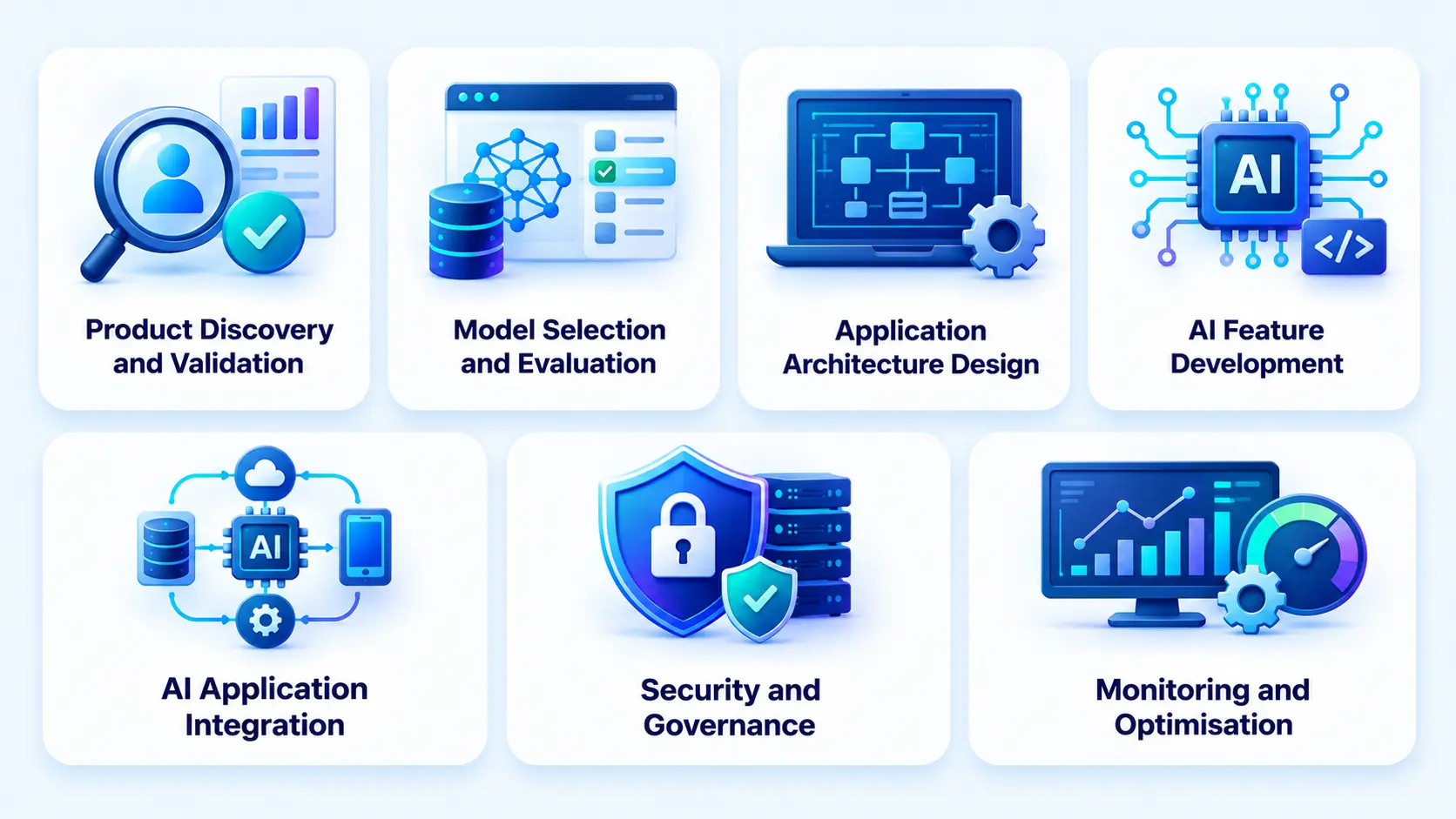
Once a business identifies the appropriate technology, the next step is to plan its implementation. Building an AI-powered product requires more than selecting a model and connecting an API. The application must combine AI capabilities with product design, backend engineering, data management, security, and ongoing evaluation.
1. Start With Product Discovery and Use-Case Validation
The first step is to define the target users, their problems, and the outcomes the AI feature should deliver. Businesses should identify the most valuable use cases and prioritise them according to feasibility, expected impact, and implementation complexity. For example, an ecommerce business may identify three opportunities:
- An AI chatbot for customer queries.
- An LLM-powered feature for product descriptions.
- An AI agent for returns and order management.
Instead of developing all three capabilities simultaneously, the business can validate the highest-value use case first.
2. Select the Right Model and AI Approach
The model should be selected based on the product’s requirements rather than popularity alone. Important factors include reasoning capabilities, response quality, latency, context window, supported modalities, pricing, privacy, and integration options.
Businesses should also evaluate whether they need a general-purpose model, a specialised model, retrieval-augmented generation, fine-tuning, or a combination of approaches. For most applications, using an existing model is a more practical starting point than training a foundation model from scratch.
3. Design the Application Architecture
The architecture should define how the AI component communicates with the frontend, backend, databases, and external services. A typical architecture may include:
- Frontend application for user interaction.
- Backend services for business logic.
- LLM API for language processing.
- Database for application data.
- Retrieval system for relevant knowledge.
- API integrations for external operations.
- Agent orchestration for multi-step execution.
- Security and monitoring components.
Each component should have a clearly defined responsibility.
4. Build and Test the AI Feature
Development should begin with a focused implementation that demonstrates the intended business value. For chatbots, testing should cover conversational quality, intent recognition, response accuracy, and escalation behaviour.
For AI agents, testing should additionally cover planning, tool selection, permission boundaries, error recovery, and task completion. Businesses should evaluate the system using realistic scenarios rather than relying only on successful demonstration cases.
5. Integrate AI Capabilities Into Existing Applications
Businesses do not always need to build an entirely new AI-powered product. Existing applications can be enhanced with intelligent search, recommendation engines, predictive analytics, conversational interfaces, and automated workflows.
For example, a retail application can introduce AI-based product recommendations, while an enterprise application can integrate an assistant that retrieves information from internal systems. An AI feature integration Service can help businesses identify opportunities to introduce practical AI capabilities into existing digital products.
6. Implement Security and Governance Controls
Before deployment, businesses should define what information the AI system can access and which operations it can perform. Important controls include data encryption, role-based permissions, secure API credentials, input validation, output filtering, audit logs, and human approval workflows.
For agentic applications, businesses should also define maximum execution limits and stop conditions. Security testing should include attempts to access restricted data, invoke unauthorised tools, and manipulate the system through malicious instructions.
7. Monitor and Optimise After Deployment
AI product development does not end when an application is launched. Businesses must continuously monitor response quality, task completion, infrastructure performance, API usage, and customer feedback. The monitoring strategy should also identify recurring errors, outdated knowledge sources, unsuccessful integrations, and unexpected agent behaviour.
Regular evaluation helps ensure that the AI feature remains aligned with changing business requirements. This ongoing improvement is an important part of AI in product development, where businesses use AI capabilities to refine product functionality, improve user experiences, and make data-driven decisions throughout the product lifecycle.
AI Chatbot Development Trends Businesses Should Watch
AI chatbot technology continues to evolve as models become more capable and conversational applications gain access to additional data and tools. Emerging AI chatbot development trends are shaping how businesses approach conversational experiences, including greater personalisation, multimodal interactions, improved contextual understanding, and deeper integration with business systems.
Businesses planning new conversational products should consider these developments when defining their long-term architecture and technology strategy.
More Context-Aware Conversations
Modern chatbots are moving beyond isolated question-and-answer interactions. Context management allows applications to consider previous messages, relevant user preferences, and approved business information when generating responses. This can make conversations more consistent and useful.
Multimodal Chatbot Experiences
Multimodal AI allows applications to process different types of information, including text, images, audio, and other supported inputs. For example, a customer may upload an image of a damaged product and ask a chatbot about the return process. The application can use image understanding and conversational AI to support the interaction.
Integration With Enterprise Systems
Businesses are increasingly interested in chatbots that can retrieve information from CRM, ERP, HRMS, and other internal platforms. These integrations make conversational systems more relevant to everyday business operations.
Agentic Capabilities in Chatbots
Some modern conversational systems are introducing agentic capabilities that allow them to perform actions and coordinate workflows. For example, a support assistant may move beyond answering questions and help investigate customer issues through connected tools.
Greater Focus on Security and Responsible AI
As conversational systems gain access to business information, security and governance become more important. Businesses need to evaluate data access, response accuracy, privacy, transparency, and escalation requirements.
Common Mistakes Businesses Should Avoid
Selecting an AI technology without understanding its limitations can lead to unnecessary expenses and poor product experiences. Businesses should avoid the following mistakes when planning an AI-powered application.
1. Building an AI Agent for Every Problem
AI agents are receiving significant attention because of their ability to automate complex tasks. However, they are not the right solution for every business requirement. If an application only needs to answer frequently asked questions, a chatbot may be sufficient. Adding autonomous planning, memory, and orchestration without a clear requirement increases complexity without necessarily improving business outcomes.
2. Assuming Every Chatbot Needs an LLM
Traditional rule-based chatbots remain useful for predictable interactions. A business that needs to guide customers through a fixed registration process may not require an LLM. Using conventional logic for structured workflows can improve predictability and reduce unnecessary model usage.
3. Treating an LLM as a Complete AI Product
Integrating an LLM API does not automatically create a production-ready AI application. Businesses still need an appropriate interface, data architecture, security controls, context management, testing, and monitoring. The surrounding application architecture determines how effectively the model contributes to the product.
4. Giving AI Agents Excessive Permissions
An agent should not have unrestricted access to all business systems. Excessive permissions increase the consequences of incorrect decisions and malicious instructions. Businesses should implement least-privilege access, operation-specific permissions, approval checkpoints, and detailed audit logs.
5. Ignoring Human Oversight
AI systems can make mistakes, misunderstand instructions, or encounter situations outside their intended scope. Businesses should define when the system must stop, request clarification, or transfer control to a human. This is particularly important for financial transactions, healthcare workflows, account changes, and other sensitive operations.
6. Failing to Measure Business Outcomes
An AI feature should be evaluated based on measurable improvements rather than the number of conversations or model calls. Businesses should track whether the technology reduces operational costs, improves task completion, increases customer satisfaction, or supports revenue growth. Without defined performance metrics, it becomes difficult to determine whether the implementation is delivering meaningful value.
Conclusion
AI agents, chatbots, and LLMs serve different purposes, and choosing between them depends on the problem your product needs to solve. An LLM is suitable for understanding and generating information. A chatbot is useful for managing conversations and supporting customer interactions. An AI agent is more appropriate when a product needs to plan, make decisions, and execute multi-step tasks through connected systems.
However, these technologies do not need to operate independently. Combining an LLM with a conversational interface and an agentic execution layer can create more capable digital products when the business requirements justify that complexity. The most effective approach is to start with the business objective, evaluate the level of automation required, and select an architecture that balances functionality, cost, security, and scalability.
At RipenApps, the focus is on helping businesses turn AI opportunities into practical digital product capabilities. Whether you are planning an intelligent chatbot, an LLM-powered application, or an autonomous workflow solution, the right technical approach can make a meaningful difference to its long-term performance.
Explore how an experienced AI app development company can help you plan and build an AI-powered product aligned with your business goals. Connect with RipenApps to discuss your requirements and identify the right AI architecture for your next digital product.
FAQs
1. What is the main difference between AI agents, chatbots, and LLMs?
The main difference lies in their functionality and level of autonomy. LLMs understand and generate human language, chatbots facilitate conversations between users and applications, and AI agents can plan, make decisions, and execute multi-step tasks using connected tools and systems.
2. Can an AI chatbot work without an LLM?
Yes. An AI chatbot can operate using predefined rules, decision trees, NLP, or traditional machine learning models without an LLM. However, LLM-powered chatbots offer more flexible conversations, better contextual understanding, and the ability to handle complex user queries.
3. Are AI agents more advanced than chatbots?
AI agents generally offer greater operational autonomy than conventional chatbots. While chatbots primarily focus on answering questions and managing conversations, AI agents can perform multi-step tasks, interact with external systems, and work towards specific objectives. However, the right choice depends on the application’s requirements rather than technological complexity.
4. Can businesses combine AI agents, chatbots, and LLMs in one application?
Yes. Businesses can combine all three technologies to create intelligent digital products. An LLM can process user instructions, a chatbot can provide the conversational interface, and an AI agent can execute tasks through connected APIs and business systems. This approach is useful for applications requiring both customer interaction and workflow automation.
5. How much does it cost to develop an AI agent compared to an AI chatbot?
AI agent development generally requires a higher investment than basic chatbot development because it involves additional components such as task orchestration, API integrations, memory management, permission controls, and workflow validation. However, the actual cost depends on the complexity, model selection, integrations, infrastructure, and ongoing maintenance requirements.
6. How should businesses choose between an AI agent, chatbot, and LLM for their product?
Businesses should begin by identifying the problem they want to solve. An LLM is suitable for content generation, summarisation, and information processing. A chatbot works well for customer support, query resolution, and conversational assistance. An AI agent is better suited to multi-step workflows requiring decisions, tool usage, and task execution. Businesses can also combine these technologies when their product requires multiple AI capabilities.
Discuss your project and request for proposal
SHARE
WRITTEN BY

Prankur Haldiya
Chief Technical Officer
A tech innovator and engineering leader, Prankur Haldiya drives RipenApps’ product development strategy and oversees cutting-edge solutions in mobility, AI, and cloud ecosystems. He is passionate about building high-performance teams and helping brands launch secure, scalable, and user-centric digital products.
View All Articles