


Quick Summary
This blog explains how businesses can choose the right travel booking API to build scalable digital travel platforms. It covers different API types, essential features, popular providers, selection criteria, integration challenges, best practices, and estimated development costs. It also highlights how businesses can create reliable booking experiences through secure API integrations and scalable backend architecture.
The travel industry is increasingly dependent on digital platforms that allow customers to search, compare, and book travel services from a single interface. Whether a business operates a flight booking platform, hotel reservation website, travel marketplace, or complete trip-planning application, access to reliable travel inventory is essential for delivering a seamless booking experience.
A travel booking API makes this possible by connecting applications with airlines, hotels, car rental companies, tour operators, and other travel suppliers. However, choosing an API involves more than comparing available features. Businesses must evaluate supplier coverage, pricing structures, integration requirements, data security, and long-term scalability.
For businesses planning to launch or expand a travel platform, partnering with a travel app development company can help align API selection with product requirements, technical architecture, and customer expectations. This guide explains how travel booking APIs work, the different types available, the features businesses should evaluate, and the factors that influence integration costs.
Table of Contents
Understand What a Travel Booking API Is and How It Works
A travel booking API is an application programming interface that allows one software application to communicate with external travel service providers. It enables travel platforms to access information such as flight schedules, hotel availability, room rates, rental vehicle options, and activity listings without building and maintaining their own inventory systems.
For example, when a customer searches for flights on a travel application, the platform sends a request to an integrated flight API. The API communicates with connected airline systems or distribution providers and returns relevant information, including available routes, departure times, fares, and booking conditions.
The application then displays these results in a user-friendly format. When the customer selects an option, the platform sends another request to retrieve the latest availability and proceed with the reservation.
How a travel booking API works
The integration generally follows a sequence of connected operations:
- Customer search: A user enters travel details, such as destination, dates, passenger count, or accommodation preferences.
- API request: The application sends the search parameters to the connected travel API.
- Supplier communication: The API retrieves relevant inventory and pricing information from its connected suppliers.
- Result display: The application processes and displays available options.
- Booking confirmation: After the customer selects an option, the platform verifies availability and submits the booking request.
- Payment and notification: The payment process is completed, and the customer receives booking confirmation and relevant details.
This process allows businesses to offer travel services without independently managing every supplier relationship. However, the quality of the experience depends on API response times, inventory accuracy, supplier connectivity, and the application’s ability to handle booking changes.
Why Businesses Need a Travel Booking API
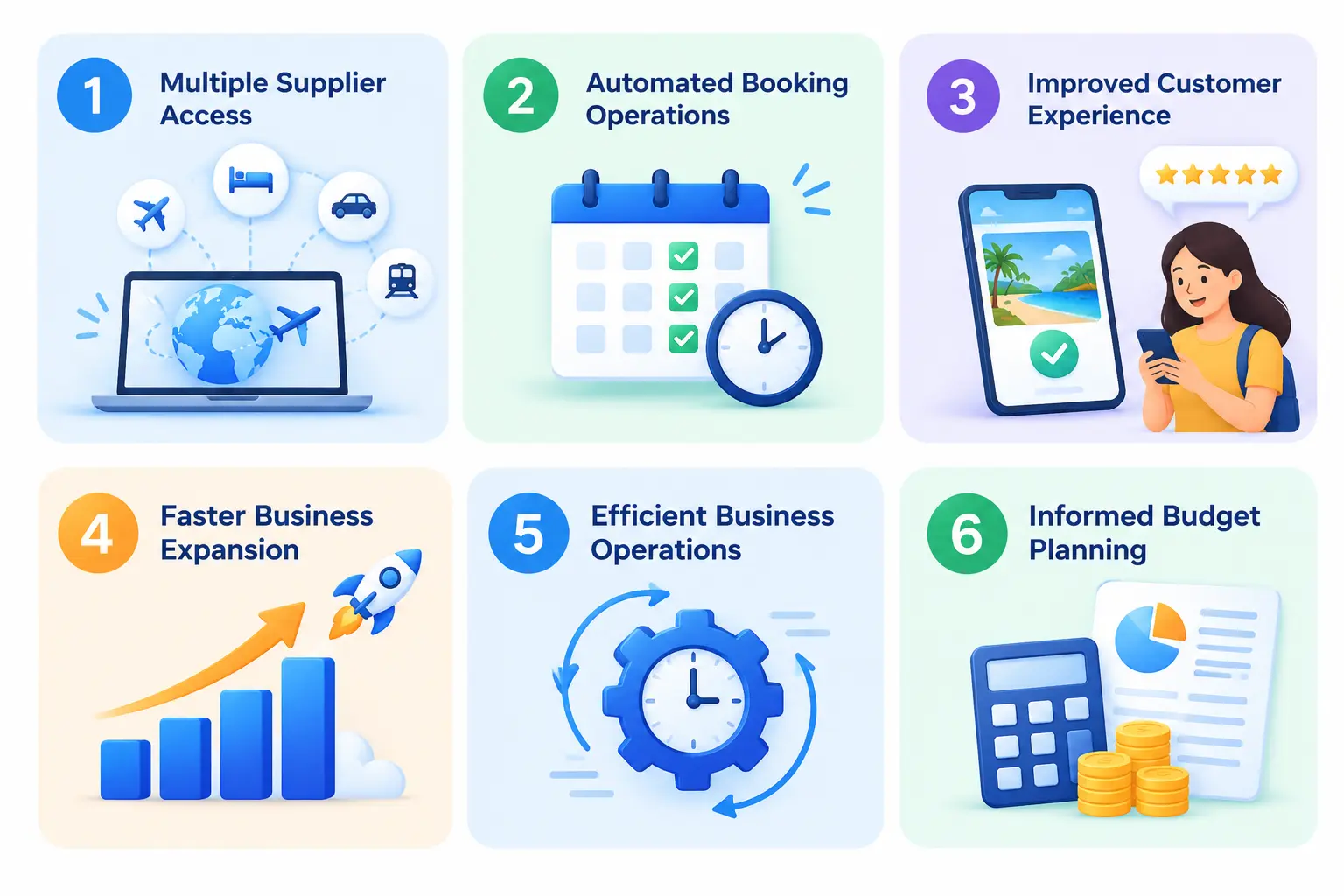
Travel businesses need access to accurate inventory, competitive pricing, and dependable reservation systems. Building these capabilities independently can require significant technical resources and ongoing supplier coordination. A travel booking API helps businesses simplify these operations while expanding their digital travel offerings.
1. Access to Multiple Travel Suppliers
A travel booking API connects a digital platform with external travel service providers, including airlines, hotels, car rental companies, and activity operators. This allows businesses to offer customers a wider range of travel options through a single platform without independently managing every supplier relationship.
2. Automated Booking Operations
APIs automate several booking-related activities, including retrieving schedules, checking availability, updating prices, and processing reservations. This reduces manual coordination, minimises repetitive operational work, and helps businesses maintain more consistent travel information.
3. Improved Customer Booking Experience
Customers can search, compare, and book different travel services from one application. Access to updated inventory, pricing, and booking information makes it easier for users to evaluate available options and complete reservations.
4. Faster Business Expansion
Businesses can introduce additional booking categories without building every supplier connection from scratch. For example, a flight booking platform can gradually expand its offerings to include hotel reservations, airport transfers, car rentals, and holiday activities.
5. Better Operational Efficiency
A centralised API integration helps businesses manage information from multiple suppliers through a connected system. This can simplify reservation management, reduce operational complexity, and help teams handle increasing booking volumes more efficiently.
6. More Informed Budget Planning
Although API integration can reduce the effort involved in building supplier connections independently, businesses must account for development, integration, maintenance, and third-party charges. Exploring the factors influencing travel app development cost can help businesses estimate the broader investment required to build and maintain a travel platform.
Types of Travel Booking APIs Available in the Market
Travel platforms have different inventory requirements depending on their business models. Some focus exclusively on flights, while others combine accommodation, transportation, and experiences into a single booking interface.
Understanding the different types of travel APIs helps businesses select integrations that match their product requirements.
Flight Booking APIs
Flight booking APIs connect travel platforms with airline inventory, global distribution systems, and flight aggregators. They provide information about available routes, departure and arrival times, fares, baggage allowances, and booking conditions.
These APIs are particularly useful for online travel agencies, corporate travel platforms, and flight comparison applications. Depending on the provider and commercial agreement, businesses may also access booking, ticketing, cancellation, and modification capabilities.
When evaluating a flights API, businesses should examine airline coverage, fare availability, ticketing support, pricing accuracy, and the ability to retrieve updated flight information.
Hotel Booking APIs
Hotel booking APIs allow applications to retrieve accommodation listings, room availability, property details, pricing, and reservation policies.
They can connect platforms with hotel chains, independent properties, accommodation aggregators, and distribution networks. This makes them suitable for hotel booking applications, travel marketplaces, and platforms offering complete holiday packages.
Important considerations include property coverage, room inventory accuracy, cancellation policies, seasonal pricing, and the availability of images and property descriptions.
Car Rental Booking APIs
Car rental APIs connect travel applications with vehicle rental providers. They allow users to compare available vehicles, rental prices, pickup locations, insurance options, and booking conditions.
These integrations are useful for airport transfer platforms, travel marketplaces, and applications that offer complete transportation services.
Businesses should evaluate vehicle category coverage, location availability, rental terms, additional charges, and booking modification capabilities before selecting a provider.
Bus and Train Booking APIs
Bus and train APIs provide access to transportation schedules, seat availability, routes, ticket prices, and reservation details.
They are especially relevant for regional travel applications, intercity transportation platforms, and businesses targeting markets where rail and bus services are widely used.
The integration should support accurate schedule updates, seat selection where available, ticket confirmation, cancellation handling, and relevant passenger information.
Activity and Tour Booking APIs
Activity and tour booking APIs allow travel platforms to offer sightseeing experiences, guided tours, attraction tickets, adventure activities, and local experiences.
These APIs can help businesses expand beyond conventional transportation and accommodation bookings. They also support travel platforms that want to offer personalised itineraries and destination-based recommendations.
For example, a travel application can combine hotel reservations with local attractions and interactive experiences. Businesses exploring this direction can learn how augmented reality is reshaping the travel and tourism industry.
Key Features to Look for in a Travel Booking API 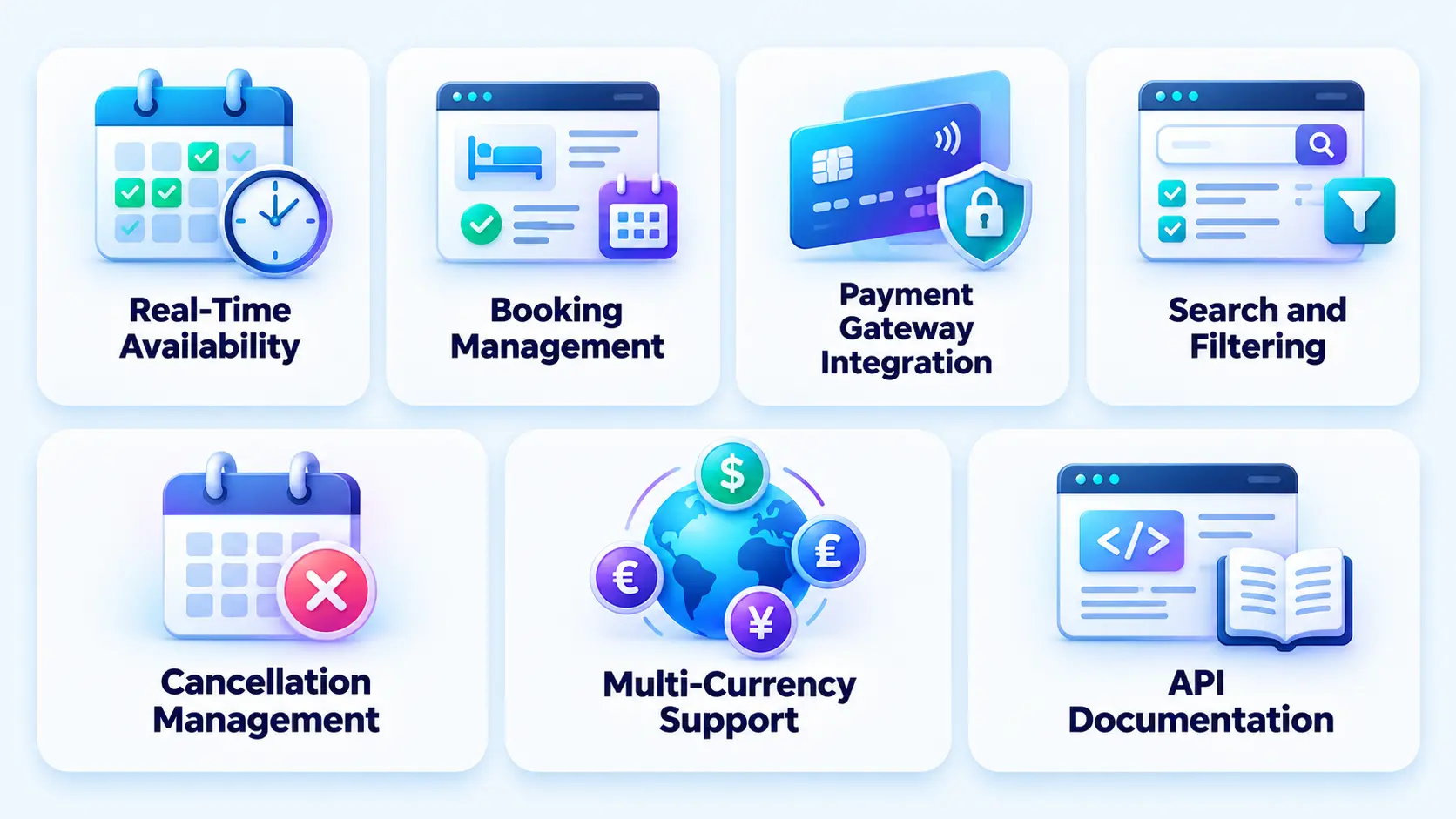
Not every API offers the same capabilities. Some focus on inventory discovery, while others support the complete reservation lifecycle, including payments, cancellations, and booking modifications. Businesses should assess the following features before selecting a travel API provider.
1. Real-Time Availability and Pricing
Real-time availability helps users access updated information about flights, hotel rooms, rental vehicles, and other travel services. Travel inventory can change frequently due to demand, seasonal variations, and supplier updates. An API should therefore provide reliable availability checks and updated pricing wherever supported.
Businesses should also understand how frequently inventory is refreshed and whether prices are revalidated before a booking is confirmed. This helps reduce situations where customers select an option that is no longer available or has changed in price.
2. Booking and Reservation Management
A travel booking API should support the reservation operations required by the business model. Depending on the provider, these may include booking creation, confirmation, retrieval, modification, cancellation, and ticket issuance.
A reliable reservation workflow is particularly important because travel bookings often involve multiple steps and external supplier dependencies. Businesses should check whether the API supports booking status updates and provides clear responses when a transaction fails, remains pending, or requires additional action.
3. Multiple Payment Gateway Integration
Payment integration allows customers to complete reservations directly through the travel platform. Businesses should evaluate whether the API supports payment workflows compatible with their preferred payment providers and business model. The platform may also need to support multiple currencies, different payment methods, refunds, and transaction reconciliation.
Payment responsibilities should be clearly defined. In some integrations, the travel supplier processes payments directly, while in others, the platform manages the customer payment and settles with the supplier.
4. Search and Filtering Capabilities
Search functionality directly influences how easily customers can discover suitable travel options. A travel booking API should provide relevant search parameters and filtering capabilities.
For example, flight searches may include departure time, airline, number of stops, and fare category. Hotel searches may include location, price range, property rating, amenities, and room type. The application should also be able to organise and display results efficiently, particularly when an API returns a large inventory.
5. Cancellation and Refund Management
Travel plans can change unexpectedly, making cancellation and refund support an important consideration. Businesses should understand how the API handles cancellation requests, refund eligibility, supplier penalties, and booking modifications. The platform should also be able to communicate relevant policies to customers before they complete a reservation.
Not all bookings offer the same flexibility. Therefore, the API should provide access to applicable fare rules, cancellation conditions, and refund information wherever supported.
6. Multi-Currency and Multi-Language Support
Businesses targeting international customers may need to display prices in different currencies and provide booking information in multiple languages. An API with suitable localisation capabilities can simplify the process of serving customers across different regions. However, businesses should confirm whether currency conversion, language translation, and regional pricing are handled by the provider or need to be implemented within the application.
7. API Documentation and Developer Support
Clear documentation helps development teams understand API endpoints, authentication methods, request formats, response structures, error codes, and integration requirements. Businesses should also check whether the provider offers sandbox access, testing credentials, SDKs, sample requests, and technical support.
A well-documented API can make integration and troubleshooting more manageable. Working with a team experienced in backend API development services can further help businesses establish secure communication between the application, external suppliers, and internal services.
How to Choose the Right Travel Booking API for Your Business
Selecting the right travel booking API requires a structured evaluation of business requirements, supplier coverage, technical compatibility, commercial terms, and long-term operational needs.
Rather than choosing a provider solely because it offers a large inventory, businesses should assess how well its capabilities align with their intended booking experience.
Identify Your Business Model and Travel Requirements
Start by defining the type of travel platform you want to build. A flight comparison application will have different integration requirements from a hotel booking marketplace or an all-in-one travel platform.
For example, an online travel agency may require flight search, fare comparison, ticket booking, and cancellation management. A holiday booking platform may need flights, hotels, transfers, and activity inventory.
You should also identify your target audience, geographical markets, booking categories, expected transaction volume, and revenue model.
This assessment will help narrow down the APIs that offer the capabilities your platform actually needs.
Evaluate API Coverage and Supplier Network
The supplier network determines the range of travel inventory available through an API. A provider may offer extensive flight coverage but limited hotel inventory in specific regions.
Businesses should evaluate supplier relationships, geographical coverage, airline participation, accommodation availability, and access to local travel services.
It is also important to distinguish between direct supplier connections and aggregated inventory. An aggregator can simplify access to multiple providers, but businesses should understand how inventory is sourced and how booking responsibilities are managed.
Requesting a supplier coverage list and testing relevant destinations can help validate whether an API meets your market requirements.
Compare Pricing Models and Transaction Fees
Travel API providers may follow different commercial models. Some charge subscription or access fees, while others use transaction-based pricing, commissions, or negotiated commercial agreements.
The overall cost may also include onboarding charges, booking fees, minimum commitments, support packages, and additional charges for specific services.
Businesses should compare the total cost of using an API rather than evaluating only its initial integration fee.
It is equally important to understand how the provider handles commissions, markups, settlements, refunds, and failed transactions. These factors can directly influence platform profitability.
Check API Integration and Technical Compatibility
Before selecting a provider, evaluate its technical requirements against your existing or planned application architecture.
Check the supported API protocols, authentication mechanisms, response formats, rate limits, webhooks, SDKs, and testing environments. You should also examine whether the API can integrate with your backend, database, payment system, and booking management infrastructure.
If your platform already uses legacy systems, integration may require additional compatibility work or architectural changes. In such cases, legacy product modernization services can help businesses improve existing systems and prepare them for modern API-based integrations.
Assess Data Security and Compliance
Travel applications process customer information such as names, contact details, passport information, payment-related data, and booking records.
Businesses must evaluate how an API provider protects this information during transmission and storage. Important considerations include authentication, encryption, access controls, data retention policies, and incident response procedures.
Payment processing should also follow applicable security requirements, including relevant PCI DSS obligations where payment card data is handled.
Depending on the markets served, businesses may need to consider applicable privacy and data protection regulations. Review the provider’s security documentation and contractual responsibilities before integration.
Review Scalability and Performance
An API that works well during initial testing may not perform equally well when the application starts handling higher traffic and booking volumes.
Businesses should assess response times, rate limits, uptime commitments, concurrent request handling, and the provider’s approach to traffic spikes.
The platform architecture should also account for caching where permitted, request optimisation, asynchronous processing, and fallback mechanisms.
If the business plans to expand into additional destinations or booking categories, the selected API should support that growth without requiring a complete integration redesign.
Evaluate Customer Support and SLA
Technical support becomes especially important when an API affects live bookings and customer transactions.
Businesses should understand the provider’s support hours, escalation process, incident response commitments, documentation updates, and service-level agreements.
Ask whether support is available during the business hours of your target markets and whether the provider offers dedicated technical assistance for integration and production issues.
A dependable support structure can help minimise disruption when booking requests fail or supplier systems experience downtime.

Popular Travel Booking APIs to Consider
Several established providers offer travel distribution and booking capabilities. The right choice depends on your inventory requirements, target market, commercial eligibility, and integration needs.
| API Provider | Primary Capabilities | Suitable For |
| Amadeus API | Flight search, hotel search, travel information, and booking capabilities through supported products | Travel startups and online travel platforms |
| Sabre API | Airline distribution, hotel content, reservations, and travel management capabilities | Travel agencies and larger travel businesses |
| Travelport API | Flight shopping, airline content, hotel services, and travel distribution | Travel agencies and booking platforms |
| Booking.com API | Accommodation-related connectivity through available partner programmes and products | Hotel booking platforms |
| Expedia Group API | Accommodation and travel content through eligible partner integrations | Travel marketplaces and accommodation platforms |
| Skyscanner API | Flight search and comparison capabilities through available partner access | Flight comparison and discovery platforms |
Amadeus API
Amadeus offers APIs for flight search, hotel search, travel information, and related booking workflows through its available products.
Its capabilities can support travel applications that need access to airline and accommodation content. Businesses should review the specific API products, commercial requirements, and booking capabilities available to their organisation before choosing an integration.
Sabre API
Sabre provides travel distribution technology for airlines, hotels, travel agencies, and other industry participants.
Its API ecosystem includes capabilities related to flight shopping, hotel content, reservations, and travel management. It may be suitable for businesses requiring broader travel distribution functionality.
Travelport API
Travelport offers connectivity to travel content through its distribution platform.
Its capabilities include airline shopping, hotel content, and other travel-related services. Businesses should assess its available content, integration requirements, and commercial terms against their intended booking model.
Booking.com API
Booking.com provides accommodation-related connectivity through its partner programmes and available API products.
Its suitability depends on partner eligibility, access permissions, and the specific integration options available to the business.
Expedia Group API
Expedia Group offers travel inventory and connectivity solutions through its partner ecosystem.
Businesses considering its APIs should review available accommodation content, booking functionality, commercial arrangements, and programme requirements.
Skyscanner API
Skyscanner provides flight search and comparison capabilities through its available partner access.
It can be relevant for platforms focused on helping users discover and compare flight options. Businesses should verify current access conditions and whether the available functionality supports their intended booking process.
Common Challenges in Travel Booking API Integration
Travel booking API integration can simplify access to travel inventory, but it also introduces technical and operational challenges. Understanding these issues early helps businesses plan more reliable booking workflows.
One common challenge is inconsistent data across suppliers. Different providers may use different formats for dates, prices, fare rules, room types, and booking statuses. The application must process this information consistently before displaying it to customers.
Another challenge is changing availability. A flight seat or hotel room displayed during a search may become unavailable before the customer completes the reservation. To reduce booking failures, platforms should revalidate availability and pricing before confirming transactions.
API rate limits can also affect application performance. Excessive requests may result in throttling or temporary access restrictions. Businesses should optimise API calls, use caching where permitted, and implement suitable retry mechanisms.
Managing cancellations and refunds across multiple suppliers can become complicated as well. Each provider may have different policies, response times, and operational procedures. A centralised booking management system can help standardise these processes.
Finally, supplier downtime and network failures can interrupt the booking experience. Platforms should plan for error handling, monitoring, and fallback workflows so customers receive clear updates instead of encountering unexplained failures.
Businesses should also consider how changes in the travel application ecosystem affect product planning. For example, Google’s decision to discontinue support for Trips highlights why travel platforms need to evaluate long-term product functionality and customer expectations.
Travel Booking API Integration: Best Practices for Businesses
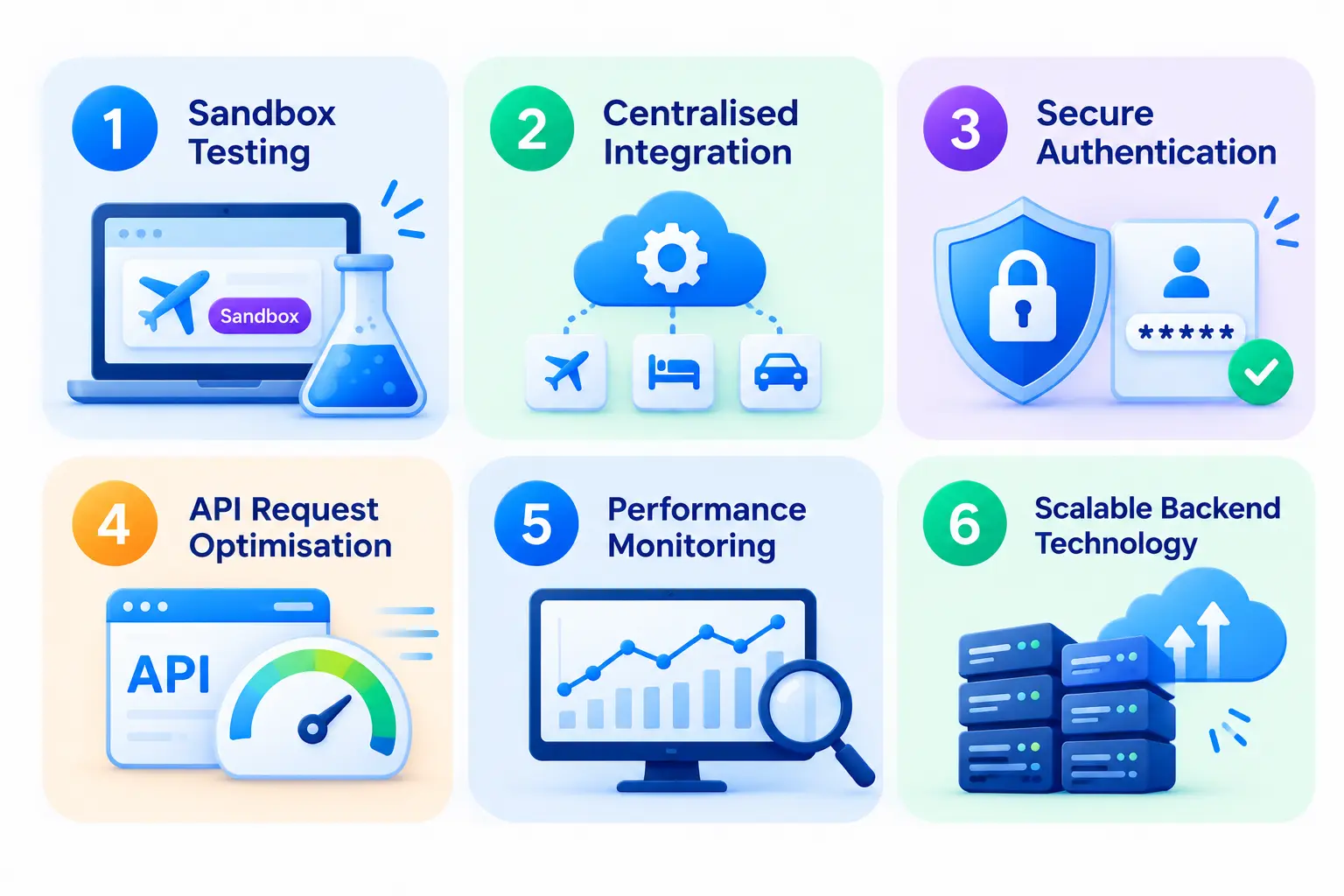
A successful travel booking API integration requires more than connecting an API endpoint. Businesses need a reliable architecture that can manage travel data, customer requests, bookings, and supplier communication. Following the right practices can improve integration quality, application performance, and long-term maintainability.
1. Test APIs in a Sandbox Environment
Before moving an integration to production, developers should test the API in a sandbox environment. This allows them to understand request formats, authentication methods, response structures, and error handling without affecting live transactions. Testing different scenarios, including successful bookings, failed requests, cancellations, and unavailable inventory, can help identify potential issues early.
2. Build a Centralised Integration Layer
Instead of allowing different application modules to communicate independently with multiple suppliers, businesses should establish a centralised integration layer. This backend component can standardise API requests and responses, manage supplier communication, and maintain consistent booking logic. It also makes adding new travel API providers easier as the platform expands.
3. Implement Secure Authentication
Travel applications process sensitive customer and booking information. Developers should implement secure authentication mechanisms and protect API credentials from unauthorised access. API keys and access tokens should never be exposed in client-side code. Access permissions should follow the principle of least privilege, ensuring that each system component receives only the permissions it requires.
4. Optimise API Requests and Response Handling
Excessive API requests can affect application performance and increase integration costs. Developers should optimise request frequency, use caching wherever permitted, and implement suitable retry mechanisms for temporary failures. They should also handle different supplier response formats consistently to ensure accurate information is displayed across the application.
5. Monitor API Performance Regularly
Businesses should continuously monitor API response times, failed requests, booking confirmation rates, and supplier errors. These metrics help development teams identify performance issues and resolve integration problems before they significantly affect customers. Logging and alert mechanisms can also help teams respond quickly to unexpected API failures or supplier downtime.
6. Choose a Scalable Backend Technology
The backend architecture should support increasing traffic, multiple supplier connections, and complex booking operations. Businesses must consider request handling, asynchronous processing, database performance, and real-time communication when selecting their technology stack. Node.js development services can support the development of scalable backend systems that manage API requests, asynchronous operations, and communication between travel applications and external service providers.
How Much Does It Cost to Integrate a Travel Booking API?
The cost of integrating a travel booking API depends on the number of suppliers, API complexity, booking workflows, application architecture, and required features. A basic integration that supports flight or hotel search may require less development effort than a platform offering multiple booking categories, payment processing, cancellations, refunds, and customer account management.
The following estimates are illustrative development ranges, not quoted API-provider fees. Actual costs depend on project scope, provider requirements, technology choices, and development location.
| Integration Scope | Estimated Development Cost |
| Basic single API integration | $3,000–$7,000 |
| Flight or hotel booking integration with reservation management | $7,000–$15,000 |
| Multiple travel API integrations | $15,000–$30,000 |
| Advanced travel booking platform with multiple suppliers and complex workflows | $30,000–$60,000+ |
Several factors influence the final investment.
- Number of API integrations: Connecting one provider is generally less complex than integrating multiple flight, hotel, transport, and activity suppliers.
- Feature requirements: Search, filtering, booking, payment, cancellation, refund, and notification features all contribute to development effort.
- Backend architecture: Applications with complex booking workflows, high traffic expectations, and multiple integrations may require more advanced backend infrastructure.
- Third-party costs: API access fees, supplier commissions, transaction charges, and partner programme requirements are separate from development expenses.
- Security and compliance: Additional work may be required for data protection, payment security, authentication, and audit requirements.
Businesses should also budget for ongoing maintenance, API version updates, infrastructure, monitoring, and technical support. A detailed travel app development guide can help evaluate the wider planning and implementation requirements.
If your business needs a platform built around specific booking workflows rather than a standard integration, custom development can help align the application architecture, features, and integrations with its operational requirements. Businesses can explore custom app development services for this purpose.
Build a Scalable Travel Booking Platform with the Right API
Choosing the right travel booking API is an important decision for any business planning to enter or expand in the digital travel market. The right integration can improve inventory access, automate reservations, simplify supplier communication, and create a smoother booking experience.
However, businesses should not select an API based only on the number of suppliers or advertised features. Supplier coverage, booking reliability, pricing models, security, documentation, and scalability should all be evaluated against the platform’s long-term objectives.
Travel businesses should also consider how emerging technologies can improve customer experiences. AI-powered recommendations, personalised itineraries, and intelligent search can help platforms make travel planning more relevant. Businesses can explore the role of AI in travel while planning future product capabilities.
At RipenApps, businesses can get support with travel application planning, API integration, backend architecture, and custom product development. The focus should be on selecting integrations that support the current business model while keeping the platform ready for future expansion.

Conclusion
Integrating the right travel booking API can help businesses simplify reservations, expand travel inventory, and deliver a more convenient booking experience. However, successful implementation depends on selecting a provider that aligns with business requirements, evaluating technical compatibility, and establishing a secure and scalable integration architecture.
Businesses should also consider long-term factors such as API maintenance, supplier reliability, booking accuracy, and future expansion before making a decision. With the right technology strategy and integration approach, travel platforms can build reliable booking experiences while remaining prepared for changing customer expectations and market demands.
At RipenApps, we help businesses plan and build scalable travel applications with suitable API integrations, robust backend architecture, and customised features that support their business goals.
FAQs
1. What is a travel booking API?
A travel booking API is a software interface that connects a travel application or website with external travel service providers. It allows businesses to retrieve information about flights, hotels, car rentals, and activities and, depending on the API, manage reservations and related booking operations.
2. How does a travel booking API work?
A travel booking API works by sending requests from an application to connected travel suppliers or distribution systems. It retrieves available inventory, pricing, and booking information, which the application displays to users. When a customer selects an option, the platform sends a booking request and processes the supplier’s response.
3. Which API is best for travel booking businesses?
The best API depends on the business model and inventory requirements. Amadeus, Sabre, and Travelport offer travel distribution capabilities, while Booking.com and Expedia Group provide accommodation-related connectivity through their partner ecosystems. Skyscanner is relevant for flight search and comparison. Businesses should compare coverage, access conditions, booking capabilities, and pricing before selecting a provider.
4. Is it possible to integrate multiple travel booking APIs?
Yes. Businesses can integrate multiple travel booking APIs to access inventory from different suppliers. For example, a platform may use one provider for flights, another for hotels, and a third for local activities. A centralised backend integration layer can help manage different API formats and booking workflows.
5. How long does it take to integrate a travel booking API?
A basic single API integration may take a few weeks, depending on documentation, authentication, testing, and application complexity. A platform with multiple suppliers, payment integration, booking management, and cancellation workflows may take several months. The actual timeline depends on the number of integrations, feature scope, and testing requirements.
6. Are free travel booking APIs available?
Yes, some travel API providers offer free access, sandbox environments, or limited trial plans for testing and development. However, free access may come with restrictions on API requests, inventory availability, booking functionality, or commercial usage. Businesses should review the provider’s terms before using a free travel API in a production application.
7. What factors should businesses consider when selecting a travel API provider?
Businesses should evaluate supplier coverage, real-time inventory accuracy, API documentation, integration complexity, pricing models, security standards, scalability, and technical support. The provider should also support the booking categories and geographical markets targeted by the platform.
8. Can a travel booking API support international bookings?
Yes, many travel booking APIs support international inventory and bookings across multiple destinations. However, businesses should verify geographical coverage, supported currencies, language options, regional payment methods, supplier availability, and applicable booking regulations before integration.
Discuss your project and request for proposal
SHARE
WRITTEN BY

Vaibhav Sharma
Business Head
Vaibhav Sharma bridges product vision with real-world execution. He shares consultation with startups and enterprises to shape digital strategies, refine user journeys, and create app experiences that feel intuitive from day one. His strength lies in transforming early concepts into clear development roadmaps that set products up for long-term success.
View All Articles