


Key Takeaways
- Money transfer app development requires a balance of user experience, security, regulatory compliance, and scalable architecture.
- Start with an MVP that includes core capabilities such as KYC onboarding, secure fund transfers, transaction tracking, and fraud detection.
- Compliance with AML, KYC, PCI DSS, FATF guidelines, and regional licensing is essential for launching and scaling successfully.
- Development costs typically range from $40,000–$300,000+, depending on features, integrations, and compliance requirements.
- Partnering with an experienced fintech software development company reduces development risks and accelerates time to market.
Every year, billions of dollars move across borders as consumers, businesses, and global workforces rely on faster, more convenient digital payment solutions. This growing demand presents a significant opportunity for startups to build innovative money transfer apps. According to J.P. Morgan, the global cross-border payments market exceeds $194 trillion and is projected to reach $320 trillion by 2032. The World Bank also reports that remittance flows to low- and middle-income countries reached $685 billion in 2024, highlighting the rising need for secure and efficient cross-border payment platforms.
However, successful money transfer app development involves much more than building a mobile application. Startups must combine seamless user experiences with robust payment infrastructure, AML/KYC compliance, fraud prevention, and scalable architecture.
Partnering with an experienced FinTech software development company can help accelerate product delivery while reducing technical and regulatory risks. This guide covers everything you need to know about building a money transfer app, including application types, essential features, compliance requirements, technology stack, development costs, and proven strategies for launching a secure, scalable cross-border payment platform.
Table of Contents
What Is a Money Transfer App?
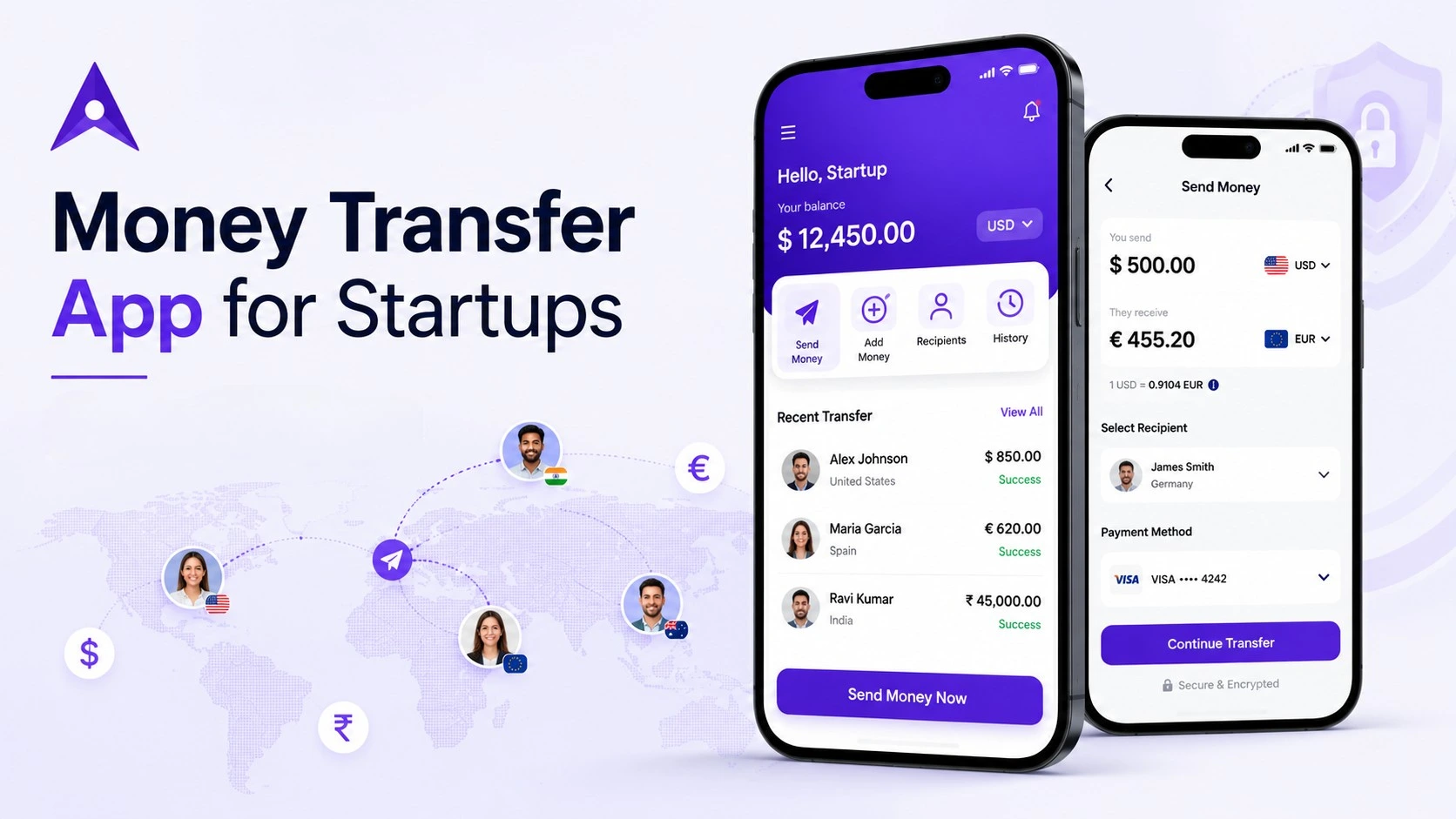
A money transfer app is a digital platform that enables users to send, receive, and manage funds electronically through mobile or web applications. These apps support domestic and international transactions while providing secure payment processing, identity verification, transaction tracking, and account management.
Unlike traditional banking systems that often involve lengthy processing times and high transfer fees, modern money transfer apps offer faster transactions through integrated payment networks and digital infrastructure. Many platforms also provide multi-currency support, live exchange rates, digital wallets, and automated compliance checks to simplify cross-border payments.
Money transfer applications serve multiple customer segments. Individual users rely on them to send money to family and friends, while businesses use them to pay international vendors, contractors, and employees. Financial institutions also integrate these platforms to expand digital payment services without building every capability from scratch.
As global commerce continues to expand, startups are increasingly investing in international money transfer app development to address growing demand for seamless cross-border financial services.
Traditional Banking vs Money Transfer Apps
A comparison highlighting the key differences between traditional banking services and modern money transfer applications.
| Feature | Traditional Banks | Modern Money Transfer Apps |
| Transfer Speed | 1–5 Days | Minutes or Seconds |
| Fees | Higher | Lower |
| Accessibility | Branch + Online | Mobile First |
| KYC | Mostly Manual | Digital eKYC |
| Notifications | Limited | Real-time |
| Cross-border | Slower | Faster |
| Tracking | Limited | Live Tracking |
| Currency Support | Limited | Multi-currency |
Why Startups Are Investing in Money Transfer Apps?
The global shift toward digital payments has created significant opportunities for startups entering the remittance and cross-border payments market. Consumers now expect financial transactions to be completed within minutes instead of days. Businesses also demand payment solutions that reduce costs while improving transparency and compliance.
The opportunity is particularly strong for startups targeting the US remittance market. According to the latest available World Bank Remittance Prices Worldwide data (Q3 2025), the average cost of sending money from the United States was 5.04% of the amount transferred, compared with the G20 average of 6.39%. Despite recent improvements, transfer costs remain above the UN’s target of 3%, creating opportunities for fintech startups to deliver faster, more affordable, and transparent cross-border payment solutions. Several factors are accelerating investment in remittance software development.
1. Growing Demand for Cross-Border Payments
Global migration, international employment, freelance work, and cross-border commerce continue to increase international money transfers. Users want faster settlement times, competitive exchange rates, and lower transaction fees than traditional financial institutions typically offer.
Juniper Research forecasts that the digital money transfer market will grow from $3.9 trillion in transaction value in 2024 to $6.5 trillion by 2028, representing 41% growth.
2. Rising Mobile Payment Adoption
Consumers increasingly prefer managing financial transactions through smartphones instead of visiting physical branches. Mobile-first experiences improve convenience while enabling startups to reach customers across multiple regions with lower operating costs.
3. Strong Revenue Opportunities
Money transfer platforms generate revenue through transaction fees, foreign exchange margins, premium subscriptions, business payment services, and value-added financial products. Diversified revenue streams make the business model attractive for venture-backed fintech startups.
4. Better Customer Experience Through Technology
Artificial intelligence, automation, and cloud infrastructure help startups streamline customer onboarding, detect fraudulent activities, personalize user experiences, and improve transaction processing efficiency. These capabilities enable smaller companies to compete effectively with established financial institutions.
5. Increasing Financial Inclusion
Millions of people worldwide still have limited access to traditional banking services. Digital money transfer applications help underserved users send and receive funds through accessible mobile platforms while supporting broader financial inclusion initiatives.
For startups, these market trends represent an opportunity to build innovative financial products that address real customer pain points while capturing demand in one of the fastest-growing fintech segments.
Who Should Build a Money Transfer App?
Money transfer applications create opportunities for businesses to offer faster, secure, and more convenient payment services while expanding their digital financial offerings. Statista forecasts continued growth in the global remittances market, driven by increasing digital adoption, fintech innovation, and mobile-first payment experiences.
- Fintech Startups: Launch innovative remittance apps, P2P payment platforms, and digital wallet solutions with faster, more affordable transactions.
- Banks & Financial Institutions: Modernize digital banking services by enabling instant domestic and cross-border money transfers.
- NBFCs: Expand financial service portfolios with secure digital payment and remittance capabilities.
- Foreign Exchange Companies: Combine currency exchange and cross-border payments into a seamless customer experience.
- Payroll Platforms: Simplify multi-currency salary disbursements for global employees and contractors.
- Gig Economy Platforms: Enable faster international payouts for freelancers, creators, and gig workers.
- International Remittance Businesses: Digitize traditional remittance services with scalable, mobile-first payment platforms.
- Digital Wallet Companies: Enhance the payment ecosystem by integrating domestic and international money transfer services.
Types of Money Transfer Apps
Money transfer applications are designed for different customer needs and business models. Understanding these categories helps startups define their product strategy, target audience, compliance requirements, and technology investments before beginning development.
1. Domestic P2P Transfer Apps
Domestic peer-to-peer (P2P) payment applications enable users to transfer money instantly within the same country. These platforms connect directly with bank accounts, debit cards, credit cards, or digital wallets to facilitate everyday payments.
Common use cases include splitting restaurant bills, paying rent, reimbursing friends, and sending personal payments. Since transactions remain within one regulatory jurisdiction, compliance requirements are generally less complex than international remittance platforms.
Startups targeting domestic markets often launch with P2P functionality before expanding into cross-border payment services. If you’re planning to build a peer-to-peer payment platform, our guide on developing a P2P payment app explains the features, technology stack, development process, and cost considerations in detail.
2. International Remittance Apps
International remittance applications allow users to send money across different countries and currencies. These platforms integrate with banking systems, payment gateways, currency exchange providers, and regulatory services to facilitate secure international transactions.
Unlike domestic payment platforms, remittance apps must support foreign exchange conversion, sanctions screening, anti-money laundering monitoring, and regional licensing requirements. These additional capabilities increase technical complexity but also create stronger competitive advantages.
Growing global migration and international employment continue to drive demand for reliable cross-border remittance solutions.
3. Currency Exchange Apps
Currency exchange applications primarily focus on converting one currency into another using live foreign exchange rates. Many platforms combine exchange services with digital wallets, international transfers, and travel-related financial features.
These applications help users monitor exchange rate fluctuations, compare conversion costs, and transfer funds when market conditions are favorable. Businesses operating across multiple countries also benefit from efficient foreign exchange management.
Currency exchange capabilities are frequently integrated into modern money transfer platforms to provide a complete international payment experience.
4. Business Payment Solutions
Business-focused money transfer platforms support organizations managing domestic and international financial operations. These solutions typically include higher transaction limits, multi-user access, approval workflows, accounting integrations, bulk payments, and detailed reporting capabilities.
Companies use these platforms to pay suppliers, contractors, remote employees, and international partners efficiently while maintaining financial transparency and regulatory compliance.
As global businesses increasingly operate across borders, business payment solutions have become an important segment within the broader cross-border payment app development market.
Essential Features Every Money Transfer App Needs
The success of a money transfer application depends on more than fast transactions. Users expect a secure, intuitive, and transparent experience from registration to payment completion. At the same time, startups must build a platform that satisfies regulatory requirements, prevents fraud, and scales with increasing transaction volumes.
Choosing the right features is a critical step in building a money transfer app for startups. The right feature set influences customer acquisition, transaction success rates, regulatory compliance, and long-term scalability. Instead of building every possible capability, startups should focus on features that strengthen customer trust, reduce operational costs, and support future business growth.
1. User Registration & Verification
The onboarding experience significantly impacts user adoption. Keep registration simple by allowing sign-ups via email, mobile number, or social login (where permitted), while collecting only essential information initially. Verify user identity using email or OTP-based phone verification before enabling transactions to prevent fraudulent accounts and ensure regulatory compliance.
2. Digital KYC Onboarding
Digital KYC is more than a compliance requirement; it directly affects onboarding conversion, fraud prevention, and operational efficiency. Faster identity verification reduces user drop-offs while helping startups satisfy regulatory obligations and lower manual review costs.
3. Multi-currency Wallet
Supporting multiple currencies enables startups to enter international markets without building separate financial products for each region. It also improves customer retention by allowing users to manage funds across different currencies from a single account. This is especially valuable for international workers, freelancers, businesses, and travelers, enabling flexible currency management while reducing unnecessary exchange fees.
4. Live Exchange Rates
Displaying real-time exchange rates builds transparency and customer trust. Integrate reliable forex APIs to show current exchange rates, transfer fees, recipient amounts, and estimated delivery times before users confirm a transaction.
5. Recipient Management
Allow users to securely save and manage beneficiary details for faster repeat transfers. Editable recipient profiles, including bank information, wallet addresses, and preferred currencies, simplify recurring personal and business payments.
6. Secure Fund Transfers
Secure fund transfers are the foundation of every money transfer app. Support domestic and international transfers, bank accounts, digital wallets, cards, and recurring payments where applicable. Before processing, provide a transaction summary with fees, exchange rates, recipient details, and a unique reference ID for every completed transfer.
7. Real-time Transaction Tracking
Provide users with real-time visibility into every transfer stage, from payment initiation to delivery. Live status updates and estimated completion times improve transparency, build trust, and reduce customer support requests.
8. Notifications
Timely notifications reduce payment-related support requests, improve customer confidence, and keep users engaged throughout the transaction lifecycle.
9. Transaction History
Comprehensive transaction records improve customer trust while helping businesses meet auditing, reporting, and regulatory requirements. Advanced search and filtering make it easier for users and businesses to manage financial records.
10. Fraud Detection & Risk Monitoring
Fraud prevention directly protects revenue, reduces chargebacks, and strengthens relationships with regulators, banking partners, and payment providers.
Integrate AI-powered fraud detection to identify suspicious transactions before they are processed. Capabilities such as behavioral analytics, device fingerprinting, IP monitoring, velocity checks, geolocation analysis, and automated risk scoring help prevent fraud while supporting regulatory compliance.
11. Admin Dashboard
An admin dashboard enables internal teams to manage users, transactions, compliance workflows, and platform operations from a centralized interface.
Typical administrative capabilities include:
User Management
Administrators can review customer profiles, verify identities, suspend suspicious accounts, and manage customer support requests.
Transaction Monitoring
Operations teams can track payment status, investigate failed transfers, review transaction logs, and generate financial reports.
Compliance Management
Compliance officers can monitor AML alerts, review KYC submissions, conduct sanctions screening, and maintain audit records required by regulators.
Analytics & Reporting
Dashboards should provide real-time insights into:
- Transaction volume
- Revenue
- Active users
- Geographic distribution
- Currency usage
- Failed payments
- Fraud incidents
- Customer growth
These insights help startups optimize operations while making informed product and business decisions.
A successful money transfer platform combines intuitive user experiences with enterprise-grade security, regulatory compliance, and scalable infrastructure. While individual features improve usability, their true value comes from working together as part of a reliable payment ecosystem.
The next step is understanding how to turn these capabilities into a production-ready application. From validating the business model to integrating payment infrastructure and launching securely, every development decision influences long-term success.
Essential Features and Their Importance at a Glance
| Feature | Why It Matters | Business Impact |
| User Registration & Verification | Creates secure user accounts | Faster onboarding and lower drop-off |
| Digital KYC Onboarding | Verifies customer identity | Regulatory compliance and fraud prevention |
| Multi-currency Wallet | Supports multiple currencies | Better international user experience |
| Live Exchange Rates | Displays real-time currency values | Greater pricing transparency |
| Secure Fund Transfers | Enables reliable transactions | Core platform functionality |
| Fraud Detection & Risk Monitoring | Detects suspicious activities | Reduced financial losses |
| Admin Dashboard | Monitors users and transactions | Operational efficiency |
How to Build a Money Transfer App?
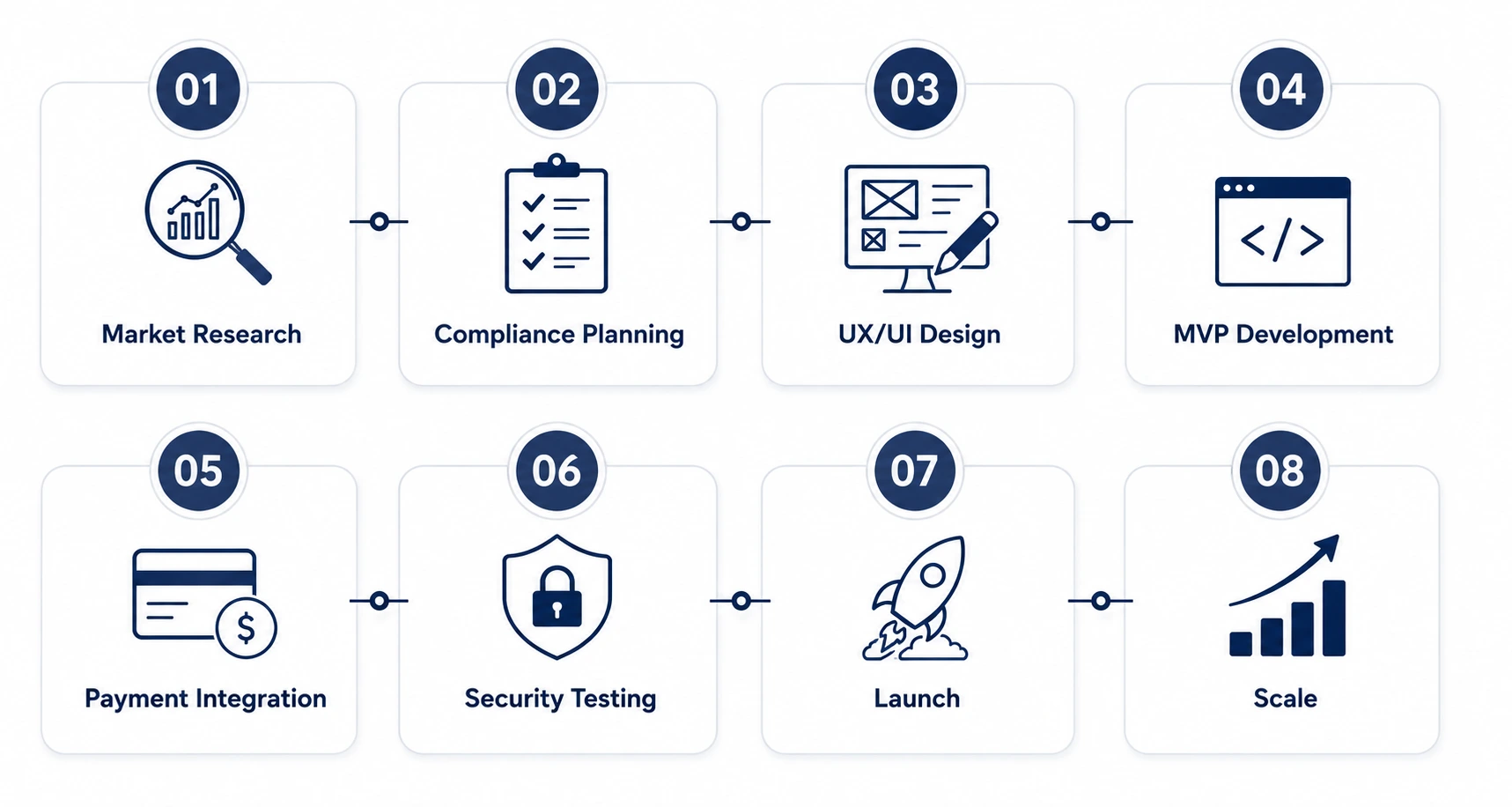
Building a successful money transfer application requires more than developing payment features. Startups must combine market research, regulatory planning, secure technology, and user-centric design to create a platform that users trust. Following a structured development process helps reduce risks, accelerate time to market, and build a solution that can scale as the business grows.
1. Validate the Business Model
Every successful fintech product starts by solving a specific customer problem. Before development, identify your target audience and understand why they would choose your platform over existing alternatives. Your users may include migrant workers sending remittances, freelancers receiving international payments, or businesses managing cross-border transactions.
Analyze competitors to identify feature gaps, pricing strategies, and customer pain points, then define a sustainable revenue model through transaction fees, foreign exchange margins, subscription plans, or premium financial services.
2. Research Target Markets
Your target market shapes your product strategy. Every country has unique financial regulations, payment preferences, and banking infrastructure, making early market research essential.
Evaluate remittance demand, digital payment adoption, regulatory complexity, and the competitive landscape before launch. For example, the US–Mexico remittance corridor requires different payment integrations and compliance processes than Europe or the Middle East. A well-defined market strategy supports long-term growth.
3. Understand Regulatory Requirements
Compliance should be built into the product from the beginning rather than added later. Failing to meet financial regulations can delay launches and result in costly penalties.
Depending on your target markets, your application may need to comply with Anti-Money Laundering (AML) regulations, Know Your Customer (KYC) requirements, PCI DSS standards, money transmitter licensing, sanctions screening, and regional data privacy laws. Engaging legal and compliance experts early helps design the platform around these requirements.
4. Design an Intuitive User Experience
Trust is essential for money transfer applications. Even the most secure platform can lose users if transactions are confusing or time-consuming.
Create a simple user journey covering registration, identity verification, payment initiation, and transaction tracking. Clearly display fees, exchange rates, and estimated delivery times before confirming a transfer to improve transparency and reduce abandoned transactions.
5. Choose Technology That Supports Long-Term Growth
Your technology stack determines application performance, scalability, and long-term reliability.
Many startups use React Native or Flutter for cross-platform development, while Node.js, Java, Python, or .NET power backend services. Databases like PostgreSQL or MySQL ensure transaction integrity, and cloud platforms such as AWS, Microsoft Azure, or Google Cloud provide the scalability required for growing payment volumes. Selecting technologies that integrate easily with financial services simplifies future expansion.
Recommended Technology Stack
| Layer | Recommended Technologies |
| Frontend | Flutter, React Native |
| Backend | Node.js, Java Spring Boot |
| Database | PostgreSQL, MongoDB |
| Cloud | AWS, Azure, Google Cloud |
| Payment APIs | Stripe, Wise Platform, Visa Direct |
| Banking APIs | Plaid, TrueLayer |
| Messaging | Firebase, Twilio |
| Security | OAuth2, JWT, HSM |
| AI | TensorFlow, AWS Fraud Detector |
6. Validate the Market Before Scaling Development
Launching a Minimum Viable Product (MVP) helps validate your business idea before making significant development investments. Focus on the core functionality required to complete secure money transfers.
A typical MVP includes user registration, digital KYC verification, recipient management, fund transfers, transaction history, notifications, and an administrative dashboard. Use customer feedback and product analytics to guide future enhancements while minimizing development risks.
7. Integrate Payment Infrastructure
Payment infrastructure directly influences transaction speed, costs, and customer satisfaction. Deloitte’s FSI Predictions 2026 highlights that delays and high processing costs in cross-border payments continue to strain business-customer relationships. Integrating reliable payment networks, banking APIs, and foreign exchange providers helps startups deliver faster settlements and a more competitive user experience.
Depending on your business model, this may include banking APIs, payment gateways, foreign exchange providers, digital wallets, AML screening solutions, and notification services. Choosing secure, scalable providers ensures consistent performance as transaction volumes grow.
8. Implement Security Controls
Security should be embedded throughout the development lifecycle rather than treated as a final deployment step. Money transfer applications handle sensitive financial and personal data, making strong security controls essential.
Implement end-to-end encryption, multi-factor authentication, secure API communication, role-based access control, and continuous fraud monitoring. Regular penetration testing, vulnerability assessments, and security audits help identify risks before they become security incidents.
9. Reduce Launch Risk Through Comprehensive Testing
Thorough testing ensures your application performs reliably before launch. Validate payment accuracy, system stability, and security under real-world conditions.
Test API integrations, identity verification workflows, currency conversions, transaction tracking, and performance under high traffic. Conduct security testing, simulate failure scenarios, and consider a phased rollout to gather user feedback before a wider release.
10. Monitor, Improve & Scale
Launching your application is only the beginning. Continuous monitoring helps improve performance, customer experience, and long-term growth.
Track transaction success rates, payment processing times, customer retention, fraud incidents, and application uptime. Use customer feedback to prioritize improvements while expanding to additional currencies, payment methods, and regional money transfer app compliance requirements. A scalable architecture enables sustainable growth without requiring major architectural changes. Businesses planning multiple fintech offerings can also benefit from the fintech app development guide, which explores the key stages of developing secure, scalable financial applications.
Money Transfer App Development Roadmap
Building a successful money transfer app requires a structured development approach that balances user experience, security, compliance, and scalability. Working with experienced mobile app development services can help startups reduce development risks, accelerate time to market, and create a reliable platform that supports future growth.
| Phase | Timeline |
| Phase 1 – Discovery & Product Strategy | Weeks 1–2 |
| Phase 2 – UI/UX Design | Weeks 3–5 |
| Phase 3 – Application Development | Weeks 6–17 |
| Phase 4 – Payment & Compliance Integrations | Weeks 18–21 |
| Phase 5 – Testing & Optimization | Weeks 22–24 |
| Phase 6 – Deployment & Go-Live | Week 25 |
Typical Project Duration
- MVP: 4-6 months
- Enterprise Platform: 8-12 months
Compliance Requirements for Money Transfer Apps
Compliance is a core requirement in money transfer app development. Money transfer platforms operate in a highly regulated environment where businesses must verify customer identities, monitor transactions, and protect sensitive financial data. Building compliance into your platform from the start reduces legal risks, strengthens customer trust, and supports expansion into new markets. AML/KYC compliance forms the foundation of every money transfer app. Alongside PCI DSS, data privacy regulations, and licensing requirements, it helps startups prevent financial crime, satisfy regulatory obligations, and build trust with banking partners and customers.
Startups planning to support stablecoin-based payments should also prepare for evolving US regulations. According to Deloitte’s 2026 Banking and Capital Markets Outlook, US federal banking regulators are expected to establish stablecoin regulations and supervisory guidance by July 2026, ahead of implementation in January 2027. Designing a flexible compliance framework today will make it easier to adopt regulated stablecoin payment rails as the regulatory landscape evolves.
1. Anti-Money Laundering (AML)
Anti-Money Laundering (AML) regulations help prevent criminals from using financial systems to conceal illegal funds. Money transfer platforms should implement transaction monitoring, risk scoring, recordkeeping, and suspicious activity reporting. Many businesses also use AI-powered monitoring to detect unusual transaction patterns in real time and strengthen compliance.
2. Know Your Customer (KYC)
Know Your Customer (KYC) regulations require businesses to verify customer identities before providing financial services. Digital KYC typically includes government-issued ID verification, facial recognition, proof of address, and liveness detection. Automated verification improves onboarding speed, accuracy, and compliance.
3. PCI DSS
If your application processes or stores card payment information, complying with the Payment Card Industry Data Security Standard (PCI DSS) is essential. PCI DSS requires strong encryption, secure authentication, access controls, network monitoring, and regular security testing to protect cardholder data and reduce payment fraud.
4. FATF Guidelines
The Financial Action Task Force (FATF) provides globally recognized recommendations for combating money laundering and terrorist financing. Following FATF guidelines helps startups build stronger compliance frameworks, support international expansion, and improve credibility with banking partners and regulators.
5. Money Transmitter Licensing
Many jurisdictions require businesses offering money transfer services to obtain a money transmitter license. Since licensing requirements vary by country and region, evaluating regulatory obligations early with legal advisors helps avoid delays and compliance issues.
6. Sanctions & PEP Screening
Money transfer platforms should screen customers against global sanctions lists and Politically Exposed Persons (PEPs) databases before approving transactions. Continuous automated screening ensures ongoing compliance as sanctions lists are regularly updated.
7. Data Privacy Regulations
Money transfer applications handle sensitive personal and financial data, making compliance with regulations such as GDPR and CCPA essential. Privacy compliance includes obtaining user consent, protecting stored data, minimizing data collection, and giving users greater control over their personal information.
Compliance Comparison Table
| Compliance Standard | Purpose | Why It Matters |
| AML (Anti-Money Laundering) | Detects and prevents money laundering activities | Helps identify suspicious transactions and meet regulatory reporting obligations. |
| KYC (Know Your Customer) | Verifies customer identities before transactions | Prevents identity fraud and reduces financial crime risks. |
| PCI DSS | Protects cardholder payment information | Ensures secure payment processing and minimizes payment data breaches. |
| FATF Guidelines | International framework for combating financial crime | Supports global compliance and simplifies expansion into new markets. |
| Money Transmitter Licensing | Legal authorization to operate money transfer services | Required in many countries and states before offering financial services. |
| Sanctions & PEP Screening | Screens users against sanctions and politically exposed person lists | Prevents prohibited transactions and strengthens regulatory compliance. |
| Data Privacy Regulations (GDPR, CCPA, etc.) | Protects personal and financial information | Builds customer trust while meeting legal privacy requirements. |
Security Best Practices
Security is the foundation of every successful money transfer platform. Users trust your application with their financial information, personal data, and transaction history. A single security incident can result in financial losses, regulatory investigations, and long-term damage to your brand reputation.
Implementing multiple layers of security helps protect users while ensuring business continuity. As security threats continue to evolve, understanding the latest approaches to cybersecurity in fintech app development can help businesses strengthen their applications and reduce operational risks. Adopting a Zero Trust Architecture, where every user, device, and request is continuously verified, further minimizes unauthorized access and reduces the attack surface.
1. End-to-End Encryption
Encryption protects sensitive information while it is transmitted between users, payment providers, and backend systems. Strong encryption ensures that intercepted data cannot be read or modified by unauthorized parties.
In addition to encrypting data during transmission, sensitive customer information should also remain encrypted while stored within databases and cloud infrastructure. Sensitive cryptographic keys should be protected using Hardware Security Modules (HSMs) or cloud-based Secrets Managers, with regular key rotation to minimize the risk of unauthorized access and credential compromise.
2. Multi-Factor Authentication
Passwords alone are no longer sufficient for protecting financial accounts. Multi-factor authentication (MFA) adds an additional layer of verification by requiring users to confirm their identity through a one-time password, authentication application, or biometric verification.
MFA significantly reduces the likelihood of unauthorized account access, even when passwords are compromised. Secure authentication frameworks such as OAuth 2.0 and JSON Web Tokens (JWT) further strengthen user authentication and session management by enabling secure, standards-based access to protected resources.
3. Fraud Detection
Modern fraud prevention relies on continuous monitoring rather than manual review alone. AI-powered fraud detection systems analyze transaction patterns, user behavior, device information, geolocation, and behavioral patterns to identify suspicious activity in real time.
Fraud prevention strategies must also evolve with emerging threats. Deloitte’s 2026 Banking and Capital Markets Outlook notes that malicious AI agents can mimic human behavior, evade traditional detection systems, and conceal fraudulent identities. To stay ahead, startups should combine AI-powered fraud detection with real-time monitoring, behavioral analytics, and continuous risk assessment instead of relying on rule-based systems alone.
When unusual behavior is detected, the system can trigger additional verification, temporarily pause transactions, or initiate manual review before processing high-risk transfers.
4. Secure APIs
Money transfer applications depend on APIs to communicate with banks, payment gateways, identity verification providers, and other financial services. Poorly secured APIs can expose sensitive customer information and create opportunities for attackers.
Implementing an API Gateway helps centralize authentication, authorization, traffic management, and monitoring across all integrations. Combined with OAuth 2.0, encrypted communication, rate limiting, and a Web Application Firewall (WAF), businesses can better protect APIs from unauthorized access, denial-of-service attacks, and common web vulnerabilities.
5. Device Security
Protecting user devices adds another layer of defense against fraud. Device fingerprinting, jailbreak detection, root detection, secure session management, and device binding help identify compromised devices before sensitive transactions are processed.
Combining device security with behavioral analytics improves fraud prevention without creating unnecessary friction for legitimate users, allowing businesses to deliver both strong security and a seamless customer experience.
6. Continuous Monitoring
Cybersecurity requires constant vigilance. Continuous monitoring enables businesses to detect security incidents quickly and respond before they escalate into larger problems.
Regular vulnerability assessments, penetration testing, automated threat detection, centralized logging, and security audits help identify weaknesses and improve incident response. Aligning security practices with internationally recognized standards such as SOC 2 and ISO/IEC 27001 further strengthens governance, risk management, and customer confidence.
Strong security controls also support AML/KYC compliance by protecting customer identities, securing transactions, and enabling continuous fraud monitoring.
How Much Does It Cost to Build a Money Transfer App?
The cost of money transfer app development depends on several factors, including feature complexity, supported platforms, third-party integrations, security requirements, regulatory compliance, and development location. Applications designed for international remittance services typically require larger investments because of additional compliance and payment infrastructure.
A money transfer app is a digital application that enables users to securely send, receive, and manage money through mobile or web platforms. It supports domestic and international payments with features such as identity verification, real-time transaction tracking, multi-currency support, fraud prevention, and regulatory compliance.
For startups, building a Minimum Viable Product (MVP) is often the best approach. An MVP focuses on core features, allowing businesses to validate market demand before investing in advanced capabilities.
| Development Stage | Estimated Cost (USD) |
| MVP | $40,000–$80,000 |
| Mid-Level Product | $80,000–$150,000 |
| Enterprise-Grade Platform | $150,000–$300,000+ |
Cost Drivers
Several factors influence the overall cost of developing a money transfer app, with compliance, integrations, security, and feature complexity having the greatest impact on the final development budget.
| Cost Driver | Impact |
| Digital KYC | High |
| AML Monitoring | High |
| Banking APIs | Medium |
| Multi-currency Wallet | Medium |
| AI Fraud Detection | High |
| Compliance Audits | High |
| Cloud Infrastructure | Medium |
| Third-party APIs | Medium |
How to Scale a Money Transfer Platform?
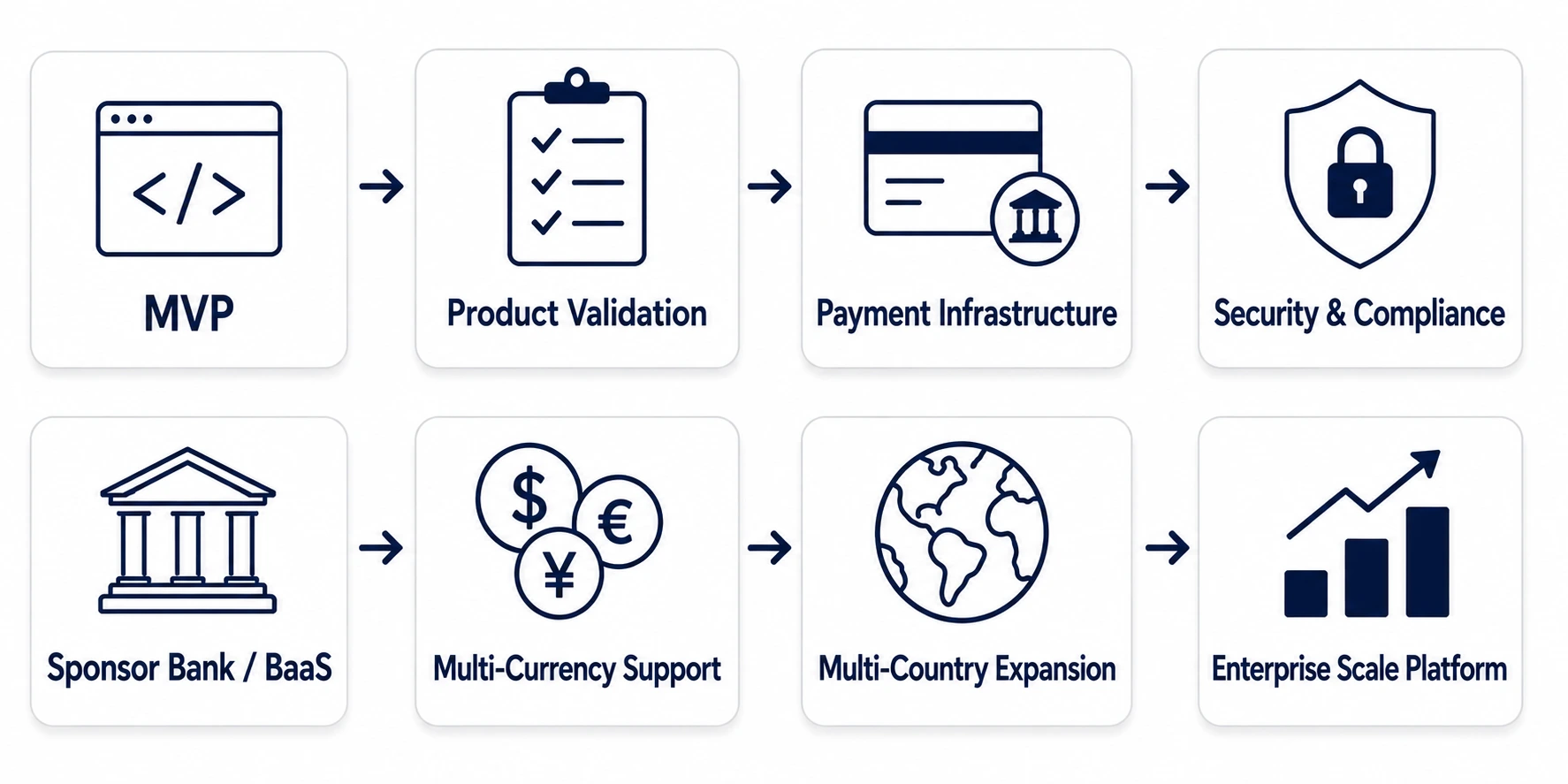
Launching a successful application is only the first milestone. As transaction volumes increase and new markets are added, your platform must continue delivering secure and reliable payment services without compromising performance.
Scalability should therefore be considered during the initial architecture design rather than after rapid growth begins.
Adopting cloud-native infrastructure allows businesses to increase computing resources automatically as demand grows. Microservices architecture further improves scalability by enabling individual services, such as payment processing, notifications, or fraud detection, to scale independently.
Expanding internationally also requires support for additional currencies, languages, payment methods, and regulatory frameworks. Building flexible integrations with payment providers and compliance services simplifies entry into new markets while reducing operational complexity.
Continuous monitoring, performance optimization, and infrastructure automation ensure the platform remains responsive even during periods of peak transaction activity. Partnering with a custom app development company can also help optimize infrastructure, improve system performance, and build scalable solutions that support long-term platform growth.
Common Mistakes to Avoid
Many startups underestimate the complexity of building a money transfer platform. Avoiding common mistakes early can save significant time, development costs, and compliance challenges.
One of the biggest mistakes is treating compliance as a final development phase. Regulatory requirements should influence product architecture from the beginning to prevent costly redesigns later.
Another common issue is prioritizing features over security. Financial applications must implement strong security controls from the first release because customer trust is difficult to rebuild after a breach.
Some startups also attempt to launch with too many features instead of validating their business model through an MVP. Beginning with essential functionality enables faster market entry while providing valuable customer feedback for future development.
Finally, choosing technology that cannot support international expansion often creates long-term scalability challenges. Working with a startup app development company can help businesses select a flexible, cloud-based architecture from the beginning, making it easier to add new markets, currencies, and payment services as the platform grows.
Why Choose RipenApps for Money Transfer App Development?
Building a secure and scalable money transfer application requires expertise in financial technology, regulatory compliance, payment infrastructure, and fintech software development. At RipenApps, we help startups and enterprises transform payment ideas into high-performance digital products through end-to-end product development, from discovery and UI/UX design to deployment and post-launch support.
Our expertise is demonstrated through Al Muzaini, one of the Middle East’s leading remittance platforms. We modernized its digital experience by developing a secure mobile application that has supported over 2 million remittance transactions with a 3.4/5 rating,, improved transfer processing by 40%, and delivered a reliable user experience across multiple countries. Our team specializes in banking API integrations, AML/KYC workflows, cloud-native architecture, and enterprise-grade fintech application development to build secure, compliant, and future-ready payment platforms.
Whether you’re launching an MVP or a large-scale cross-border payment solution, RipenApps delivers the technical expertise, security, and scalability needed to accelerate growth and succeed in the competitive fintech market.
Conclusion
Startups that combine strong compliance, scalable architecture, and customer-centric design are better positioned to build long-term competitive advantages in the rapidly evolving fintech market. As part of a successful FinTech software development strategy, partnering with an experienced fintech software development company like RipenApps helps reduce development risks, accelerate time to market, and build a platform that can confidently scale alongside your business.
However, successful money transfer app development involves much more than payment processing. It requires a strong business strategy, intuitive user experience, enterprise-grade security, regulatory compliance, and a scalable technical architecture. Addressing these areas from the beginning helps reduce development risks and supports long-term growth. Whether you are launching a domestic payment solution or an international remittance platform, starting with a well-planned MVP and partnering with the right development team can accelerate your journey to market.
FAQs
Q1. What is money transfer app development?
Money transfer app development is the process of designing, building, and maintaining applications that enable users to send and receive money digitally. These platforms support secure payment processing, user authentication, compliance management, transaction tracking, and integrations with banks or payment providers.
Q2. How long does it take to build a money transfer app?
The development timeline depends on the application’s complexity, feature set, and compliance requirements. A basic MVP typically takes 4 to 6 months, while a fully featured cross-border money transfer platform may require 8 to 12 months or longer.
Q3. How much does it cost to develop a money transfer app?
The cost varies based on platform support, security features, third-party integrations, and regulatory requirements. A startup MVP generally ranges from $40,000 to $80,000, while enterprise-grade platforms can exceed $300,000 depending on complexity.
Q4. What features should a money transfer app include?
Essential features include user registration, digital KYC verification, secure fund transfers, multi-currency wallets, live exchange rates, recipient management, transaction tracking, notifications, fraud detection, transaction history, and an admin dashboard.
Q5. What compliance requirements apply to money transfer apps?
Most money transfer platforms must comply with AML and KYC regulations, PCI DSS standards, sanctions screening requirements, data privacy laws, and money transmitter licensing rules. The exact requirements depend on the countries where the application operates.
Q6. How do money transfer apps prevent fraud?
Modern platforms use multiple security layers, including end-to-end encryption, multi-factor authentication, AI-powered fraud detection, secure APIs, device fingerprinting, behavioral analytics, and continuous transaction monitoring to identify and prevent suspicious activities.
Q7. Can a startup launch with an MVP before building a complete platform?
Yes. Launching with a Minimum Viable Product (MVP) allows startups to validate market demand, gather customer feedback, and optimize their product before investing in advanced features or expanding into new markets.
Q8. Why should startups partner with an experienced fintech software development company?
Developing a money transfer platform requires expertise in payment infrastructure, compliance, cybersecurity, cloud architecture, and financial integrations. An experienced development partner helps reduce technical risks, accelerate product delivery, and build a scalable solution that supports future business growth.
Discuss your project and request for proposal
SHARE
WRITTEN BY

Ishan Gupta
CEO & Founder
Ishan Gupta is a seasoned entrepreneur and CEO with extensive 10+ years of experience in business and mobile app development landscape. He believes that the right digital product allows companies to focus on what they do best, while technology handles the rest. With deep exposure to global markets, he understands what makes an app succeed. His approach translates business needs into clear product strategies, ensuring that every feature contributes to measurable ROI.
View All Articles