


Key Takeaways
- The right AI development partner should understand both AI technology and product strategy.
- Evaluate partners based on scalability, architecture expertise, and real-world AI implementation experience.
- A clear AI strategy for digital products is essential before starting development.
- Review case studies, technical capabilities, and industry-specific experience before making a decision.
- Strong AI partners focus on business outcomes, not just AI features.
- Consider long-term support, model optimization, and maintenance capabilities alongside development expertise.
- Choosing the right partner early helps reduce risks, control costs, and accelerate product success.
AI is changing how digital products are built, scaled, and experienced. Businesses are no longer adding AI as an experimental feature. They are building AI-powered systems that automate workflows, personalize customer experiences, improve operational efficiency, and support real-time decision-making. From SaaS platforms and eCommerce systems to enterprise dashboards and mobile applications, AI is becoming a core part of modern digital products.
The challenge is that successful AI implementation depends far more on execution quality than on AI tools alone. Many businesses invest heavily in AI initiatives without evaluating infrastructure readiness, data quality, workflow alignment, or long-term scalability. As a result, AI systems often become expensive to maintain, disconnected from business operations, and difficult to scale as product complexity grows.
In 2026, AI projects are becoming increasingly business-critical. Organizations expect AI-powered products to deliver automation, conversational experiences, predictive analytics, intelligent recommendations, and adaptive user journeys without compromising performance or security. Achieving these outcomes requires more than software development expertise. It requires strong engineering foundations, scalable architecture, cloud infrastructure knowledge, and a clear understanding of product workflows.
This is why choosing the right AI development partner has become a strategic business decision rather than a simple vendor selection process. A successful AI strategy for digital products depends on partnering with teams that understand AI integration, scalability, infrastructure, and long-term product growth. This guide explains how businesses can evaluate AI development partners, identify the capabilities that matter most, and avoid costly implementation mistakes.
Table of Contents
Why Choosing the Right AI Development Partner Matters
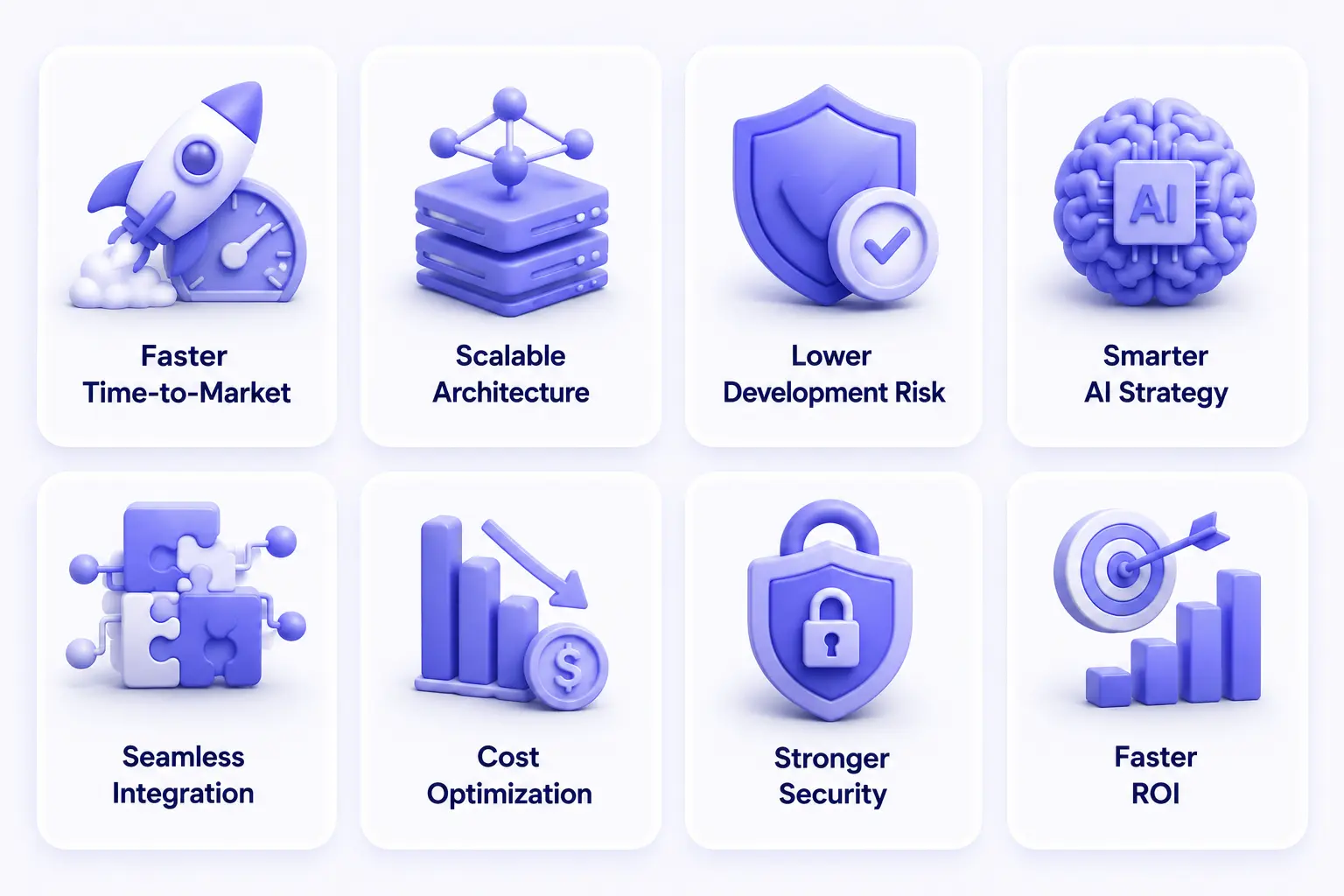
Most AI projects fail long before users interact with the product. The problem is rarely the AI model itself. The real issue is a weak execution strategy, poor infrastructure planning, disconnected workflows, and unrealistic implementation expectations.
Businesses still approach AI as an isolated feature instead of an operational system. They integrate AI capabilities into products without evaluating whether the underlying architecture, data systems, APIs, or workflows are prepared to support long-term scalability. As usage grows, these systems begin creating latency issues, rising infrastructure costs, inconsistent outputs, and operational bottlenecks.
A strong software development partner focuses on much more than implementation. They evaluate how AI fits into business operations, customer journeys, infrastructure scalability, and long-term product evolution. This becomes especially important for businesses investing in AI in mobile app development, enterprise automation systems, AI-powered SaaS products, and intelligent customer platforms.
Key Signs You Are Choosing the Wrong AI Development Partner
App owners select AI vendors based on presentations, pricing, or AI buzzwords without evaluating operational expertise. This often leads to weak implementations that fail when products begin scaling.
1. Lack of Business Workflow Understanding
One of the biggest warning signs appears when vendors discuss AI capabilities without understanding operational workflows. Strong AI systems are designed around business problems, customer behavior, and measurable outcomes. Vendors who only focus on tools or models usually fail to create long-term business value.
Businesses should evaluate whether the company understands:
- Operational bottlenecks
- User behavior patterns
- Workflow automation
- Product scalability
- Business performance metrics
AI systems should improve operational efficiency, not increase complexity.
2. Weak Infrastructure and Scalability Planning
AI products create pressure on APIs, databases, backend systems, and cloud infrastructure. If a vendor cannot explain infrastructure scalability, observability systems, workload distribution, or performance optimization, long-term risks increase significantly.
Modern AI systems require:
- Cloud-native infrastructure
- Low-latency APIs
- Scalable backend systems
- Distributed architecture
- Infrastructure monitoring
Without these foundations, AI systems become expensive and unstable as user activity grows.
3. Unrealistic Timelines and Promises
AI implementation involves experimentation, testing, optimization, retraining, and infrastructure tuning. Vendors promising extremely fast AI implementation without discussing these factors usually create operational problems later.
Businesses should avoid partners who treat AI implementation as a plug-and-play process without discussing:
- Data quality
- Infrastructure complexity
- Workflow integration
- Scalability requirements
- Monitoring systems
Reliable AI development companies focus on sustainable execution instead of unrealistic delivery promises.
How to Choose a Custom Software Development Partner for AI Projects
Businesses searching for how to choose a custom software development partner often evaluate only frontend or backend expertise. AI projects require much broader capabilities because AI systems directly affect infrastructure, workflows, product experience, and operational scalability.
1. Evaluate Their AI Integration Experience
Businesses should first assess whether the company has real experience with AI integration in product development beyond prototypes or demo applications. A reliable partner should explain how they implemented recommendation engines, conversational interfaces, predictive systems, or AI automation workflows inside scalable digital products.
This becomes especially important for companies building:
- AI-powered SaaS products
- Intelligent customer platforms
- Enterprise automation systems
- AI-enabled mobile applications
- Predictive analytics dashboards
Operational implementation experience matters far more than AI marketing claims.
2. Assess Product Thinking and Workflow Understanding
The best AI companies think like product teams, not coding vendors. They focus on customer journeys, user retention, operational bottlenecks, and workflow efficiency before discussing AI features.
This is particularly valuable for businesses investing in SaaS development platforms or AI-powered operational systems where scalability and user adoption directly affect business growth.
Strong product-focused AI teams help businesses:
- Reduce workflow friction
- Improve operational efficiency
- Prioritize valuable AI use cases
- Build scalable product ecosystems
AI systems create the strongest impact when they support real operational goals instead of isolated feature additions.
Why AI Strategy Matters Before Development Begins
Several businesses start AI implementation too early. They focus on interfaces, automation ideas, or chatbot functionality before validating whether AI actually solves a meaningful operational problem.
1. Focus on Problem-First AI Planning
An effective AI strategy for digital products starts with identifying business inefficiencies, workflow bottlenecks, and customer friction points. Businesses should evaluate where AI improves productivity, automation, decision-making, or user engagement before investing in development.
This strategic approach helps businesses avoid:
- Unnecessary AI complexity
- Poor user adoption
- Expensive infrastructure waste
- Misaligned automation systems
Strong AI implementation starts with operational clarity.
2. Evaluate Infrastructure and Data Readiness
AI performance depends heavily on infrastructure maturity and data quality. Businesses should assess whether their systems support:
- Structured data pipelines
- API integrations
- Scalable backend systems
- Workflow visibility
- Real-time data processing
Without strong infrastructure planning, AI systems struggle to scale efficiently later.
This is especially important for companies planning enterprise AI systems or AI-powered customer platforms where operational stability directly impacts business performance.
3. Evaluating Technical Capabilities Beyond AI Models
Some app owners assume AI expertise begins and ends with machine learning models. In reality, scalable AI products depend heavily on engineering maturity, infrastructure planning, backend systems, and operational architecture.
4. Backend and Infrastructure Expertise
A reliable AI development company should understand:
- Container orchestration
- Cloud-native systems
- Event-driven architecture
- Distributed infrastructure
- Observability systems
- API optimization
These capabilities become essential when AI workloads increase or user activity grows rapidly.
For example, businesses planning to apply machine learning in Android app development must evaluate whether the partner understands mobile optimization, edge inference, API orchestration, and frontend performance constraints.
5. AI Scalability and System Reliability
Scalable AI systems require continuous optimization and monitoring after deployment. Businesses should evaluate whether the company understands:
- Model retraining workflows
- Usage analytics
- Performance monitoring
- AI governance systems
- Reliability engineering
AI systems evolve continuously after launch. Partners who ignore post-launch optimization often create unstable long-term products.
This becomes even more important for businesses building AI-powered enterprise systems, ecommerce platforms, or operational dashboards.
Questions Businesses Should Ask Before Hiring an AI Partner
The quality of questions during vendor evaluation often determines project success later. Instead of focusing only on timelines or pricing, businesses should evaluate operational maturity, scalability understanding, and experience with AI-driven product development. This approach also helps organizations hire the right mobile app development company when AI capabilities need to be integrated into broader mobile product strategies.
1. Questions About Scalability and Infrastructure
Businesses should ask:
- What is your approach to AI scalability?
- How do you optimize infrastructure costs?
- Which monitoring systems do you implement?
- How is workload distribution managed?
Strong vendors discuss infrastructure maturity in practical terms instead of generic technical jargon.
2. Questions About AI Reliability
AI systems require governance, validation, and monitoring. Businesses should understand how the partner manages:
- AI hallucinations
- Output validation
- Workflow consistency
- Data governance
- Model monitoring
Reliable AI implementation requires operational oversight, not just deployment.
3. Questions About Long-Term Product Evolution
AI products require ongoing optimization after launch. Businesses should evaluate whether the company supports:
- Continuous model improvement
- Infrastructure optimization
- Retraining pipelines
- Usage analytics
- Workflow refinement
AI systems are operational products, not one-time implementations.
AI Development Partner Evaluation Checklist
Choosing an AI development partner involves more than comparing proposals or pricing. Businesses should evaluate whether the company has the technical expertise, product understanding, and operational maturity required to support long-term AI initiatives.
Before making a final decision, use the checklist below:
- Proven experience building AI-powered mobile or web products
- Strong understanding of cloud infrastructure and scalable architectures
- Experience integrating AI into existing business workflows
- Expertise in data security, privacy, and compliance requirements
- Clear process for AI testing, monitoring, and performance optimization
- Ability to support post-launch maintenance and model improvements
- Relevant AI case studies with measurable business outcomes
- Transparent communication, timelines, and delivery methodology
- Knowledge of both product strategy and AI implementation
- Capability to scale AI systems as user demand and operational complexity grow
The strongest AI partners combine technical expertise with product thinking. They focus not only on AI feature integration but also on ensuring those features create measurable business value, remain scalable, and support long-term growth objectives.
How AI Costs Influence Partner Selection
Many businesses underestimate how quickly AI integration costs scale after launch. Development expenses are only one part of the equation. Infrastructure usage, API consumption, inference pipelines, monitoring systems, and retraining workflows all contribute to long-term operational cost.
Understanding AI Cost Drivers
Businesses evaluating AI app development cost should prioritize partners who understand:
- Infrastructure optimization
- API efficiency
- Cloud scalability
- AI workload balancing
- Long-term operational sustainability
Weak infrastructure planning often creates rising costs as AI usage grows.
This becomes especially important for businesses investing in Generative AI development or intelligent automation systems, where AI workloads continuously increase.
Scaling AI Investment Strategically
Similarly, AI agent software development cost depends heavily on orchestration complexity, memory systems, multi-agent coordination, and infrastructure maturity. Strong AI partners help businesses validate workflows early and scale investment strategically instead of overengineering systems from the beginning.
The goal is not only to reduce development expenses. The goal is building AI systems that remain commercially sustainable as operations scale.
How to Verify an AI Partner’s Real-World Experience
Many AI vendors claim expertise, but not all have experience deploying AI systems in production environments. Businesses should look beyond presentations and evaluate whether a partner has successfully delivered AI-powered products at scale.
What to Look For
- AI product case studies
- Industry-specific implementation experience
- Production deployment examples
- Long-term client engagements
- Measurable business outcomes
Ask for Proof, Not Promises
Strong AI partners can explain:
- The business problem they solved
- The AI approach they selected
- Implementation challenges they faced
- Results achieved after deployment
The best way to assess an AI development company is to evaluate what they have successfully built, not what they claim they can build.
What Strong AI Development Partnerships Actually Look Like
The best AI partnerships are built around operational understanding instead of trend-driven implementation. Strong AI companies focus on solving business problems through scalable engineering, workflow automation, and intelligent infrastructure planning.
Reliable partners understand how AI affects customer experience, infrastructure, operational workflows, and product scalability simultaneously. They prioritize measurable business outcomes instead of feature quantity and help businesses reduce implementation risk through strategic execution.
This is especially important for businesses evaluating criteria for selecting AI software vendors or planning enterprise-scale AI adoption. Companies should prioritize development teams that combine AI expertise, product thinking, backend engineering, and infrastructure maturity.
Successful AI systems are rarely built through isolated development efforts. They are built through long-term collaboration between businesses and technology partners who understand how scalable digital ecosystems evolve.
Conclusion
Choosing the right AI development partner is no longer only a technology decision. It is a long-term business decision that directly affects scalability, infrastructure costs, operational efficiency, customer experience, and product performance. Businesses that prioritize strategic execution, workflow-focused AI integration, and scalable engineering foundations build systems that continue delivering measurable value as operations grow.
As AI adoption accelerates across mobile apps, SaaS platforms, enterprise systems, and web products, businesses need partners who understand much more than implementation alone. Through AI-powered product development consulting, RipenApps helps companies define the right strategy, architecture, and implementation roadmap before development begins. We combine strong engineering architecture, intelligent infrastructure planning, and operationally aligned AI integration strategies to build scalable digital products designed for long-term growth.
FAQ’s
1. How do I choose the right AI development partner for my business?
Start by evaluating the company’s experience in scalable AI implementation, product development, infrastructure planning, and workflow automation. A strong AI development partner should understand both technology and business operations.
2. What should businesses look for in an AI development company?
Businesses should assess AI expertise, cloud infrastructure capabilities, scalability planning, post-launch support, security practices, and experience with mobile or web product ecosystems before selecting a partner.
3. Why is scalability important in AI product development?
AI systems often work well initially but fail as usage grows. Scalable architecture helps businesses avoid latency issues, rising infrastructure costs, fragmented workflows, and expensive rebuilds later.
4. What questions should I ask before hiring an AI software vendor?
Businesses should ask about AI scalability, infrastructure optimization, monitoring systems, workflow integration, post-launch maintenance, and experience with real-world AI deployments.
5. How much does AI-powered product development cost in 2026?
AI development costs vary based on product complexity, integrations, infrastructure, AI models, and scalability requirements. Simple AI integrations may cost significantly less than enterprise-grade AI systems with automation and predictive capabilities.
6. Can AI be integrated into an existing mobile or web application?
Yes. Businesses can integrate AI into existing systems for personalization, automation, analytics, conversational AI, and intelligent recommendations. The implementation approach depends on the product architecture and infrastructure readiness.
7. Why do many AI projects fail after launch?
Most AI projects fail because of weak infrastructure planning, poor data quality, unrealistic expectations, or a lack of workflow alignment. Long-term AI success depends on operational scalability and continuous optimization.
8. What industries benefit the most from AI-powered digital products?
Industries like healthcare, fintech, ecommerce, logistics, education, SaaS, and enterprise operations benefit heavily from AI through automation, predictive analytics, intelligent workflows, and personalized customer experiences.

SHARE
WRITTEN BY

Ishan Gupta
CEO & Founder
Ishan Gupta is a seasoned entrepreneur and CEO with extensive 8+ years of experience in business and mobile app development landscape. He believes that the right digital product allows companies to focus on what they do best, while technology handles the rest. With deep exposure to global markets, he understands what makes an app succeed. His approach translates business needs into clear product strategies, ensuring that every feature contributes to measurable ROI.
View All Articles





 India
India USA
USA Australia
 Canada
 UK
UK UAE
UAE