

Key Takeaways
- A practical planning range for custom website development is $5,000–$100,000+, depending on website type, design complexity, functionality, integrations, content requirements, and development approach.
- Simple business websites can cost significantly less than custom ecommerce websites, membership platforms, portals, and large enterprise websites.
- The number of pages matters, but functionality, custom design, integrations, content management, performance, security, and technical complexity have a greater impact on the final cost.
- Development is only part of the budget. Domain registration, hosting, SSL, third-party services, maintenance, content updates, analytics, SEO, and optimization can contribute to the total cost of ownership.
- A structured estimate should define the website’s purpose, map pages and functionality, estimate design and development effort, apply the team’s rate, add a contingency buffer, and account for Year-1 operating costs.
- A phased approach can reduce the initial investment by launching essential pages and functionality first, then expanding the website as business requirements evolve.
Website development cost typically depends on the website’s type, number of pages, design requirements, functionality, integrations, content, CMS, and development team.
A simple business website with a limited number of pages and standard functionality may require a relatively modest investment. A custom ecommerce website, enterprise website, membership platform, or highly interactive website can require significantly more design and engineering work.
For businesses planning a custom website, the right budget depends on more than the number of pages. A website with custom design, advanced forms, CRM integrations, payment functionality, personalized content, or complex content management requirements will require more work than a basic informational website.
If you are already defining requirements, reviewing web design and development services can help translate your website scope into a more realistic development budget. In this guide, you’ll learn how website development costs vary by website type, complexity, industry, development team, features, design, and ongoing ownership expenses.
Table of Contents
How Much Does Website Development Cost?
A custom website can cost anywhere from $5,000 to $100,000+, depending on its scope and technical requirements.
The following ranges are intended for early-stage business planning rather than fixed quotations. Actual pricing depends on the website’s number of pages, functionality, design requirements, CMS, integrations, content, development approach, and delivery team.
Website Development Cost by Complexity
| Website complexity | Typical scope | Planning cost | Typical timeline |
| Basic | 5–10 pages, standard design, contact forms, responsive layout, CMS | $5K–$10K | 3–6 weeks |
| Standard | 10–25 pages, custom UI/UX, CMS, forms, integrations, advanced content | $10K–$25K | 6–10 weeks |
| Advanced | Custom functionality, ecommerce, memberships, advanced integrations, personalization | $25K–$50K | 2–4 months |
| Enterprise | Large content architecture, multiple integrations, custom workflows, high traffic, advanced security and scalability | $50K–$100K+ | 3–6+ months |
These are planning ranges rather than universal market prices. A smaller website can move into a higher cost tier when it requires extensive custom design, complex integrations, multilingual content, advanced search, ecommerce functionality, or specialized security requirements.
Website Development Cost by Project Phase
Website development cost is distributed across several stages rather than spent entirely on coding.
| Phase | What it covers | Budget role |
| Discovery & Planning | Goals, sitemap, requirements, content structure, technical planning | Part of the initial project budget |
| UI/UX Design | Wireframes, visual design, responsive layouts, design system | Part of the initial project budget |
| Development | Frontend, CMS, backend functionality, forms, integrations | Largest portion of the budget |
| Content & SEO | Content migration, on-page SEO, metadata, redirects, optimization | Depends on scope |
| Testing & Launch | QA, responsive testing, performance checks, deployment | Final delivery portion |
| Maintenance | Updates, security, backups, fixes, optimization | Ongoing cost |
The exact phase split depends on the website’s scope and delivery model rather than applying a fixed percentage to every project.
Website Development Cost by Website Type
Different websites require different levels of design, functionality, content management, and technical complexity. Identifying the website type is therefore one of the first steps in estimating the budget.
Business and Corporate Websites
Business websites are primarily designed to establish an online presence, communicate a company’s value proposition, showcase services, generate leads, and support sales. A basic business website with several informational pages, contact forms, responsive design, and a CMS may fall within the $5K–$10K range.
A more customized corporate website with 10–25 pages, custom UI/UX, resource sections, advanced forms, CRM integrations, animations, multilingual content, or complex content management can reach $10K–$25K or more. The budget should therefore be based on the website’s business requirements rather than simply the number of pages.
Ecommerce Websites
Ecommerce websites require more functionality than informational business websites because they must support product discovery, transactions, customer accounts, payments, orders, and administrative workflows.
Common requirements include:
- Product catalogs
- Search and filtering
- Shopping carts
- Payment gateways
- Customer accounts
- Order management
- Inventory integration
- Shipping integration
- Promotions and discounts
- Analytics
- Product reviews
- Administrative controls
A relatively focused ecommerce website may cost $15K–$30K, while a highly customized ecommerce platform with extensive integrations and advanced functionality can reach $30K–$100K+.
Businesses evaluating ecommerce platform development should identify payment, inventory, fulfillment, and third-party integration requirements before requesting a final estimate.
Portfolio and Personal Websites
Portfolio websites typically have a smaller scope and focus on presenting work, professional information, case studies, testimonials, and contact details.
A professionally designed portfolio website may cost approximately $3K–$10K, depending on the level of customization, animations, CMS requirements, content creation, and integrations.
A simple portfolio requires less development than a highly interactive personal brand website with custom animations, booking functionality, gated content, or integrations.
Landing Pages and Marketing Websites
Landing pages are generally focused on a specific marketing objective such as lead generation, product promotion, event registration, or paid advertising.
A professionally designed landing page may cost $1K–$5K+, depending on the level of design, copywriting, animations, forms, analytics, A/B testing, and integrations.
A larger marketing website with multiple landing pages, blog functionality, resource libraries, lead-generation workflows, and CRM integration can require a substantially larger budget.
Membership and Community Websites
Membership websites require user registration, login functionality, protected content, subscription management, profiles, permissions, and often payment processing.
A basic membership website may cost $15K–$30K, while platforms with multiple membership tiers, community functionality, subscriptions, personalized dashboards, and advanced integrations can reach $30K–$75K+.
Content and Publishing Websites
Content-heavy websites such as media platforms, online publications, blogs, and knowledge hubs require more than static pages.
They may include:
- Content management systems
- Author profiles
- Categories and tags
- Advanced search
- Editorial workflows
- Media libraries
- Newsletter integrations
- Advertising systems
- Analytics
- SEO controls
A content-focused website may cost $10K–$30K, while larger publishing platforms with complex editorial workflows, integrations, personalization, and high traffic requirements can exceed $50K.
Website Development Cost by Industry
Industry requirements can influence website development cost because businesses in different sectors have different content structures, integrations, compliance requirements, and customer journeys.
| Industry | Common website requirements | Typical complexity | Typical cost |
| Ecommerce | Catalogs, checkout, payments, inventory, customer accounts | Medium–Advanced | $15K–$100K+ |
| Healthcare | Services, provider profiles, appointments, forms, privacy controls | Medium–Advanced | $10K–$50K+ |
| Education | Courses, resources, registration, content management, portals | Medium–Advanced | $10K–$50K+ |
| Real Estate | Property listings, search, maps, inquiries, CRM integrations | Medium–Advanced | $10K–$50K+ |
| SaaS & Technology | Product pages, documentation, resources, lead generation, integrations | Basic–Advanced | $5K–$50K+ |
| Professional Services | Service pages, case studies, lead forms, booking, CRM | Basic–Medium | $5K–$25K+ |
Industry alone does not determine price. The final estimate depends on the website’s required functionality, content volume, integrations, design, security, and expected traffic.
For example, a real estate website with thousands of property listings and advanced search can require significantly more engineering than a small real estate company’s brochure website.
Similarly, an ecommerce website with multiple payment methods, inventory synchronization, shipping integrations, and personalized experiences will require more work than a standard online store.

Key Factors That Drive Website Development Cost
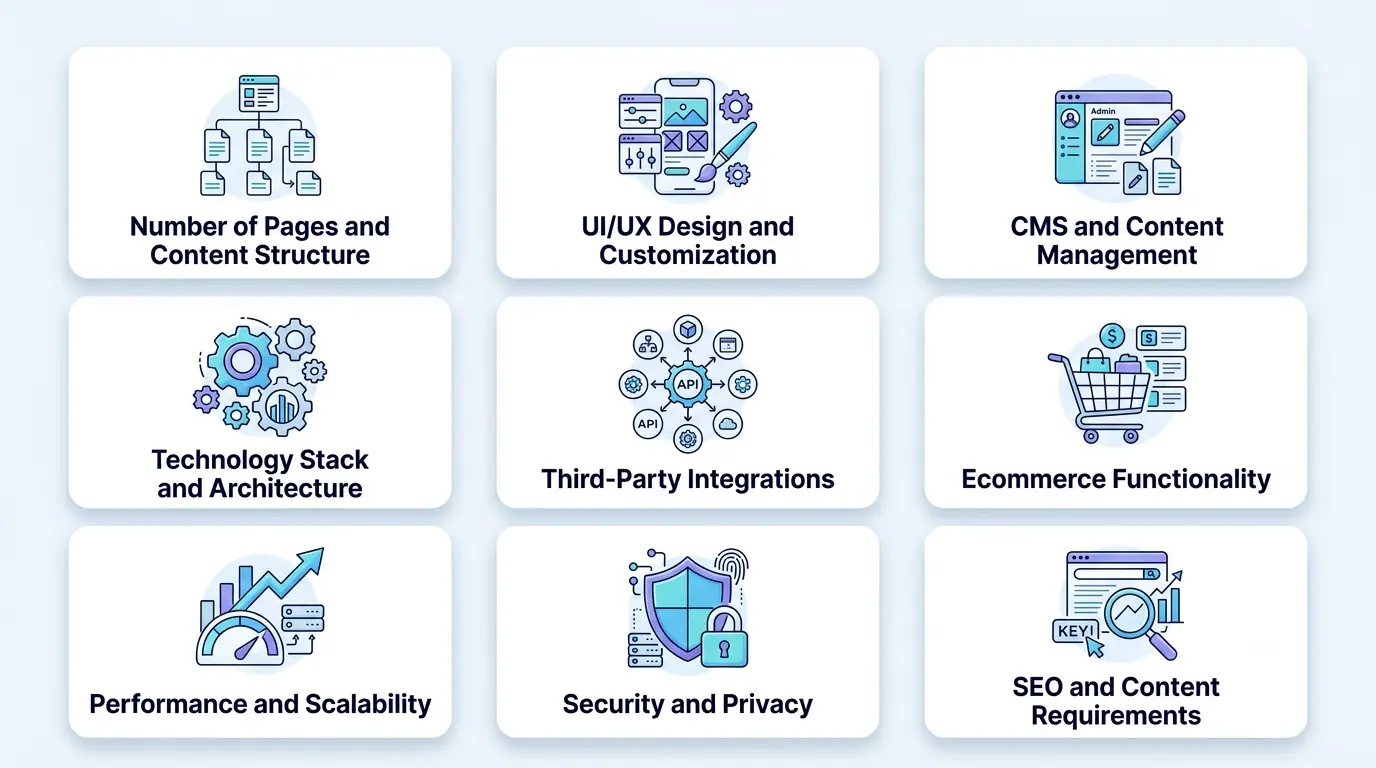
Website development costs vary based on the product’s scope, design requirements, technical functionality, content, and long-term business goals.
Number of Pages and Content Structure
The number of pages affects design, development, content migration, testing, and SEO effort. However, page count should not be treated as the only cost driver.
A 20-page website using a consistent template can require less work than a 10-page website where every page has a unique layout and interaction pattern. Businesses should therefore define both the number of pages and the types of templates required.
UI/UX Design and Customization
Design is one of the major factors affecting website development cost.
A website built from a standardized template requires less design effort than a fully customized website with original layouts, animations, interactive elements, responsive behavior, and a dedicated design system.
Design requirements may include:
- User research
- Information architecture
- Wireframes
- High-fidelity designs
- Responsive layouts
- Design systems
- Interaction design
- Accessibility
- Prototyping
The more customized the experience, the greater the design and development effort.
CMS and Content Management
A content management system allows business teams to create, edit, organize, and publish website content without relying on developers for every update.
The cost depends on whether the website uses an existing CMS, a customized CMS implementation, or a headless architecture. Businesses should also consider content migration, custom content types, editorial workflows, user permissions, media management, and SEO controls when estimating CMS-related work.
Technology Stack and Architecture
Technology choices influence development speed, maintainability, hosting requirements, and long-term scalability.
A simple corporate website may work effectively with a conventional CMS and straightforward hosting. A large content platform may require a more customized architecture to support complex content structures, integrations, performance requirements, and traffic volumes.
The architecture should match the actual business requirements rather than introducing unnecessary technical complexity. The web application development guide can provide broader technical context for businesses whose website requirements extend into application-like functionality.
Third-Party Integrations
Integrations can substantially increase website development effort because each external service requires API configuration, authentication, data mapping, error handling, testing, and maintenance.
Common website integrations include:
- CRM platforms
- Email marketing systems
- Payment gateways
- Analytics platforms
- Marketing automation
- Booking systems
- Chat and communication tools
- Social media platforms
- Shipping systems
- Customer support platforms
The more business-critical an integration is, the more carefully it should be included in the initial estimate.
Ecommerce Functionality
Adding ecommerce functionality can significantly increase development cost because the website must manage products, customers, transactions, orders, payments, shipping, taxes, inventory, and security.
Businesses should define these requirements early because changes to transactional workflows can affect both development and testing.
Performance and Scalability
Performance requirements become increasingly important as traffic, content volume, media assets, and concurrent users increase.
A small business website may require relatively straightforward hosting and caching. A high-traffic website may require CDN configuration, caching strategies, image optimization, database optimization, monitoring, load management, and scalable infrastructure.
Planning for expected traffic rather than hypothetical maximum traffic can help businesses avoid unnecessary infrastructure costs.
Security and Privacy
Website security and privacy requirements can significantly affect development cost, particularly for websites that handle personal, healthcare, financial, or payment-related information. The required controls depend on the website’s functionality, data sensitivity, industry, and target markets.
Core Website Security
Security for most websites includes HTTPS, secure forms, access controls, administrator authentication, regular backups, monitoring, vulnerability management, and protection against common web attacks. More complex websites may also require encryption, audit logging, security testing, stronger authentication, and secure third-party integrations.
Healthcare Compliance
Healthcare websites that collect, process, or transmit protected health information may require additional security and compliance measures. For businesses operating in the U.S., HIPAA can affect how health information is stored, accessed, transmitted, and protected.
Depending on the website’s scope, compliance requirements may influence access controls, encryption, audit logging, data handling, vendor management, and other technical safeguards. These requirements can increase both development and ongoing maintenance costs.
Fintech and Financial Compliance
Financial and fintech websites may require additional controls when they handle financial, payment, or customer information. PCI DSS may apply when a website processes or handles payment card data, while GLBA can apply to certain U.S. financial institutions.
Compliance requirements can affect authentication, encryption, access management, monitoring, data protection, payment integrations, and third-party services. The applicable requirements depend on the business model, services offered, data handled, and jurisdictions served.
Privacy and Data Protection
Websites collecting personal, health, or financial information may also require privacy controls based on where users are located and how their data is processed. Requirements can include consent mechanisms, cookie management, privacy notices, data retention controls, and processes for handling user data requests.
Ongoing Security Costs
Security does not end when the website launches. Businesses may need to budget for CMS and plugin updates, vulnerability scanning, security monitoring, backups, incident response, SSL management, security testing, and periodic compliance reviews.
For this reason, security, privacy, and applicable compliance requirements should be defined during the planning stage rather than treated as a final launch checklist. Addressing them early can reduce rework, security risks, and unexpected development costs later.
SEO and Content Requirements
SEO can affect website development cost when it requires technical implementation, content migration, information architecture, structured data, redirects, performance optimization, or large-scale content management.
A website redesign, for example, may require URL mapping and redirect planning to prevent the loss of existing organic traffic. Businesses should therefore account for SEO requirements before development begins rather than attempting to retrofit them after launch.
Web Development Pricing by Team Model and Region
The development approach affects both hourly pricing and the amount of project management, technical oversight, QA, and design support included in the engagement.
| Region | Hourly Rate |
| USA / UK / Western Europe | $80 – $150/hr |
| Eastern Europe | $40 – $90/hr |
| India & South Asia | $25 – $60/hr |
| Southeast Asia / Philippines | $25 – $100/hr |
These are broad planning ranges rather than fixed market prices. A lower hourly rate does not automatically result in a lower total project cost if the team requires more hours, additional management, or extensive rework.
For a meaningful comparison, businesses should evaluate the complete delivery scope, including discovery, UI/UX, development, QA, project management, SEO requirements, deployment, and post-launch support.
How AI Is Changing Website Development Cost
AI is changing website development in two different ways. First, AI-assisted development tools can help teams accelerate certain activities such as coding, testing, documentation, content structuring, and repetitive development tasks.
Second, businesses can add AI-powered capabilities directly to websites, including conversational assistants, personalized recommendations, AI search, content generation, lead qualification, and automated customer support.
Adding AI functionality can increase development costs because it may require model integration, data processing, API usage, evaluation, security controls, monitoring, and ongoing infrastructure. Businesses should therefore distinguish between using AI to improve the development process and building AI functionality into the website. The two can have very different cost implications. For broader context, see AI in web development.
Hidden Costs and 3-Year Total Cost of Ownership
The initial website development quote is only one part of the overall investment.
A practical way to budget is to evaluate the website’s three-year total cost of ownership, rather than looking only at the initial development fee.
For example, an illustrative website could have:
| Cost | Year 1 | Year 2 | Year 3 |
| Initial development | $15,000 | — | — |
| Hosting and infrastructure | $1,200 | $1,500 | $1,800 |
| Security and SSL | $1,000 | $1,000 | $1,200 |
| Maintenance | $3,000 | $3,500 | $4,000 |
| Content and optimization | $5,000 | $6,000 | $7,500 |
| Total | $25,200 | $12,000 | $14,500 |
This produces an illustrative three-year TCO of approximately $51,700.
The figures are examples for budgeting, not a RipenApps project quotation. Actual costs will depend on traffic, hosting requirements, third-party services, maintenance needs, content volume, and how frequently the website is updated.
Businesses evaluating the financial return from their website should also consider web app ROI where the website includes application-like functionality and measurable business workflows.
How to Estimate Your Website Development Cost
A defensible website estimate should start with business objectives and website requirements rather than a preferred budget.
Define the Website’s Purpose
Identify what the website needs to achieve. For example, the primary objective could be:
- Lead generation
- Ecommerce sales
- Brand awareness
- Customer education
- Content publishing
- Online bookings
- Product discovery
- Customer self-service
The objective determines the required pages, functionality, integrations, and content structure.
Define the Sitemap and Page Types
Create the initial sitemap and group pages into reusable templates. For example, a corporate website may require:
- Homepage
- About
- Services
- Service detail pages
- Industries
- Case studies
- Blog
- Contact
- Careers
Defining page templates makes the design and development effort easier to estimate.
Map the Required Functionality
Identify features beyond standard content pages. These might include:
- Forms
- Search
- Filters
- Booking
- Payments
- User accounts
- Product catalogs
- Interactive calculators
- CRM integration
- Analytics
- Multilingual functionality
Estimate Design and Development Hours
Estimate the effort required for discovery, UI/UX, frontend development, CMS configuration, backend functionality, integrations, content migration, SEO implementation, testing, and deployment.
The estimate should reflect actual requirements rather than simply multiplying the number of pages by an assumed cost.
Apply the Development Rate
Multiply estimated hours by the team’s blended hourly rate.
Estimated development cost = Estimated hours × blended hourly rate
For example, a hypothetical website requiring 300 hours at a $60 blended rate would produce a base development estimate of $18,000 before additional infrastructure and operating costs.
Add a 15–20% Planning Buffer
Requirements can change once stakeholders review designs, content, integrations, or early builds.
A 15–20% contingency can provide room for reasonable scope adjustments without disrupting the overall delivery plan.
Add Year-1 Operating Costs
Include hosting, domain registration, third-party services, security, maintenance, analytics, content updates, and SEO where applicable.
This provides decision-makers with a more realistic first-year budget rather than a development-only estimate.
How to Reduce Website Development Cost Without Cutting Quality
Reducing website development cost does not mean choosing the cheapest provider or removing essential quality controls. It means controlling scope, reusing proven components, and reducing avoidable rework.
Start With the Essential Pages
Prioritize the pages required to launch and support the primary business objective.
For example, a B2B company may launch with its homepage, core service pages, industry pages, case studies, about page, and contact page before expanding into a larger resource center.
Use Reusable Page Templates
Reusable templates can reduce design and development effort.
Instead of creating a completely unique layout for every page, businesses can establish consistent templates for service pages, case studies, blogs, products, and other recurring content types.
Choose the Right CMS
An appropriate CMS can make ongoing content management easier and reduce future development dependency.
The CMS should be selected based on content volume, editing requirements, integrations, permissions, SEO needs, and the team’s technical capabilities.
Reuse Proven Integrations
Using established third-party services can reduce custom development compared with building common functionality from scratch.
However, businesses should still evaluate vendor costs, security, scalability, API limitations, and long-term dependency before selecting an integration.
Optimize Content Before Development
Preparing copy, images, product information, and other content before development can reduce delays and rework.
Content structure should also be considered alongside SEO and user experience so that the website does not require major restructuring after launch.
Build in Phases
A phased roadmap allows businesses to launch the core website first and introduce additional functionality as requirements become clearer.
This approach can reduce the initial investment while allowing the architecture and content structure to support future expansion.
Website Developed by RipenApps
Real project experience provides a more useful reference point than speculative development estimates for well-known platforms.
HolyPills: Healthcare Website
RipenApps designed and developed the HolyPills website to provide a digital healthcare experience focused on women’s health, specialist consultations, and accessible health information. The website combines service information, specialist profiles, consultation functionality, health resources, FAQs, and other user-focused features.
The project demonstrates how healthcare website development can involve more than standard informational pages, particularly when a business needs structured content, intuitive navigation, consultation-related functionality, responsive design, and an experience tailored to specific healthcare needs.
The project’s cost is not publicly disclosed, so it should not be used to assign a specific dollar amount to a website cost tier.

Final Words
Website development cost depends on more than the number of pages. Design complexity, functionality, CMS requirements, integrations, content, ecommerce capabilities, security, and performance all influence the final investment. Professional UI/UX services can also influence website development costs by improving navigation, simplifying page layouts, and making it easier for visitors to complete their goals.
A practical budget starts by defining the website’s purpose, target audience, sitemap, page templates, functionality, and business goals. From there, estimate the design and development effort, account for operating costs, and include a reasonable buffer for changes during development.
With a clear understanding of these factors, businesses can make better decisions about what to launch now, what to prioritize later, and where additional investment is justified.
If you already have a defined website scope, RipenApps can help translate your requirements into a more tailored development estimate.
FAQs
1. How much does website development cost for a small business?
A small business website typically costs around $5,000–1$0,000 when it includes several core pages, responsive design, a CMS, contact forms, and standard functionality. Custom designs, additional pages, integrations, ecommerce functionality, and advanced features can increase the budget to $10,000–$25,000 or more.
2. How much does it cost to build an ecommerce website?
A custom ecommerce website can cost approximately $15,000–$30,000 for a focused implementation and $30,000–$100,000+ for more complex projects. Product catalogs, payment gateways, inventory, shipping, customer accounts, integrations, and custom purchasing workflows can significantly affect the final cost.
3. How long does it take to develop a website?
Website development can take anywhere from a few weeks to several months depending on scope. A basic business website may take around three to six weeks, while a larger custom website with advanced functionality and integrations can require three to six months or longer.
4. How do you calculate website development cost?
Start by defining the website’s purpose, sitemap, page templates, design requirements, functionality, integrations, CMS, and content needs. Estimate the hours required for planning, design, development, content migration, SEO, testing, and deployment, then multiply the estimated hours by the team’s blended hourly rate. Add a 15–20% planning buffer and Year-1 operating costs.
5. Is it cheaper to use a website builder or hire a development company?
Website builders can reduce initial costs for simple websites because they provide templates, hosting, and standard functionality. A development company becomes more useful when the website requires custom design, advanced functionality, integrations, ecommerce workflows, complex content structures, or long-term scalability.
6. How much does it cost to maintain a website annually?
Website maintenance costs vary based on the website’s complexity, traffic, hosting requirements, integrations, content volume, and support needs. Businesses should budget separately for hosting, domain renewal, security, backups, CMS and dependency updates, bug fixes, content changes, performance optimization, and ongoing SEO.
7. What hidden costs should businesses consider when developing a website?
Common additional costs include domain registration, hosting, SSL and security tools, third-party services, content creation, content migration, analytics, SEO, maintenance, backups, performance optimization, and new functionality after launch. Including these expenses in the initial budget creates a more realistic view of the website’s total cost of ownership.
8. Is website development more expensive than web application development?
Generally, a standard website costs less than a custom web application because websites primarily focus on presenting content, generating leads, or supporting transactions. Web applications typically require more complex user workflows, authentication, databases, business logic, dashboards, and integrations. However, a highly customized website can overlap with web application functionality and reach similar cost levels.
Discuss your project and request for proposal
SHARE
WRITTEN BY

Vaibhav Sharma
Business Head
Vaibhav Sharma bridges product vision with real-world execution. He shares consultation with startups and enterprises to shape digital strategies, refine user journeys, and create app experiences that feel intuitive from day one. His strength lies in transforming early concepts into clear development roadmaps that set products up for long-term success.
View All Articles